Showing posts with label Winter Count. Show all posts

Wednesday, December 9, 2020

The Challenge of the Winter Moons, Winter Solstice Time of Hope & Light

Above, "Snowshoe Dance at the First Snowfall, 1835-1837," by George Catlin.
The Challenge of The Winter Moons
Winter Solstice Time of Hope & Light

By Dakota Wind

Winter lasts five moons in the traditional Očhéthi Šakówiŋ calendar. 

The snow made hunting easier. When the first snow fell, Očhéthi Šakówiŋ men put on snowshoes and danced. They sang a song of Wópila (Thanksgiving) to Creator for sending snow. Snow may fall as early as Čhaŋwápe Ǧí Wí (the Moon when the Leaves turn Brown), or September, on the northern plains, but that doesn’t make it a snow moon. Generally, Waníyetu Wí (the Winter Moon), the first moon of winter is about the month of November.

Waníčhoka Wí (the Midwinter Moon) is about the month of December. According to Haŋwíyawapi Wičhóȟ’aŋ (the Moon Counting Tradition), each moon may be known by more than one name. The Midwinter Moon might also be called Tȟahékapšuŋ Wí (the Moon when Deer shed their Antlers). The Midwinter Moon may also be called Haŋyétu Háŋska Wí (the Long Night/Nights Moon).

The natural observation of the winter solstice was over the span of four days/nights. On contemporary calendars, this might be the nights of December 19-20, 20-21, 21-22, and 22-23. Astronomy informs us that the 2020 winter solstice will be on Monday, December 21, at about 4:02 AM CST. 

During these long nights, the Očhéthi Šakówiŋ gathered together in their lodges in wóčhekiye (prayer). There was no universal special prayer. The Očhéthi Šakówiŋ didn’t have formal prayer together as Christians do. Rather, an individual fostered his or her own relationship with Creator. While there might not be collective formal observance there were some things they did together.

Haŋyétu Háŋska Wí él Pahá Makȟásaŋ, or The Long Night Moon at White Earth Butte. A watercolor pictographic representation of the midwinter moon. Appearing upside-down at the top of the image is a profile view of that summit from the south looking north. 

The Winter Solstice was a special time. The Očhéthi Šakówiŋ shared many stories, among which was the story cycle of the cultural hero Wičháȟpi Hiŋȟpáye (Fallen Star, or “Star Boy”). Sometime during the longest night of the year his star, in the constellation commonly known as Auriga, rises above Pahá Makȟásaŋ (White Earth Butte, or “White Butte,” the highest point in North Dakota). In his last day among the Očhéthi Šakówiŋ he hiked to the summit with his kȟolá (his lifelong best friend; him who he did everything with as a brother) where Fallen Star lay down, died, and transformed into light. He rose into the sky to take his place in the heavens with his father Wičháȟpi Owáŋžila (the Star that does not move), or North Star, and from there sends rays of light and hope to his people. Fallen Star broke the trail so that the Očhéthi Šakówiŋ may return to the sky after death.

I asked Lekší Virgil Taken Alive about winter solstice observations, and he shared this incite: they prayed. “When I was a younger man I heard that this was the start of preparation for the upcoming times of ceremony,” he said. They smudged their čhaŋnúŋpa (sacred pipe), čhaŋčhéǧa (drum), and such that they held sacred. “After Čhaŋnápȟopa Wí (the Moon of Popping Trees) they went out to gather Čhaŋšáŋšaŋ (the inner bark of the Eastern Dogwood, or ‘Red Willow’),” he concluded. 

Wiótheȟika Wí, or the Moon of Difficult Times. The rib lines demarcate the concept for hunger.

The month following Waníčhoka Wí was a challenging one. They called it Wiótheȟika Wí (the Moon of Hard Times). 

Lekší Kevin Locke offered this retrospective of the Midwinter Moon, “In most accounts of pre-reservation days it seems to be a time when folks could enjoy the success of their winter preparation.” Locke reflected on the following month, Othehike Wi (the Moon of Difficulties), had good reason for being thusly named. 

Indeed, the Moon of Hard Times is represented in Plains Indian pictography as a figure with rib lines (to denote hunger) above an inverted crescent moon (the month). It can even be represented with an empty meat rack (another sign of hunger) above the sign for the moon or month.

Further, winter counts recall the most challenging winters. The High Dog Winter Count recalls the summer of 1800 as one of the most challenging years to survive. The summer heat was unbearably hot. The great gangs of bison went away, and hunting was poor. Flowers disappeared from the landscape, and the wind drank up the water. The birds refused to sing too.

A punishing winter followed, as remembered in the White Bull Winter Count.


Winter came, snow and ice were everywhere. A group of Lakȟóta decided to move winter camp from the bottomlands of one river to that of another. As they moved over the high plains, a blizzard caught them. Gradually some of them began to succumb to the cold and fell. As one person fell, another lifted and carried him or her for the rest of their journey. Kičhíč’iŋpi keúŋkiyapi, “They say that they carried each other.” 


Thiyóȟeyuŋka Wí, or the Frost in the Lodge Moon. A view of the interior of the lodge looking up through the smoke hole as a few snowflakes enter.

In a communique with Dallas Nelson, an educator and second language learner of Lakȟóta, Nelson shared what he learned from his lekší and other relatives in his community, “Aŋpétu Wí kiŋ haŋbléčheyapi iyéčheča hečhé, it appears as if the Sun were on a vision quest. For those four days the sun prepares himself. Readies himself for the coming seasons. A medicine man may offer prayer or hold ceremony during the winter solstice. He prays for that season [winter].” Nelson noted that they “cleanse each other,” he said, and they smudge their hóčhoka (the ground upon which they have ceremony) and their čhaŋnúŋpa. 

“They tell traditional stories after sundown in the winter months,” said Nelson. He shared a traditional warning too, “they say if you tell stories at the wrong time you’ll get hairy!” As for the winter solstice, he concluded to me that observations during the winter solstice was a sacred time and that prayer was highly individual, concluding, “Many people pray at home.” 

Throughout the winter moons they sheltered in place, from about the time we call today November to about March or April. The men prepared themselves for the coming seasons. They worked on their bows, made arrows, and other needed tools. Hunting parties went out from time to time when their meat supply ran low. Severe winters brought starvation. The women kept busy too, they made and repaired winter apparel, gathered wood and water, and kept a kettle of soup ready. 

The late Harriet Skye informed me during the difficult times of winter the mothers and grandmothers reached into a pouch containing Haȟúŋtahu kiŋ Sú (Blue Flax Seed) and drew forth a handful. “They added that to their soup to make it go further. When unexpected company came they did this too. Where the grandmas were prepared to feed all within their lodge, a moment later they could feed many more. They were prepared to share.” The harsh winter taxed their supply of precious seed. 

Ištáwičhayazaŋ Wí, or the Sore Eyes Moon. The last winter moon on the traditional calendar. The name for this moon and the pictograph represent the concept of snowblindness.

The Flame Winter Count recalls the winter of 1845-1846, as a winter feast. That winter took a toll on the people and there wasn’t enough food to go around. A young man they called Curley Hair (he would later be known as Crazy Horse) rode through camp calling the people to his family’s lodge where they had food. 

The Battiste Good Winter Count recalls the winter of 1720-1721 as a starvation winter. Three lodges of people died. The pictograph for this year denotes a man standing next to a lodge, his ribs are showing. Going out in the winter, whether to make war on an enemy or to hunt, could prove disastrous; a later entry in this same winter count for 1738-1739 informs us of a war party that went out and perished in the cold. 

Starvation in the winter moons made the people consider eating things that they wouldn’t normally consume. Drifting Goose recalled the winter of 1689 as the winter that they ate their own with great difficulty. White Cow Killer recalled the winter of 1839-1840 as the year they ate horses they captured from the Pawnee. In a later entry of his winter count, Drifting Goose recalled the brutal near-starvation conditions of winter internment at the Fort Snelling prison camp in 1865. 

The Blue Thunder Winter Count recalls the winter of 1788-1789 as a deadly cold winter. It was so cold the birds fell dead from the sky. A dead crow bird represents the concept for this year’s entry. 

Winter took its toll on the horses too. The Cloud Shield Winter Count recalls the winter of 1865-1866 as the year they lost many horses to starvation. 

The fourth moon of winter, Thiyóȟeyuŋka Wí (the Moon When Frost Enters their Lodges), informs us of the lingering cold. The long winters took a toll on the people. Long cold nights, short gray days. Today that emotional toll is known as Seasonal Affected Disorder (SAD), but long before the medical diagnosis the Očhéthi Šakówiŋ this winter stress as Čhantípiskiče (Something pushing against his/her/their heart/s). 

Wíačhéič’ithi, the Sun makes a fire for himself. This winter feature in the sky is commonly known as a "Sundog." In this image, it appears above the Little Apple Creek Fork in the Missouri River valley.

Regarding the cold gray that settles into one’s heart during the winter, Lekší Cedric Good House shared the story of Wíačhéič’ithi (the Sun makes a fire for himself). Long ago during a bleak seemingly endless winter. Many days had passed since they last saw the sun. The people called for council in the middle of winter camp. After prayer and deliberation, they built two fires east of camp. As they prayed for a break in the weather, the sky began to lighten and the clouds dissipated, the winds calmed, and the sun broke through. As the sun ascended into the sky, the two fires east of camp rose up into the sky on each side of the sun. I vaguely recollect lalá Innocent sharing this with me as a young boy. Lekší Cedric remembered lalá Ed Good House (Innocent’s older brother) sharing this story. Iná Carmine Good House (my mother’s sister) recalled that the winter gloom caused the people to have bad dreams, which was the impetus for calling a council in the middle of the camp.

The end of winter was marked by natural signs. When the ice broke. When the first flower Hokšíčhekpa, what settlers call the Pasque Flower, blossomed - often when snow was still on the ground. When the geese returned. When the meadowlarks sang out, “Oíyokhipi! Omákȟa tȟéča,” or “Take pleasure! The world is anew!” 

Lekší Kevin thoughtfully shared a benediction, the kind of prayerful and hopeful philosophy that is embraced by the Očhéthi Šakówiŋ during difficult times. He said, “Although surrounded by adversity, nonetheless, may you safely emerge on the other side.” I inquired with both Lekší Kevin and Lekší Virgil how I might best articulate this Lakȟól’iya. 

Akhé Haŋyétu Háŋska Wí ú. Akhé kičhíč’iŋpi kte. Ohómni wótheȟike ečhéča takómni uŋmáčhetkiya yakpáptapi kta héčha. Mitȟákuye Owás’iŋ.  Again, the Long Night Moon approaches. Again, let’s carry each other. Although surrounded by adversity, nonetheless, may you safely emerge on the other side. All my relatives. 


Thursday, December 26, 2019

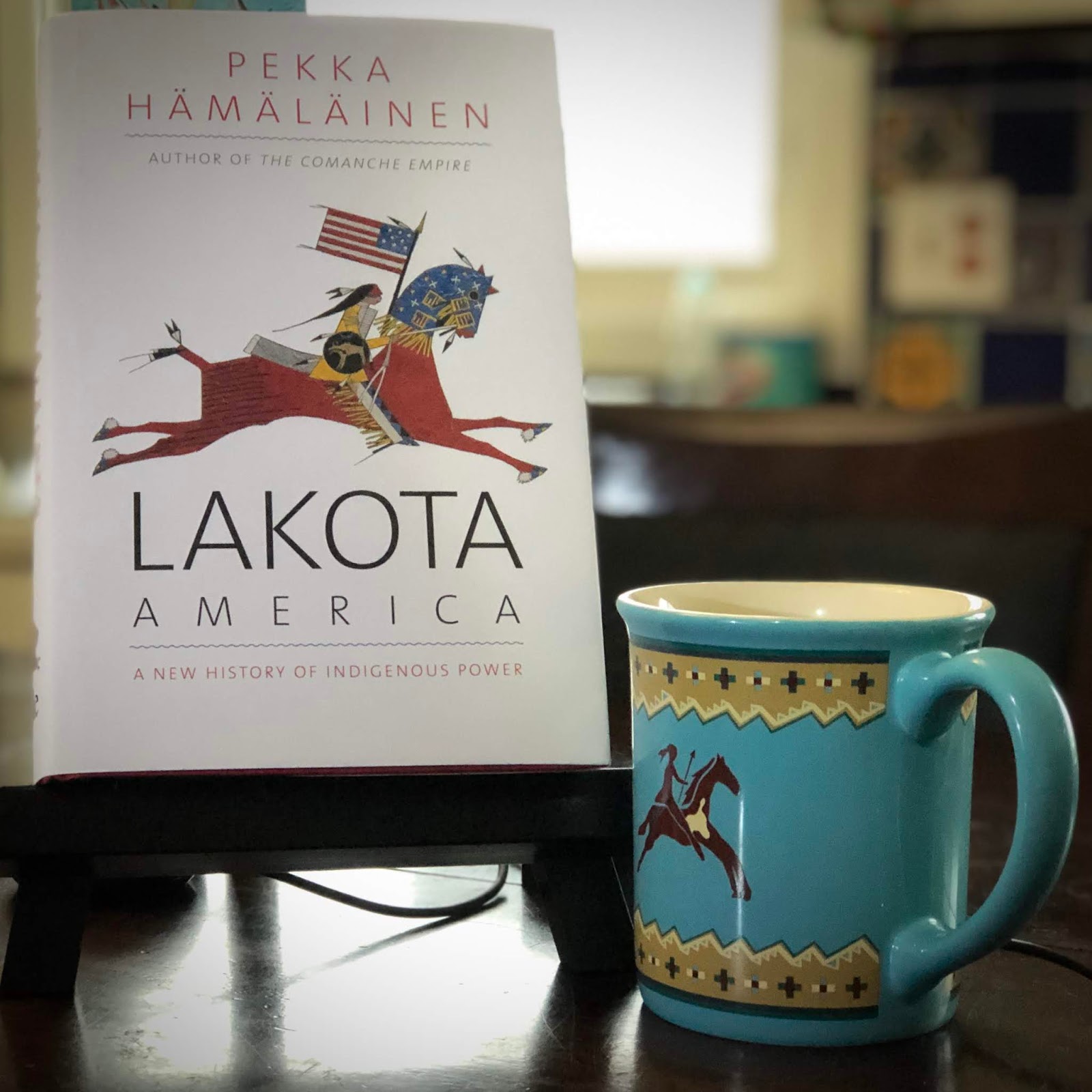
Lakota America, A Book Review

The cover of Lakota America features the art of Lakȟóta artist Jim Yellowhawk (Cheyenne River Sioux Tribe; Itázipčho). A simple photo of my copy of this book. 
Lakota America, A Book Review
This Book Fuckin' Moved Me
By Dakota Wind
Hämäläinen, Pekka. Lakota America: A New History of Indigenous Power. New Haven, CT: Yale University Press. 2019. $35.00 (hardcover). 544 pages + ix. Acknowledgments, a note on terminology, introduction, epilogue, a list of abbreviations, notes, glossary, index, maps, photos, illustrations.

“Yet this book is decidedly a history of the Lakotas, written from sources that seek to convey their perspective, often in their own words. An extraordinary archive makes this possible to an unusual degree. Lakota communities traced the passage of time by drawing on a buffalo hide a pictograph of one memorable event for each year. Lakotas call these calendars waníyetu iyáwapi. They draw attention to the mundane and reveal the sublime. Perhaps most important, as a body of historical record, winter counts capture what fascinated Lakotas and what mattered to them most. Lakota America makes the fullest use yet of this Indigenous archive in writing Lakota history.” (Hämäläinen, 2019; 8)

Thus begins Hämäläinen’s Lakota America, a post-colonial contact history of a people referencing their own historical records, and in this process, treating these pictographic records with a serious care and careful regard that these primary resource documents deserve. Most histories regarding the Očhéthi Šakówiŋ, Seven Council Fires (or “The Great Sioux Nation), are constructed primarily from colonial records (i.e. explorer journals, trader records, and missionary accounts). Hämäläinen embraces the indigenous record as a concurrent history, complemented by the colonial record.

I felt a deep sense of gratification reading this beautiful work.

Hämäläinen paints a picture of a people occupying a known and busy landscape inhabited and shaped by other indigenous peoples from trade, war, disease, and expanding colonial empires, to displacement, removal, imprisonment, and survival in a post-reservation world.

The story begins not with conflict, but with the arrival of Thiyóškate (Plays In The Lodge) on a diplomatic mission to Montreal to secure peace in the interior of North America. Conflict spread west threatening to invade Očhéthi Šakówiŋ homelands for beaver pelts in a trading system that left indigenous peoples dependent on iron wrought trade items.

There are many books about the Očhéthi Šakówiŋ, among them other notables including Royal Hassrick’s “The Sioux: Life and Customs of a Warrior Society,” Thomas Mails’ “Mystic Warriors of the Plains.” Nearly all western history books agree that the horse arrived in the mid-1700s. Hämäläinen breaks from academic consensus by informing readers that the horse arrived on the northern plains following the Pueblo Revolt of 1682. (Hämäläinen, 2019; 55)

The chapter, The Lakota Meridian, explores the Očhéthi Šakówiŋ in the context of world history. Hämäläinen reconstructs the setting of the interior of North America following the arrival of the horse, the gun, and smallpox epidemics which obliterated or weakened so many other first nations. The Lakȟóta secured and manipulated trade to their benefit. The Arikara War of 1823, the first American military campaign against Plains Indians sees the Očhéthi Šakówiŋ side with the United States, years after refusing “to be discovered” and acknowledging the United States as sovereign. (Hämäläinen, 2019; 140)

Lakota America is not a conflict history of the American West. It is closer to a biography in tone, but not on any one individual or few of Očhéthi Šakówiŋ leadership. It is not so much a cultural examination either; there are other resources for that. This work is like a study of the character of a people throughout several generations. Hämäläinen briefly articulates the cultural story of the White Buffalo Calf Woman and the Gift of the Sacred Pipe but reimagines this ancient narrative as a story of new urgency as the Lakȟóta ventured west from the Mnišóše, the Water-Astir (or Missouri River). (Hämäläinen, 2019; 164-165). He does reiterate throughout his work that Očhéthi Šakówiŋ identity is evidenced by virtue of practice and language. 

The image above was drawn by Sitting Bull's own hand. In his later years, Sitting Bull and his own people, the Húŋkpapȟa, identified him as a medicine man or spiritual leader. 

Očhéthi Šakówiŋ homeland is determined by occupation of waterways, in particular, the Mnišóše and all his tributaries. Boundaries are determined by the waters, and those boundaries were recognized in both the Fort Laramie Treaties. Hämäläinen carefully determines and explains how those boundaries were set through conflict and diplomacy. Their villages moved from valley to valley across the plains. The traditional Očhéthi Šakówiŋ recalls that the people moved from stream source to stream source across the plains.

Hämäläinen explores Lakȟóta political philosophy in their own terms as well as they dealt with the decline of the great bison ganges and the arrival of more fixed signs of American occupation. Iwáštegla, meaning “moderate,” “gentle,” and “easy,” but for also for the greatest maximum benefit, that which is “wašté,” or “good,” for the people. “Lakotas still expected wašíčus [sic] to compromise more than they did: after all, most of their interactions took place in Lakota territory. In this charged moment one can glimpse something essential about Lakotas’ ability to accept new realities, adjust to changing governing conditions, and yet remain indigenous.” (Hämäläinen, 2019; 300)

Lakota America has many strengths. Meticulous research is one, but what makes Hämäläinen’s work stand out is that he acknowledges, employs, and attributes the history (oral and pictographic) of the people he writes about, putting it on the same page as colonial records equating its importance.

Lakota America touches on the greatest conflict to shape the American West, Pȟežíšla Wakpá Okíčhize, or the Battle of the Little Bighorn. Every year there’s a book written about Lt. Col. Custer and the fate of the 7th Cavalry. Every book published about the Očhéthi Šakówiŋ includes this fight. It is refreshing that Hämäläinen does not dedicate an entire chapter retreading the last great Indian fight.

Hämäläinen does not stop his narrative of Lakȟóta history with Čhaŋkpé Ópi Owíčhakte, the Wounded Knee Massacre. No, he brings the story of adaptation, survival, and self-determination up to recent events at Íŋyaŋ Iyá Wakpá, the Talking Stone River (or the Cannonball River). A people and their history did not end at the turn of 1900. It lives and is a constant story of change. Hämäläinen gets it.

Lakota America is an engaging read. I found myself stopping several times throughout, lost in thought, and provoked to remember that indigenous occupation includes several other first nations who contested the landscape and gratified to discover how much Hämäläinen relied on Lakȟóta history to create this immensely reflective work.

My only concern, and it is a very minor thing, is that not all Dakhóta-Lakȟóta use the same term for the “winter count:” Northern Lakȟóta (i.e. Húŋkpapȟa) and Iháŋkthuŋwaŋna (i.e. Wičhíyena, or “Upper Yanktonai”) refer to the pictographic records as Waníyetu Wówapi, which means, “Keeping an Account of the Winter.” The Dakhóta and Lakȟóta who were placed at Fort Peck refer to winter counts as Hékta Yawápi, or “Counting Back.”

Lakota America has earned its place on my bookshelf. Get your copy as soon as you can to add it to yours. 


Friday, August 30, 2019

Moon Counting Tradition, A Poster

Pictured above is a screen capture of a poster with information about the Moon Counting Tradition. 
Haŋwíyawapi Wičhóȟ'aŋ Kiŋ
The Moon Counting Tradition
Dakota Wind, Editor
Bismarck, N.D. (The First Scout) - Winter Count Keepers kept track of time by following natural changes in the environment and naming the moon in which that moon became associated. 

Months were moons, and thirteen moons represented a winter. The Očhéthi Šakówiŋ (the Seven Council Fires; the "Great Sioux Nation") called a cycle of thirteen moons a winter because winter was the longest season on the Northern Plains. 

A moon could have many names. The Wolf Moon one year may be called the Moon of Popping Trees the next. The Yellow Leaf Moon among the Lakȟóta might also be called the Brown Leaf Moon; this same moon among the Dakhóta would be called the Moon When Rise is Laid Up to Dry. 

The historic Lakȟóta held a world-view perspective that was south-oriented. Taking this into account, then the rotation of the moon and the rotation of the earth around the sun would give us a moon calendar layout that looks like the poster above with the cycle of the moons and the phases of the moons "read" in a counter-clockwise manner. 

Of course, the traditional Lakȟóta would never have laid out images like this, rather, the winter count keeper kept track of the moons with counting sticks. 

This poster measures at 3' x 4' and is available for FREE, click here. Share this poster with others and your classroom today. 

Wednesday, December 19, 2018

The Long Soldier Winter Count

Waníyetu Wówapi Kíŋ Akíčhita Háŋska
Long Soldier Winter Count Revisited
By Dakota Wind
In 2007, editors Candace Green and Russell Thornton brought together in one publication "The Year the Stars Fell: Lakota Winter Counts at the Museum." This book features not just the winter counts, but interpretations of the pictographs, including commentary about the further meanings of various entries. It is obvious that the editors care deeply for these pictographic records. 

The Long Soldier Winter Count deserves to be revisited and compared to other Hunkpapa Lakota winter counts. Long Soldier's winter count seems to match up closely with the High Dog Winter Count, but there are some distinctions. This second look is also an attempt to put the narrative of each entry back into the Lakota language. 

There exists a variant of the Long Soldier Winter Count that has been studied and interpreted by Dr. Jenny Tone-Pah-Hote in the summer of 2004. Her interpretation of the MIA Long Soldier Winter Count may still be on the internet somewhere. 

I've employed the Lakota Language Consortium's (LLC's) Standard Lakota Orthography (SLO). Entries follow the format of year, the year's "name" written using the SLO, a free translation, followed by narrative or additional commentary. 

Get yourself a copy of "The Year the Stars Fell."

View a full-size copy of the Long Soldier Winter Count at the Sitting Bull College Library

Download the Long Soldier Winter Count Revisited.

Questions? Comments? Email me at tunweyathokaheya (at) gmail (dot) com.


Wednesday, December 20, 2017

Revisiting The John K. Bear Winter Count

Drifting Goose, chief of the Húŋkpatina, a winter count keeper, along with his people were placed onto the Crow Creek Indian Reservation. 
The Drifting Goose Winter Count
John K. Bear Winter Count Revisited

By Dakota Wind
In 1976, James H. Howard published his Yanktonai Ethnohistory And The John K. Bear Winter Count in the Plains Anthropologist. Howard counseled with native informants from native communities in South Dakota. The strength of his work is determined by two things: his informants and his scholarly research. Howard genuinely cared for the subject and people he wrote about.

There are a few things which must be revisited in Howard’s work: the arrival of the horse is one. This is important because it establishes the earliest record of the Očhéthi Šakówiŋ (the Great Sioux Nation) encounter with the horse, its location, which places the Iháŋktȟuŋwaŋna (the Yanktonai) at the mouth of the Čhaŋsáŋsaŋ Wakpá (the James River), and a date of 1692.

A few things must be re-interpreted. An example is the 1841 entry regarding Thamína Wé (His Bloody Knife). Howard calls this record an “anomaly,” and assumes this entry is in regard to the Arikara US Indian Scout, Bloody Knife, a friend of the infamous Lt. Col. George Armstrong Custer, from whom the latter learned how to converse in Lakȟóta, Sahnish (Arikara), and the Plains Indian Sign & Gesture language. This Bloody Knife is the Iháŋktȟuŋwaŋ chief, not the Arikara scout.

I’ve employed the LLC standard orthography in this “update,” and have expanded or amended some of Howard’s entries. Howard’s general format will be used: Numerical year in the Common Era, original text, the text re-written using the LLC standard orthography, a word-for-word translation, a free interpretation, followed by cultural/historical narrative.

Some biographical information about Maǧá Bobdú (Drifting Goose) can be found at American-Tribes.com. Go visit this website for its great forum on the subject of American Indian history and culture.


Download the PDF document of "Revisiting The John K. Bear Winter Count." 

For whatever odd reason, the citations didn't carry over when I converted the doc to PDF. Please contact me if you'd like a copy of the original document. 

Dakota Wind is an enrolled member of the Standing Rock Sioux Tribe. He is currently a university student working on a degree in History with a focus on American Indian and Western History. He maintains the history website The First Scout.


Monday, March 27, 2017

New Moon, New Year In The Moon Counting Tradition

Settlers called the first flower of spring "Prairie Crocus" or "Pasque Flower," but the Lakota people know it as Hoksicekpa, A Child's Navel, or "Wanahca Unci, Grandmother Flower. 
Moon Counting Tradition
New Moon, New Year: 2017-2018

By Dakota Wind
Great Plains, N.D. & S.D. (TFS) – Waná wétu ahí, Spring as arrived. Maǧá, the geese, have returned over the past month from their sojourn in the south, Wakíŋyela, the Mourning Doves, greet the mornings in the Missouri River valley with their queries of possible snow, and Škipípila, the Chickadees, whistle their queries into the wind if spring has indeed returned. Tȟašíyagmuŋka, the Western Meadowlark sings to all, “Oíyokiphi! Ómakȟa Tȟéča yeló!” “Take Pleasure! The New Season [Year] is here!”

The Lakȟóta moon counting tradition calls for incising a notch on a willow switch, a stick would suffice, with the passing of each moon (month). At the end of the year, one should have thirteen notches. The new month in this new cycle is known by a few names: Pȟeží Tȟó Alí Wí (The Green Grass Moon), Maǧá Aglí Wí (Moon When Geese Return), or Wakíŋyaŋ Aglí Wí (Moon Of Returning Thunder).

The 2017 spring equinox occurred on Monday, March 20. Many Lakȟóta journeyed to a special place in Ȟesápa, the Black Hills, to participate in an annual tradition reaching back thousands of years to welcome the Thunder. Some Lakȟóta call this special place Hiŋháŋ KáǧA Pahá, the Making Of Owls Peak. For many years, this highest peak of Ȟesápa, was known as Harney Peak, which some now call Black Elk Peak, in honor of the Oglála holy man.

When spring arrived, not all Lakȟóta made the journey to Ȟesápa. When winter camps broke, many took to the open Great Plains to engage in the first big game hunt of the Ómakȟa Tȟéča. This kind of hunt is called WanásA. Spring was also the time when the Húŋkpapȟa journeyed east to Čaŋsáŋsaŋ Wakpá, Creamy White Tree River (White Birch River; the James River), to trade with the Iháŋktȟuŋwaŋna (Yanktonai). One rendezvous point was where the Íŋyaŋ Iyá Wakpá, Talking Stone River (the Cannonball River) converges with Mníšoše, another rendezvous point where the Oglála met with the Iháŋktȟuŋwaŋ (Yankton), where the Čaŋsáŋsaŋ Wakpá converged with the Mníšoše.

In the Lakȟóta calendar tradition, the year is referred to as Waníyetu, or Winter. It was called such because winter was the longest season of the year, typically lasting five moons. Wétu, or Spring, lasted two months. Blokétu, or Summer, lasted four months. Ptaŋyétu, or Fall, lasted two months. The Lakȟóta calendar tradition may need to be revised in the future to reflect a change in weather. Deny climate change or acknowledge it, the growing season in North Dakota since 1879 has lengthened twelve days.

Since the equinox, a light rain fell, even as blankets of snow still linger on the landscape. Some might even say that the Thunders stayed on over the winter. Indeed, lightning and thunder was present at Standing Rock. The Mníšoše, the Water A-Stir (the Missouri River), has been breaking for a month now. Geese gather on and around the sandbars to feed before taking flight north.

This morning, in Heart River country, where the Heart River converges with Mníšoše, light wisps of clouds stretched across the eastern horizon and caught fire in the first rays of morning. Fog enveloped the Missouri River valley over a still Mníšoše, so still as to be a perfect mirror. The air is cool and crisp enough to leave whorls of frost on car windows, and a wind so light as to be barely a whisper.

One more sign by which the Lakȟóta know and celebrate Ómakȟa Tȟéča is by the blossoming of Hokšíčhekpa, A Child’s Navel (Prairie Crocus; Pasque Flower), also called Wanáȟča Uŋčí, Grandmother Flower. It is the first flower to appear and the first to take her journey. She sings songs to the other flowers, that their time will come, and not to worry when it does, for their spirits come together to make the rainbow. The entire flower is medicine, used to treat dry skin and arthritis. Her petals are purple and furry like a bison robe, and her heart is golden like the sun, though once in a while Wanáȟča Uŋčí emerges with a white robe which indicates a spot where a bison breathed his or her last breath.

I hiked the rolling hills in Heart River country over the weekend searching for Wanáȟča Uŋčí, but my search bore no results. I found dried and weathered prairie aster from last summer, hard and wrinkled prairie rose hips my grandmother would have called SákA, and lichen ranging from grey and green to brilliant orange and bright red on sandstone jutting out of the hillsides. The 
Lakȟóta call lichen Ziŋtkála Ipátȟapi, which means "Bird Embroidery." I’ll check again in a week’s time.

The Lakȟóta waníyetu, year, will last until March 16, 2018, which is 354 days. Or, as some would have it, the new year began on Monday, March 20, 2017. Ómakȟa Tȟéča yeló!


Dakota Wind is an enrolled member of the Standing Rock Sioux Tribe. He is currently a university student working on a degree in History with a focus on American Indian and Western History. He maintains the history website The First Scout.


Wednesday, March 8, 2017

The Lakota Months And New Year

An illustration from Jospeph Bruchac's "Thirteen Moons On Turtle's Back." A good book for introducing concepts of the months and names from several First Nations. 
The Lakota Calendar & New Year’s Day
Thirteen Months Equals One Year/Winter

By Dakota Wind
Bismarck, N.D. (TFS) – The Thitȟuŋwaŋ (Lakȟóta) refer to the year as waníyetu (a winter). They called it such for it was the longest season on Makȟóčhe Wašté (The Beautiful Country; Great Plains, or North America). The waníyetu was marked by the passing of thirteen moons (months). Some say that the waníyetu lasted from snowfall to snowfall, others from spring to spring. There is one Lakȟóta man on Standing Rock who says that he learned that the year lasted from mid-summer to mid-summer.

A traditionalist would say that the Lakȟóta month is twenty-eight days long. Using the moon counting stick method to track the days, one finds that new moon nights are not counted, so the length of the month can be said to be roughly twenty-eight days. A month lasted from new moon to new moon. Each month of the moon calendar, however, lasts on average twenty-nine to thirty days. The moon calendar from March 2017 to March 2018, lasts 383 days.

The Húŋkpapȟa say that after a full moon, a large mouse with a pointed nose nibbles away at the lodge of Haŋwí (the Moon) to describe the waning of the moon, then Haŋwí rebuilds her lodge after each new moon. Some Lakȟóta say that Haŋwí draws her shawl over her face as her husband, Wí (the Sun) approaches her. Long ago, Wí shamed Haŋwí with an indiscretion and they’ve been parted since. But on occasion, it is Haŋwí who approaches Wí and covers him with her shawl, they embrace for a moment, and then they part. You would call this a solar eclipse. The Húŋkpapȟa call it Maȟpíya Yapȟéta, “Cloud On Fire.”


A partial solar eclipse as seen from the central North Dakota, by author. 

Sometimes during the winter months, the light of Haŋwí spills out and lights the sky in a ring around her lodge. The Húŋkpapȟa say that Haŋwí is cooking and she has vigorously stirred her pot, and light has spilled out into the night sky. The Lakȟóta call this ring around the moon, Wíačhéič’ithi.

The Lakota Language Consortium have recorded eight phases of the moon in their New Lakota Dictionary. These are: Wit’é (the New Moon), Wílečhala (the crescent between the New Moon and the First Quarter), Wíokhiseya (the First Quarter), Wímimá Kȟaŋyéla (phase between First Quarter and Full Moon), Wímimá (the full moon), Wí Makȟátaŋhaŋ (phase between Full Moon and Third Quarter), Wiyášpapi (the Third Quarter), and Wit’íŋkta Kȟaŋyéla (the crescent between Third Quarter and New Moon).

New Year’s Day for the Húŋkpapȟa will fall on the day of the New Moon following the Spring Equinox, which is March 27, 2017. New Year’s Day for the one Húŋkpapȟa man in Wakpála, S.D. will fall on the Summer Solstice, which is June 20, 2017. For the Lakȟóta who say that the year lasts from snowfall to snowfall, their year will begin with snowfall later in 2017. 

A FREE 2017 Moon Phase Calendar at 72 Hours American Power

The name of the moon was never permanently set because the new moons gradually moved to a different time each winter. This explains why moons have alternate names. The Holding Hands Moon might be next year’s Moon Of Popping Trees. 


Here’s a breakdown of the thirteen month calendar for 2017 (with alternate names):

Dec. 29, 2016 – Jan. 26, 2017.
Wiótheȟika Wí: (Lit. “Sun-Hard-Time Moon”) The Sun Is Scarce Moon
Napé Oyúspa Wí: (Lit. “Hand To-Hold Moon”) Holding Hands Moon

Jan. 27, 2017 – Feb. 25, 2017
Čhaŋnápȟopapi Wí: (Lit. “Trees-Popping Moon) Moon Of Popping Trees
Aŋpétu Núŋpa Osní Wí (Lit. “Day Two Cold Moon”) Two Cold Days Moon
Šuŋgmánitu Tȟáŋka Wí (Lit “Wolf Moon”) Wolf Moon

Feb. 26, 2017 – March 26, 2017
Ištáyazaŋ Wí: (Lit. “Eyes-Sore Moon”) Sore Eyes [Snow-blindness] Moon
Aŋbháŋkeya Wí (Lit. “Day-Night-Half Moon”) Moon Of Half Day, Half Night

March 27, 2017 – April 25, 2017
Pȟeží Tȟo Wí (Lit. “Grass-Green Moon”) Green Grass Moon
Maǧá Aglí Wí (Lit. “Goose Returns Moon”) Moon When Geese Return
Wakíŋyaŋ Aglí Wí: (lit. “Thunder Return Moon”) Moon Of Returning Thunder

April 26, 2017 – May 24, 2017
Čhaŋwápenableča Wí (Lit. “Tree-Leaf-Unfold-Themselves Moon”) Moon When The Leaves Unfold
Waȟčá Hdehdé Wí (Lit. “Flower/s Scattered-Here-And-There Moon”) Flowers Bloom Here And There Moon
Ptehíŋčhala Tȟúŋ Wí: (Lit. “Bison-Calf Born Moon”) Moon When Bison Calves Are Born

May 25, 2017 – June 22, 2017
Maȟčhíŋča Nuŋwáŋ Wí (Lit. “Ducklings To-Swim Moon”) Moon When Ducklings Swim
Uŋžíŋžiŋtka Wí (Lit. “Prairie Rose Moon”) Prairie Rose Moon
Thíŋpsiŋla Wí (Lit. “Turnip Moon”) Prairie Turnip Moon
Wípazukȟa Wí (Lit. “Juneberry Moon”) Juneberry Moon

June 23, 2017 - July 22, 2017
Blokétučhokaŋ Wí (Lit. “Middle-Of-The-Summer Moon”) Middle Of The Summer Moon
Čhaŋpȟásapa Wí (Lit. “Chokecherry-Black Moon”) Ripe Chokecherry Moon

July 23, 2017 - Aug. 20, 2017
Kȟáŋtašá Wí: (Lit. “Plum-Red [Ripe] Moon”) Ripe Plum Moon
Wasútȟuŋ Wí: (Lit. “Things-Ripen Moon”) Moon When Things Ripen

Aug. 21, 2017 - Sept. 19, 2017
Čhaŋwápe Ǧí Wí: (lit. “Tree-Leaves Brown Moon”) Moon When Leaves Turn Brown
Čhaŋwápe Zí Wí: (lit. “Tree-Leaves Yellow Moon”) Moon When Leaves Turn Yellow

Sept. 20, 2017 - Oct. 18, 2017
Čhaŋwápe Kasná Wí: (lit. “Tree-Leaves To-Drop-Off Moon”) Moon Of Falling Leaves

Oct. 19, 2017 - Nov. 17, 2017
Ȟeyúŋka Wí: (lit. “Frost Moon”) Frost Moon
Thiyóȟeyuŋka Wí: (lit. “Lodge-On-Frost Moon”) Frost On The Lodge Moon

Nov. 18, 2017 - Dec. 17, 2017
Waníyetu Wí: (lit. “Winter Moon”) Winter Moon

Dec. 18, 2017 - Jan. 15, 2018
Waníčhokaŋ Wí: (lit. “Middle-Of-The-Winter Moon”) Midwinter Moon


Dakota Wind is an enrolled member of the Standing Rock Sioux Tribe. He is currently a university student working on a degree in History with a focus on American Indian and Western History. He maintains the history website The First Scout.
__________

BIBLIOGRAPHY
Mrs. Amanda Grass, Welch Dakota Papers
Mr. Kevin Locke (The First To Arise) and Mr. Joe Bull Head
Mr. Raymond Winters (Fighting Bear)


Friday, February 3, 2017

A 2017 Lakota Moon Calendar

The Lakȟóta call her, the moon, Haŋwíŋ. The Húŋkpapȟa say that when the full moon wanes, a large mouse with a long nose is nibbling away at her lodge. When her lodge is completely gone, Haŋwíŋ then reconstructs her lodge until full again. 
A 2017 Lakota Calendar
Thirteen Months In Year

By Dakota Wind
Fort Yates, ND (TFS) – Before the reservation era, each Thítȟuŋwaŋ (Teton; Western Sioux, or Lakȟóta) band had a winter count keeper. The keeper kept track of the years with a pictographic record (the winter count), and kept track of the months with a stick, or sticks.

Raymond Winters (Standing Rock; Matȟó Wičhá 
KhízA, or “Boar [as in 'a Male Bear'] Fight”), known in the art world by his signature of "Fighting Bear," served as an advisor for the beautifully illustrated children’s book “Moonstick: The Seasons of The Sioux.” According to Winters, one stick was used, and with each wit’é (the new moon), a notch was cut into the stick at one end. 

Gratify yourself and get a copy today. Not just for children, this book is informational for grown adults as well.

When the new year begins differs from band to band. Some say the new year begins and ends with the first snowfall of winter. Some say that the new year begins with the summer solstice. Others say the new year begins in the spring when the geese have returned, when the bison cows have their calves, when the leaves begin to unfold, when the ice breaks, or when the meadowlark sings aloud, “O’iyókiphiyA! Ómakȟa Théča Yeló! [Take pleasure! The earth is made anew!].”

No matter what each band may consider when the new year begins or ends, one thing is certain. The year is regarded by all as waníyetu (a winter), for winter is the longest season on Makȟóčhe Wašté (The Beautiful Country).

This writer has constructed a 2017 calendar based on the traditional thirteen lunar month system of the Húŋkpapȟa Lakȟóta and Iháŋktȟuŋwaŋna Daȟóta people. Each month begins with wit’é. This calendar is for educational purposes only, and not for sale. It is for use by the general public. 

A morning sundog appears above the Missouri River (Lake Oahe) in front of the Standing Rock Administrative Building in Fort Yates, ND. 

A winter evening at the north end of the Burnt Hills range on the Standing Rock Sioux Indian Reservation. 

Near this natural feature along the Missouri River, the White Buffalo Calf Woman came to the Húŋkpapȟa Lakȟóta in the hour of their need and gave them bison calling songs. 

Canadian Geese make their return to the Great Plains in this wallpaper image. 

Hokšíčhekpa (A Child's Navel), or Pasque Flower blooms in springtime on the Great Plains. An ice age flower, she blooms sometimes when snow is still on the ground. She is also known as Wanáȟča Unčí (Grandmother Flower). 


Buttes reach the heavens between Wakpala S.D. and McLaughlin S.D. on the Standing Rock Sioux Indian Reservation. 

Killdeer Mountain rises from the prairie like a step to heaven. A sacred place for generations and the site of the July 1864 General Sully assault on Lakȟóta who had nothing to do with the 1862 Minnesota Dakota Conflict. 

My grandmother's tree located between Kenel S.D. and Wakpala S.D. on the Standing Rock Sioux Indian Reservation. 

According to the Lakota Language Consortium's New Lakota Dictionary, an eclipse is called Aháŋzi (Shadow) or AóhanziyA (To Cast A Shadow Upon). The Húŋkpapȟa call this event Maȟphíya Yapȟéta (Cloud On Fire; Fire Cloud). There will be a solar eclipse on August 21, 2017. 

The North Dakota Badlands is featured here. It was a hot, hazy day. 

A spotted black horse grasses on what little grass is available along Long Soldier Creek on the Standing Rock Sioux Indian Reservation.

The annual Leonid Meteor Shower will be on Nov. 17 & 18, 2017. Don't miss it. 

They say that when a ring is around the moon, Haŋwíŋ has vigorously stirred her pot and light has spilled out and around her lodge. 

Download a zip file of this calendar. 


Thursday, January 26, 2017

The Origin Of Counting Coup

According to The Flame Winter Count, the "Uncpapa kill two Rees," 1799-1800. The bow over their heads indicates that they also counted coup on the two Arikara. The Arikara were designated by their distinctive hair, or by an ear of corn.
The Origin of Counting Coup
Honor Began With Birds
By Dakota Wind
Great Plains, N.A. (TFS) – The traditional war honor of counting coup reaches back to a time before the First Nations walked upon Mak
ȟóčhe Wašté (Beautiful Country; North America). When the Očhéthi Šakówiŋ (Seven Council Fires; the Great Sioux Nation, or “Sioux”) arrived, they learned to survive by first observing nature.

When the Očhéthi Šakówiŋ learned warfare, they were prepared for the First Battle by Tȟokéya (the very First man), aided by Iŋktómi (the Spider Nation in this instance, not the legendary trickster) and Ziŋtkála (the Bird Nation).

With a heavy heart, Tȟokéya gave the first bow and arrows to men. “Misúŋkala (Little Brother/s),” said Tȟokéya, “the time to give you weapons is now and I am sorry to do so. Now, at last there is war in the hearts of animals and man.” According to Ohíyesa (The Winner; aka Dr. Charles Eastman) and his work Wigwam Evenings, Tȟokéya gave them a spear as well and showed them how to use these tools.


The late Paul Goble illustrated this scene from his "The Great Race." In the story of the first battle, the First Man threw a rock up which then came down as a wall of stone. 

Iŋktómi fashioned stone tools for arrows, spears, and knives, then scattered these things across 
Makȟóčhe Wašté for the people to find and use. They say that Iŋktómi continued to knap stone up until recent times. The high-pitched ring of stone on stone was heard by Lakȟóta men and women on Standing Rock. “Some people have heard him at work, but could never see him. I have, myself, heard him at work, chipping stones. It was a small hole south of Fort Yates where I heard him working. He went slow (chip chip). We got within a few feet of the hole, when he would stop and we could not find him then. When we went away he worked again,” said Bull Bear to Col. A. Welch in 1926.

In the First Battle, the Ziŋtkála had chosen the side of the animals. In another story, there was a Great Race around Ȟesápa (the Black Hills) between man and animal, to decide who would hunt who. Ziŋtkála stood with man, because like man, Ziŋtkála has two legs. 


A snippet of Mails illustration of a war party on the Great Plains. Each carries a coup stick.

The Očhéthi Šakówiŋ observed how Ziŋtkála defended their nests from one another and from other threats. In 1919, Siŋté Wakíŋyaŋ (Thunder Tail; Oglála) shared that all Ziŋtkála are alike in the regard they have for their young. When approached, Ziŋtkála cries out vigorously, and if the interloper still advances, only then do they fly out and give chase. “...iwíčhačupi čhíŋpi šni hé uŋ héčhapi (...they do not want their children taken, that’s why they do this),” said Siŋté Wakíŋyaŋ.

Siŋté Wakíŋyaŋ continued: “Wóeye kiŋ le othéȟike lápi: ‘Blihíč’iyapo! Ziŋtkála waŋ iyé wípȟe yuhá šni yéš čhiŋčá awíčhakikšiža,’ eyápiča na hé tóna okíčhize él opȟápi kiŋ hená líla óta waóŋtoŋyaŋpi ktA ogná škaŋpi nakúŋ t’ápi eyáš na oyáte kiŋ hé uŋ awáŋiglakapi (They have a determined saying: ‘Take courage! Birds have no weapons and yet they keep their young,’ they said. They fight determinedly and wound their many enemies, sometimes killing them to protect what is theirs).”

“Heháŋl íčhinuŋpa wóeye kiŋ: ‘Ziŋtkála owé oyásiŋ kiŋyáŋpi na okté šičápi.’ Hé uŋ oyáte kiŋ okíčhize él ziŋtkála iyéčhel škaŋpí (They have a second saying: ‘All the birds fly and strike the bad ones.’ In battle, the people are like birds).”

Counting coup then, can be taken by way of touching the enemy with one’s own hand, with a stick, quirt, lance, bow, staff, or even a rifle. The 
Očhéthi Šakówiŋ call this honor: Tȟóka Kté ("Strike/Kill an enemy"). The coup stick is called Čhaŋwápaha. Recounting these deeds is called WaktóglakA. The victory dance is a Waktégli Wačhípi. 


The 1715-1716 entry on the Baptiste Good Winter Count recalls the enemy astride a horse entering camp who stabbed a boy near the lodge. 

The Baptiste Good Winter Count (Sičháŋǧu; aka Brulé) recalls a curious development in warfare. In the entry for 1714-1715 a warrior astride a horse, carrying a pine lance, came to attack, but killed nothing. According to Dr. Corbusier’s notes, this mounted attack was the first of its kind experienced by the Sičháŋǧu. The rider certainly didn’t come to joust. He came to collect war honor, not to kill. 


Red Dragonfly counts coup on the enemy with a bow.

The Rosebud Winter Count (Sičháŋǧu) mentions coup a few times, the earliest of which will be shared here. In 1774-1775, a man named Red Dragonfly counted coup using a bow on a Crow Indian. A winter count entry was selected because it was outstanding. Counting coup was bold and daring, and young men were expected to be so as well. Not every war party went to count coup. In fact, some had coup counted on them, and the unlucky returned in humiliation. There was something exceptional about this particular deed that needed to be remembered. 


An entry from the Long Soldier Winter Count. The two men return with scalps on their coup sticks. A copy is available to view at the Sitting Bull College Library in Fort Yates, ND.

The Long Soldier Winter Count (Húŋkpápȟa) mentions coup in the entry for 1816-1817, "2 Sioux killed 2 Crows and scalped them and blackened their own faces for gladness and came home [sic]."

For the Húŋkpapȟa, there are four coups: first coup is for the one who struck the enemy first, alive or dead, second coup is for the one who struck second, third coup for third strike, and fourth coup for fourth strike. A coup must be substantiated by an eyewitness. 


Mails illustrated this image of the scalp (the first coup) on this horse. Get yourself a copy of the profusely illustrated Mystic Warriors of The Plains.

According to Matȟó Watȟákpe (John Grass), first coup is designated by an eagle tail feather with the quill painted red, bound in red cloth, or embroidered with quillwork. A first coup feather may be colored or notched to include second, third, or fourth coup. A rider would designate first coup with a horse tail affixed beneath the horse’s bridle bit. Other methods of showing one’s first coup included attached a streamer of horsehair to the tip of an eagle feather, or a small tuft of plumage was carefully glued to the tip of the feather.

Second, third, and fourth coup would be evidenced by stripes, perhaps on a shirt, leggings, or even painted on a horse when riding to meet the enemy.


Living narrative of the coup designations survives today in lekší (uncle) Wilbur Flying By.  "Amongst our Hunkpapa relatives the first to count coup wore a center eagle tail feather straight up. [The] second to count coup wore an eagle feather to the right. [The] third to count coup wore an eagle feather to the left, and the fourth to count coup wore a buzzard feather."

The coup stick might have the crown (the scalp) of an enemy attached to it. The swirl, or crown, of hair represented the soul to the Lakȟóta. Taking the crown, or scalping the enemy meant taking the soul of the enemy.

Counting coup wasn’t limited to touching just the enemy. Sometimes a warrior made a run through an enemy village, on his pass through, he might reach out and touch a painted lodge, stealing the other’s medicine and take it home with him to put on his lodge. 


Another illustration by Mails. This coup stick resembles the one described by Mr. Leo Caddotte of Wakpala, SD to Col. Welch. 

Sometimes a man would gather his honors, his feathers, and had he accumulated enough, created a wápaha, a kind of banner or staff, sometimes adorned with cloth. Other banners or staves, were long and crooked on one end, and wrapped in otter fur. The feathers were arranged to adorn either wápaha.

An esteemed warrior might even invite his kȟolákičhiyapi, his brothers-in-arms or society, to his wife’s lodge for a meal. Then they would recount the stories of each feather earned, then the man might make a wapȟáha, a warbonnet or headdress.

The honor of the coup could also be gifted to another. This honor can be the one feather or more, a warshirt, a staff, or even a headdress. When this honor was gifted, it was also accompanied by a song and a feast.


The most important symbol of the leader, according to the Hunkpapa, was the staff. 

In 1941, Col. Welch was visiting Húŋkpápȟa friends at Wakpála, SD on the Standing Rock Sioux Indian Reservation. Welch inquired about the significance of the wičhápȟaha ógle (the warshirt), the wápaha, and the wapȟáha. The Húŋkpápȟa told Welch the most important symbol of the itȟáŋčhaŋ (chief), was the wápaha. Specifically, the kind of staff that was crooked. They detailed to Welch a staff that was squared and painted white on two sides and red on the others. High Reach said that the white represented purity of purpose, and the red symbolized honor. A blue band was painted at the halfway point of this staff, which stood for the everlasting sky above. The feathers hung down on one side of the staff and a five-pointed star hung from the crook. 


Conflict wasn’t about taking life, but securing personal honor and demonstrating courage. Warfare, according to Ohíyesa, “... was held to develop the quality of manliness and its motive was chivalric or patriotic, but never the desire for territorial aggrandizement or the overthrow of a brother nation.”


Good read. McGinnis bucks the trend of historians and begins his timeline at 1738, and the typical year that most historians say the horse arrived on the nothern Great Plains, which is typically said to be at "about 1750."  

Lakȟóta military strategy was carefully planned to avoid unnecessary risks.

In 1879, a young Lt. William Philo Clark was stationed in Dakota Territory. There he was charged with learning the Plains Indian sign language. Clark recorded the sign for counting coup as: hold the left hand, back to left and outwards, in front of the body, index finger extended and pointing to front and right, others [remaining fingers] and thumb closed; bring right hand, back to front, just in rear of left [hand] and lower, index finger extended, pointed downwards and to the left, right index finger under left, other fingers and thumb closed; raise right hand, and turn it by wrist action so that end of right index strikes sharply against [the] side of the left as it passes.

The Očhéthi Šakówiŋ learned to survive by observing nature. Especially Ziŋtkála (the bird nation). Ziŋtkála built nests at certain times of the year, and defended their young and their m
akȟóčhe (country; territory) when needed. Ziŋtkála even help each other sometimes; the meadowlark never reminds the prairie chicken of the time they defended their ground nests from a common foe. Ziŋtkála doesn't disparage the ways of other Ziŋtkála. When the seasons change, each respects its time and calling. 
__________
BIBLIOGRAPHY


Eastman, Charles A., Dr., and Elaine Goodale Eastman. Wigwam Evenings: 27 Sioux Folktales. Dover ed. Mineola, NY: Dover Publications, Inc., 2000.

Welch, A. B., Col. "Life on The Plains in The 1800's." Welch Dakota Papers. November 2, 2011. Accessed January 5, 2017. http://www.welchdakotapapers.com/.

Stars, Ivan, Peter Irin Shell, and Eugene Buechel. Lakota Tales And Texts. Edited by Paul Manhart. Pine Ridge, SD: Red Cloud Lakota Language and Cultural Center, 1978.

Lakota Winter Counts Online. March 3, 2005. Accessed January 12, 2017. 

http://wintercounts.si.edu/index.html.

Flying By, Wilbur. Interview by Charles I. Walker. Lakota Traditions. Wakpala, SD, 2001.

The Year The Stars Fell: Lakota Winter Counts At The Smithsonian. Edited by Candace S. Greene and Russell Thornton. Lincoln, NE: University of Nebraska Press, 2007.

Clark, W. P. The Indian Sign Language. First ed. Lincoln: U of Nebraska, 1982.

Mails, Thomas E. The Mystic Warriors of the Plains. Garden City, NY: Doubleday, 1972.