Showing posts with label Little Bighorn. Show all posts

Thursday, April 6, 2017

A Review: Sitting Bull, Lakota Warrior And Defender Of His People

A Review: Sitting Bull, Warrior & Defender
Beautiful Book About Great Leader
By Dakota Wind
Fort Yates, ND (TFS) – In 2015, SD Nelson published his Sitting Bull: Lakota Warrior and Defender of His People, a first-person historical narrative through the eyes of Sitting Bull. His people's struggle to survive manifest destiny in the late nineteenth century is told through historical photos and Great Plains pictography.

Nominally a children’s book, but much more, Nelson beautifully illustrates a carefully researched and composed historical narrative. Each page is a work of art rendered in the historic Plains Indian style on a ledger book background. Every piece of art is lovingly constructed with a contemporary feel without sacrificing style or story.

Nelson acknowledges the oral traditions for Sitting Bull’s childhood name, Jumping Badger, from the direct lineal descendant, the great-grandson of Sitting Bull, Mr. Ernie LaPointe.

Sitting Bull touches on the last greatest conflict in the American West, Little Bighorn. Nelson takes readers on the journey to Fort Walsh in Canada, where Sitting Bull and his people remained in exile for a few years until the overwhelming call to return home pulled the Lakota back to Missouri River country. Nelson thoughtfully reconstructs the “surrender” of Sitting Bull at Fort Buford, which was actually an exchange of one lifestyle, a hunter-gatherer one, for another, an agricultural one. Imprisonment at Fort Randall is mentioned too.

Sitting Bull’s time as part of Buffalo Bill’s Wild West Show is also touched upon, then Sitting Bull’s return to his first and last home on the Grand River, SD. Agent McLaughlin is rendered in a confrontation with Sitting Bull about the Ghost Dance, and Sitting Bull is simply but beautifully rendered as Ikčé (common) in wrapped braids and a robe.

Nelson brings Sitting Bull to a conclusion with the death of the great spiritual leader at the hands of his own people. Nelson illustrates Sitting Bull falling, but not quite on the ground. Two police officers are depicted firing at Sitting Bull in the side and head. The images are suggestive, not graphic in their depiction, truly rendered in the historic Plains Indian style of art.

Nelson’s book is a beautiful tribute to one of the great leaders of the Lakota people. His vibrant use of color enhances a traditional art. This isn’t a typical childhood read, and it shouldn’t be. This is based on a living, breathing first nation man and his struggle in the post-reservation era. If your bookcase has any work by Paul Goble, this one earns its place front and center on that shelf. Get it for yourself and your family if you love art and history.

S.D. Nelson is a member of the Standing Rock Sioux Tribe. His traditional name is Maȟpíya Kiŋyáŋ (Flying Cloud) He is an award-winning author and illustrator of numerous children’s books. His books have received many accolades, including the American Indian Library Association’s Youth Literature Award, a place on the Texas Bluebonnet Award Master List, and the Western Writers of America Spur Award. Nelson lives in Flagstaff, AZ. Follow him online at sdnelson.net.

Nelson, S. D. Sitting Bull: Lakota Warrior and Defender of His People. First ed. New York, NY: Abrams Books For Young Readers, 2015. 64 pp. $19.95. Hardcover. Photos, illustrations, timeline, notes, bibliography, index.


Dakota Wind is an enrolled member of the Standing Rock Sioux Tribe. He is currently a university student working on a degree in History with a focus on American Indian and Western History. He maintains the history website The First Scout.

North Dakota Content Standards
Grades 4 and 8
Resources: 4.1.4; 8.1.2
Timeline: 4.1.5
State Symbols: 4.2.1 (Western Meadowlark, Red Tomahawk)
Concepts of time: 4.2.2, 4.2.3, 4.2.4
People and events: 4.2.5
Colonization: 4.2.9
Expansion: 4.2.10
Physical geography: 4.5.3; 8.5.1
Human geography: 4.5.5, 4.5.6; 8.5.2, 8.5.3
Culture: 4.6.1, 4.6.2; 8.6.2
US History & Imperialism: 8.2.4, 8.2.9, 8.2.10, 8.2.11


Wednesday, July 10, 2013

Oškate: A Victory Celebration

The morning haze made for a muggy afternoon at the pow-wow and rodeo grounds along the Long Soldier Creek.
Oškate: A Victory Celebration
A Commemoration Of The Little Bighorn
By Dakota Wind
Fort Yates, N.D. - Last year I had heard about a Little Bighorn victory commemoration on the Standing Rock Sioux Indian Reservation, where I’m from. Intrigued, but unable to attend the event, I waited. Another year passed, and my schedule allowed me to take it in.

My day began with the sunrise, north of Mandan. The morning sun shone brightly through the windows and into the living room spilling golden light throughout the house and into the kitchen. I bid the family goodbye and braced myself for a long hot day.

The morning was relatively cool. A light ran during the night kissed the grass with dew. The sun’s warmth rung the moisture from the ground and air, and filled the sky with a heavy clammy haze. Clouds hung low, and combined with the haze gave the landscape an almost dreamy quality. The sunlight danced through the clouds and haze as light would through water at the bottom of a pool.

The drive itself was quiet and uneventful. Traffic was light in the early dawn and I passed by what I imagine to be farm traffic. Almost nothing but pick-ups were on the highway or just merging with the highway from the many dirt roads that broke off from the main road.


 The poster that was circulating the web said that the event would begin promptly at 9:00 AM. I drove just slightly over the speed limit, pacing myself, so that I’d get there at least fifteen minutes before the flag song and flag raising at the Akičita Haŋska Wačipi grounds (the Long Soldier Pow-wow grounds).

When I pulled onto the grounds a group of veterans were already there patiently waiting for the singers (drum group) and Nača (headman) and eyapaha (announcers). One of my lekši (uncles) and his wife and their children and grandson came out to see and hear what was happening.

A short but pleasant wait later, the headman of the Šuŋg Sapa Gleška Okolakičiyĕ (The Spotted Black Horse Society) made an announcement that several people had mistaken the information that was circulating online and believed that the victory celebration wouldn’t take place until the evening.

Since there were veterans present, and two American flags to raise, regardless that the celebration wouldn’t take place until later that day, the leader brought out the Spotted Black Horse Society’s drum to render the Lakota National Anthem. There were few singers present, so my lekši and two of his sons, my téhaŋši (male cousins), joined the leader to render the song. My lekši turned to me and simply said, “Here,” and gestured to the drum. I have never sung with my lekši nor my téhaŋši before, and never at the grounds I danced at when I was boy.

Téhaŋši John led us in the Lakota National Anthem, then my téhaŋši Rick “Bu’bu” lead us in the flag song as the flags were reverently brought out and raised with honor.

One of the eyapaha, John Eagle, offers words in memory of our ancestors and encouragement to the Lakota people today. 

I thought to myself, “How could we [the Lakota] be so patriotic as we honored that flag and remembered our relatives who fought for a country who had once fought desperately to put us here, AND honor our relatives who fought to defend us on this day 137 years ago?” The setting of strong contemporary patriotism and commemoration for our relatives who defended our homes and land left me feeling a wonderful juxtaposition of humility, pride, and a tremendous amount of respect for our Lakota lalaki and unčiki (grandfathers and grandmothers) who fought, lived and sacrificed so that we could be here today.

Who can say they’re more patriotic in this land?

I took lunch with my lekši at his home. There he shared with me the story of my lala Innocent’s grandmother, Emma Creek, who had fought at the Little Bighorn to defend her family.

Great-Grandson of Sitting Bull, Ernie LaPointe, "Women didn't fight at the Battle of the Little Bighorn," he explained. 

A few summers ago, I heard an Oglala named Ernie LaPoint – a direct-lineal descendant, a great-grandson, of Tatanka Iyotanke (Sitting Bull) – speak about how Lakota women didn’t fight at the Battle of the Little Bighorn or elsewhere. I think that it may be true, from his perspective, that women didn’t fight.

Major Reno, who was an officer more at ease behind a desk than on actual campaign or in combat, lead his command of the 7th Cavalry into the Hunkpapa Lakota camp at the Little Bighorn.

There are other women who took up arms against the soldiers because the need to protect their children was so great. Among the Hunkpapa Lakota and Ihanktowana Dakota on Standing Rock there are women like Rocky Butte Woman and Moving Robe Woman, and many others, who stood up with their fathers’ or brothers’ warclubs and went into the fight, and not just to repel Reno and his command but also at General Custer’s fight on Last Stand Hill.

Midday came swiftly and the sun cast broken shadows through the passing clouds, dappling the land in sunlight and shadow. It wasn’t hot, but humid. The morning’s haze had burned away only by a small margin that the air seemed to have a bluish tinge to it. A nice crowd of maybe a hundred or so people had gathered at the rodeo grounds on the north side of Long Soldier Creek – the pow-wow grounds rest on the south bank of the creek.

I crossed the creek and memories of my grandmother Thelma camping along the creek during the pow-wow came back. I knew the exact spot where she set her tent, and I walked by it. I remember playing on the bridge there as a little boy during the pow-wows. I remember a quiet walk to the rodeo stand with a girl I used to like.


Jerking myself back from my own reverie of the past, I made my way to the racetrack where a horse racing challenge was about to take place. There, a drum group rendered an honor song for the spirit of the horses and a Lakota cowboy elder gave a prayer to commemorate our past relatives and the enduring spirit of the Lakota today.

Several races, bareback and saddle, occurred throughout the afternoon. My personal favorite to witness was the Stealing-A-Maiden race. The race began with my lekši providing exposition about a story he heard from his father, my grandfather, about a Lakota warparty long ago who went into Crow country not just to steal horses, but to bring back wives. One young man captured a Crow woman who eventually became so beloved by the people that when she died, she was honored in song.

Cedric Goodhouse tells the story of a Lakota horse-stealing raid that ended with a man taking a Crow woman too and eventually marrying her. 

My lekši shared too, that my grandfather also said to be mindful and respectful of the Crow because one day we may have relatives among them. And we do. My lekši has two granddaughters who are part Crow.

A young man "steals" a maiden in this race. 

The Stealing-A-Maiden race began in earnest with a bareback rider making a run to a point demarcated with a line of women. The riders rode hard to get to the women, dismounted, and put their women on horseback, then ran on foot while guiding their horses back to “camp.”


There was also the "Wounded Warrior" race in which a rider races to a point to pick up his kola (his best close personal friend; so close a friend that they were as brothers) from the open field and bring him back. I've seen a similar demonstration by the Frontier Army of the Dakota at Fort Abraham Lincoln State Park. 

The first place winner of the last race on foot and on horseback. 

The last horse racing contest of the day was a grueling test of stamina. It began with runners making a one-mile run uphill, down and through the creek, and to a line of horses, where they raced another three miles bareback. The runners/riders returned safely to the ending and singers honored them with victory songs.

The Vocational Rehabilitation program sponsored the feed. They made an announcement for people to bring their own plates utensils as was still practiced just a few decades ago, with the intention to cut down on refuse after the feed. I think I was the only one who saw that announcement in the poster, but the Voc-Rehab folks thoughtfully provided paper plates and plasticware for all.

The actual Oškate (Victory Celebration) began after the evening meal. There was no grand entry, typical of regular pow-wows. A young woman walked around with a handful of black grease paint, and applied a victory stripe to everyone’s cheek. The commemoration began with a victory round dance. Dancers were separated by sex. Men in the inner circle, women in the outer circle. It appeared to be generally arranged by age too. Generally speaking, older men and women led the circles followed, again, generally, by younger men and women. A whipman, a type of cultural enforcer, walked around the bowery and motivated passive attendees to become active dancers. Only the elderly or those unable to walk were given leave to remain seated.

The evening progressed with general community dances called “inter-tribals,” that is, songs were sung so that all dancers from all categories were invited to dance, even attendees who came in street clothes.

In between a few of the songs, the eyapaha invited people to come up and share family stories of relatives who were at the Little Bighorn. My tuŋwiŋ (aunt) Thipiziwiŋ was called up to the announcer stand and share the story of Rocky Butte Woman. She asked me to accompany her, and it was my pleasure to hear as complete a story as I’ve ever heard of Rocky Butte Woman’s account of the Little Bighorn.

Rocky Butte Woman entered the fight when Reno’s command attacked the Hunkpapa camp. She had no choice but to defend her children. A man, probably a lala or lekši of her’s told her to carry only a warclub into the fight at Last Stand Hill, as the air was so heavy with dust that none could clearly see. And it was as dark as dusk.

I left the Oškate at sundown with the question ringing in my heart, “Who can say they’re more patriotic in this land?” 

Friday, February 22, 2013

An Experience of Traditional Storytelling

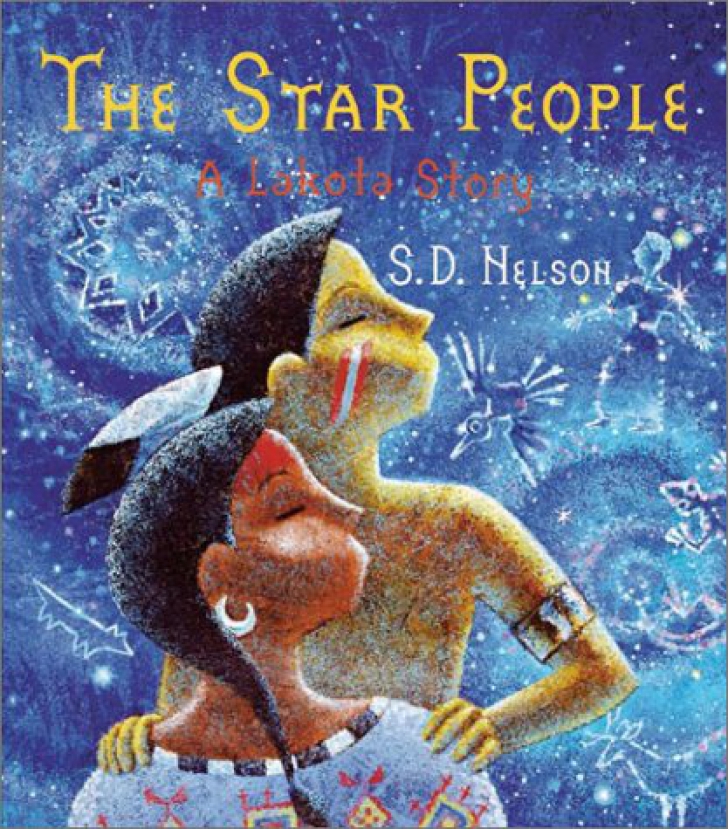
S.D. Nelson's "The Star People." Get your copy of this beautifully illustrated book.
An Experience Of Traditional Storytelling
Star Stories Told In The Days Of Winter 
By Dakota Wind
FORT YATES, N.D. - The Lakota people call the month of February Čhaŋnápĥopa Wi (The Moon of Popping Trees) or Thiyŏĥeyunka Wi (The Moon of Frost in The Lodge). These are names to articulate the coldest months of Waniyetu (Winter) when Makĥoče (Grandmother Earth) was at rest.

The needle dropped below zero and the only news the wind carried was that more cold was on the way. Over a hundred people gathered together over the course of two evenings at Sitting Bull College in Fort Yates, ND in the heart of winter, to hear a Lakota visitor, an elder from South Dakota, share the Lakota Creation Story and Lakota Star Knowledge.

The room was filled with the murmur of raucous laughter, playful teasing and the cries of hungry babies when an assuming man entered the room and quietly prepared at a table near the front of the room. His name, Rick Two Dogs.

Two Dogs, an Oglala Lakota from the Pine Ridge Sioux Indian Reservation, began the first evening with a little exposition that the stories he was going to share were told in the lodges around the campfire long ago. These were the kind of stories that were shared by the Lala and Uŋči (Grandfathers and Grandmothers) and one can feel the weight of centuries and tradition echo in Two Dogs’ tranquil voice when he began the evening with a prayer of Whŏpila, Thanksgiving.

The attention and quiet in the room which followed was like the crack of a whip, sudden and sharp, and even the youngest of children quickly stood in quiet respect when prayer was invoked.

When the prayer concluded, a traditional horseman named Jon reiterated to the mass what many already know, that elders eat first, then visitors before the rest. Young women dashed off to the front of the line to prepare bowls of bapa soup, a traditional soup made with corn and jerked meat, wŏžapi, a type of pudding traditionally made with chokecherries but for these two evenings is made with blueberries, fresh fried bread and steaming black coffee for the elders. Everyone else formed a line and the jocular murmur of laughter and teasing among friends returned.

When hunger was satiated and thirst was slaked, Jon introduced Two Dogs in Lakota and English. Two Dogs isn’t just unassuming, he’s self-deprecating, and is quick to attribute or credit others for the stories he shared, his Lala especially, who witnessed the Battle of Little Bighorn when he was ten years old.

Two Dogs recalled his Lala fondly. He took his meals seated on the floor, speared his food with his knife and refused the aid of a fork. He would look askance at anyone who offered him a napkin, and wiped his hands on his braids. During the long winter nights, his Lala put a few sprigs of cedar on the wood-burning stove, the kerosene lamps were doused, and firelight lit the home.

When Two Dogs opened the floor to field questions, one man asked, “Why are these stories told only in the winter?” Two Dogs replied that he once asked the Lakota scholar Albert White Hat the same thing and was told that if the stories were told out of season, one would get a hairy butt crack, but quickly reminded the crowd too, that the stories were shared when the world was at rest.

The following night, Two Dogs and his wife asked everyone to imagine the room as though it were one great lodge with one entrance. They divided the room between the sexes with men on the left half of the lodge and the women on the right. Between the men and women they explained was a path, a path of wisdom. The men sat in descending order from eldest to youngest going left from the path, just as the women sat in descending age from eldest to youngest, only they sat in order right from the path. It was an exercise in tradition and order.

Two Dogs’ stories are the traditional stories of the people, and should best be listened to in person, on a cold winter night, after supper, in the natural dark.

Haŋhépi čhaŋečela héčhuŋpi (This was done only at night).

Waniyetu čhaŋečela héčhuŋpi (This was done only in the winter).

Tuesday, November 29, 2011

Crazy Horse's Last Year

Ambrose does a wonderful comparative analysis of Crazy Horse and General Custer. Two historical figures, both legends in American history. Get yourself a copy of this book.
Crazy Horse's Last Year
Life After The Battle Of The Little Bighorn

By Dakota Wind
FORT ROBINSON, N.E. - Ambrose was one of the greatest American historians, always able to relate the past to the contemporary reader – in his book, he draws parallels between two of the most remembered figures of the Battle of the Little Bighorn. Marshall takes a measure of primary source documents, generally Anglo accounts, and weighs it against oral traditions of Crazy Horse as the Lakota knew him. Bray’s book, while beautifully rendered and polished, is more of a perspective narrative on Lakota society than it is about Crazy Horse, though Crazy Horse is touched on.

A great companion to Ambrose's Crazy Horse and Custer is Joseph Marshall's The Journey of Crazy Horse. If any book about Crazy Horse should grace your library its this one. 

In Ambrose’s book, he mentions that Crazy Horse enlisted in the US Army as an Indian Scout. Ambrose tries to put the reader in Crazy Horse’s moccasins, as it were, about how the Oglala Lakota warrior must have felt deeply conflicted. My interested was piqued, and I paid a visit to the State Historical Society of North Dakota, the State Historical Society of South Dakota, Fort Robinson, Nebraska, and Fort Laramie, Wyoming. It is my thought that if you want a stronger oral tradition about Crazy Horse, and I believe that oral tradition can be accurate, contrary to some of the reviews of Marshall’s book on Amazon, I would encourage you, reader, to pick up a copy or purchase a copy of Marshall’s book.

Written as a narrative, more novel than history text, Powers' book is a wonderful example of telling the story through as many perspectives as possible, almost bogging his book down in detail, but as complete a story as has been put together thus far on the tragic death of Crazy Horse. Check this onw out of your local library before deciding to add it to your collection.  

Thomas Powers’ The Killing of Crazy Horse is a very heavy scholarly piece of work detailing the year following the Battle of the Little Bighorn. Powers breaks down the reasons for the Indian Wars, treaties, and is written as a narrative, which “takes the reader there.”
For an account of the life of Crazy Horse, there are several books from which to choose at your local library, but I would personally recommend: The Journey of Crazy Horse: A Lakota History by Joseph Marshall III, Crazy Horse: Strange Man of the Oglalas, A Biography by Mari Sandoz, and Crazy Horse and Custer: The Parallel Lives of Two American Warriors by Stephen Ambrose.

Tasunka Witko (Crazy Horse) was a phenomenal and charismatic war leader in his time. This is the story of his last days, when life on the Northern Plains was as confusing and uncertain as it was turbulent and violent.

Sitting Bull, after the Little Bighorn conflict, pictured here.

In May, 1877, nearly a full year following the last great victory of the Great Sioux Nation against General Custer and the 7th Cavalry, many Lakota made the journey to Indian agencies across the plains. Others fled north to Canada with Sitting Bull, and nearly all the great Lakota leaders had exchanged their nomadic way of living for a sedentary lifestyle. Some were tired of running. Others tired of being hungry. Still more were weary with heartbreak of watching loved ones die. 

Crazy Horse came to the conclusion that there was no possible way for the Lakota to ever be rid of the Americans, the Sacred Black Hills were lost, and the bison were nearly gone. Author Joseph Marshall III says that the only reassurances the Lakota people had was that they would be alive when they turned themselves in to the agencies.

Camp Robinson, this is the earliest known photo of the camp where Crazy Horse's journey was brought to a sudden end.

On May 6, 1877, Crazy Horse came in to exchange one lifestyle for another for the good of his people. On a flat a few miles north of Camp Robinson, Nebraska, Crazy Horse met with Lt. William Philo Clark. Upon meeting the lieutenant, Crazy Horse extended his left hand and reportedly said to Clark, “Friend, I shake with this hand because my heart is on this side; the right hand does all manner of wickedness; I want this peace to last forever.”

While at Camp Robinson, several officers and the Indian Agent James Irwin tried to convince Crazy Horse to make a journey to Washington DC and meet the Great Father. They were nearly successful. The purpose of that journey was for Crazy Horse to meet the president and receive authorization to establish his own agency, either in Beaver Creek country (near present-day Gillette, Wyoming) or close to the Bighorn Mountains (near present-day Sheridan, Wyoming).

Red Cloud pictured here. He too enlisted as a sergeant in the US Indian Scouts.

Contenders for authority of the Oglala Lakota (Red Cloud and Spotted Tail) immediately worked to convince Crazy Horse that going to Washington was not in the best interest of his people, and were rewarded when Crazy Horse suddenly decided not to go.

Crazy Horse's enlistment as Sergeant in the Ogallala Detachment of US Indian Scouts.

In addition to being harassed by officers to go and distracters to stay, news came from the northwest that Chief Joseph and the Nez Perce were fighting and winning a running battle against Colonel Nelson Miles, and they were planning to join Sitting Bull and the Hunkpapa Lakota across the Canadian border. Lt. Clark quickly enlisted as many Oglala Lakota as possible to assist against the Nez Perce. Crazy Horse is reported to have said to Clark: “I came here for peace. No matter that if my own relatives pointed a gun at my head and ordered me to change that word I would not change it.”

Lieutenant WP Clark stands next to Little Hawk. Clark later went on to publish his Indian Sign Language, which was required reading at West Point Military Academy at one time.

Clark devoted himself to pestering Crazy Horse without ceasing or relenting and eventually wore down the Oglala Lakota warrior. Crazy Horse enlisted as Sergeant Red Cloud and Sergeant Spotted Tail had done, with the rank of sergeant and the Oglala Lakota Detachment of US Indian Scouts were formed. 

A beleaguered Crazy Horse, worn from harassing officers, distracters, and talk of the Nez Perce campaign, went to Clark and in the presence of two interpreters (Grouard and Louie Bordeaux) and reportedly said: “We came in for peace. We are tired of war and talking of war. From back when Conquering Bear was still with us we have been lied to and fooled by the whites, and here it is the same, but still we want to do what is asked of us and if the Great Father wants us to fight we will go north and fight until not a Nez Perce is left.”

The Lakota word for Nez Perce is Pohgehdoka (Poh-GAYH-doh-kah; glottal sound on the second "h"). The Lakota word for Anglos or Europeans is Wasicu (Wah-SHEE-Chu).

One of the interpreters misinterpreted Crazy Horse’s words, saying instead that Crazy Horse would fight until there were no more white people left. Rumors grew and swirled as rumors do, about Crazy Horse’s supposed intention to kill every white person.

General Crook, pictured here, became known for his part in the wars with the Apache.

On September 2, 1877, General Crook came to Camp Robinson to pick up his detachment of scouts. Crook left on September 4, 1877, exasperated with the rumblings that Crazy Horse wanted him dead or that Crazy Horse would start another war. Crazy Horse didn’t go with Crook on campaign to bring in the Nez Perce, neither did the Oglala Lakota Detachment of Indian Scouts (Crook instead picked up the Cheyenne Detachment of US Indian Scouts on route west and north), for Crazy Horse had urged the Oglala Lakota Detachment not to go.

According to the post surgeon’s report, at Camp Robinson, Crazy Horse had his fill of strawberries and cream on September 3, 1877, and was incapacitated with a sour gut which effectively removed himself from Crook’s command whether or not he wanted to go on campaign.

General Crook ordered Crazy Horse arrested, but Crazy Horse fled north to Spotted Tail Agency. Crook left on the Nez Perce campaign. On September 6, 1877, Crazy Horse was escorted back to Camp Robinson. Once there, he was taken to the Adjutant’s office where one of Red Cloud’s warriors shouted loudly enough for all to hear that Crazy Horse was supposed to have been a brave man but was now a coward. Crazy Horse lunged after the anonymous warrior but Little Big Man grabbed him by the arms and held him back.

Little Big Man was known for being crafty but also for being a trouble maker.

When they reached Colonel Bradley’s office, the colonel ordered Crazy Horse bound and taken to the guard house. What happened next is a tragedy. It is also a mess of confusion. There is the claim that a soldier killed Crazy Horse with a bayonet thrust, but years later a story by Little Big Man tells us that is was he who plunged his knife into Crazy Horse, twice. Some say they saw a hawk circling above which cried out, perhaps in honor of the mortally wounded Oglala Lakota warrior.

Crazy Horse’s last words are reported to be, “Let me go, my friends. You have hurt me enough.” The soldiers carried Crazy Horse back to the guard house, but Touch-The Clouds intervened and reportedly said, “He was a great chief. And he cannot be put into a prison,” and picked him up and carried Crazy Horse instead to Colonel Bradley’s bed where he later died.

Friday, September 9, 2011

A Visit to Fort Abraham Lincoln

A Visit to Fort Abraham Lincoln

Military History Explored At Historic Site
By Dakota Wind
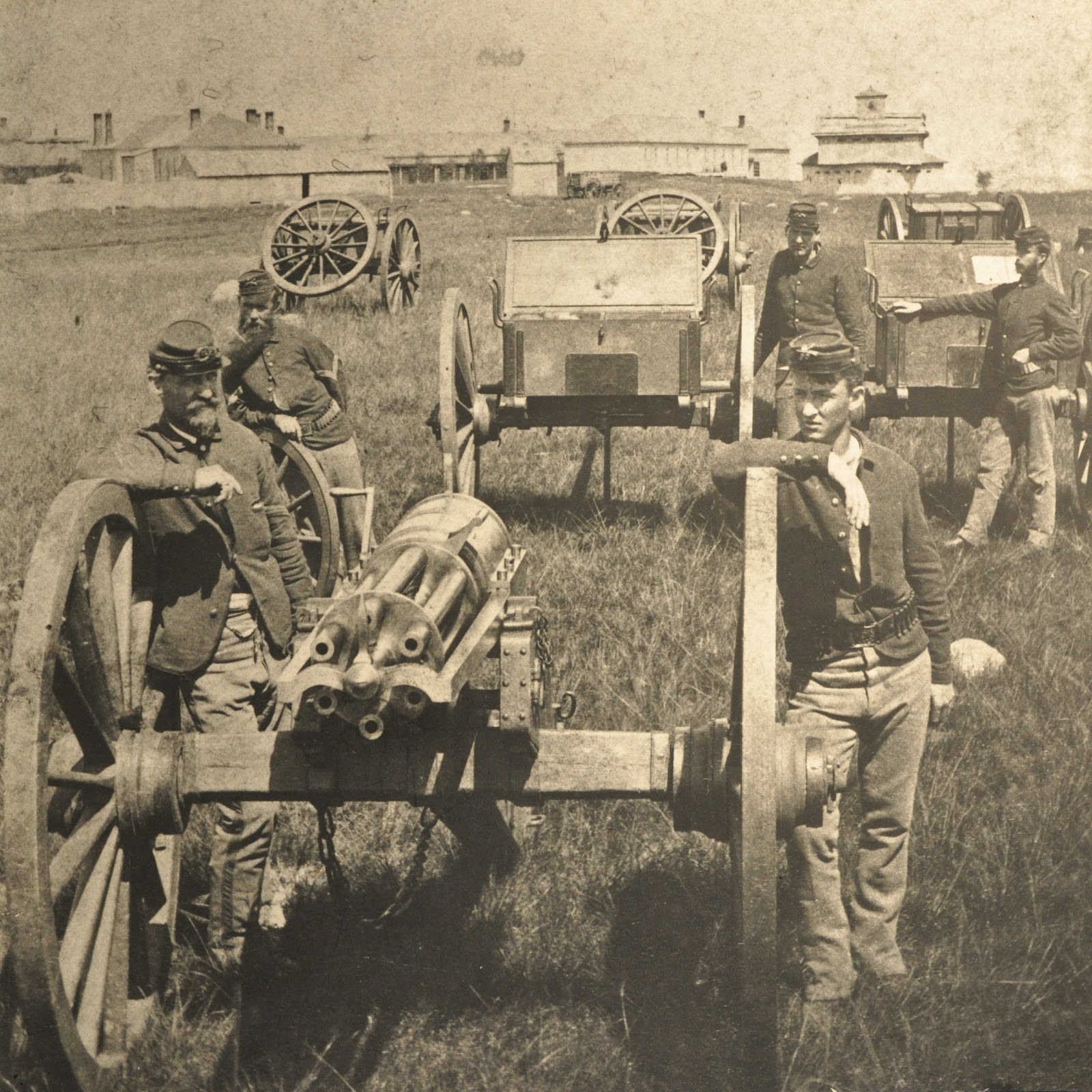
MANDAN, N.D. - Fort McKeen, infantry post, was established in June, 1872. Companies “B” and “C” of the 6th Infantry and a detachment of Arikara US Indian Scouts under the command of Lieutenant Colonel Daniel Huston were the first to occupy what one year later became Fort Abraham Lincoln.

Fort McKeen was named in the tradition of the day, that is, named in honor of someone really important in the military or politics.  This particular fort was named to commemorate Colonel H. Boyd McKeen who led the 81st Pennsylvania Volunteers.  Colonel McKeen lost his life at the Battle of Cold Harbor in the Civil War. 


Fort McKeen was established to protect the Northern Pacific Railway survey line as it went west into Yellowstone country.  The infantry discovered that the Indians had horses, and further, that the Indians didn’t have the patience to wait for soldiers on foot to catch up to them. 

Of course, long before Fort McKeen was established, and before the Mandan Indians constructed their first earthlodge below the bluff, but above the floodplain, this particular site was probably regarded with reverence.  Near the blockhouse furthest away in the first picture of this article is the remains of one earth mound from the Late Woodlands Culture. 

It is clear that this site has been continuously culturally occupied for the past two thousand years, first by the earth mound culture, then the earth lodge culture, and later by the US military. 


Near the Fort Abraham Lincoln State Park museum, is a Corps of Discovery II medallion embedded in a concrete pillar. The medallion commemorates the 200th anniversary of the Corps of Discovery, also known as the Lewis and Clark Expedition.

I’ve seen for myself, hard core “Lewis and Clarkers” stop here and at the Lewis and Clark Overlook north of the Mandan Indian village, to read passages from Lewis and Clark’s journals on the day Lewis and Clark stopped there.  It is almost like a religious pilgrimage. 


Of course, Fort Abraham Lincoln State Park, the greatest park in North Dakota, is named for the fort, and is known more for it’s association as being the home of General Custer’s last command and his trail to the Little Bighorn than for being named for President Abraham Lincoln (it was named in honor of the 16th US President about eight years after his death).

It was determined that the infantry wasn’t the right kind of soldier to protect the Northern Pacific survey line, so Congress established Fort Abraham Lincoln in March of 1873. The fort was home to six companies of the 7th Cavalry. General Custer was stationed here from 1873 to his death at the Battle of the Little Bighorn in 1876.


In 1873, General Custer led his command to the Yellowstone to provide protection to the survey crews from various Sioux attacks. 


In 1874, General Custer led his command to the Black Hills to confirm the discovery of gold. 

The meanings of building forts in the American west weren’t articulated very well to the Indians or the settlers.  For American Indians, forts were a sign of an encroaching domineering society.  Fort settlers, forts meant protection from Indians.  In hindsight, it is easy to say and agree that forts symbolized the Manifest Destiny policy of the day.  A little more difficult to see is the fact that forts didn’t provide protection to settlers at all. 

In Libby Custer’s “Boots and Saddles,” she describes the scene about an old man visiting with her husband.  The general repeatedly warned him not to “squat” on the west bank; the old man did anyway and was killed by “wild Indians.”  The Bismarck Tribune ran a story about the inaction of General Custer and the fort, settlers were angry and scared, but the fort and the soldiers there were not there to protect settlers. 


Getting back to what you’ll see at Fort Abraham Lincoln today is a reconstruction of the commanding officer’s quarters as General Custer and his wife would have known it in 1875.  My friend and former co-worker, First Sergeant Al Johnson, greets visitors here regularly each summer.


Al’s been living in 1875 since 1995. He’s the face of Fort Abraham Lincoln.

Throughout the house, you’ll see furnishings from the late 19th century to the turn of the century. Really important stuff, like things actually owned by General Custer and his beloved Libby the living history guide will point out to visitors by saying the magic words, “Take special notice of…” That is your cue to express your deepest admiration for the appointed item in the forms of “oohs” and “aahs.” An occasional feigned yawn or laborious stretch and a murmur about the general’s taste works here too.


Take special notice of the burgundy drapes. 


Take special notice of the silverware. 


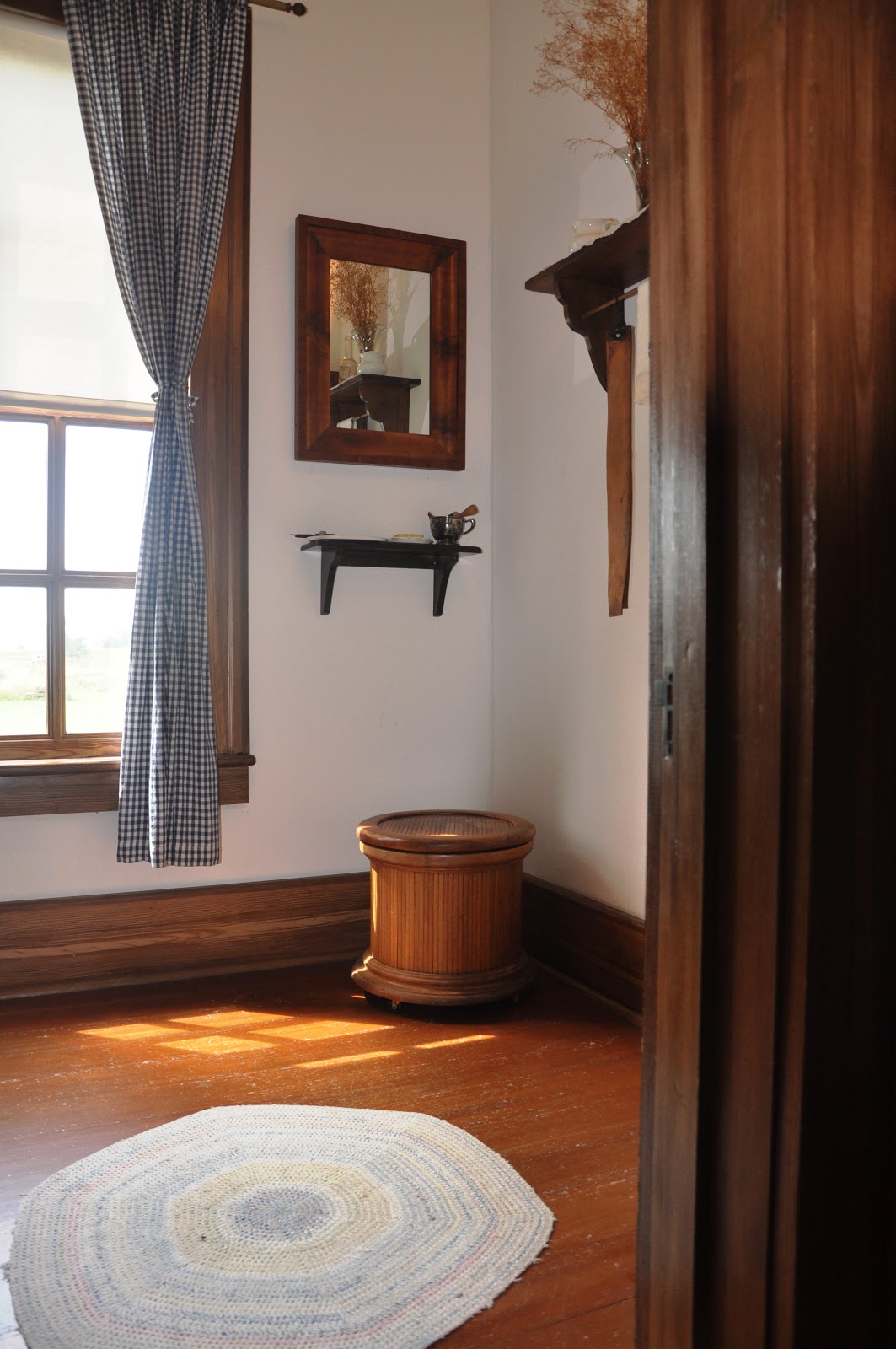
You don’t have to take special notice of this commode, but one day someone in a largish group was immediately seized with a sour gut and left a rather unpleasant gift for the next visitors to tour the house. The stench was so pungent and strong and wafted out into the hallway in waves of such sour putrescence one could but barely choke back gags with polite coughs. I share the story here only to notify you dear reader to pay a visit to the latrine and leave your presents there. 


Take special notice of the turkey platter. 


The cellar.  At one point, General Custer kept a bobcat and a porcupine he acquired on the Yellowstone Expedition down there as pets, until he donated them to the University of New York, if I recall correctly.  The brickwork is from the very first house. 


This drawer and mirror piece was part of General Custer’s and his wife’s personal belongings. 


This little marble top table goes with the drawer. 


These two chairs were once owned by General Custer.  I’m sure that they weren’t artfully arranged for people to look at but used, probably in the study. 


This campaign desk was with General Custer throughout the Civil War, his campaign against the KKK in Louisiana after the Civil War, the Indian Wars, and on the Centennial Campaign or the Little Bighorn Campaign of 1876.  One time a person on tour actually broke down and cried after hearing about the background of this desk. 


The green cloth bound book titled “Life of Daniel Webster” was given to General Custer by his good friend Lawrence Barrett, a famous Shakespearean actor in New York in the 1870s.  General Custer saw Barrett in Hamlet over a dozen times. According to Libby Custer, he watched it with as much attention and zeal as seeing it the first time every time. 


If you are so lucky and have the time, First Sergeant Johnson or other guide, can handle the book and show visitors the dedication from Barrett to Custer.  The inscription reads, “To. my dear Friend G. A. Custer – from Lawrence Barrett feb 17th 1874.” 


Libby’s rocking chair in the main bedroom. 


The only other thing that was actually owned by the Custers is the map case on display in the Commissary.  The little brass placard on the glass reads, “GA CUSTER’S MAP CASE Libby’s only memento from The Little Bighorn on loan from the trust of Stephen Ronald Cloud Jr. and Ryan John Cloud.”  A notarized document testifying the line of ownership back to General Custer has been taped on to the map case. 

Thank you to Fort Abraham Lincoln State Park, the greatest park in North Dakota, and First Sergeant Al Johnson, the face of Fort Abraham Lincoln. 

Thursday, June 30, 2011

Photo Essay: From Little Bighorn To Fort Abercrombie

Photo Essay Of Skirmish Site & Little Bighorn Battlefield
Theodore Roosevelt National Park & Ft. Abercrombie
By Dakota Wind
GREAT PLAINS - About five miles south of Fort Abraham Lincoln State Park is the original boundary of the Fort Abraham Lincoln military reservation along a little creek which converges with the Missouri River.  In the middle distance of the picture, close to where the bush and scrub line is, is that creek. The Lakota had launched a ten day siege on Fort Rice back in 1868, a smaller less-organized war party had attempted to do the same on Fort Abraham Lincoln in 1873. The field in the picture is privately owned (see image above), but the creek is property of the US Army Corps of Engineers. There is no signage to mark the skirmish, but it is right off of HWY 1806, five miles south of Fort Abraham Lincoln State Park. 


Painted Canyon (see above) lies west of Dickinson, ND on I-90, out by Theodore Roosevelt National Park. The canyon is as old as the Grand Canyon, but not nearly as large or well known. If you ever get a chance to visit North Dakota, take in a visit to this geophysical site and experience the mystery of creation. I felt a vast serenity and immense solitude on my early morning visit here. 


Another view of Painted Canyon (above). 


About fourteen miles easterly of the Little Bighorn Battlefield is "The Crow's Nest," (above) in the distance near the center of the photo. The Crow and Arikara scouts told General Custer that there were more Indians than bullets, and they also advised him to attack immediately while they had the element of surprise. The General waited for about three hours instead, much to the disgust of the scouts. 


In roughly the center of this picture (above) is where Major Reno began his engagement with the Hunkpapa Lakota (Teton).  Major Reno was an officer used to office work, and had no experience fighting Indians. General Custer divided his command into three with himself leading one third, Major Reno leading a third to make the first attack, and Captain Benteen who lead the last third - the pack train. Reno's attack was to draw the warriors south, the women and children of the Lakota and Cheyenne fled north, General Custer was to flank the encampment from the north - where the women and children were fleeing to, but the encampment was larger than he anticipated. This actually was the same strategy that General Custer employed at Washita, in Oklahoma, where he was also outnumbered.  When he captured the women and children there, the fight ended, but it ended with the deaths, a massacre, of Cheyenne women and children. But that's a tale for another day. 


Here's the timber line (above) where the Hunkpapa Lakota, led in a counter attack by Chief Gall, retaliated and pushed back Major Reno and his command.  Chief Gall, Pizi Intancan, had stepped away from his wife and children, as he did so, they were shot by the soldiers in Reno's command.  Among the first, if not the very first of Reno's command to be killed in retaliation, was Bloody Knife.  Gall, or Pizi, and Bloody Knife, known to the Lakota as "Tamina Wewe," were lifelong adversaries who grew up in the same Hunkpapa encampment. 


The Little Bighorn River, or creek if you prefer (above). Major Reno witnessed the end of Bloody Knife in a way that probably haunted him the rest of his life. Bloody Knife rode in with Reno against the Hunkpapa Lakota and was promptly shot in the head, his brains and blood spattered onto Reno's face. Reno was so rattled that he called for his men to mount and dismount three times before their retreat. Reno's and his men's retreat took them across this part of the Little Bighorn River, and up the embankment towards where I standing when I snapped this photo. 


After Reno's retreat, the entire encampment of Lakota and Cheyenne followed General Custer's command to this site, Last Stand Hill (above). General Custer failed to capture any women and children, the encampment was far larger than he thought, and tactics dictated that he ascend the highest point of battle for any advantage, however slight. He and his entire command were killed to the man. The warriors took the hill using three tactics at once: some warriors rode around the hill and me (as seen in many movies), some rode directly through the soldiers to count coup or take them out, yet others shot their arrows up and over the circle of riding warriors and into the soldiers on the hill - according to Wooden Leg, a Northern Cheyenne, it literally rained arrows, and the dust kicked up by the horses turned day to night. 


During and after the fight at Last Stand Hill, some Lakota continued to harass Reno and his command. A Lakota sharpshooter took shelter from the top of this hill (above) and proceeded to pick off soldiers who were trying to dig a shelter and assemble a makeshift field hospital. The Lakota Akicita nearly took out a line of soldiers before being shot himself. 


Here are the Bighorn Mountains to the south and west of Little Bighorn Battlefield (above). The Lakota and Cheyenne encampment broke the day after the Battle of the Greasy Grass and moved across this plain below. To the Crow and survivors who witnessed the camp break, the movement was awe inspiring. Nothing has been seen like that since. 


Captain Weir came a day after the camp breakup and took a survey of the battlefield from this point, today called Weir Point (above). I took this picture looking south to the Reno-Benteen site. 


From the same spot, I simply turned northerly to face the Last Stand Hill (above), which I tried to center in this photo. I have a higher resolution of this image, but I couldn't post it here - too big. 


On the drive north from Weir Point to Last Stand Hill I encountered some ponies on the privately owned part of the battlefield (above). The Real Bird family on the Crow Indian Reservation put on a reenactment of the battle each year on their land on the battlefield. I've only seen parts of it, but I'm sure that some day I'll catch the whole thing. My reenactor friend, Mr. Stephen Alexander (the world's foremost Custer living historian), has invited me to participate in killing Custer (him) one day and then dying beside him the next. As a native, I'm part of a very select few who could do this. I might take him up on killing him one day, figuratively speaking of course. 


The horses are acclimated to the heavy traffic from visitors to the battlefield. I got within five feet of this recently born foal (above). The mare "whuffed" at me and stepped over to me and brought her head to my outstretched hand. 


About a hundred paces north of the 7th Cavalry monument is the American Indian monument (above). It lists the tribes and bands who fought to defend their way of life at the battle. The tribes who participated in the battle are the Lakota, Cheyenne, Arapaho, Crow, Arikara, and Blackfeet. 


Here's a close up of the metal sculpture (above), a beautiful open representation of Northern Plains Indian pictography. I learned that the Cheyenne have a different name for the battle. They refer to it as "The Battle where the girl rescued her brother." According to one an oral tradition, a boy or young man was unhorsed at the battle. The girl, or young woman, jumped onto a horse and raced into the fight to get him, and she did. 


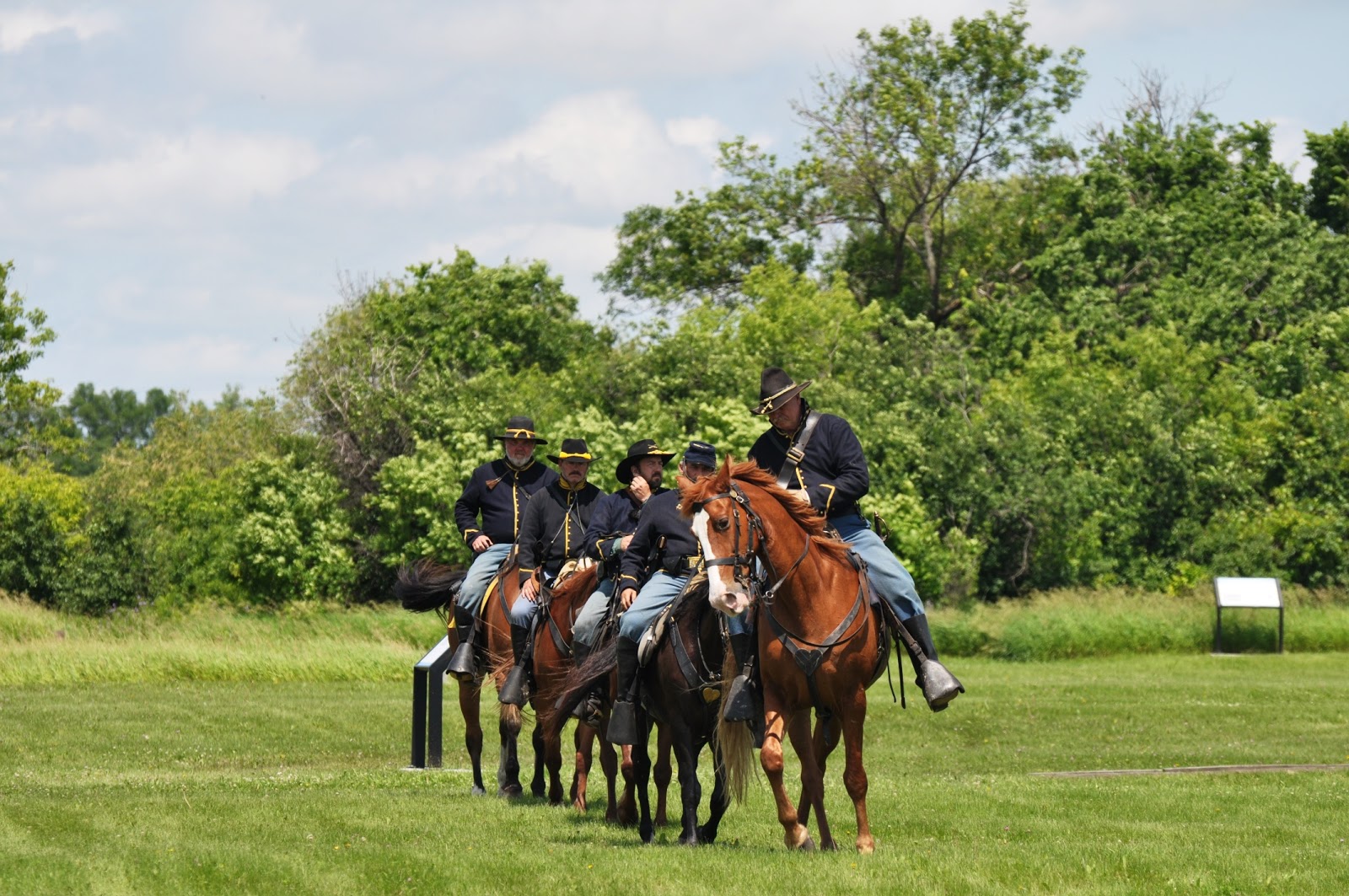
A few days later, I was at Fort Abercrombie south of Fargo, ND about twenty miles, on the day of the 135th anniversary of the Battle of the Little Bighorn (above). After the battle, Co. F of the 7th Cavalry, was brought to Fort Abercrombie. A group of reenactors of the 7th Cavalry were there. 


This group of the 7th Cavalry were conducting some drills on horseback (above).


One of the reenactors liked my presentation and my stuff, so he snapped this pic of me with my wintercount (above). I was in one of the blockhouses at the fort, Fort Abercrombie. Two of the 7th Cavalry reenactors were native, one an enrolled Cherokee and the other an enrolled Choctaw, both from Missouri. They really liked my combination of native regalia and cavalry, and invited me to participate in next year's civil war reenactment someplace in Missouri where natives fought for the Union and the Confederate States of America. I'd like to go, but I think that I'll wear the blue.


South of Mandan, ND about thirty miles on HWY 1806, is this interesting geophysical feature (above). It has at least four names I've heard, but my favorite is "Rain In The Face Butte." I took a long-time friend of mine down to Cannonball once and on our way I pointed this out on our drive. I told him that the Indians believe that this face looks up into the heavens to the face thats on Mars. I was so serious about it, and his reaction was a mix of confusion and wonder, that I waited a minute to tell him I was pulling his leg. The butte does resemble the profile of a person looking up though, and probably not to Mars.