Showing posts with label Red Cloud. Show all posts

Tuesday, April 11, 2017

A Review, Red Cloud, A Lakota Story of War and Surrender

A Review, Red Cloud 
A Story Of War And Surrender
By Dakota Wind
Bismarck, ND (TFS) – “I was born a Lakota and I have lived as a Lakota and I shall die a Lakota,” said Red Cloud. So opens S.D. Nelson’s Red Cloud: A Lakota Story of War and Surrender, a first-person narrative of the Lakȟóta leader Maȟpíya Lúta, Red Cloud, and the history of his people before his birth, through his life, and death in the confines of the Pine Ridge Indian Reservation in what became South Dakota.

Similar to Nelson’s Sitting Bull: Lakota Warrior and Defender of His People, Nelson tells this story by rendering a beautifully and fully realized world in the historic Plains Indian style of art reproduced here as though on a ledger book.

Red Cloud’s story breaks down the complexity of inter-tribal conflict, and the great struggle for resources and tribal sovereignty on Makȟóčhe Wašté, the Beautiful Country (Great Plains; North America). The two Fort Laramie Treaties are touched on, an agreement between nations, and how both were broken by the United States.

Red Cloud’s War is retold with this new pictography, and first-person narrative. The evolution of Plains Indian warfare grows from personal conflict and honor to organized military strategy. Red Cloud’s War is one of the wars the United States lost, a concession of the war was that the Lakȟóta shut down the Bozeman Trail and retain control of Powder River Country, but this was short-lived.

The decision for Red Cloud to sign the 1868 Fort Laramie must have caused a great internal struggle for the Lakȟóta leader and the people who followed him. The first-person narrative captures this struggle, “For the sake of my own people, those who followed, me, I accepted and signed the new treaty papers. But of course I did not represent the desire of all the people. Opinions were divided.”

The story of Red Cloud is taken up to his death, followed by a reflection on the journey of his people. Red Cloud’s story isn’t finished because his life came to an end, his story continues because his people continue.

There are books that deserve to be taken apart, but Nelson’s book literally deserves to be taken apart if only to frame the pages. Such pages are 4 (men astride their horses in water), 16 (meeting at Fort Laramie in 1851), pages 20 & 21 (the pipe dance), pages 29 & 29 (Red Cloud’s challenge of the Bozeman Trail), page 33 (a war party), and page 49 (the post-death reflection).

S.D. Nelson is a member of the Standing Rock Sioux Tribe. His traditional name is Maȟpíya Kiŋyáŋ (Flying Cloud) He is an award-winning author and illustrator of numerous children’s books. His books have received many accolades, including the American Indian Library Association’s Youth Literature Award, a place on the Texas Bluebonnet Award Master List, and the Western Writers of America Spur Award. Nelson lives in Flagstaff, AZ. Follow him online at sdnelson.net.

Nelson, S.D. Red Cloud: A Lakota Story of War and Surrender. First ed. New York, NY: Abrams Books For Young Readers, 2017. 64 pp. $19.95. Hardcover. Photos, illustrations, timeline, notes, bibliography, index.


Dakota Wind is an enrolled member of the Standing Rock Sioux Tribe. He is currently a university student working on a degree in History with a focus on American Indian and Western History. He maintains the history website The First Scout.

North Dakota Content Standards
Grades 4 and 8
Resources: 4.1.4; 8.1.2
Timeline: 4.1.5
Concepts of time: 4.2.2, 4.2.3, 4.2.4
People and events: 4.2.5
Colonization: 4.2.9
Expansion: 4.2.10
Physical geography: 4.5.3; 8.5.1
Human geography: 4.5.5, 4.5.6; 8.5.2, 8.5.3
Culture: 4.6.1, 4.6.2; 8.6.2
US History & Imperialism: 8.2.4, 8.2.9, 8.2.10, 8.2.11


Friday, October 5, 2012

Ely Parker: Seneca Chieftan, American General

Parker wears his grandfather Red Jacket's medal. President George Washington gave the silver medal to Red Jacket in 1792.Seneca Chieftain, American General
Drafter Of Civil War Surrender Terms
By Dakota Wind
Note: The following article originally appeared in the North Dakota Humanities Council's publication On Second Thought, the Civil War issue. Reuben Fast Horse wrote the original draft, this author edited and expanded upon it. The story of Parker is an amazing one, and shows how far up the chain of command the efforts of Indians who fought for the Union during the Civil War.


Ha-sa-no-an-da (Leading Name) came into this world in 1828 on the Tonawanda Seneca Indian Reservation in upstate New York. He was the sixth child of seven, born to Jo-no-es-sto-wa (Dragonfly) a.k.a. William Parker and Ga-ont-gwut-twus or Ji-gon-sa-seh (Lynx) a.k.a. Elizabeth Parker. Both Dragonfly and Lynx walked with one foot in the Seneca nation and the other in the United States. They immersed their children in the language and heritage of the Seneca Nation and the Iroquois Confederacy. Dragonfly was also a Baptist minister who baptized all his children and gave them Christian names.

When Lynx was pregnant with her son Leading Name, she received a vision about the future of her baby: A son will be born to you who will be distinguished among his nation as a peacemaker; he will become a white man as well as an Indian, with great learning; he will be a warrior for the palefaces; he will be a wise white man, but will never desert his Indian people or 'lay down his horns as a great Iroquois chief'; his name will reach from the East to the West–the North to the South, as great among his Indian family and the palefaces. His sun will rise on Indian land and set on the white man's land. Yet the land of his ancestors will fold him in death. When Dragonfly baptized Leading Name at Ely Stone’s Baptist church, he gave his son the name “Ely Parker.”


The Grand River Valley as it could have been in 1781. Painting by Michael Swanson. The original is at Laurier’s Carnegie Hall, Brantford, Ontario, Canada. Learn more about this image and the War of 1812.

Parker was educated at Elder Ely Stone’s Baptist School early on in life and was later sent to an Iroquois settlement along the Grand River in Ontario to learn traditional hunting and fishing when he was ten years old. When Ely turned thirteen, he became extremely homesick and left for home in New York. On the road from London to Hamilton in Ontario, some British officers ridiculed him for is his poor speech. Parker could understand what they said but was unable to comprehend the humor at his expense. Parker came away from the experience determined to master English.

Parker’s parents approved of his initiative to learn the English language and sent him to back to the mission school. His studies excelled and he earned a tuition waiver to attend the Yates Academy in Orleans County, NY. At the academy he also studied Greek and Latin, which he also mastered. Parker became so well versed in the studies and proficient in English at the age of fourteen that his people selected him to serve as their interpreter in their exchange with President John Tyler.

Here's a map of where the Tonawanda River (Creek) converges with the Niagara River in New York. The Long House on the map shows viewers where the Tonawanda used to live, which is the city of Tonawanda today.

As a teenager, when young people begin to develop and explore their interests, Parker became heavily involved in drafting and interpreting in their correspondence with the Ogden Land Company. The land company struck a private deal with the Seneca at Cattaraugus and the Seneca at Allegheny. Quaker missionaries advised these other two Seneca bands to sign over the lands of the Seneca at Buffalo Creek and Tonawanda. From 1842 to 1845, the land of the Tonawanda was seized and settled.

Parker finished his studies at Yates Academy and enrolled at the Cayuga Academy in Aurora where he faced some hostility from classmates, though generally he was treated well. In 1846, the Seneca at Tonawanda called him back to defend with words on paper the right for the Seneca to stay at Tonawanda. He was eighteen years old when the Tonawanda Seneca took him with them to appeal their case with President James Polk.

President James K. Polk, whom Parker met when he worked on the Seneca's appeal.

The Tonawanda Seneca appeal took five years to fight, and in the end, Parker was credited with saving 3/5ths of the Tonawanda reservation from the Ogden Land Company and was given fifty acres of land for his personal use.

Parker’s academic pursuits received a boost in motivation when he visited Washington DC in 1847 when he viewed a series of paintings of explorers, traders, and settlers in their meetings with the natives such as the Pilgrims receiving food from the Indians, Captain Smith and Pocahontas, and Daniel Boon fighting Indians. When he went to church, he was asked to remove himself to the seating above.

Harvard, an engraving by Paul Revere. While the institution of the 1800s repeatedly turned down Parker's application, its a different story today. Today, Harvard has "The Harvard Project on American Indian Economic Developing." Check them out, they focus on why sovereignty matters: http://hpaied.org/

The slights he received and Parker’s own reflections about the injustices of all Indian peoples moved him to become a lawyer. He applied to Harvard, but received no word on his application. Parker applied for a clerkship in Washington DC, but no position opened up for him. Parker applied to take the bar exam in New York, but was denied when he was told he was not a US citizen.

Parker had made become friends with Lewis Morgan who tapped his network to get Parker a job as an engineer on the Genesee Valley Canal project. As he gained work experience as an engineer, he learned to country dance from a fellow’s wife. By 1850, Parker’s contacts, unparalleled work ethic, knowledge of the land and engineering landed him a job in Rochester as a civil engineer on the New York canals.

Lewis Henry Morgan, the father of modern anthropology.

Parker’s friendship with Morgan grew out of Morgan’s keen interest in documenting the changing or disappearing cultural traditions of the Seneca. They worked together and produced Morgan’s League of the Ho-de-no-sau-nee, or Iroquois which was published in 1851. Morgan’s research and methodology has led many to regard him as the father of American anthropology. Morgan’s book was dedicated to Parker.

Parker’s work with Morgan and legal fight with the Federal court system on behalf of the Seneca came to a head in September, 1851. The council of the Six Nations (Mohawk, Oneida, Onondaga, Cayuga, Seneca, and Tuscarora) met and called on Parker to return, where they installed him as one of the fifty sachems of the Iroquois Confederacy. Parker was then selected as the Grand Sachem of the Six Nations. The new sachem was also given a new name: Do-ne-ho-ga-wa, “Open Door.” The sachem who traditionally carried this name was also the Keeper of the Western Door, the one whom all approaches by other tribes were made. Parker was twenty-three.

Fort Gratiot Lighthouse on Lake Michigan.

Parker applied for a position with the US Treasury Department in hopes of getting an assignment in Chicago, IL, but when he was brought on, he was appointed to work on lighthouses on the Great Lakes in Michigan. His work on lighthouses on the lakes eventually brought him from Detroit, MI to work on a public buildingsl in Galena, IL. There in Galena Parker became friends with Capt. Ulysses Grant.

Politics in Illinois took a turn for the worse for Parker. The locals called him a stranger and resented his assignment there without their consultation. Petitions called for his removal, but his support from congressmen on the east coast and his engineering associates in the canals overwhelmingly supported his work assignment in Illinois. Parker resigned after the construction of the Galena custom house was complete.

The Galena Custom House and Post Office, Galena, Illinois. The building is still there.

Throughout Parker’s engineering career, tensions between the North and the South escalated into impending war. At an appearance in Dubuque, IA Parker was called on to speak about the state of the country. He rendered a short speech about the founding of the country and the beliefs of the founding fathers then Parker reached into his pocket and removed a medal for all to see. The medal was gift to his great-grandfather Red Jacket from President George Washington. Parker’s speech and the medal “awakened the spark of patriotism” of everyone present.

Parker returned to Tonawanda and raised crops while he made every effort to enlist with the Union army. He sought commissions as an engineer, but was repeatedly declined because he was an Indian and not a US citizen despite the dire need for engineers. Several of his tribesmen found ways to enter the service, but Parker wanted a commission because of his education and experience. Parker waited two years.

Brig. Gen. John E. Smith, pictured above, was a Swiss immigrant. His father served under Napoleon Bonaparte. The Smith family moved to the US after Bonaparte's fall.

Brig. Gen. John E. Smith, a friend of Parker’s in Galena, knew of Parker’s desire to enlist as an officer. Smith got an endorsement from General Grant, another of Parker’s friends, and was commissioned as Grant’s staff as Assistant Adjutant General of Volunteers with the rank of Captain. The Seneca honored Parker’s commission with a feast and blessing before he went off to serve in the war.

The Battle of orchard Knob, by Kurz and Allison, 1888.

Parker was barely under Grant’s command a few days when he took ill and nearly died, but he recovered after to accompany Grant on the Chattanooga Campaign at the Battle of Orchard Knob and Lookout Mountain. When Grant was promoted to Lieutenant General and went east to Washington, Parker went with him.

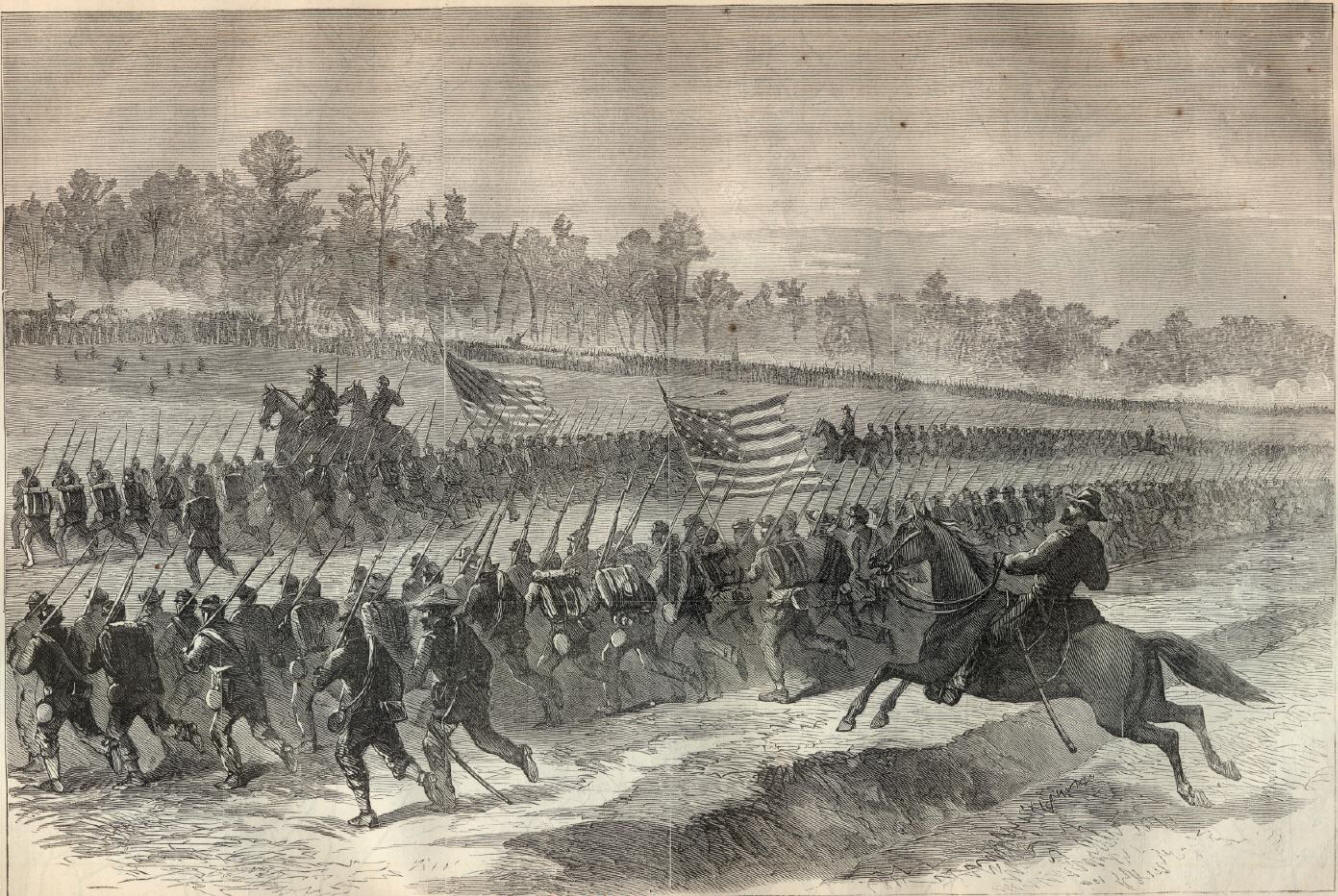
The Battle of The Wilderness. This image appeared in Harper's Weekly, May 28, 1864. Union soldiers are depicted here charging against Confederate forces.

In General Grant’s move to cross the Rapidan River in Virginia, which precipitated the Battle of the Wilderness, 1864, Parker saved Grant from capture. On May 7, 1864, Grant was heading toward Confederate General Roger Pryor’s line. Parker sensed a trap and led Grant’s command away from Pryor’s line.

Grant used Parker’s engineering skill to plan and dig entrenchments and post batteries. On one occasion a Southern woman refused to vacate her home and told Parker that her husband was in command of nearby Confederate forces, and that he’d never fire on their house. Parker told the woman she could stay and he quickly ordered the line behind her house.

General Grant and his staff of fourteen. Parker is featured in this image, fourth from the right, seated.

In September, 1864, Grant promoted Parker to Lieutenant Colonel and served as Grant’s personal secretary the remainder of the war. After the war, Parker continued to serve General Grant as his personal secretary, retiring in 1869 as Brevet Brigadier General.

One of the most famous and beautiful paintings of Lee's surrender is this Tom Lovell image called "The Surrender at Appomattox," 1987. It currently hangs at Appomattox Court House National Historic Park, Virginia. Lovell even included General Custer, far right, next to Parker.

On April 7, 1865, General Grant was closing in General Lee’s command. Grant began a correspondence with Lee through Parker’s hand and on April 9, Lee met with Grant at the village of Appomattox Court House to discuss the terms of surrender with Grant who took Parker with him.

This image of the Surrender at Appomattox is by Keith Rocco. Parker stands behind Lee at the surrender desk. General Phil Sheridan purchased the table and gave it to General Custer. It is now at the Smithsonian in Washington, DC.

Grant’s staff met with Lee’s staff in the parlor of William McLean’s house where both staffs were formally introduced to one another. Lee was said to be courteous and cool, offering no further remark to Grant’s staff other than a salutation. When Parker was introduced to Lee, Lee paused for several seconds, startled, then extended his hand to Parker and said, “I am glad to see one American here.” Parker took Lee’s hand and replied, “We are all Americans.” Grant then had Parker compose the surrender papers, which Lee signed.

Parker as the Commissioner of the Bureau of Indian Affairs. Parker was President Grant's architect in the new Peace Policy in relation to the Indians in the west. While Parker was the commissioner, and probably because of his friendship with Grant, military actions against Indians were reduced.

After the war Grant appointed Parker as Commissioner of Indian Affairs. He was the first American Indian to hold this post and resigned from this position in 1871. Parker's initial optimism of reshaping the BIA, one of the most corrupt branches of federal government (and some say it still is), led to a tremendous pressure on him to resign. Parker was faced with false charges of fraud that wouldn't go away.

Mahpiya Luta, Red Cloud.
While Parker was the BIA Commissioner, he initiated contact with the Lakota chief Red Cloud and Spotted Tail to meet President Grant in an effort to bring an end to the conflicts out west, but it was a peace that lasted until the confirmation of gold in the Black Hills.

Although Parker was recognized more for drafting the terms of Surrender at Appomattox, his accomplishments in his life let us know that he was a formidable man, despite his difficulties and heritage he set out to achieve whatever he put his mind to.

Often we hear or read about heroic figures in our past yet we don’t always hear about the person themselves. Who they were, what they were like, why they did what they did, and what remains are the facts left for us to decipher about a person. Parker signifies the change we all have to make at some point in our lives to accept, to adapt, and to overcome not just our obstacles or enemies but ourselves. This is what America is, and to be American is to honor the sacrifices of those who gave and believed in what they so desperately lived, bleed and died for.

Tuesday, November 29, 2011

Crazy Horse's Last Year

Ambrose does a wonderful comparative analysis of Crazy Horse and General Custer. Two historical figures, both legends in American history. Get yourself a copy of this book.
Crazy Horse's Last Year
Life After The Battle Of The Little Bighorn

By Dakota Wind
FORT ROBINSON, N.E. - Ambrose was one of the greatest American historians, always able to relate the past to the contemporary reader – in his book, he draws parallels between two of the most remembered figures of the Battle of the Little Bighorn. Marshall takes a measure of primary source documents, generally Anglo accounts, and weighs it against oral traditions of Crazy Horse as the Lakota knew him. Bray’s book, while beautifully rendered and polished, is more of a perspective narrative on Lakota society than it is about Crazy Horse, though Crazy Horse is touched on.

A great companion to Ambrose's Crazy Horse and Custer is Joseph Marshall's The Journey of Crazy Horse. If any book about Crazy Horse should grace your library its this one. 

In Ambrose’s book, he mentions that Crazy Horse enlisted in the US Army as an Indian Scout. Ambrose tries to put the reader in Crazy Horse’s moccasins, as it were, about how the Oglala Lakota warrior must have felt deeply conflicted. My interested was piqued, and I paid a visit to the State Historical Society of North Dakota, the State Historical Society of South Dakota, Fort Robinson, Nebraska, and Fort Laramie, Wyoming. It is my thought that if you want a stronger oral tradition about Crazy Horse, and I believe that oral tradition can be accurate, contrary to some of the reviews of Marshall’s book on Amazon, I would encourage you, reader, to pick up a copy or purchase a copy of Marshall’s book.

Written as a narrative, more novel than history text, Powers' book is a wonderful example of telling the story through as many perspectives as possible, almost bogging his book down in detail, but as complete a story as has been put together thus far on the tragic death of Crazy Horse. Check this onw out of your local library before deciding to add it to your collection.  

Thomas Powers’ The Killing of Crazy Horse is a very heavy scholarly piece of work detailing the year following the Battle of the Little Bighorn. Powers breaks down the reasons for the Indian Wars, treaties, and is written as a narrative, which “takes the reader there.”
For an account of the life of Crazy Horse, there are several books from which to choose at your local library, but I would personally recommend: The Journey of Crazy Horse: A Lakota History by Joseph Marshall III, Crazy Horse: Strange Man of the Oglalas, A Biography by Mari Sandoz, and Crazy Horse and Custer: The Parallel Lives of Two American Warriors by Stephen Ambrose.

Tasunka Witko (Crazy Horse) was a phenomenal and charismatic war leader in his time. This is the story of his last days, when life on the Northern Plains was as confusing and uncertain as it was turbulent and violent.

Sitting Bull, after the Little Bighorn conflict, pictured here.

In May, 1877, nearly a full year following the last great victory of the Great Sioux Nation against General Custer and the 7th Cavalry, many Lakota made the journey to Indian agencies across the plains. Others fled north to Canada with Sitting Bull, and nearly all the great Lakota leaders had exchanged their nomadic way of living for a sedentary lifestyle. Some were tired of running. Others tired of being hungry. Still more were weary with heartbreak of watching loved ones die. 

Crazy Horse came to the conclusion that there was no possible way for the Lakota to ever be rid of the Americans, the Sacred Black Hills were lost, and the bison were nearly gone. Author Joseph Marshall III says that the only reassurances the Lakota people had was that they would be alive when they turned themselves in to the agencies.

Camp Robinson, this is the earliest known photo of the camp where Crazy Horse's journey was brought to a sudden end.

On May 6, 1877, Crazy Horse came in to exchange one lifestyle for another for the good of his people. On a flat a few miles north of Camp Robinson, Nebraska, Crazy Horse met with Lt. William Philo Clark. Upon meeting the lieutenant, Crazy Horse extended his left hand and reportedly said to Clark, “Friend, I shake with this hand because my heart is on this side; the right hand does all manner of wickedness; I want this peace to last forever.”

While at Camp Robinson, several officers and the Indian Agent James Irwin tried to convince Crazy Horse to make a journey to Washington DC and meet the Great Father. They were nearly successful. The purpose of that journey was for Crazy Horse to meet the president and receive authorization to establish his own agency, either in Beaver Creek country (near present-day Gillette, Wyoming) or close to the Bighorn Mountains (near present-day Sheridan, Wyoming).

Red Cloud pictured here. He too enlisted as a sergeant in the US Indian Scouts.

Contenders for authority of the Oglala Lakota (Red Cloud and Spotted Tail) immediately worked to convince Crazy Horse that going to Washington was not in the best interest of his people, and were rewarded when Crazy Horse suddenly decided not to go.

Crazy Horse's enlistment as Sergeant in the Ogallala Detachment of US Indian Scouts.

In addition to being harassed by officers to go and distracters to stay, news came from the northwest that Chief Joseph and the Nez Perce were fighting and winning a running battle against Colonel Nelson Miles, and they were planning to join Sitting Bull and the Hunkpapa Lakota across the Canadian border. Lt. Clark quickly enlisted as many Oglala Lakota as possible to assist against the Nez Perce. Crazy Horse is reported to have said to Clark: “I came here for peace. No matter that if my own relatives pointed a gun at my head and ordered me to change that word I would not change it.”

Lieutenant WP Clark stands next to Little Hawk. Clark later went on to publish his Indian Sign Language, which was required reading at West Point Military Academy at one time.

Clark devoted himself to pestering Crazy Horse without ceasing or relenting and eventually wore down the Oglala Lakota warrior. Crazy Horse enlisted as Sergeant Red Cloud and Sergeant Spotted Tail had done, with the rank of sergeant and the Oglala Lakota Detachment of US Indian Scouts were formed. 

A beleaguered Crazy Horse, worn from harassing officers, distracters, and talk of the Nez Perce campaign, went to Clark and in the presence of two interpreters (Grouard and Louie Bordeaux) and reportedly said: “We came in for peace. We are tired of war and talking of war. From back when Conquering Bear was still with us we have been lied to and fooled by the whites, and here it is the same, but still we want to do what is asked of us and if the Great Father wants us to fight we will go north and fight until not a Nez Perce is left.”

The Lakota word for Nez Perce is Pohgehdoka (Poh-GAYH-doh-kah; glottal sound on the second "h"). The Lakota word for Anglos or Europeans is Wasicu (Wah-SHEE-Chu).

One of the interpreters misinterpreted Crazy Horse’s words, saying instead that Crazy Horse would fight until there were no more white people left. Rumors grew and swirled as rumors do, about Crazy Horse’s supposed intention to kill every white person.

General Crook, pictured here, became known for his part in the wars with the Apache.

On September 2, 1877, General Crook came to Camp Robinson to pick up his detachment of scouts. Crook left on September 4, 1877, exasperated with the rumblings that Crazy Horse wanted him dead or that Crazy Horse would start another war. Crazy Horse didn’t go with Crook on campaign to bring in the Nez Perce, neither did the Oglala Lakota Detachment of Indian Scouts (Crook instead picked up the Cheyenne Detachment of US Indian Scouts on route west and north), for Crazy Horse had urged the Oglala Lakota Detachment not to go.

According to the post surgeon’s report, at Camp Robinson, Crazy Horse had his fill of strawberries and cream on September 3, 1877, and was incapacitated with a sour gut which effectively removed himself from Crook’s command whether or not he wanted to go on campaign.

General Crook ordered Crazy Horse arrested, but Crazy Horse fled north to Spotted Tail Agency. Crook left on the Nez Perce campaign. On September 6, 1877, Crazy Horse was escorted back to Camp Robinson. Once there, he was taken to the Adjutant’s office where one of Red Cloud’s warriors shouted loudly enough for all to hear that Crazy Horse was supposed to have been a brave man but was now a coward. Crazy Horse lunged after the anonymous warrior but Little Big Man grabbed him by the arms and held him back.

Little Big Man was known for being crafty but also for being a trouble maker.

When they reached Colonel Bradley’s office, the colonel ordered Crazy Horse bound and taken to the guard house. What happened next is a tragedy. It is also a mess of confusion. There is the claim that a soldier killed Crazy Horse with a bayonet thrust, but years later a story by Little Big Man tells us that is was he who plunged his knife into Crazy Horse, twice. Some say they saw a hawk circling above which cried out, perhaps in honor of the mortally wounded Oglala Lakota warrior.

Crazy Horse’s last words are reported to be, “Let me go, my friends. You have hurt me enough.” The soldiers carried Crazy Horse back to the guard house, but Touch-The Clouds intervened and reportedly said, “He was a great chief. And he cannot be put into a prison,” and picked him up and carried Crazy Horse instead to Colonel Bradley’s bed where he later died.

Friday, June 3, 2011

War Correspondence from the Front Lines: The Black Hills

This beautiful book has the entire Black Hills Expedition of 1874 faithfully mapped and is profusely illuminated with images of the photos taken in 1874 with photos of those same sites today. This book is by Ernest Grafe and Paul Horsted. Go get yourself a copy and plan a visit to the Black Hills. 
War Correspondence from the Front Lines:
The Black Hills Expedition Of 1874
By Dakota Wind
BLACK HILLS, S.D. - Finerty, a war correspondent for the Chicago Times, offers a retrospective narrative in his book “Warpath and Bivouac: or Conquest of the Sioux,” 1890, about the causes of “Indian trouble,” wars between the Indians, the gold rush to the Black Hills, and depredations and perils that prospectors faced during “Black Hills Fever.”


Captain William Ludlow authored this map of the Black Hills entitled "Reconnaisance of the Black Hills." This map appears in the Grafe and Horsted book. 

There had raged for many years a war between the Sioux Nation, composed of about a dozen different tribes of the same race under various designations, and nearly all the other Indian tribes of the Northwest. The Northern Cheyenne were generally confederated with the Sioux in the field, and the common enemy would seem to have been the Crow, or Absarake, Nation. The Sioux and the Cheyennes together were more than a match for all the other tribes combined, and even at this day the former peoples hold their numerical superiority unimpaired. There must be nearly 70,000 Sioux and their kindred tribes in existence, and they still possess, at least, 5,000 able-bodied warriors, more or less well armed. But times have greatly changed since the spring of 1876. Then nearly all of Dakota, Northern Nebraska, Northern Wyoming, Northern and Eastern Montana lay at the mercy of the savages, who, since the completion of the Treaty of 1868, which filled them with ungovernable pride, had been mainly successful in excluding all white men from the immense region, which may roughly described as bounded on the east by the 104th meridian; on the west by the Big Horn Mountains; on the south by the North Platte, and on the north by the Yellowstone river.


This stereoscopic view of Chief Red Cloud was taken by S.J. Morrow.

Finerty is referring to Red Cloud’s War from the early spring of 1866 to November of 1868. The United States immediately broke the 1866 Fort Laramie Treaty by constructing new forts along the Bozeman Trail. Red Cloud led a series of engagements from 1866 to 1868, known as Red Cloud’s War. Those engagements include attacks on Fort Kearny and Fort Smith to close the Bozeman Trail, the Wood Train Fight, the Fetterman Fight, the Hayfield Fight, and the Wagon Box Fight. The Lakota were held off in the latter two fights, but won the war when Red Cloud was invited to parley at Fort Laramie for a second treaty. Red Cloud refused to parley until the Powder River strongholds were abandoned. They were, and Red Cloud went to Fort Laramie in November, 1868.


A wood engraving of Fort Laramie. This fort served as the meeting place where the treaties of Fort Laramie were signed.

In fact, the northern boundary, in Montana, extended practically to the frontier of the British possessions. About 240,000 square miles were comprised in the lands ceded, or virtually surrendered by the Government to the Indians - one-half for occupation and the establishment of agencies, farms, schools and other mediums of civilization; while the other half was devoted to hunting grounds, which no white man could enter without the special permission of the Indians themselves. All this magnificent territory was turned over and guaranteed to the savages by solemn treaty with the United States Government. The latter made the treaty with what may be termed undignified haste. The country, at that time, was sick of war. Colonel Fetterman, with his command of nearly one hundred men and three officers, had been overwhelmed and massacred by the Sioux, near Fort Phil Kearney, in December, 1866. Other small detachments of the army had been slaughtered here and there throughout the savage region. The old Montana emigrant road had been paved with the bodies and reddened with the blood of countless victims of Indian hatred, indeed, twenty years ago, strange as it may now appear to American readers, nobody, least of all the authorities at Washington, thought that what was then a howling, if handsome, wilderness, would be settled within so short a period by white people. Worse than all else, the Government weakly agreed to dismantle the military forts established along the Montana emigrant trail, running within a few miles of the base of the Big Horn range, namely, Fort Reno, situated on Clear Fork of the same stream, and Fort C. F. Smith, situated on the Big Horn river, all these being on the east side of the celebrated mountain chain. The Sioux had no legitimate claim to the Big Horn region. A part of it belonged originally to the Crows, whom the stronger tribe constantly persecuted, and who, by the treaty of ‘68, were placed at the mercy of their ruthless enemies. Other friendly tribes, such as the Snakes, or Shoshones, and the Bannocks, bordered on the ancient Crow territory, and were treated as foemen by the greedy Sioux and the haughty Cheyennes. The abolition of the three forts named fairly inflated the Sioux. The finest hunting grounds in the world had fallen into their possession, and the American Government, instead of standing by and strengthening the Crows, their ancient friends and allies, unwisely abandoned the very positions that would have held the more ferocious tribes in check. The Crows had a most unhappy time of it after the treaty was ratified. Their lands were constantly raided by the Sioux. Several desperate battles were fought, and, finally, the weaker tribe was compelled to seek safety beyond the Big Horn River.

The 1874 Black Hills Expedition left Fort Abraham Lincoln on July 2, 1874, with about 1200 men. They were guided by the Fort McKeen Detachment of Scouts (Arikara) and a detachment of Sioux scouts up from Santee, NB. Lieutenant Colonel George A. Custer led the expedition and had orders to return by August 30, 1874. He followed the order to the letter, arriving back at Fort Abraham Lincoln on August 30.

At the time, many newspapers criticized the actions of Colonel Carrington, General Crook, and others for being too soft and lenient with the “Indian problem.” Finerty’s writings don’t criticize the soldier or officer who commands; he praised the dead soldiers and officers of failed campaigns like the Fetterman Fight or the Battle of the Little Bighorn as heroes; Finerty took aim at the authority in Washington for exasperating the conditions of war on the American frontier.

Miners pan for gold in the Black Hills. The leftmost miner could very well be a 49er.

Simply telling readers that miners came from the across the country and from the world over isn’t enough for Finerty. Here Finerty indulges in describing from where and how far away miners came just to get to the Black Hills. 


Had the Sioux and Crows been left to settle the difficulty between themselves, few of the latter tribe would be left on the face of the earth to-day. The white man’s government might make treaties it pleased with the Indians, but it was quite a different matter to get the white man himself to respect the official parchment. Three-fourths of the Black Hills region, and all of the Big Horn, were barred by the Great Father and Sitting Bull against the enterprise of the daring, restless and acquisitive Caucasian race. The military expeditions under Generals Sully, Connors, Stanley and Custer - all of which were partially unsuccessful - had attracted the attention of the country to the great region already specified. The beauty and variety of the landscape, the immense quantities of the nobelest species of American game; the serrated mountains, and forested hills; the fine grazing lands and rushing streams, born of the snows of the majestic Big Horn peaks; and , above all else, the rumor of great gold deposits, the dream of wealth which hurled Cortez on Mexico and Pizarro on Peru, fired the Caucasian heart with the spirit of adventure and exploration, to which the attendant and well-organized danger lent an additional zest. The expedition of General Custer, which entered the Black Hills proper - those of Dakota- in 1874, confirmed the reports of “gold finds,” and, thereafter, a wall of fire, not to mention a wall of Indians, could not stop the encroachments of that terrible white race before which all other races of mankind, from Thibet [sic] to Hindostan [sic], and from Algiers to Zululand, have gone down. At the news of gold, the grizzled ‘49er shook the dust of California from his feet, and started overland, accompanied by daring comrades, for the far-distant “Hills;” the Australian miner left his pick half-buried in the antipodean sands, and started, by ship and saddle, for the same goal; the diamond hunter of Brazil and of “the Cape;” the veteran “prospectors” of Colorado and Western Montana; the “tar heels” of the Carolinian hills; the “reduced gentleman” of Europe; the worried and worn city clerks of London, Liverpool, New York or Chicago; the stout English yeoman, tired of high rents and poor returns; the sturdy Scotchman, tempted from stubborn plodding after wealth to seek fortune under more rapid conditions; the light-hearted Irishman, who drinks in the spirit of adventure with his mother’s milk; the daring mine delvers of Wales and of Cornwall; the precarious gambler of Monte Carlo - in short, every man who lacked fortune, and who would rather be scalped than remain poor, saw in the vision of the Black Hills, El Dorado; and to those picturesquely sombre eminences the adventurers of the earth - some honest and some the opposite - came trooping in massess, “like clouds at eventide.”


One of the more famous images of a miner camp in the Black Hills.

In vain did the Government issue its proclamations; in vain were our veteran regiments of cavalry, commanded by warriors true and tried, drawn up across the path of the daring invaders; in vain were arrests made, baggage seized, horses confiscated and wagons burned; no earthly power could hinder that bewildering swarm of human ants. They laughed at the proclamations, evaded the soldiers, broke jail, did without wagons or outfit of any kind, and, undaunted by the fierce war whoops of the exasperated Sioux, rushed on to the fight for gold with burning hearts and naked hands! Our soldiers, whom no foe, white, red or black, could make recreant to their flag upon the field of honor, overcome by the moral epidemic, deserted by the squad to join the indomitable adventurers. And soon, from Buffalo Gap to Inyan Kara [Lakota: lit. “The Stone is Made” or “The Stone Makes;” In reference to the Lakota creation story], and from Bear Butte to Grand Cañon, the sound of the pick and spade made all the land resonant with the music of Midas. Thickly as the mushrooms grow in the summer nights on the herbage-robbed sheep range, rose “cities” innumerable, along the Spearfish and Deadwood and Rapid Creeks. Placer and quartz mines developed with marvelous rapidity, and, following the first, and boldest, adventurers, the eager, but timid and ease-loving, capitalists, who saw Indians in every sage brush, came in swarms. Rough board shanties, and hospital tents, were the chief “architectural” features of the new “cities,” which swarmed with gamblers, harlots, and thieves, as well as with honest miners. By the fall of 1875, the northern segment of the irregular, warty geological formation, known as the Black Hills, was prospected, “staked” and, in fairly good proportion, “settled,” after the rough, frontier fashion.

Yet another image of an early miner camp in the Black Hills. 

Pierre and Bismarck, on the Missouri river, and Sidney and Cheyenne, on the Union Pacific railroad, became the supply depots of the new mining regions, and, at that period, enjoyed a prosperity which they have not equaled since. All the passes leading into “the Hills,” from the points mentioned, swarmed with hostile Indians, most of whom were well fed at the agencies, and all of whom boasted of being better armed, and better supplied with fixed ammunition, than the soldiers of regular army. The rocks of Buffalo Gap and the Red Cañon, particularly, rang with the rifle shots of the savages, and the return fire of the hardy immigrants, many of whom paid with their lives the penalty of their ambition. The stages that ran to “the Hills” from the towns on the Missouri and the Union Pacific rarely ever escaped attack - sometimes by robbers, but oftenest by Indians. All passengers, even the women, who were, at that time, chiefly composed of the rough, if not absolutely immoral, class, traveled with arms in their hands ready for immediately action. Border ruffians infested all the cities, and, very soon, became almost as great a menace to life and property as the savages themselves. Murders and suicides occurred in abundance, as the gambling dens increased and the low class saloons multiplied. Notwithstanding these discouragements, the period of 1874, ‘75 and ’76 was the Augustan era, if the term be not too transcendental, of the Black Hills. The placer mines were soon exhausted, and, as it required capital to work the quartz ledges, the poor miners, or the impatient ones, who hoped to get rich in a day, quickly “stampeded” for more promising regions, and left the mushroom “cities” to the capitalists, the wage workers, the gamblers, the women in scarlet, and to these, in later days, may be added the rancheros, or cattle men.


The last Deadwood stage coach drive.

Morality has greatly improved in “the Hills” since 1876, and business has settled down to a steady, old fashioned gait, but the first settlers still remember, with vague regret, the whisky was bad and fighting general; when claims were held dear and life cheap; when the bronzed hunter, or longhaired “scout,” strutted around in half savage pride, and when the renowned “Wild Bill,” who subsequently met a fate so sudden and so awful, was at once the glory and the terror of that active, but primitive, community.


Wild Bill Hickok, famous gunman and gambler. Shortly after marrying he ditched his bride in Cinncinati for the Black Hills. He was shot in the head playing a round of poker, his cards, a hand of aces and eights became the Dead Man's Hand.