Showing posts with label General Crook. Show all posts

Sunday, July 29, 2018

Woman Walks Ahead, A Film Review

"This does not look like Standing Rock," he said. "...Standing Rock is supposed to look like New Mexico...," she replied.
Woman Walks Ahead, A Film Review
Can One Scene Redeem A Movie?
By Dakota Wind
Woman Walks Ahead. Directed by Susanna White. Produced by Edward Zwick, Marshall Herskovitz, Erika Olde, Rick Solomon, and Andrea Calderwood. Written by Steven Knight. Music by George Fenton. Starring Jessica Chastain, Michael Greyeyes, Chaske Spencer, Sam Rockwell, and others. U.S.A. & U.K.: Black Bicycle Entertainment, Bedford Falls Productions, and Potboiler Productions. June 29, 2018. Film. 101 Minutes.

Some films are beautifully crafted narratives based on real-life people or circumstances. Others struggle in their telling to make a story bigger than it was. Still more only have one redeeming quality to them. Woman Walks Ahead has one powerful message in a beautifully constructed scene that contains a minimal presence of the film’s female protagonist.

Before the film began, I was milling around in the atrium of the Grand Theater, a locally owned theater in Bismarck, ND, with an old friend talking about life and church. We got there about half an hour early to get good seats. About fifteen minutes into our wait, a young native man comes up to me and shakes my hand. I introduce myself in Lakȟóta and ask him his name. Lo, he offers a confident reply and we exchange pleasantries. A quiet opened around us as we engaged in our language. I told him that I’m not a fluent speaker and that he spoke very well. He nodded his head before rejoining his mother. They went on to see “Deadpool 2.”

Sam Rockwell, pictured above, as Col. Groves on a mission to justify killing Indians and redeem himself, but can't escape white male paternalism, plays a perfect guilty asshole who hasn't slept since the Killdeer fight of 1863. His Lakhota is alright too. 

I knew I wasn’t going to see a historically accurate film. There are plenty of articles drifting in the internet atmosphere challenging the artistry of Susanna White and a rambling self-serving narrative by Steven Knight that pretty much cover my concerns, but I have one overwhelming question.

Why film the movie in New Mexico? There are a few shots where the landscape might pass for Standing Rock, but anyone who has made the pilgrimage to Sitting Bull’s camp knows the rolling hills and sinuous banks of the Grand River are shaded overwhelmingly by cottonwood. The story is as removed from historical fact as it is in location.

New Mexico and its mountains are beautiful, but a beautiful mountain sunset in the southwest is not the same on the vast open prairie steppe. The prairie features unique flat-topped plateaus, an open sky with bright sunlight unhindered only by passing clouds, and a constant wind that has been here since creation. Thítȟuŋwaŋ, or Teton, means “They Who Dwell On The Plains.” White removed the people from the land that made them.

Susanna White (above) goes for emotional truth, not historical truth. The emotional truth that existed between Sitting Bull and Weldon simply did not exist.

Agent McLaughlin (pronounced mick-LOFF-lin by the community and by the Major’s descendants) would have been better served by perpetual cowboy Sam Elliot, at least he’s got the mustache for it. Knight didn’t know whether to write the Major as an apologist or paternalist, and it shows. McLaughlin learned Dakhota from his wife; Hinds’s Major is as confused about hearing Lakhota as Knight’s apparent research about the time and setting of the actual story, and neither should be.

Sam Rockwell’s Colonel Silas Groves is the perfect asshole whose arc represents something of a mix between white guilt and white redemption. Groves tells Chastain’s Weldon of the Indian depredation as justification for the country’s punitive campaign against the red man, and just barely touches on the exchange of escalating violence on the frontier (the 1863 Killdeer Mountain conflict is mentioned in which Sitting Bull mentions seeing Groves there, who was on campaign against the Lakhota who had nothing to do with the events in Minnesota, but for Groves, an Indian is an Indian).

Where's the snow that Knight's script mentioned in Sitting Bull's recollecton? It was not snowing, as it was the middle of summer. 

The 1863 Killdeer Mountain conflict took place in late July, the Moon of Ripe Chokecherries, making it nigh improbable that there was snowfall, and though it could snow in July, there is none mentioned at all in the oral tradition. Maybe in England it snows in July, but not on the Great Plains, but snowfall, even in retrospect in a rambling narrative makes for good telling.

There is a lot to deconstruct and inquire about this film, but it has one powerful redeeming scene. Agent McLaughlin sat with his wife/translator and General George Crook to hear testimony about whether the tribe should sign the Dawes Treaty, which in fact was not a treaty but a congressional act, to break up the Great Sioux Nation into small reservations. These smaller reservations were originally part of official US Indian policy called “concentration,” and were prison camps, the legacy of which enrolled members of federally recognized tribes are assigned enrollment numbers (prison numbers in the concentration policy days).

Sitting Bull, played by Michael Greyeyes (Plains Cree), delivers a powerful oratory about Makȟóčhe (Grandmother Earth) and how the Lakȟóta cannot sell it, “not even this much,” he said as he reached down for a handful of earth and held it before the agent. Some films redeem themselves with the perfect music, others with cinematography. This moment is this film's redemption. 

Stone Man's pictographic testimony of the conflict at Sitting Bull's camp the morning he was killed on the Grand River. Soldiers' guns and cannon fired onto Spotted Elk's (Big Foot's) band of Mnikowozu as they fled. 

The film concludes with the arrest and death of Sitting Bull. Artistic licensing aside, there was just too much missing for me to appreciate this scene as the director intended (a dramatic close up of Welden in the snow in distress over the loss of Sitting Bull). There was a conflict there between the police and the people camped there at Sitting Bull’s home. Soldiers stood atop the bluff of the south bank of the Grand River and fired gun and shell at the camp. Sitting Bull’s death was not by a sniper, but by BIA police officer Bull Head after he was shot; Bull Head shot Sitting Bull twice, once in the side, then in the head.

Sitting Bull was shot and killed by the BIA Indian Police up close, not by sniper. 

Welden’s painting is on display at the ND State Heritage Center and Museum, torn by one of the BIA police officers, but it is not the same as the painting as depicted in Woman Walks Ahead. Sitting Bull was painted “old” because he was old.

Weldon's painting of Sitting Bull on display at the ND Heritage Center and State Museum. The tear in the painting came from one of the BIA police officers. 

There was no romantic love between Sitting Bull and Weldon, but she did things for him that were expected of wives while she lived there: cooked and fed him, chopped wood, and tended his fire. I remember hearing that Sitting Bull asked her just to be his wife since she was doing the things wives do, but there was no romantic attachment. The on-screen chemistry between Weldon and Sitting Bull is chaste and distant, but the introduction of that chemistry is introduced by White and Knight.

See the movie, then visit the North Dakota Heritage Center and Museum to see the real Weldon painting. Adjacent to Weldon’s painting is Stone Man’s pictographic testimony of the conflict that ensued as Sitting Bull was arrested. Both images are worth taking in. 


Tuesday, November 29, 2011

Crazy Horse's Last Year

Ambrose does a wonderful comparative analysis of Crazy Horse and General Custer. Two historical figures, both legends in American history. Get yourself a copy of this book.
Crazy Horse's Last Year
Life After The Battle Of The Little Bighorn

By Dakota Wind
FORT ROBINSON, N.E. - Ambrose was one of the greatest American historians, always able to relate the past to the contemporary reader – in his book, he draws parallels between two of the most remembered figures of the Battle of the Little Bighorn. Marshall takes a measure of primary source documents, generally Anglo accounts, and weighs it against oral traditions of Crazy Horse as the Lakota knew him. Bray’s book, while beautifully rendered and polished, is more of a perspective narrative on Lakota society than it is about Crazy Horse, though Crazy Horse is touched on.

A great companion to Ambrose's Crazy Horse and Custer is Joseph Marshall's The Journey of Crazy Horse. If any book about Crazy Horse should grace your library its this one. 

In Ambrose’s book, he mentions that Crazy Horse enlisted in the US Army as an Indian Scout. Ambrose tries to put the reader in Crazy Horse’s moccasins, as it were, about how the Oglala Lakota warrior must have felt deeply conflicted. My interested was piqued, and I paid a visit to the State Historical Society of North Dakota, the State Historical Society of South Dakota, Fort Robinson, Nebraska, and Fort Laramie, Wyoming. It is my thought that if you want a stronger oral tradition about Crazy Horse, and I believe that oral tradition can be accurate, contrary to some of the reviews of Marshall’s book on Amazon, I would encourage you, reader, to pick up a copy or purchase a copy of Marshall’s book.

Written as a narrative, more novel than history text, Powers' book is a wonderful example of telling the story through as many perspectives as possible, almost bogging his book down in detail, but as complete a story as has been put together thus far on the tragic death of Crazy Horse. Check this onw out of your local library before deciding to add it to your collection.  

Thomas Powers’ The Killing of Crazy Horse is a very heavy scholarly piece of work detailing the year following the Battle of the Little Bighorn. Powers breaks down the reasons for the Indian Wars, treaties, and is written as a narrative, which “takes the reader there.”
For an account of the life of Crazy Horse, there are several books from which to choose at your local library, but I would personally recommend: The Journey of Crazy Horse: A Lakota History by Joseph Marshall III, Crazy Horse: Strange Man of the Oglalas, A Biography by Mari Sandoz, and Crazy Horse and Custer: The Parallel Lives of Two American Warriors by Stephen Ambrose.

Tasunka Witko (Crazy Horse) was a phenomenal and charismatic war leader in his time. This is the story of his last days, when life on the Northern Plains was as confusing and uncertain as it was turbulent and violent.

Sitting Bull, after the Little Bighorn conflict, pictured here.

In May, 1877, nearly a full year following the last great victory of the Great Sioux Nation against General Custer and the 7th Cavalry, many Lakota made the journey to Indian agencies across the plains. Others fled north to Canada with Sitting Bull, and nearly all the great Lakota leaders had exchanged their nomadic way of living for a sedentary lifestyle. Some were tired of running. Others tired of being hungry. Still more were weary with heartbreak of watching loved ones die. 

Crazy Horse came to the conclusion that there was no possible way for the Lakota to ever be rid of the Americans, the Sacred Black Hills were lost, and the bison were nearly gone. Author Joseph Marshall III says that the only reassurances the Lakota people had was that they would be alive when they turned themselves in to the agencies.

Camp Robinson, this is the earliest known photo of the camp where Crazy Horse's journey was brought to a sudden end.

On May 6, 1877, Crazy Horse came in to exchange one lifestyle for another for the good of his people. On a flat a few miles north of Camp Robinson, Nebraska, Crazy Horse met with Lt. William Philo Clark. Upon meeting the lieutenant, Crazy Horse extended his left hand and reportedly said to Clark, “Friend, I shake with this hand because my heart is on this side; the right hand does all manner of wickedness; I want this peace to last forever.”

While at Camp Robinson, several officers and the Indian Agent James Irwin tried to convince Crazy Horse to make a journey to Washington DC and meet the Great Father. They were nearly successful. The purpose of that journey was for Crazy Horse to meet the president and receive authorization to establish his own agency, either in Beaver Creek country (near present-day Gillette, Wyoming) or close to the Bighorn Mountains (near present-day Sheridan, Wyoming).

Red Cloud pictured here. He too enlisted as a sergeant in the US Indian Scouts.

Contenders for authority of the Oglala Lakota (Red Cloud and Spotted Tail) immediately worked to convince Crazy Horse that going to Washington was not in the best interest of his people, and were rewarded when Crazy Horse suddenly decided not to go.

Crazy Horse's enlistment as Sergeant in the Ogallala Detachment of US Indian Scouts.

In addition to being harassed by officers to go and distracters to stay, news came from the northwest that Chief Joseph and the Nez Perce were fighting and winning a running battle against Colonel Nelson Miles, and they were planning to join Sitting Bull and the Hunkpapa Lakota across the Canadian border. Lt. Clark quickly enlisted as many Oglala Lakota as possible to assist against the Nez Perce. Crazy Horse is reported to have said to Clark: “I came here for peace. No matter that if my own relatives pointed a gun at my head and ordered me to change that word I would not change it.”

Lieutenant WP Clark stands next to Little Hawk. Clark later went on to publish his Indian Sign Language, which was required reading at West Point Military Academy at one time.

Clark devoted himself to pestering Crazy Horse without ceasing or relenting and eventually wore down the Oglala Lakota warrior. Crazy Horse enlisted as Sergeant Red Cloud and Sergeant Spotted Tail had done, with the rank of sergeant and the Oglala Lakota Detachment of US Indian Scouts were formed. 

A beleaguered Crazy Horse, worn from harassing officers, distracters, and talk of the Nez Perce campaign, went to Clark and in the presence of two interpreters (Grouard and Louie Bordeaux) and reportedly said: “We came in for peace. We are tired of war and talking of war. From back when Conquering Bear was still with us we have been lied to and fooled by the whites, and here it is the same, but still we want to do what is asked of us and if the Great Father wants us to fight we will go north and fight until not a Nez Perce is left.”

The Lakota word for Nez Perce is Pohgehdoka (Poh-GAYH-doh-kah; glottal sound on the second "h"). The Lakota word for Anglos or Europeans is Wasicu (Wah-SHEE-Chu).

One of the interpreters misinterpreted Crazy Horse’s words, saying instead that Crazy Horse would fight until there were no more white people left. Rumors grew and swirled as rumors do, about Crazy Horse’s supposed intention to kill every white person.

General Crook, pictured here, became known for his part in the wars with the Apache.

On September 2, 1877, General Crook came to Camp Robinson to pick up his detachment of scouts. Crook left on September 4, 1877, exasperated with the rumblings that Crazy Horse wanted him dead or that Crazy Horse would start another war. Crazy Horse didn’t go with Crook on campaign to bring in the Nez Perce, neither did the Oglala Lakota Detachment of Indian Scouts (Crook instead picked up the Cheyenne Detachment of US Indian Scouts on route west and north), for Crazy Horse had urged the Oglala Lakota Detachment not to go.

According to the post surgeon’s report, at Camp Robinson, Crazy Horse had his fill of strawberries and cream on September 3, 1877, and was incapacitated with a sour gut which effectively removed himself from Crook’s command whether or not he wanted to go on campaign.

General Crook ordered Crazy Horse arrested, but Crazy Horse fled north to Spotted Tail Agency. Crook left on the Nez Perce campaign. On September 6, 1877, Crazy Horse was escorted back to Camp Robinson. Once there, he was taken to the Adjutant’s office where one of Red Cloud’s warriors shouted loudly enough for all to hear that Crazy Horse was supposed to have been a brave man but was now a coward. Crazy Horse lunged after the anonymous warrior but Little Big Man grabbed him by the arms and held him back.

Little Big Man was known for being crafty but also for being a trouble maker.

When they reached Colonel Bradley’s office, the colonel ordered Crazy Horse bound and taken to the guard house. What happened next is a tragedy. It is also a mess of confusion. There is the claim that a soldier killed Crazy Horse with a bayonet thrust, but years later a story by Little Big Man tells us that is was he who plunged his knife into Crazy Horse, twice. Some say they saw a hawk circling above which cried out, perhaps in honor of the mortally wounded Oglala Lakota warrior.

Crazy Horse’s last words are reported to be, “Let me go, my friends. You have hurt me enough.” The soldiers carried Crazy Horse back to the guard house, but Touch-The Clouds intervened and reportedly said, “He was a great chief. And he cannot be put into a prison,” and picked him up and carried Crazy Horse instead to Colonel Bradley’s bed where he later died.

Thursday, May 26, 2011

War Correspondence from the Front Lines: Slim Buttes

General George Crook pictured here led the soldiers at the Slim Buttes fight. Slim Buttes is located in the northwestern corner of South Dakota. Just south of Slim Buttes, going towards Spearfish, is Crow Buttes, where not ten years earlier, the Lakota defeated the Crow Indians in a gunfight there.
War Correspondence from the Front Lines: 
Slim Buttes, Conflict On The Northern Plains
By Dakota Wind
SLIM BUTTES, S.D. - Note: Fintery’s account of the Slim Butte Fight took place three months after the Battle of the Little Bighorn.

As we were about to break camp, on the morning of September 9th, a packer named George Herman rode up in hot haste to General Crook, bearing a dispatch from Colonel Mills, which announced that his detachment and attacked and captured, that morning, an Indian village of forty-one lodges, a large herd of ponies, and some supplies. The Sioux were still fighting to regain what they had lost, and the colonel requested reinforcements. He was then seventeen miles south , at Slim Buttes, on a tributary of Grand river. General Crook at once selected one hundred men, with the horses, from the 3d Cavalry, fifty from Noyes’ battalion of the 2d [Cavalry], and the 5th Cavalry, and, accompanied by his staff and the commanding officers of the different regiments, rode forward to the assistance of his subordinate. Mills, not anticipating an Indian fight, had allowed his men only fifty rounds of ammunition each, and Crook was alarmed lest the Sioux should compel him to expend his last cartridge before assistance could reach him. Finerty followed General Crook to the captured village. The Lakota retreated to gather together reinforcements to crush the white offense. Finerty speculates that the Lakota thought that Mills was alone like Custer before, because they weren’t anticipating Crook’s arrival to back Mills. The capture of the village took a few minutes at about 10 o’clock according to Finerty. Milles dispatched the scout Gruard to track the fleeing Lakota, which he did for about four miles. Mills then determined to attack the next morning.

Of course it rained all night, and while yet dark, the colonel moved forward his attachment, together with the pack mules, two miles. Then he halted the packers, fearing heir beats praying would alarm the Indians, dismounted all his cavalry, except twenty-five men under Schwatka, of Omaha, a well-known scout, and some other guides, went with Gruard and joined in the subsequent charge. Mills arriving in the edge of the ravine where the redskins sle[t securely, as they thought, sent Lieutenant Shwatka with his twenty-five mounted men, to drive off the pony heard [sic]. The ponies were stamped at once, but rushed for the village and alarmed the Indians.

A photo of Slim Buttes from Bob's Blah Blah Blog. There are plenty of beautiful and haunting images of Slim Buttes online, and blogs of people who visited that site. Plenty of antelope roam the range there, and an antelope research station is also at Slim Buttes. 

Von Leutwitz and Crawford, with fifty men each, on foot, surrounded the lodges and charged. There was a ripping of canvas and buffalo hide, as the Sioux had no time to untie the strings of the lodges and, therefore cut the tents with their knives. The soldiers fired a volley which the Indians returned in a desultory way. Almost at the first shot, Lieut. A. H. Von Leutwitz, of Troop F, 3d Cavalry, fell with a bullet through his right knee joint. This gentleman had served in the Austrian and Prussian armies, had fought at Montebello, Magneta, Solferino, all through the Italian campaign of ’59, had distinguished himself at Gettysburg and other great battles of our war, and had escaped comparatively unscathed. Yet his hour had come, and he fell wounded in a miserable Indian skirmish the very first man. Colonel Mills and Lieutenant Crawford then led on the soldiers and made short work of the village, although the Indians kept up a scattering fire from the bluffs.

When daylight came, the Sioux made matters much hotter, and the soldiers who were much exposed on that bare bluff were almost at their mercy. Mills sent back for his train, which came up with Moore, Bubb and R.A. Strahorn, all of whom behaved in a gallant manner during the skirmish which followed. Lieutenant Crawford acted fine judgment, and was spoken highly of by the soldiers who participated in the affair. Shwatka did his work in a thorough manner, and made a mark of which he may well be proud. But Mills is peculiar, and occasionally the reverse of politic, which to some extent neutralizes his undeniable ability as an officer. Yet, for all that, Crook’s column can never forget his brilliant dash on September 9, which saved it from much greater privation. He captured a large amount of dried provisions, 2,500 buffalo robes, and many other campaign luxuries which Indians appreciate as much as white men.


Anson Mills recovered this guidon from American Horse's band at the fight at Slim Buttes. The guidon was carried into battle at the Little Bighorn a few months earlier. 

One of the gallant Custer’s guidons, Colonel Keogh’s gauntlets, five horses of the 7th Cavalry and several other relics of the fated regiment were among the prizes secured. A party of Sioux, unable to make their escape, took refuge in a sort of deep, brush-covered gully, just above the site of the village, on the eastern slope, dug intrenchments [sic] with their hands and knives, and could not be dislodged by Mills’ detachment. In an attempt to drive them out, nearly all the casualties occurred. Private John Wenzel, of Troop A, 3d Cavalry was killed, and Sergt. Ed Glass, of Troop E, one of the boldest non-commissioned officers in the army, was shot through the right forarm. Several other soldiers were wounded in attempting to carry this fatal den.

The firing of the Indians from the bluffs compelled the soldiers to throw up temporary breastworks, which saved them particularly serious damage. The riding mule of Mr. Moore, and a horse belonging to Troop I were shot from the “lava bed” arrangement. Mills, when he sent back for his train in the morning, had the good sense to send for re-enforcements at the same time. Crook arrived a little after 11 o’clock, and immediately attacked the Indian burrow in the gully. In that affair he displayed to the fullest extent his eccentric contempt for danger. No private soldier could more expose himself than did the General and the officers of his staff. I expected to see them shot down every moment; for Charley White, the well-known scout, was shot through the heart, just across the ravine, not ten paces from Crook. Kennedy, of the 5th Cavalry, and Stevenson, of the 2d, were wounded, the one mortally and the other dangerously, beside him, while many other soldiers had hair-breadth escapes. The boys in blue, although unquestionably brave, did not quite relish the idea of being shot in the digestive organs by an unseen and “ungettable” enemy, but their officers rallied them without difficulty, heading the assault musket or carbine in hand. Besides General Crook and his staff, Major W.H. Powell and Major Munson, of the infantry, Major Burke, of the same branch of service; Lieut. Charles King, of the 5th Cavalry; Lieutenant Rogers, and the ever gallant Lieut. W. Philo Clark, of the 2d Cavalry, took desperate chances in true “forlorn hope” fashion. The guide, Baptiste Pourier, already so distinguished for bravery, fought his way into the cavern, and succeeded in killing one of the male Indians, ingeniously using a captive squaw as a living barricade between himself and the fire of the other warriors. He took the scalp of the fallen brave in a manner that displayed perfect workmanship. Scalping is an artistic process, and, when neatly done, may be termed a satanic accomplishment. Lieutenant W. Philo Clark would later study the universal Plains Indian sign language and write of it in such detail, that his notes were edited and compiled into a book, “The Indian Sign Language” was became required reading at West Point Military Academy for several years.


Clark's book "The Indian Sign Language" is one of the most detailed examinations of the Plains Indian sign language, however, there are no illustrations or photographs to reference from. There are, however, other really good books out there that do. Do a search at Barnes and Nobles or Amazon and get yourself a copy. 

Crook, exasperated by the protracted defense of the hidden Sioux, and annoyed by the casualties inflicted among his men, formed, early in the afternoon, a perfect cordon of infantry and dismounted cavalry around the Indian den. The soldiers opened upon it incessant fire, which made the surrounding hills echo back a terrible music. The circumvallated Indians distributed their shots liberally among the crowing soldiers, but the shower of close-range bullets from the latter terrified unhappy squaws, and they began singing the awful Indian death chant. The papooses wailed so loudly, and piteiously, that even the hot firing could not quell their voices, and General Crook ordered me to suspend operations immediately. Then Frank Gruard and Baptiste Pourier, both versed in the Sioux tongue, by order of General Crook, approached the abrupt western bank of the Indian rifle pit and offered the women and children quarter. This was accepted by the besieged, and Crook in person went to the mouth of the cavern and handed out one tall, fine looking women, who had an infant strapped to her back. She trembled all over and refused to liberate the general’s hand. Eleven other squaws, and six papooses, were then taken out, but the few surviving warriors refused to surrender and savagely re-commenced the fight.

Then our troops re-opened with a very “rain of hell” upon the infatuated braves, who, nevertheless, fought it out with Spartan courage, against such desperate odds, for nearly two hours. Such matchless bravery, electrified even our enraged soldier into the spirit of chivalry, and General Crook, recognizing the fact that the unfortunate savages had fought like fiends, in defense of wives and children, ordered another suspension of hostilities and called upon the ducky heroes to surrender.
 
This image is said to be that of the elder American Horse. The younger, a nephew, also named American Horse, rose up to lead his uncles band of Oglala Lakota.

After a few minutes’ deliberation, the chief, American Horse – a fine looking, broad-chested Sioux, with a handsome face and a neck like a bull – showed himself at the mouth of the cave, presenting the butt end of his rifle toward the General. He had just been shot in the abdomen, and said, in his native language, that he would yield, if the lives of the warriors who fought with him were spared. Some of the soldiers, who lost comrades in the skirmish, shouted, “No quarter!” but not a man was base enough to attempt shooting down the disabled chief. Crook hesitated for a minute and then said – “Two or three Sioux more or less can make no difference. I can yet use them to good advantage. Tell the chief,” he said, turning to Gruard, “that neither he nor his young men will be harmed further.”

This message having been interpreted to American Horse, he beckoned to his surviving followers, and two strapping Indians, with their long, but quick and graceful stride, followed him out of the gully. The chieftan’s intestines protruded from his wound, but a squaw – his wife perhaps – tied her shawl around the injured part, and then the poor, fearless savage, never uttering a complaint, walked slowly to a little camp fire, occupied by his people, about 20 yards away, and sat down among the women and children. The surgeons examined the wound, pronounced it mortal, and during the night American Horse, one of the bravest and ablest of the Sioux chiefs, fell back suddenly, and expired without uttering a groan.

This photograph was taken by Stanley J. Morrow, of a family that was taken prisoner at the fight at Slim Buttes. 

It seems to have taken Finerty some time to acknowledge the fortitude and bravery of the Indian foe, which at first was only haltingly begrudged, now seemingly flows as he sees the enemy less a savage antagonist and more as desperate human beings with reasons of their own to fight. Finerty’s sympathetic account of the victims of the Slim Buttes Fight here now follows.


Crook under the surrender of the chief, took all the survivors under his protection, and ordered the dead and wounded to be taken from their stronghold. Let the country blame or praise the General for his clemency, I simply record the affair as it occurred. Several soldiers jumped at once into the ravine and bore out the corpses. The warrior killed by Baptiste Pourier was a grim looking old fellow, covered with scars and fairly laden down with Indian jewelry and other savage finery. The other dead were three squaws – one at first supposed to be a man – and, sad to relate, a tiny papoose. The captive squaws, with their children, came up to view the corpses. They appeared to be quite unmoved, although a crowd of half-savage camp followers, unkempt scouts and infuriated soldiers surged around them – a living tide. The skull of one poor squaw was blown, literally, to atoms, revealing the ridge of the palate and presenting a most ghastly and revolting spectacle. Another of the dead females – a middle-aged woman – was riddled by bullets that there appeared to be no unwounded part of her person left. The third victim was young, plump, and, comparatively speaking, light of color. She had a magnificent physique, and, for an Indian, a most attractive set of features. She had been shot through the left breast, just over the heart, and was not in the least disfigured.

“Ute John,” the solitary friendly Indian who did not desert the column, scalped all the dead, unknown to the General or any of the officers (of ignored by), and I regret to be compelled to state a few – a very few – brutalized soldiers followed his savage example. Each took only a portion of the scalp, but the exhibition of human depravity was nauseating. The unfortunates should have been respected, even in the coldness and nothingness of death. In that affair, surely, the army were the assailants, and the savages acted purely in self-defense. I must add, in justice to all concerned, that neither General Crook nor any of his officers of men suspected that any women or children were in the gully until their cries were heard above the volume of fire poured upon the fatal spot.

That was a particular picture of Indian warfare at Slim Buttes. There a dead cavalry horse lay on his side on the western bank of the bloody burrow, while Tom Moore’s mule, his feet sticking up in the air, lay on his back about thirty years nearer to the abandoned tepees. On the southern slope of the embankment, in the line of fire, face downward, the weight of his body resting on his forehead and knees, the stiff, dead hands still grasping the fully cocked carbine, two empty cartridge shells lying beside him, lay John Wenzel. He had been shot through the brain – the bullet entering the left jaw from below, and passing out through the top of his head – by either American Horse or Charging Bear, after having fired twice into the gully. He, doubtless, never realized that he had been hit, poor fellow. Wenzel knew more about a horse than, perhaps, any man of Troop A, 3d Cavalry, and used to attend to my animal before he was detailed, for the reason that he was well mounted, to accompany hat [sic] to him, fatal advance movement of Colonel Mills. Diagonally the opposite, on the northern slope, lay the stalwart remains of Charley White – “Buffalo Chip,” as he was called – the champion harmless liar and most genial scout upon the plains. I saw him fall and heard his death cry. Anxious to distinguish himself, he crept cautiously up the slope to have a shot at the hostiles. Some of the soldiers shouted, “Get away from there Charley, they’ve got a bead on you!” Just then a shot was fired, which broke the thigh bone of a soldier of the 5th Cavalry, named Kennedy, and White raised himself on his hands and knees in order that he might locate the spot from whence the bullet came. As he did so, one of the besieged Indians, quick as lightning, got his range and shot him squarely through the left nipple. Charley threw up his hands, crying out loud enough for all of us to hear him, “My God, my God, boys, I’m done for this time!” One mighty convulsion doubled up his body, then he relaxed all over and rolled like a log three or four feet down the slope. His dead face expressed tranquility rather than agony when I looked at him some hours later. The wind blew the long, fair locks over the cold features, and eyes were almost perfectly closed. The slain hunter looked as if he were taking a rest after a toilsome buffalo chase. Last, and also least (in size I suspect from Finerty’s account, not in importance as it would seem to read today) the slaughtered Indian papoose, only about two months old, lay in a small basket, where a humane soldier had placed the tiny body. Had the hair of the poor little creature been long enough, “Ute John,” I believe, would have scalped it also.


A horse drawn strecher carries a wounded soldier from the fight at Slim Buttes. Photo by Stanley J. Morrow.


With all this group of mutilated mortality before them, and with the groans of the wounded soldiers from the hospital tepee ringing in their ears, the hungry troopers and infantry tore the dried Indian meat they had captured into eatable pieces, and marched away as unconcernedly as if they were attending a holiday picnic. It was, indeed, a ghastly, charnel-house group – one which, if properly put on canvas, would, more than anything I have read of, or heard described, give the civilized world a faithful picture of the inevitable diabolism of Indian warfare. Most of our dead were hastily buried by their comrades, but the bodies of the Indians, both male and female, were left where they fell, so that their friends might have the privilege of properly disposing of them after we had left. The Sioux Indians, so far as known, never place their dead in the earth, so that leaving the bodies above ground was of no particular consequence in their case. During the afternoon, American Horse, and some of the squaws, informed Gen. Crook, through the scouts, that Crazy Horse was not far off, and that we would certainly be attacked before nightfall. The General, under the circumstances, wished for nothing better.

As Lieutenant Lawson was about to preside over funeral rites for the fallen soldiers, the troops were fired upon at once. The terrain of Slim Buttes offered modest protection to Crazy Horse’s war party. Crook’s men quickly mounted a counter offensive. Gen. Merritt took command of the soldiers in the vicinity of the burials; Col. Chambers made for the southern bluff to flank the Lakota war party; Col. Royall led the offense on the northern and north-western bluff; Major Noyes led to the 2nd Cavalry to protect the eastern flank of Crook’s command. The soldiers ascended the bluff, Slim Buttes actually offered more protection for them as they made their way up, than to the Lakota who had the high ground. The Lakota mounted a strike from horseback against the 3rd Cavalry from out of a ravine in the northwestern angle of the bluffs, led by a mounted warrior on a quick white horse, whom Finerty speculates must be Crazy Horse.
This map comes from the Command and General Staff College's "Atlas of the Sioux Wars." Though there isn't a close-up of the flight at Slim Buttes as there is of the Little Bighorn or the Battle of the Rosebud, this one documents the dispersal of the Lakota and Cheyenne after the battle of the Little Bighorn. It does note where the Slim Buttes fight is, in the north west corner of South Dakota.

Like the Napoleonic cuirassiers at Waterloo, they rode along the line looking for a gap through which to penetrate. They kept up a perpetual motion, apparently encouraged by a warrior, doubtless Crazy Horse himself, who, mounted on a fleet, white horse, galloped around the array and seemed to possess the power of ubiquity. Failing to break into that formidable circle, the Indians, after firing several volleys, their original order of battle being completely broken, and recognizing the folly of fighting such an outnumbering force any longer, glided away from out front with all possible speed. As the shadows came down into the valley, the last shots were fired, and the affair of Slim Buttes was over.

Finerty estimates that Crook lost about thirty men in this “battle.” They settled down for rest that night after hasty burials presided over by Sergeant Van Moll and a small party of soldiers from Troop A. General Crook’s surgeon, Dr. McGillicuddy attended American Horse’s last hours, noting the Lakota’s zest for life to the end. They broke camp the next morning, September 10th, 1876.


The rear guard of the column consisted, that morning, of two troops of the 5th Cavalry, commanded by Captains Summer and Montgomery, under Gen. E.A. Carr. They remained dismounted, until all the rest of the command had filed by them, bound for “the Hills.” Scarcely had they mounted their horses, when they were attacked most determinedly by Indians secreted in the ravines that abound that region. But they were veterans, and coolly held their ground. They lost many wounded, but none killed outright. The Indians on the other hand, were unfortunate, and left five warriors gasping upon the sod. Crazy Horse, convinced that Slim Buttes was not the Little Bighorn, drew off in despair, and the remainder of the march was made without molestation.

Wednesday, April 20, 2011

War Correspondence from the Front Line: The Battle of the Rosebud

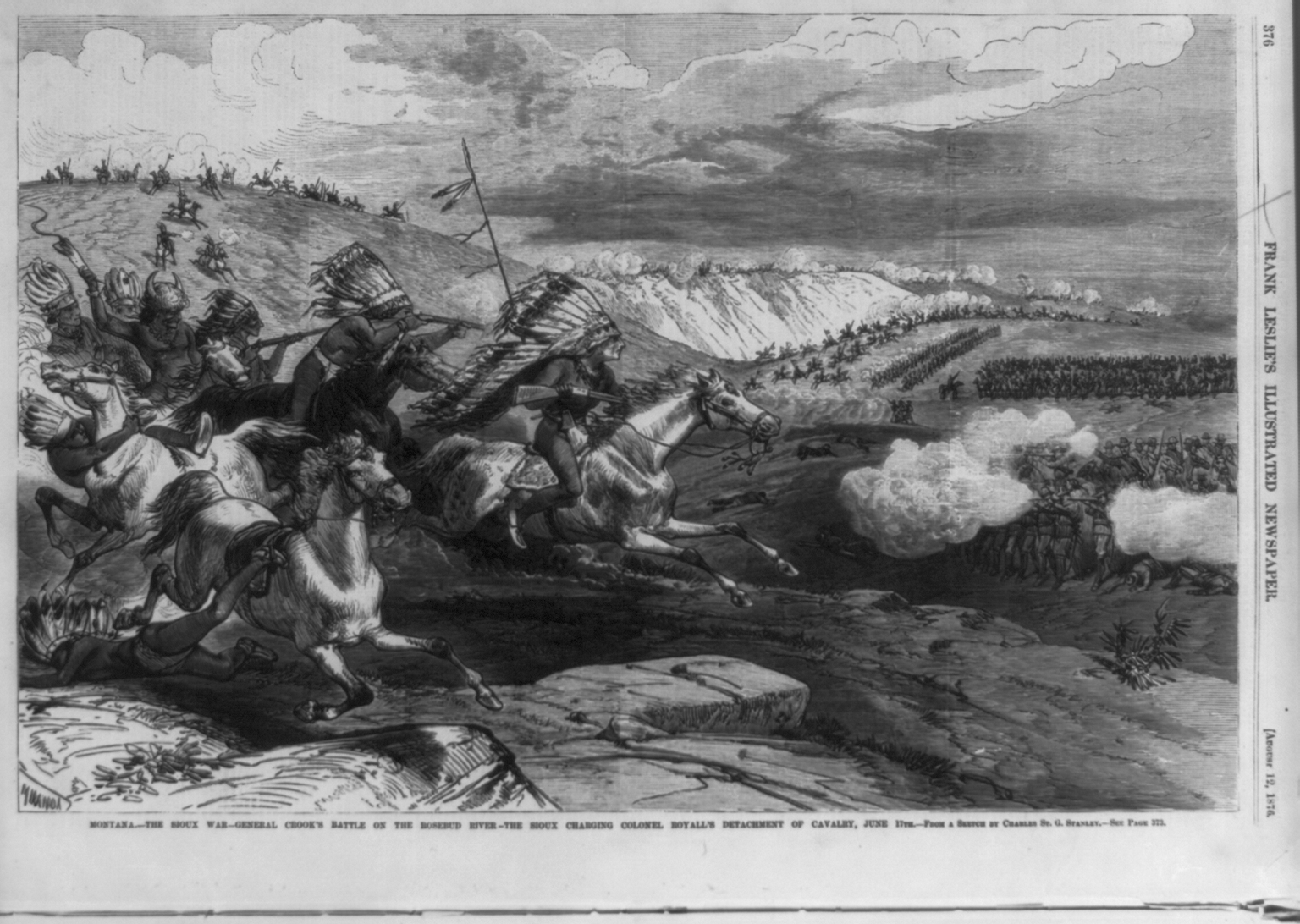
"Sioux charging at Battle of Rosebud," by Charles St. G. Stanley.
War Correspondence From The Front Line
The Battle Of The Rosebud, 1876

By Dakota Wind
Author and historian, Peter J. Powell collects the Cheyenne oral traditions about the Battle of the Rosebud in his resource "People of the Sacred Mountain." Therein is a story about how a Cheyenne maiden who witnessed her brother fall off his horse during the fight. She promptly jumped on a horse and rose into the crossfire to save him. The Cheyenne refer to the Battle of the Rosebud as "The Girl Who Saved Her Brother Fight."

Author and historian, Jerome Greene also has a wonderful resource utilizing Lakota and Cheyenne oral traditions about the Rosebud, the Battle of the Little Bighorn and other fights in his resource "Lakota and Cheyenne: Indian Views of the Great Sioux War, 1876-1877."

In 1890, Joseph F. Finerty a war correspondent for the Chicago Times, published a collection of his narratives from 1876 through 1879 titled “War-path and Bivouac, or the Conquest of the Sioux.” Here follows an excerpt:


Dawn had not yet begun to tinge the horizon above the eastern bluffs, when every man of the expedition was astir. How it came about, I know not, but, I suppose, each company commander was quietly notified by the headquarter’s orderlies to get under arms. Low cooking fires were allowed to be kindled, so that the men might have coffee before moving farther down the cañon, and every horse and mule was saddled and loaded with military despatch. Finerty notes that the Indians had a feast the night before and that the following morning the Crow were reluctant to go forward to meet the Sioux and Cheyenne, the Shoshone, however, showed some “martial alacrity.” They [the Cavalry and Scouts] got their horses ready, looked to their arms, and, at last, in the dim morning light, a large party left camp and speedily disappeared over the crests of the northern bluffs.

Finerty describes the Infantry moving out with their mules and other equipment. The Cavalry being generally bored and some even taking naps in the saddle until they all began with the “regularity of a machine complicated.” We marched in this fashion, the cavalry finally outstripping the infantry, halting occasionally, until the sun was well above the horizon. At about 8 o’clock, we halted in a valley, very similar in formation to the one in which we had pitched our camp the preceding night. Rosebud stream, indicated by the thick growth of wild roses, or sweet brier, from which its name is derived, flowed sluggishly through it, dividing it from south to north into almost equal parts. Our battalion (Mill’s) occupied the right bank of the creek, with the 2d Cavalry, while on the left bank were the infantry and Henry’s and Van Vliet’s battalions of the 3d Cavalry. The pack train was also on that side of the stream, together with such of the Indians as did not move out before daybreak to look for the Sioux, whom they were by no means anxious to find. The young warriors of the two tribes were running races with their ponies, and the soldiers in their vicinity were enjoying the sport hugely.


At 8:30 o’clock, without any warning, we heard a few shots from behind the bluffs to the north.  “They are shooting buffalo over there,” said the Captain [Sutorius]. Very soon we began to know, by the alternate rise and fall of the reports, that the shots were not all fired on one direction. Hardly had we reached this conclusion, when a score or two of our Indian scouts appeared upon the northern crest, and rode down the slopes with incredible speed. “Saddle up, there - saddle up, there, quick!” shouted Colonel Mills, and immediately all the cavalry within sight, without waiting for formal orders, were mounted and ready for action. General Crook, who appreciated the situation, had already ordered the companies of the 4th and 9th Infantry, posted at the foot of the northern slopes, to deploy as skirmishers, leaving their mules with the holders. Hardly had this precaution been taken, when the flying Crow and Snake [Shoshone] scouts, utterly panic stricken, came into camp shouting at the top of their voices, “Heap Sioux! Heap Sioux!” gesticulating wildly in the direction of the bluffs which they had abandoned in such haste. All looked in that direction, and there, sure enough, were the Sioux in goodly numbers, and in loose, but formidable array. The singing of the bullets above our heads speedily convinced us that they had called on business. Finerty doesn’t run out of adjectives to describe the bravery and fortitude of his company; Finerty never holds his callous estimation for the “inferior” race in check, clearly showing present day readers he was a man of his time. “Why the d---l don’t they order us to charge?” asked the brave Von Leutwitz. “Here comes Lemley (the regimental adjutant) now,” answered Sutorius. “How do you feel about it, eh?” he inquired, turning to me. “It is the anniversary of Bunker Hill,” was my answer. “The day of good omen.” “By Jove, I never thought of that,” cried Sutorius, and (loud enough for the soldiers to hear) “It is the anniversary of Bunker Hill, we’re in luck.” The men waved their carbines, but didn’t cheer. Lemley came bounding up on his horse. “The commanding officer’s compliments, Colonel Mill!” he yelled. “Your battalion will charge those bluffs on the center.”

Mills shouted the charge, and Troops A, E, I, and M went to meet the Sioux on the bluff. At about fifty paces the Sioux line broke. When Mills and his troops reached the crest of the bluff, they immediately formed a line. General Crook ordered the 2nd Battalion of the 3rd Cavalry under Col. Guy V. Henry to charge the right flank of the broken Sioux line.

General Crook kept five troops of the 2d Cavalry, under Noyes, in reserve, and ordered Troops C and G of the 3d Cavalry, under Captain Van Vliet and Lieutenant Crawford, to occupy the bluffs on our left rear, so as to check any movement that might be made by the wily enemy from that direction. General Crook estimated that they faced a Sioux force of about 2,500 warriors. The Sioux reformed another line on the second line of heights from Rosebud Creek. Finerty suggests that it was likely Crazy Horse directing and signaling the Sioux with a pocket mirror. Under Crook’s orders, our whole line remounted, and, after another rapid charge, we became masters of the second crest. When we got there, another just like it rose on the other side of the valley. There, too, were the savages, as fresh, apparently, as ever. We dismounted accordingly, and the firing began again. Colonel Mills, who had active charge of our operations, wished to dislodge them. The firefight shifted from Mills’ position to Maj. Evan’s position to the left. Mills led a charge into the valley under cover of the rocky terrain there. The Crow and Shoshone joined the fight led by Maj. Randall. The two bodies of savages, all stripped to the breech-clout, moccasins, and war bonnet, came together in the trough of the valley, the Sioux having descended to meet our allies with right good will. They began a most exciting encounter. Our regulars did not fire because it would have been sure death to some of the friendly Indians, who were barely distinguishable by a red badge which they carried. An Infantryman, Sergeant Van Moll joined the fight. Finerty found it strange that casualties on both sides couldn’t have exceeded more than twenty-five; he also remarks that war cries were constant on both sides. Since this fight was an “Indian” fight, one could safely speculate that the warriors on both sides were fighting for war honors, such as counting coup.

Sergeant Van Moll found himself fighting alone, when the Shoshone and Crow fled from the Sioux. A diminutive Crow scout, “Humpy,” made a bold rescue of Van Moll – and returned to the cheers of all the Cavalry and Scouts.

In order to check the insolence of the Sioux, we were compelled to drive them from the ridge. Colonel Royall met with difficulty on his front. Captain Vroom was deceived by the terrain and became overwhelmed. Lieutenant Foster and Lieutenant Morton, and Captain Andrews (Troop I) extricated Vroom. In repelling the audacions [sic] charge of the Cheyennes upon his battalion, the undaunted Colonel Henry, one of the most accomplished officers in the army, was struck by a bullet, which passed through both cheek bones, broke the bridge of his nose and destroyed the optic nerve in one eye. His orderly, in attempting to assist him, was also wounded, but temporarily blinded as he was, and throwing blood from his mouth by the handful, Henry sat his horse for several minutes in front of the enemy. He finally fell to the ground, and, as that portion of our line, discouraged by the fall of so brave a chief, gave ground a little, the Sioux charged over his prostrate body, but were speedily repelled, and he was happily rescued by some soldiers of his command.

As the day advanced, General Crook became tired of the indecisiveness of the action, and resolved to bring matters to a crisis. He rode up to where the officers of Mill’s battalion were standing, or sitting, behind their men, who were prone to skirmish line, and said, in effect, “It is time to stop this skirmishing, Colonel. You must take your battalion and go for their village away down the cañon.” “All right, sir,” replied Mills, and the order to retire and remount was given. The Indians, thinking we were retreating, became audacious, and fairly hailed bullets after us, wounding several soldiers. Our men, under the eyes of the officers, retired in orderly time, and the whistling of the bullets could not induce them to forget that they were American soldiers. Under such conditions, it was easy to understand how steady discipline can conquer mere numbers. 

The bluffs, on both sides of the ravine, were thickly covered with rocks and fir trees, thus affording ample protection to the enemy, and making it impossible for our cavalry to act as flankers. We began to think our force rather weak for so venturous an enterprise, but Lieutenant Bourke informed the colonel [Mills] that the five troops of the 2d Cavalry, under Major Noyes, were marching behind us. A slight rise in the valley enabled us to see the dust stirred up by the supporting columns some distance in the rear.

The day had become absolutely perfect, and we all felt elated, exhilarated as we were by our morning’s experience. Nevertheless, some of the more thoughtful officers has their misgivings, because the cañon was certainly a most dangerous defile, where all the advantage would be on the side of the savages. 


Noyes, marching his battalion rapidly, soon overtook our rear guard, and the whole column increased its pace. Fresh signs of Indians began to appear in all directions, and we began to feel that the sighting of their village must be only a question of a few miles further on. We came to a halt in a kind of cross cañon, which had an opening toward the west, and there tightened up our horse girths, and got ready for what we believed must be a desperate fight. Finerty remarked that Gruard’s keen ears heard gunfire toward the “occident.” Major A. H. Nickerson raced to where Colonel Mills and other officers were on the bluffs.

“Mills,”he [Maj. Nickerson] said,”Royall is hard pressed, and must be relieved. Henry is badly wounded, and Vroom’s troop is all cut up. The General orders that you and Noyes defile by your left flank out of this cañon and fall on the rear of the Indians who are pressing Royall.” This, then was the firing that Gruard had heard.


Crook’s order was instantly obeyed, and we were fortunate enough to find a comparatively easy way out of the elongated trap into which duty had led us. We defiled as nearly as possible, by the heads of companies, in parallel columns, so as to carry out the order with greater celerity. They carefully moved around boulders and fallen timbers. When they crested the crown of the plateau, they could hear the attack on Royall’s troop. “Prepare to mount - mount!” shouted the officers, and we were again in the saddle. Then we urged our animals to their best pace, and speedily came in view of the contending parties. The Indians had their ponies, mostly guarded by mere boys, in rear of the low, rocky crest which they occupied. The position held by Royall rose somewhat higher, and both lines could be seen at a glance. There was very heavy firing, and the Sioux were evidently preparing to make an attack in force, as they were riding in by the score, especially from the point abandoned by Mill’s battalion in its movement down the cañon, and which was partially held thereafter by the friendly Indians, a few infantry and a body of sturdy mule packers, commanded by the brave Tom Moore, who fought on that day as if he had been private soldier. Suddenly the Sioux lookouts observed our unexpected approach, and gave the alarm to their friends. We dashed forward at a wild gallop, cheering as we went, and I am sure we were all anxious at that moment to avenge our comrades of Henry’s battalion. But the cunning savages did not wait for us. They picked up their wounded, all but thirteen of their dead, and broke away to the northwest on their fleet ponies, leaving us only the thirteen “scalps,” 150 dead horses and ponies and a few old blankets and war bonnets as trophies of the fray. Our losses, including the friendly Indians, amounted to about fifty, most of the casualties being the 3rd Cavalry, which bore the brunt of the fight on the Rosebud. Thus ended the engagement which was the prelude to the great tragedy that occurred eight days later in the neighboring valley of the Little Big Horn.


According to the Biographical Directory of the United States Congress, Finerty was born in Galway, Ireland, 1846, immigrated to the United States in 1864 and immediately enlisted in the Ninety-Ninth Regiment of the New York State Militia. During the “Indian Wars,” Finerty corresponded with at least three newspapers, most often with the Chicago Times, during the “Indian Wars” from 1876-1881. He established his own weekly paper, the Citizen in 1882 and the following year was elected to the Forty-eighth Congress as an Independent Democrat. He died in June of 1908 and was interned in Cavalry Cemetery , Chicago, Ill.