Showing posts with label Devil's Heart Butte. Show all posts

Thursday, April 17, 2014

A Legend Of Devil's Lake

Sunrise on Devils Lake by Mitchell's Guide Service.
The Heart Of The Mysterious Land
A Legend Of Devil’s Lake
By Ohíyesa (The Winner), aka Dr. Charles Eastman
GREAT PLAINS - Ohíyesa’s wonderful first person narrative, "Indian Boyhood," is about his life growing up as a traditional Dakȟóta. “I have put together these fragmentary recollections of my thrilling wild life expressly for the little son who have to late to behold for himself he drama of savage existence,” he wrote, in dedication to his son, also named Ohíyesa. Here is an excerpt from his book, “Indian Boyhood."

The Animals Are Given Different Form
“Tell me, good Weyuha, a legend of your father’s country,” I said to him one evening, for I knew the country which is now known as North Dakota and South Dakota and Southern Manitoba was their ancient hunting ground. I was prompted by Uncheedah[1] to make this request, after the old man had eaten at our lodge.

Many years ago, he began, as he passed the pipe to uncle, we traveled from the Otter Tail to Minnewakan[2] (Devil's Lake). At that time the mound was very distinct where Chotanka lies buried. The people of his immediate band had taken care to preserve it.

This mound under which lies the great medicine man is upon the summit of Minnewakan Chantay,[3] the highest hill in all that region. It is shaped like an animal's heart placed on its base, with the apex upward.
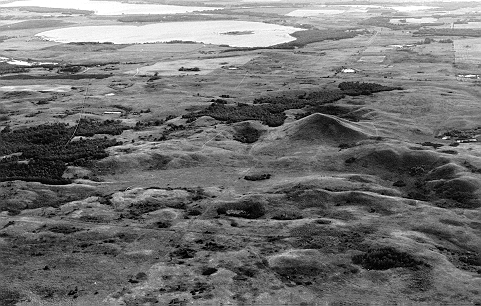
A view of Spirit Heart Butte from above. It is popularly known as "Devil's Heart Butte."

The reason why this hill is called Minnewakan Chantay, or the Heart of the Mysterious Land, I will now tell you. It has been handed down from generation to generation, far beyond the memory of our great-grandparents. It was in Chotanka's line of descent that these legends
were originally kept, but when he died the stories became everybody's, and then no one believed in them. It was told in this way.

I sat facing him, wholly wrapped in the words of the storyteller, and now I took a deep breath
and settled myself so that I might not disturb him by the slightest movement while he was reciting his tale. We were taught this courtesy to our elders, but I was impulsive and sometimes forgot.

A long time ago, resumed Weyuha, the red people were many in number, and they inhabited all the land from the coldest place to the region of perpetual summer time. It seemed that they were all of one tongue, and all were friends.

All the animals were considered people in those days. The buffalo, the elk, the antelope, were tribes of considerable importance. The bears were a smaller band, but they obeyed the mandates of the Great Mystery[4] and were his favorites, and for this reason they have always known more about the secrets of medicine. So they were held in much honor. The wolves, too, were highly regarded at one time. But the buffalo, elk, moose, deer and antelope were the ruling people.

These soon became conceited and considered themselves very important, and thought no one could withstand them. The buffalo made war upon the smaller tribes, and destroyed many. So one day the Great Mystery thought it best to change the people in form and in language.

The hill, or butte, resembles a great lodge in shape. 

He made a great tent and kept it dark for ten days. Into this tent he invited the different bands, and when they came out they were greatly changed, and some could not talk at all after that. However, there is a sign language given to all the animals that no man knows except some medicine men, and they are under a heavy penalty if they should tell it.

The buffalo came out of the darkened tent the clumsiest of all the animals. The elk and moose were burdened with their heavy and many branched horns, while the antelope and deer were made the most defenseless of animals, only that they are fleet of foot. The bear and the wolf were made to prey upon all the others.

Man was alone then. When the change came, the Great Mystery allowed him to keep his own shape and language. He was king over all the animals, but they did not obey him. From that day, man's spirit may live with the beasts before he is born a man. He will then know the animal language but he cannot tell it in human speech. He always retains his sympathy with them, and can converse with them in dreams.

I must not forget to tell you that the Great Mystery pitched his tent in this very region. Some legends say that the Minnewakan Chantay was the tent itself, which afterward became earth and stones. Many of the animals were washed and changed in this lake, the Minnewakan, or Mysterious Water. It is the only inland water we know that is salt. No animal has ever swum in this lake and lived.

"Tell me," I eagerly asked, "is it dangerous to man also?"

Yes, he replied, we think so; and no Indian has ever ventured in that lake to my knowledge. That is why the lake is called Mysterious, he repeated.

"Attacking the Grizzly Bear" by George Catlin.

Life As A Grizzly Bear
I shall now tell you of Chotanka. He was the greatest of medicine men. He declared that he was a grizzly bear before he was born in human form. Weyuha seemed to become very earnest when he reached this point in his story. Listen to Chotanka's life as a grizzly bear.
“As a bear,” he used to say, “my home was in sight of the Minnewakan Chantay. I lived with my mother only one winter, and I only saw my father when I was a baby. Then we lived a little way from the Chantay to the north, among scattered oak upon a hillside overlooking the Minnewakan.”

“When I first remember anything, I was playing outside of our home with a buffalo skull that I had found nearby. I saw something that looked strange. It walked upon two legs, and it carried a crooked stick, and some red willows with feathers tied to them. It threw one of the willows at me, and I showed my teeth and retreated within our den.’”

“Just then my father and mother came home with a buffalo calf. They threw down the dead calf, and ran after the queer thing. He had long hair upon a round head. His face was round, too. He ran and climbed up into a small oak tree.”

“My father and mother shook him down, but not before he had shot some of his red willows into their sides. Mother was very sick, but she dug some roots and ate them and she was well again.” It was thus that Chotanka was first taught the use of certain roots for curing wounds and sickness, Weyuha added.

"Hunting of the Grizzly Bear" by Karl Bodmer.

“One day,” he, Weyuha, resumed the grizzly's story, “when I was out hunting with my mother, my father had gone away and never came back, we found a buffalo cow with her calf in a ravine. She advised me to follow her closely, and we crawled along on our knees. All at once mother crouched down under the grass, and I did the same. We saw some of those queer beings that we called ‘two legs' riding upon big-tail deer (ponies). They yelled as they rode toward us. Mother growled terribly and rushed upon them. She caught one, but many more came with their dogs and drove us into a thicket. They sent the red willows singing after us, and two of them stuck in mother's side. When we got away at last she tried to pull them out, but they hurt her terribly. She pulled them both out at last, but soon after she lay down and died.”

“I stayed in the woods alone for two days. Then I went around the Minnewakan Chantay on the south side and there made my lonely den. There I found plenty of hazel nuts, acorns and wild plums. Upon the plains the teepsinna[5] were abundant, and I saw nothing of my enemies.”

“One day I found a footprint not unlike my own. I followed it to see who the stranger might be. Upon the bluffs among the oak groves I discovered a beautiful young female gathering acorns. She was of a different band from mine, for she wore a jet black dress.”

“At first she was disposed to resent my intrusion, but when I told her of my lonely life she agreed to share it with me. We came back to my home on the south side of the hill. There we lived happy for a whole year. When the autumn came again Woshepee, for this was her name, said that she must make a warm nest for the winter, and I was left alone again.”

"Purple Lightning" over Morton County, ND. Photo by Dee Brausch.

A Race Between Lightning And A Bear
Now, said Weyuha, I have come to a part of my story that few people understand. All the long winter Chotanka slept in his den, and with the early spring there came a great thunder storm. He was aroused by a frightful crash that seemed to shake the hills, and lo! A handsome young man stood at his door. He looked, but was not afraid, for he saw that the stranger carried none of those red willows with feathered tips. He was unarmed and smiling.

“’I come,’”said he, “’with a challenge to run a race. Whoever wins will be the hero of his kind, and the defeated must do as the winner says thereafter. This is a rare honor that I have brought you. The whole world will see the race. The animal world will shout for you, and the spirits will cheer me on. You are not a coward, and therefore you will not refuse my challenge.’”

“’No,” replied Chotanka, after a short hesitation. The young man was fine looking, but
lightly built.

“’We shall start from the Chantay,[6] and that will be our goal. Come, let us go, for the universe is waiting!’ impatiently exclaimed the stranger.’”

He passed on in advance, and just then an old, old wrinkled man came to Chotanka's door. He leaned forward upon his staff.

“My son,” he said to him, “I don't want to make you a coward, but this young man is the greatest gambler of the universe. He has powerful medicine. He gambles for life. Be careful! My brothers and I are the only ones who have ever beaten him. But he is safe, for if he is killed he can resurrect himself. I tell you he is great medicine.”

“However, I think that I can save you. Listen! He will run behind you all the way until you are within a short distance of the goal. Then he will pass you by in a flash, for his name is Zig-Zag Fire![7] (Lightning!). Here is my medicine.” So speaking, he gave Chotanka a rabbit skin and the gum of a certain plant. “When you come near the goal, rub yourself with the gum, and throw the rabbit skin between you. He cannot pass you.”
“And who are you, grandfather?” Chotahka inquired.

“I am the medicine turtle,” the old man replied, “The gambler is a spirit from heaven, and those whom he outruns must shortly die. You have heard, no doubt, that all animals know beforehand when they are to be killed; and any man who understands these mysteries may also know when he is to die.”

The race was announced to the world. The buffalo, elk, wolves and all the animals came to look on. All the spirits of the air came also to cheer for their comrade. In the sky the trumpet was sounded, the great medicine drum was struck.[8] It was the signal for a start. The course was around the Minnewakan.[9] Everywhere the multitude cheered as the two sped by.

The young man kept behind Chotanka all the time until they came once more in sight of the Chantay. Then he felt a slight shock and he threw his rabbit skin back. The stranger tripped and fell. Chotanka rubbed himself with the gum, and ran on until he reached the goal. There was a great shout that echoed over the earth, but in the heavens there was muttering and grumbling. The referee declared that the winner would live to a good old age, and Zig-Zag Fire promised to come at his call. He was indeed great medicine, Weyuha concluded.

“But you have not told me how Chotanka became a man," I said.
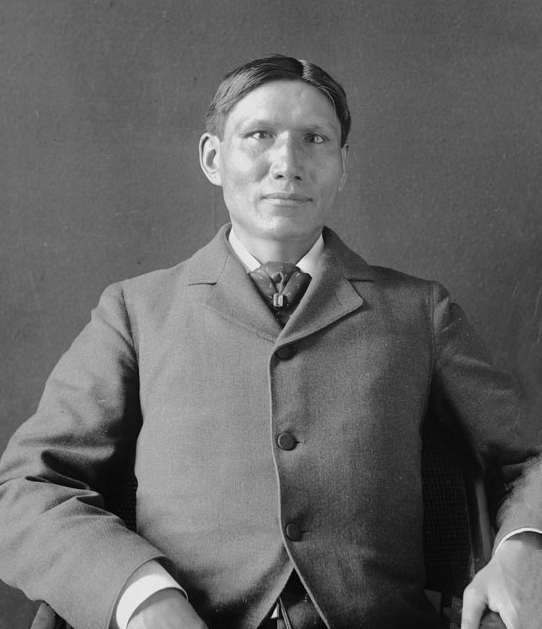
Ohíyesa, Dr. Charles Eastman.

The Bear Is Reborn As A Man
One night a beautiful woman came to him in his sleep. She enticed him into her white teepee[10] to see what she had there. Then she shut the door of the teepee and Chotanka could not get out. But the woman was kind and petted him so that he loved to stay in the white teepee. Then it was that he became a human born. This is a long story, but I think, Ohiyesa, that you will re- member it, said Weyuha, and so I did.


[1] Uŋčí is the Dakȟóta/Lakȟóta word for maternal grandmother.

[2] Mníwakȟáŋ is literally “Water-With-Energy,” which is taken in the context of this story to mean present-day Spirit Lake in North Dakota.

[3] Mníwakȟáŋ Čhaŋté is literally “Water-With-Energy Heart,” is in reference to the mound, a sand volcano on the south side of Spirit Lake. According to tradition, the butte resembles a heart, and it is this heart that serves as the lodge of a water spirit. The butte, according to Ohíyesa, was the Creator’s lodge where he transformed the animals into their present shape. After the animals were transformed, the lodge became earth and stone. Contemporary North Dakotans call this site, “Devil’s Heart Butte.”

[4] Wakȟáŋ Tȟáŋka is most often freely translated as “Great Mystery,” it is literally “With-Energy Great,” and serves as a way to address the Creator.

[5] Thíŋpšiŋla, the prairie turnip.

[6] Mníwakȟáŋ Čhaŋté, the butte.

[7] Wakȟáŋgli is “Lightning.”

[8] Wakíŋyaŋ, or “Thunder.”

[9] According to Ohíyesa,That means around the earth or the ocean.”

[10] Thiíkčeya is the proper word for “Teepee,” though some use “Tipi” or Thipí interchangeably. 

Monday, July 22, 2013

Devil's Heart Butte: An Enlightening Visit With A Dakota Elder


Devil's Heart Butte
The Story Of Devil's Heart Butte
By Dakota Wind
SPIRIT LAKE, N.D. - I was looking at the North Dakota state map that’s pegged to my office wall. I don’t know what it is, maybe it was a recent trip out to Heháka Wakpá Makĥoche (Elk River Country, or Theodore Roosevelt National Park) and I was in the mood to learn what the Dakota-Lakota people called places before explorers, traders, and settlers arrived.

There’s a lake in the north eastern quarter of the state. It’s a fresh water lake that’s been growing and spilling onto shore property. New islands have been formed, roads have been built higher, fields are underwater, and the water threatens to rise higher without relent.

The lake is known to the Dakota and Lakota people as Mni Wakaŋ Čhaŋté. Don’t believe Wikipedia in this, if you look it up there. A word for word translation of the Dakota to English is Water With-Energy Heart, which freely translates as Spirit Heart Lake. The calque of Bad Spirit Lake is entirely a misconception.

There, on the southern bank of the Spirit Heart Lake lay the Spirit Lake Sioux Indian Reservation, home of the Spirit Lake Oyate (Nation). The Spirit Lake Oyate has about 6,700 or so enrolled members, but not all live on the reservation.

The lake, Spirit Heart Lake (aka Devil’s Lake), the people (the Spirit Lake Oyate), have a name in common with a site on the reservation near the town of Tokio (a strange word in and of itself; said to named after the Dakota word for “Toki” for “gracious gift,” but it isn't; the closest word for gift, is in the act of receiving a gift, “Okini”). There, nestled among the rolling hills of the prairie land overlooking the lake is Spirit Heart Butte, only it’s popularly known as “Devil’s Heart Butte.”

I turned to Spirit Lake tribal historian Louie Garcia to find an answer. I’ve conversed with Louie on the phone over the years and by email. I had always thought he was perhaps a middle-aged gentleman by the youthful exuberance of his voice. Some voices age. Louie’s voice does not. He’s in his 70's, a respected member of the tribe, he’s gracious to give me an answer, and he wants me to share it with others. 

Louie has asked me to post it as he sent it to me, word for word. Pilamiya pelo, Lekshi Louie! He Even included a bibliography and a glossary of Dakota terminology (at the end of this entry).

__________


Heart Hill is a treeless kame located one mile northwest of Tokio, North Dakota in Section Four Woodlake Township (T152N – R64W) Benson County. It sits on the eastern edge of the Backbone, a line of hills formed when Spirit Lake (Devils Lake) was formed some 10,000 years ago during the last ice age. With an elevation of 1725 feet above sea level it can been seen on the horizon for miles in the lake region, and from its summit one can look over a vast area surrounding this hill. The name ‘heart’ means that it is at the center of the area but also the center of spiritual knowledge. As this hill appears to be in the shape of an upside down human heart, some incorrectly speculate this as the reason for its name.

Heart Hill is the most sacred elevation in all of North Dakota. It could be considered a cathedral. This Butte de Coeur of the French fur traders is called in the Dakota language Miniwakan Cante Paha or Heart Hill at Spirit Lake. The French fur traders named Devils Lake so that presently the term ‘devil’ is attached to many local geographical features.  “Devils Heart” is the name used by local people. Naturally the ‘devil’ word is a misunderstanding, but referring to the Water Spirits who live in the lake.

This Heart Hill is a sacred location because it is the Lodge of the Water Spirit for whom Spirit Lake is named. These spirits are called Unktehi or Terrible Ones due to their custom of drowning anyone who foolishly ventured upon the lake without their permission. These Unktehi are worshiped in the Wakan Wacipi or Grand Medicine Ceremony (Skinner 1920:273).

This hill belongs to a class of sacred lodges (hills) where the spirits meet to decide the help, if any, they will grant humans. Prehistorically the waters of the lake flowed up to the east side of this hill, to the door or entrance of this the Water Spirit’s home. The spirits could enter and exit their home to do their business within this sacred lake. Unfortunately the entrance to this sacred hill was blown closed with dynamite in the 1930’s when a local rancher discovered a den of coyotes living within. If one looks closely at the change in vegetation, the location of the former entrance can be discovered.

There are many heart hills or buttes in the state but this most important one is at Spirit Lake. Examples of other heart hills are: The Heart of the Turtle Mountain or as it is known today Butte Saint Paul. It is located in Cordella Township (13-162-74) Bottineau County. There is also a Heart Butte located on the Ft. Berthold Reservation (9-148-92) in northeastern Dunn County. Cavalier County has a Heart Butte (19-162-62), as well as Grant County (23-137-89).

Thomas F. Eastgate records in his notes two northerly connected hills who he calls ‘sisters’ to Heart Hill (Eastgate). This must be a non-Indian name or a mistranslation as features on the earth are considered male. As an example there is a Sanborn Hill  or “Heart Hill’s Little Brother” located in Heman Township (1-139-59) Barnes County named for its exact appearance but smaller stature than the hill presently under discussion.

The Spirit Lake area formerly belonged to the Hidatsa. Their main earthlodge village was located on the west end of Graham’s Island, now a peninsula jutting into northwestern Spirit Lake (Devils Lake). The Hidatsa name for Heart Hill is Mirixopa Nata Sh or Heart of the Holy Water. Hidatsa traditions acknowledge the tribe was ‘born’ at Heart Hill. In a narrative similar to the European tale of Jack and the Bean Stalk, the tribe emerged from an underworld by climbing a vine. Unfortunately the vine broke leaving half of the people in their subterranean world. The Hidatsa departed the Spirit Lake area circa 1550 when their leader was told in a dream to move west to the Missouri River (Bowers 1992:22; Milligan 1972; Libby Papers Box 29: folder 14; Kittleson 1992:15).

The Hidatsa have many Lake Region legends and tales, especially about geophysical features. One story that is remembered, tells of them making a stone effigy of a bear on the north side of Heart Hill. A bison effigy is mentioned too. Dana Wright was shown a trail of 385 stones leading 450 feet to the west from the hill (Roy Johnson Papers).

In 1839 Nicollet visited the area to map the lake and surrounding area. He drew a sketch map from the top of the hill. Today one can see the same view of Black Tiger Bay just as it was drawn some 166 years ago because little has changed (Bray and Bray 1976:192).

I have a reference to this hill in 1855 bring called Clarence Peak.
Dr. Charles Eastman writes in his book Indian Boyhood of visiting Heart Hill in the 1860’s and was informed a great medicine man named Cotanka (Reed or Flute) was buried on top (Eastman 1971:163). A man by the name of Charles Belgarde is also buried on top of the hill (St. Ann’s Centennial). In June of 1992 a group of Crow Indians from Montana ascended the hill and erected two shades for the purpose of a vision quest. A four post shade was erected on the top at the west end, and another on the east end. A year later local children began to dig in the abandoned post holes and discovered a skull and arm bones. The bones were eventually sent to the State Historical Society of North Dakota in Bismarck for evaluation (Devils Lake Journal).

Father Genin on March 4, 1868 erected a thirty three foot tin laminated oak crucifix, but it was destroyed by a prairie fire, or a wind storm. On July 22, 1873 another cross of glass and steel construction replaced the wooden cross (Cory-Forbes Papers: Box 2; Norton 1931:163). Both crosses were said to be spectacular when they reflected the suns rays. Some say that glass particles can still be found at the base of the hill, remnants of the second cross. Father Genin (Richard 1975:3) renamed the hill The Sacred Hearts of Jesus and Mary, a name closer to the original intent of the Indians. It is better than the present non-Indian name of Devils Heart (Cory-Forbes Papers: Box 2).

I was told that in1924, on a day with a clear blue sky a local church group went to Heart Hill for a picnic. They sang a hymn and the minister said a prayer, a single white cloud approached and poured hail and lighting upon them, sending them for cover. From a religious aspect one could say the Thunders were attacking the Water Spirits lodge.

Heart Hill has been used for recreational purposes during the last century. There is a photograph of a ski jump built upon the top of the hill. It has been a favorite hiking destination as well as winter sledding, especially for local school classes. By the 1930’s the ski jump was moved to a location by Highway 57 where its skeleton can be seen today. Yearly a wagon train camps for one night at the base of the hill. It is a favorite site to take visitors who have the stamina to climb to the top.

Most if not all you readers would naturally assume the Spirit Lake Tribe owns this sacred hill. You would of course be wrong. When the Spirit Lake Reservation land was allotted to individuals in accordance with the Treaty of 1872-73 and Dawes Act of 1887, no tribal member selected the hill. The ownership of land was against Indian thought. How could anyone think of owning a sacred location? No one can own land, it belongs to God. When the reservation was opened to non-Indian ownership in 1904, the hill was selected by a Whiteman and remains so today. However if we analyze the situation, this non-Indian really doesn’t own Heart Hill, all he has to do it not pay his taxes for five years.

Bibliography

Bowers, Alfred W.                   Hidatsa Social and Ceremonial Organizations.
                                                University of Nebraska Press, Lincoln and London 1992.

Bray Edmund C.                     Joseph N. Nicollet on the Plains and Prairies: Expeditions
Bray, Martha Coleman           of 1838 39 with Journals, Letter, and Notes on the Dakota
Translators and editors           Indians. Minnesota Historical Society Press, St. Paul; 1976.

Centennial Committee            St. Ann’s Centennial, 100 years of Faith 1885 – 1985
                                                Turtle Mountain Indian Reservation, Belcourt, ND

Cory – Forbes Papers                        (1853 -1927) A-C833 Box 2, Minnesota Historical Society,
                                                St. Paul. Three boxes and 10 volumes.
                                                (Father Genin and the crosses)

Devils Lake Journal                “B.I.A. Probes Bone Discovery” May 19, 1993.

Eastgate, Thomas F. Papers.             (1855-1907) Location unknown.
Formerly located in Larimore, ND.
                                                Withdrawn by family possibly to Minot, ND.

Eastman, Charles A.               Indian Boyhood.
                                                Dover Publications, Inc. New York. 1971.

Eastman, Charles A.               “The Wars of Wakeeyan and Unktayhee”
Eastman, Elaine Goodale       Wigwam Evenings: Sioux Folk Tales Retold
                                                University of Nebraska Press, Lincoln 1990. Pp. 117 – 121.

Hanson, Jeffrey R.                 “Ethnohistoric Problems in the Crow – Hidatsa
                                                Separation”
                                                Archaeology in Montana 20 (3) Pp. 7-85. Billings 1979

Kittleson, Cindy Cooper          “Legends and Lore in Devils Lake”
                                                Going Places 2 (9) September 1992 Pp 14 &15.

Libby, Orin Grant Papers        A85 State Historical Society of North Dakota, Bismarck.

Matthews, Washington           Grammar and Dictionary of the Language of the Hidatsa:
                                                Introductory Sketch of the Tribe.
Cramoisy Press, New York. 1873.

Mattison, Ray H.                     “Report on the Historic Sites in the Garrison Reservoir
                                                Area, Missouri River”.
                                                North Dakota History 22 (1&2) 1955

Milligan, Edward A.                 The Indian in the Northern Plains.
                                                North Dakota State University – Bottineau, 1972
                                                No page numbers, probably written for his classes.

Norton, Sister Mary                “Catholic Missions and Missionaries”
Aquinas O.S.F.                       North Dakota Historical Quarterly 5 (3) April 1975
                                               
Richard, Frank                                    “St. Benedict of Wild Rice”
                                                Red River Valley Historian Summer 1975.

Skinner, Alanson                     “Wahpeton Dakota Wakan Wacipi or Medicine Dance”
                                                Indian Notes and Monographs 4, 1920 Pp. 262-340.
                                                Museum of the American Indian, Heye Foundation.
                                                New York, NY.
                                                                                                           

Glossary

Backbone                    Miniwakan Cankahu (Mini = water; Wakan = sacred, holy; Canka
= back; Hu = bone). A continuous ridge on the south side of Spirit Lake beginning at Sully’s Hill, travels east to the St. Michael area and then swings south to end at the Sheyenne River.

Black Tiger Bay          Located on the south shore of Spirit Lake north of Tokio, ND
                                    Named for Igmusapa (Black Panther) DLS #482 1829 – 1915.

Butte de Couer            French: Heart Hill (Butte = hill; de = of the; Couer = heart).

Butte St. Paul              Heyatanka Cante Paha (He = mountain; Yatanka = great; Cante =
heart; Paha = hill). Heart Hill at the Great Mountain (Turtle Mountain) has an elevation of 2305 above sea level.

Cotanka                      Medicine man buried on top of Heart Hill. His name translates
                                    Reed, also whistle or flute as reeds were used for this purpose.

Eastman, Charles A.   Ohiyesa (Ohiya = to win; Sa= continually) an Eastern Dakota
                                    who fled to Canada via Spirit Lake as a boy. He later became a
                                    medical doctor.

Genin, Father              Jean-Baptiste Genin an Oblate missionary was born in France 1837. Immigrated to Canada in 1860, in 1865 he journeyed to St. Boniface (Winnipeg, Manitoba), May 7, 1865 went to Ft. Abercrombie which later became his headquarters. He didn’t get along with the settlers because as soon as he selected land for an Indian mission squatters would take the land. The administering to Indians became a bone of contention with Bishop Shanley of Fargo, a new comer who wanted Genin to establish non-Indian churches. He did establish churches at White Earth, Detroit Lakes,
                                    and Moorhead, MN. He died at Bathgate, ND; January 18, 1900
                                    (Richard 1975).

Graham’s Island          Named for Duncan Graham, a Scottish fur trader who operated a post on the island circa 1815. His Indian name was Hoarse Voice
                                    (Hoġita) probably named for his brogue.

Heart Hill                     Miniwakan Cante Paha (MiniWakan = sacred water; Cante = heart;
Paha = hill), located in the Northwest quarter of the northwest quarter of Section four, Woodlake Township, Benson County.

Hidatsa                        The Red Willow People, meaning they were tall and slender as the
                                    Red Willow. They gathered at the mouth of the Knife River where
it enters the Missouri River near present Stanton, ND (Mercer County) is today in three villages. The River Crow separated from the Big Hidatsa Village (Midahati Sh = Willow Village) and the Mountain Crow separated from Sakakawia Village (Awatixa Sh = Elongated Village) (Mattison 1955:22-23; Hanson 1979).

Kame                          Sand and gravel deposited by the melting glacial ice. A hole in the
                                    ice sheet would be filled with sand and gravel. When the ice sheet
                                    melted, the result was a hill. Geologists use the term kame.

Mirixopa Nata Sh        Hidatsa for Heart Hill (Miri = water; Xopa = holy, sacred; Nata =
Heart; Sh = definite article [the] used for personal names and places) (Matthews1873).
                                                                                                           
Sanborn Hill                Miniwakan Cante Paha Sunkaku (Miniwakan = Sacred Water [Spirit Lake]; Cante = heart; Paha = hill; Sunkaku = his younger
                                    Brother) The younger brother of the Heart Hill at Spirit Lake.

Unktehi                        Water Spirit (Un = to be; K = inserted for euphony; Teĥike = terrible, difficult). The Difficult (to deal with) One. The Water

Spirits are the meniscus of the Thunders. Their battles explain the hydrological cycle (Eastman and Eastman 1990).

Wright, Dana               He was the premier historian for the state of North Dakota.
                                    His primary interest was military trails, publishing his findings
                                    in North Dakota History in the 1950’s.