Showing posts with label Kevin Locke. Show all posts

Tuesday, October 4, 2022

May You Emerge Safely On The Other Side

The First To Arise, a wetplate photograph by Shane Balkowitsch, 2016. 
Uŋmáčhetkiya Yakpáptapi Kta Héčha
May You Safely Emerge On The Other Side

By Dakota Wind

Tȟokéya Inážiŋla tókhi éyaye hé? Thíyata oníčilapelo. Uŋmá ečhíyataŋhaŋ iyáye. Waŋná Čhaŋkú Wanáǧi maní. Čhaŋkú Tȟó maní. Tókša akhé waŋčhíyaŋkiŋ kte. 


Where have you gone First To Arise? They have called you home. You have gone on to the other side. Now you walk the Spirit Road. You walk on the Blue Road. I will see you again for certain. 


Lekší Kevin Locke loved the land. When he was home he regularly ran on the prairie steppe above the floodplain of the Missouri River, overlooking Lake Oahe. His home, in the community of Wakpala, S.D. overlooks the water. Day or night, light from the sun or moon stretches across the water and illuminates his home. During the darkest nights and coldest days of winter, his home is filled with earnest love for family and land.


One of his favorite places to run was at an old Sahnish (Arikara) village site close to his home. He wondered if it would be a good place to camp in the old days and looked at the site as though for the first time. Lo! There, he saw the evidence of a village from days gone by. Depressions in the ground where once stood great earthlodges. Time, erosion, and development took much of the old village. Thereafter, when he ran there he imagined running through a living village filled with laughter and singing in the air. The wind that swirled about him at the same time when he ran there, was the same wind that swirled then and there in a different distant time long ago; this same wind carried the smell of joy and prayer across the water and into the sky. 


Lekší loved to dance. He refused to contest dance. The only one in competition for excellence he danced against was himself. He was renowned for hoop dancing, storytelling, and playing the traditional northern plains Indian flute. Kevin cultivated excellence in others too. When he saw the best in others he would say so, and further, he would tell others. 


Lekší would say he was not a singer, yet he frequently sang. He loved and shared the songs he heard and learned from the elders of his youth. He listened to the mystery of creation. Swallows would swoop by and let him know he needed to brush his hair. Western Meadowlarks perched outside his home and sang in the New Year each spring, and each fall fond wishes for a safe emergence on the other side of winter. We just have to stop and listen for revelation in the quiet moments of creation. 


Lekší believed that it was important to sing. Song renewed one’s identity and connection to the landscape. Song renews cultural identity. There is an exchange of energy, like electricity, between people who sing together. Long before Scientific American studied choirs and discovered that people who sing together their heartbeats synchronize, the Očhéti Šakówiŋ made this natural observation. Kevin explained it simply as: Lowáŋpi čhaŋná čhaŋtiyapȟa akhÍptaŋ hečhé, or “When they sing together, their hearts beat as one.” 


Lekší would say he was not a singer, yet he frequently sang. The singing voice is the most precious instrument of the Očhéti Šakówiŋ. As an instrument of the Great Plains, the singing voice is known to carry several miles and still be understood. In an arid landscape with the near constant presence of the wind, the Lakȟóta language was a language of the wind. The rattle is the essence of hail; the drum the essence of thunder; the flute the essence of the wind; the voice the essence of lightning. The Lakȟóta singer’s voice carries where English falls apart. 


Day and night. Equinox and solstice. Month and year. He saw the heavens and landscape in a constant state of renewal. In late summer of 2017, a solar eclipse washed over the Beautiful Country. The Očhéti Šakówiŋ last saw one in 1868. They believed that what was in the world here below was reflected in the heavens above. The Húŋkpapȟa lit sage and smudged. They brought out their pipes and prayed. The children of the sun and moon shone from their places in the heavens and life was wondrous and mysterious. The most beautiful thing about this moment was sharing this experience with family. For Kevin it was a profound moment of renewal. Even as the sun “died” it emerged moments later victorious. 


It was important for Lekší to experience the Beautiful Country. Looking out upon the landscape to distant summits gives one a sense of atmospheric perspective, that is to say, that from a distance sites and summits become like a dream and take on a blue color. That distance, that blue color reminds the Očhéti Šakówiŋ observer of a long abiding presence of Niyá Awičhableze, or the Enlightening Breath Upon Which All Life Returns. 


The Enlightening Breath is said to arrive on the Northern Plains in the spring, but all that lives and breathes draw upon it throughout the year. The Očhéti Šakówiŋ natural observation of atmospheric perspective is perceived thusly: Tȟéhaŋtaŋhaŋ táku tȟotȟó kiŋ tȟó atȟáŋiŋ, or “That which is green, from a distance becomes blue.” It is this sacred blue perspective that reminds the observer to treat the very land and air with the same respect as one treats home. 


Lekší Kevin’s favorite conversational topics were language, culture, land, and how these each serve as metaphor for renewal and must be cultivated each and every day. The Missouri River is central to life in the Beautiful Country. The Mnišóše, or Missouri River, begins at the confluence of three rivers. This great confluence is known to the Očhéti Šakówiŋ as Mnitȟáŋka, or “The Great Water.” This Great Water flows and becomes the Mnišóše, or “The Water Astir.” It grows and turns about the landscape south, until it concludes its long journey. There it once again becomes Mnitȟáŋka. The journey of the river and its flow south is reflected in the Spirit Road of the night sky. 


A favorite topic of traditional story was that of Wičháȟpi Hiŋȟpáye, or “Fallen Star.” In the last narrative of the cycle of Fallen Star stories, this traditional hero heard his father’s voice in the heavens call out for him to take his place in the sky. The people were camped at Pahá Makȟásaŋsaŋ, what is today White Butte, and gathered in a great circle to send off their beloved hero. With his Kȟolá, Fallen Star ascended the White Butte and embraced his brother, lay down on the summit, and there he died. But his story doesn’t end there. He transformed into light and rose into the sky. From there he sends rays of light and hope to his people below. 


It is now fall. A Western Meadowlark flew by me and cried out, “Tókša akhé.” At that moment, the sun seemed to shine a little brighter, the air was filled with the intoxicating smell of spring or heaven, a breeze swirled and a little whirlwind danced and dissipated into the sky. In one breath I smelled and tasted sage. It was a holy breath. An Enlightening Breath, one filled with the promise of renewal. The Western Meadowlark said so. 


We may not see you in the here and now, but you are as close as our next breath, as close as our dreams, as close as shadow in the prairie grass, as close as reflection in the water. 


Akhé waníyetu ú. Akhé kičhíč’iŋpi kte. Ohómni wótheȟike ečhéča takómni uŋmáčhetkiya yakpáptapi kta héčha. Mitȟákuye Owás’iŋ.


Again, the winter approaches. Again, they will carry each other. Although surrounded by adversity, nonetheless, may you safely emerge on the other side. All my relatives. 


Friday, December 6, 2013

Expressions Of Gratitude: Thank You In Speech And Sign

A Lakota Give Away (above). 
Expressions Of Gratitude
"Thank You" In Speech And Sign
By Dakota Wind
GREAT PLAINS – Kevin Locke, enrolled member of the Standing Rock Sioux Tribe and emminent flute-player and world renowned hood dancer, finished his program with a recitation of White Cloud’s “An Indian Prayer” which included  a demonstration of the Plains Indian sign language.

Accompanying Locke was Reuben Fast Horse, also an enrolled member of the Standing Rock Sioux Tribe and a traditional singer and flute-player in his own right. Fast Horse is also a hand-talker, or signer, of the Plains Indian Sign and Gesture language, the world’s first universal langauge.

The program came at the latter end of November, close to the national American holiday known as Thanksgiving. In North Dakota, the entire month is designated as Native American Heritage Month. The program, in Locke’s and Fast Horse’s execution, bespoke of the universal thread that is humanity in language, song, story, and dance.

I turned to Fast Horse as Locke was taking a few questions on stage and asked how one signs gratitude. Fast Horse set his hand drum down on the table he was seated at and extended his arms up and out and shoulder level, fingers extended and gently curved, palms out, and patted his hands downward to about waist level.

Locke uses the same gesture to express gratitude. He learned from his mother, Patricia, who was also a signer. The gesture is synominous with respect to someone or something.


Marland Aitson, Kiowa, demonstrates the sign for "thank you," from George Fronval's "Indian Signs And Signals."

Cedric Goodhouse, and his wife Sissy, both enrolled members of the Standing Rock Sioux Tribe and keepers of the living culture, offered a program of their own in Bismarck the previous week, also to commemorate Native American Heritage Month. Afterward, I asked about methods of expressing gratitude. One might say philámayayA or philámiya pó, the first an expression of gratitude to someone, the second is the way a man would express his gratitude to more than one person. The phrase wóphila, an expression of thanksgiving or appreciation, can be used to express common thanks, but its usage is acquainted with blessings and prayers.

During the Sioux Wars of the 1870s, a military officer named William Philo Clark was sent to Dakota Territory. There he personally lead commands of Crow, Pawnee, Cheyenne, Shoshone, Arapahoe, and Lakota. In the evenings he witnessed entire conversations pass with no difficulty among people who spoke different languages. Clark was stationed at Red Cloud and Spotted Tail Agencies then was assigned north, either to run mail or manage another detachment of US Indian Scouts, but he found himself among the Mandan, Arikara, Assiniboine, and Bannocks, and he found that the Plains sign and gesture langauge a reliable method of communicting.

In 1881, General Phil Sheridan assigned Clark to submit a compilation of the Indian sign and gesture langauge to the military, a comprehensive work that eventually became known as The Indian Sign Language. Within this work is an entry for gratitude.

Clark recorded that the concept of gratitude as he learned it as, “You have taken pity on me; I will remember it, and take pity on you.” The sign is as follows: hold the right hand near the heart, thumb and index nearly extended, palmer surface near ends pressed together, other fingers closed; move right hand outwards (which represents something drawn out of the heart; this means “thanks”); followed by the sign for “Give,” which is as Locke and Fast Horse articulate gratitude through sign.


Tompkins pictured here engaging in the Plains Indian Sign Language with the Lakȟóta. Tompkins was given the friendship name Waŋblí WíyutȟA, Sign Talking Eagle.

In the 1880s, William Tompkins was raised at Fort Sully, south of Pierre, SD, then in Dakota Territory, near what became the Crow Creek and Lower Brule Sioux Indian Reservations. Tompkins put together his own book with accompanying illustrations about the sign and gesture langauge, but also including a little of the pictographic langauge and even a page on smoke signals.

Tompkins book, Indian Sign Language, published in 1931, concurs with Locke’s and Fast Horse’s method of expressing thanks. Later publications, like Robert Hofsinde’s Indian Sign Language, and George Fronval’s Indian Signs And Signals, also correlate the method of articulating thanks used by Locke and Fast Horse.

Another non-native, Alfred Burton Welch, was born on a homestead near Armour, SD (then Dakota Territory) in 1874 to a traveling Methodist minister father. The Welch family moved to Tacoma, WA. AB Welch went to university in Puget Sound, then served in the US Military in the Philippines. Welch moved to Mandan, ND but maintained his military service in the National Guard. While in Mandan, Welch grew close to the Sihásapa (Blackfeet) Lakȟóta, in particular, Mahtó WatȟákpA (Charging Bear), also called Chief John Grass who fought in the Battle of the Little Bighorn. Grass grew fond of Welch, so fond in fact, that he adopted Welch as his son in the Huŋká (Making-Of-Relatives) ceremony.

While Welch became familiar with the Lakȟóta on the Standing Rock Sioux Indian Reservation he recorded several stories and even took a few notes about the Plains Indian sign and gesture language.

In Welch’s notes is mention of how one articulates gratitude, which is described as follows: draw one’s hand (left or right) over one’s face, touching the forehead and then down below one’s chin. This method of signing gratitude, as it was recorded on Standing Rock in 1919, was accompanied with the interjection hahó hahó, which means  delight, gratitude, or joy. Welch recorded that signers would accompany the gesture with the interjection of hayé hayé, which also conveyed gratitude but was/is addressed to the Creator.

The Lakȟóta also say and accept thanks in English too, and offer a warm handshake.

It is especially good luck to gift a Lakȟóta twenty dollars. I’m just kidding, it isn’t. But if you gave me a twenty I’d be grateful. 

Thursday, May 16, 2013

Sitting Bull Visitor Center Opens On Standing Rock

The new visitor center near the Sitting Bull College is dedicated.
Sitting Bull Visitor Center, Standing Rock
Hear The Stories Of The Land and People
By Dakota Wind
Fort Yates, ND - On Wednesday, May 15, 2013, the people of Standing Rock and many invited  visitors celebrated the grand opening of the new Sitting Bull Visitor Center on the Sitting Bull College campus in Fort Yates, ND. According to LaDonna Bravebull-Allard, Standing Rock Tribal Tourism Director, it was a project a decade in the making. 


The building, a log cabin, was donated to the Sitting Bull College ten years ago and assembled on a hillside overlooking the campus and highway. At first it was used for offices, then languished with various problems from an unstable foundation to finishing the interior. Gradually, each problem was assessed and then tackled methodically as funding became available. 

A Medicine Wheel rests just outside on the north side of the visitor center. Pergola shading offers modest protection from the sun and rain. Outdoor seating provides a quiet place at three of the four corners for reflection and relaxation. 


Things aren't finished just yet. Future plans call for an amphitheatre for outside public demonstrations of culture, art, story telling, dance and song. 


Hard wood lines the floor and display cases within the visitor center. Lighting inside is bright but soft and profuse. Cases are filled with the finest examples of quill and bead work both historic and contemporary. Historic photos decorate the walls of the reservation in its early agency days.

Interior plans for the ground floor, or basement, show that a classroom will provide an area for Standing Rock's finest artisans to demonstrate their craft to visitors or instruct the next generation in centuries of tradition. 


The dedication of the visitor center was graced with the attendance of Isaac Dog Eagle, one of Sitting Bull's descendants. Kevin Locke, pre-eminent flute-player of the traditional Plains Indian flute and world-reknowned hoop dancer, provided the assembly with a benediction to the Creator and a song by Sitting Bull. Charles Murphy, Standing Rock's Tribal Chairman - longest chairman in office briefly shared a few words of welcome to all. 


A light rainfall sprinkled down, but never threatened a downpour, and an ever-present plains breeze carried the songs of meadowlarks throughout the entire program. In a beautiful gesture an esteemed visitor from North Carolina brought tobacco from his family land and shared it with Standing Rock's leadership. 

For more information visit Standing Rock Tourism.

Thursday, March 28, 2013

Revival Of The Flute Tradition


Kevin Locke shares the background of some of the oldest flutes in his collection.
Flute Tradition Returns With The Spring
Practice Nearly Faded Away
By Dakota Wind
Standing Rock, N.D. & S.D. - Dawn hit the Land of Sky and Wind, the Land of Standing Rock, and bathed the ancient prairie steppe with warm sweet light that turned last year’s grass gold despite the cold silence of winter. The frozen air seemed to shatter with each mile I drove. Aside from my car, I imagine that the morning of the first spring must have been much like this. The cold and quiet was so sharp I could imagine a knife scraping along the backs of my exposed hands.

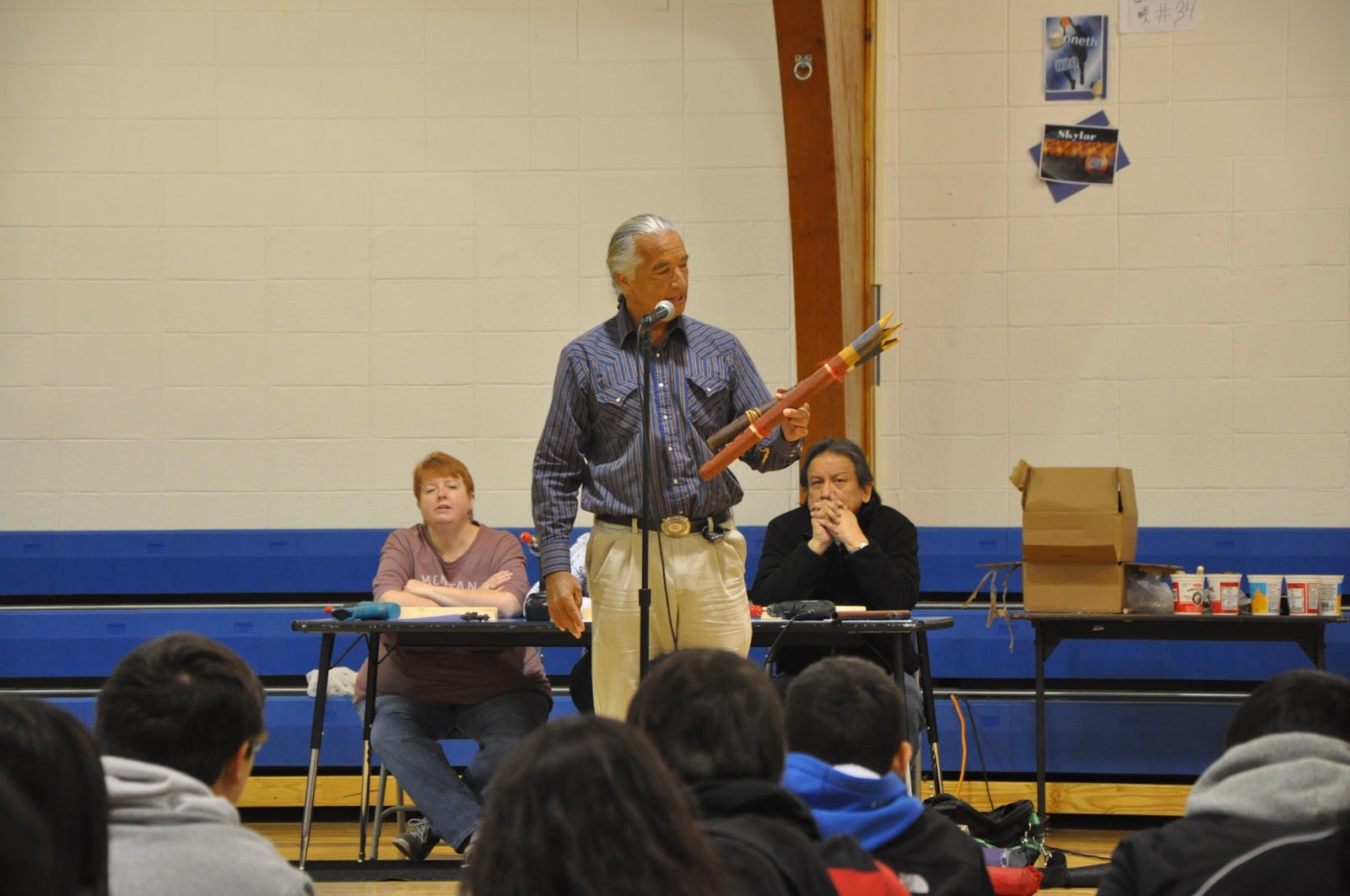
I pulled up to Solen High School on the Standing Rock Sioux Indian Reservation. My passenger Rich Dubé, a personal friend of my Lekši (uncle) and Wauŋšpekiyapi (teacher) Kevin Locke, and I swapped stories about the gift of Šiyotĥaŋka (the flute), where it came from, when it appeared on the steppe of the Northern Great Plains, and its growing revival.

Rich Dubé, came down from the great snows of Saskatoon, Saskatchewan to conduct a flute workshop in four of the schools on the reservation. I visited with Dubé the evening before. When I heard he was from Saskatoon, and was coming down to the Land of Sky and Wind, I prejudged who I thought I’d be meeting. Kevin raved about Dubé’s knowledge in the reconstruction of the traditional flute, how they were made, the original sound, and that Dubé even wrote his Masters thesis around the flute.

Naturally, I thought Dubé was going to be a member of the White Cap Dakota Nation who reside on a reserve just south of Saskatoon. Not that skin color matters but I was expecting to meet a native man. Who met me instead, and broke my prejudice, was an impeccable skinny white guy. He seemed used to native scrutiny however and graciously anticipated and answered my probing questions, which eased my mental lockjaw. I backed off when I was satisfied that he knew what he was about.

Dubé had never heard of the native flute until he attended a session for choir teachers...

Dubé is a music teacher. His story with the native flute begins about ten years ago in Saskatoon. He was teaching native youth in an inner city music program. Dubé had never heard of the native flute until he attended a session for choir teachers and he leafed through a book by Bryan Burton called Voices of the Wind which had native flute songs transcribed for the recorder. He was looking for something to capture the interest and inspire his senior kids and thought the native flute would be much more appealing to his students than just trying to play the songs on a recorder, a western European instrument.

The music teacher searched the internet looking for flute makers, and experimenting with various flute kits, discarding those that didn’t seem to have a true sound to his sharp ears. Eventually, Dubé crossed paths with Kevin Locke. Kevin sent Dubé the schematics of one of his great-grandfather’s flutes. Dubé seized the opportunity to reconstruct not just a traditional flute, but a traditional flute with the original sound.

One of Dubé's flutes.

Dubé created a cast using the original traditional flute from Kevin’s schematics. Dubé wanted to create a flute that was easily constructed and mass produced yet true to the original sound. In the end, his experiments found success in a custom size ABS plastic flute matching the exact sound of the original one-hundred twenty-year-old flute.

...small town pride in the class B team that represented the best hopes of the community...

I entered the high school and remembered my days when my team played the Solen Sioux. There was the typical small town pride in the class B team that represented the best hopes of the community, and like any small town, the team was fiercely held high in respect. Putting the games of yesteryear firmly in the back of my head I made my way down the hall towards the gym where Dubé was preparing his workshop.

Dubé’s luggage was opened up on the bleachers and inside it was as though he had brought an entire workshop. Someone had set up some tables and Dubé was quick to set drills, tools and all his accoutrements out for the workshop. In the span of twenty minutes he trained staff and volunteers in preparation for students to drill the holes of their flutes.

Kevin arrived about fifteen minutes after we got to the school. Students were quietly milling about in the halls in eager anticipation of the morning’s project. A few had poked their heads into the gym to watch Dubé set up and train the school staff. A teacher, possibly the principle, cheerfully made some announcements about lunch and stuff before she gently reminded students to be on their best behavior for Dubé’s flute workshop.

Locke offered a heart-felt greeting to the youth who assembled at the school.

About fifty-five high school students filed into the gym, arranged by year, and immediately staked out spots on the basketball court. The gym quickly filled with echoes of growing chatter which became a loud buzz with the arrival of fifth and sixth graders from the nearby community of Cannonball, who took the floor closest to where Dubé was set up.

The principle made a few announcements reiterating students to be on their best behavior and extended a welcome on behalf of the schools and introduced Kevin. Kevin introduced Dubé who shared some technical things about the flute and what to be expected in the workshop, and the students listened as best as students could while they itched to get to the construction.

Dubé divided the large group into three and subdivided each of those into three at each table. From the time of Dubé’s beginning instructions to the last student drilling the last hole in the last flute and the last student assembling the various pieces into a replica of the Lakota Grandfather flute, about forty minutes had passed. At one point in the assembly Kevin remarked, “Rich is really organized,” a sentiment which was repeated by high school staff.

Dubé (orange shirt) plays a quick tune between instructing students.

When the last flute was put together, Dubé called for the students to gather together once again on the basketball court where he offered some basic flute instruction. It was this instruction that Dubé’s experience as music teacher came out. When the students were quieted with their flutes and ready to play, Dubé played a few simple songs with the students who echoed his rendition of the old English tune “Hot Cross Buns.” The fifth and sixth grade students were quite familiar with playing the song on their recorders and followed Dubé’s instruction swiftly.

There, Kevin shared the story of the first flute.

After Dubé’s crash course in flute basics, Kevin stepped in and shared a few flute songs, one of which was the Flag song which the students recognized right away. The students had grown tired of the floor towards the end of the workshop and took to the bleachers on the other side of the gym after the song. There, Kevin shared the story of the first flute. He played the first flute song as part the story, and sang the song at the end.

One of the things that Kevin shared, a traditional belief, was that the Dakota and Lakota people are people of the wind. On the tips of ones fingers are what we call fingerprints. We all have fingerprints. For the Dakota and Lakota people however, fingerprints are more than something that identifies and/or incriminates a person, they say that the patterns tell one which direction the winds were blowing on the day of one’s birth.

In the days of warriors and legend, the flute was played by young men in traditional courtship, to win the heart of a particular young woman. A young man might sit outside the lodge of a young woman and serenade her. If he was successful, she might contrive an excuse to fetch water or gather additional firewood to spend a few moments with a suitor.

"Indian Courting" by Captain Seth Eastman, 1852.

The flute was a part of daily life.

The flute was a part of daily life. Early American Western artists like Seth Eastman and George Catlin painted scenes of young men playing the flute. When the post reservation era began, traditional courtship faded and was nearly forgotten.

In the 1970s, Kevin Locke took up the flute and learned about the tradition from men like Richard Fool Bull, William Horn Cloud, Joseph Rockboy, Asa Primeaux, Henry Crow Dog, Bill Black Lance, Charles Wise Spirit and Pete Looking Horse among many others. At a wacipi, Locke saw Richard Fool Bull’s display of flutes and remarked, “Someone should learn this tradition,” to which Fool Bull said, “Maybe you should.” And Kevin did.

Locke hopes to pass on the flute tradition to the today’s generation. Dubé’s flute workshop fits snugly into the world of the young native student. An individual can construct a flute with traditional specs and a faithful sound and be finished in five minutes using Dubé’s kit. In a world where studies come first, where extracurricular activities play a large role in a student’s life and where popular media influences style and dress, there’s still time and place for dancers and singers to hit the pow-wow circuit.

In the Land of Sky and Wind the wind is a constant presence. The people of Standing Rock are people of the stars. They are people of the wind. Maybe the flute tradition will work itself back into the daily lives of the people as it once did. 

Visit Kevin Locke online at Kevin Locke.
Visit Rich Dubé at Northern Spirit Flutes.

Thursday, February 23, 2012

Traditional Lakota Courtship

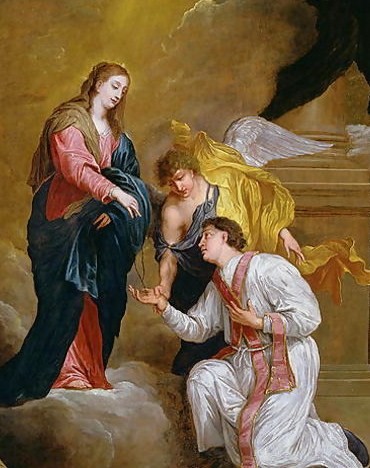
File:St-Valentine-Kneeling-In-Supplication.jpg
Saint Valentine recieves a rosary from the Virgin Mary.
Traditional Lakota Courtship
Lakota Demonstrations Of Affection

By Dakota Wind
GREAT PLAINS - Valentine’s Day is a day most associated with romantic love, often celebrated with affectionate cards, fresh flowers, or gifting of sweets to loved ones. Its my understanding that celebrating Valentine’s Day as it is celebrated today wasn’t always so, that it wasn’t until the Middle Ages that the saint’s day became associated with courtly love.


Amongst the Lakota there is a courting practice, an old tradition seldom performed today, but reaching back nearly a thousand years, and it starts with serenading one’s object of affection with the haunting sound of flute music.


Like many ancient world traditions, the Lakota used to arrange marriages for their daughters. This practice, along with polygamous marriages (when a man took more than one wife), have not been put into practice in well over a century.


The origin of the flute on the Northern Plains has many stories, about as many stories as there are tribes with variations among the bands or clans of those tribes.

Kevin Locke from his Makoche album "Open Circle." Artistically speaking, it is Kevin's best piece of work. Gratify yourself and get a copy on Amazon or buy it through Makoche in Bismarck, ND.

Traditional flute-players Bryan Akipa and Kevin Locke tell the story of a young man who fell in love with a young woman a long time ago. The young man became so smitten around the woman of his affections, that he found he could not talk to her. Motivated by his silence of melancholy, the young man removed himself from the village.

They say this young man came to the river and followed it. He eventually came to rest under the shade of a tree; some say it was a cedar tree. He fell asleep, or as he was drifting off to sleep, he heard the wind passing through the branches of the tree. In the branches of the tree were holes that a woodpecker had drilled, probably looking for termites or bore beetles. As the wind passed over the holes of the branch, a melody was produced.

Some say that it was the personification of elk who came to visit the young man and gifted him with the flute because they were moved by his inability to articulate his feelings to the young woman of his affections. Some say he merely reached up and carefully removed the branch and the birds taught him how to sing with it.


Englishman Paul Goble renders the first flute story in his book "Love Flute" which is published by Aladdin Paperbacks. The look and feel of the book is based on pictographs of the Plains Indians.

However he came to possess the flute, he learned its art. Then he returned to his village. He played his flute from the outskirts of the encampment, perhaps from the top of a hill or perhaps upwind so that his music could carry.

The young woman with whom he was in love with knew immediately that the music was for her. She returned his affections and they became a couple.

I have always been interested in when something happened. Like the flute story. When did the flute appear on the Northern Plains? I like to ask flute-players when they think the flute came to be, but the answer is almost always a resounding “a long time.” Then one day I asked Keith Bear, a Mandan-Hidatsa flute-player when the flute came to be. He quietly reflected that when he was young he had asked a grandfather that same question who in turn told him that when he was young, had asked the same question of a grandfather and was told, “They [the flutes] have been around for the span of ten grandfather’s lives.”

Keith Bear poses regally in a traditional quilled war shirt and carried a beautiful crane flute. He, like Kevin Locke, recorded at Makoche in Bismarck.

It was a puzzle to figure out, the span of ten grandfather’s lives. Keith ruminated that a grandfather’s life could be anywhere from forty to 100. Who knew the answer? I turned to renowned Plains Indian archaeologist Dr. Ray Wood and asked him how long the whistle has been on the northern plains, for in Lakota, one word for whistle is the same as flute, while flute also has another name for it.

As I was waiting for Dr. Wood’s response to my query, I came across the Brown Hat Winter Count in which the span of a grandfather’s life is measured at about seventy-five winters (years). I took this as a good sign, for the Mandan and Hidatsa are long ago relatives of the Lakota. Being that Keith is a grandfather himself, and he had asked a grandfather too, we could easily today say that the flute has been on the Northern Plains for the span of twelve grandfathers. Twelve times seventy-five equals 900. Now subtract 900 from the year I asked, which was back in 2000, we arrive at the year AD 1100.


Here's one of Dr. Wood's many works about the archaeology and history on the Northern Plains. Dr. Wood might not have had the excitement of Indiana Jones, but at one point fifty some years ago, he and several other archaeologists worked feverishly to salvage what they could when the dams were built by the Army Corps of Engineers back in the 1950s.

I eventually received a reply from Dr. Wood. He graciously and swiftly responded (in two weeks) and sent me images of the whistles he personally recovered from a few sites along the Upper Missouri River. He dated them to the year AD 1100.

In contrast of the flute story where the young man courts the affections of the woman and wins her heart is the story of the Homely Girl.

A long time ago, as these stories go, a young girl was relentlessly teased about her looks. She wasn’t regarded in any way beautiful. In the version I heard, she lived with her grandmother, and she was in love with the chief’s son. The grandmother was in a way, the fairy god-mother of this story.

A day came when the chief wanted to arrange the marriage of his son and he made an announcement to the people. The chief’s son was considered by many to be not just brave in battle but quite handsome in appearance. All the single young women of the village wanted to be the wife of the chief’s son. The chief proclaimed that a test would determine who would be his son’s wife.


I haven't heard the story of the Homely Girl since I was little, but the story of the "Rough-Face Girl" by Rafe Martin and David Shannon is close. Buy yourself a copy of this beautiful story.

Perhaps it was a year that passed as the women prepared for the test, perhaps a summer only, I don’t recollect that detail, but they prepared. When the young women heard that the homely girl wanted to participate, they scoffed and openly mocked her efforts.

The test consisted of a demonstration of domestic life, which at that time meant food preparation, building a fire, and a host of other skills like tanning and making moccasins.

The homely girl’s grandmother took her granddaughter out in the summer field and showed her which turnips to pick to make soup with, and they plaited them together into one long braid. The grandmother took her granddaughter into the woods and showed her which wood to pick for starting a fire and which wood to pick to burn the longest. The grandmother showed her granddaughter how best to set up the tipi and take it down in wind and rain, in the heat and cold.

The time of the test arrived, and the chief and his son visited all the families who had suitors. They visited the beautiful and the daughters of other chiefs, many who rushed to prepare food, who couldn’t maintain a fire, whose impatience showed in their beadwork or quillwork, or who couldn’t assemble or disassemble a tipi swiftly enough to satisfy the chief.

They came at last to the homely girl’s demonstration. She made simple moccasins with hard soles and modest accents of quillwork. She built a fire and it lasted through the night. For much of their time, the chief and his son quietly watched the homely girl in her demonstrations.

The test came to an end. The beautiful women were confident one of them would be chosen. The daughters of other chiefs were confident were confident one of them would chosen. At the end of the day, though, it was the homely girl who was chosen for her quality of character was revealed in her craft and preparation. She was not haughty, she was not impatient, and she did not spite any of her rivals.

In the first story, the lesson men should take is patience, and to find one’s voice. A natural lesson is to be learned from it too is that in nature it is the male who must prove his worth to the female.

In the second story, the virtues that Lakota women should practice are humility and patience. Virtue wins out in the end.

Monday, October 10, 2011

The Waterfall Maiden, A Lakota Love Story

The Waterfall Maiden
An Enduring Tale Of A Sad Love Story
By Dakota Wind
SIOUX FALLS, S.D. - The Ihanktowon, or Yankton, were camped at the falls of the Big Sioux River in South Dakota.  The falls was a favorite winter camp site as there was plenty of water, game, and resources for keeping the camp there. 

In the late fall and throughout the winter when the water was low enough, the Yankton could easily cross the river on stepping stones above the falls. 

Because this site was so popular, many tribes would trade here in an annual rendezvous. 

It happened one winter, at the time when winter passes and nature embraces spring, a neighboring tribe came to make temporary camp on the east bank of the Winding River.  The Yankton were camped on the west bank and as the seasons were changing, so did they begin to prepare to break camp.


The Yankton chief immediately formed a delegation of his head men, some of his relatives, and his own immediate family and crossed the Winding River Falls to meet their new neighbors. 

The new neighbors proved to be quite hospitable and gracious.  They put on a feast and dance for the Yankton and the celebration lasted into the evening.  The next day, the Yankton chief and his band readied themselves and broke camp, their destination: west to hunt and gather as their Teton Lakota relatives had always done. 

The evening before, during the festivities, the Yankton chief’s daughter met a young brave from the other tribe.  As her people began to prepare to leave their winter camp at the falls, she began to lose her motivation to break camp.  Her enthusiasm to leave waned, but she also didn’t want to disobey her parents and stay behind.  She broke camp with her people and left the winter camp behind. 


It was nearing the end of winter.  The time of year when the geese return, when bison calves are born, when trees began to leave, and it is also the time when ice breaks. 

It was late winter, or early spring if you see it that way, and as her people’s band moved further and further away from the Winding River Falls, the chief’s daughter became withdrawn and sad.  The Yankton maiden became so overcome with longing that she left her father and people and stealthily made her return to the falls. 

Okay, so I couldn't find a proper appropriate image of a native woman by a waterfall, and, "No. Native women didn't dress like this.  If they did, I wonder why I didn't see a sight like this back on the rez."

During the ensuing days from when her people initially left their winter camp to her arrival, the snow melted and the ice broke, submerging the stepping stones of the Winding River Falls.  She couldn’t cross the river.  She stood at the edge of the river looking at the neighboring tribe’s abandoned campsite. 

The Yankton Chief noticed the absence of his daughter sometime later and he knew just where she might be bound, so he sent some of his scouts back to the winter campsite to retrieve her. 

The scouts came upon the Yankton maiden, and as they came closer they overheard the maiden’s song. 

As she stood there, a melody from the falls came to her.  With this melody, she put the words that the young brave had spoken to her: 

One of William Horncloud's albums.  Gratify yourself and get a copy today.

Nióiye wéksuye,
Nióiye wéksuye,
Nióiye wéksuyiŋ na wačhéye nióiye wéksuyiŋ na wačhéye. 
“Eháŋni šáš kičhí waúŋ šni,”
ečháŋmi kiŋ óta ye nióiye wéksuyiŋ na wačhéye. 

I regretted losing you (I wanted you back) and I was heart broken many times. You live somewhere else and are having a hard time.

When you quit (that one) you and I will live together. 

Why did you tell about us?  And now I am in misery, I am in misery.  Why did you tell about us?  And now I am in misery.  

If this is not possible on earth, it will be possible in heaven.  

Love me, you made me miserable.

I remember your words,  
I remember your words,
I remember your words and cried.  
I remember your words and cried.  Many times I have thought:
“I should have been with her long ago,”
I remember your words and cried.   

The song, adapted to flute by Kevin Locke, appears on Locke's album "Dream Catcher."  You should go get yourself a copy of this one too.  Kevin is teaching me this song and has permitted me to play it, which I will when I'm confident I sound good.

Song by William Horncloud
Story by Ben Black Bear Sr.
Big Sioux River name, Ipákšaŋkšaŋ Wakpá (Winding River) remembered by Agnes Ross
Adapted to flute by Kevin Locke


Thursday, July 28, 2011

My Trip to Fort Buford and Back, a Photo Essay Part 2

The new Sitting Bull statue is unveiled at Williston State College.
My Trip to Fort Buford and Back
Photo Essay Part 2
By Dakota Wind
WILLISTON, N.D. - Williston State College wants to challenge and change the sense of place that the community of Williston has of it. The campus has what this writer could only describe as an industrial look to it. The architecture of the campus is heavy on brick, concrete, and pavement. Some locals have taken to calling it “Walmart.”


On July 15, 2011, Williston State College unveiled the Sitting Bull statue to commemorate the 130th anniversary of Sitting Bull’s return to the United States. Sitting Bull and the Hunkpapa, or at least the Hunkpapa who followed him, numbered about 200 at Fort Walsh across the border. Sitting Bull actually returned to Fort Buford on July 18, 1881, just over five years after the Battle of the Little Bighorn.  


Michael Westergard created the bronze Sitting Bull statue which now stands at Williston State College. At the base is the speech which Sitting Bull was said to give as he handed his gun to Crow Foot, who in turn turned it over to commanding officer of Fort Buford. The speech is also in Lakota. Did Sitting Bull Surrender? On Standing Rock, where the Hunkpapa Lakota reside, some interpret the event as an exchange of one lifestyle that of the nomadic hunter-gatherer for that of a sedentary one.


Kevin Locke performed the hoop dance and some flute playing. Locke rendered White Cloud’s “The Indian Prayer” and an American Indian version of the 23rd Psalm in Plains Indian sign and gesture. I did not take pictures of Locke demonstrating the prayers.


Ernie LaPoint, great-grandson and direct lineal descendant of Sitting Bull, offered some words to the community of Williston and all present about his famous ancestor. He is an enrolled member of the Oglala Lakota on the Pine Ridge Sioux Indian Reservation in South Dakota. LaPoint articulated his ill feelings about the people of Standing Rock to the people in attendance. I don’t know if LaPoint has ever met with the nearly 16,000 enrolled members living on and off the reservation. One can read LaPoint’s thoughts of Standing Rock by reviewing his book "Sitting Bull: His Life and Legacy."


This writer isn’t trying to cut down the works or teachings of LaPoint. Far from it. LaPoint is seemingly a good man possessed of great humor and quick wit. This writer wants you, reader, to be aware that Standing Rock has good people too and is a great place to live and visit. There might not be lineal descendants of Sitting Bull on Standing Rock, but Sitting Bull’s own band are still there, the Hunkpapa Lakota (some are also on the Fort Peck Sioux Indian Reservation).


From Williston State College this writer went to Fort Union. The above picture is the view across the river much the same as Karl Bodmer knew it back it in the 1830s.  

Picture of Fort Union from Frank Leslie’s Illustrated Newspaper, May 1868.

It was once an American Fur Trade company outpost from 1828 to 1867. The Hunkpapa Lakota attacked this fort several times in the 1860s. The fort itself was a rendezvous for several tribes like the Crow, Hidatsa, Arikara, Mandan, Chippewa, Blackfeet, and the Dakota/Lakota.


Last summer, June 2010, this writer asked the ranger on duty in this room, the reception area for trade, for my allotment, to which he said after a stunned moment, “We don’t do that anymore.” 


Mr. Loren Yellow Bird was gracious enough to take a picture with this writer outside the commanding officer’s quarters within Fort Union. The walls were intended to keep out Indians, but now an Indian serves as superintendant of the site. Mr. Yellow Bird brings understanding of cultural and historical context to this national historic site.  


Fort Union along the Upper Missouri River seen today much as it would have been seen in the mid nineteenth century. The fort is inside North Dakota but the drive and parking lot are in Montana.  


A couple of miles east of Fort Union is Fort Buford, a North Dakota state historic site. It was in operation from 1866 to 1895 when the US Army abandoned it. The fort was established as a camp in mid 1866 and was attacked almost daily until the late fall. The Lakota saw the forts along the Missouri as representative of invasion. Fort Buford is where Sitting Bull exchanged one lifestyle for another (generally regarded as a surrender) in July 1881.  


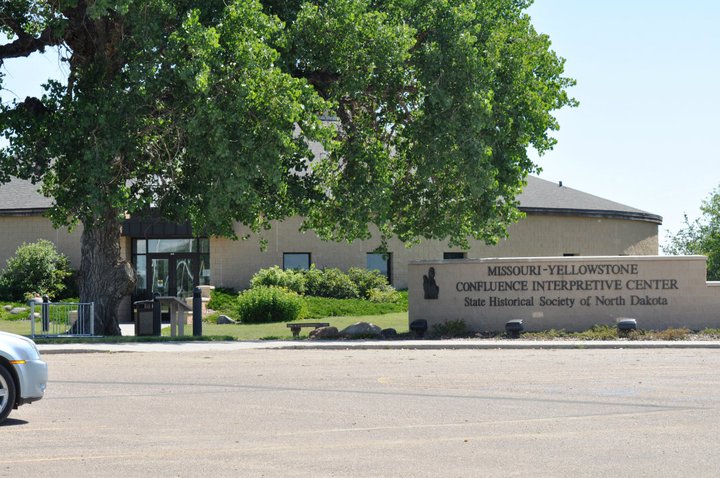
The Missouri-Yellowstone Confluence Interpretive Center. If ever you, dear reader, get a chance to visit the northwest corner of North Dakota, take in this center. A museum is inside and the trails there offer beautiful riverfront walks. The staff are friendly and offer tours of Fort Buford.  


The North Unit of the Theodore Roosevelt National Park.


Again.


Another view from the other side of the Little Missouri River valley at the North Unit.


On my way home, I stopped by the Killdeer Battle site, a North Dakota state historic site. The signage says “Tachawakute (The Place Where They Kill Deer),” and far be it from this writer to disagree with interpretive signage, and though this writer has often heard it called “Killdeer,” it might be more correct to interpret the name as The Place Where They Hunt Deer, or in Lakota “Tahċa Wakutėpi.”  


Carl Ludwig Boeckmann painted this scene of Killdeer entirely from memory. The depiction of the landscape is surprisingly accurate. Look for similarities between this image and the following pictures.  


This is the east side of the Killdeer plateau. This writer parked and hiked and climbed the east embankment and walls to reach Medicine Hole, where the Dakota and Lakota say that some of them escaped the military by crawling through the tunnels. This author arrived as the sun was setting. A lonely coyote sung in the hills somewhere, dragonflies buzzed and kept the mosquitoes to a minimum. A slight breeze caused the leaves and branches to “shush.” It would have been an entirely peaceful visit if this author wasn’t aware of the gunfight that happened here in 1863.  


Medicine Hole.


A view from Medicine Hole at the top of the Killdeer plateau to the southwest.


A view from Medicine Hole (bottom foreground) to the sunset west-north-westerly.  


A view of the Killdeer plateau from the southeast facing northwest as the sun sank behind the geophysical feature.


A hawk flew into frame as this writer caught one more picture of the Killdeer site from the southeast looking northwest.