Showing posts with label Dakota 38. Show all posts

Wednesday, August 28, 2013

Whitestone Hill 150 Years Later

Whitestone Hill 150 Years Later, 1863-2013
The Bloodiest Massacre On The Great Plains
By Dakota Wind
WHITESTONE HILL, N.D. – The wind blew in gusts across the vast open plains. The Dakota and Lakota people who have lived here for millennia are people of the stars, and some of them say too that they are people of the wind. The wind isn’t just the defining characteristic of prairie life, but a part of the indigenous culture.

The Dakota say that the patterns on ones’ fingertips indicate which direction the wind was blowing on the day of one’s birth. The swirling pattern on one’s crown was taken to mean not just the living presence of one’s spirit, but the wind that brings that spirit. Sometimes, a very powerful wind was even referred to as Táku Wakȟáŋ Škaŋškáŋ, Something With-Energy Is Moving About. Indeed, a Dakȟóta elder visiting from Crow Creek, SD declared that the strength of the wind was an indication that the spirits were there at Whitestone Hill.

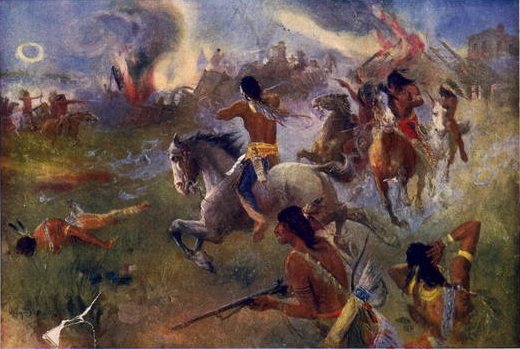
On Saturday, August 24, 2013, over 300 people from across North Dakota and the Great Plains gathered at Whitestone Hill near Kulm, ND to remember the bloodiest massacre of Dakota Indians following the largest mass execution in the history of the United States, which involved thirty-eight of the Dakota Indians in Mankato, MN, Dec. 26, 1862.

Despite high winds, and green lodge assemblers, this beautifully painted lodge was set up.

On this day, someone from Lake Traverse, the Sisseton-Wahpeton Oyate, brought a beautifully painted thipí rendered in warm earth tones of red, orange, and brown with constellation patterns embellishing the outside of the lodge. A call went out for assistance to erect the lodge on that windy day and volunteers rushed to assist.

They say in the days of memory, that women could erect a lodge in as little as ten minutes. Their nomadic life way demanded a lifetime of practice, but on this day Dakȟóta women supervise a handful of non-native men, there’s even a Chippewa in the mix helping to get the lodge up.

Renowned and eminent flute-player and hoop dancer, and enrolled member of the Standing Rock Sioux Tribe, Kevin Locke, was called forward to begin the day with a prayer. At the end of the afternoon’s lectures and reflections, Locke would share the message of vision and unity of the human spirit with the hoop dance, traditional stories, and flute songs.

Locke performs the hoop dance, pictured here at Williston State College. 

Locke, known among the Dakȟóta and Lakȟóta as Tȟokéya Inážiŋ, The First To Arise, is also a descendant of Ta’Oyáte Dúta, His Red Nation, who is more widely known by the name Little Crow. Locke doesn’t make a public issue about his great-grandfather, probably because Tȟaóyate Dúta was not at Whitestone Hill, but had died of a gunshot wound in a field near Hutchinson, MN in a fight with a farmer.

One of Tȟaóyate Dúta’s sons, Mokáȟniȟya, had fled west to the Húŋkpapȟa and was among them in the running battle from Big Mound to Apple Creek. Mokáȟniȟya survived the Apple Creek conflict in late July by cutting a reed, grabbing a rock, and jumping into the Missouri River. There he waited until it was safe for him to cross. But this wasn’t a story that Locke shared at Whitestone Hill, it was a story shared with this writer in Locke’s home. Locke’s message this day was instead based on the ideal of what Dakȟóta is, as ally, as friend, and as peace.

Richard Rothaus, owner and director of Trefoil Natural and Cultural out of Minnesota, was invited to present about the causes of the 1862 Minnesota Dakota Conflict, and expertly tied the Dakota Conflicts in Minnesota and Dakota Territory to the American Civil War which was being waged concurrently in the south.

Aaron Barth, a historian and archaeologist from North Dakota State University, offered his thoughts about the Whitestone Hill massacre as an agent of genocide in American history. Barth facetiously suggested attaching cables to the current monument atop Whitestone Hill and pulling it down, but in seriousness suggested a memorial be erected on site honoring the Dakȟóta and Lakȟóta.


A local city band gathered together over the lunch hour and played music themes from popular movies and other pieces. The music, while rendered in the spirit of peace, seemed decidedly out of place. At one point the band played the theme made popular in the Rocky movies. A visitor from the Sisseton-Wahpeton Oyate observed that the music was very nice but out of place and jovially said during the Rocky theme, “That makes me feel like running to the top of the hill and raise my fists and shout, ‘We’re still here!’”

A panel discussion made up of members from the Sisseton-Wahpeton Oyate and the Standing Rock Sioux shared observations regarding the history and conflict of Whitestone Hill. LaDonna Brave Bull-Allard shared her grandmother’s story of survival when her people, the Iháŋktȟuŋwaŋna Pabáska, the Cuthead Yanktonai, came under sudden and unexpected fire.

The Cuthead Yanktonai band had been proponents of the United States since 1818 when their chieftain, Waná’at’á, The Charger, was released from an internment at Fort Snelling. The Charger led the Yanktonai in a siege under the command of Colonel Leavenworth against the Arikara in 1823. The Yanktonai had no reason to fear their American allies until General Sully brought the wrath of the soldiers on them at Whitestone Hill, Sept. 3-5, 1863.

A tribal elder from Crow Creek, and a descendant of Tȟóka Khuté, Shoots The Enemy, who was captured at Whitestone Hill and imprisoned at Fort Thompson, Dakota Territory (present-day South Dakota), articulated a short explanation of the site before he departed from Whitestone Hill that afternoon. In the Ihanktowana dialect, Wičhéyena, Whitestone Hill was never called or recognized as Whitestone Hill. They called it Pa IpuzA Nape Wakpana, Dry Bone [as in “Very Thirsty] Hill Creek. “They never called it ‘Whitestone Hill,’” insists Corbin Shoots The Enemy.

Shoots The Enemy shared the story that few young men were in the village as most were out hunting. Men who were past their warrior days stayed behind with elders and youth in the village. Among the chiefs who led thiyóšpaye, an extended family, at Whitestone Hill that day are: Nasúna Thaŋka (Big Head), Taȟča Ska (White Deer), Šuŋkáȟa Napíŋ (Wolf Necklace), Mahtó Wakáŋtuya (High Bear), Hotháŋke (Big Voice, Winnebago), Mahtó Nuŋpa (Two Bear), Wáğa (Cottonwood), Hoğáŋ Dúta (Red Fish), Mahtó KnaškiŋyAn (Mad Bear), Awáska (White With Snow), Waŋbdí Wanapȟéya (Eagle That Scares), Waŋbdí Maní (Walking Eagle), Waoŋzoği (With Pants, or Pantaloons), Čhaŋ Ičú (Takes The Wood), Waŋbdí Ska (White Eagle), Tȟóka Khuté (Shoots The Enemy), and Ziŋtkála Maní (Walking Bird).

These Itȟáŋčhaŋ, chiefs, led tens to hundreds in their thiyóšpaye. There were easily at least a thousand Ihanktowana at Whitestone Hill. Several tons of food were destroyed following the massacre, thousands of dogs were killed, and as many as three hundred Dakȟóta people lost their lives, and over a hundred were taken prisoner, most of whom were women and children.

Lakȟóta language instructor, Earl Bull Head, and an enrolled member of the Standing Rock Sioux Tribe, was called upon to share a song and story. A storyteller, Bull Head opened with a few jokes about his travels to Europe and his experiences with the world before sharing a story and song he originally composed for a friend who lost his son. Bull Head’s friend was caught up in misery and heartbreak. The song came to Bull Head to inspire his friend to live a good life; it was a call to redemption and forgiveness.

A stone circle, this one about five feet in diameter, rests on private land at the Whitestone Hill site.

A local landowner invited this writer to his land nearby to view some of the features not found at the Whitestone Hill State Historic Site. On top of a rolling hill were several stone circles, several about five feet across and one measured about fifty feet in diameter, and a few great heavy anvil stones bore evidence of shaping tools over thousands of years, which reminded this visitor once again that people were coming here millennia before the conflict.

Sunset at Stoney Lake, north of Tappen, ND. This is where the Lakota engaged General Sibley's command for the second time in July, 1863.

The day ended with a buffalo feed. A long lingering line gradually worked itself through the hundreds of visitors present. Plates were piled with great cuts of lean bison meat, hot steaming potatoes, warmed beans, and handmade biscuits. Conversation ebbed and flowed as the line shrunk. The wind gradually calmed to a breeze, which in the great shade a cottonwood, actually cooled the waiting hungry crowd.

My plate was piled high and heavy with food. I took a cup of lemonade and downed it before I made it back to my car. I was hungry and the smell of roasted meat nearly made me break my fast, but I couldn’t eat. I felt the impression of my grandmother, after all these years sometimes it seems like I can smell her or sense her watching me.

Sunset at Big Mound where Sitting Bull counted coup on one of Sibley's men. Sitting Bull also stole a mule from the line in a show of bravery. This was the first engagement that summer between the Lakota and Sibley's command, July 1863.

I drove off down the dusty gravel road, over the rolling grassy hills, and out of sight from the crowd. It may seem like waste to some, but it wasn’t to me. I pulled over onto the grass, took my plate, and carried it to the side of the road. I said no prayer or benediction. I didn’t call out or cry. I could not eat there when long ago my relatives were forced to go without. It is the custom of the Dakȟóta and Lakȟóta people to take food to our relatives who’ve taken their journey. 

Wednesday, April 10, 2013

Dakĥota Kaškapi Okicize Wowapi: The Dakota Prisoner Of War Letters, A Review

The Dakota Prisoner Of War Letters
A Review Of A Powerful Narrative
By Dakota Wind
BISMARCK, N.D. - I received my copy of Dr. Clifford Canku’s The Dakota Prisoner Of War Letters: Dakota Kaškapi Okicize Wowapi through the mail and I carefully removed it from the box it came in. I was excited to read it, but not joyous to do so. Its about a real life tragedy, the consequences of which the Dakota and Lakota are still living with today. 

My initial perception of the book, my judgment of the book based on its cover, was that I was getting a book in the vein of Albert White Hat’s Life’s Journey. In the case of White Hat’s book, the transcriber, Mr. John Cunningham, and White Hat took great pains to keep the oration of the book even as a translation into English as how a traditional Lakota would speak English. White Hat’s work retains the “flavor” of the language.

Canku’s book goes a step further. Not only did White Hat and his associates invest several years translating beautifully hand-written letters in Dakota to English, Canku keeps the original Dakota, but he adds a word for word translation, then a free translation into English which contains Dakota connotations.

Dr. Canku carefully reads a letter of a Dakota prisoner.

There are two things which reached out to me about this book. The first being that its about the Dakota who became prisoners of war following the Minnesota Dakota Conflict of 1862. The book contains letters, first-person accounts of innocent men and women who were wrongly accused and imprisoned. They weren’t US Citizens, so due process didn’t apply to them, so they were guilty and imprisoned until they were determined to be innocent or no longer a threat.

Part of the story of the letters involves a missionary to the Dakota people, Rev. Stephen Riggs.

Riggs, a missionary among the Dakota in the 1850s, was present when cases involving the Dakota were judged, as fast as the service at a fast food restaurant. In one day, Riggs saw forty Dakota cases judged and sentenced to death in about seven hours. Some of the cases took mere minutes.

The missionary Stephen Riggs.

Missionaries, including Riggs, visited the Dakota prisoners, and converted a captive audience, while writing their letters of appeal for them, letters to loved ones at different agencies and letters to military commanders pledging to never more resist the American expansion westward.

The second thing which reached out to me was that the book is bi-lingual. There aren’t many resources published in both Dakota and English. As a person whose first language is English, and being a Dakota-Lakota person, having the original Dakota language present for me to read and learn is wonderful.

The most intriguing part of this book is the scholar himself. Dr. Clifford Canku. He is an enrolled member of the Sisseton-Wahpeton Oyate and a retired Presbyterian minister. Canku is a common man and his stirring introduction includes early efforts from the previous teams he worked with at Flandreau, SD, the Sisseton Wahpeton College, and then North Dakota State University. Even though his name is on the cover alongside Michael Simon, Canku is quick to acknowledge the efforts of others.

Taoyate Duta, His Red Nation, more commonly known as "Little Crow."

Before being brought on to earliest efforts of this translation project, Canku was visited by the spirit of Taoyate Duta (His Red Nation; aka Little Crow). Throughout the translation process, a spiritual presence was always present. When the project wrapped, Canku received another visitor through a dream. He was at a sundance in this dream and a old man was brought into the east gate where his name was announced four times. The grandfather’s name: Wakaŋboide (Sacred Blazing Fire). The grandfather came to Canku and said, “Hau, wičohaŋ ečanupi kiŋ de wašhté do.” (Yes, the work you are doing is good, it is so.)

Canku is deliberate in that the reader, casual or otherwise, clearly understands that the book is about the Dakota prisoners of war. There are plenty of books out there, and more so with the 150th anniversary of the Civil War and the Dakota War, but Canku’s and Simon’s book is the only published primary resource from the perspective of the people who fought, the people who defended, and the people who were entirely innocent of the 1862 Minnesota Dakota Conflict.

Camp Kearny, where the Dakota prisoners of war were taken.

An excerpt of one of the letters places the reader in the first person. Wiŋyaŋ, or Woman, writes to her relative Pa Yuĥa, Curly Head, about starving and the heartbreak in the prison camp at Davenport, Iowa:
…my heart is so very broken, it is so. Last summer, we all know one terrible event has occurred, and always we are very heartbroken, because now again, my heart if broken very much, because this winter we are without, we are all suffering. I hate to live, it is so. And now where will they take us?...now we don’t know where they will take us, and therefore I thought maybe we will never see all of you, and therefore my heart is very sad.

Another letter by Stands On Earth Woman tells her relative His Country that she is recently widowed and with a new baby, at the prison camp. She asks for her relative’s assistance because she literally has nothing and she’s starving.

Get this book if you are interested in the “other” side, the forgotten side of the story. Get this book to support a native elder and scholar, but get this book so that we never forget what happened as a result of this terrible conflict. 

Tuesday, October 9, 2012

His Red Nation: A Tale of Little Crow

Little Crow's village on the Mississippi by Capt. Seth Eastman, 1846.
His Red Nation: A Tale of Little Crow
Dakota Leader And The Struggle For Survival
By Jerome Kills Small
GREAT PLAINS - Note: This was written for an issue of the North Dakota publication "On Second Thought" in 2012. Taoyate Duta, His Red Nation was born the winter that Little Beaver’s cabin burned down (1810), in the Dakota village of Kaposia, Not Encumbered With Much Baggage (St. Paul, MN), where the Minnesota and Mississippi Rivers converge. His Red Nation was named so by his father, a prominent Mdewakanton Dakota chief by the name of Cetan Wakhuwan Mani, Hawk Hunting Walks. Due to a mis-translation, and probably because of His Red Nation’s status as son to Hawk Hunting Walks, His Red Nation is more commonly recognized as Little Crow.

Little more than a toddler, His Red Nation's mother took him to the frozen Minnesota River in the middle of winter. There she broke the ice, took her son and proceeded to dunk him into the icy waters, and as she did so, she told him that he would grow into a man who would become a great leader. It sounds cruel, however, but His Red Nation never forgot his mother's words. Even as a man years later, he remembered what she did and as a result, what she said, as clearly as if it happened only yesterday.


His Red Nation, a pencil sketch by Frank Blackwell Mayer in 1851 at Traverse de Sioux, Minnesota Territory.

His Red Nation will forever be associated with the 1862 Minnesota Dakota Conflict, but the conflict was only the latest of terrible events. To understand the conflict and its consequences, one must examine the precarious circumstances in which the Eastern Dakota found themselves.

The Santee Dakota, or Eastern Sioux, had actively traded with the French and English since about 1640. The English pushed west, of what was considered then the Northwest Territory, or present-day Ohio. Colonel Robert Dickson, a British Trade Agent at the turn of 1800, became good friends with the Santee. His Red Nation was still a toddler when the War of 1812 broke out. Dickson recruited hundreds of Chippewa and Dakota and led them into Ohio to fight against Americans. Hawk Hunting Walks, was among those who fought for the English.

Taoyate Duta's father, Cetan Wakhuwan Mani (Hawk Hunting Walks) as painted by Charles Bird King, 1824. The painting is called or titled "Chetaii Wakan Mani, The Sacred Pigeon-Hawk Which Comes Walking."

After the War of 1812, England and the United States signed the Treat of Ghent, ending warfare between the two countries. The treaty also gave control of Minnesota to the United States. The Santee would now have to deal with an unforgiving country they had initially fought against. Hawk Hunting Walks was honored with several gifts and accommodations from Colonel Dickson, but Hawk Hunting Walks refused them and was said to have kicked them, saying, “Now after we have fought for you, endured many hardships, lost some of our people, and awakened the vengeance of a powerful nation, our neighbours, you make a peace for yourselves, and leave us to get such terms as we can. You no longer need our services, and offer us these goods as a compensation for having deserted us. But, no-we will not take them; we hold them and yourselves in equal contempt.”

Traditional warfare between the Santee and Chippewa resumed regardless that they briefly fought alongside each other in the War of 1812. In 1823, Colonel Leavenworth led the Missouri Legion in a campaign against the Arikara on the Missouri River. About 750 Dakota and Lakota warriors fought for the United States under Leavenworth against an age-old foe in the first US led military campaign against a Plains Indian tribe. It was an absolute crushing defeat for the Arikara, who abandoned their earthlodge villages and fled west. Their fields of corn, squash, and beans, were plucked clean by the Dakota and Lakota who recalled the year as “The Winter Corn was Taken.”


"The year corn was taken," or 1823, from the Long Soldier Winter Count.

Hawk Hunting Walks’ image was painted by Charles King Bird on a visit to President James Monroe in 1824. Monroe congratulated the Sioux for their participation in breaking the Arikara out west, this, as sentiment grew in DC that Indians should all be moved west of the Mississippi River. Hawk Hunting Walks returned to Minnesota, perhaps a little wary, and signed the Treaty of Prairie Du Chien of 1825 under the watchful eye of General William Clark, former captain of the Corps of Discovery. The treaty formalized tribal territories and sought to end generations of inter-tribal conflict.

In 1830, General Clark brought several bands of Sioux together to sign another Treaty of Prairie Du Chien, which ceded three large tracts of land to the United States for westward expansion into Minnesota. It was a treaty that the Dakota were hard-pressed to keep.


Little Crow, photo by Whitney, 1862.

The Sioux, Dakota and Lakota, had other concerns throughout the 1830s and 1840s. There was warfare with the Crow, Arikara, Pawnee, and Shoshone west of the Missouri River, and continuing warfare with the Chippewa up north. Smallpox took the lives of thousands of Indians across the Plains. A massive star fall is remembered in nearly all winter counts. In 1846, Hawk Hunting Walks had a gun mishap in which he accidentally shot himself and died.

Chieftanship of the Mdewakanton Dakota, whom Hawk Hunting Walks led, was in dispute. Hawk Hunting Walks had children with three wives. His Red Nation’s mother was a Wahpekute Dakota, and so his brothers from his father’s other wives conspired to keep the chieftanship within the Mdewakanton. All of Hawk Hunting Walks’ sons met at a tribal get together. His Red Nation’s brothers attempted to assassinate him, at the last moment however, a young man knocked the gun with his hatchet causing the bullet to strike His Red Nation in the arm, breaking it – it was never set properly and healed crookedly, and left an awful scar. The conspiring brothers were condemned to death and His Red Nation became the chief.


"Execution Of The Thirty Eight Sioux Indians" by John C Wise.

As a boy, His Red Nation engaged in sham fights to learn stealth and leadership. To gain a victory in a sham fight, a mock war party had to take the village by surprise, or it wasn’t a victory at all. When he was ten, His Red Nation took his village by surprise when he crept into it unseen with the aid of his dog. A few years later, a friend of his fell through the ice and His Red Nation risked his own life to save him with a line. He fell through the ice as well, but managed to save his friend. His Red Nation became known in his youth as a trusty messenger and a great hunter.

In 1851, after years of preparation, the untimely death of his father, and an attempt on his life, His Red Nation received his first test in American bureaucracy at the Treaty of Traverse De Sioux in which the southern half of Minnesota was ceded to the United States, and the Treaty of Mendota, in which permanent agencies were established for the Dakota in Minnesota. The Dakota were to receive payments for their land cession, and food supplements while they adjusted to a completely sedentary lifestyle.


"Mass Execution of 38 Dakota on the Day After Christmas" By John Stevens.

His Red Nation tried his best to placate the settlers and new Minnesota government by adopting the white man’s clothes. He also converted to Christianity and became an Episcopalian. His Red Nation even took up farming. In his best efforts to ensure peace in his homeland, which had become an island in the middle of non-native settlement, in 1860 His Red Nation went east to visit with President James Buchanan to remind him that the Dakota fought for the US under Leavenworth and had willingly signed and followed treaty stipulation.

The United States had other concerns. The Civil War.


Sibley-Indian-Expedition, Harpers Weekly 1863.

By 1862, the Civil War was drawing on all the resources of the states from able men to fields of crops. The Indian agents and traders were suddenly faced with little supervision in their work and as the saying goes, “Absolute power corrupts absolutely.” Indian agents in Minnesota were selling their wards food, supplies and seed when it was supposed to have been distributed according to treaty. Meanwhile, a combination of drought, disease and infestation nearly put an end to the growing season leaving little to harvest. The Dakota began to starve while warehouses stood full. The situation became desperate and in bad times the only choices left are bad choices.

His Red Nation could not reassure his people, ease their anxiety, or feed them and his ability to restrain his people weakened.


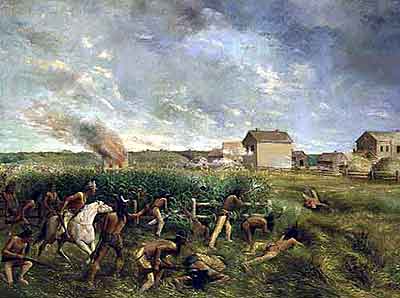
"The Siege of New Ulm, Minn.", a painting by Henry August Schwabe. Schwab depicts an attack on New Ulm on August 19, during the Dakota War of 1862.

On August 4, 1862, a desperate and hungry party of Dakota men broke into the food warehouse at the Lower Agency on the Minnesota River. The Indian Agent, Thomas Galbraith, ordered the soldiers under his command not to fire and immediately called for a council with His Red Nation and his people. At this hastily called council, His Red Nation reminded Galbraith that the Dakota were owed money to buy food and supplies and warned the agent that “when men are hungry, they help themselves.” A representative of the traders, Andrew Myrick, smartly retorted, “So far as I am concerned, if they are hungry let them eat grass or their own dung."

With hunger abated for the moment, the Dakota returned home. A few days later, August, 17, five Dakota men were returning from an unsuccessful hunt and goaded one another to steal from a farmer on their return home. The theft turned into a gunfight which left five settlers dead. The hunters returned home and told of their exploit which rattled the Dakota community. Some were for turning in the five hunters, others were for outright war. His Red Nation was for keeping the peace but he was still their chief, and when an overwhelming number of his people wanted to fight, he reluctantly prepared for war.


"Attack on New Ulm during the Sioux Outbreak, Aug. 19-23, 1862," by Anton Gag, 1904.

His Red Nation led the war party to Myrick’s house. They killed Myrick and then stuffed his mouth with grass for his cutting words. His Red Nation led them on a campaign along the Minnesota River with victories at New Ulm, which they burned to the ground, but only a month into their campaign against the settlers and soldiers, His Red Nation took a severe defeat in the Battle of Wood Lake, September 23. The defeat was such that His Red Nation broke for Canada. Men who fought under his leadership in a war he did not want to fight, either fled for Canada as well, or journeyed west to Dakota Territory to live among their Teton relatives.


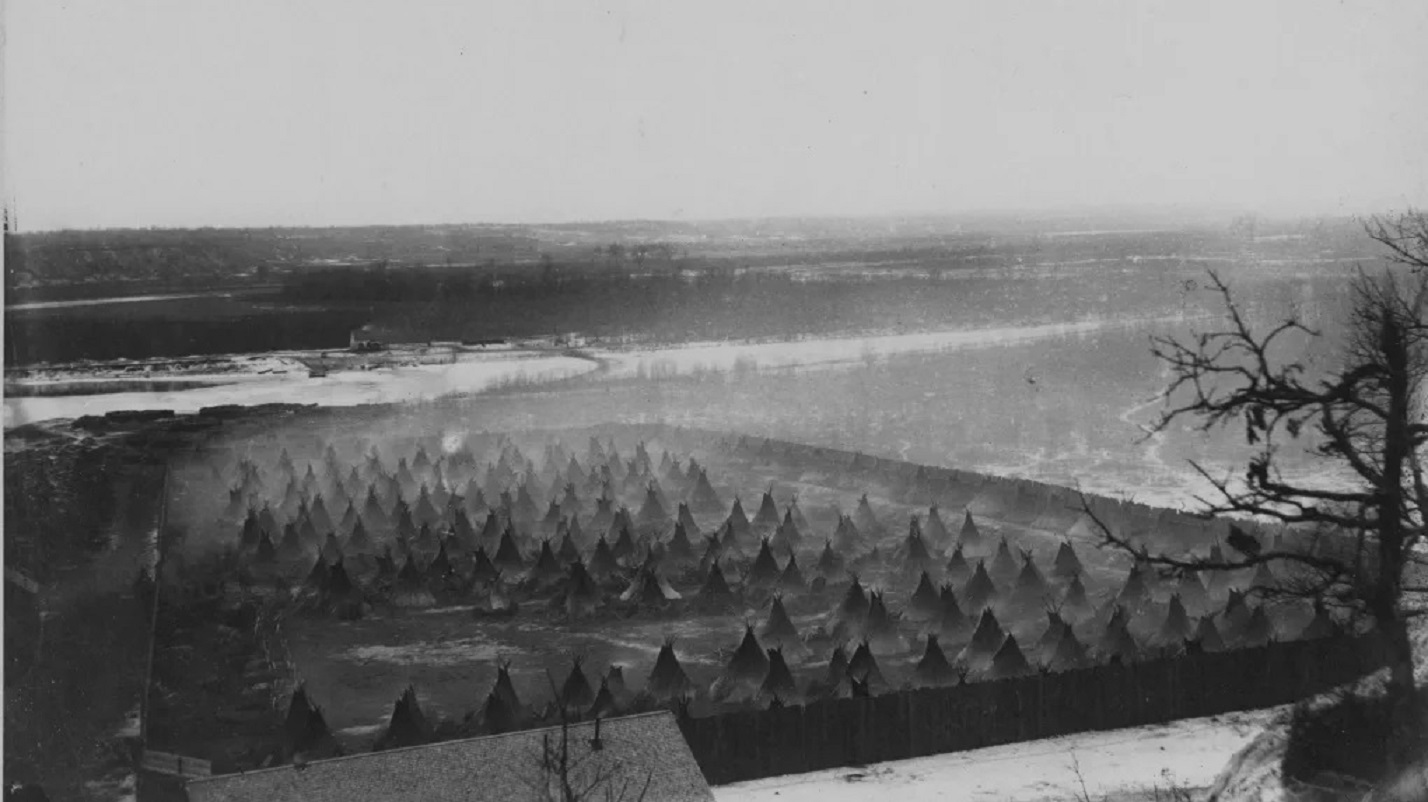
Internment camp at Pike Island on the Minnesota River below Fort Snelling, Minnesota by Benjamin Franklin Upton, 1862.

The Dakota who surrendered after the Battle of Wood Lake were taken to Mankato, MN. There, 303 Dakota men were convicted of murder and rape. The trials for many lasted five minutes or less. No one explained the proceedings, nor were any Dakota men represented. President Abraham Lincoln personally reviewed each case and commuted the death sentence of 264 of the Dakota men, and ordered thirty-nine to hang in the largest mass execution in US history on December 26, 1862. On January 1, 1863, just one week later, President Lincoln issued the Emancipation Proclamation.


Condemned prisoners in prison at Mankato, MN, 1862.

According to Kills Small, His Red Nation spent the winter and spring petitioning the Teton Lakota, petitioning even the Arikara, the Hidatsa, and the Mandan Indians to take up arms against the whites. The Teton Lakota had other concerns with warfare on other tribes, and defending their own lands. The Arikara, Hidatsa, and Mandan were too few and did not have the strength nor heart to take up arms against a country that they depended on since the last smallpox epidemic.

The following summer, His Red Nation decided to risk a return to Minnesota with his seventeen year-old son, Wowinape, Haven or Sanctuary but often translated as Place Of Refuge. His Red Nation and Haven decided to stop in a farmer’s field to gather raspberries. The farmer, Nathan Lamson, and his son engaged His Red Nation and Haven mortally wounding His Red Nation. His Red Nation shot and wounded Lamson. His Red Nation told his son to run, even as Lamson’s son ran to get help.


A Yanktonai Dakota camp is being invaded by Sully's brigade during the Dakota Wars at the Battle of White Stone Hill, North Dakota, September 3, 1863, Harper's Weekly, Oct. 31, 1863, p. 693. Killing and mutilating His Red Nation's body wasn't enough. General Sully was called in to attack a group of Sioux who had nothing to do with the 1862 conflict.

Lamson’s son ran about twelve miles to Hutchinson, MN, and returned with a posse. At first the posse didn’t recognize that the dead Dakota man was His Red Nation, but as realization dawned on them that they had the body of “Little Crow,” they mutilated his body, brought it back to Hutchinson where they dragged it down Main Street. The citizens placed firecrackers in the body’s ears and allowed their dogs to chew on the body, which was tossed in an alley where refuse was typically discarded.


The 8th Minn Infantry, again led by General Sully. This time, Sully and his command attacked an encampment of Teton Lakota who were led by Chiefs Sitting Bull and Gall. As was the case this time around as it was at Whitestone Hill, this group of Sioux had nothing to do with what happened in Minnesota, 1862. Painting by Carl Ludwig Boeckmann.

Haven ran to Spirit Lake, Dakota Territory. He was captured around Fort Totten, tried and sentenced to hang. Haven was sent to prison in Davenport, Iowa. There, he converted to Christianity and took the name Thomas Wakeman. He was pardoned in 1865, after the Civil War, and settled in Dakota Territory.

In 1971, His Red Nation’s remains were returned to Jesse Wakeman, Haven’s son, for internment.


Jerome Kills Small, Sisoka (Robin) pictured here. Image from his CD Inikagapi.

Jerome Kills Small, Sisoka (Red Robin) is an Oglala Lakota from Pine Ridge, SD. Kills Small is the recipient of the Distinguished Scholar Award from the South Dakota Humanities Council, a Reconciliation Award from the Governor of SD, George Nickleson, and was selected by the University of South Dakota as the Poet of the Year in 1994. Kills Small has portrayed Tecumseh and Dr. Charles Eastman in the Chautauqua venue across the country. He is a traditional singer and storyteller. Kills Small can be heard on the CD "Inikagapi." Support a native author, storyteller, poet, and singer. Get your copy on Amazon or whatever.