Showing posts with label Flute. Show all posts

Sunday, March 19, 2017

Lakota Courtship: Catch Her Wrap, Sing Her Songs, Steal Her Moccasins

The Plains Indian flute is featured in Paul Goble's "Love Flute."
Lakota Courtship And Marriage
Catch Her Wrap, Steal Her Moccasins

By Dakota Wind
The Great Plains, ND (TFS) – Long ago, young Očhéthi Šakówiŋ men would court their sweethearts with spoken words and by serenading them with song. Courtship was public, in full view of the wičhóthi (the village, or encampment). How a man pursued his love, and how she returned or didn’t return his affections was known to all. This public courtship was known as Wiókhiyapi, or “To court a woman.”

One of the tools men used to court women was the Plains Indian love flute. The Lakȟóta call the flute Wayážo, which simply means, “To play the flute.” The Plains Indian love flute has its origins in a variety of stories, but the common elements include: a young man who is in love with a young woman and has an inability to express himself to her, supernatural assistance (how he acquires the flute), and then how he wins the affections of his sweetheart. The young women were never expected to respond, but if they did, the young man might craft a song from her words to him.

Regarding the flute and the nature of serenading, the late Ella Deloria had much to share about this subject. “To have a love song sung about one was shameful. This was the only kind of love song that existed and it was no compliment,” Deloria said in her work The Dakota Way of Life. The Dakota call these love songs Wiílowaŋpi, Singing About A Woman. The Thítȟuŋwaŋ term for the same is Wióweštelowaŋpi, which Deloria interprets as, A Singing In Mockery Of Woman.

Deloria said the Wiílowaŋpi was like a public report on a young woman’s courtship behavior. From the love song, two things are implied: that she had yielded herself outside of marriage, or had promised to marry with no intention of doing so. The Wiílowaŋpi had a rule for its composition: young women were not outright named. Her identity had to be guessed. There's always an exception, and Deloria recalled on one occasion that a jilted lover actually named his obsession, which was shameful to him and intolerable to her.


From inside Goble's "Love Flute," which shows young men singing past sunset and into the night.

The traditional courting hour, according to Deloria, was towards evening when the sun hung low and men took their horses to water, when the women went to gather fuel and water to last the night.

Deloria called courtship WióyuspA, or To Catch A Woman, in reference to catching hold of a woman’s wrap to detain her. The alternate term in Dakota is WiókhiyA, To Talk To A Woman. Once caught, it was proper for a young woman to free herself or pretend a false resistance if she liked her suitor, but not too much resistance lest her efforts dampen his pursuit of her. When her suitor spoke to her, she would affect disinterest in him. It was the man’s role to pursue and the woman’s role to be pursued. A highly romantic young woman might be seduced into an indiscretion and then abandoned after once yielding herself. Deloria called this Maníl Éiȟpéyapi, Abandoned In The Wilds.


"Courting In A Blanket," by Evans Flammond.

Another tool men employed in Wiókhiyapi was the bison robe or blanket. A young man would wear a blanket about his shoulders, there might be other suitors too, all politely ignoring each other, waiting for their intended to appear. If a man was able to catch his sweetheart for just a moment, he’d wrap his blanket around himself and her, and share his feelings with her. The Lakȟóta have a phrase to describe this situation: Šiná Aópemni Inážiŋpi (lit. “Robe Wrapped-up-in Standing-they”), or Standing Wrapped In A Blanket. The blanket tradition is still seen in modern times, late night, on the pow-wow trail, but only the blanket itself is referred to in colloquial terms as a “snagging blanket.” According to the late Albert White Hat, they stood under the robe and spoke, the blanket was means of providing a moment of privacy.


Courtship Scene with Umbrella. A beautifully executed example of quillwork. Prairie Edge, Rapid City, SD.

Lastly, the umbrella was used in the traditional courtship as a supplemental tool to provide not just shade, but additional privacy from wary eyes. The umbrella was a popular trade item long before the reservation era. They were decorated with feathers, ribbons, bells, thimbles, and beadwork. Some were even painted.

The primary usage of the umbrella was for shade, which is reflected in the names for the umbrella. The New Lakota Dictionary has an entry for umbrella as Íyohaŋzi, or To Cast Shadow On. The Dakota call the umbrella Óhaŋzihdepi, which refers to any constructed shade against the sun (a pow-wow bowery, an awning, a light branch with the leaves still on, and even an umbrella). Buechel’s Lakota Dictionary entry for umbrella as Oíyohaŋzi, which refers to a shelter providing shade from the sun, but Buechel’s entry says this referred to a wagon covering.


Tipis at Fort Yates, ND. Photo by Frank Fiske.

A woman didn’t draw attention to herself, but she could announce her availability for suitors by affixing a pair of rabbit ears to one of the lodge poles when camp was established.

The woman was not without authority in her suitors’ courtship. If a man held no interest for her at all, she might say, “Héčhe šni (Don’t do that),” or more simply make a sign of negation, which is holding one’s open hand up, fingers together, palm facing inward, and waving one’s hand in and out a few times.

It was not unheard of for a young woman to demonstrate her affections to a young man by secretly gifting him with her work (ex. a decorated pair of moccasins), but this was considered improper. Deloria calls this “man buying,” and that this was cause for private ridicule and suspicion among the women. When a gift, as such, was given, the young woman hoped that the young man cared enough not to reveal from whom he received it. As she gifted him, she might whisper, “Wíyukčaŋ,” or “Think about this [us],” which Deloria freely translates as, “Perhaps this will help you think.”


Lakota moccasins, ~1910 CE. The wear on the soles indicate that the wearer walked on the balls of his feet. Fully beaded moccasins with beaded soles were actually worn. Eiteljorg Museum.

Haŋpa, or moccasins, played a role in courtship and marriage too. When a young man pursued his sweetheart, he might ride his horse in front of her mother’s lodge. Doing so, he usually plaited his hair, dressed his best, and even painted his face. If his mother or sisters were so inclined, they would make a pair of fully beaded moccasins. Not just the moccasin tops were beaded or quilled, but the very soles as well. This would indicate that his female relatives thought highly of him, a good sign for his intended.

Some men might offer a young woman’s father a gift of fine fleet horses, guns, blankets, or another special gift. He did this not to “buy a wife,” but to demonstrate his ability to provide for her. If her parents approved of his match to their daughter, they accepted these gifts and presented some of their own, this formalized and recognized the marriage. If his gifts were refused, it wasn’t a slight to the suitor, rather, they thought highly of their daughter that they wanted a man who could provide better. This demonstration of gifts to “buy” one’s wife is called Wíŋyaŋčhiŋ. When the marriage was recognized, the bride’s family presented her and her new husband with a lodge of their own to start their family.

In the tradition of giving gifts to “get the girl,” young lovers might announce their intention to marry concurrently. A young man might urge his parents to prepare gifts and a feast, then his family took horses and clothes for the young man’s intended. The young woman would dress in the clothes her lover’s family made for her, and her Hakátaku, or brothers, would set her upon one of the horses her fiance gifted to them, and escort their sister to the feast. There were no speeches or formal rite to observe. He wanted her, and she wanted him. This kind of marriage was called Wíŋyaŋ Hé Čhiŋčák’upi, or They Gave Her To Him.

Sometimes a man captured a woman from another tribe for his wife. This was called YúzA, or To Hold Something or Somebody Tight. This word is never used in reference by men or women to take a man.


A Yanktonai man and a Mandan woman elope.

It happened from time to time, that a young couple might elope. Elopement wasn’t unknown to the Lakȟóta. They called it WiínaȟmA, or To Run Away With Somebody (a woman) and marry in secret. The reasons vary. Perhaps she didn’t like any of her suitors and loved only one suitor.

When a young woman made her choice, the other young men assumed an air of nonchalance. It was laughable to show resentment of her choice, there were other women. If more than one young woman showed interest in a man, neither would they deride the man’s choice. A woman might say, “Is he the only man?”


The 1824-1825 entry of the Swan Winter Count portrays a single horse, but the entry recalls the death of twenty of Swan's horses killed by a jealous person. wintercounts.si.edu.

Now and then, there was a jilted man who demanded retaliatory satisfaction. Deloria recounted a story of a man who made lame a rival’s horse. Deloria couldn’t find an informant who knew of this incident, but this did happen. According to the Swan Winter Count in 1824-1825, when Swan, an Oóhenuŋpa (Two Boilings; Two Kettle), had all his horses killed. Once, an angry young man threw dirt in the face of a woman who married another. This demonstration served a grievous insult meaning that she was a liar and now all would know of it. Deloria said of this particular incident, that no one felt sorry for the new bride and that she “had it coming.”

Jilted women sometimes demanded satisfaction too. Deloria recalled the story of a woman who cast her knife at a man who had betrayed her (two-timed her perhaps?) and took out one of his eyes. In another incident, a place called Chateau Creek in south-eastern South Dakota, known in Dakota as Nawízi Kičhízapi, or The Jealous Ones Fight Each Other, was where two women cast dignity aside and fought over a man.


A young man removed her moccasins to prevent her from running away. Photo of pictograph by Holly Young.

If a young man captured a woman or eloped with her, he pulled her up on to his horse behind him, removed her moccasins, and held onto them so she wouldn’t run away.

Mature men and women courted politely and respectfully. An older man didn’t serenade his woman with song or flute, neither did he try to grab her wrap or wrap her in his blanket, not did he steal her moccasins. That was behavior for young men. No. The mature man might call on a mature woman and visit politely for a while before saying something like, “You seem to me a woman I could live with harmoniously.” A mature woman might say, “I have no one to hunt for me (or my father).” The mature man and woman never dared to elope either. They were adults, and elopement was for the young.

Divorce isn’t a topic focused on here, but it certainly happened and it could be initiated by a woman as easily as a man. The general causes for divorce were unfaithfulness and laziness. 


Dakota Wind is an enrolled member of the Standing Rock Sioux Tribe. He is currently a university student working on a degree in History with a focus on American Indian and Western History. He maintains the history website The First Scout.
__________

BIBLIOGRAPHY
Kevin Locke. 


Deloria, Ella Cara. The Dakota Way Of Life. Sioux Falls, SD: Mariah Press, 2007.

White Hat, Albert, and compiled and edited by John Cunningham. Life’s Journey - Zuya: Oral Teachings from Rosebud. Ann Arbor, MI: University of Utah Press, 2012.

Goble, Paul. Tipi: Home of The Nomadic Buffalo Hunters. Lanham: World Wisdom, 2013.

Belitz, Larry, and Mark Belitz. The Buffalo Hide Tipi of The Sioux. Sioux Falls, SD: Pine Hill Press, SD, 2006.

Ullrich, Jan F. New Lakota Dictionary: Lakȟótiyapi-English/English-Lakȟótiyapi & incorporating the Dakota Dialects of The Yankton-Yanktonai & Santee-Sisseton. Bloomington, IN: Lakota Language Consortium, 2011.

Buechel, Eugene, and Paul Manhart. Lakota Dictionary: Lakota-English/English-Lakota. Lincoln, NB: University of Nebraska Press, 2002.

Waggoner, Josephine, Emily Levine, and Lynne Allen. Witness: A Húŋkpapȟa Historian’s Strong-Heart Song of The Lakotas. Lincoln, NB & London, England: University of Nebraska Press, 2013.

Clark, W.P. The Indian Sign Language. LaVergne, TN: General Books, 2009.

Hassrick, Royal B. The Sioux: Life And Customs Of A Warrior Society. Norman, OK: University of Oklahoma Press, 1964.

Swan Winter Count (Oóhenuŋpa). wintercounts.si.edu. Accessed on March 19, 2017.

Monday, November 18, 2013

The Wind Is The Spirit Of The Great Plains

Tȟaté’káoškokpa (Canyon Made-By-Wind), or Wind Canyon, along the Heȟáka Tȟa Wakpá (River Of Elk; Little Missouri River) in Makȟóšíća (Badlands, N.D.; Theodore Roosevelt National Park).
The Wind Is The Spirit Of The Great Plains
The Sky In Word, Pictograph, And Sign
By Dakota Wind
THE GREAT PLAINS - The wind has been a constant presence on the open prairie since creation, and has shaped the landscape with its caress. It races across the open sky with the summer and winter storms, and flows about the landscape playfully, fitfully, and angrily. It is the very essence of the Great Plains.

The Lakȟóta have several words for the wind and its attributes such as tȟaté (air in motion), uyá (to blow leeward of the wind), kaȟwókA (to be carried along with the wind), ikápȟaŋyaŋ (to be beaten down by the wind, as with grass) or itáglaȟweya (with the wind). OkáluzA, or ičáluzA, refers to a breeze.


When a strong wind is present, or suddenly appears, during prayer or at a gathering, the wind might even be referred to as takú wakȟáŋ škaŋškáŋ (something with great energy is moving). A whirlwind is called tȟatéiyumni, which some regard as a sign that a spirit is present.

There is only one word to describe a windless day, ablákela (calm or quiet).

When the wind blows cold, such as it does in the winter months, the Lakȟóta refer to it as tȟatóšni. The cold winter wind had a story of its own, and in the days of legend, before steamboats and trains, before soldiers and missionaries, when the camps moved across the prairie steppe in the fall to establish winter camps, they told the story of Wazíya, that which some call a giant, or the Power Of The North. Wazíya blew his cold breath across the world. 


The blizzard is known to the Lakȟóta as Iwóblu. 

But even the wind has an origin. There are various stories about the wind, but the basics are that after creation, Tȟaté (Wind) took the daughter of Old Man and Old Woman, Ité (Face) as his wife. They had four sons, the Four Winds. Iŋktómi, the Lakȟóta trickster, persuaded Ité to begin an affair with Wí (the Sun) to gain status. 


The affair backfired, and Takú Wakȟáŋ Škaŋškáŋ gave Haŋwí (the Moon) her own domain, and sent Old Man and Old Woman to earth along with Ité. Ité was ever after parted from her husband, Tȟaté, and their four sons. Ité, however, had a fifth son, Tȟatéiyumni (Whirlwind). Woȟpá (Falling Star Woman), daughter of Wí and Haŋwí, was sent to earth. Woȟpá became the wife of Okáǧa (the South Wind) and they raised Tȟatéiyumni as their son.

They say as the summer wanes and turns to autumn, the wind changes with the weather. That change in the wind is the breath of North. The cold was and is deadly, never to be feared, but respected. The North spreads his robe across the sleeping land. The North makes hunting game easier to track. In fact, the Lakȟóta used to dance in snowshoes in the blanket of the first snowfall. They rejoiced in the weather and embraced the deep cold. 


In the spring or autumn mornings, in the early morning just as the sun rises, there appears a mist. The Lakȟóta call this Aŋptȟáŋiya. Regular fog is P'ó. 

Sometimes the winter seems like it will never end, even for people who’ve lived here for thousands of years. Gray skies smother the light for days on end. Everywhere the land is monochrome. Months without color took its toll on the people. These days it’s called Seasonal Affective Disorder (SAD).

For the Lakȟóta people, even the winter holds the promise of light and hope.

On cold days one might see what they call a sundog, but its not every cold day that features a sundog. The ancient Greeks called it a “mock sun.” The Romans called it a “double sun.” The English in the early 1400s said the sundog was a representation of the Holy Trinity.


This Campfire-Of-The-Sun is seen here above the Mníšoše (Water-Astir; Missouri River) and Iŋyáŋ Wosláta Oyáŋke (Where Standing Rock Dwells), the Standing Rock Sioux Indian Reservation

The 
Lakȟóta call the sundog Wíačhéič’ithi which means The Sun Makes A Campfire For Itself. The story of this beautiful name for this awesome phenomenon comes to me from Cedric Good House: A long time ago the people experienced several days of bleak grayness. People began experiencing bad dreams and others became depressed. It was the bad dreams that haunted the grandchildren that moved a grandfather to leave his village to pray for an end to the grayness. When he returned he called everyone in to the center of the village and selected two groups of young men to go the east of the camp and build two campfires. They did as they were told and returned to the camp where the people prayed. A lightening of the grayness indicated that morning had arrived. The clouds broke and the sun burst through the grayness. As the sun rose above the horizon, the campfires ascended into the sky with it. The people rejoiced and sang.

Just as there are several words for wind, the Lakȟóta have some words for clouds, which are of the sky. Maȟpíya in itself is a reference to the sky, or heavens. Maȟpíya tȟó, is the blue sky. Maȟpíya šápe is dark clouds. Maȟpíya akáȟpA is a cloudy overcast. Maȟpíya naȟléčA literally “the sky tears,” is a reference to a cloud burst of rain. Maȟpíya okáksaksa is partly cloudly. Maȟpíyaya is cloudy. Čhumaȟpiya means “dew clouds” or “vapor clouds.” Op’ó is a cloud of dust or steam. OkpúkpA is cloudy, hazy, or unclear. Makȟóp’oya is a cloud of dust.

When the Christian missionaries arrived they needed to articulate the Kingdom of Heaven, and coined the term Maȟpíya Wókičhuŋze, which literally means “Kingdom of the Sky.”


The northern lights above North Dakota. Unknown photographer.

The northern lights mean something very special to the Lakȟóta. Maȟpíya Tȟaŋíŋ is the northern lights, but is literally, “Buffalo-hair Sky.” Wanáği Tȟawáčhipi, a reference for the northern lights meaning “Dance Of The Spirits,” and there’s a story, or experience, about out there but it won't be shared here. Haŋwákȟaŋ, another word for the northern lights, literally means “Night With-Energy.” It was a tradition of some Lakȟóta to burn incense, sweet-grass or cedar, when the northern lights appeared.

Sometimes, just as there is no wind, there are no clouds in the sky. There are a few ways of describing a day without clouds: Maȟpíya waníče, there are no clouds. Waŋžíla Tȟo, blue oneness or complete blueness, or tȟowáŋžiča, the sky is blue.

In the spring or summer, storms or rainfall strikes in daylight. The Lakȟóta have the tradition that the Wakíŋya, Thunder-Beings, bring the storms, but not just to bring rain. Lightning flashes from their eyes, claws, and wings. With lightning and rain the Wakíŋya cleansed the earth and destroyed or perhaps chased out the negative entities which settled into the lands. At the end of daylight storms the plains are treated to rainbows stretching from horizon to horizon, a grand arch reaching to heaven.


In the blistering summer months mirages appear on the horizons. The Lakȟóta call this shimmer of air at the edge of the earth Mašténaptapta. 


A double rainbow in Theodore Roosevelt National Park, by Travel Garden Eat.

The Lakȟóta refer to rainbows as Wígmuŋke, A Snare. It is said that the wígmuŋke, causes the storm to end by trapping it, so that no more rain can fall. No one points at wígmuŋke with their fingers, but use their lips or elbows if they gesture to it.

In the spring, the wind signals another change. The Lakȟóta call this wind Niyá Awičhableze, The Enlightening Breath. This is the first spring wind upon which the meadowlarks return. It’s the time of year in which the Lakȟóta carefully watch for the ice to break on the Mníšoše, the Water-Astir (Missouri River), the geese return, and when the bison bear their calves.

One of the names that the Lakȟóta people have for the courting flute is Wayážo, which means To Play A Flute. It is the essence of the wind. Flutes are traditionally made from red cedar. The heart of the wood, the soft red center, is removed with the intention of that space becoming filled with the flute-maker’s own heart. Breath flows through the flute and the wind carries its haunting song.


Tȟokéya Inažiŋ (The First To Arise; Kevin Locke) here with his great-grandfather's flute, shares the flute tradition with youth on the Standing Rock Sioux Indian Reservation.

In a discussion with Deacon Terry Star, enrolled member of the Standing Rock Sioux Tribe, about the wind and the flute, Deacon Star shared that he heard the four winds were brothers who represented the four cardinal directions. The West Wind, according to how Deacon Star heard it, didn’t just bring the thunderstorms, but also played the flute.

The wind, clouds, northern lights, and rainbow are expressed in the non-speaking languages of the Great Plains too.

In pictography, the wind is represented by a series of straight lines ending in a curly-cue or wave, and more lines indicate the strength of the wind. A whirlwind is represented by a swirl of four lines spiraling outward from the center of a circle. Clouds are represented sometimes by a simple line drawing of a cloud, but generally clouds are almost always depicted with rain and lightning. An arch above a straight line is a representation of the sky above the earth.

A pictograph for northern lights may be represented by night (a darkened circle with a line running through it top to bottom; or other variant) and fire (above the image depicting night). A rainbow is depicted by a series of arches over a straight line.


Dr. Jesse Johnson (Cheyenne River Lakota), center,  in front of a thípi.

In the sign and gesture language of the American Indians, there is a sign for wind as well. In a communiqué from Dr. Jesse Johnson, Blú Wakpá (Powder River), enrolled member of the Cheyenne River Sioux Tribe, the sign for wind takes a few forms, but its most basic execution involves holding the hands up, backs up at about shoulder height, fingers spread, and moving hands in a wavy tremulous motion in the direction of the wind.

Like pictography, the Plains Indian sign for cloud or clouds is inseparable from rain or lightning. The sign for rain consists of holding one’s hands up at shoulder height and drawing one’s hands down slowly two to three times. Kevin Locke, enrolled member of the Standing Rock Sioux Tribe, draws his hands down, backs up, and does “piano fingers” to sign rain. Lightning is signed by miming a jagged lightning pattern in mid air with either hand.

According to Dr. Johnson’s research into the Plains Indian sign language, the northern lights are depicted as “both hands, backs down, half closed, thumb and finger tips together, raised very high and spread with a sweep to indicate flashes. It should be done facing north.” Johnson adds that the sign is helped if the hands are swung apart in an arc at the highest point in executing the sign.


Wáǧačhaŋ (Cottonwood) on the floodplain of the Heȟáka Tȟa Wakpá.

The constant wind blowing across the open prairie steppe and through a vast open sky is a part of the Lakȟóta culture, or perhaps it is that the Lakȟóta are a part of the wind. They say that patterns on one’s fingertips indicate the direction the wind was blowing on the day of one’s birth. 


The Lakȟóta have the saying Takú šičá owás’iŋla kaȟwóg iyáyiŋ kte ló, which means, "All the bad things will blow away." 

On the vast open plains, grasses bow down and sway in motion as if in dance. Great cottonwood trees catch the winds and rattle their leaves in a deafening roar, like the crash of waves in the distant oceans. These ancient trees catch the smallest breeze and their leaves shush the world. 


Le tȟaté na maȟpíya tȟa makȟóčhe hečha lo. This is the land of sky and wind. 

Terry Star is an enrolled member of the Standing Rock Sioux Tribe. His traditional Dakȟóta name is Ȟé Ská, White Mountain, after Mount Rainier of which the top of the mountain bears snow year round. He is a deacon in the Episcopal Church and is currently a candidate for the Master of Divinity at Nashotah House Theological Seminary in Wisconsin. Star was raised by his late grandmother, Lillian Ironbull Martinez in the traditions of the church and the Dakota. For several years he has served as a youth pastor on Standing Rock and has frequently called on the stories he received from Lillian and her friends to relate biblical ones to the youth.

Jesse Johnson is an enrolled member of the Cheyenne River Sioux Tribe. His traditional Lakȟóta name is Blú Wakpá, Powder River, after Čhaȟlí Wakpá, which means Charcoal River and is the proper place name of Powder River. Johnson graduated with his Ph.D. in American Indian Studies. In his spare time Johnson teaches martial arts.


GLOSSARY:
Ablákela: Quiet, or windless, calm

Aŋptȟáŋiya: Vapor, mist that arises in the early morning

Čhumaȟpiya: Dew Clouds, Vapor Clouds

Haŋwákȟaŋ: Night-With-Energy, Northern Lights

Haŋwí: Moon

Heȟáka Tȟa Wakpá: River Of Elk, Little Missouri River

IčáluzA: Breeze

Ikápȟaŋyaŋ:To-Be-Beaten-Down-By-The-Wind

Iŋktómi: Trickster

Iŋyáŋ Wosláta Oyáŋke: Standing Rock Agency

Itáglaȟweya: With-The-Wind

Ité: Face

Iwóblu: Blizzard

KaȟwókA: To-Be-Carried-Along-With-The-Wind

Maȟpíya: Cloud, Sky, Heaven

Maȟpíya AkáȟpA: Clouds Overcasted

Maȟpíya NaȟléčA: The Sky Tears, a cloud burst of rain

Maȟpíya Okáksaksa: Partly Cloudy

Maȟpíya Šápe: Dark Clouds

Maȟpíya Tȟaŋíŋ: Buffalo-Hair Sky, Northern Lights

Maȟpíya Tȟó: Blue Sky

Maȟpíya Waníče: No-Clouds, Cloudless

Maȟpíya Wókičhuŋze: "Kingdom of Heaven"

Maȟpíyaya: Cloudy

Makȟóp’oya: A cloud of dust

Makȟóšíća: Badlands

Mašténaptapta: Sunlight-Waving, shimmer on the horizon on a hot day, mirage

Mníšoše: Water-Astir, Missouri River

Niyá Awičhableze: Enlightening Breath, spring wind

Okáǧa: South Wind

OkáluzA: Breeze

Op’ó: A cloud of dust or steam

OkpúkpA: Haze

P'ó: Fog

Takú Wakȟáŋ Škaŋškáŋ: Somthing With-Energy Moves/Moving; often contracted to Takú Škaŋškáŋ (Something Moving), or when talking about creation, simply Škaŋ.

Tȟaté: Air-In-Motion, Wind

Tȟatéiyumni: Whirlwind

Tȟaté’káoškokpa: Canyon Made-By-Wind, Wind Canyon

Tȟatóšni: Cold Wind

Tȟowáŋžiča: Completely Blue, Blue Oneness, a completely blue sky

Uyá: To-Blow-Leeward-Of-The-Wind

Wáǧačhaŋ: Cottonwood 

Wakíŋya: Thunder

Wanáği Tȟawáčhipi: Dance of The Spirits, Northern Lights

Waŋžíla Tȟo: Complete Blueness, Blue Oneness, a completely blue sky

Wayážo: To-Play-The-Flute, Flute

Wazíya: Lit. Pine, Power-Of-The-North, also a name of the North Wind

Wí: Sun

Wíačhéič’ithi: The Sun Makes A Campfire For Itself, Sundog

Wígmuŋke: Snare, Rainbow

Woȟpá: Meteor, Falling Star

Thursday, March 28, 2013

Revival Of The Flute Tradition


Kevin Locke shares the background of some of the oldest flutes in his collection.
Flute Tradition Returns With The Spring
Practice Nearly Faded Away
By Dakota Wind
Standing Rock, N.D. & S.D. - Dawn hit the Land of Sky and Wind, the Land of Standing Rock, and bathed the ancient prairie steppe with warm sweet light that turned last year’s grass gold despite the cold silence of winter. The frozen air seemed to shatter with each mile I drove. Aside from my car, I imagine that the morning of the first spring must have been much like this. The cold and quiet was so sharp I could imagine a knife scraping along the backs of my exposed hands.

I pulled up to Solen High School on the Standing Rock Sioux Indian Reservation. My passenger Rich Dubé, a personal friend of my Lekši (uncle) and Wauŋšpekiyapi (teacher) Kevin Locke, and I swapped stories about the gift of Šiyotĥaŋka (the flute), where it came from, when it appeared on the steppe of the Northern Great Plains, and its growing revival.

Rich Dubé, came down from the great snows of Saskatoon, Saskatchewan to conduct a flute workshop in four of the schools on the reservation. I visited with Dubé the evening before. When I heard he was from Saskatoon, and was coming down to the Land of Sky and Wind, I prejudged who I thought I’d be meeting. Kevin raved about Dubé’s knowledge in the reconstruction of the traditional flute, how they were made, the original sound, and that Dubé even wrote his Masters thesis around the flute.

Naturally, I thought Dubé was going to be a member of the White Cap Dakota Nation who reside on a reserve just south of Saskatoon. Not that skin color matters but I was expecting to meet a native man. Who met me instead, and broke my prejudice, was an impeccable skinny white guy. He seemed used to native scrutiny however and graciously anticipated and answered my probing questions, which eased my mental lockjaw. I backed off when I was satisfied that he knew what he was about.

Dubé had never heard of the native flute until he attended a session for choir teachers...

Dubé is a music teacher. His story with the native flute begins about ten years ago in Saskatoon. He was teaching native youth in an inner city music program. Dubé had never heard of the native flute until he attended a session for choir teachers and he leafed through a book by Bryan Burton called Voices of the Wind which had native flute songs transcribed for the recorder. He was looking for something to capture the interest and inspire his senior kids and thought the native flute would be much more appealing to his students than just trying to play the songs on a recorder, a western European instrument.

The music teacher searched the internet looking for flute makers, and experimenting with various flute kits, discarding those that didn’t seem to have a true sound to his sharp ears. Eventually, Dubé crossed paths with Kevin Locke. Kevin sent Dubé the schematics of one of his great-grandfather’s flutes. Dubé seized the opportunity to reconstruct not just a traditional flute, but a traditional flute with the original sound.

One of Dubé's flutes.

Dubé created a cast using the original traditional flute from Kevin’s schematics. Dubé wanted to create a flute that was easily constructed and mass produced yet true to the original sound. In the end, his experiments found success in a custom size ABS plastic flute matching the exact sound of the original one-hundred twenty-year-old flute.

...small town pride in the class B team that represented the best hopes of the community...

I entered the high school and remembered my days when my team played the Solen Sioux. There was the typical small town pride in the class B team that represented the best hopes of the community, and like any small town, the team was fiercely held high in respect. Putting the games of yesteryear firmly in the back of my head I made my way down the hall towards the gym where Dubé was preparing his workshop.

Dubé’s luggage was opened up on the bleachers and inside it was as though he had brought an entire workshop. Someone had set up some tables and Dubé was quick to set drills, tools and all his accoutrements out for the workshop. In the span of twenty minutes he trained staff and volunteers in preparation for students to drill the holes of their flutes.

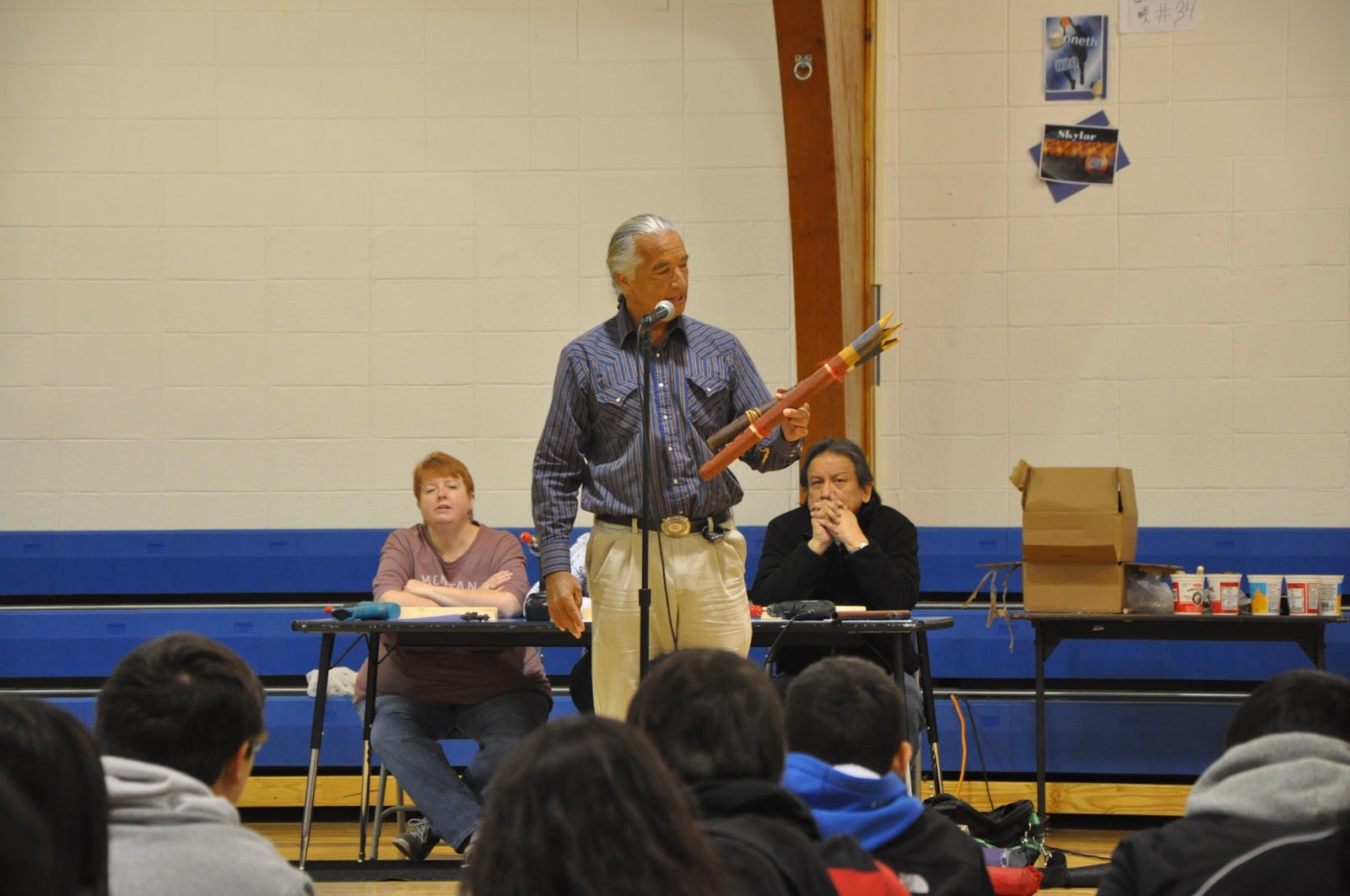
Kevin arrived about fifteen minutes after we got to the school. Students were quietly milling about in the halls in eager anticipation of the morning’s project. A few had poked their heads into the gym to watch Dubé set up and train the school staff. A teacher, possibly the principle, cheerfully made some announcements about lunch and stuff before she gently reminded students to be on their best behavior for Dubé’s flute workshop.

Locke offered a heart-felt greeting to the youth who assembled at the school.

About fifty-five high school students filed into the gym, arranged by year, and immediately staked out spots on the basketball court. The gym quickly filled with echoes of growing chatter which became a loud buzz with the arrival of fifth and sixth graders from the nearby community of Cannonball, who took the floor closest to where Dubé was set up.

The principle made a few announcements reiterating students to be on their best behavior and extended a welcome on behalf of the schools and introduced Kevin. Kevin introduced Dubé who shared some technical things about the flute and what to be expected in the workshop, and the students listened as best as students could while they itched to get to the construction.

Dubé divided the large group into three and subdivided each of those into three at each table. From the time of Dubé’s beginning instructions to the last student drilling the last hole in the last flute and the last student assembling the various pieces into a replica of the Lakota Grandfather flute, about forty minutes had passed. At one point in the assembly Kevin remarked, “Rich is really organized,” a sentiment which was repeated by high school staff.

Dubé (orange shirt) plays a quick tune between instructing students.

When the last flute was put together, Dubé called for the students to gather together once again on the basketball court where he offered some basic flute instruction. It was this instruction that Dubé’s experience as music teacher came out. When the students were quieted with their flutes and ready to play, Dubé played a few simple songs with the students who echoed his rendition of the old English tune “Hot Cross Buns.” The fifth and sixth grade students were quite familiar with playing the song on their recorders and followed Dubé’s instruction swiftly.

There, Kevin shared the story of the first flute.

After Dubé’s crash course in flute basics, Kevin stepped in and shared a few flute songs, one of which was the Flag song which the students recognized right away. The students had grown tired of the floor towards the end of the workshop and took to the bleachers on the other side of the gym after the song. There, Kevin shared the story of the first flute. He played the first flute song as part the story, and sang the song at the end.

One of the things that Kevin shared, a traditional belief, was that the Dakota and Lakota people are people of the wind. On the tips of ones fingers are what we call fingerprints. We all have fingerprints. For the Dakota and Lakota people however, fingerprints are more than something that identifies and/or incriminates a person, they say that the patterns tell one which direction the winds were blowing on the day of one’s birth.

In the days of warriors and legend, the flute was played by young men in traditional courtship, to win the heart of a particular young woman. A young man might sit outside the lodge of a young woman and serenade her. If he was successful, she might contrive an excuse to fetch water or gather additional firewood to spend a few moments with a suitor.

"Indian Courting" by Captain Seth Eastman, 1852.

The flute was a part of daily life.

The flute was a part of daily life. Early American Western artists like Seth Eastman and George Catlin painted scenes of young men playing the flute. When the post reservation era began, traditional courtship faded and was nearly forgotten.

In the 1970s, Kevin Locke took up the flute and learned about the tradition from men like Richard Fool Bull, William Horn Cloud, Joseph Rockboy, Asa Primeaux, Henry Crow Dog, Bill Black Lance, Charles Wise Spirit and Pete Looking Horse among many others. At a wacipi, Locke saw Richard Fool Bull’s display of flutes and remarked, “Someone should learn this tradition,” to which Fool Bull said, “Maybe you should.” And Kevin did.

Locke hopes to pass on the flute tradition to the today’s generation. Dubé’s flute workshop fits snugly into the world of the young native student. An individual can construct a flute with traditional specs and a faithful sound and be finished in five minutes using Dubé’s kit. In a world where studies come first, where extracurricular activities play a large role in a student’s life and where popular media influences style and dress, there’s still time and place for dancers and singers to hit the pow-wow circuit.

In the Land of Sky and Wind the wind is a constant presence. The people of Standing Rock are people of the stars. They are people of the wind. Maybe the flute tradition will work itself back into the daily lives of the people as it once did. 

Visit Kevin Locke online at Kevin Locke.
Visit Rich Dubé at Northern Spirit Flutes.

Thursday, February 23, 2012

Traditional Lakota Courtship

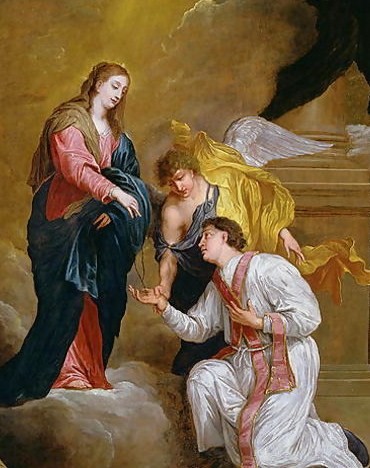
File:St-Valentine-Kneeling-In-Supplication.jpg
Saint Valentine recieves a rosary from the Virgin Mary.
Traditional Lakota Courtship
Lakota Demonstrations Of Affection

By Dakota Wind
GREAT PLAINS - Valentine’s Day is a day most associated with romantic love, often celebrated with affectionate cards, fresh flowers, or gifting of sweets to loved ones. Its my understanding that celebrating Valentine’s Day as it is celebrated today wasn’t always so, that it wasn’t until the Middle Ages that the saint’s day became associated with courtly love.


Amongst the Lakota there is a courting practice, an old tradition seldom performed today, but reaching back nearly a thousand years, and it starts with serenading one’s object of affection with the haunting sound of flute music.


Like many ancient world traditions, the Lakota used to arrange marriages for their daughters. This practice, along with polygamous marriages (when a man took more than one wife), have not been put into practice in well over a century.


The origin of the flute on the Northern Plains has many stories, about as many stories as there are tribes with variations among the bands or clans of those tribes.

Kevin Locke from his Makoche album "Open Circle." Artistically speaking, it is Kevin's best piece of work. Gratify yourself and get a copy on Amazon or buy it through Makoche in Bismarck, ND.

Traditional flute-players Bryan Akipa and Kevin Locke tell the story of a young man who fell in love with a young woman a long time ago. The young man became so smitten around the woman of his affections, that he found he could not talk to her. Motivated by his silence of melancholy, the young man removed himself from the village.

They say this young man came to the river and followed it. He eventually came to rest under the shade of a tree; some say it was a cedar tree. He fell asleep, or as he was drifting off to sleep, he heard the wind passing through the branches of the tree. In the branches of the tree were holes that a woodpecker had drilled, probably looking for termites or bore beetles. As the wind passed over the holes of the branch, a melody was produced.

Some say that it was the personification of elk who came to visit the young man and gifted him with the flute because they were moved by his inability to articulate his feelings to the young woman of his affections. Some say he merely reached up and carefully removed the branch and the birds taught him how to sing with it.


Englishman Paul Goble renders the first flute story in his book "Love Flute" which is published by Aladdin Paperbacks. The look and feel of the book is based on pictographs of the Plains Indians.

However he came to possess the flute, he learned its art. Then he returned to his village. He played his flute from the outskirts of the encampment, perhaps from the top of a hill or perhaps upwind so that his music could carry.

The young woman with whom he was in love with knew immediately that the music was for her. She returned his affections and they became a couple.

I have always been interested in when something happened. Like the flute story. When did the flute appear on the Northern Plains? I like to ask flute-players when they think the flute came to be, but the answer is almost always a resounding “a long time.” Then one day I asked Keith Bear, a Mandan-Hidatsa flute-player when the flute came to be. He quietly reflected that when he was young he had asked a grandfather that same question who in turn told him that when he was young, had asked the same question of a grandfather and was told, “They [the flutes] have been around for the span of ten grandfather’s lives.”

Keith Bear poses regally in a traditional quilled war shirt and carried a beautiful crane flute. He, like Kevin Locke, recorded at Makoche in Bismarck.

It was a puzzle to figure out, the span of ten grandfather’s lives. Keith ruminated that a grandfather’s life could be anywhere from forty to 100. Who knew the answer? I turned to renowned Plains Indian archaeologist Dr. Ray Wood and asked him how long the whistle has been on the northern plains, for in Lakota, one word for whistle is the same as flute, while flute also has another name for it.

As I was waiting for Dr. Wood’s response to my query, I came across the Brown Hat Winter Count in which the span of a grandfather’s life is measured at about seventy-five winters (years). I took this as a good sign, for the Mandan and Hidatsa are long ago relatives of the Lakota. Being that Keith is a grandfather himself, and he had asked a grandfather too, we could easily today say that the flute has been on the Northern Plains for the span of twelve grandfathers. Twelve times seventy-five equals 900. Now subtract 900 from the year I asked, which was back in 2000, we arrive at the year AD 1100.


Here's one of Dr. Wood's many works about the archaeology and history on the Northern Plains. Dr. Wood might not have had the excitement of Indiana Jones, but at one point fifty some years ago, he and several other archaeologists worked feverishly to salvage what they could when the dams were built by the Army Corps of Engineers back in the 1950s.

I eventually received a reply from Dr. Wood. He graciously and swiftly responded (in two weeks) and sent me images of the whistles he personally recovered from a few sites along the Upper Missouri River. He dated them to the year AD 1100.

In contrast of the flute story where the young man courts the affections of the woman and wins her heart is the story of the Homely Girl.

A long time ago, as these stories go, a young girl was relentlessly teased about her looks. She wasn’t regarded in any way beautiful. In the version I heard, she lived with her grandmother, and she was in love with the chief’s son. The grandmother was in a way, the fairy god-mother of this story.

A day came when the chief wanted to arrange the marriage of his son and he made an announcement to the people. The chief’s son was considered by many to be not just brave in battle but quite handsome in appearance. All the single young women of the village wanted to be the wife of the chief’s son. The chief proclaimed that a test would determine who would be his son’s wife.


I haven't heard the story of the Homely Girl since I was little, but the story of the "Rough-Face Girl" by Rafe Martin and David Shannon is close. Buy yourself a copy of this beautiful story.

Perhaps it was a year that passed as the women prepared for the test, perhaps a summer only, I don’t recollect that detail, but they prepared. When the young women heard that the homely girl wanted to participate, they scoffed and openly mocked her efforts.

The test consisted of a demonstration of domestic life, which at that time meant food preparation, building a fire, and a host of other skills like tanning and making moccasins.

The homely girl’s grandmother took her granddaughter out in the summer field and showed her which turnips to pick to make soup with, and they plaited them together into one long braid. The grandmother took her granddaughter into the woods and showed her which wood to pick for starting a fire and which wood to pick to burn the longest. The grandmother showed her granddaughter how best to set up the tipi and take it down in wind and rain, in the heat and cold.

The time of the test arrived, and the chief and his son visited all the families who had suitors. They visited the beautiful and the daughters of other chiefs, many who rushed to prepare food, who couldn’t maintain a fire, whose impatience showed in their beadwork or quillwork, or who couldn’t assemble or disassemble a tipi swiftly enough to satisfy the chief.

They came at last to the homely girl’s demonstration. She made simple moccasins with hard soles and modest accents of quillwork. She built a fire and it lasted through the night. For much of their time, the chief and his son quietly watched the homely girl in her demonstrations.

The test came to an end. The beautiful women were confident one of them would be chosen. The daughters of other chiefs were confident were confident one of them would chosen. At the end of the day, though, it was the homely girl who was chosen for her quality of character was revealed in her craft and preparation. She was not haughty, she was not impatient, and she did not spite any of her rivals.

In the first story, the lesson men should take is patience, and to find one’s voice. A natural lesson is to be learned from it too is that in nature it is the male who must prove his worth to the female.

In the second story, the virtues that Lakota women should practice are humility and patience. Virtue wins out in the end.