Showing posts with label Teton. Show all posts

Monday, July 31, 2017

Mandan Woman Turned Into Stone

A lichen covered red granite stone rests in the earth about halfway up the plateau at Fort Abraham Lincoln State Park. Not evident in this photo of this stone, but a rut runs through the half which is exposed to the elements.
Mandan Woman Turned Into Stone
Trees Grew To Honor Her Bravery

As told by Capt. Henry Marcotte (ret.)
Bismarck Tribune, Reprinted Dec. 15, 1922 as “The Clump of Trees on The Hogback”
Mandan, N.D. (TFS) - Fifty years after the construction of Fort McKean and Fort Abraham Lincoln, Captain Henry Marcotte (ret.), shared a story of sacrifice and remembrance regarding a Lakȟóta war party leader, a Nu’Eta (Mandan) man, and a beautiful Nu’Eta woman.

In 1872, Marcotte was serving at Fort McKeen as the Chief of Scouts. In his first summer of service he witnessed many ambuscades carried out on the north side of the newly constructed fort. Marcotte also witnessed the brave responses of the Fort McKeen Detachment of US Indian Scouts - namely, the Sahnis (Arikara). On the evening of November 3rd, Marcotte was invited to sit and smoke with the Sahnis, Hidsatsa, and Nu’Eta, and heard the tale of Black Hare, a Nu’Eta woman.

They had gathered just outside the north side of the palisades of Fort McKeen. It was the custom of Plains Indian men and women to sit on the ground in treaty, in council, at home, and in prayer. Men sat with straight backs and legs crossed; women sat with their knees together, legs tucked under and back, heels to one side. On this day, however, only men were present, and Marcotte undertook to sit on a rock that had been rolled into the circle.

At this gathering, though all spoke different first languages, Marcotte watched and listened to the men speak carefully and deliberately, testing the friendship of all gathered. Sergeant Young War Eagle began the afternoon with a pipe and passed it onto each man calling out his name, who responded in the affirmative. 


By 1910, five trees remained on the top of the plateau, where once was Fort McKeen.

When it was Marcotte’s turn, Young War Eagle recognized him as an officer, then pointed at the rock upon which Marcotte sat. Young War Eagle explained that Marcotte sat on the petrified remains of the Nu’Eta woman known to them as Black Hare. It was to recount her story that brought them together that day. Marcotte doesn’t mention whether or not he removed himself from his perch, but it would have been good manners to do so, and to apologize for his faux pas. Young War Eagle and the men gathered apparently took no offense, and the sergeant recounted the story of Black Hare, as Marcotte noted, “in pleasing tones.”

Black Hare, a young woman, was renowned by many nations near and far for her great beauty. She turned down all her suitors for the simple reason that she didn’t want to leave her village there overlooking the floodplain of the Heart and Missouri Rivers. According to the Sitting Rabbit map of the river, this village was called Watchman’s Village, which today is known as On-A-Slant.

A Thítȟuŋwaŋ (lit. “Dweller On The Plains”; Teton; Lakȟóta) man whom the Nu’Eta knew as Crow Necklace, a leader amongst his people, approached the Nu’Eta and wanted Black Hare for his woman. She declined. Crow Necklace then threatened the Nu’Eta leader with death, to be carried out by sundown, if Black Hare wasn’t brought to him.

The Mandan leader, “To’sh” according to Marcotte’s memory and spelling, induced Black Hare to go walking with him, and on this walk, he took her to where Crow Necklace was lodged, and turned her over to the Xa’Numak (Nu’Eta: lit. “Grass Man”; the Nu’Eta word for the “Sioux”). When To’sh returned to the safety within his palisaded village, he contrived to tell his people that Crow Necklace abducted Black Hare.

The Nu’Eta suspected To’sh’ insincerity, and the other leader of the village - for each village each had a civil chief and a war chief - ordered To’sh to be buried on the spot up to his neck for his disingenuity. The other Nu’Eta leader then made the very threat to To’sh that Crow Necklace made earlier that day, saying that if Black Hare wasn’t here by sundown, To’sh would die. 


By 1922, only one tree remained on the plateau. This photo was taken in the 1930s following the CCC's reconstruction of the three blockhouses. A last tree, dead, can be seen in this image.

From a distance, To’sh saw Black Hare returning to the village, her feet wounded and bleeding. Marcotte’s recollection didn’t tell readers why Black Hare would return in this condition, but other first nations of the Great Plains knew by cultural understanding that when a Lakȟóta man stole a woman from another tribe with the intention of making her his wife, he removed her háŋpa (her moccasins) so that she would be less likely to return to her people. Makȟóčhe Wašté (lit. “The Beautiful Country”; the Great Plains, and by extension, North America) is fraught with uŋkčéla ( little cacti). In this story, Black Hare was a strong-willed young woman to leave her captor and return.

To’sh feared that Black Hare’s return would reveal his falsehood, and earnestly prayed for her to turn into stone. Lo! Black Hare turned into a red calcined stone (as Marcotte described his seat)! A bird sang out during this transformation, and a spirit planted seeds in Black Hare’s bloody footprints. Winter spread its mantle of purity over the stone of Black Hare and her seeded tracks. The sun warmed the land and from Black Hare’s innocent blood grew trees to shade and shelter her stone memorial.

The stone is near Watchman’s Village, within present-day Fort Abraham Lincoln State Park, about halfway up the plateau. When the 17th Infantry arrived, they cut all but eight trees, which were transplanted in front of the officers’ quarters at Fort McKeen. Black Hare’s stone lay on the hillside, bereft of shade and shelter. The water wagons used the stone to check and hold the rear wheels to afford the mules momentary rest.

In 1922, one last tree remained on the hilltop.


Marcotte's narrative appeared as "The Clump of Trees on The Hogsback" in The Bismarck Tribune, Dec. 15, 1922. 

Dakota Wind is an enrolled member of the Standing Rock Sioux Tribe. He is currently a university student working on a degree in History with a focus on American Indian and Western History. He maintains the history website The First Scout.


Wednesday, March 1, 2017

Origins Of The Cannonball Stones

A cannonball concretion near Sentinel Butte, ND. Photo by ND State.
Origin Of The Cannonball
How The Stone Is Formed

By Dakota Wind
Cannonball, N.D. (TFS) – Mníšoše (the “Water A-stir;” Missouri River) is perhaps as old as 80 million years. Before the Quaternary Ice Age, the river ran north and drained into Hudson Bay. Following that ice age, the river altered its course and flowed east and south. The Lakȟóta worldview perspective observes that over time, rivers and mountains change. The Lakȟóta worldview embraces change. Everything changes.

One of the Mníšoše tributaries, Íŋyaŋ IyÁ Wakpá (Talking Stone River; Cannonball River) is a natural landmark, known by the first nations for thousands of years, and later by explorers and traders like the Corps of Discovery, traders, and military expeditions.

The Cannonball River is known by many names. The Húŋkpapȟa and Iháŋktȟuŋwaŋna call it Íŋyaŋ IyÁ Wakpá, or Íŋyaŋwakaǧapi Wakpá (Stone Production [“Cannonball”] River), respectively. The Cheyenne call this same river É’ome’tá’á’e’t, in reference to the cannonball concretions. The Hidatsa know the Cannonball River as Aashihdia, which means Big River. The Mandan Indians, whose earliest historical record goes back to the Cannonball River, call it Pasąhxte’, meaning Big River.

The Mníšoše was known to the Thítȟuŋwaŋ (Dwellers On The Plains; Lakȟóta) as a dangerous river with a deadly undercurrent. Where tributaries converged with the Mníšoše, great wamníyomni (whirlpools) formed in the river. When the first nations crossed the Mníšoše they did so upstream of the wamníyomni. 


A Mandan Village by Karl Bodmer. In the image, Mandan women cross the Missouri River to tend to their gardens on the flood plain of the opposite shore. 

There are two explanations that explain the origin of the cannonball concretions. One mystical, a lesson in holding dear the mystery of creation; the other geological, telling us that these stones have a long history reaching back to a time before humans. In both explanations water is the key to their formation.

According to Jon Eagle Sr., Tribal Historic Preservation Officer of the Standing Rock Sioux Tribe, the wamníyomni at the confluence of the Mníšoše and Íŋyaŋ IyÁ Wakpá, where the energy of one river converged with the energy of another, is where the cannonball concretions were formed. The energy of the wamníyomni created the stones. Eagle contends that after the construction of Oáhe (Something-To-Stand-On; a “Foundation”) Dam, after the creation of Lake Oáhe, the wamníyomni at the confluence of Íŋyaŋ IyÁ Wakpá and Mníšoše, stopped producing the spherical cannonball stones.

Dr. Ray Wood sums up the disappearance of the cannonball concretions in his Prologue To Lewis And Clark, “the banks and valley of this stream once were home to uncounted spherical sandstone concretions that ranged from a few inches to several feet in diameter. Some of them indeed were the size of cannonballs. Today they have been carried away by curio hunters in such numbers that they are very rare.” 


Bluemle explains how the Missouri River once drained into Hudson Bay. Visit his amazing website explaining the geological history of the Great Plains: johnbluemle.com

John Bluemle Ph.D. (former State Geologist for the state of North Dakota) explains the cannonball stones’ process through cementation. The cannonball stones “form as a result of the selective deposition from water of cementing materials in the pores of the sediment,” and, “All the geologic formations in western North Dakota contain concretions and nodules of many sizes and shapes.” Bluemle states in his work The Face Of North Dakota, that “some concretions are nearly spherical, some long and tubular, and others have irregular shapes.” As the landscape erodes around the cemented concretions, the cannonball is revealed.

The cannonball is so important to the identity of North Dakota, that the North Dakota Heritage Center and State Museum features several cannonball concretions outside its east entrance.


Dakota Wind is an enrolled member of the Standing Rock Sioux Tribe. He is currently a university student working on a degree in History with a focus on American Indian and Western History. He maintains the history website The First Scout.


Friday, September 23, 2016

Historical Conflict And Trade At Cannonball River, A Review


Challenges And Conflict On The Cannonball
Confluence Of Indians & Traders, A Review
By Dakota Wind
Cannonball, ND – Is the Cannonball River so different today than it was two hundred years ago? Yes and no. The river still drains into the Missouri River as it has done for thousands of years, but the similarities depart from there. The Cannonball River drains into a stretch of the Missouri River that is more lake now than flowing stream.

600 years ago, the Mandan lived in two earthlodge villages, the Big River Villages, on the north and south banks at the Cannonball River and Missouri River confluence. The Cheyenne lived in an earthlodge village located at present-day Fort Yates, ND, and occupied the region including the Cannonball River from around 1700 to about the turn of 1800 before taking up the nomadic horse culture for themselves and moving west. The Arikara contested the Cheyenne occupation, and even came to live at the Big River Village on the north bank for a time.

Tracy Potter’s “Sheheke: Mandan Indian Diplomat” offers a summary of the backstory which sets up the Mandan Indian protagonist Shehek Shote (“White Wolf;” aka Sheheke, or “White Coyote”) in the post-contact and early trade era on the Upper Missouri River. Potter references living oral tradition of the Mandan people, and archaeology of the ancient territory of the Mandan, as well as writings from the early fur traders including the Corps of Discovery to show the struggle and survival of the Mandan on the prairie steppe.

Potter’s teeters back and forth between a biographical epic of White Wolf who journeyed east to parlay with President Jefferson and his return, and a historical summary of the Mandan people. The tale concludes with a grand gesture of self-sacrifice and service to a country that has largely forgotten that White Wolf died protecting Americans on the frontier when the War of 1812 spread to the Missouri River.

Sheheke: Mandan Indian Diplomat was released in 2003 as a companion book to all the Corps of Discovery excitement during the Lewis & Clark Bicentennial. Its a genuine original concept, with a focus on the story of a native man, a civil chief of a peaceful first nation, at a time when a dozen books a month were coming out about the Corps of Discovery. It’s 2016 and Potter’s book deserves a second closer look at its brief narrative involving the conflicts on the Cannonball River in light of the current energy interests there.

Inter-tribal conflict is a part of the collective history of the first nations. Different languages yield different world views and values, which may lead to conflict, but contests for control of natural resources is universal in the history of humanity anywhere in the world at any time.

During the Corps of Discovery’s mission, they selected various tribal leaders to journey downriver and east to meet with the great father of the new United States. In 1804, the corps selected Arketarnawhar Was-to-ne (“Is A Whippoorwill”) and a company of six others from the Osage, Missouri, and Pawnee nations, to entreat with President Jefferson. Is A Whippoorwill died in the spring of 1805; the other tribal representatives soon died as well. Jefferson wrote a missive telling the Arikara that their beloved leader had promised their friendship to the Americans before dying, and that he was buried in the east.

The Arikara received official word of their leader’s death in the summer of 1807. By then, the Arikara and Mandan were at war with one another. One of the conflicts between the two nations was at the Cannonball River, where the Mandan had fought the Arikara and killed two of their warriors. The Mandan wanted and supported trade with the Americans; the Arikara wanted the same too, but wanted their leader back more.

In the fall of 1812, war tension spread west. The Hidatsa supported the English in their trade. The Mandan supported trade with the American Fur Company. The Arikara indiscriminately harassed all white trappers and traders on the Upper Missouri. The Cheyenne were withdrawing from the Missouri River for the deep west, but lingering trade drew them back to the Missouri River. The American Fur Company had set up shop with Fort Manuel Lisa near present-day Kenel, SD near the ND-SD border.

The Arikara reported to a Fort Manuel trader that the Cheyenne had robbed and whipped a trader at the Cannonball. The trappers were so nervous when the sun went down, they shot a skulking dog thinking it was a Cheyenne. What’s not reported, is the Cheyenne were lied to and robbed in trade themselves. Their retaliation was just. They didn’t kill the trader, only suffered him to be humiliated for his corrupt dealings. Some of the Cheyenne were still on good terms with the traders at Fort Manuel Lisa and had planned on wintering there in 1812-1813.

Fort Manuel Lisa was attacked and burned in December 1812. Lisa and his men, even the Cheyenne were anticipating attack from the Arikara, but it was the Thítȟuŋwaŋ (“Teton”), persuaded by English trade agent Col. Robert Dickson who had married into the Očhéthi Šakówiŋ (“Seven Council Fires;” Great Sioux Nation), who carried the fight to the trade fort.

Potter’s “Sheheke: Mandan Indian Diplomat” is a wonderfully short historical book in clear light prose, but it’s deep and rich enough for serious study. His book is dedicated to the Mandan people and includes many Mandan and Hidatsa descendants in his acknowledgements. Get your copy from the North Dakota Heritage Center & State Museum store. The book isn’t listed on the website, but it’s available on the floor. Get your copy today! 


Friday, May 1, 2015

Lakota Woman Goes To War

Camp of the Gros Ventre on the Prairies, by Karl Bodmer. 
Brave Woman Counts Coup
Huŋkphápȟa Woman Remembered

As told by Jenny Leading Cloud
American Indian Myths And Legends
Edited by The First Scout
White River, Rosebud, SD - Over a hundred years ago, when the Očhéthi Šakówiŋ (“Sioux”) were still living in Mníšota (Minnesota), there was a Thítȟuŋwaŋ (Teton) band of Huŋkphápȟa at Mní Wakȟáŋ (Spirit Lake) under an chief called Tȟáwa Makȟóčhe (His Country). It was his country too, Indian Country, until the white soldiers with their cannon finally drove the Thítȟuŋwaŋ across the Mníšoše (Water-Astir; Missouri River).

In his youth the chief had been a great warrior. Later, when his fighting days were over, he was known as a wise leader, invaluable in council, a great giver of feasts, and a provider for the poor.

The chief had three sons and one daughter. The sons tried to emulate their father in deed by becoming great warriors as their father, but it was a difficult thing to do. Time and again they battled against the Kȟaŋğí (Crow) with reckless bravery, exposing their selves in the front rank, fighting hand to hand, until one by one they were all killed. The sad chief had only his daughter left. Some say her name was Makȟáta Wiŋ (On The Ground Woman). Others called her Ohítika Wiŋ (Brave Woman).

The young woman was beautiful and proud. Many young men sent their fathers to the old chief with gifts of fine horses that were preliminary to marriage proposals. Among those who desired Ohítika Wiŋ for a wife was a young warrior named Hé Lúta (Red Horn), himself the son of a chief, who sent his father again and again to arrange a marriage on his behalf.

Ohítika Wiŋ would not marry. “I will not take a husband,” she said, “until I have counted coup on the Crow to avenge my brothers.”

Another young man, Waŋblí Čík’ala (Little Eagle), also loved Ohítika Wiŋ. He was too shy to declare his love because he was poor, and had never been able to distinguish himself.

At this time, the Kȟaŋğí made a great effort to establish their nation on the upper Mníšoše, a country the Saóŋ (Northern Thítȟuŋwaŋ) consider their own. The Huŋkphápȟa decided to send out a strong war party to chase them back. Hé Lúta and Waŋblí Čík’ala were in this same war party.

“I shall ride with you,” Ohítika Wiŋ said. She put on her best dress of white buckskin, which was richly decorated with beadwork and quillwork; around her neck she wore a dentalium choker.

Ohítika Wiŋ then went before Tȟáwa Makȟóčhe and addressed him, “Father, I must go to the place where my brothers died. I must count coup for them. Tell me that I can go.”

Tȟáwa Makȟóčhe wept with overwhelming pride and profound sadness. “You are my last child,” he said, “I fear for you, and for a lonely age without children to comfort me. Your decision has long been determined. I see that you must go. Do it quickly. Wear my warbonnet into battle. Go and do not look back.”

Ohítika Wiŋ then took her brothers weapons, her father’s warbonnet and best horse, and rode out with the war party. They came upon a vast enemy camp, that it appeared to be the entire Kȟaŋğí nation – hundreds of men and thousands of horses. There were many more Kȟaŋğí than Huŋkphápȟa, but they attacked nevertheless.

Ohítika Wiŋ was a sight to stir and motivate the warriors to great deeds. She gave Hé Lúta her oldest brother’s lance and shield, and said, “Count coup for my brother.” To Waŋblí Čík’ala she gave her second brother’s bow and arrows, and said, “Count coup for him who owned these.” She gave her youngest brother’s war club to another young warrior. For herself, Ohítika Wiŋ carried her father’s coup stick wrapped in otter fur.

At first Ohítika Wiŋ held back in the fight. She supported the Huŋkphápȟa by singing brave-heart songs and trilling (the tremulous cry which women use to encourage their men). When the Huŋkphápȟa were driven back by overwhelming numbers, she rode into the midst of the fight. She didn’t try to kill her enemies, but counted coup left and right. What Lakȟóta warrior could think of retreat when a woman fought bravely beside them?

The press of the Kȟaŋğí and their horses pushed the Huŋkphápȟa back a second time. The horse of Ohítika Wiŋ was hit by a musket ball and went down. She was one foot and defenseless when Hé Lúta passed her by. She was too proud to call out for help and he pretended not to see her. Waŋblí Čík’ala then came riding out of the battle dust, dismounted, and told her to get on. She did so, thinking that they would ride double when he called out, “This horse is wounded, and is too weak to carry us both.”

“I won’t leave you to be killed,” said Ohítika Wiŋ, when Waŋblí Čík’ala struck the horse’s rump with her brother’s bow. The horse bolted and Waŋblí Čík’ala went back into the fight on foot. Ohítika Wiŋ rallied the war party for a final charge. Their final push was so determined and fierce that the Kȟaŋğí retreated.

This was the battle in which the Kȟaŋğí were driven away from the Mníšoše. It was a great victory for the Huŋkphápȟa, and many brave young men had died. Among the dead was Waŋblí Čík’ala, struck down with his face towards the enemy. The Huŋkphápȟa warriors took the bow of Hé Lúta and broke it, then took his feathers and sent him home.

They placed the body of Waŋblí Čík’ala on a scaffold, where the enemy camp had been. Then, they killed his horse to serve him in the spirit world. “Go willingly,” they told the horse, “Your rider has need of you in the spirit world.”

Ohítika Wiŋ gashed her arms and legs with a knife in her grief. She also cut her hair short and tore her dress. Thus, she mourned for Waŋblí Čík’ala. They had not been husband and wife. In fact, he hardly dared look at her or speak to her, but now she asked everyone to treat her as a widow.

Ohítika Wiŋ never took a husband, and she never ceased to mourn the loss of Waŋblí Čík’ala. “I am his widow, “she would tell people. She died of old age. She had done a great thing and her fame endures.


GLOSSARY:
Huŋkphápȟa: Head Of The Camp Circle, Hunkpapa
Kȟaŋğí: Crow
Očhéthi Šakówiŋ: Seven Council Fires
Mníšoše: Water Astir, Missouri River
Mníšota: Smoking Water, Minnesota
Mní Wakȟáŋ: Water With Energy, Spirit Lake
Saóŋ: Northern Thítȟuŋwaŋ (Huŋkphápȟa, Oóheŋuŋpa, Mníkowožu, Itázipčho)
Thítȟuŋwaŋ: Dwellers On The Plains, Teton

Friday, August 22, 2014

The Origin Of Fire

The jacket of the book features ledger book art by Black Hawk titled, "Sans Arc Lakota."
The Origin Of Fire
Pȟéta Ohútkȟaŋ

By Dakota Wind
Standing Rock, N.D. & S.D. – The following is an excerpt from Josephine Waggoner’s wonderful book “Witness: A Húŋkphapȟa Historian’s Strong-Heart Song of the Lakotas,” which is published by the University of Nebraska Press, available now. Get your copy today.

The origin of fire as it is remembered in the traditions told by the old men of the tribe of the Sioux is that there had been no fires used by them in the times past. Fires may have been seen but not used. It was feared by the Indians as a destructive element.

Pȟóğe (Inside-Of-Nose) was the first to discover fire. He was an active man, was always examining and noticing everything about him. One day Pȟóğe went to the woods to look for hardwood knots. Those days, men looked for knots in decayed wood. The fallen logs were rotten, but the knots were hard. These were picked up, scooped out, and used for dishes. The dishes were sometimes sort of sandpapered or filed on sandstone till they were the shape they were wanted.

Pȟóğe found a rotten stump. He scooped it all out; he worked with it for quite a while. He tried to work a deep hole in the center. He got a stick. He sharpened it at the end, and with this stick placed sharpened side to the heart of the stump, he rolled it fast between his hands, trying to deepen the hole. It started to smoke, but he kept on twirling the stick. A fire started where it was smoking.

Pȟóğe has been sitting on a knoll and when the fire burnt in earnest, he started toward the camp, toward the center of the village where some of the village had gathered. Everyone was watching Pȟóğe as he walked along with the burning stump. From camp to camp it was spoken of. “Look at Pȟóğe, look at Pȟóğe. He is coming home in a strange way.” The burning stump was taken to the council lodge. Men ran and got wood. Wood was brought from all sides of the camp. Excitement ran high about this new thing that had been discovered. People carried lighted sticks home from the council lodge to start fires in their homes. Meat that had always been cured and dried before using was now cooked – that is, it was roasted.

It was decided that the fire must always be kept up in the council lodge so that those who wanted it could go and get it. After this, the fire was never extinguished. At each council the sacred fire was kept, till there were seven fires among the Sioux.

Friday, July 25, 2014

Impact Of Killdeer Mountain Battle Felt 150 Years Later

Killdeer Mountain at sunset. Photo by Dakota Wind.
'Overlooked' History: Killdeer Mountain 
Battle Felt 150 years Later
By Nadya Faulx, for The Dickinson Press
KILLDEER, N.D. - Monday marks 150 years since the battle at Killdeer Mountain, an event that shaped North Dakota in ways felt more than a century later.

As one of the western-most Civil War-era battles, the Killdeer Mountain Battle was “a turning point in Dakota history,” said writer Jennifer Strange, co-coordinator of a commemoration event beginning at 9 a.m. Saturday at the Dunn County Historical Society and Museum, where she also sits on the board.

But for many outside of the state — even inside the state — the conflict between the U.S. military and a gathering of Teton, Yanktonai and Dakota Indians doesn’t carry the same weight as other Civil War-era battles like Gettysburg or Antietam.

“It’s not much taught about, or, for that matter, discussed,” said Tom Isern, a North Dakota State University professor of history. “Here within North Dakota, there’s just a little postage stamp of a historic site. Hardly anybody goes there.

“It’s a very much neglected and overlooked chapter in history,” he said.

Some state historians say they hope that by commemorating the events of 1864, it will bring renewed attention to their impact on the state, particularly on Native American communities.

“It’s a good time to reflect on this,” said Diane Rogness, historic sites manager with the State Historical Society of North Dakota.

The impact of the two-day battle in 1864 cannot be understated, she added.

“It’s very significant,” she said. “It changed the way of life for the Sioux and for the settlement of Dakota territory. It changed the world. It changed history.”


The Killdeer Mountain conflict as portrayed by C.L. Boeckmann.
Remembering The Battle
She and several others — including United Tribes Technical College instructor of Native Studies Dakota Good House and Standing Rock Sioux tribal historian Ladonna Brave Bull Allard — will speak at the Dunn County museum Saturday on a panel discussing the significance of the battle, which saw General Alfred Sully and 2,200 troops launch an attack on an estimated 1,600 Indians who had gathered at the sacred site of Killdeer Mountain.

Anywhere from 31 to 100 Indians were killed in the conflict, depending on whose historical account you read, as well as two U.S. soldiers. Troops targeted women, children and other non-combatants, even returning to burn down lodges and buffalo meat, and shoot abandoned dogs and horses, according to historians.

The bloody assault was and is regarded as a punitive campaign for the Dakota War of 1862, in which Sully and General Henry Sibley sent forces in to quell an uprising of Dakota Indians in Minnesota angered over late payments from the U.S. for their land. Sully and his men either didn’t know or didn’t care that most of the Indian tribes at Killdeer Mountain two years later had no involvement with the Dakota War, historians said.

Though Killdeer Mountain was theoretically punishment for the hostilities in Minnesota, it was beyond any provocation that took place in Minnesota, Isern said.

“This was about the fate of North Dakota territory,” he said.

Somewhat indirectly, the Battle of Killdeer Mountain opened the door for western railroad expansion, pushed many Native Americans onto reservations, and effectively shaped North Dakota 25 years before the territory was even a state.


Killdeer Mountain from the south side looking north. Photo by Dakota Wind.
A New Focus For An Old Battlefield
Historians and educators have put a renewed focus on Killdeer Mountain in recent years, both because of the lead up to the 150th anniversary of the battle, and because of the encroachment of the energy industry on the now-private land on which the battle took place.

New information is being discovered all the time, mostly in the form of U.S. military correspondence and documents, said Isern, but the American Indian perspective is often left out of the story.

More than a century later, the Native narrative that has been passed down orally for two generations or more is starting to help shape modern understanding of the conflict.

Good House said he has been meeting with tribal elders — many whose grandparents witnessed the conflict — who have continued to share the story of Killdeer Mountain with their own children and grandchildren.

“The most important thing is that we’re talking about it and we remember it so another generation or two don’t go by and we forget about it,” he said.

The State Historical Society of North Dakota could, in the future, update their North Dakota studies curriculum to included the American Indian perspective of not only Killdeer Mountain, but of other conflicts across the prairie between the U.S. military and Native Americans, he said.

Though the Civil War-era battles “did nothing but shape anti-American sentiment” among Native American tribes, by continuing to share the story in oral tradition, “I feel like there’s a burden that’s lifted,” Good House said.

“When we talk about history or significant sites or conflicts where terrible things happened, we need to remember those things happened,” he said. “But those things didn’t happen to us today or yesterday or just last year.”

Strange said the goal of Saturday’s event — featuring storytelling, a bison roast and a writing workshop — is to be “inclusive, educational and respectful of all cultures.”

The spiritual significance of Killdeer Mountain, where for years separate bands of Sioux Indians would gather, often for coming-of-age vision quests for young males, lends an added element to the battle that took place there.

A narrative is still taking shape of what happened at Killdeer Mountain 150 years ago, and what it means for North Dakota today.

“In some ways it’s not as climactic, I don’t think, as some have made it out to be,” Isern said, “but in other ways, it’s more so.

“I think it still remains to be placed in full context,” he said.

Wednesday, March 12, 2014

The Thunderbirds and Water Dragons

From the cover of Eastman's book "Wigwam Evenings." Image by Paul Goble.
Wakíŋyaŋ (Thunderbirds), Uŋktéhi (Dragons)
At War Since Creation
By Ohíyesa (The Winner), Dr. Charles A. Eastman
GREAT PLAINS, N.D. & S.D. - The following story comes from Dr. Charles Eastman's "Wigwam Evenings: Sioux Folktales Retold." Minor edits include spellings of Dakȟóta words using the Lakȟóta Language Consortium's standard orthography.

Wakíŋyaŋ is the Great Bird of storm and tempest, who was appointed in the beginnings of things to keep the earth and upper air pure and clean. Although there is sometimes death and destruction in his path, yet he is a servant of the Great Mystery and his work is good.

Yet he rules only one half of the year. The other half is ruled by Wazíya, the Spirit of Cold, and he too purifies the air and the water.

When Wazíya, the North Wind, the Cold-Maker, comes, the animals put on thicker robes and some even change their eye color to be like the white blanket that he lays over the earth. Then the waters are imprisoned for a season, and all things sleep and rest.

Then comes Heyókȟa, the South Wind, also called the Fool Wind, he who is the herald of the Thunder Bird and causes all the trees and the plains to put on their garments of green.

For ages there had been war between the Thunder Bird, the ruler of the upper air, and the Water Monster, or Uŋktéhi, the ruler of the deep. Whenever a black cloud appeared in the sky and cast its threatening shadow upon the water, all the fish knew it for a warning to descend to the floor of their watery abode, the deep, dark realm, away from the power of his arrows.

Even the sea birds must seek their sheltered coves and hiding places, pull tight their downy blankets and be still, for now Wakíŋyaŋ would sweep sea and air with his mighty wing, and punish the disobedient.

All was quiet before his approach. His breath was the tempest, the roll of thunder his drumbeat, the lightening’s flash his tomahawk. At his approach, the dace of the deep was thrown into a mighty commotion. Column after column of white warriors advanced boldly upon the land, and broke upon the rocky shores with a loud war hoop. Such was the combat of the Spirits of Air and Water, at which all living creatures hid themselves and trembled.

At last the great peace maker, , the Sun, appeared, holding in his hand the Wígmuŋke, the Rainbow, like a flag of many colors, a sign that the battle is over. He sent each of the warriors to his own place. Gentle airs came down from above to meet and play with the little waves that danced upon the blue water. He who is our Father, the father of our bodies, whose wife is Uŋčí Makȟá (Grandmother Earth), our Mother the Earth, wishes safety and peace for all his children, therefore he still watches the unruly ones from the middle of the sky, and their battles are quickly ended. 

Friday, May 10, 2013

The Villages of the Ochéti Šhakówiŋ in 1750

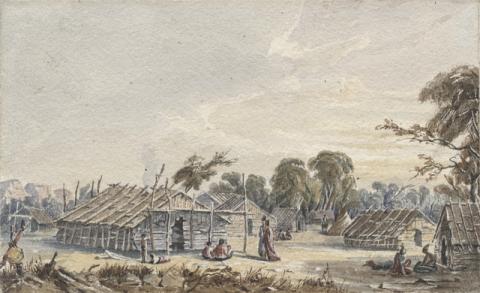
A Dakota Village by Seth Eastman
The Villages of the Ochéti Šhakówiŋ
The Year 1750 On The Northern Great Plains
By D. Jerome Tweton, The North Star Dakotan
BISMARCK, N.D. - They are commonly referred to as the Sioux. They call themselves the Ochéti Šhakówiŋ, Lakĥota for “Seven Campfires,” representing the seven major bands of the Great Sioux Nation. Once each year representatives of the bands come together to hold council, socialize, and participate in religious rites. This meeting of the Great Sioux Nation takes place in Péšhla “The Heart Of Everything That Is”—the Black Hills, the place, according to tradition, that gave birth to the Ochéti Šhakówiŋ. It is a serious mistake, however, to group all these Siouan-speaking people under one name or characterization, for the ways of life of the Campfires differ considerably.

The Dakota, sometimes referred to as the Eastern Sioux or the Santee Sioux, live in the Mississippi and Minnesota river valleys and account for four of the seven Campfires: the Mdwakanton (Spirit Lake People), the Waĥpékute (Shooters Among The Leaves), the Waĥpétowon (Dwellers Among The Leaves), and the Sissétowon (People Of The Swamp). To the west of the Dakota in the region of the James River Valley lie two Campfires, the Ihanktowan (Yankton) and the Ihanktowana (Yanktonai), sometimes known as the Middle Sioux. The Lakĥota, who populate the plains from the Platte to the Knife rivers, is the seventh Campfire. Also known as the Teton Sioux or Western Sioux, the Lakĥota are comprised of seven bands: Oglala (They Scatter Their Own); Sĥičhaŋğu or Brule (Burnt Thighs); Mniconjou (Planters Beside The Water); Itážipčho or Sans Arcs (Those Without Bows); Oohénoŋpa (Two Boilings/Kettles); Sihasapa (Blackfeet); Hunkpapa (Campers At The Horn).

Siouan territory about 1750.

By the 1500s, the Ochéti Šhakówiŋ inhabited the prairie and woods to the east of the plains. They could not avoid contact with the Ojibway who were moving toward the same territory south of Lake Superior. Tied closely to the French fur trade, the Objiwa, armed with French guns, gradually pushed the Yankton, Yanktonai, and Lakota to the west. The Ojibway made peace with the 5,000 Dakota who stayed in the Mississippi and Minnesota river valleys.

The Dakota remain people of the woods. The Mdewakanton occupy seven villages along the Mississippi; the Wahpekute have a large single village on the Minnesota River not far upstream from where it empties into the Mississippi. The Wahpeton’s seven villages and the 12 of the Sisseton are to the west on the Minnesota River. That the Dakota are people of the woods and water influences how they live. They construct permanent heavily-timbered bark houses with pitched roofs. Some live in small conical structures covered with skins and bark. Both men and women build the dwellings—sometimes referred to as wigwams. For food, the Dakota depend upon the lakes and rivers for fish and the woods for deer and small animals such as rabbits and muskrats. An annual early winter deer hunt usually brings enough meat to get through the winter. The Sisseton, the furthest west of the Dakota, venture out into the open prairie to hunt buffalo. Some Dakota raise corn, squash, and pumpkins. Wild rice and cranberries are plentiful and maple sugar mixed with water provides a tasty hot drink. Dakota life reflects a typical woodlands culture.

The Yankton and Yanktonai lived together around Leech Lake prior to the late 1600s when the two campfires separated. The Yankton, about 3,000 people, moved out of the northern woodlands and onto the prairie country near the pipestone quarries. A hundred years later they have established themselves in the region of the lower James River Valley. The Yanktonai, with a population of about 6,000, left the woodlands in the early 1700s and have built permanent winter homes in the James River Valley to the north of the Yankton.

The two groups developed into mixed cultures; that is, they combine the ways of the woods with the realities of a new environment. They continue to live in permanent villages near water where fish are plentiful. Gone are the large quantities of deer, wild rice, maple sugar, and cranberries. In their place are large gardens and buffalo. Buffalo hunts take the Yanktonai north to Devils Lake, east to the Red River, and west to the Missouri River. The Yanktonai have adopted the earthlodge , probably learning the building technique from the Missouri Valley tribes.

A Lakhota camp follows a bison gange, a scene by George Catlin.

The Lakota, the largest campfire with about 12,000 people, moved to the plains between the late 1600s and the mid-1700s. By the mid-1700s, the Lakota entered the sacred Black Hills, displacing the Cheyenne and Kiowa. As more and more bands reached the lower Missouri River, the Lakota pushed the Sahnish (Arikara) northward upriver toward the Mandan and Hidatsa villages.

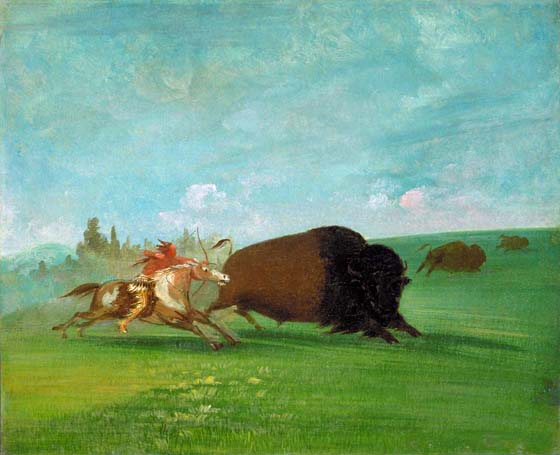
Facing a new land, the Lakota have had to abandon their woodland ways and adjust to a completely different climate and terrain. Soft-soled moccasins, so comfortable in the woods, have been replaced by hard soles, more appropriate on the sun-baked plains. Total dependence upon the buffalo has forced radical change. The buffalo, so numerous that they look like a vast brown sea, have become the life blood for the Lakota, providing food; skins for clothing, shelter, and beading; bone tools; sinew for sewing; materials for making all kinds of containers including cooking pouches and spiritual objects. One cannot overstate the importance of the buffalo to sustaining Lakota life.

A Lakhota chases a bison bull on horseback, a scene by George Catlin.

Because the buffalo herds migrate from place to place—sometimes hundreds of miles apart—so, too, do the Lakota. This has made permanent villages impossible; the tipi, a portable dwelling, has replaced the fixed wigwam. Village membership disappeared and has been replaced by smaller units called tiospaye—groups of related people. Each tiospaye is divided into camps that represent extended families. Because the Lakota have to travel, skin cookery has taken the place of breakable and heavy pottery. Because a tiospaye sometimes has to move suddenly, life is extremely well-organized and the closing down of a campsite can be done in a short time. The Lakota have acquired horses, making life much easier.

The Ochéti Šhakówiŋ are people of the woodlands, people of the prairie, and people of the plains. Where they live has dictated how they live. Their bond of togetherness, however, is stronger than their separatism.