Showing posts with label Plains Indians. Show all posts

Thursday, December 26, 2019

Lakota America, A Book Review

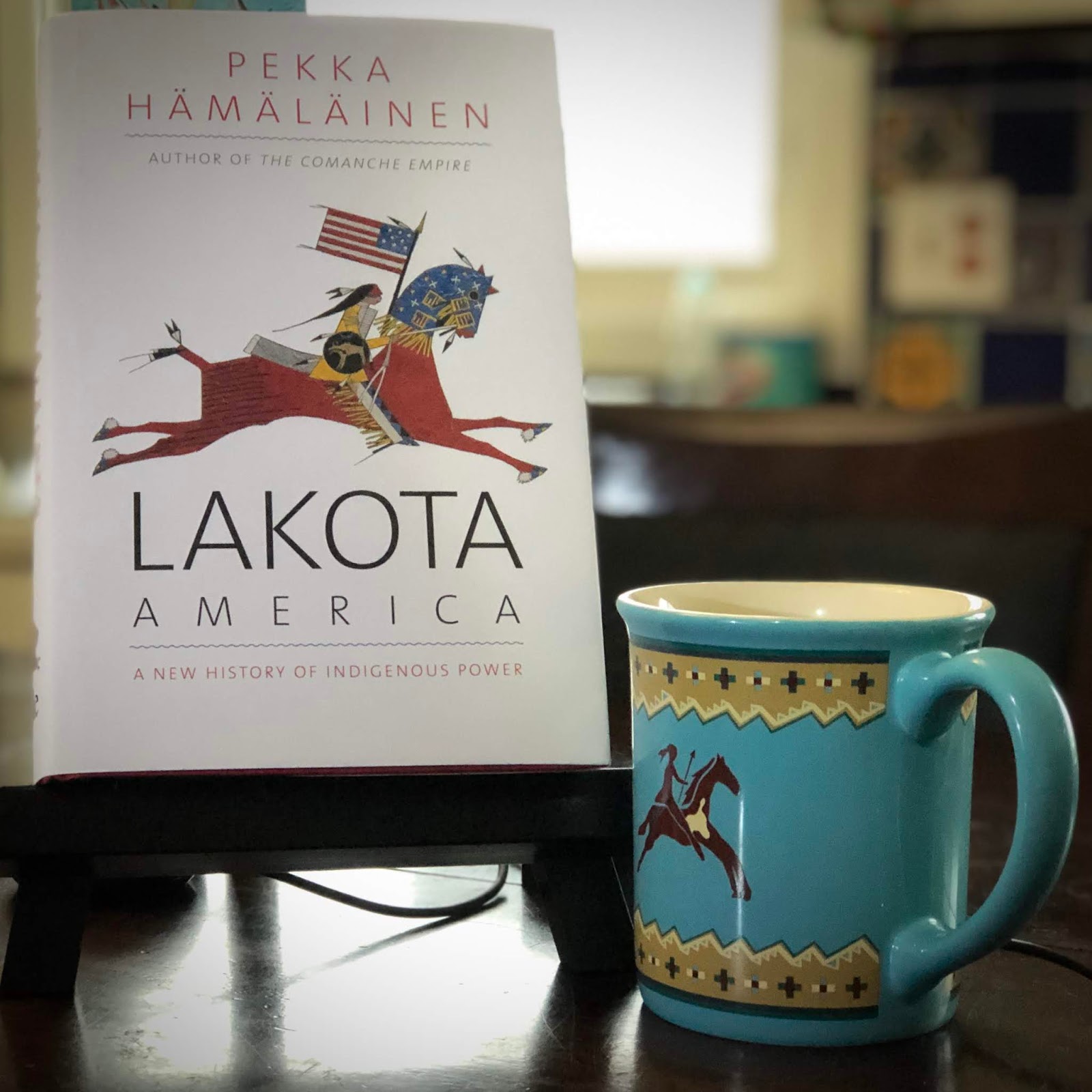
The cover of Lakota America features the art of Lakȟóta artist Jim Yellowhawk (Cheyenne River Sioux Tribe; Itázipčho). A simple photo of my copy of this book. 
Lakota America, A Book Review
This Book Fuckin' Moved Me
By Dakota Wind
Hämäläinen, Pekka. Lakota America: A New History of Indigenous Power. New Haven, CT: Yale University Press. 2019. $35.00 (hardcover). 544 pages + ix. Acknowledgments, a note on terminology, introduction, epilogue, a list of abbreviations, notes, glossary, index, maps, photos, illustrations.

“Yet this book is decidedly a history of the Lakotas, written from sources that seek to convey their perspective, often in their own words. An extraordinary archive makes this possible to an unusual degree. Lakota communities traced the passage of time by drawing on a buffalo hide a pictograph of one memorable event for each year. Lakotas call these calendars waníyetu iyáwapi. They draw attention to the mundane and reveal the sublime. Perhaps most important, as a body of historical record, winter counts capture what fascinated Lakotas and what mattered to them most. Lakota America makes the fullest use yet of this Indigenous archive in writing Lakota history.” (Hämäläinen, 2019; 8)

Thus begins Hämäläinen’s Lakota America, a post-colonial contact history of a people referencing their own historical records, and in this process, treating these pictographic records with a serious care and careful regard that these primary resource documents deserve. Most histories regarding the Očhéthi Šakówiŋ, Seven Council Fires (or “The Great Sioux Nation), are constructed primarily from colonial records (i.e. explorer journals, trader records, and missionary accounts). Hämäläinen embraces the indigenous record as a concurrent history, complemented by the colonial record.

I felt a deep sense of gratification reading this beautiful work.

Hämäläinen paints a picture of a people occupying a known and busy landscape inhabited and shaped by other indigenous peoples from trade, war, disease, and expanding colonial empires, to displacement, removal, imprisonment, and survival in a post-reservation world.

The story begins not with conflict, but with the arrival of Thiyóškate (Plays In The Lodge) on a diplomatic mission to Montreal to secure peace in the interior of North America. Conflict spread west threatening to invade Očhéthi Šakówiŋ homelands for beaver pelts in a trading system that left indigenous peoples dependent on iron wrought trade items.

There are many books about the Očhéthi Šakówiŋ, among them other notables including Royal Hassrick’s “The Sioux: Life and Customs of a Warrior Society,” Thomas Mails’ “Mystic Warriors of the Plains.” Nearly all western history books agree that the horse arrived in the mid-1700s. Hämäläinen breaks from academic consensus by informing readers that the horse arrived on the northern plains following the Pueblo Revolt of 1682. (Hämäläinen, 2019; 55)

The chapter, The Lakota Meridian, explores the Očhéthi Šakówiŋ in the context of world history. Hämäläinen reconstructs the setting of the interior of North America following the arrival of the horse, the gun, and smallpox epidemics which obliterated or weakened so many other first nations. The Lakȟóta secured and manipulated trade to their benefit. The Arikara War of 1823, the first American military campaign against Plains Indians sees the Očhéthi Šakówiŋ side with the United States, years after refusing “to be discovered” and acknowledging the United States as sovereign. (Hämäläinen, 2019; 140)

Lakota America is not a conflict history of the American West. It is closer to a biography in tone, but not on any one individual or few of Očhéthi Šakówiŋ leadership. It is not so much a cultural examination either; there are other resources for that. This work is like a study of the character of a people throughout several generations. Hämäläinen briefly articulates the cultural story of the White Buffalo Calf Woman and the Gift of the Sacred Pipe but reimagines this ancient narrative as a story of new urgency as the Lakȟóta ventured west from the Mnišóše, the Water-Astir (or Missouri River). (Hämäläinen, 2019; 164-165). He does reiterate throughout his work that Očhéthi Šakówiŋ identity is evidenced by virtue of practice and language. 

The image above was drawn by Sitting Bull's own hand. In his later years, Sitting Bull and his own people, the Húŋkpapȟa, identified him as a medicine man or spiritual leader. 

Očhéthi Šakówiŋ homeland is determined by occupation of waterways, in particular, the Mnišóše and all his tributaries. Boundaries are determined by the waters, and those boundaries were recognized in both the Fort Laramie Treaties. Hämäläinen carefully determines and explains how those boundaries were set through conflict and diplomacy. Their villages moved from valley to valley across the plains. The traditional Očhéthi Šakówiŋ recalls that the people moved from stream source to stream source across the plains.

Hämäläinen explores Lakȟóta political philosophy in their own terms as well as they dealt with the decline of the great bison ganges and the arrival of more fixed signs of American occupation. Iwáštegla, meaning “moderate,” “gentle,” and “easy,” but for also for the greatest maximum benefit, that which is “wašté,” or “good,” for the people. “Lakotas still expected wašíčus [sic] to compromise more than they did: after all, most of their interactions took place in Lakota territory. In this charged moment one can glimpse something essential about Lakotas’ ability to accept new realities, adjust to changing governing conditions, and yet remain indigenous.” (Hämäläinen, 2019; 300)

Lakota America has many strengths. Meticulous research is one, but what makes Hämäläinen’s work stand out is that he acknowledges, employs, and attributes the history (oral and pictographic) of the people he writes about, putting it on the same page as colonial records equating its importance.

Lakota America touches on the greatest conflict to shape the American West, Pȟežíšla Wakpá Okíčhize, or the Battle of the Little Bighorn. Every year there’s a book written about Lt. Col. Custer and the fate of the 7th Cavalry. Every book published about the Očhéthi Šakówiŋ includes this fight. It is refreshing that Hämäläinen does not dedicate an entire chapter retreading the last great Indian fight.

Hämäläinen does not stop his narrative of Lakȟóta history with Čhaŋkpé Ópi Owíčhakte, the Wounded Knee Massacre. No, he brings the story of adaptation, survival, and self-determination up to recent events at Íŋyaŋ Iyá Wakpá, the Talking Stone River (or the Cannonball River). A people and their history did not end at the turn of 1900. It lives and is a constant story of change. Hämäläinen gets it.

Lakota America is an engaging read. I found myself stopping several times throughout, lost in thought, and provoked to remember that indigenous occupation includes several other first nations who contested the landscape and gratified to discover how much Hämäläinen relied on Lakȟóta history to create this immensely reflective work.

My only concern, and it is a very minor thing, is that not all Dakhóta-Lakȟóta use the same term for the “winter count:” Northern Lakȟóta (i.e. Húŋkpapȟa) and Iháŋkthuŋwaŋna (i.e. Wičhíyena, or “Upper Yanktonai”) refer to the pictographic records as Waníyetu Wówapi, which means, “Keeping an Account of the Winter.” The Dakhóta and Lakȟóta who were placed at Fort Peck refer to winter counts as Hékta Yawápi, or “Counting Back.”

Lakota America has earned its place on my bookshelf. Get your copy as soon as you can to add it to yours. 


Wednesday, December 20, 2017

Revisiting The John K. Bear Winter Count

Drifting Goose, chief of the Húŋkpatina, a winter count keeper, along with his people were placed onto the Crow Creek Indian Reservation. 
The Drifting Goose Winter Count
John K. Bear Winter Count Revisited

By Dakota Wind
In 1976, James H. Howard published his Yanktonai Ethnohistory And The John K. Bear Winter Count in the Plains Anthropologist. Howard counseled with native informants from native communities in South Dakota. The strength of his work is determined by two things: his informants and his scholarly research. Howard genuinely cared for the subject and people he wrote about.

There are a few things which must be revisited in Howard’s work: the arrival of the horse is one. This is important because it establishes the earliest record of the Očhéthi Šakówiŋ (the Great Sioux Nation) encounter with the horse, its location, which places the Iháŋktȟuŋwaŋna (the Yanktonai) at the mouth of the Čhaŋsáŋsaŋ Wakpá (the James River), and a date of 1692.

A few things must be re-interpreted. An example is the 1841 entry regarding Thamína Wé (His Bloody Knife). Howard calls this record an “anomaly,” and assumes this entry is in regard to the Arikara US Indian Scout, Bloody Knife, a friend of the infamous Lt. Col. George Armstrong Custer, from whom the latter learned how to converse in Lakȟóta, Sahnish (Arikara), and the Plains Indian Sign & Gesture language. This Bloody Knife is the Iháŋktȟuŋwaŋ chief, not the Arikara scout.

I’ve employed the LLC standard orthography in this “update,” and have expanded or amended some of Howard’s entries. Howard’s general format will be used: Numerical year in the Common Era, original text, the text re-written using the LLC standard orthography, a word-for-word translation, a free interpretation, followed by cultural/historical narrative.

Some biographical information about Maǧá Bobdú (Drifting Goose) can be found at American-Tribes.com. Go visit this website for its great forum on the subject of American Indian history and culture.


Download the PDF document of "Revisiting The John K. Bear Winter Count." 

For whatever odd reason, the citations didn't carry over when I converted the doc to PDF. Please contact me if you'd like a copy of the original document. 

Dakota Wind is an enrolled member of the Standing Rock Sioux Tribe. He is currently a university student working on a degree in History with a focus on American Indian and Western History. He maintains the history website The First Scout.


Monday, October 9, 2017

Forgotten Fires, A Book Review

Wíačhéič’thi, "The Sun Makes A Campfire For Itself." In English, you'd call these "Sundogs."
Forgotten Fires, A Book Review
Historic Narratives Of Fires
By Dakota Wind
Stewart, Omer C. Forgotten Fires: Native Americans and the Transient Wilderness. Edited by Henry T. Lewis. Norman, OK: University of Oklahoma Press, 2002. 364 pp. $24.95 (paperback). Illustrations, bibliography, and references.

As a boy, my younger brother and I were fascinated with fire. Sometimes, around the Fourth of July, Golf Hill (aka “Boot Hill,” “Agency Hill,” or even as the Cheyenne knew it, “The Hill That Stands Alone”) would burn. It was an annual occasion. At some point, before I cared, someone had arranged and painted white some stones to say on the hillside, “WARRIORS.” Following one of the fires, my brother and I took to rearranging the letters to spell, “ASS.” You could see it fifteen miles away.

We loved fire. Especially starting them. My enthusiasm for fire waned one day after burning myself on the smoker in the backyard. My brother’s infatuation continued unabated. He’d carefully cut open fireworks to light the powders. One day he almost burned down the house when he lit our mother’s god’s eye that hung in the corner of the dining area. I still remember him saying, “It started by itself!” I threw a pitcher of water on it, and he hung it back up after turning it around. When our mother discovered it, she thought it was the result of one of her parties.

Omer’s Forgotten Fires is a great resource for all things fire related in native North America. Historic fires, like the Chicago Fire, isn’t included here, and with good reason. One can find a number of resources on that one topic. Omer has combed through the journals of explorers, traders, trappers, and artists and has delivered an astonishing read that challenges the notion of Indians living harmoniously in a pristine Garden of Eden.  

There are several reasons to start fires on the Great Plains and Omer explores them all. From renewing the grass so that horses could consume fresh green grass and driving game to signal fires and maintaining trails.

Omer perfectly captures George Catlin’s fascination with the great prairie fires, “sparkling and brilliant chains of liquid fire.” Catlin also describes a firestorm, “…there is yet another character of burning prairies…that requires another letter, and a different pen to describe – the war, or hell of fires!” The kind of firestorm that creates and sustains its own weather, drawing in air with hurricane force winds, which overtakes the swiftest horses, and animals coming to an immutable and terrified stop when such fires cross the plains.

The German traveler Maximilian Wied-Neuwied mentions that some of the fires were caused by the natives in order to escape the pursuit of their enemies, and witnesses fire whirls or, “graceful undulations, to the zenith.” Catlin and Bodmer never seem to run out of adjectives and adverbs to describe the wildfires.

Other firsthand accounts of fires range across North America from the woodlands to the mountains, plateaus, and valleys. Omer’s book is an amazingly fast read because of it. And suffers because of it. These accounts are overwhelmingly non-native, that the book title should perhaps be instead Forgotten Fires, Forgotten Resources: Non-Native Accounts of Native Americans and the Transient Wilderness.

There is no mention of sedentary agricultural tribes like the Arikara, Hidatsa, Mandan, or Pawnee burning their fields in the fall after a harvest, or why. The resources to draw from are out there, like Bowers’ Mandan Social and Ceremonial Organization or Hidatsa Social and Ceremonial Organization. These two tribes are still with us today, it’s not as if one couldn’t ask them “why?”

While there’s some mention of fire used in warfare, there isn’t one native narrative regarding the use of fire in war. Garrick Mallery’s Picture Writing of the American Indians, Vol. 1, contains part of such a narrative when the Cheyenne resorted to prairie fires in retaliation against a Thítȟuŋwaŋ (Teton; Lakota) war party in the 1760s.

Lastly, what’s missing is an inclusion of the living memory of Native Americans regarding fires, actual and metaphorical. There are many descriptions for fire, but here’s a basic few to consider: óna (prairie fire), pȟetá (fire), and očhéthi (the council fire). Fire is for more than burning, cooking, signaling, and destruction. It’s constructive, has spiritual significance, and for gathering the community together.

If one is studying the Great Plains, one needs this book. It contains immense ecological value about establishing a balance on the Great Plains between natural and human benefit. It is worth one’s time to revisit it a few times more, and certainly worth referencing Omer’s scholarship. Forgotten Fires is a good book, it's only missing a little. If it’s worth this much time to read and re-read, get a copy for yourself. 

Dakota Wind is an enrolled member of the Standing Rock Sioux Tribe. He is currently a university student working on a degree in History with a focus on American Indian and Western History. He maintains the history website The First Scout.


Monday, November 18, 2013

The Wind Is The Spirit Of The Great Plains

Tȟaté’káoškokpa (Canyon Made-By-Wind), or Wind Canyon, along the Heȟáka Tȟa Wakpá (River Of Elk; Little Missouri River) in Makȟóšíća (Badlands, N.D.; Theodore Roosevelt National Park).
The Wind Is The Spirit Of The Great Plains
The Sky In Word, Pictograph, And Sign
By Dakota Wind
THE GREAT PLAINS - The wind has been a constant presence on the open prairie since creation, and has shaped the landscape with its caress. It races across the open sky with the summer and winter storms, and flows about the landscape playfully, fitfully, and angrily. It is the very essence of the Great Plains.

The Lakȟóta have several words for the wind and its attributes such as tȟaté (air in motion), uyá (to blow leeward of the wind), kaȟwókA (to be carried along with the wind), ikápȟaŋyaŋ (to be beaten down by the wind, as with grass) or itáglaȟweya (with the wind). OkáluzA, or ičáluzA, refers to a breeze.


When a strong wind is present, or suddenly appears, during prayer or at a gathering, the wind might even be referred to as takú wakȟáŋ škaŋškáŋ (something with great energy is moving). A whirlwind is called tȟatéiyumni, which some regard as a sign that a spirit is present.

There is only one word to describe a windless day, ablákela (calm or quiet).

When the wind blows cold, such as it does in the winter months, the Lakȟóta refer to it as tȟatóšni. The cold winter wind had a story of its own, and in the days of legend, before steamboats and trains, before soldiers and missionaries, when the camps moved across the prairie steppe in the fall to establish winter camps, they told the story of Wazíya, that which some call a giant, or the Power Of The North. Wazíya blew his cold breath across the world. 


The blizzard is known to the Lakȟóta as Iwóblu. 

But even the wind has an origin. There are various stories about the wind, but the basics are that after creation, Tȟaté (Wind) took the daughter of Old Man and Old Woman, Ité (Face) as his wife. They had four sons, the Four Winds. Iŋktómi, the Lakȟóta trickster, persuaded Ité to begin an affair with Wí (the Sun) to gain status. 


The affair backfired, and Takú Wakȟáŋ Škaŋškáŋ gave Haŋwí (the Moon) her own domain, and sent Old Man and Old Woman to earth along with Ité. Ité was ever after parted from her husband, Tȟaté, and their four sons. Ité, however, had a fifth son, Tȟatéiyumni (Whirlwind). Woȟpá (Falling Star Woman), daughter of Wí and Haŋwí, was sent to earth. Woȟpá became the wife of Okáǧa (the South Wind) and they raised Tȟatéiyumni as their son.

They say as the summer wanes and turns to autumn, the wind changes with the weather. That change in the wind is the breath of North. The cold was and is deadly, never to be feared, but respected. The North spreads his robe across the sleeping land. The North makes hunting game easier to track. In fact, the Lakȟóta used to dance in snowshoes in the blanket of the first snowfall. They rejoiced in the weather and embraced the deep cold. 


In the spring or autumn mornings, in the early morning just as the sun rises, there appears a mist. The Lakȟóta call this Aŋptȟáŋiya. Regular fog is P'ó. 

Sometimes the winter seems like it will never end, even for people who’ve lived here for thousands of years. Gray skies smother the light for days on end. Everywhere the land is monochrome. Months without color took its toll on the people. These days it’s called Seasonal Affective Disorder (SAD).

For the Lakȟóta people, even the winter holds the promise of light and hope.

On cold days one might see what they call a sundog, but its not every cold day that features a sundog. The ancient Greeks called it a “mock sun.” The Romans called it a “double sun.” The English in the early 1400s said the sundog was a representation of the Holy Trinity.


This Campfire-Of-The-Sun is seen here above the Mníšoše (Water-Astir; Missouri River) and Iŋyáŋ Wosláta Oyáŋke (Where Standing Rock Dwells), the Standing Rock Sioux Indian Reservation

The 
Lakȟóta call the sundog Wíačhéič’ithi which means The Sun Makes A Campfire For Itself. The story of this beautiful name for this awesome phenomenon comes to me from Cedric Good House: A long time ago the people experienced several days of bleak grayness. People began experiencing bad dreams and others became depressed. It was the bad dreams that haunted the grandchildren that moved a grandfather to leave his village to pray for an end to the grayness. When he returned he called everyone in to the center of the village and selected two groups of young men to go the east of the camp and build two campfires. They did as they were told and returned to the camp where the people prayed. A lightening of the grayness indicated that morning had arrived. The clouds broke and the sun burst through the grayness. As the sun rose above the horizon, the campfires ascended into the sky with it. The people rejoiced and sang.

Just as there are several words for wind, the Lakȟóta have some words for clouds, which are of the sky. Maȟpíya in itself is a reference to the sky, or heavens. Maȟpíya tȟó, is the blue sky. Maȟpíya šápe is dark clouds. Maȟpíya akáȟpA is a cloudy overcast. Maȟpíya naȟléčA literally “the sky tears,” is a reference to a cloud burst of rain. Maȟpíya okáksaksa is partly cloudly. Maȟpíyaya is cloudy. Čhumaȟpiya means “dew clouds” or “vapor clouds.” Op’ó is a cloud of dust or steam. OkpúkpA is cloudy, hazy, or unclear. Makȟóp’oya is a cloud of dust.

When the Christian missionaries arrived they needed to articulate the Kingdom of Heaven, and coined the term Maȟpíya Wókičhuŋze, which literally means “Kingdom of the Sky.”


The northern lights above North Dakota. Unknown photographer.

The northern lights mean something very special to the Lakȟóta. Maȟpíya Tȟaŋíŋ is the northern lights, but is literally, “Buffalo-hair Sky.” Wanáği Tȟawáčhipi, a reference for the northern lights meaning “Dance Of The Spirits,” and there’s a story, or experience, about out there but it won't be shared here. Haŋwákȟaŋ, another word for the northern lights, literally means “Night With-Energy.” It was a tradition of some Lakȟóta to burn incense, sweet-grass or cedar, when the northern lights appeared.

Sometimes, just as there is no wind, there are no clouds in the sky. There are a few ways of describing a day without clouds: Maȟpíya waníče, there are no clouds. Waŋžíla Tȟo, blue oneness or complete blueness, or tȟowáŋžiča, the sky is blue.

In the spring or summer, storms or rainfall strikes in daylight. The Lakȟóta have the tradition that the Wakíŋya, Thunder-Beings, bring the storms, but not just to bring rain. Lightning flashes from their eyes, claws, and wings. With lightning and rain the Wakíŋya cleansed the earth and destroyed or perhaps chased out the negative entities which settled into the lands. At the end of daylight storms the plains are treated to rainbows stretching from horizon to horizon, a grand arch reaching to heaven.


In the blistering summer months mirages appear on the horizons. The Lakȟóta call this shimmer of air at the edge of the earth Mašténaptapta. 


A double rainbow in Theodore Roosevelt National Park, by Travel Garden Eat.

The Lakȟóta refer to rainbows as Wígmuŋke, A Snare. It is said that the wígmuŋke, causes the storm to end by trapping it, so that no more rain can fall. No one points at wígmuŋke with their fingers, but use their lips or elbows if they gesture to it.

In the spring, the wind signals another change. The Lakȟóta call this wind Niyá Awičhableze, The Enlightening Breath. This is the first spring wind upon which the meadowlarks return. It’s the time of year in which the Lakȟóta carefully watch for the ice to break on the Mníšoše, the Water-Astir (Missouri River), the geese return, and when the bison bear their calves.

One of the names that the Lakȟóta people have for the courting flute is Wayážo, which means To Play A Flute. It is the essence of the wind. Flutes are traditionally made from red cedar. The heart of the wood, the soft red center, is removed with the intention of that space becoming filled with the flute-maker’s own heart. Breath flows through the flute and the wind carries its haunting song.


Tȟokéya Inažiŋ (The First To Arise; Kevin Locke) here with his great-grandfather's flute, shares the flute tradition with youth on the Standing Rock Sioux Indian Reservation.

In a discussion with Deacon Terry Star, enrolled member of the Standing Rock Sioux Tribe, about the wind and the flute, Deacon Star shared that he heard the four winds were brothers who represented the four cardinal directions. The West Wind, according to how Deacon Star heard it, didn’t just bring the thunderstorms, but also played the flute.

The wind, clouds, northern lights, and rainbow are expressed in the non-speaking languages of the Great Plains too.

In pictography, the wind is represented by a series of straight lines ending in a curly-cue or wave, and more lines indicate the strength of the wind. A whirlwind is represented by a swirl of four lines spiraling outward from the center of a circle. Clouds are represented sometimes by a simple line drawing of a cloud, but generally clouds are almost always depicted with rain and lightning. An arch above a straight line is a representation of the sky above the earth.

A pictograph for northern lights may be represented by night (a darkened circle with a line running through it top to bottom; or other variant) and fire (above the image depicting night). A rainbow is depicted by a series of arches over a straight line.


Dr. Jesse Johnson (Cheyenne River Lakota), center,  in front of a thípi.

In the sign and gesture language of the American Indians, there is a sign for wind as well. In a communiqué from Dr. Jesse Johnson, Blú Wakpá (Powder River), enrolled member of the Cheyenne River Sioux Tribe, the sign for wind takes a few forms, but its most basic execution involves holding the hands up, backs up at about shoulder height, fingers spread, and moving hands in a wavy tremulous motion in the direction of the wind.

Like pictography, the Plains Indian sign for cloud or clouds is inseparable from rain or lightning. The sign for rain consists of holding one’s hands up at shoulder height and drawing one’s hands down slowly two to three times. Kevin Locke, enrolled member of the Standing Rock Sioux Tribe, draws his hands down, backs up, and does “piano fingers” to sign rain. Lightning is signed by miming a jagged lightning pattern in mid air with either hand.

According to Dr. Johnson’s research into the Plains Indian sign language, the northern lights are depicted as “both hands, backs down, half closed, thumb and finger tips together, raised very high and spread with a sweep to indicate flashes. It should be done facing north.” Johnson adds that the sign is helped if the hands are swung apart in an arc at the highest point in executing the sign.


Wáǧačhaŋ (Cottonwood) on the floodplain of the Heȟáka Tȟa Wakpá.

The constant wind blowing across the open prairie steppe and through a vast open sky is a part of the Lakȟóta culture, or perhaps it is that the Lakȟóta are a part of the wind. They say that patterns on one’s fingertips indicate the direction the wind was blowing on the day of one’s birth. 


The Lakȟóta have the saying Takú šičá owás’iŋla kaȟwóg iyáyiŋ kte ló, which means, "All the bad things will blow away." 

On the vast open plains, grasses bow down and sway in motion as if in dance. Great cottonwood trees catch the winds and rattle their leaves in a deafening roar, like the crash of waves in the distant oceans. These ancient trees catch the smallest breeze and their leaves shush the world. 


Le tȟaté na maȟpíya tȟa makȟóčhe hečha lo. This is the land of sky and wind. 

Terry Star is an enrolled member of the Standing Rock Sioux Tribe. His traditional Dakȟóta name is Ȟé Ská, White Mountain, after Mount Rainier of which the top of the mountain bears snow year round. He is a deacon in the Episcopal Church and is currently a candidate for the Master of Divinity at Nashotah House Theological Seminary in Wisconsin. Star was raised by his late grandmother, Lillian Ironbull Martinez in the traditions of the church and the Dakota. For several years he has served as a youth pastor on Standing Rock and has frequently called on the stories he received from Lillian and her friends to relate biblical ones to the youth.

Jesse Johnson is an enrolled member of the Cheyenne River Sioux Tribe. His traditional Lakȟóta name is Blú Wakpá, Powder River, after Čhaȟlí Wakpá, which means Charcoal River and is the proper place name of Powder River. Johnson graduated with his Ph.D. in American Indian Studies. In his spare time Johnson teaches martial arts.


GLOSSARY:
Ablákela: Quiet, or windless, calm

Aŋptȟáŋiya: Vapor, mist that arises in the early morning

Čhumaȟpiya: Dew Clouds, Vapor Clouds

Haŋwákȟaŋ: Night-With-Energy, Northern Lights

Haŋwí: Moon

Heȟáka Tȟa Wakpá: River Of Elk, Little Missouri River

IčáluzA: Breeze

Ikápȟaŋyaŋ:To-Be-Beaten-Down-By-The-Wind

Iŋktómi: Trickster

Iŋyáŋ Wosláta Oyáŋke: Standing Rock Agency

Itáglaȟweya: With-The-Wind

Ité: Face

Iwóblu: Blizzard

KaȟwókA: To-Be-Carried-Along-With-The-Wind

Maȟpíya: Cloud, Sky, Heaven

Maȟpíya AkáȟpA: Clouds Overcasted

Maȟpíya NaȟléčA: The Sky Tears, a cloud burst of rain

Maȟpíya Okáksaksa: Partly Cloudy

Maȟpíya Šápe: Dark Clouds

Maȟpíya Tȟaŋíŋ: Buffalo-Hair Sky, Northern Lights

Maȟpíya Tȟó: Blue Sky

Maȟpíya Waníče: No-Clouds, Cloudless

Maȟpíya Wókičhuŋze: "Kingdom of Heaven"

Maȟpíyaya: Cloudy

Makȟóp’oya: A cloud of dust

Makȟóšíća: Badlands

Mašténaptapta: Sunlight-Waving, shimmer on the horizon on a hot day, mirage

Mníšoše: Water-Astir, Missouri River

Niyá Awičhableze: Enlightening Breath, spring wind

Okáǧa: South Wind

OkáluzA: Breeze

Op’ó: A cloud of dust or steam

OkpúkpA: Haze

P'ó: Fog

Takú Wakȟáŋ Škaŋškáŋ: Somthing With-Energy Moves/Moving; often contracted to Takú Škaŋškáŋ (Something Moving), or when talking about creation, simply Škaŋ.

Tȟaté: Air-In-Motion, Wind

Tȟatéiyumni: Whirlwind

Tȟaté’káoškokpa: Canyon Made-By-Wind, Wind Canyon

Tȟatóšni: Cold Wind

Tȟowáŋžiča: Completely Blue, Blue Oneness, a completely blue sky

Uyá: To-Blow-Leeward-Of-The-Wind

Wáǧačhaŋ: Cottonwood 

Wakíŋya: Thunder

Wanáği Tȟawáčhipi: Dance of The Spirits, Northern Lights

Waŋžíla Tȟo: Complete Blueness, Blue Oneness, a completely blue sky

Wayážo: To-Play-The-Flute, Flute

Wazíya: Lit. Pine, Power-Of-The-North, also a name of the North Wind

Wí: Sun

Wíačhéič’ithi: The Sun Makes A Campfire For Itself, Sundog

Wígmuŋke: Snare, Rainbow

Woȟpá: Meteor, Falling Star

Monday, April 30, 2012

More Christian Iconography in The Tradition of Plains Indian Pictography

A picture of the icon as in its finished state.
Christian Iconography: The Archangel Gabriel
Plains Indian Pictography
By Dakota Wind
BISMARCK, N.D. - This past spring season I thought I'd finish a project that began maybe five or six years ago. I had applied plaster to a wood plank then pretty much forgot about it. It sat around in the basement and was occasionally moved when I went to the book shelf, when it would be briefly remembered, then forgotten about. I didn't even know what the icon was going to represent.

It started with a sketch on regular paper. It looked much the same when finished.

I stetched out a couple of concepts of the Archangel Gabriel. I had at first envisioned the angel without wings. Instead, I pictured a figure looking like the above image, only instead of wings, this angel would have clouds behind with lightning making the outline of the wings. I ended up going with wings, because without wings, no one would recognize that it was supposed to be an angel.

The drawing was applied to the plaster and a few parts were filled in.

The wings of Gabriel are often painted blue and red. I kept the edges of the wings silver, in a throwback to my original concept of lightning. Gabriel is said to have a trumpet. The Lakota people did not have trumpets, but we have flutes. I painted Gabriel holding a flute instead. The shirt is a mix of an old time war shirt, like the kind made out of elk skins, and a mix of the late nineteeth century ghost dance shirt.

The icon nears completion.The blue of the sky and wings turned out great.

I added paint to the bottom half of the image. The very top is the celestial heavens, the blue is heaven above. The angel is standing on the world, with his height reaching above the sky and into the stars. The shirt has seven stars. Ghost dance shirts were often decorated with celestial imagery to represent the heavens. In this case, the seven stars on the shirt represent the seven archangels.


I added clouds, a few other destails, and a warbonnet pattern emanating from the traditional halo. In direct sunlight, the icon sparkles and the halo warmly glows.

Here is a close up of the detail on the head, halo, and shirt.

I submitted this icon to the editorial staff of the Indigenous Theology Training Institute's First People's Theology Journal for their consideration, and in hopes the image would be chosen for publication in their forthcoming journal. It was selected. I am grateful and happy.

Visit the Indigenous Theology Training Institute's website sometime, for information about ordering a copy of their journal at: www.indigenoustheologicaltraininginstitute.org.

Friday, April 20, 2012

Christian Iconography...But Painted in The Tradition of Plains Indian Pictography

Above is a side view of the icon I wrote.
Christian Iconography
Plains Indian Pictography
By Dakota Wind
BISMARCK, N.D. - Some years back I painted an icon of the Holy Trinity. I thought that I'd take a traditional art like American Indian pictography and attempt to "write" an icon in the tradition of eastern or Russian Christian iconography. Here's my first attempt.

I am no expert in iconography. I took a course of Christian art while I pursued my degree in Theology at the University of Mary from Sister Edith Selzer. 

Traditionally, I believe, and I hope I'm recalling this correctly, iconographers selected a cypress plank upon which to write their icon. They "wrote" the icon rather than "painted" it because many Christians couldn't read or write, but they could understand pictures and colors. 

I chose to use cedar on which to write my icon, for it is a sacred wood. Its an aromatic wood, and the tree itself grows with other cedar trees. The roots of one cedar twine around the roots of other cedar trees and in this way the trees are collectively stronger, and on the Great Plains of North America the cedar needs all the strength it can call on to withstand the winds.

I anointed the plank with linseed oil. I then applied a red cotton cloth to the side on which I was going to write. Iconographers typically use white cloth to represent the shroud of Jesus Christ. I used red cloth, for red is a sacred color and is often used in medicine ties when one prays, and to represent the blood of the Christ. 

From the angle of the above picture, one can see plaster. I had put it on rather thick. Over the past few years, the wood has warped ever so slightly which caused the plaster to crack. 

A head-on view of the icon. The good people at KAT Communications allowed me to use their studio to take these pictures.

A bald eagle flies in the bottom left hand corner, a golden eagle flies in the opposite corner. The two eagle do not fly within the circle of green, they fly above and beyond. In the Lakota tradition, eagles carry the messages or prayers of the people to the Creator above. 

The circle of green has three green rectangles in the top left corner, two rectangles and a triangle in the corner opposite. The green circle and the green shapes subtly suggest a turtle. In the Lakota tradition the turtle represents the world, grandmother earth.

The Holy Trinity stand above or beyond the visible heavens.

A closer view of the icon.

The Holy Trinity stand in front of the Creator's lodge. On the left tipi flap are seven stars arranged in the pattern of Seven Brothers, commonly known as The Big Dipper. On the right tipi flap are also seven stars, these are the Seven Sisters, more commonly known as the Pleiades. In the Lakota tradition, some say that our souls or spirits descend from the heavens from the Seven Sisters, on its descent, the spirit passes through the "spoon" of the Big Dipper, before beginning its worldly journey in a body. 

A closer view yet of the icon.

The "Black Warbonnet" pattern radiates from the heads of the Holy Trinity. The left figure wears a creation robe, the robe with the patterns of the sun, the stars, the moon, and animals which were created before people. The right figure wears a blanket of holiness and humaness, and also carries the gift of the sacred pipe and a pipe bag which features the image of a bison cow. In Lakota tradition, the White Buffalo Calf Woman brought the pipe to the people, a "covenant" if you will, that each Lakota person create a deep and personal relationship with the Creator and the world around. The figure in the center is the Christ. This center figure makes two signs. The first sign is the sign for good in the Plains Indian Sign Language - with the left hand. The second sign is the Christian sign for divinity touching humanity - two fingers are shown, the thumb and the ring and pinky fingers touch, leaving the middle and index fingers straight out.

The icon was blessed by then Roman Catholic Bishop Paul Zipfel of the Bismarck Diocese. The icon now resides in a private collection.