Showing posts with label Tragedy. Show all posts

Wednesday, April 9, 2014

The Tragic Love Of Flying Shadow Woman And Track Maker

"The Falls Of Saint Anthony" by Henry Lewis.
Love And Death Between Enemies
Flying Shadow Woman And Track Maker

Edited by Dakota Wind
The story of the love between the Dakȟóta warrior Track Maker and the young Anishinaabe woman Flying Shadow has appeared in print twice, once in Charles Skinner’s Myths And Legends Of Our Own Lands, 1896, and again in Terri Hardin’s Legends And Lore Of The American Indians, 1993. Both books are out of print. This story is retold here with edits. It has not been verified by living oral tradition, but it bears similarities (i.e tragic deaths of lovers, conflict) to living stories such as Painted Woods and Spirit Wood.

BDÓTE, M.N. - The Anishinaabe and Dakȟóta had come together at Bdóte (“Where Two Waters Converge*”) to cement friendships and celebrate. A young Anishinaabe, Flying Shadow Woman, was sad when the time came for the tribes to part, for a Dakȟóta man, Track Maker, had won her heart.

In those days, inter-tribal marriages were not unknown. If she married him and went to live with his people, it might well be possible that every Dakȟóta would be against her should the tribes wage war. War between the Anishinaabe and the Dakȟóta was closer than neither Flying Shadow Woman nor Track Maker anticipated.

The Anishinaabe left with feelings of good will. Flying Shadow Woman had received a token of love from Track Maker and kept it close.
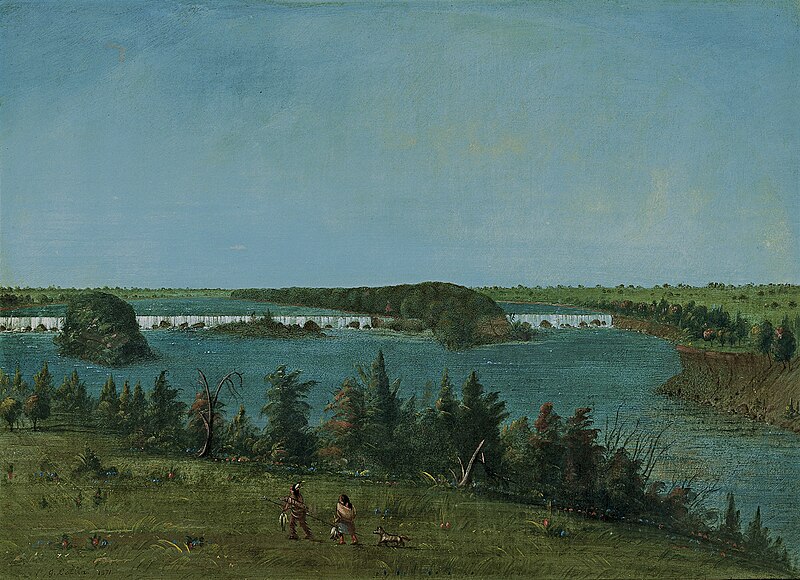

"The Falls Of Saint Anthony" by George Catlin.

Two Anishinaabe warriors lingered behind their band, and for reasons of their own, killed a Dakȟóta man after this congenial gathering. News of the murder reached the Dakȟóta village which provoked an immediate retaliation, and a war party of 300 was swiftly formed. Track Maker counted himself first among the war party as it was his brother who was shot and killed, and though he loved Flying Shadow Woman, he could not remain behind. The war party descended upon the unsuspecting Anishinaabe who had made camp between Owámni (“Whirlpool,” aka St. Anthony Falls) and Wakpá Wakáŋ (“Spirit River,” aka Rum River).

The Anishinaabe camp was unaware of the murder of the Dakȟóta man. 

"Ojibwe Encampment" by Paul Kane.

The Dakȟóta fell upon them and exacted furious revenge. In the midst of the violence Track Maker beheld Flying Shadow Woman who rushed into his arms with a cry of relief, but serenity was denied her. Track Maker embraced her but for a moment until he bowed his head and fortified his will to annihilate her people for the murder of his brother. Track Maker abandoned Flying Shadow Woman to claim retribution. He never looked back. He did not kill her, but he refused to save her.

The Dakȟótas' thirst for vengeance was slaked only when the last Anishinaabe lay dead.

The war party took a hundred scalps that day, and upon their return celebrated their victory.

Track Maker returned with more scalps than any other warrior, and the Dakȟóta welcomed him home as a hero, but he kept a solemn distance from all, and refused to share in the celebration. The memory of Flying Shadow Woman’s face haunted him thereafter. He saw her in the river, in the leaves, in the clouds, and even in the faces of deer when he went hunting.

At last, one day, a war party was mustered. Track Maker was the first to join, and on the field of battle he was the first to engage the enemy by running directly into them. He laid his axe about the enemy until he fell, pierced by a several arrows.

He smiled as he died.

Though this is a very short story retold with edits, two people graciously offered guidance:

Lise Erdrich, an enrolled member of the Turtle Mountain Band of Chippewa, lives and works in Wahpeton, ND, and has worked in American Indian health and education for over twenty years. She is the author of the children’s picture books Sacagawea, Bear Makes Rock Soup, and many other acclaimed works.

Dawí, Huhá Máza, is a lineal descendant of the Kap'óža Bdewákhaŋthuŋwaŋ Oyáte. A traditional bow and arrow maker, and Dakȟóta language student, Dawí lives in occupied Bde Óta Othúŋwe (aka Minneapolis).

____________________

* Where the Wakpá Mní Šóta (Smoking Water River, aka “Minnesota River”) converges with the Ȟaȟá Wakpá (Falling Water River, aka “Mississippi River”).

Thursday, January 26, 2012

Spotted Elk's (Big Foot's) Journey Ends In Tragedy At Wounded Knee

Major James McLaughlin, BIA Indian Agent at the Standing Rock Sioux Indian Reservation. Photo by D.F. Barry.
Spotted Elk's (Big Foot's) Journey
Tragedy At Wounded Knee

By Dakota Wind
STANDING ROCK - The Ghost Dance came to the Standing Rock Sioux Indian Reservation sometime in 1889, about the time that North and South Dakota entered the union as states. Major James McLaughlin ordered BIA Indian Police to Sitting Bull’s home on the Grand River in South Dakota, in an attempt to halt the Ghost Dance. The arrest was to happen in the early morning of Dec. 15, 1890. The BIA Indian Police surrounded Sitting Bull’s cabin, knocked on the door, and informed the Lakota leader that he was under arrest. Sitting Bull’s camp awoke and tried to inhibit the arrest. Anxiety gripped the camp and the police alike. Catch-The-Bear shot Bullhead, Bullhead shot Sitting Bull in the chest, Red Tomahawk fired a round into Sitting Bull’s temple. At the end of the gunfight, the bodies of Sitting Bull, six policemen, and eleven warriors turned the winter snow red with blood.


Unphan Gleska (Spotted Elk), also known as Si Tanka (Big Foot), a chief of the Mniconjou band of Lakota, is pictured here with his wife Cetan Ska Win (White Hawk Woman).

Spotted Elk, also known as Big Foot, a Mniconjou Lakota Chief, took flight and lead his band south, the destination: Pine Ridge. There, perhaps Spotted Elk might find refuge among the Lakota of Red Cloud and Crazy Horse.

On Dec. 28, 1890, Spotted Elk’s band stopped near Porcupine Creek. Spotted Elk called for the men to raise the white flag. Major Whiteside of the 7th Cavalry parlayed with Spotted Elk, promising food to the hungry and blankets for the cold, and then escorted Spotted Elk’s band to Wounded Knee Creek where the 7th Cavalry was camped. Two companies of cavalry took the lead, followed by an ambulance carrying Spotted Elk, Spotted Elk’s band (now on foot), wagons, and two cavalry companies, and bringing up the rear was a battery of Hotchkiss guns.


In this picture are seven Lakota scouts and four soldiers posing with a Hotchkiss gun.

When the column of cavalry and Lakota reached the military camp at Wounded Knee, the Lakota were counted at about 120 men and 200 women and children. After camp was established, Major Whiteside ordered two troops of cavalry stationed around the camp to serve sentry duty with two Hotchkiss guns placed on a rise overlooking the camp. Later that night, Colonel Forsyth arrived with orders to take Spotted Elk and his band to a military prison in Omaha, NB. A few spectators and a self-serious Jesuit priest named Francis Craft came with Forsyth. Fr. Craft was selected to use his influence with the Lakota as a Black Robe to persuade them to come in peaceably (as Fr. John Lutz had done earlier that month with the Sicangu Lakota chief Two-Strike). Forsyth placed his Hotchkiss guns alongside Whitesides’s guns.


Colonel James Forsyth pictured here in his Brigadier General uniform. He made the rank of general in November 1894.

According to Fr. Craft’s account of the Wounded Knee Massacre, Forsyth made a peaceful speech and asked the Lakota to surrender their arms. The Lakota denied that they had any. Forsyth sent soldiers amongst the Lakota to retrieve any arms they found. A medicine man began to pray and sing. Some of the Lakota men came forward, one by one to leave their arms, and when about twenty rifles were collected, a soldier spied rifles under blankets and cried out, “Look out, look at that,” followed by nervous laughter on both sides. Forsyth assured the Lakota that he would not take their arms by force even if he had ten years to wait. Then according to Fr. Craft, he walked among the Lakota calming them as best as he could as he passed out cigarettes. Craft further says that several Lakota men threw aside their blankets and actually raised their guns to companies B and K, and he identified many of the Lakota arms as repeating twelve-shot Winchester rifles. Craft says that he ran along the line of Lakota warriors and begged them to stop, at which the Lakota warriors laughed then lowered their arms, all but one. Craft identified the remaining Lakota rifleman as Black Fox, a deaf-mute, who was unable to understand the exchange between priest and warriors and who then fired off a round.


Fr. Francis Craft carried a pipe. He fought in the Union army in the Civil War at the age of ten. He recieved a bayont wound to the head at the Battle of Gettysburg. His maternal great-grandfather, a mohawk chief in New York fought for the States in American Revolution. Craft was a descendant of Nathanial Greene, who also fought in the American Revolution.

Fr. Craft says that the Lakota women and children were standing behind the Lakota warriors, looking on. When the 7th retaliated with gunfire, the Lakota broke into small parties and tried to break past the lines of the soldiers. Hotchkiss gunfire mowed down all who were in its line of fire, whether they were soldier or Lakota. Scouts ordered the women and children down on, but were likely not heard over the gunfire or couldn’t understand English, but few obeyed.

Caught in the crossfire, Fr. Craft tried to give absolution to a dying cavalry soldier and was accidentally shot by him, a passing Lakota warrior tried to bring Craft to his feet but it looked to the soldiers as an attack on the priest and the dying soldier. The soldiers raised their weapons to fire on the Lakota who was assisting Craft, but Craft pushed the Lakota man down and interjected his body between the soldiers and the Lakota. A Lakota called Aimed-At-Him saw Craft push the Lakota down and he retaliated by stabbing the priest.


Fr. Craft is pictured here recovering from the wounded he received at Wounded Knee. The words on the image say, "Father Craft, the Hero of Wounded Knee Fight."

Fr. Craft paints an entirely different scene of the soldiers after the massacre, that after the gunfire was finished, soldiers carried the bodies of the children off the field in their coats, many of the men breaking down and crying. In contrast, American Horse’s account gives readers a view of cold-blooded murderers: “There was a woman with an infant in her arms who was killed as she almost touched the flag of truce...A mother was shot down with her infant; the child not knowing that its mother was dead was still nursing...The women as they were fleeing with their babies were killed together, shot right through...and after most all of them had been killed a cry was made that all those who were not killed or wounded should come forth and they would be safe. Little boys...came out of their places of refuge, and as soon as they came in sight a number of soldiers surrounded them and butchered them there."


General Nelson Miles, a Civil War hero, captured Chief Joseph and the Nez Perce, captured Geromino and his band of Apache, and surrounded the Lakota at White Clay in the last military engagement between the Lakota and the US military. Miles also served in the Spanish-American War. He wanted to serve in World War I, but was considered too old.

Hugh McGinnis, First Battalion, Co. K, Seventh Cavalry: “General Nelson A. Miles who visited the scene of carnage, following a three day blizzard, estimated that around 300 snow shrouded forms were strewn over the countryside. He also discovered to his horror that helpless children and women with babes in their arms had been chased as far as two miles from the original scene of encounter and cut down without mercy by the troopers. ... Judging by the slaughter on the battlefield it was suggested that the soldiers simply went berserk. For who could explain such a merciless disregard for life?... As I see it the battle was more or less a matter of spontaneous combustion, sparked by mutual distrust...”

Fr. Craft was a mix-blood Mohawk from upstate New York who was called to the priesthood because of his native heritage. Craft said that he “would not have endured the trials of religious profession for any other purpose.” Craft sought an appointment out west and eventually came to Pine Ridge where he learned the Lakota language and was adopted into Chief Spotted Tail’s family. Craft was given the name Waŋbli Cica Aglahpaya, The-Eagle-That-Covers-Its-Young, or simply Hovering Eagle. Fr. Craft wasn’t the typical religious zealot who forced conversion by persecuting traditional practices, in fact, he encouraged the traditional songs and dances. It would seem that Fr. Craft would have little reason to lie about what he saw at Wounded Knee, and perhaps from his vantage point as he lie wounded between soldier and Lakota he saw no more. He certainly didn’t see less.

Sinte Gleska, Spotted Tail.

According to Dee Brown in his book Bury My Heart At Wounded Knee, Col. Forsyth broke fast and then ordered the Lakota to disarm. The Lakota stacked their arms in the center of the camp and when there weren’t enough arms piled up, the soldiers were ordered to go through the Lakota’s belongings and retrieve them all. The soldiers collected two more guns and removed axes, knives, and even tipi stakes. A medicine man named Yellow Bird began to sing and dance. One of the rifles belonged to a deaf Lakota named Black Coyote. Black Coyote shouted about how much he had paid for the gun and raised it above his head. Soldiers grabbed him, and though he hadn’t directed his rifle at anyone, then the rifle. Somehow, Black Coyote was spun around and as he was spun, the gun went off. Brown’s resources say that Black Coyote was of bad influence and that he fired his gun at no one, possibly in hopes of keeping it. Brown quotes Weasel Bear as saying, “They shot us like we were buffalo. I know there are some good white people, but the soldiers must be mean to shoot women and children. Indian soldiers would not do that to white children.” Brown estimates that as many as 300 of Big Foot’s band were killed or mortally wounded. Four men and forty-seven women and children were taken to the fort at Pine Ridge and left in the open winter, at least until the Episcopal mission church there opened.


One of the images of the scene of Wounded Knee after the firefight.

General Miles pressed charges against Colonel Forsyth for the murders of the women and children, but Forsyth was exonerated. The Lakota were outraged and united at White Clay, south of Pine Ridge. The Lakota camp there numbered about 4,000, meaning that there were anywhere from 800 to 1000 able-bodied warriors. On Dec. 30, 1890, the Lakota ambushed the 7th Cavalry at Drexel Mission and a small skirmish followed until the buffalo soldiers of the 9th Cavalry came to the rescue. Meanwhile, Gen. Miles quietly surrounded the Lakota war party with a force of 3,500 men, and what nearly became the Lakota’s Last Stand became complete surrender on January 15, 1891.


One of the most iconic images of the Wounded Knee Massacre is this one of Spotted Elk (Big Foot).

John Keegan writes in his book Fields Of Battle: The Wars of North America, that “soldiers caught up with the last hostiles at Wounded Knee Creek in South Dakota, surrounded them, and when they refused to be disarmed, opened fire with automatic cannon. Within a few minutes, 150 Sioux were dead, and within the month, Native American resistance to white power in the continent was over for ever. Custer had been avenged. The 7th Cavalry paraded its colour to mark the surrender of his rifle by Kicking Bear, the last fighting Indian chief.”

If no one actually ever said “revenge,” it was implied. On January 21, 1891, one week after complete surrender, a grande parade passed before General Miles as the military band played “Garry Owen” when the 7th Cavalry marched by. It goes further to say that when a soldier shouted, “Remember Custer,” during the Wounded Knee Massacre retaliation of some kind was being executed.


A view of the canyon where the Mniconjou were killed in the Wounded Knee Massacre.

General Miles’ words regarding Wounded Knee were that the rudeness of the white soldiers frightened the women and children and that “a remark was made by some of the soldiers that ‘when we get the arms away from them we can do as we please with them’ indicating that they were to be destroyed. Some of the Indians could understand English. This and other things alarmed the Indians and [a] scuffle occurred between warrior who had [a] rifle in his hand and two soldiers. The rifle was discharged and a massacre occurred, not only the warriors but the sick Chief Spotted Elk, and a large number of women and children who tried to escape by running over the prairie were hunted down and killed.”

Mr. Will Robinson, Secretary of the South Dakota State Historical Society, 1946-68, said, “It is the army viewpoint that they are not only dead but bad Indians and deserved what they got. That is not realistic but it is the apparent army line dating back into antiquity. It is the basis of their denial of the right of the survivors to compensation. It is not based on fact or sound logic but on guilt complex so strong that they gave out Congressional Medals of Honor to the participants in the Wounded Knee affair (eighteen) and 12 more to the people who did next to nothing at the Mission and White River fracas later of which were of minor importance. They built a great monument at Ft. Riley eulogizing the dead soldiers in this lamentable affair. When one considers that in World War II, sixty-four thousand South Dakotans were engaged for the better part of four years and that they received only three Congressional Medals the incongruity of the Army’s attitudes toward Wounded Knee is emphasized.”

Did Spotted Elk have to go to Pine Ridge at all? Some might say that he went to find a chance at a better life for his band. Others might say that he went because he had no sureties for the survival of his band of Lakota, especially after the tragic death of Sitting Bull. Yet another possibility, a reason why, exists as to his disastrous journey to Pine Ridge. Spotted Elk was said to be the keeper of a white swan wing. This symbol tasked Spotted Elk with the responsibility of bringing peace and settling differences between the various Lakota bands. In the case of Spotted Elk’s pilgrimage to Pine Ridge, he was to bring reconciliation between the followers of Red Cloud and the followers of Crazy Horse. It was his obligation to his people that made him go, but it was the death of Sitting Bull that hurried him.

It is always too late to play “what if,” but if Sitting Bull was not killed, Spotted Elk may have waited until the spring to go to Pine Ridge, but he would have gone nonetheless, and Wounded Knee might not have happened or may have been delayed. It is a matter of honor to remember that it did.


Updated April 6, 2016.
____________________
Bibliography:

Brown, Dee, Bury My Heart At Wounded Knee: A History Of The American West, page 440, Henry Colt and Company LLC, 1970.

Foley, Thomas, Father Francis M. Craft: Missionary To The Sioux, page 87, University of Nebraska Press, 2002.

Utley, Robert M., & Wilcomb E. Washburn, Indian Wars, page 300, Houghton Mifflin Company, 1977.

Keegan, John, Fields Of Battle: The Wars For North America, pp. 311-312, Vintage Books (A Division of Random House), 1997.

Wagner, Sally, Editor, Daughters Of Dakota: Stories From The Attic, Vol. 2, Yankton, SD, 1990.

Ricker, Eli Seavey, Voices of the American West: The Indian interviews of Eli S. Ricker, 1903-1919.

Hugh McGinnis, "I Took Part In The Wounded Knee Massacre", Real West Magazine, January 1966.

Monday, October 10, 2011

The Waterfall Maiden, A Lakota Love Story

The Waterfall Maiden
An Enduring Tale Of A Sad Love Story
By Dakota Wind
SIOUX FALLS, S.D. - The Ihanktowon, or Yankton, were camped at the falls of the Big Sioux River in South Dakota.  The falls was a favorite winter camp site as there was plenty of water, game, and resources for keeping the camp there. 

In the late fall and throughout the winter when the water was low enough, the Yankton could easily cross the river on stepping stones above the falls. 

Because this site was so popular, many tribes would trade here in an annual rendezvous. 

It happened one winter, at the time when winter passes and nature embraces spring, a neighboring tribe came to make temporary camp on the east bank of the Winding River.  The Yankton were camped on the west bank and as the seasons were changing, so did they begin to prepare to break camp.


The Yankton chief immediately formed a delegation of his head men, some of his relatives, and his own immediate family and crossed the Winding River Falls to meet their new neighbors. 

The new neighbors proved to be quite hospitable and gracious.  They put on a feast and dance for the Yankton and the celebration lasted into the evening.  The next day, the Yankton chief and his band readied themselves and broke camp, their destination: west to hunt and gather as their Teton Lakota relatives had always done. 

The evening before, during the festivities, the Yankton chief’s daughter met a young brave from the other tribe.  As her people began to prepare to leave their winter camp at the falls, she began to lose her motivation to break camp.  Her enthusiasm to leave waned, but she also didn’t want to disobey her parents and stay behind.  She broke camp with her people and left the winter camp behind. 


It was nearing the end of winter.  The time of year when the geese return, when bison calves are born, when trees began to leave, and it is also the time when ice breaks. 

It was late winter, or early spring if you see it that way, and as her people’s band moved further and further away from the Winding River Falls, the chief’s daughter became withdrawn and sad.  The Yankton maiden became so overcome with longing that she left her father and people and stealthily made her return to the falls. 

Okay, so I couldn't find a proper appropriate image of a native woman by a waterfall, and, "No. Native women didn't dress like this.  If they did, I wonder why I didn't see a sight like this back on the rez."

During the ensuing days from when her people initially left their winter camp to her arrival, the snow melted and the ice broke, submerging the stepping stones of the Winding River Falls.  She couldn’t cross the river.  She stood at the edge of the river looking at the neighboring tribe’s abandoned campsite. 

The Yankton Chief noticed the absence of his daughter sometime later and he knew just where she might be bound, so he sent some of his scouts back to the winter campsite to retrieve her. 

The scouts came upon the Yankton maiden, and as they came closer they overheard the maiden’s song. 

As she stood there, a melody from the falls came to her.  With this melody, she put the words that the young brave had spoken to her: 

One of William Horncloud's albums.  Gratify yourself and get a copy today.

Nióiye wéksuye,
Nióiye wéksuye,
Nióiye wéksuyiŋ na wačhéye nióiye wéksuyiŋ na wačhéye. 
“Eháŋni šáš kičhí waúŋ šni,”
ečháŋmi kiŋ óta ye nióiye wéksuyiŋ na wačhéye. 

I regretted losing you (I wanted you back) and I was heart broken many times. You live somewhere else and are having a hard time.

When you quit (that one) you and I will live together. 

Why did you tell about us?  And now I am in misery, I am in misery.  Why did you tell about us?  And now I am in misery.  

If this is not possible on earth, it will be possible in heaven.  

Love me, you made me miserable.

I remember your words,  
I remember your words,
I remember your words and cried.  
I remember your words and cried.  Many times I have thought:
“I should have been with her long ago,”
I remember your words and cried.   

The song, adapted to flute by Kevin Locke, appears on Locke's album "Dream Catcher."  You should go get yourself a copy of this one too.  Kevin is teaching me this song and has permitted me to play it, which I will when I'm confident I sound good.

Song by William Horncloud
Story by Ben Black Bear Sr.
Big Sioux River name, Ipákšaŋkšaŋ Wakpá (Winding River) remembered by Agnes Ross
Adapted to flute by Kevin Locke


Wednesday, March 30, 2011

Painted Woods: A Tragic Love Story


"The young lovers approach the dead cottonwood tree," Dakota Wind, 2014.
Painted Woods
A Tragic Love Story
By Dakota Wind
This paper was originally part of another paper that appeared in the Fort Abraham Lincoln Foundation's quarterly paper "The Past Times," Vol. IX, No. 4, 2002.

The story goes, that a long time ago the wooded area now called Painted Woods was neutral ground between the Yanktonai Dakota and the Mandan. Then it happened one day in the autumn that the Yanktonai Dakota came to trade with the Mandan, for that’s the time of year when fighting stopped between the native nations and friendly trade relations were opened. Sometimes it happened that men and women would choose a mate from another tribe, cementing a friendly trade alliance between families.


A young Yanktonai Dakota brave came with his people to learn how to trade, to learn how to meet on friendly terms with a traditional enemy. The term “enemy” in those days implied people not one’s own, that there were “good” enemies who one traded and occasionally married into, and that there were “bad” enemies who one fought against and sometimes stole horses from.

The Mandan Indians were a sedentary horticultural tribe who lived on the Missouri River bottomlands between the Knife River (present-day Stanton) to the north and the Heart River (present-day Fort Abraham Lincoln State Park near the city of Mandan) to the south. It was a golden age for the Mandan. They dwelt in as many as a dozen fortified earthlodge villages. The women owned the lodges. The women owned the gardens. The women determined the worth of their produce when it came time to trade. The bloodline was carried down from mother to child. A woman usually stayed in her mother’s village all the days of her life. The Mandan lived along the Missouri River for a thousand years. 


"Winter village of the Minatarres," by Karl Bodmer.

The fall is a beautiful time of year along the Missouri River. Frost glitters on everything, thickly on leaves, vines, and branches, sparsely on boulders and grass, but everything shines in the morning light. Fog stretches along the Missouri River bottomlands as far as the eye can follow, so thick one couldn’t see the lodge at the end of the village, to thin wispy tendrils hanging in the air so delicately one feels almost an otherworldly presence.

The Yanktonai came to trade with the Mandan. War was politely put aside in efforts for each side to acquire needs and wants from the other. For the Yanktonai, they needed the corn, squash, beans, sunflowers, and tobacco the Mandan grew in their gardens; the Mandan wanted trade items, guns, trade iron, mirrors, beads, and such that could only be obtained by trade with the Yanktonai.

The story goes a Yanktonai Dakota brave met and fell in love with a Mandan maiden, and she for him, most likely during the time of trade.

The Mandan have many cultural conventions, among which is when a couple marry it is the man who goes to live with the woman in her mother’s lodge. The Lakota/Dakota too have many cultural standards about how to live and how to live married, but should a man take a wife from another tribe it would often work out that she would live with him.

Young, innocent, first love often sees past the barriers and codes set in place by wiser, more experienced love. So it seems.

When trade came to an end, the Mandan held a feast to see their trade partners off, a strong tradition that they held even for enemies.

The story goes that when the Yanktonai broke camp to head south towards winter camp, north of Omaha territory, the brave opted to stay behind with his true love. It seemed that Mandan custom won out and the Yanktonai departed in peace. Sometime after the Yanktonai left, the young couple eloped and made a departure of their own. Mandan custom didn’t hold the young man or the young woman as strongly as they hoped. 


Sitting Rabbit, a Mandan, painted a lengthy mural of the Missouri River which showcases the old villages, various significant cultural sites, and landmarks as the Mandan knew them. 

She must have loved him for she gave up a thousand years of tradition, her ancestral homeland, and the lines of her family to be with him and his traveling people.

The Mandan and Yanktonai agree on the story up to this point: that a Mandan maiden and a Yanktonai brave fell in love. The Mandan say the Yanktonai brave stole her and that the Yanktonai people killed her. The Yanktonai say that the Mandan killed the brave and lost the young woman.

What is the truth? Is there a middle ground? There just might be if we look at through the cultural eyes of the times.

The brave and the maiden eloped. Her father probably gifted the Black Mouth Society, a police society of the Mandan made up of fierce warrior protectors, to bring her back. The brave led them to neutral ground, a wooded area on the east bank of the Missouri River just south of the Knife Rive confluence.

In the old days, in the grandeur of the Plains Indian horse culture, when a woman was kidnapped, she died to her people for they often never saw her again. Women and children were often brought into the circle of the tribe and made one of them, women to live and eventually love as their captors, children raised to be like their captors. To borrow a Christian thought, one “died” to one’s self and became a member of another tribe, even given a new name to reflect a new stage of life.

The Yanktonai say that the Mandan killed the brave. When the Mandan warriors came to get back one of their own, the brave turned and fought his last stand and died for the love of his life.

In the old days, in the splendor of the Plains Indian culture, a woman would sometimes pick up and carry a man’s weapons, even ride into battle – but that’s another story. It is reasonable to say that the Mandan maiden, blind in her grief, reached for her lover’s weapons. She died to her people and became a Yanktonai. She became the enemy and the time for trade passed by. She died when she eloped. She died when she became a Yanktonai Dakota. She died with her lover.

The Mandan and Yanktonai agree that the bodies of the young lovers were wrapped in bison robes and placed them in the branches of the grove of cottonwoods where they spent their last day together. The Mandan warriors took out their paints and illuminated the trunks of dead cottonwood trees nearby.

The story concludes that in the spring when the Yanktonai ventured north, ostensibly to visit the brave they left behind, they came across the bodies of the young lovers hanging in the branches of the cottonwoods. The Yanktonai carefully removed the bodies and buried them in the ground below. They also saw the pictographs painted on the bleached and weathered trees around, and the Yanktonai warriors took out their paints and went to neighboring cottonwoods and adorned them with pictographs of their own.

Gradually, all the trees in that particular wooded area became known to all as “Painted Woods.” The Mandan were struck by smallpox and moved north and west, eventually to Fort Berthold, their concerns mainly for survival. The Yanktonai were split and moved onto different reservations in North Dakota and South Dakota.

A likely time this may have happened is after the Yanktonai wintered with the Mandan, a winter of peace, in 1715, and before Pierre la Verendrye made first contact with the Mandan in 1738, for the Yanktonai and the Mandan were sore enemies.

Today a game and wildlife preserve protects the Missouri River bottomlands of the Painted Woods. An interpretive sign tells an abbreviated version of the tragic love story on site.
____________________
Bibliography:

Yanktonai Ethnohistory and the John K. Bear Winter Count by James Howard, as published in the Plains Anthropologist, 1976.

Origins of North Dakota Place Names by Mary Ann Barnes Williams, 1966.

Author conversations with various elders of the Fort Berthold Indian Reservation, particularly Mr. Edwin Benson and Ms. Diana Medicine Stone, 2002-2010.