Showing posts with label Civil War. Show all posts

Monday, April 29, 2013

The KKK In North Dakota

Former Confederate soldiers founded the Ku Klux Klan (KKK) after the American Civil War (1861-65). The KKK used violence and intimidation to keep blacks segregated and to prevent them from voting and holding office. Courtesy of D. Jerome Tweton.
The KKK In North Dakota
An Investigative Report
By Jerome Tweton, North Star Dakotan, January 31, 1932
Grand Forks, ND - Following the American Civil War an organization called the Ku Klux Klan (KKK) spread like wildfire across the South. Begun as a social club in Pulaski, Tennessee, in 1867, the KKK soon became a symbol of hatred and bigotry. Its main objective was to keep black people from voting and taking their constitutionally rightful place in society.

Led by the Grand Cyclops, the Klan, a secret organization, was organized into local Adens. Dressed in bizarre fashion - high-pointed hats, masks, and flowing white robes - KKK members promised to defend the constitution and to protect the weak and oppressed, but in reality they terrorized black Americans and filled their lives with fear and fright.

Having succeeded in reducing the black vote, in 1877 the KKK disbanded as a national organization. This did not mean, however, that local Adens stopped tormenting blacks. Lynchings and cross burnings continued as part of the southern scene into the 1890s. The KKK then pretty much faded from view until 1915.
In that year a new Ku Klux Klan was organized in Georgia as a fraternal organization dedicated to the principles of white supremacy. It sounded and looked like the old KKK, but it was different. The new Klan added Roman Catholics, Jews, and left-wing political radicals to its list of enemies. The new KKK sought to protect the purity and values of native-born, white, Anglo-Saxon Americans and claimed a higher morality and dedication to Christian ideals. Led by the Imperial Wizard, the KKK, like its predecessor, held secret meetings around fiery crosses with members hooded and robed in white. Its tactics for intimidation included whipping, branding, mutilating, and lynching.
In the summer of 1921 Klan organizers moved into South Dakota and gained many followers by attacking the politically radical Nonpartisan League. The national organizers attempted to recruit Protestant ministers who were staunchly anti-Catholic to serve as heads of the local klans/klavens. This has been a successful method in South Dakota.
At that time an Indiana Klansman traveled secretly to Grand Forks where the Presbyterian minister, F. Halsey Ambrose, had gained a reputation as a powerful orator, a staunch foe of the Roman Catholic Church, an arch-opponent of the Nonpartisan League, and a booster of white Protestant Americanism. Soon after arriving in Grand Forks in 1918 Ambrose began attacking the Nonpartisan League as “socialist” and “Bolshevist,” endearing himself to the Grand Forks Herald and its owner, Jerry Bacon. Ambrose’s pamphlet, “A Sermon on Applied Socialism,” a violent assault on the League, was published with the help of the Herald and sold 5,000 copies in two weeks.
Ku Klux Klan Rally. Courtesy of D. Jerome Tweton.
Ambrose believed that a Roman Catholic couldn’t be a good American because the Catholic’s first allegiance is to the Pope in Rome. His sermons were full of anti-Catholic statements. Ambrose was a clergyman who fit the KKK’s qualifications for leadership. His popularity tripled church membership and his special Sunday night services usually have attracted 1,200 people. What more could the Klan want? Reverend Ambrose became its chief leader for Grand Forks and for North Dakota. Even though Roman Catholics were outnumbered almost three to one by Protestants in Grand Forks, Ambrose persuaded Protestant civic leaders that the Catholics had a master plan to take over the city’s government. The minister’s charisma convinced business leaders that the town’s Roman Catholics, led by furniture dealer and funeral director Moses Norman, presented a threat to their livelihoods and American values.
A source within the Klan has told the North Star Dakotan that the Grand Forks Klan first met 22 miles west of that city in September 1922, and that its leaders were members of the business community, including three bankers, three insurance men, seven store owners, two hotel proprietors, three lawyers, one doctor, one architect, and one clergyman other than Ambrose. According to our source, about 500 men have joined the Grand Forks klaven.
That North Dakota legislative leaders saw the KKK as a mounting threat became obvious in 1922 when a bill was introduced to outlaw the wearing of a mask or regalia which concealed the identity of the wearer except when such a mask was worn inside a building or by a person less than 15 years old.
Reverend Ambrose, who has never denied his leadership in the KKK, went to Bismarck and testified for an hour against the bill. He argued that no klansman had ever been convicted of a crime committed while wearing hoods. He insisted that hundreds of klansmen around the state were pillars of their communities and concluded that the KKK had to remain secret, in his words, “to do its valuable work.”
Both houses overwhelmingly approved the bill and Governor R.A. Nestos signed it into law, earning him the hatred of klansmen.
That fall of 1923, paying no attention to the new law, Ambrose organized a Klan rally west of Grand Forks. A thousand hooded klansmen from all parts of the state gathered to hear Ambrose preach the virtues of the KKK. Amid burning crosses, he emphasized the Klan’s patriotism and its desire to accomplish its goals in a peaceful manner. A reporter has told the North Star Dakotan that he saw at least 300 carloads of klansmen arrive at the ceremony and that a major reason for the rally was to initiate new members and install a klaven in Larimore.
With a growing membership and increasing strength within the city, the Klan moved into civic politics, endorsing and working for candidates who were in the KKK or sympathetic toward it. In the 1924 Grand Forks city election, one Klan candidate won a seat on the five-person city commission, and a klansman defeated the incumbent city justice, a Roman Catholic.
Flushed with victory, the Klan entered vigorously into the school board election three weeks later. The division was clear: two Klan businessmen versus a physician’s wife and the wife of a retired minister. In a Sunday night sermon Ambrose attacked the women as pawns of the Roman Catholics and charged that the Catholics were attempting to gain control of the public schools. The campaign tore the community apart. Mass rallies on behalf of the Klan and the anti-Klan candidates drew crowds numbering in the hundreds.
The Presbyterian clergyman told the North Star Dakotan that Moses Norman had started the petition drive for the women. “He will give his unqualified support to circulating those petitions,” he stated. “Any woman who will accept his support absolutely deserves the disrespect of every respectable woman in the city. Any two ladies who will permit a dirty thing like this to take his support are unworthy of the name of woman.” He referred to Catholic supporters as “the scum of the earth” and pledged that Catholics were the same the world over, “rotten.” Jerry Bacon and his Grand Forks Herald now began to attack the Klan. The paper backed the women candidates, stating that Ambrose’s reasoning was absurd. Tracy Bangs, a longtime Grand Forks lawyer, told the North Star Dakotan, “Ambrose has disturbed old friendships and has torn families asunder with his gospel of hatred.”
The two klansmen easily won election to the school board. Their objective was to reintroduce Bible reading into school classrooms. This, the Klan believed, would make the schools safe from the Roman Catholic threat. The board passed a Bible-reading motion. The Klan achieved its goal.
Ku Klux Klan members march down Pennsylvania Avenue in Washington, D.C., 1928. Courtesy of D. Jerome Tweton.
After its political victory in 1924, the Klan became much more open. A statewide Fourth of July rally at Hillsboro drew hundreds of klansmen, mostly from Fargo and Grand Forks. The visit of the national head of the KKK, the Imperial Wizard, attracted a crowd of 5,000 to the Grand Forks fairgrounds. In 1926 the Klan won control of four of the five seats on the city commission. The klansmen voted as a block to dismiss many Roman Catholic and anti-Klan city workers. The fire chief, a Catholic with 33 years in the department, and the electrician, a Catholic with 28 years of employment, were fired. In all, ten officials were let go, including the City Hall’s janitor who was a Catholic.
A Klansman told this paper that most members believed that the KKK’s work was finished with the housecleaning at City Hall and that there was no longer a need for the Klan. Ambrose tried to whip up Klan enthusiasm for last year’s city elections and asked, “Will our citizens stand for a silent campaign?”
The answer was “yes”; the Klan began to run out of steam. Reverend Ambrose has departed Grand Forks for a pulpit in St. Paul. He has left behind a bitterly divided town. He convinced many of its people, through the force of his dynamic personality, that Protestant Grand Forks had much to fear from Roman Catholic Grand Forks. This, of course, was an imagined fear - a danger that existed in Ambrose’s head. For all the hatred that he spread, the accomplishments were small: Bible reading in the schools and a dozen fired city employees. There were no whippings, mutilations, or lynching in North Dakota, but the mental scars left by the KKK run deep.

Wednesday, April 10, 2013

Dakĥota Kaškapi Okicize Wowapi: The Dakota Prisoner Of War Letters, A Review

The Dakota Prisoner Of War Letters
A Review Of A Powerful Narrative
By Dakota Wind
BISMARCK, N.D. - I received my copy of Dr. Clifford Canku’s The Dakota Prisoner Of War Letters: Dakota Kaškapi Okicize Wowapi through the mail and I carefully removed it from the box it came in. I was excited to read it, but not joyous to do so. Its about a real life tragedy, the consequences of which the Dakota and Lakota are still living with today. 

My initial perception of the book, my judgment of the book based on its cover, was that I was getting a book in the vein of Albert White Hat’s Life’s Journey. In the case of White Hat’s book, the transcriber, Mr. John Cunningham, and White Hat took great pains to keep the oration of the book even as a translation into English as how a traditional Lakota would speak English. White Hat’s work retains the “flavor” of the language.

Canku’s book goes a step further. Not only did White Hat and his associates invest several years translating beautifully hand-written letters in Dakota to English, Canku keeps the original Dakota, but he adds a word for word translation, then a free translation into English which contains Dakota connotations.

Dr. Canku carefully reads a letter of a Dakota prisoner.

There are two things which reached out to me about this book. The first being that its about the Dakota who became prisoners of war following the Minnesota Dakota Conflict of 1862. The book contains letters, first-person accounts of innocent men and women who were wrongly accused and imprisoned. They weren’t US Citizens, so due process didn’t apply to them, so they were guilty and imprisoned until they were determined to be innocent or no longer a threat.

Part of the story of the letters involves a missionary to the Dakota people, Rev. Stephen Riggs.

Riggs, a missionary among the Dakota in the 1850s, was present when cases involving the Dakota were judged, as fast as the service at a fast food restaurant. In one day, Riggs saw forty Dakota cases judged and sentenced to death in about seven hours. Some of the cases took mere minutes.

The missionary Stephen Riggs.

Missionaries, including Riggs, visited the Dakota prisoners, and converted a captive audience, while writing their letters of appeal for them, letters to loved ones at different agencies and letters to military commanders pledging to never more resist the American expansion westward.

The second thing which reached out to me was that the book is bi-lingual. There aren’t many resources published in both Dakota and English. As a person whose first language is English, and being a Dakota-Lakota person, having the original Dakota language present for me to read and learn is wonderful.

The most intriguing part of this book is the scholar himself. Dr. Clifford Canku. He is an enrolled member of the Sisseton-Wahpeton Oyate and a retired Presbyterian minister. Canku is a common man and his stirring introduction includes early efforts from the previous teams he worked with at Flandreau, SD, the Sisseton Wahpeton College, and then North Dakota State University. Even though his name is on the cover alongside Michael Simon, Canku is quick to acknowledge the efforts of others.

Taoyate Duta, His Red Nation, more commonly known as "Little Crow."

Before being brought on to earliest efforts of this translation project, Canku was visited by the spirit of Taoyate Duta (His Red Nation; aka Little Crow). Throughout the translation process, a spiritual presence was always present. When the project wrapped, Canku received another visitor through a dream. He was at a sundance in this dream and a old man was brought into the east gate where his name was announced four times. The grandfather’s name: Wakaŋboide (Sacred Blazing Fire). The grandfather came to Canku and said, “Hau, wičohaŋ ečanupi kiŋ de wašhté do.” (Yes, the work you are doing is good, it is so.)

Canku is deliberate in that the reader, casual or otherwise, clearly understands that the book is about the Dakota prisoners of war. There are plenty of books out there, and more so with the 150th anniversary of the Civil War and the Dakota War, but Canku’s and Simon’s book is the only published primary resource from the perspective of the people who fought, the people who defended, and the people who were entirely innocent of the 1862 Minnesota Dakota Conflict.

Camp Kearny, where the Dakota prisoners of war were taken.

An excerpt of one of the letters places the reader in the first person. Wiŋyaŋ, or Woman, writes to her relative Pa Yuĥa, Curly Head, about starving and the heartbreak in the prison camp at Davenport, Iowa:
…my heart is so very broken, it is so. Last summer, we all know one terrible event has occurred, and always we are very heartbroken, because now again, my heart if broken very much, because this winter we are without, we are all suffering. I hate to live, it is so. And now where will they take us?...now we don’t know where they will take us, and therefore I thought maybe we will never see all of you, and therefore my heart is very sad.

Another letter by Stands On Earth Woman tells her relative His Country that she is recently widowed and with a new baby, at the prison camp. She asks for her relative’s assistance because she literally has nothing and she’s starving.

Get this book if you are interested in the “other” side, the forgotten side of the story. Get this book to support a native elder and scholar, but get this book so that we never forget what happened as a result of this terrible conflict. 

Monday, January 7, 2013

Taĥċa Wakutėpi: Where They Killed Deer

A golden eagle at sunset at the place where they killed deer.
Taȟčá Wakútepi: Where They Killed Deer
Sacred Site Also Historical

By Dakota Wind
KILLDEER, N.D. – Killdeer Mountain is hardly a mountain, but it is a beautiful and majestic plateau nonetheless as it rises gently above the steppe of the Northern Great Plains. In the summer, native plants and flowers dot the hillside and grow in the cracks of shattered sandstone. Short and middle indigenous grasses sway in a wind that has been present since creation.

The song of coyotes hauntingly fills the air on a gentle midsummer’s eve. The trees, a mix of ash and cottonwood grow in clusters, but it’s the cottonwood trees which sway and shush the world. Crickets take up their hum in the twilight where the cicadas left off theirs in sunlight.

Aeries of golden eagles and hawks remind the meadowlarks and rabbits to keep a wary eye on the skies. One golden eagle circles lazily above me and I take it as a good sign, my prayers will be carried, and I pause a moment to remember my grandparents.

The sunset, from the plateau of Killdeer Mountain. At the bottom of this image is the entrance to Medicine Hole. The wind exhaling the cave created a faint whistle.

At the very top of the plateau is a cave, an entrance into the heart of grandmother earth. Medicine Hole. Since the days of warriors and legend the Nu’Eta (Mandan) have called the mountain Bah-eesh, the Mountain That Sings. By day, like a great inhalation, the wind rushes into the deep embrace of the earth and at night like a long sigh the wind comes out with a whistle, and if one listens carefully, the song of the earth.

The breathing earth. The singing earth. To the Lakota what has breath has spirit, and the earth is a living breathing being, a grandmother. It is a reminder that we human beings belong to the earth. The earth doesn’t belong to people. In the Lakota language, Lahkol’iya, the earth is called Makoċė, grandmother. And she is honored as such.

"We estimated the natural gas flame had at least a 30' vertical from where it exited the stack," said Aaron Barth, Great Plains historian and archaeologist. Photo courtesy of Aaron Barth.

At dusk, when the sun’s fire has gone below the far horizon, true night no longer arrives. The moon no longer spreads her ebon robe over the land, and her embrace becomes a memory. In the distance are oil rigs. One can literally hear the fires of industry and human ingenuity humming across the land. The unnatural firelight smothers the land in perpetual gloomy twilight.

The site known today as the Killdeer Battlefield near Killdeer, ND, is known primarily for the conflict which occurred on June 28, 1864. On that day, General Sully led a command of 4000 soldiers in the last days of his Punitive Sioux Campaign in retaliation for the Minnesota Dakota Conflict of 1862. The village of Lakota and Dakota which Sully attacked had little to nothing to do with the 1862 conflict. The Teton and Yanktonai who were present had actually fought under Colonel Leavenworth’s command in the Arikara War of 1823.

General Sully’s assault continued into the evening and night with a hail of cannon volley.

The attack on the Lakota and Dakota camp from Sully's perspective.

Killdeer is designated a North Dakota State Historical Site and is valued for its contribution to the story of the state. The signage on site reflects the value the state has placed on the conflict. While there is nothing wrong with valuing, protecting, and interpreting the site as a battlefield, the story of the site as a hunting place, the story of the site as a spiritual place goes largely untold, and maybe that’s how it should be. But these are different days and the site should be preserved for more than the tragedy that occurred there.

The site was maintained by the North Dakota Department of Parks and Recreation at one time and shows it. Like Whitestone Hill, old picnic tables and a weathered playground await visitors. It’s an odd sight and it’s something that wouldn’t be seen at places like Gettysburg. A visit to a battlefield should be for reflection, not recreation.

Killdeer, or Taĥċa Wakutėpi, was more than just a place where they killed deer. Young Lakota and Dakota men would ascend the hill for prayer and reflection in the ceremony called Haŋblėċiyė, Crying For A Vision. They would mentally, emotionally, physically and spiritually prepare far in advance for their spiritual pilgrimage. The site for their quest also determined long in advance. Their quests generally lasted four days on the hill or mountain, standing, kneeling or sitting while they prayed through cold rain, blistering heat, and desperate thirst to humble themselves before the creator. Killdeer was and still is a special place for prayer and reflection.

For the Lakota, ceremonies began a long time ago. “Ceremonies are forever,” says Cedric Goodhouse, an Uncapa Lakota on the Standing Rock Sioux Indian Reservation, “We live a life, and all the negative statistics associated with that, are the direct result of having a void of our spirituality, being denied a right to practice where and when our ceremonies are done, appropriately.”


The Nu’Eta (Mandan Indians) have the tradition that the bison entered into the world from Medicine Hole.

They also have the tradition that the mountain was once solid and unbroken stone until the son of Foolish One was killed. The spirits who were present at the death of Foolish One’s son entered the mountain. When Foolish One took up the lifeless body of his son, he smote the mountain with his staff and clove it in two leaving the two parts broken and cracked as we know it today.

Medicine Hole is where some of the Lakota and Dakota people fled into when Sulley began his unwarranted assault. The story goes that some of the people wound their way through the labyrinth and came out west of the mountain. It’s possible. A landslide, however, now marks the western exit.

The entrance to Medicine Hole. 

Medicine Hole splits into three passages. In 1973, a spelunker named Earle Dodge, determined that one passage went west for about 120 feet, another was too narrow for exploration, and a third went east about 120 feet. Another spelunker made a descent of eighty feet before extreme cold made the exploration difficult to continue.

The following day after Sully’s assault, his command destroyed all that was left behind, even the dogs, of which over 3000 were put to sleep. Children who were left behind in the hastily abandoned camp were killed.

Sully executed total war theory. Up to the Battle of Antietam, the Confederate States of America were winning the Civil War. The Union needed to win and subscribed to the total war theory of treating the civilians of the enemy as enemies. This meant the capture and imprisonment of innocent women and children, if they weren’t killed outright on the battlefield.


The success of the Union in the Civil War is directly related to the success of total war theory as demonstrated in the Punitive Campaigns of 1863 and 1864. If the site should be protected and preserved for its tragic history, then it must be argued that Killdeer holds a key to the victory of the union and must be protected.

In the summer of 1998, Isaac Dog Eagle officiated the Releasing Of The Souls ceremony at the Killdeer conflict site. The following year, he conducted the Wiping Of Tears ceremony to facilitate the healing process of people who lost family in the conflict.

Several private landowners and ranchers in and around Killdeer Mountain, many of them non-native but who have fostered a relationship with the land and want to preserve the site for its natural history, are gathering together to protect the site. A group of interested individuals are coordinating efforts to enlighten oil industry officials, and hopefully preserve the integrity of a natural site worth saving for its aesthetics as it is for the cultural traditions surrounding it.

There will be a public hearing about the preservation of Killdeer Mountain at 1:00 PM on Thursday, January 17, 2013 (or January 24, 2013) with the North Dakota Industrial Commission in the Governor’s Conference Room at the State Capital. Visit http://www.nd.gov/ndic/ or call (701) 328-3722 to inquire about the correct time and date.

Friday, October 5, 2012

Ely Parker: Seneca Chieftan, American General

Parker wears his grandfather Red Jacket's medal. President George Washington gave the silver medal to Red Jacket in 1792.Seneca Chieftain, American General
Drafter Of Civil War Surrender Terms
By Dakota Wind
Note: The following article originally appeared in the North Dakota Humanities Council's publication On Second Thought, the Civil War issue. Reuben Fast Horse wrote the original draft, this author edited and expanded upon it. The story of Parker is an amazing one, and shows how far up the chain of command the efforts of Indians who fought for the Union during the Civil War.


Ha-sa-no-an-da (Leading Name) came into this world in 1828 on the Tonawanda Seneca Indian Reservation in upstate New York. He was the sixth child of seven, born to Jo-no-es-sto-wa (Dragonfly) a.k.a. William Parker and Ga-ont-gwut-twus or Ji-gon-sa-seh (Lynx) a.k.a. Elizabeth Parker. Both Dragonfly and Lynx walked with one foot in the Seneca nation and the other in the United States. They immersed their children in the language and heritage of the Seneca Nation and the Iroquois Confederacy. Dragonfly was also a Baptist minister who baptized all his children and gave them Christian names.

When Lynx was pregnant with her son Leading Name, she received a vision about the future of her baby: A son will be born to you who will be distinguished among his nation as a peacemaker; he will become a white man as well as an Indian, with great learning; he will be a warrior for the palefaces; he will be a wise white man, but will never desert his Indian people or 'lay down his horns as a great Iroquois chief'; his name will reach from the East to the West–the North to the South, as great among his Indian family and the palefaces. His sun will rise on Indian land and set on the white man's land. Yet the land of his ancestors will fold him in death. When Dragonfly baptized Leading Name at Ely Stone’s Baptist church, he gave his son the name “Ely Parker.”


The Grand River Valley as it could have been in 1781. Painting by Michael Swanson. The original is at Laurier’s Carnegie Hall, Brantford, Ontario, Canada. Learn more about this image and the War of 1812.

Parker was educated at Elder Ely Stone’s Baptist School early on in life and was later sent to an Iroquois settlement along the Grand River in Ontario to learn traditional hunting and fishing when he was ten years old. When Ely turned thirteen, he became extremely homesick and left for home in New York. On the road from London to Hamilton in Ontario, some British officers ridiculed him for is his poor speech. Parker could understand what they said but was unable to comprehend the humor at his expense. Parker came away from the experience determined to master English.

Parker’s parents approved of his initiative to learn the English language and sent him to back to the mission school. His studies excelled and he earned a tuition waiver to attend the Yates Academy in Orleans County, NY. At the academy he also studied Greek and Latin, which he also mastered. Parker became so well versed in the studies and proficient in English at the age of fourteen that his people selected him to serve as their interpreter in their exchange with President John Tyler.

Here's a map of where the Tonawanda River (Creek) converges with the Niagara River in New York. The Long House on the map shows viewers where the Tonawanda used to live, which is the city of Tonawanda today.

As a teenager, when young people begin to develop and explore their interests, Parker became heavily involved in drafting and interpreting in their correspondence with the Ogden Land Company. The land company struck a private deal with the Seneca at Cattaraugus and the Seneca at Allegheny. Quaker missionaries advised these other two Seneca bands to sign over the lands of the Seneca at Buffalo Creek and Tonawanda. From 1842 to 1845, the land of the Tonawanda was seized and settled.

Parker finished his studies at Yates Academy and enrolled at the Cayuga Academy in Aurora where he faced some hostility from classmates, though generally he was treated well. In 1846, the Seneca at Tonawanda called him back to defend with words on paper the right for the Seneca to stay at Tonawanda. He was eighteen years old when the Tonawanda Seneca took him with them to appeal their case with President James Polk.

President James K. Polk, whom Parker met when he worked on the Seneca's appeal.

The Tonawanda Seneca appeal took five years to fight, and in the end, Parker was credited with saving 3/5ths of the Tonawanda reservation from the Ogden Land Company and was given fifty acres of land for his personal use.

Parker’s academic pursuits received a boost in motivation when he visited Washington DC in 1847 when he viewed a series of paintings of explorers, traders, and settlers in their meetings with the natives such as the Pilgrims receiving food from the Indians, Captain Smith and Pocahontas, and Daniel Boon fighting Indians. When he went to church, he was asked to remove himself to the seating above.

Harvard, an engraving by Paul Revere. While the institution of the 1800s repeatedly turned down Parker's application, its a different story today. Today, Harvard has "The Harvard Project on American Indian Economic Developing." Check them out, they focus on why sovereignty matters: http://hpaied.org/

The slights he received and Parker’s own reflections about the injustices of all Indian peoples moved him to become a lawyer. He applied to Harvard, but received no word on his application. Parker applied for a clerkship in Washington DC, but no position opened up for him. Parker applied to take the bar exam in New York, but was denied when he was told he was not a US citizen.

Parker had made become friends with Lewis Morgan who tapped his network to get Parker a job as an engineer on the Genesee Valley Canal project. As he gained work experience as an engineer, he learned to country dance from a fellow’s wife. By 1850, Parker’s contacts, unparalleled work ethic, knowledge of the land and engineering landed him a job in Rochester as a civil engineer on the New York canals.

Lewis Henry Morgan, the father of modern anthropology.

Parker’s friendship with Morgan grew out of Morgan’s keen interest in documenting the changing or disappearing cultural traditions of the Seneca. They worked together and produced Morgan’s League of the Ho-de-no-sau-nee, or Iroquois which was published in 1851. Morgan’s research and methodology has led many to regard him as the father of American anthropology. Morgan’s book was dedicated to Parker.

Parker’s work with Morgan and legal fight with the Federal court system on behalf of the Seneca came to a head in September, 1851. The council of the Six Nations (Mohawk, Oneida, Onondaga, Cayuga, Seneca, and Tuscarora) met and called on Parker to return, where they installed him as one of the fifty sachems of the Iroquois Confederacy. Parker was then selected as the Grand Sachem of the Six Nations. The new sachem was also given a new name: Do-ne-ho-ga-wa, “Open Door.” The sachem who traditionally carried this name was also the Keeper of the Western Door, the one whom all approaches by other tribes were made. Parker was twenty-three.

Fort Gratiot Lighthouse on Lake Michigan.

Parker applied for a position with the US Treasury Department in hopes of getting an assignment in Chicago, IL, but when he was brought on, he was appointed to work on lighthouses on the Great Lakes in Michigan. His work on lighthouses on the lakes eventually brought him from Detroit, MI to work on a public buildingsl in Galena, IL. There in Galena Parker became friends with Capt. Ulysses Grant.

Politics in Illinois took a turn for the worse for Parker. The locals called him a stranger and resented his assignment there without their consultation. Petitions called for his removal, but his support from congressmen on the east coast and his engineering associates in the canals overwhelmingly supported his work assignment in Illinois. Parker resigned after the construction of the Galena custom house was complete.

The Galena Custom House and Post Office, Galena, Illinois. The building is still there.

Throughout Parker’s engineering career, tensions between the North and the South escalated into impending war. At an appearance in Dubuque, IA Parker was called on to speak about the state of the country. He rendered a short speech about the founding of the country and the beliefs of the founding fathers then Parker reached into his pocket and removed a medal for all to see. The medal was gift to his great-grandfather Red Jacket from President George Washington. Parker’s speech and the medal “awakened the spark of patriotism” of everyone present.

Parker returned to Tonawanda and raised crops while he made every effort to enlist with the Union army. He sought commissions as an engineer, but was repeatedly declined because he was an Indian and not a US citizen despite the dire need for engineers. Several of his tribesmen found ways to enter the service, but Parker wanted a commission because of his education and experience. Parker waited two years.

Brig. Gen. John E. Smith, pictured above, was a Swiss immigrant. His father served under Napoleon Bonaparte. The Smith family moved to the US after Bonaparte's fall.

Brig. Gen. John E. Smith, a friend of Parker’s in Galena, knew of Parker’s desire to enlist as an officer. Smith got an endorsement from General Grant, another of Parker’s friends, and was commissioned as Grant’s staff as Assistant Adjutant General of Volunteers with the rank of Captain. The Seneca honored Parker’s commission with a feast and blessing before he went off to serve in the war.

The Battle of orchard Knob, by Kurz and Allison, 1888.

Parker was barely under Grant’s command a few days when he took ill and nearly died, but he recovered after to accompany Grant on the Chattanooga Campaign at the Battle of Orchard Knob and Lookout Mountain. When Grant was promoted to Lieutenant General and went east to Washington, Parker went with him.

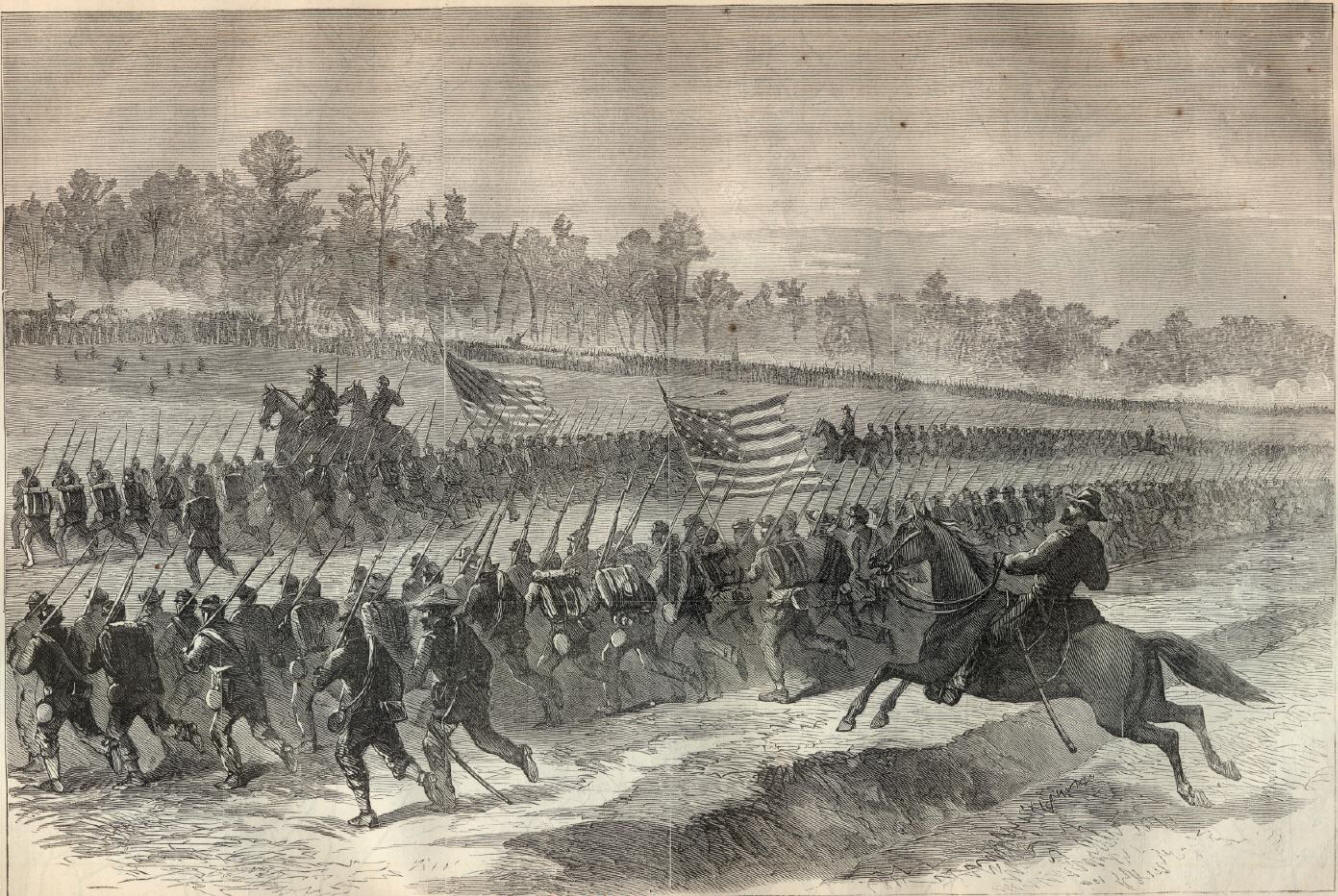
The Battle of The Wilderness. This image appeared in Harper's Weekly, May 28, 1864. Union soldiers are depicted here charging against Confederate forces.

In General Grant’s move to cross the Rapidan River in Virginia, which precipitated the Battle of the Wilderness, 1864, Parker saved Grant from capture. On May 7, 1864, Grant was heading toward Confederate General Roger Pryor’s line. Parker sensed a trap and led Grant’s command away from Pryor’s line.

Grant used Parker’s engineering skill to plan and dig entrenchments and post batteries. On one occasion a Southern woman refused to vacate her home and told Parker that her husband was in command of nearby Confederate forces, and that he’d never fire on their house. Parker told the woman she could stay and he quickly ordered the line behind her house.

General Grant and his staff of fourteen. Parker is featured in this image, fourth from the right, seated.

In September, 1864, Grant promoted Parker to Lieutenant Colonel and served as Grant’s personal secretary the remainder of the war. After the war, Parker continued to serve General Grant as his personal secretary, retiring in 1869 as Brevet Brigadier General.

One of the most famous and beautiful paintings of Lee's surrender is this Tom Lovell image called "The Surrender at Appomattox," 1987. It currently hangs at Appomattox Court House National Historic Park, Virginia. Lovell even included General Custer, far right, next to Parker.

On April 7, 1865, General Grant was closing in General Lee’s command. Grant began a correspondence with Lee through Parker’s hand and on April 9, Lee met with Grant at the village of Appomattox Court House to discuss the terms of surrender with Grant who took Parker with him.

This image of the Surrender at Appomattox is by Keith Rocco. Parker stands behind Lee at the surrender desk. General Phil Sheridan purchased the table and gave it to General Custer. It is now at the Smithsonian in Washington, DC.

Grant’s staff met with Lee’s staff in the parlor of William McLean’s house where both staffs were formally introduced to one another. Lee was said to be courteous and cool, offering no further remark to Grant’s staff other than a salutation. When Parker was introduced to Lee, Lee paused for several seconds, startled, then extended his hand to Parker and said, “I am glad to see one American here.” Parker took Lee’s hand and replied, “We are all Americans.” Grant then had Parker compose the surrender papers, which Lee signed.

Parker as the Commissioner of the Bureau of Indian Affairs. Parker was President Grant's architect in the new Peace Policy in relation to the Indians in the west. While Parker was the commissioner, and probably because of his friendship with Grant, military actions against Indians were reduced.

After the war Grant appointed Parker as Commissioner of Indian Affairs. He was the first American Indian to hold this post and resigned from this position in 1871. Parker's initial optimism of reshaping the BIA, one of the most corrupt branches of federal government (and some say it still is), led to a tremendous pressure on him to resign. Parker was faced with false charges of fraud that wouldn't go away.

Mahpiya Luta, Red Cloud.
While Parker was the BIA Commissioner, he initiated contact with the Lakota chief Red Cloud and Spotted Tail to meet President Grant in an effort to bring an end to the conflicts out west, but it was a peace that lasted until the confirmation of gold in the Black Hills.

Although Parker was recognized more for drafting the terms of Surrender at Appomattox, his accomplishments in his life let us know that he was a formidable man, despite his difficulties and heritage he set out to achieve whatever he put his mind to.

Often we hear or read about heroic figures in our past yet we don’t always hear about the person themselves. Who they were, what they were like, why they did what they did, and what remains are the facts left for us to decipher about a person. Parker signifies the change we all have to make at some point in our lives to accept, to adapt, and to overcome not just our obstacles or enemies but ourselves. This is what America is, and to be American is to honor the sacrifices of those who gave and believed in what they so desperately lived, bleed and died for.