Showing posts with label Seven Council Fires. Show all posts

Saturday, February 13, 2021

The Red Road and Other Narratives of the Dakota Sioux, A Review

Mniyo, Samuel, and Robert Goodvoice. The Red Road and Other Narratives of the Dakota Sioux. Edited by Daniel Beveridge. Lincoln, NE: University of Nebraska Press, 2020. Hardcover. $75. 304 pages + xxvi. Contents, photographs, figures, maps, appendices, glossary, notes, bibliography. 

I grew up on the Standing Rock Sioux Indian Reservation hearing about the Red Road. My lekší Kenny struggled with alcohol and chemical dependence issues for years, and when he was clean we had some of the greatest philosophical discussions about the purpose of life, existentialism, and even the Red Road. He frequently questioned “why” about life, church, and traditional ceremony. I learned about the Socratic method of argument and the introspective meditative philosophy from him long before ever hearing about Socrates or Descartes. 


When I heard about the Red Road, it seemed to be a spiritual philosophy for people recovering from chemical and alcohol dependency. It was inseparable from recovery. I’ve had more than few, but I never let it become a lifestyle. Talking about the Red Road always seemed removed and distant. Conversations in school with friends about the Red Road immediately became quiet or turned to a discussion about becoming holy. 


The Red Road and Other Narratives of the Dakota Sioux was published in February 2020. I knew I wanted to read it after reading the title. It’s costly, and I waited for my local library to get a copy in so I could read it, but that never happened. I turned to the North Dakota State Library and did an interlibrary loan request, and a copy came in a week later from Nebraska. I hope that the University of Nebraska Press publishes a softcover edition soon. 


The Red Road is a duology of Dakhóta narratives which serve as a spiritual history of the Dakhóta people and by extension, the Očhéthi Šakówiŋ. Samuel Mniyo and Robert Goodvoice articulate an oral tradition of the Očhéthi Šakówiŋ that reaches back to a time when the Council Fires were not seven, but twelve. 


The Red Road is not a history book in the sense that it’s filled with footnotes, endnotes, and bibliography. It employs oral tradition that reaches into time beyond living memory, further back than winter counts can recall. It’s a pre-Columbian oral tradition without ever referencing that it is pre-Columbian. Historians who rely on the written record may struggle with these narratives. This reader suggests that this should be treated with the same respect and seriousness as one would treat the Holy Bible as history. 


The narratives in The Red Road takes readers to a time and place when and where the Twelve Fires traveled and occupied land that stretched from the eastern seaboard in the east, and the Gulf Coast in the south, to the Rocky Mountains in the west. The narratives don’t fully articulate why five of the Council Fires removed themselves, but it was during a time of great struggle when the people fought themselves over resources. 


The Seven Council Fires that remained united faced a great existential crisis in their search for ultimate truth. They searched for generations for the elusive Hill of Truth. Their travels took them across the great prairie steppe. Some stayed in areas to live their lives. Others remained nomadic in their generations-long pilgrimage. Mniyo goes so far as to suggest that this great quest was to prepare the Dakhóta to receive the biblical word of God when the missionaries arrived. “The promise of Oúŋ [Life] wasn’t really a lie. It was really the voice of God that spoke to our ancestors, but it was misunderstood. Oúŋ was not land [the Hill of Truth] but salvation in Jesus Christ, who went to Calvary Hill and paid for our sins.” (Mniyo and Goodvoice, 2020; 124). 


This retro understanding of Dakhól Wičhóȟ’aŋ (the Dakhóta Way of Life) removes the agency or sense of self-determination from the Dakhóta people and embraces pre-determinism, the very kind of thinking that colonizers and settlers embraced to justify missionizing the indigenous and taking their land. Mniyo’s philosophical approach to the arrival of missionaries is echoed in Pope Benedict XVI’s paternalistic statement in May of 2007 that the church had not imposed it’s will on the native peoples, rather, they were silently longing for Christianity [1].


The narratives include what one might call mysticism. Both Mniyo and Goodvoice recall stories of a person or people walking on water. Goodvoice includes a prophetic warning to the Council Fire people's encounter with people who speak a different language in the future.


One outstanding narrative retelling by Goodvoice recalls an encounter with Iŋktómi, a traditional folk character who causes mischief and oftentimes outsmarts his own self, in which he puts aside mischief and warns the Dakhóta that an epidemic will strike them in a forthcoming winter. He told them what medicines to consume and to sequester that winter and when spring came, they survived. (Mniyo and Goodvoice, 2020; 157-158). 


I have never read such a thought-provoking book. I picked this book up and set it down so many times over the course of a month. I don’t think that Goodvoice intended at all for readers to be provoked into relating a way of papel thinking - these narratives were recorded over forty years ago - but rather, Goodvoice perhaps wanted Očhéthi Šakówiŋ to consider that we are living in the best of all possible worlds. Perhaps in modern times, we will return to self-determination through the rediscovery of language and way of life. 


Goodvoice also provides an amazing narrative of the Dakhóta war effort in the War of 1812. The English gave the Dakhóta seven medals and a cannon. Goodvoice takes readers on a winding narrative of promises and betrayal worthy of an Indiana Jones film. Think, “It belongs in a museum,” as if that makes the appropriation of historic artifacts right. It doesn’t. 


The Red Road is a path of recovery and self-determination. The Mniyo and Goodvoice narratives inform us that one doesn’t need to be a holy person but an everyday common person. The existential journey that the Očhéthi Šakówiŋ took an age ago has come back around. Who are we? Where are we going? What does it mean to be Dakhóta-Lakȟóta? Like the relatives long ago, I as an individual, don’t know those answers. The book The Red Road has certainly provoked me to ask myself, “What can I do to cultivate Lakȟól Wičhóȟ'aŋ, the traditional way of life?” 


This deserves to be read by anyone who has an interest in indigenous philosophy. This book is history if one considers oral tradition to be history. It is philosophy. It might be religious studies. The publisher labeled this book anthropology. It's all these things. Buy it, read it, and maybe share it with a relative who can't afford it.


[1] 
 Raymond Colitt, “Brazil's Indians Offended by Pope Comments,” Reuters (Thomson Reuters, May 14, 2007), https://www.reuters.com/article/us-pope-brazil-indians/brazils-indians-offended-by-pope-comments-idUSN1428799220070514.

Thursday, December 17, 2020

A 2021 Traditional Lakota Calendar

Wičháȟpi Hiŋȟpaye (Fallen Star or Star Boy), the traditional hero of the Očhéthi Šakówiŋ, takes his place in the heavens with his father Wičháȟpi Owáŋžila (North Star). 
Exploring the Traditional Calendar
Thirteen Moons In A Year

By Dakota Wind
The traditional calendar of the Očhéthi Šakówiŋ (the Seven Council Fires; Great Sioux Nation) consists of thirteen moons. A month begins with Wit'é (New Moon). The Winter Count Keepers kept track of the year with counting sticks. This was Haŋwí Yawápi, the Moon Counting Tradition. 

For many Očhéthi Šakówiŋ people the year begins in spring. Natural occurring events inform them when the New Year begins. When the ice breaks on the rivers and streams. When the geese return north. When the spring rain falls. When the bison bear their calves. When the trees bud. When Tȟašíyagmuŋka (the Western Meadowlark) sings. When certain stars appear too. 

In the winter count tradition, the year was referred to as Waníyetu (a Winter). The winter, or year as it were, was named after the year had passed. A year lasted from spring to spring. There were two spring moons, four summer moons, two autumn moons, and five winter moons. Since winter was the longest season on Northern Plains, it was natural to refer to the year as winter

In the moon counting tradition, the month was generally named for the natural events that occurred during that span of time. A month begins with the new moon. It is poetic to say that a month lasts twenty-eight days, but the winter count keeper with counting sticks knows the month is usually twenty-nine days or thirty days. 

The thirteen-month calendar overlaps the twelve-month astronomical by about twenty days. To reconcile the difference when the last month overlaps with the first month, the winter count keeper referenced the names of the last month and first month interchangeably. 

Last summer, a Lakȟóta educator contacted me about the possibility of creating a traditional calendar that was as faithful to the original calendar system as could be. I removed the names of the week because the traditional calendar did not have that, but I kept the seven-day week format. I removed western and American holidays and added several Wókiksuye (Memorial) Days. Blackened circles on each page demarcate where that month is in relation to the year (i.e. five black circles = fifth month, ten black circles = tenth month). Colors on the sides of the pictograph for each month correlate with the season (Blue = Spring; Red = Summer; Yellow = Autumn; White = Winter). 

This calendar includes the winter moons from the traditional year of 2020-2021. The new year for the Očhéthi Šakówiŋ begins on March 13, 2021, and runs through April 31, 2022. 

You can download this sixteen-month calendar RIGHT HERE. Its dimensions are 11" x 17". 

Here's a "white guy friendly" version too that is just 2021. Humanities North Dakota has beautifully redesigned each month and inserted my captions to explain the pictography for each traditional month. You can download that version if you want, RIGHT HERE. Humanities North Dakota will be printing a limited number of FREE calendars. Visit their website and sign yourself up for notifications and updates, or make a donation to them. 


Thursday, December 26, 2019

Lakota America, A Book Review

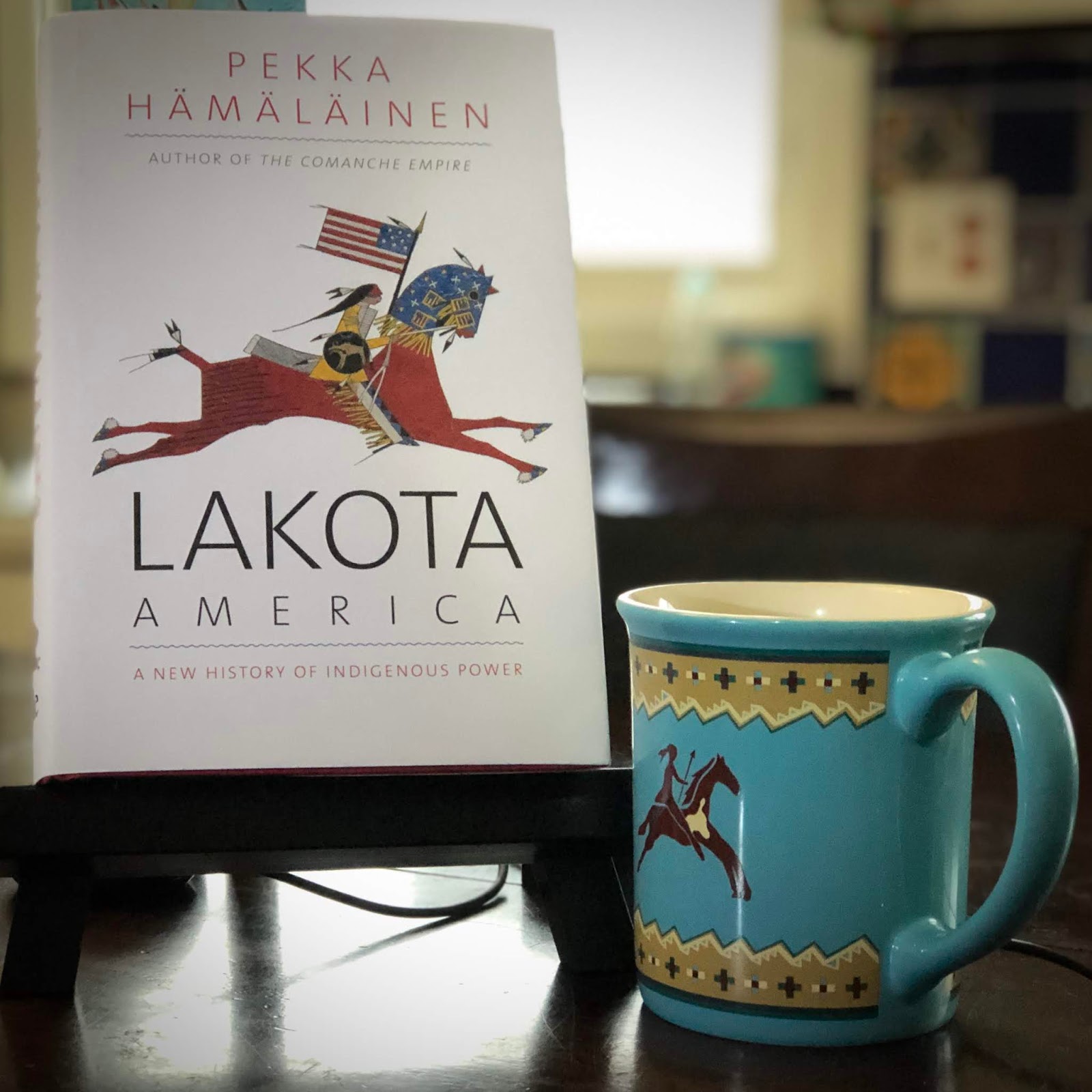
The cover of Lakota America features the art of Lakȟóta artist Jim Yellowhawk (Cheyenne River Sioux Tribe; Itázipčho). A simple photo of my copy of this book. 
Lakota America, A Book Review
This Book Fuckin' Moved Me
By Dakota Wind
Hämäläinen, Pekka. Lakota America: A New History of Indigenous Power. New Haven, CT: Yale University Press. 2019. $35.00 (hardcover). 544 pages + ix. Acknowledgments, a note on terminology, introduction, epilogue, a list of abbreviations, notes, glossary, index, maps, photos, illustrations.

“Yet this book is decidedly a history of the Lakotas, written from sources that seek to convey their perspective, often in their own words. An extraordinary archive makes this possible to an unusual degree. Lakota communities traced the passage of time by drawing on a buffalo hide a pictograph of one memorable event for each year. Lakotas call these calendars waníyetu iyáwapi. They draw attention to the mundane and reveal the sublime. Perhaps most important, as a body of historical record, winter counts capture what fascinated Lakotas and what mattered to them most. Lakota America makes the fullest use yet of this Indigenous archive in writing Lakota history.” (Hämäläinen, 2019; 8)

Thus begins Hämäläinen’s Lakota America, a post-colonial contact history of a people referencing their own historical records, and in this process, treating these pictographic records with a serious care and careful regard that these primary resource documents deserve. Most histories regarding the Očhéthi Šakówiŋ, Seven Council Fires (or “The Great Sioux Nation), are constructed primarily from colonial records (i.e. explorer journals, trader records, and missionary accounts). Hämäläinen embraces the indigenous record as a concurrent history, complemented by the colonial record.

I felt a deep sense of gratification reading this beautiful work.

Hämäläinen paints a picture of a people occupying a known and busy landscape inhabited and shaped by other indigenous peoples from trade, war, disease, and expanding colonial empires, to displacement, removal, imprisonment, and survival in a post-reservation world.

The story begins not with conflict, but with the arrival of Thiyóškate (Plays In The Lodge) on a diplomatic mission to Montreal to secure peace in the interior of North America. Conflict spread west threatening to invade Očhéthi Šakówiŋ homelands for beaver pelts in a trading system that left indigenous peoples dependent on iron wrought trade items.

There are many books about the Očhéthi Šakówiŋ, among them other notables including Royal Hassrick’s “The Sioux: Life and Customs of a Warrior Society,” Thomas Mails’ “Mystic Warriors of the Plains.” Nearly all western history books agree that the horse arrived in the mid-1700s. Hämäläinen breaks from academic consensus by informing readers that the horse arrived on the northern plains following the Pueblo Revolt of 1682. (Hämäläinen, 2019; 55)

The chapter, The Lakota Meridian, explores the Očhéthi Šakówiŋ in the context of world history. Hämäläinen reconstructs the setting of the interior of North America following the arrival of the horse, the gun, and smallpox epidemics which obliterated or weakened so many other first nations. The Lakȟóta secured and manipulated trade to their benefit. The Arikara War of 1823, the first American military campaign against Plains Indians sees the Očhéthi Šakówiŋ side with the United States, years after refusing “to be discovered” and acknowledging the United States as sovereign. (Hämäläinen, 2019; 140)

Lakota America is not a conflict history of the American West. It is closer to a biography in tone, but not on any one individual or few of Očhéthi Šakówiŋ leadership. It is not so much a cultural examination either; there are other resources for that. This work is like a study of the character of a people throughout several generations. Hämäläinen briefly articulates the cultural story of the White Buffalo Calf Woman and the Gift of the Sacred Pipe but reimagines this ancient narrative as a story of new urgency as the Lakȟóta ventured west from the Mnišóše, the Water-Astir (or Missouri River). (Hämäläinen, 2019; 164-165). He does reiterate throughout his work that Očhéthi Šakówiŋ identity is evidenced by virtue of practice and language. 

The image above was drawn by Sitting Bull's own hand. In his later years, Sitting Bull and his own people, the Húŋkpapȟa, identified him as a medicine man or spiritual leader. 

Očhéthi Šakówiŋ homeland is determined by occupation of waterways, in particular, the Mnišóše and all his tributaries. Boundaries are determined by the waters, and those boundaries were recognized in both the Fort Laramie Treaties. Hämäläinen carefully determines and explains how those boundaries were set through conflict and diplomacy. Their villages moved from valley to valley across the plains. The traditional Očhéthi Šakówiŋ recalls that the people moved from stream source to stream source across the plains.

Hämäläinen explores Lakȟóta political philosophy in their own terms as well as they dealt with the decline of the great bison ganges and the arrival of more fixed signs of American occupation. Iwáštegla, meaning “moderate,” “gentle,” and “easy,” but for also for the greatest maximum benefit, that which is “wašté,” or “good,” for the people. “Lakotas still expected wašíčus [sic] to compromise more than they did: after all, most of their interactions took place in Lakota territory. In this charged moment one can glimpse something essential about Lakotas’ ability to accept new realities, adjust to changing governing conditions, and yet remain indigenous.” (Hämäläinen, 2019; 300)

Lakota America has many strengths. Meticulous research is one, but what makes Hämäläinen’s work stand out is that he acknowledges, employs, and attributes the history (oral and pictographic) of the people he writes about, putting it on the same page as colonial records equating its importance.

Lakota America touches on the greatest conflict to shape the American West, Pȟežíšla Wakpá Okíčhize, or the Battle of the Little Bighorn. Every year there’s a book written about Lt. Col. Custer and the fate of the 7th Cavalry. Every book published about the Očhéthi Šakówiŋ includes this fight. It is refreshing that Hämäläinen does not dedicate an entire chapter retreading the last great Indian fight.

Hämäläinen does not stop his narrative of Lakȟóta history with Čhaŋkpé Ópi Owíčhakte, the Wounded Knee Massacre. No, he brings the story of adaptation, survival, and self-determination up to recent events at Íŋyaŋ Iyá Wakpá, the Talking Stone River (or the Cannonball River). A people and their history did not end at the turn of 1900. It lives and is a constant story of change. Hämäläinen gets it.

Lakota America is an engaging read. I found myself stopping several times throughout, lost in thought, and provoked to remember that indigenous occupation includes several other first nations who contested the landscape and gratified to discover how much Hämäläinen relied on Lakȟóta history to create this immensely reflective work.

My only concern, and it is a very minor thing, is that not all Dakhóta-Lakȟóta use the same term for the “winter count:” Northern Lakȟóta (i.e. Húŋkpapȟa) and Iháŋkthuŋwaŋna (i.e. Wičhíyena, or “Upper Yanktonai”) refer to the pictographic records as Waníyetu Wówapi, which means, “Keeping an Account of the Winter.” The Dakhóta and Lakȟóta who were placed at Fort Peck refer to winter counts as Hékta Yawápi, or “Counting Back.”

Lakota America has earned its place on my bookshelf. Get your copy as soon as you can to add it to yours. 


Saturday, December 21, 2019

Winter Solstice Is Sacred Time

The Long Night Moon at White Earth Butte. The crescent represents the moon or month. Above the moon, appearing upside down at the top is the landscape profile of White Earth Butte as seen from the south looking north. 
Winter Solstice Is Sacred Time
A Time To Carry One Another

By Dakota Wind
The longest season of the year was winter on the Great Plains. On the traditional Očhéthi Šakówiŋ lunar calendar, the year consisted of two spring, four summer, two autumn, and five moons or months. The word for "year," in fact, is “Waníyetu,” meaning “Winter.”

The first snow was celebrated. Men put on their snowshoes and danced in the fresh powder. The snow made for ease of hunting. The Lakȟóta explained the changing of the seasons as an epic battle between two brothers: Wazíya (The North) and Okáǧa (The South). As one retreated, the other gained ground. When Wazíya won, his breath blew across the landscape, and for as deadly and sharp his cold breath might be, he brought a blanket of snow under which Uŋčí Makȟá (Grandmother Earth) slept.

The cultural genesis of the seasons aside, they remembered and shared real events from winters past. The High Dog Winter Count recalls the year 1800 as one of the most challenging years to survive. The summer heat was unbearably hot. The great gangs of bison went away, and hunting was poor. Flowers disappeared from the landscape, and the wind drank up the water. The birds refused to sing too.

A punishing winter followed, as remembered in the White Bull Winter Count.

Winter came, snow and ice were everywhere. A group of Lakȟóta decided to move winter camp from the bottomlands of one river to that of another. As they moved over the high plains, a blizzard caught them. Gradually some of them began to succumb to the cold and fell. As one person fell, another lifted and carried him or her for the rest of their journey. Kičhíč’iŋpi keúŋkiyapi, “They say that they carried each other.”

The Lakȟóta used the long winter night to share stories like that of Wičháȟpi Hiŋȟphaya (The Fallen Star; also called “Star Boy”). The story of his mother, Tȟapȟúŋ Šá Wíŋ (Red Cheek Woman), and father, Wičháȟpi Owáŋžila (The Star that Does Not Move; “The North Star”) is fairly well known and told in books and various online media.

The Lakȟóta share Ohúŋkakaŋ (stories from the distant past) and Wičhówoyake (stories, legends, myth) during the five lunar months of Waníyetu (the winter season), and during this moon especially, they share stories like the Fallen Star narrative. 


Sometime during the Long Night, the Fallen Star rises from the highest point of White Earth Butte. As the heavens turn, or as the earth rotates, the constellation gradually moves counter-clockwise until most of it gradually disappears past the northern horizon. Fallen Star, or Capella, dips down past the horizon, then majestically rises, bringing hope to the people. 

According to Ronald Goodman’s work in his Lakota Star Knowledge, Fallen Star was renowned among the Lakȟóta as “the Protector, the bringer of light and higher consciousness.” After becoming a father, Fallen Star ascended “a hill at night with a friend,” and told him that he was going to return home. Fallen Star laid down upon the hilltop and died. His spirit was seen as a light that rose into the star world. “At some time in the past, all Lakȟóta acquired the gift of light he brought them.” (Goodman, 2017; 32)

Goodman discusses an ancient central symbol strongly associated with the heavens and the world. This symbol is referred to as Kapémni (“the action is swinging around and around,” as with a warclub or bull roar), and resembles an hourglass. One half represents all that is heavenly, the other half represents all that is worldly. What is in the heavens is also present in the world. In the pages of Lakota Star Knowledge, this “mirroring” is demonstrated in a map of the Lakȟóta constellation Čhaŋgléška Wakȟáŋ (The Sacred Hoop) which demarcates the locations of landmarks in and around the Black Hills.

In 1967, Helen Blish published her thesis A Pictographic History of the Oglala Sioux, featuring the works of Amos Bad Heart Bull (~1868-1913), a noted Lakȟóta artist, amongst of what was a map of the Black Hills and other features including Pahá Ská (White Butte). White Butte is noted as being north of the Black Hills.

It is a general map; not everything matches up perfectly, in fact, maps of the landscape were concerned with lineal cohesion rather than over-exactness. Matȟó Thípila (Bear Lodge), or Devils Tower, is not actually within Khiíŋyaŋka Očháŋku (The Race Track), the edge of the Black Hills. The Race Track is the “mirror” of the Sacred Hoop, just as Makȟáska (White Earth Butte), or White Butte, is not a part of the Black Hills, it is north of the ‘Hills. It is a real butte. It is also the hill upon which Fallen Star made his journey back to the sky. 

Like Devils Tower, White Butte appears to be in the narrative of the Sacred Hoop in Bad Heart Bull’s map narrative, though it is not so in actuality. Yet according to the map of the Sacred Hoop constellation in Lakota Star Knowledge, a star commonly known as Capella, the brightest star in the constellation Auriga appears as part of the Sacred Hoop.

Referencing Bad Heart Bull’s map and tracking the sky from the Sacred Hoop to the North Star one “sees” the stars associated with the constellation Auriga “pointing” or “reaching” towards the North Star. The constellation Auriga appears to be Kapémni, or "mirror" of White Butte and the immediate landscape surrounding that beautiful plateau. 

Fallen Star returns to the sky to be with his father. He sends rays of light and hope to the Očhéthi Šakówiŋ people. 

As Capella is the Fallen Star I’d like to suggest that Auriga is his constellation. At about 6:00 PM on the longest night of the year, this constellation appears upside down. Twelve hours later, at about 6:00 AM, which is at the tail end of the longest night, the heavens have rotated 180° counterclockwise, and have become right side up. The Fallen Star “rises” from the horizon, it rises from the top of White Earth Butte.

Long ago, before the reservation era anyway, the month which some might call December today, was known by some Lakȟóta as Waníčhokaŋ Wí (The Midwinter Moon). They might not have known the exact time (it’s 10:19 PM CST) but could reckon the subtle shift in daylight when there was a little more of it and could track the general date with counting sticks; they knew it happened in the Midwinter Moon.

According to Vi Waln, “I believe the real day of prayer was observed on the winter solstice by the people with ceremony, food, and family.” Further, “Nature and the stars were monitored carefully to help with preparation for whatever time of year was upon the people.” And lastly, “Many Lakota people will offer prayer in much the same our ancestors did so on the Winter Solstice.” (Valn, Winter Solstice Is Sacred, 2011)

There are five winter moons in the traditional Lakȟóta calendar. After the Winter Solstice, it was time to gather red willow (eastern dogwood) to make čhaŋšáŋšaŋ, traditional tobacco made from the inner bark of the red willow, and used for ceremony.

In the heart of winter, in daylight, there sometimes appears the sundog. The Lakȟóta call it Wíačhéič'thi, which means "The Sun Makes A Campfire [For Himself]," and the story associated with this event holds the promise of light, that it returns. Sometimes, during the winter nights, they see a ring around the moon, also called Wíačhéič'thi, only this is interpreted as "The Moon Makes a Campfire [For Herself]." The Moon has vigorously stirred her pot and light has spilled about her lodge.

The New Lakota Dictionary lists the Winter Solstice as Waní-Wí-Ipȟá (Crest of the Winter Sun). The Húŋkpapȟa might call the same Haŋyétu Háŋska (The Long Night) as they called this traditional month Haŋyétu Háŋska Wí (The Long Night Moon).

However it is called this day, or this month, these things are certain: gather close together with family in observation or prayer, eat together, share stories, and carry each other.


Friday, May 10, 2013

The Villages of the Ochéti Šhakówiŋ in 1750

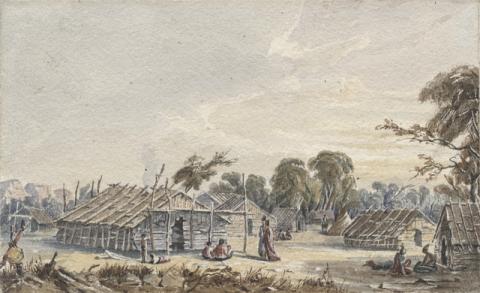
A Dakota Village by Seth Eastman
The Villages of the Ochéti Šhakówiŋ
The Year 1750 On The Northern Great Plains
By D. Jerome Tweton, The North Star Dakotan
BISMARCK, N.D. - They are commonly referred to as the Sioux. They call themselves the Ochéti Šhakówiŋ, Lakĥota for “Seven Campfires,” representing the seven major bands of the Great Sioux Nation. Once each year representatives of the bands come together to hold council, socialize, and participate in religious rites. This meeting of the Great Sioux Nation takes place in Péšhla “The Heart Of Everything That Is”—the Black Hills, the place, according to tradition, that gave birth to the Ochéti Šhakówiŋ. It is a serious mistake, however, to group all these Siouan-speaking people under one name or characterization, for the ways of life of the Campfires differ considerably.

The Dakota, sometimes referred to as the Eastern Sioux or the Santee Sioux, live in the Mississippi and Minnesota river valleys and account for four of the seven Campfires: the Mdwakanton (Spirit Lake People), the Waĥpékute (Shooters Among The Leaves), the Waĥpétowon (Dwellers Among The Leaves), and the Sissétowon (People Of The Swamp). To the west of the Dakota in the region of the James River Valley lie two Campfires, the Ihanktowan (Yankton) and the Ihanktowana (Yanktonai), sometimes known as the Middle Sioux. The Lakĥota, who populate the plains from the Platte to the Knife rivers, is the seventh Campfire. Also known as the Teton Sioux or Western Sioux, the Lakĥota are comprised of seven bands: Oglala (They Scatter Their Own); Sĥičhaŋğu or Brule (Burnt Thighs); Mniconjou (Planters Beside The Water); Itážipčho or Sans Arcs (Those Without Bows); Oohénoŋpa (Two Boilings/Kettles); Sihasapa (Blackfeet); Hunkpapa (Campers At The Horn).

Siouan territory about 1750.

By the 1500s, the Ochéti Šhakówiŋ inhabited the prairie and woods to the east of the plains. They could not avoid contact with the Ojibway who were moving toward the same territory south of Lake Superior. Tied closely to the French fur trade, the Objiwa, armed with French guns, gradually pushed the Yankton, Yanktonai, and Lakota to the west. The Ojibway made peace with the 5,000 Dakota who stayed in the Mississippi and Minnesota river valleys.

The Dakota remain people of the woods. The Mdewakanton occupy seven villages along the Mississippi; the Wahpekute have a large single village on the Minnesota River not far upstream from where it empties into the Mississippi. The Wahpeton’s seven villages and the 12 of the Sisseton are to the west on the Minnesota River. That the Dakota are people of the woods and water influences how they live. They construct permanent heavily-timbered bark houses with pitched roofs. Some live in small conical structures covered with skins and bark. Both men and women build the dwellings—sometimes referred to as wigwams. For food, the Dakota depend upon the lakes and rivers for fish and the woods for deer and small animals such as rabbits and muskrats. An annual early winter deer hunt usually brings enough meat to get through the winter. The Sisseton, the furthest west of the Dakota, venture out into the open prairie to hunt buffalo. Some Dakota raise corn, squash, and pumpkins. Wild rice and cranberries are plentiful and maple sugar mixed with water provides a tasty hot drink. Dakota life reflects a typical woodlands culture.

The Yankton and Yanktonai lived together around Leech Lake prior to the late 1600s when the two campfires separated. The Yankton, about 3,000 people, moved out of the northern woodlands and onto the prairie country near the pipestone quarries. A hundred years later they have established themselves in the region of the lower James River Valley. The Yanktonai, with a population of about 6,000, left the woodlands in the early 1700s and have built permanent winter homes in the James River Valley to the north of the Yankton.

The two groups developed into mixed cultures; that is, they combine the ways of the woods with the realities of a new environment. They continue to live in permanent villages near water where fish are plentiful. Gone are the large quantities of deer, wild rice, maple sugar, and cranberries. In their place are large gardens and buffalo. Buffalo hunts take the Yanktonai north to Devils Lake, east to the Red River, and west to the Missouri River. The Yanktonai have adopted the earthlodge , probably learning the building technique from the Missouri Valley tribes.

A Lakhota camp follows a bison gange, a scene by George Catlin.

The Lakota, the largest campfire with about 12,000 people, moved to the plains between the late 1600s and the mid-1700s. By the mid-1700s, the Lakota entered the sacred Black Hills, displacing the Cheyenne and Kiowa. As more and more bands reached the lower Missouri River, the Lakota pushed the Sahnish (Arikara) northward upriver toward the Mandan and Hidatsa villages.

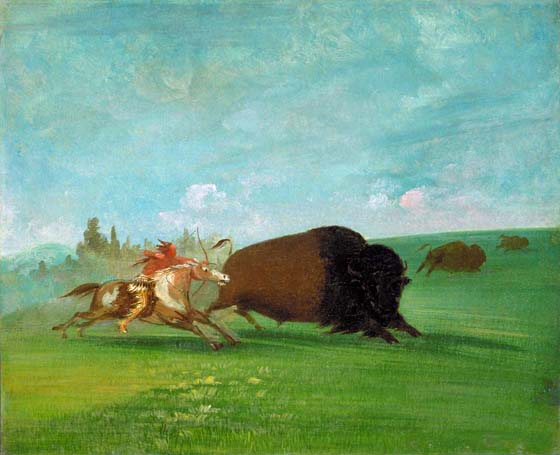
Facing a new land, the Lakota have had to abandon their woodland ways and adjust to a completely different climate and terrain. Soft-soled moccasins, so comfortable in the woods, have been replaced by hard soles, more appropriate on the sun-baked plains. Total dependence upon the buffalo has forced radical change. The buffalo, so numerous that they look like a vast brown sea, have become the life blood for the Lakota, providing food; skins for clothing, shelter, and beading; bone tools; sinew for sewing; materials for making all kinds of containers including cooking pouches and spiritual objects. One cannot overstate the importance of the buffalo to sustaining Lakota life.

A Lakhota chases a bison bull on horseback, a scene by George Catlin.

Because the buffalo herds migrate from place to place—sometimes hundreds of miles apart—so, too, do the Lakota. This has made permanent villages impossible; the tipi, a portable dwelling, has replaced the fixed wigwam. Village membership disappeared and has been replaced by smaller units called tiospaye—groups of related people. Each tiospaye is divided into camps that represent extended families. Because the Lakota have to travel, skin cookery has taken the place of breakable and heavy pottery. Because a tiospaye sometimes has to move suddenly, life is extremely well-organized and the closing down of a campsite can be done in a short time. The Lakota have acquired horses, making life much easier.

The Ochéti Šhakówiŋ are people of the woodlands, people of the prairie, and people of the plains. Where they live has dictated how they live. Their bond of togetherness, however, is stronger than their separatism.