Showing posts with label Lakota Creation. Show all posts

Tuesday, March 28, 2017

Badlands Or Bad Lands

A view of Painted Canyon at the Theodore Roosevelt National Park.
Badlands Or Bad Lands
Little Missouri Country

By Dakota Wind
Great Plains, ND (TFS) – The landscape is beautiful. Beautiful in the sense that the renaissance poet might say it was beautiful because it required a balance of placement, light, color, and time. It’s beautiful in the sense that the Lakȟóta looked at it and saw that it was inherently good, because good is beautiful. Creation is good.

Over at The Prairie Blog, author and moderator, Mr. Jim Fuglie, features a breakdown about the Badlands, or Bad Lands, if you prefer. There are readers, North Dakota citizens, and out-of-state people who are drawn to one way it's written or the other. In his article, Mr. Fuglie draws on the Lakȟóta place name for the Badlands National Park about this kind of landscape:

Why is it called the Badlands?

The Lakota people were the first to call this place “mako sica” or “land bad.” Extreme temperatures, lack of water, and the exposed rugged terrain led to this name. In the early 1900’s, French-Canadian fur trappers called it “les mauvais terres pour traverse,” or “bad lands to travel through.”

“Today, the term badlands has a more geologic definition. Badlands form when soft sedimentary rock is extensively eroded in a dry climate. The park’s typical scenery of sharp spires, gullies, and ridges is a premier example of badlands topography.”


The Lakȟóta word for land, country, or earth, is Makȟá. The Lakȟóta word for bad is ŠíčA. When the word Makȟá is compounded with ŠíčA, it becomes Makȟóšica. It would seem then, that the written proper name if one needs proper, is Badlands. ŠíčA doesn’t mean bad in the sense that the land isn’t productive, the land was/is quite good for hunting deer, elk, bison, and at one time the bighorn sheep, and might serve as a descriptor of how the landscape appeared, but the land itself wasn’t “bad.” There was something there that was malevolent and dark.


A Tyrannosaurus Rex, as featured at Dinopedia

The erosion of the landscape in the various badland formations tends to reveal fossilized dinosaur remains. The Lakȟóta refer to the great serpents as Uŋktéǧi, a twisted creation of Uŋčí Makȟá (Grandmother Earth). In the early days, after creation, they say these Uŋktéǧi ate people or caused people to mysteriously disappear. Íŋyaŋ, Stone, created WakÍŋyaŋ, the Flying Ones, to do battle with the Uŋktéǧi. WakÍŋyaŋ fly in from the west, terrible lightning flashes from their eyes, and wind gusts from each stroke of their wings, as they cleanse Makȟóčhe Wašté, the Beautiful Country (Great Plains; North America).

The Lakȟóta also name the regions of Makȟóčhe Wašté by the name of the stream which flows through it. The Little Missouri River is known to the Lakȟóta as Čhaŋšótka Wakpá, or Charred Woods River. The Badlands, by this place name method, is called Čhaŋšótka Wakpá Makȟóčhe, meaning Charred Wood River Country. They might call it this if born in that country. In everyday speech, however, the Lakȟóta would call it Makȟóšica.

Mr. Fuglie knows that it isn’t worth the energy to argue about the semantics of Badlands vs. Bad Lands (he prefers two separate words). The better question to ask, and perhaps argue over, would be, “what does the Badlands mean to you?”


Dakota Wind is an enrolled member of the Standing Rock Sioux Tribe. He is currently a university student working on a degree in History with a focus on American Indian and Western History. He maintains the history website The First Scout.

See also:
The Sheyenne River Or The Cheyenne River

How To Pronounce Oahe


Visit:

Theodore Roosevelt National Park
____________________

Glossary:


Čhaŋšótka Wakpá (chahn-SHOHT-kah wahk-PAH): Charred Woods River

Íŋyaŋ (EEN-yahn): Stone

Lakȟóta (lah-KHOH-tah): lit. “Affection.” Friend or Ally

Makȟá (mah-KHAH): Earth

Makȟóčhe Wašté (mah-KHOH-chay wash-TAY): The Beautiful Country, Great Plains, North America

Makȟóšica (mah-KHOH-shee-chah): Badlands

ŠíčA (SHEE-chah): Bad

Uŋčí (oon-CHEE): Grandmother

Uŋktéǧi (oonk-TAY-ghee): Serpents, or Dinosaurs

WakÍŋyaŋ (wah-KEEN-yah): Winged Ones, Thunder

Wakpá (wahk-PAH): River


Monday, July 29, 2013

The Remains Of Killdeer Mountain

An outcropping of stone along the trail ascending Killdeer Mountain to Medicine Hole.
The Remains Of Killdeer Mountain
Industry Encroaches On Historical Landmark
By Dakota Wind
Killdeer, N.D. – A Lakota tradition is that blue is a sacred color, all colors are, but blue is special. It’s the color of heaven. It’s the color of Iŋyaŋ’s (Stone's, or Rock's) sacrifice and of life that came forth in the Lakota creation story.

Aŋpó, the sun, stepped above the far horizon and golden light poured into the Mnišoše (Water-Astir; Missouri River) valley. The sky was clear and clean. Not a cloud in heaven dare bar the sun today. An uncle of mine likened days like this to be very special. ”Waŋžila tȟó,” I heard him breathe out after a long yawn of air, “It means complete blueness or blue oneness.

A quiet wind kissed me on the face and through my hair on the way to my car. A wave of melancholy took me momentarily as I remembered my uŋči (grandmother) on mornings like this. She’d rise when the sun was just a promise of light on the lip of the world and she'd down a tall glass of water, praying in-between deep draughts, then she’d ready herself for a walk along the river.


The drive to Killdeer was pleasant. I carpooled with friends and we exchanged good conversation on the drive west. Both are archeologists and shared stories about work in the field. Conversation made the trip short and soon enough we were in the rumbling city of Killdeer.

We stopped at the city park where a motley collection of local landowners, historians, more archaeologists, a biologist, and members of various organizations had gathered in fellowship to see Killdeer Mountain before more industrial development lay claim to the earth.

I am reminded of an interpretation of eucharist after a round in introductions. It’s a religious term generally held to mean the part of a Christian service in which the Gifts are brought forward, the Thanksgiving. One of my university professors, a Benedictine sister, in class one day said that, too, when people come together for a common purpose, at a common time, and at a common place, that it is eucharist.


The introductions in and of itself, was held in a circle. There might not have been prayer, but I felt something mutual pass among everyone who was there.

A few local landowners, the Jepsons and the Sands, hosted a picnic on the rise of the west side of Killdeer Mountain. The modest spot of land was an old tipi encampment site. Tertiary flint flakes lay scattered about on unturned soil. Native grasses, medium or middle grasses, grew unhindered about the gentle rise. The gentle wind combed its breeze through the grass, the trees shushed the landscape, and thousands of native flowers crowned the hill in yellow, purple, blue, pink, and white.


 Ancient cracked and worried stone testified to archaeologists that the steppe was once under a vast freshwater ocean millions of years ago. Old shattered stone broke the soil in defiance of the wind and rain. The formations looked deceptively small from a distance. Either I shrank as I approached the stones or they grew with each step toward them.

In the days of legend, the Mandan said that the son of Foolish Boy was killed at the plateau by the spirits who dwelt there. Foolish boy retaliated by taking up his staff and struck the plateau, cleaving the plateau as we see it today. The Mandan know the mountain by another name, Singing Butte.

I embraced the illusion of the changing hillside and hiked up to the western most point of the Killdeer plateau. Deer lived there. Careless prances quickly turned to startled runs at the arrival of people. They were sunning themselves only moments earlier in the grassy rise as evidenced by depressions in the grass. A few ground plums were nibbled on and abandoned, but there were a few more near the top.

Looking north, here's one of the ravines which leaves the west side of Killdeer and goes west to Elk River (Little Missouri River).

From the top of the western most rise of Killdeer Mountain I saw two ravines stretching west through the cracked thirsty earth to Heȟáka Wakpá Makȟočhe (Elk River Country; the Little Missouri River). There, in 1864, after Sully’s assault on Sitting Bull’s Huŋkpapȟa camp on the southeastern rise of Killdeer Mountain, he ordered his soldiers to pursue the Lakȟóta into the Badlands.

The Lakȟóta had been at Killdeer Mountain for a few reasons, but the most important to the people was that it was a place to hunt. In Lakȟóta, they call the plateau Tȟáȟča Wakhúte, The Place Where They Kill Deer. In July, they were hunting and gathering some of the very foods I saw on my hike. Kȟáŋta (wild plums), maštíŋčaphuté (buffalo berries), čhaŋpȟáhu (chokecherry bushes), ptetȟáwote (ground plums) all upon the hillside in abundance.


 General Sully was there to level the might of the U.S. military upon the Sioux in a punitive campaign for the Eastern Dakota’s participation in the 1862 Minnesota Dakota Conflict. Aside from obliteration of homes, the deaths of as many as 300, about 150 prisoners, and destruction of foodstuff for the coming winter, Sully’s aggressive campaign succeeded in shaping the opinion of the Huŋkpapȟa and other Lakȟóta tribes throughout the era of western settlement. Warfare between traders, land surveyors, the railroad, settlers, and the Lakȟóta continued throughout the 1860s and 1880s.


I descended the western point of Killdeer Mountain enjoying the sun that warmed me and the breeze that cooled me. The hikers I was with, made a circuit of our ascension then descended on a ridge line back to the old encampment site. There, the contentment of edification and gratification washed away from me at the site of two oil stakes. Did I miss them somehow while the picnic was happening earlier? Did I look past the stakes? Did I preoccupy myself with the setting of old encampment site? I must have, and a dreadful feeling of fatalism filled me.

Industry will be here soon. The earth will be turned, a well pad and a road will go in, and physical memory of a Lakȟóta camp will vanish entirely.

Mr. Rob Sand and Ms. Lori Jepson reflected about the experience of preserving Killdeer Mountain. 

Two local landowners expressed their heartfelt wishes that they could have done more. When the oil companies came to gauge the earth for mineral extraction, they weighed the hearts and minds of an otherwise close-knit community. Some individual land owners were lured by the promise of an income far more than what the humble rancher earns through his sweat.

Rob Sand, one of the local landowners, was asked by a visitor from out of state if there was any one thing he could change, and without a moment’s hesitation, Sand simply replied, “I would change the minds of the Industrial Commission.” Sand, a common man who holds the land dear as his settler ancestors and who finds beauty in the untouched and unturned land, carefully articulated - but not once criticized the character of the men who make up the North Dakota Industrial Commission nor the Director of the North Dakota Department of Mineral Resources - his deepest desire to preserve the history and heritage of the Killdeer Mountain.

The oil under the Killdeer plateau isn’t much, somewhere between three and three and a half million barrels of oil, but its enough that it’s considered a waste if its left there. That’s enough oil to power to the United States for over four hours, if it’s going to the U.S.

A golden eagle flew straight out of a nest near the top of Killdeer Mountain. 

A visit to the Killdeer Mountain conflict site was capped by the regal nature of the eagles’ aeries on a south facing cliff side of Killdeer Mountain. Golden eagles ride the endless prairie wind, a wind that has been a constant presence since before the landscape was under the ocean, since before Foolish Boy cracked the plateau.

Jagged cracked stone reaches out from Killdeer Mountain.

The climb up the mountain to the summit to where Medicine Hole sings is filled with pauses to enjoy the view by some. I look at the degree of ascension, anywhere from a 30° incline at the base to 90° on the cliff side. I imagine women holding babies and shepherding children in an escape from Sully’s command and thanked God I’m here today.

Indian Paint. My pictures of this flower did not turn out. Here is an image from Wikimedia Commons. 

Orange lichen clings to shattered stone. A forest of stunted white birch grows on the south face about half-way to the flat summit. More native flowers, purple, grow delicately in the cracks and crevices. Some Lakȟóta smile and call it “love medicine.” I recognize one yellow flower that some call “Indian Paint.” With it, one could acquire a yellow or purple pigment.

Along the way, a work crew had placed seismic sensors to measure the impact of oil wells a half-mile away, which makes me conscience of the well flares and further away, constant truck traffic on the roads. Men would ascend the plateau to remove their selves from the noise and distraction of everyday camp life. In seclusion, they prayed under a searing sun, they prayed in the winds, they prayed in moonlight and starlight. People still go to pray on Killdeer Mountain.

A traditional pilgrim created a medicine wheel from the broken white stone about the summit. I left a handful of seeds before I descended. The evening was as cloudless as the morning, sunlight golden again in the evening, the same breeze or perhaps a different one entirely, kissed my brow as I stepped into Killdeer’s shadow.


By day the air is drawn into Medicine Hole, at night it is exhaled like breath. The wind isn't seen by the dust of the earth that comes out, it is heard, and what is heard is the song of Makȟočhe, of Grandmother Earth. 

Friday, February 22, 2013

An Experience of Traditional Storytelling

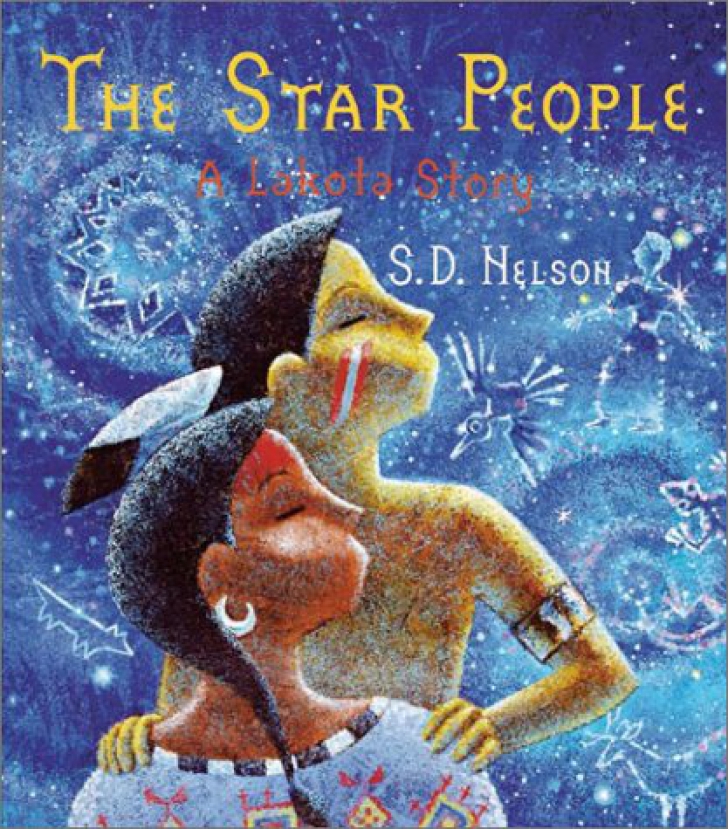
S.D. Nelson's "The Star People." Get your copy of this beautifully illustrated book.
An Experience Of Traditional Storytelling
Star Stories Told In The Days Of Winter 
By Dakota Wind
FORT YATES, N.D. - The Lakota people call the month of February Čhaŋnápĥopa Wi (The Moon of Popping Trees) or Thiyŏĥeyunka Wi (The Moon of Frost in The Lodge). These are names to articulate the coldest months of Waniyetu (Winter) when Makĥoče (Grandmother Earth) was at rest.

The needle dropped below zero and the only news the wind carried was that more cold was on the way. Over a hundred people gathered together over the course of two evenings at Sitting Bull College in Fort Yates, ND in the heart of winter, to hear a Lakota visitor, an elder from South Dakota, share the Lakota Creation Story and Lakota Star Knowledge.

The room was filled with the murmur of raucous laughter, playful teasing and the cries of hungry babies when an assuming man entered the room and quietly prepared at a table near the front of the room. His name, Rick Two Dogs.

Two Dogs, an Oglala Lakota from the Pine Ridge Sioux Indian Reservation, began the first evening with a little exposition that the stories he was going to share were told in the lodges around the campfire long ago. These were the kind of stories that were shared by the Lala and Uŋči (Grandfathers and Grandmothers) and one can feel the weight of centuries and tradition echo in Two Dogs’ tranquil voice when he began the evening with a prayer of Whŏpila, Thanksgiving.

The attention and quiet in the room which followed was like the crack of a whip, sudden and sharp, and even the youngest of children quickly stood in quiet respect when prayer was invoked.

When the prayer concluded, a traditional horseman named Jon reiterated to the mass what many already know, that elders eat first, then visitors before the rest. Young women dashed off to the front of the line to prepare bowls of bapa soup, a traditional soup made with corn and jerked meat, wŏžapi, a type of pudding traditionally made with chokecherries but for these two evenings is made with blueberries, fresh fried bread and steaming black coffee for the elders. Everyone else formed a line and the jocular murmur of laughter and teasing among friends returned.

When hunger was satiated and thirst was slaked, Jon introduced Two Dogs in Lakota and English. Two Dogs isn’t just unassuming, he’s self-deprecating, and is quick to attribute or credit others for the stories he shared, his Lala especially, who witnessed the Battle of Little Bighorn when he was ten years old.

Two Dogs recalled his Lala fondly. He took his meals seated on the floor, speared his food with his knife and refused the aid of a fork. He would look askance at anyone who offered him a napkin, and wiped his hands on his braids. During the long winter nights, his Lala put a few sprigs of cedar on the wood-burning stove, the kerosene lamps were doused, and firelight lit the home.

When Two Dogs opened the floor to field questions, one man asked, “Why are these stories told only in the winter?” Two Dogs replied that he once asked the Lakota scholar Albert White Hat the same thing and was told that if the stories were told out of season, one would get a hairy butt crack, but quickly reminded the crowd too, that the stories were shared when the world was at rest.

The following night, Two Dogs and his wife asked everyone to imagine the room as though it were one great lodge with one entrance. They divided the room between the sexes with men on the left half of the lodge and the women on the right. Between the men and women they explained was a path, a path of wisdom. The men sat in descending order from eldest to youngest going left from the path, just as the women sat in descending age from eldest to youngest, only they sat in order right from the path. It was an exercise in tradition and order.

Two Dogs’ stories are the traditional stories of the people, and should best be listened to in person, on a cold winter night, after supper, in the natural dark.

Haŋhépi čhaŋečela héčhuŋpi (This was done only at night).

Waniyetu čhaŋečela héčhuŋpi (This was done only in the winter).