Showing posts with label Spirit Lake. Show all posts

Saturday, October 7, 2017

The History of Wells County, A Book Review

The History of Wells County, A Book Review
Book Offers Insight To Place Names, Stuff
By Dakota Wind
Spokesfield, Walter. The History of Wells County, North Dakota and Its Pioneers, with a sketch of North Dakota History and the Origin of Place Names. Jamestown, ND: North Dakota, 1929. 804 pages. Index, illustrations, maps, and photos.

The History of Wells County is heavy reading. There are some images scattered throughout, but it’s the kind of book that expects its reader to read, but it’s also the kind of book that is easy to get through once you become familiar with its layout. It also helps to know that the index is at the end of the book.

Google is an impressive search engine, and its book search shares excerpts of many books and features many books online, but this isn’t one of them. There’s something satisfying about going to the North Dakota State Library and finding something that isn’t online yet, and it’s there where I found this dusty tome. It was equal parts dusty, dry, and delicate, and frankly, I was surprised that I was allowed to take it home. I swear the book was almost grateful that I checked it out.

The subject of site names, and origin of place names is what piqued my interest, and this book has it. Spokesfield put more into this book regarding this subject than one could think possible. It is certainly more edifying than Mary Anne Barnes Williams’ 1966 effort: Origins of North Dakota Place Names.

Spokesfield research on North Dakota’s place names doesn’t have the finesse of works like contemporary place name historians like Mr. Louie Garcia, but then Mr. Garcia has the advantage of insight by marrying into the Dakhóta people. Spokesfield has something, however, neither Williams nor Garcia has, and that’s the sheer size of his work. Spokesfield has not just place names, but alternatives in names and narrative.

An example of rediscovering a place for me is “Hawksnest,” found in section 26 of the Hawksnest township, located about a mile south of Sykstown, ND. Spokesfield writes of this location as Huyawayapaahdi, written in what’s called “Mission Dakota,” which is how priests and missionaries wrote the Dakhóta language. Spokesfield’s “Huyawayapaahdi” means nothing to me, until I read his narrative: the Dakhóta saw an eagle (or hawk) carrying a bit of meat in its beak as it took to the sky. Suddenly, I can deconstruct Spokesfield’s word and pronounce it. Using the new Lakota Language Consortium’s standard of writing the language, I would write Spokesfield’s word as: Ȟuyá Wayápȟa Akdí (Eagle [archaic] To-Hold-Things-In-The-Mouth To-Return-Bringing-Something).

Hawknest was an overnight campsite when Dakhóta went west to the Missouri River, and for when the Lakȟóta went east to Spirit Lake.

History is also a collection, a who’s who of pioneers, but he also acknowledges explorers and the indigenous. Many of the narratives of people and places, at least in the first half of the book, are written in the first person. One narrative is outstanding for its concise information regarding horse thieves in 1896 operating between Spirit Lake and the Missouri River. The Wells County sheriff and deputy captured four horse thieves, but failed to secure one of them properly which resulted in the escape of one. The others were later released for lack of evidence. Eventually, the sheriff married one of the supposed horse thieves’ sister.

Another eye-catching narrative is about the “Teton Okandandas.” When I see a word that looks “native” I try to pronounce it several ways, with different accent placement, and with glottal pronunciations until the word comes to me. This is another “Mission Dakota” word. In this case, this is an archaic word in Dakhóta for “They Scatter Their Own.”

Spokesfield probably never intended his written word to be powerful or emotive, but his work is certainly inspiring. Near the end of his work, I found myself unexpectedly moved: The Indians were grossly misunderstood and long cheated and abused. They objected to the intrusion of the white men because it interfered with their roamings and their hunting grounds and fought only for their lands and their homes, which were often wrested from them through force and intrigue.

Spokesfield gives all the people of North Dakota their due. Names of First Nations leaders appear along with prominent pioneers and settlers. Histories of early explorers get mentioned. The Corps is included, and Spokesfield coverage of them is not overdone. General Custer, the 7th Cavalry, and the Little Bighorn Campaign are included, neatly and concisely in Spokesfield’s writing, not aggrandized, but certainly more is written of than contemporary North Dakota Studies.

This book deserves to be in all North Dakota city, county, college, and university libraries. It probably is. Go check it out. 

Dakota Wind is an enrolled member of the Standing Rock Sioux Tribe. He is currently a university student working on a degree in History with a focus on American Indian and Western History. He maintains the history website The First Scout.


Wednesday, December 9, 2015

The North Dakota Indian Affairs Commission Since 1949

Map of tribal nations of North Dakota. Standing Rock and the Lake Traverse (Sisseton-Wahpeton) extend into South Dakota. 
North Dakota Indian Affairs Commission
A Reflection Of State To State Relations

By Dakota Wind
Bismarck, ND – In 1949, the North Dakota Legislature created the North Dakota Indian Affairs Commission (NDIAC). The first responsibilities of the NDIAC was to secure assistance for American Indians to work in agriculture or other self-sustaining businesses and to work with the five tribal nations to secure federal funding for programs that benefit all citizens of North Dakota.

In the early years of the NDIAC, the commission took a paternal approach to providing assistance to first nation peoples, and believed that the way of helping the first nations was to assimilate them into the state through their association with the larger population in their day-to-day business and social relationships. At the time, the NDIAC un-successfully lobbied the federal government to administer Bureau of Indian Affairs assistance and programming.

As paternal as the NDIAC was in those early years, the NDIAC lobbied many important issues regarding Indian Country, including two: that the federal government determine a new and more specific definition of who and “Indian” is, and that off-reservation American Indians should be entitled to all the same benefits as regular North Dakota citizens, such as medicine, education, housing, and employment.

In 1952, the NDIAC lobbied Congress to abolish the reservation system, and soon after, the federal recognition status of the Turtle Mountain Band of Chippewa was placed in jeopardy. Federal recognition is granted to tribal peoples who signed treaties with the United States for irrevocable rights in exchange for permanent land cessions. 


Scott Davis is the current NDIAC Executive Director. He is an enrolled member of the Standing Rock Sioux Tribe, but he is also part Turtle Mountain Band of Chippewa. His Lakota name is Ošká Tȟáwa, His Celebration. Listen to Davis' story

Treaties are legal agreements between two or more nations. The relationship between the United States and the First Nations people was established in the 2nd Article of the US Constitution. Tribes that have entered into treaties with states have state recognition. Tribes that have entered into treaties with the United States have federal recognition. Federal recognition general entails that certain lands are set aside for the use of a tribe forever.

In 1954, the Turtle Mountain band of Chippewa successfully lobbied to retain their recognition and rights.

The NDIAC has changed with the needs of the tribal nations, and in 1959, sixteen years before the federal government recognized sovereignty in tribal nations’ own determination with the Indian Self-Determination and Education Act, the first nations of North Dakota were given a voice on the NDIAC board.

Despite the oppositional agenda on which the NDIAC was founded, the NDIAC has since worked hard to improve the state to state relationship between the State of North Dakota and the five federally recognized nations within North Dakota. Highlights include scholarships to American Indian students attending a North Dakota institution, the development of the United Tribes Technical College, which opened its doors to native and non-native students in 1969, and legislative support for North Dakota to adopt an Indian education requirement for educators to have had at least one college course in American Indian Studies in their pursuit to teach in North Dakota.

In March of 1999, the NDIAC observed its fiftieth year in operation by co-sponsoring the University of North Dakota’s Writer’s Conference, which featured Native American authors and film makers, and brought their work in contact with the general public.

In 1999, the NDIAC updated its goals to include: “work for greater understanding and improved relationships between Indians and non-Indians.”

Scott Davis (enrolled member of the Standing Rock Sioux Tribe), Executive Director, NDIAC (2009-present), believes the NDIAC as evolved and matured as the state has realized the unique status of federally recognized tribal nations, “Our state is ahead in its relationship between tribal nations and the state. The NDIAC is really the only state with a cabinet level position dedicated to fostering a nation to nation relationship.” 

President Lindquist is known to her people as Šuŋka Wičháȟpi Wiŋ, Star Horse Woman.

Dr. Cynthia Lindquist (enrolled member of the Spirit Lake Dakota Nation), President of Candeska Cikana Community College on the Spirit Lake (2003-present), was the Executive Director of the NDIAC when the commission observed its 50th anniversary.

Lindquist recalls of the NDIAC’s 50th anniversary, “The most memorable thing for me was that the governor was so supportive. United Tribes set up some tipis on the lawn – we had to acquire special permission to set those up. We had elders from all the reservations come and share their stories.” When asked about the next fifty years, Linquist added, “We Indian people still struggle with how we relate to our state and our country. There needs to be a better relationship between our native people and non-native peoples. We should always have a place at the table of the state.”

Monday, May 5, 2014

Mischievous Boy Pranks Entire Village

"The little brave who visited the grave of a medicine woman, with several other boys," appears in Marie McLaughlin's "Myths And Legends Of The Sioux."
Mischievous Boy Pranks Others
Stunt Spreads To Village, Causes Fear
By Marie L. McLaughlin
GREAT PLAINS - "A Little Brave And The Medicine Woman" comes from Marie L. McLaughlin’s “Myths And Legends Of The Sioux.” It is retold here with minor edits.

A village of Indians[1] moved out of winter camp and pitched their tents[2] in a circle on high land overlooking a lake. A little way down the declivity was a grave. Chokecherry[3] bushes had grown up, hiding the grave from view. But as the ground had sunk somewhat, the grave was marked by a slight hollow.

One of the men going out to hunt took a short cut through the chokecherry bushes. As he pushed them aside he saw the hollow grave, but thought it was a washout made by the rains. As he essayed to step over it, to his great surprise he stumbled and fell. Made curious by this mishap, he drew back and tried again, but again he fell. When he came back to the village[4] he told the old men what had happened to him. They remembered then that a long time before there had been buried there a medicine woman.[5] Doubtless it was her medicine that made the hunter stumble.


Chokecherries. The fruit is ready to pick in late July/early August. 

The story of the hunter’s adventure spread through the camp and made many curious to see the grave. Among others were six little boys who were, however, rather timid, for they were in great awe of the dead medicine woman. But they had a little playmate named Brave,[6] a mischievous little rogue, whose hair was always unkempt and tossed about and who was never quiet for a moment.

“Let us ask Brave to with us,” they said, and they went in a body to see him.

“All right,” said Brave, “I will go with you. But I have something to do first. You go on around the hill that way, and I will hasten around this way, and meet you a little later near the grave.”

So, the little boys went on as bidden until they came to a place near the grave. There they halted.

“Where is Brave?” they asked.

Now Brave, full of mischief, had thought to play a jest on his little friends. As soon as they were well out of sight he had sped around the hill to the shore of the lake and sticking his hands in the mud had rubbed it over his face, plastered it in his hair, and soiled his hands until he looked like a newly risen corpse with the flesh rotting from his bones. He then went and lay down in the grave and awaited the boys.

When the little boys came they were more timid than ever when they did not find Brave, but they feared to go back to the village without seeing the grave, for fear the old men would call them cowards.

So they slowly approached the grave and one of them timidly called out, “Please, grandmother, we won’t disturb your grave. We only want to see where you lie. Don’t be angry.”

At once a thin quavering voice, like an old woman’s, called out, “Háŋ, háŋ, tȟakóža, héčhetuya! [Yes, yes, grandson, do so!]”

The boys were frightened out of their senses believing the old woman had come to life.

“Oh, grandmother,” they gasped, “Don’t hurt us. Please don’t. We’ll go.”

Just then Brave raised his muddy face and hands up through the chokecherry bushes. With the mud dripping from his features he looked like a witch just raised from the grave. The boys screamed outright. One fainted. The rest ran yelling up the hill to the village, where each broke at once for his mother’s thípi.

As all the thípi in a Dakȟóta encampment face theh center, the boys were in plain view when they came tearing into camp. Hearing the screaming, every woman in camp ran to her thiyópa[7] to see that had happened. Just then, Brave, as badly scared as the rest, came rushing in after them, his hair on end as covered with mud and crying out, forgetful of his appearance, “It’s me! It’s me!”

The women yelped and bolted in terror from the village. Brave dashed into his mother’s thípi, scaring her out of her wits. Dropping pots and kettles, she tumbled out of the thípi to run screaming with the rest. Nor would a single villager come near poor Brave until he had gone down to the lake and washed himself.


[1] Marie McLaughlin’s maternal grandmother was Mdewákhanthunwaŋ (Dwellers At The Sacred/Spirit Lake). Marie married Major James McLaughlin. She lived at Spirit Lake Agency (Devil’s Lake Agency) for ten years before moving with her husband to Standing Rock. In her book, “Legends Of The Sioux,” McLaughlin frequently uses “Sioux” and “Indian” interchangeably with Očhéthi Šakówiŋ (Seven Council Fires) and Dakȟótá or Lakȟótá (Allied; Friends).

[2] Wakhéya: Tents. The Lakȟótá word for thípi is thiíkčeya, or thipȟéstola.

[3] Čhaŋpȟáhu: Chokecherry bush. Čhaŋpȟá refers to the fruit.

[4] Wičhóthi: Village, camp, or encampment.

[5] The original text includes, “…or conjurer.”

[6] Ohítika: Brave.

[7] Thípi door.

Monday, August 12, 2013

The Origin Of Tokio

A log cabin with an awning near Spirit Lake.
Origin: Čhaŋbdáska Otȟúŋwahe (Tokio, ND)
Tókhiya (Where Is It) Is Where Its At
By Louie Garcia
SPIRIT LAKE, N.D. - The town of Tokio began in 1906 when Victor Ruth built a general store in anticipation of the Great Northern Railroads arrival. The story begins with the construction of the store building in the middle of nowhere. An unidentified elderly Indian observed the carpenters at work and asked Alex DuMarce, the local interpreter, what these crazy men were building. Mr. DuMarce or GuGu (Burnt) informed him a store was being built, where he could buy or trade for general merchandise. The elderly Indian only half understanding kept repeating “Tókhiya (Where)?" The carpenters remembered part of the word, and when it was time to pick a name for the new town, suggested Toki. Everyone agreed and the name was sent to J.J. Hill the President and Owner of the Great Northern Railroad. He disapproved, “we will just add an ‘o’, and call this place Tokio”. Unfortunately and incorrectly Mary Ann Williams in her book, Origins of North Dakota Place Names was informed the term "To-ki" means "a gracious gift." This error as continued on to this very day.

A hundred years ago when the Dakota language was used on a daily basis, Indian people had their own name for most of the local towns. The rational for this is obvious; the town names selected was foreign and difficult to pronounce for Native people. The official Indian name for Tokio is Čhaŋbdáska Otȟúŋwahe. Čhaŋ (Chahn) means wood; bdáska (b'DAH skah) means flat; and Otȟúŋwahe (oh-TOON-wah-hay) means a town. The name was used because Tokio was the only place in the area where you could buy ‘flat wood’ or lumber.

Tokio officially became a town when Victor Ruth became the first postmaster on January 26, 1907. The town is located in Section 2, T.151, R.64W, Woodlake Township, Benson County. Originally the town was to be located two miles north of the Doyle homestead, and named Revere, the railroad however changed the location. Today the postal Zip Code is 58379. The largest number of residents recorded was 112 in the 1930 and 1940 censuses. Today about 35 people live in the old townsite, but south, across the road over 200 people live in the Tribal Housing circle.

On August 29, 1907 the first train arrived in Tokio on the Great Northern Aneta line. In 1908 there was only the Ruth Store and Post Office. By the 1920’s Tokio reached its height. There were two stores, two poolrooms, one café, one beer hall, one restaurant, a bank, lumberyard, butcher shop, school, Catholic Church, three-grain elevators, and a blacksmith shop. The depression of 1929 killed the town, and people began to move away.
__________
Bibliography:
Origins of North Dakota Place Names: Benson, Cavalier, Pembina, Ramsey, and Walsh Counties. By Mary Ann Barnes Williams. Bismarck Tribune 1976, Page 14.

North Dakota Place Names by Douglas A. Wick. Prairie House, Fargo, ND 1989, Page 194.

Thursday, August 8, 2013

Wamduska Bde: The Origin Of Stump Lake

Sunset at Stump Lake, N.D. Photo By Aaron Barth, The Edge Of The Village.
Wamduska Bde: Serpent Lake
The Origin Of Stump Lake
By Louie Garcia, Spirit Lake Oyate
SPIRIT LAKE, N.D. - They say a long time ago that there was no Stump Lake. The story goes that an underground fire, possibly a vein of coal, burned continuously for about forty years. The ground caved in upon itself, and water from nearby Spirit Lake rushed in to fill it. The tree stumps protruded from the lake inspired the Metis to call it Lac du Chilots, Lake of Snags, or Stump Lake.

The Dakota who lived in the region say that there's an ancient entity that inhabits Stump Lake, a great serpent they call in their language Wamduska, which means Creeping Thing or Serpent, which is one of sixteen spirits of Unktehi, or Large Water Monster. The Dakota came to call the new lake Wamduska Bde, or Lake of the Serpents.

The explorers, traders, and then settlers chose to call it Stump Lake. A name that reflects the natural history of the lake. Lake of the Serpents might have kept people away. 

Today Stump Lake is a place for recreation. Among the many events, which one might call the culture of North Dakota, are a threshing bee, a polka fest, craft shows, music & art, and a country fair. Visit Stump Lake Park for more information.

Monday, July 22, 2013

Devil's Heart Butte: An Enlightening Visit With A Dakota Elder


Devil's Heart Butte
The Story Of Devil's Heart Butte
By Dakota Wind
SPIRIT LAKE, N.D. - I was looking at the North Dakota state map that’s pegged to my office wall. I don’t know what it is, maybe it was a recent trip out to Heháka Wakpá Makĥoche (Elk River Country, or Theodore Roosevelt National Park) and I was in the mood to learn what the Dakota-Lakota people called places before explorers, traders, and settlers arrived.

There’s a lake in the north eastern quarter of the state. It’s a fresh water lake that’s been growing and spilling onto shore property. New islands have been formed, roads have been built higher, fields are underwater, and the water threatens to rise higher without relent.

The lake is known to the Dakota and Lakota people as Mni Wakaŋ Čhaŋté. Don’t believe Wikipedia in this, if you look it up there. A word for word translation of the Dakota to English is Water With-Energy Heart, which freely translates as Spirit Heart Lake. The calque of Bad Spirit Lake is entirely a misconception.

There, on the southern bank of the Spirit Heart Lake lay the Spirit Lake Sioux Indian Reservation, home of the Spirit Lake Oyate (Nation). The Spirit Lake Oyate has about 6,700 or so enrolled members, but not all live on the reservation.

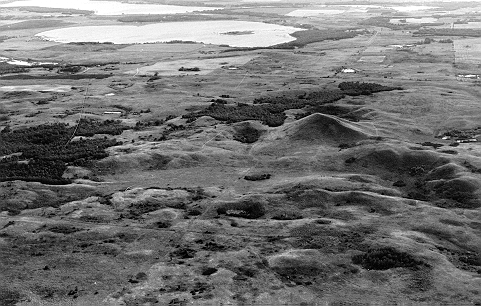
The lake, Spirit Heart Lake (aka Devil’s Lake), the people (the Spirit Lake Oyate), have a name in common with a site on the reservation near the town of Tokio (a strange word in and of itself; said to named after the Dakota word for “Toki” for “gracious gift,” but it isn't; the closest word for gift, is in the act of receiving a gift, “Okini”). There, nestled among the rolling hills of the prairie land overlooking the lake is Spirit Heart Butte, only it’s popularly known as “Devil’s Heart Butte.”

I turned to Spirit Lake tribal historian Louie Garcia to find an answer. I’ve conversed with Louie on the phone over the years and by email. I had always thought he was perhaps a middle-aged gentleman by the youthful exuberance of his voice. Some voices age. Louie’s voice does not. He’s in his 70's, a respected member of the tribe, he’s gracious to give me an answer, and he wants me to share it with others. 

Louie has asked me to post it as he sent it to me, word for word. Pilamiya pelo, Lekshi Louie! He Even included a bibliography and a glossary of Dakota terminology (at the end of this entry).

__________


Heart Hill is a treeless kame located one mile northwest of Tokio, North Dakota in Section Four Woodlake Township (T152N – R64W) Benson County. It sits on the eastern edge of the Backbone, a line of hills formed when Spirit Lake (Devils Lake) was formed some 10,000 years ago during the last ice age. With an elevation of 1725 feet above sea level it can been seen on the horizon for miles in the lake region, and from its summit one can look over a vast area surrounding this hill. The name ‘heart’ means that it is at the center of the area but also the center of spiritual knowledge. As this hill appears to be in the shape of an upside down human heart, some incorrectly speculate this as the reason for its name.

Heart Hill is the most sacred elevation in all of North Dakota. It could be considered a cathedral. This Butte de Coeur of the French fur traders is called in the Dakota language Miniwakan Cante Paha or Heart Hill at Spirit Lake. The French fur traders named Devils Lake so that presently the term ‘devil’ is attached to many local geographical features.  “Devils Heart” is the name used by local people. Naturally the ‘devil’ word is a misunderstanding, but referring to the Water Spirits who live in the lake.

This Heart Hill is a sacred location because it is the Lodge of the Water Spirit for whom Spirit Lake is named. These spirits are called Unktehi or Terrible Ones due to their custom of drowning anyone who foolishly ventured upon the lake without their permission. These Unktehi are worshiped in the Wakan Wacipi or Grand Medicine Ceremony (Skinner 1920:273).

This hill belongs to a class of sacred lodges (hills) where the spirits meet to decide the help, if any, they will grant humans. Prehistorically the waters of the lake flowed up to the east side of this hill, to the door or entrance of this the Water Spirit’s home. The spirits could enter and exit their home to do their business within this sacred lake. Unfortunately the entrance to this sacred hill was blown closed with dynamite in the 1930’s when a local rancher discovered a den of coyotes living within. If one looks closely at the change in vegetation, the location of the former entrance can be discovered.

There are many heart hills or buttes in the state but this most important one is at Spirit Lake. Examples of other heart hills are: The Heart of the Turtle Mountain or as it is known today Butte Saint Paul. It is located in Cordella Township (13-162-74) Bottineau County. There is also a Heart Butte located on the Ft. Berthold Reservation (9-148-92) in northeastern Dunn County. Cavalier County has a Heart Butte (19-162-62), as well as Grant County (23-137-89).

Thomas F. Eastgate records in his notes two northerly connected hills who he calls ‘sisters’ to Heart Hill (Eastgate). This must be a non-Indian name or a mistranslation as features on the earth are considered male. As an example there is a Sanborn Hill  or “Heart Hill’s Little Brother” located in Heman Township (1-139-59) Barnes County named for its exact appearance but smaller stature than the hill presently under discussion.

The Spirit Lake area formerly belonged to the Hidatsa. Their main earthlodge village was located on the west end of Graham’s Island, now a peninsula jutting into northwestern Spirit Lake (Devils Lake). The Hidatsa name for Heart Hill is Mirixopa Nata Sh or Heart of the Holy Water. Hidatsa traditions acknowledge the tribe was ‘born’ at Heart Hill. In a narrative similar to the European tale of Jack and the Bean Stalk, the tribe emerged from an underworld by climbing a vine. Unfortunately the vine broke leaving half of the people in their subterranean world. The Hidatsa departed the Spirit Lake area circa 1550 when their leader was told in a dream to move west to the Missouri River (Bowers 1992:22; Milligan 1972; Libby Papers Box 29: folder 14; Kittleson 1992:15).

The Hidatsa have many Lake Region legends and tales, especially about geophysical features. One story that is remembered, tells of them making a stone effigy of a bear on the north side of Heart Hill. A bison effigy is mentioned too. Dana Wright was shown a trail of 385 stones leading 450 feet to the west from the hill (Roy Johnson Papers).

In 1839 Nicollet visited the area to map the lake and surrounding area. He drew a sketch map from the top of the hill. Today one can see the same view of Black Tiger Bay just as it was drawn some 166 years ago because little has changed (Bray and Bray 1976:192).

I have a reference to this hill in 1855 bring called Clarence Peak.
Dr. Charles Eastman writes in his book Indian Boyhood of visiting Heart Hill in the 1860’s and was informed a great medicine man named Cotanka (Reed or Flute) was buried on top (Eastman 1971:163). A man by the name of Charles Belgarde is also buried on top of the hill (St. Ann’s Centennial). In June of 1992 a group of Crow Indians from Montana ascended the hill and erected two shades for the purpose of a vision quest. A four post shade was erected on the top at the west end, and another on the east end. A year later local children began to dig in the abandoned post holes and discovered a skull and arm bones. The bones were eventually sent to the State Historical Society of North Dakota in Bismarck for evaluation (Devils Lake Journal).

Father Genin on March 4, 1868 erected a thirty three foot tin laminated oak crucifix, but it was destroyed by a prairie fire, or a wind storm. On July 22, 1873 another cross of glass and steel construction replaced the wooden cross (Cory-Forbes Papers: Box 2; Norton 1931:163). Both crosses were said to be spectacular when they reflected the suns rays. Some say that glass particles can still be found at the base of the hill, remnants of the second cross. Father Genin (Richard 1975:3) renamed the hill The Sacred Hearts of Jesus and Mary, a name closer to the original intent of the Indians. It is better than the present non-Indian name of Devils Heart (Cory-Forbes Papers: Box 2).

I was told that in1924, on a day with a clear blue sky a local church group went to Heart Hill for a picnic. They sang a hymn and the minister said a prayer, a single white cloud approached and poured hail and lighting upon them, sending them for cover. From a religious aspect one could say the Thunders were attacking the Water Spirits lodge.

Heart Hill has been used for recreational purposes during the last century. There is a photograph of a ski jump built upon the top of the hill. It has been a favorite hiking destination as well as winter sledding, especially for local school classes. By the 1930’s the ski jump was moved to a location by Highway 57 where its skeleton can be seen today. Yearly a wagon train camps for one night at the base of the hill. It is a favorite site to take visitors who have the stamina to climb to the top.

Most if not all you readers would naturally assume the Spirit Lake Tribe owns this sacred hill. You would of course be wrong. When the Spirit Lake Reservation land was allotted to individuals in accordance with the Treaty of 1872-73 and Dawes Act of 1887, no tribal member selected the hill. The ownership of land was against Indian thought. How could anyone think of owning a sacred location? No one can own land, it belongs to God. When the reservation was opened to non-Indian ownership in 1904, the hill was selected by a Whiteman and remains so today. However if we analyze the situation, this non-Indian really doesn’t own Heart Hill, all he has to do it not pay his taxes for five years.

Bibliography

Bowers, Alfred W.                   Hidatsa Social and Ceremonial Organizations.
                                                University of Nebraska Press, Lincoln and London 1992.

Bray Edmund C.                     Joseph N. Nicollet on the Plains and Prairies: Expeditions
Bray, Martha Coleman           of 1838 39 with Journals, Letter, and Notes on the Dakota
Translators and editors           Indians. Minnesota Historical Society Press, St. Paul; 1976.

Centennial Committee            St. Ann’s Centennial, 100 years of Faith 1885 – 1985
                                                Turtle Mountain Indian Reservation, Belcourt, ND

Cory – Forbes Papers                        (1853 -1927) A-C833 Box 2, Minnesota Historical Society,
                                                St. Paul. Three boxes and 10 volumes.
                                                (Father Genin and the crosses)

Devils Lake Journal                “B.I.A. Probes Bone Discovery” May 19, 1993.

Eastgate, Thomas F. Papers.             (1855-1907) Location unknown.
Formerly located in Larimore, ND.
                                                Withdrawn by family possibly to Minot, ND.

Eastman, Charles A.               Indian Boyhood.
                                                Dover Publications, Inc. New York. 1971.

Eastman, Charles A.               “The Wars of Wakeeyan and Unktayhee”
Eastman, Elaine Goodale       Wigwam Evenings: Sioux Folk Tales Retold
                                                University of Nebraska Press, Lincoln 1990. Pp. 117 – 121.

Hanson, Jeffrey R.                 “Ethnohistoric Problems in the Crow – Hidatsa
                                                Separation”
                                                Archaeology in Montana 20 (3) Pp. 7-85. Billings 1979

Kittleson, Cindy Cooper          “Legends and Lore in Devils Lake”
                                                Going Places 2 (9) September 1992 Pp 14 &15.

Libby, Orin Grant Papers        A85 State Historical Society of North Dakota, Bismarck.

Matthews, Washington           Grammar and Dictionary of the Language of the Hidatsa:
                                                Introductory Sketch of the Tribe.
Cramoisy Press, New York. 1873.

Mattison, Ray H.                     “Report on the Historic Sites in the Garrison Reservoir
                                                Area, Missouri River”.
                                                North Dakota History 22 (1&2) 1955

Milligan, Edward A.                 The Indian in the Northern Plains.
                                                North Dakota State University – Bottineau, 1972
                                                No page numbers, probably written for his classes.

Norton, Sister Mary                “Catholic Missions and Missionaries”
Aquinas O.S.F.                       North Dakota Historical Quarterly 5 (3) April 1975
                                               
Richard, Frank                                    “St. Benedict of Wild Rice”
                                                Red River Valley Historian Summer 1975.

Skinner, Alanson                     “Wahpeton Dakota Wakan Wacipi or Medicine Dance”
                                                Indian Notes and Monographs 4, 1920 Pp. 262-340.
                                                Museum of the American Indian, Heye Foundation.
                                                New York, NY.
                                                                                                           

Glossary

Backbone                    Miniwakan Cankahu (Mini = water; Wakan = sacred, holy; Canka
= back; Hu = bone). A continuous ridge on the south side of Spirit Lake beginning at Sully’s Hill, travels east to the St. Michael area and then swings south to end at the Sheyenne River.

Black Tiger Bay          Located on the south shore of Spirit Lake north of Tokio, ND
                                    Named for Igmusapa (Black Panther) DLS #482 1829 – 1915.

Butte de Couer            French: Heart Hill (Butte = hill; de = of the; Couer = heart).

Butte St. Paul              Heyatanka Cante Paha (He = mountain; Yatanka = great; Cante =
heart; Paha = hill). Heart Hill at the Great Mountain (Turtle Mountain) has an elevation of 2305 above sea level.

Cotanka                      Medicine man buried on top of Heart Hill. His name translates
                                    Reed, also whistle or flute as reeds were used for this purpose.

Eastman, Charles A.   Ohiyesa (Ohiya = to win; Sa= continually) an Eastern Dakota
                                    who fled to Canada via Spirit Lake as a boy. He later became a
                                    medical doctor.

Genin, Father              Jean-Baptiste Genin an Oblate missionary was born in France 1837. Immigrated to Canada in 1860, in 1865 he journeyed to St. Boniface (Winnipeg, Manitoba), May 7, 1865 went to Ft. Abercrombie which later became his headquarters. He didn’t get along with the settlers because as soon as he selected land for an Indian mission squatters would take the land. The administering to Indians became a bone of contention with Bishop Shanley of Fargo, a new comer who wanted Genin to establish non-Indian churches. He did establish churches at White Earth, Detroit Lakes,
                                    and Moorhead, MN. He died at Bathgate, ND; January 18, 1900
                                    (Richard 1975).

Graham’s Island          Named for Duncan Graham, a Scottish fur trader who operated a post on the island circa 1815. His Indian name was Hoarse Voice
                                    (Hoġita) probably named for his brogue.

Heart Hill                     Miniwakan Cante Paha (MiniWakan = sacred water; Cante = heart;
Paha = hill), located in the Northwest quarter of the northwest quarter of Section four, Woodlake Township, Benson County.

Hidatsa                        The Red Willow People, meaning they were tall and slender as the
                                    Red Willow. They gathered at the mouth of the Knife River where
it enters the Missouri River near present Stanton, ND (Mercer County) is today in three villages. The River Crow separated from the Big Hidatsa Village (Midahati Sh = Willow Village) and the Mountain Crow separated from Sakakawia Village (Awatixa Sh = Elongated Village) (Mattison 1955:22-23; Hanson 1979).

Kame                          Sand and gravel deposited by the melting glacial ice. A hole in the
                                    ice sheet would be filled with sand and gravel. When the ice sheet
                                    melted, the result was a hill. Geologists use the term kame.

Mirixopa Nata Sh        Hidatsa for Heart Hill (Miri = water; Xopa = holy, sacred; Nata =
Heart; Sh = definite article [the] used for personal names and places) (Matthews1873).
                                                                                                           
Sanborn Hill                Miniwakan Cante Paha Sunkaku (Miniwakan = Sacred Water [Spirit Lake]; Cante = heart; Paha = hill; Sunkaku = his younger
                                    Brother) The younger brother of the Heart Hill at Spirit Lake.

Unktehi                        Water Spirit (Un = to be; K = inserted for euphony; Teĥike = terrible, difficult). The Difficult (to deal with) One. The Water

Spirits are the meniscus of the Thunders. Their battles explain the hydrological cycle (Eastman and Eastman 1990).

Wright, Dana               He was the premier historian for the state of North Dakota.
                                    His primary interest was military trails, publishing his findings
                                    in North Dakota History in the 1950’s.