Showing posts with label Yellowstone Expedition. Show all posts

Friday, September 9, 2011

A Visit to Fort Abraham Lincoln

A Visit to Fort Abraham Lincoln

Military History Explored At Historic Site
By Dakota Wind
MANDAN, N.D. - Fort McKeen, infantry post, was established in June, 1872. Companies “B” and “C” of the 6th Infantry and a detachment of Arikara US Indian Scouts under the command of Lieutenant Colonel Daniel Huston were the first to occupy what one year later became Fort Abraham Lincoln.
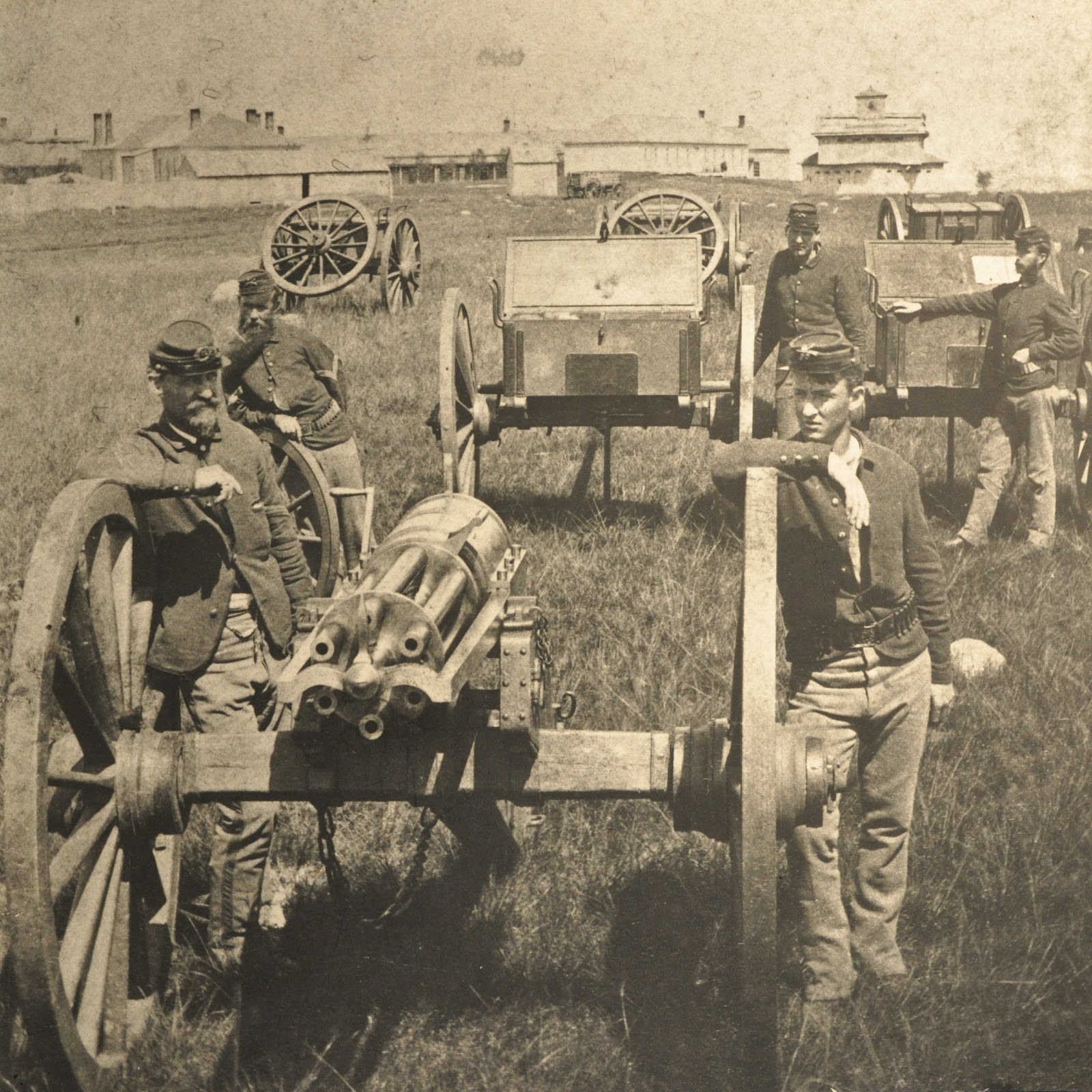
Fort McKeen was named in the tradition of the day, that is, named in honor of someone really important in the military or politics.  This particular fort was named to commemorate Colonel H. Boyd McKeen who led the 81st Pennsylvania Volunteers.  Colonel McKeen lost his life at the Battle of Cold Harbor in the Civil War. 


Fort McKeen was established to protect the Northern Pacific Railway survey line as it went west into Yellowstone country.  The infantry discovered that the Indians had horses, and further, that the Indians didn’t have the patience to wait for soldiers on foot to catch up to them. 

Of course, long before Fort McKeen was established, and before the Mandan Indians constructed their first earthlodge below the bluff, but above the floodplain, this particular site was probably regarded with reverence.  Near the blockhouse furthest away in the first picture of this article is the remains of one earth mound from the Late Woodlands Culture. 

It is clear that this site has been continuously culturally occupied for the past two thousand years, first by the earth mound culture, then the earth lodge culture, and later by the US military. 


Near the Fort Abraham Lincoln State Park museum, is a Corps of Discovery II medallion embedded in a concrete pillar. The medallion commemorates the 200th anniversary of the Corps of Discovery, also known as the Lewis and Clark Expedition.

I’ve seen for myself, hard core “Lewis and Clarkers” stop here and at the Lewis and Clark Overlook north of the Mandan Indian village, to read passages from Lewis and Clark’s journals on the day Lewis and Clark stopped there.  It is almost like a religious pilgrimage. 


Of course, Fort Abraham Lincoln State Park, the greatest park in North Dakota, is named for the fort, and is known more for it’s association as being the home of General Custer’s last command and his trail to the Little Bighorn than for being named for President Abraham Lincoln (it was named in honor of the 16th US President about eight years after his death).

It was determined that the infantry wasn’t the right kind of soldier to protect the Northern Pacific survey line, so Congress established Fort Abraham Lincoln in March of 1873. The fort was home to six companies of the 7th Cavalry. General Custer was stationed here from 1873 to his death at the Battle of the Little Bighorn in 1876.


In 1873, General Custer led his command to the Yellowstone to provide protection to the survey crews from various Sioux attacks. 


In 1874, General Custer led his command to the Black Hills to confirm the discovery of gold. 

The meanings of building forts in the American west weren’t articulated very well to the Indians or the settlers.  For American Indians, forts were a sign of an encroaching domineering society.  Fort settlers, forts meant protection from Indians.  In hindsight, it is easy to say and agree that forts symbolized the Manifest Destiny policy of the day.  A little more difficult to see is the fact that forts didn’t provide protection to settlers at all. 

In Libby Custer’s “Boots and Saddles,” she describes the scene about an old man visiting with her husband.  The general repeatedly warned him not to “squat” on the west bank; the old man did anyway and was killed by “wild Indians.”  The Bismarck Tribune ran a story about the inaction of General Custer and the fort, settlers were angry and scared, but the fort and the soldiers there were not there to protect settlers. 


Getting back to what you’ll see at Fort Abraham Lincoln today is a reconstruction of the commanding officer’s quarters as General Custer and his wife would have known it in 1875.  My friend and former co-worker, First Sergeant Al Johnson, greets visitors here regularly each summer.


Al’s been living in 1875 since 1995. He’s the face of Fort Abraham Lincoln.

Throughout the house, you’ll see furnishings from the late 19th century to the turn of the century. Really important stuff, like things actually owned by General Custer and his beloved Libby the living history guide will point out to visitors by saying the magic words, “Take special notice of…” That is your cue to express your deepest admiration for the appointed item in the forms of “oohs” and “aahs.” An occasional feigned yawn or laborious stretch and a murmur about the general’s taste works here too.


Take special notice of the burgundy drapes. 


Take special notice of the silverware. 
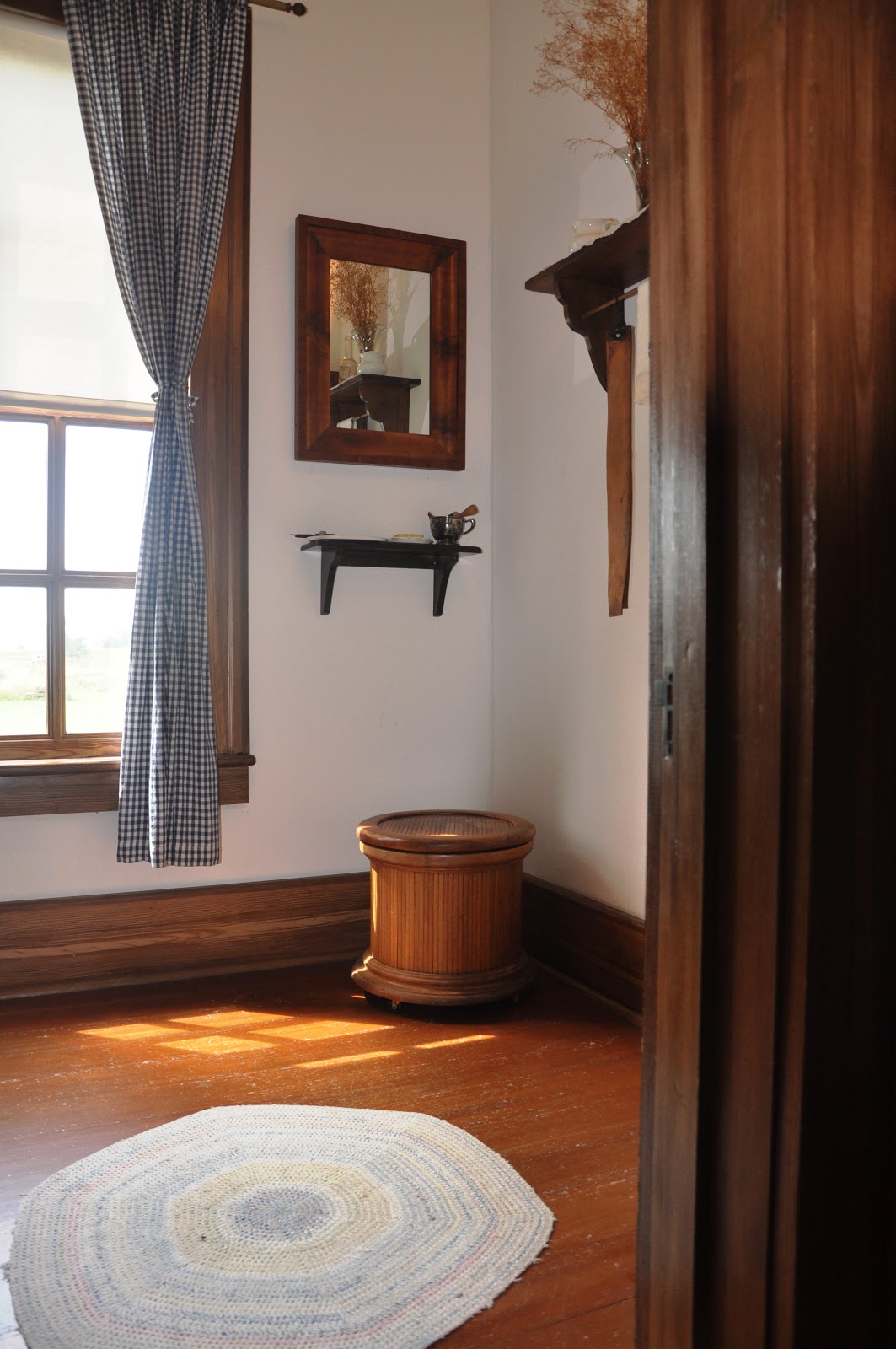

You don’t have to take special notice of this commode, but one day someone in a largish group was immediately seized with a sour gut and left a rather unpleasant gift for the next visitors to tour the house. The stench was so pungent and strong and wafted out into the hallway in waves of such sour putrescence one could but barely choke back gags with polite coughs. I share the story here only to notify you dear reader to pay a visit to the latrine and leave your presents there. 


Take special notice of the turkey platter. 


The cellar.  At one point, General Custer kept a bobcat and a porcupine he acquired on the Yellowstone Expedition down there as pets, until he donated them to the University of New York, if I recall correctly.  The brickwork is from the very first house. 


This drawer and mirror piece was part of General Custer’s and his wife’s personal belongings. 


This little marble top table goes with the drawer. 


These two chairs were once owned by General Custer.  I’m sure that they weren’t artfully arranged for people to look at but used, probably in the study. 


This campaign desk was with General Custer throughout the Civil War, his campaign against the KKK in Louisiana after the Civil War, the Indian Wars, and on the Centennial Campaign or the Little Bighorn Campaign of 1876.  One time a person on tour actually broke down and cried after hearing about the background of this desk. 


The green cloth bound book titled “Life of Daniel Webster” was given to General Custer by his good friend Lawrence Barrett, a famous Shakespearean actor in New York in the 1870s.  General Custer saw Barrett in Hamlet over a dozen times. According to Libby Custer, he watched it with as much attention and zeal as seeing it the first time every time. 


If you are so lucky and have the time, First Sergeant Johnson or other guide, can handle the book and show visitors the dedication from Barrett to Custer.  The inscription reads, “To. my dear Friend G. A. Custer – from Lawrence Barrett feb 17th 1874.” 


Libby’s rocking chair in the main bedroom. 


The only other thing that was actually owned by the Custers is the map case on display in the Commissary.  The little brass placard on the glass reads, “GA CUSTER’S MAP CASE Libby’s only memento from The Little Bighorn on loan from the trust of Stephen Ronald Cloud Jr. and Ryan John Cloud.”  A notarized document testifying the line of ownership back to General Custer has been taped on to the map case. 

Thank you to Fort Abraham Lincoln State Park, the greatest park in North Dakota, and First Sergeant Al Johnson, the face of Fort Abraham Lincoln. 

Friday, June 17, 2011

Battle on the Yellowstone: The Yellowstone Campaign of 1863

Custer's Last Stand. The General can be easily seen in the center lower half of this popular image of the Battle of the Little Bighorn. 
Battle On The Yellowstone
The Yellowstone Campaign Of 1863
By Dakota Wind
YELLOWSTONE RIVER, M.T. - A month after the Battle of the Little Bighorn, Galaxy published General Custer’s account of his first altercation with the Lakota on the Yellowstone three years previous. General Custer wrote under the alias Nomad for the Galaxy, what we’d call today a magazine or periodical. Here is an excerpt of that account.

There were three Yellowstone Expeditions altogether, or rather, one survey over three years from 1871 to 1873.
At ten o’clock we reached the crest of the high line of bluffs bordering the Yellowstone valley, from which we obtained a fine view of the river and valley extended above and beyond us as far as the eye could reach. Here and there the channel of the river was dotted with beautiful islands covered with verdure and shaded by groves of stately forest trees, while along the banks on either side could be seen for miles and miles clumps of trees varying in size from the familiar cottonwood to the wavering osier, and covering a space in some instances no larger than a gentleman’s garden, in others embracing thousands of acres.
A photo from the bluffs overlooking the Yellowstone River valley.

After halting upon the crest of the bluffs long enough to take in the pleasure of the scene and admire the beautiful valley spread out like an exquisite carpet at our feet, we descended to the valley an directed our horses’ heads toward a particularly attractive and inviting cluster of shade trees standing on the river bank and distant from the crest of the bluffs nearly two miles. Upon arriving at this welcome retreat, we found it all that a more distant view had pictured it. An abundance of rich, luxuriant grass offered itself to satisfy the craving appetites of our travelled steeds, while the dense foliage of the forest trees provided us with a protecting shade which exposure to the hot rays of an August sun rendered more than welcome. First allowing out thirsty horses to drink from the clear, crystal water of the Yellowstone, which ran murmuringly by in its long torturous course to the Missouri, we then picketed them out to graze.

This photo of the Yellowstone is by L A Huffman.
Precautionary and necessary measures having been attended to looking to the security of our horses, the next important and equally necessary step was to post half a dozen pickets on the open plane beyond to give timely warning in the event of the approach of hostile Indians. This being done, the remainder of our party busied themselves in arranging each for his individual comfort, disposing themselves on the grass beneath the shade of the wide-spreading branches of the cottonwoods that grew close to the river bank. Above us for nearly a mile, and for a still greater distance below, the valley was free from timber. This enabled our pickets to command a perfect view of the entire valley, at this point about two miles wide, and almost level, save where here and there is, was cut up by deep washes in the soil. Satisfied that every measure calculated to insure our safety had been taken, officers and men – save the trusty pickets – stretched their weary forms on the grassy lawn, and were soon wrapped in slumber, little reckoning that within a few rods there lay concealed more than five times their number of hostile Sioux warriors, waiting and watching for a favorable moment to pounce upon them. For myself, so obvious was I to the prospect of immediate danger, that after selecting a most inviting spot for my noonday nap, and arranging my saddle and buckskin coat in the form of a comfortable pillow, I removed my boots, untied my cravat, and opened my collar, prepared to enjoy to the fullest extent the delights of an outdoor siesta.


Tom Custer enlisted as a private during the Civil War at the age of sixteen. By war’s end he had the rank of Brevet Lieutenant Colonel and was a two-time recipient of the Medal of Honor. Though he was only a lieutenant with the 7th Cavalry on the Yellowstone Expedition of 1873, he worked to regain the regain the rank of captain by the Centennial Campaign.

I did not omit, however, to place my trusty Remington rifle within easy grasp – more from habit, it must be confessed, than from anticipation of danger. Near me, and stretched on the ground sheltered by the shade of the same tree, was my brother, the Colonel, divested of his cap, coat, and boots; while close at hand, wrapped in deep slumber, lay the other three officers, Moylan, Calhoun, and Varnum. Sleep had taken possession of us all – officers and men – excepting of course the watchful pickets into whose keeping the safety, the lives, of our little detachment was for the first time entrusted. Many of the horses even, having lunched most bountifully from the rich repast which nature had spread around and beneath them, seemed to share in the languor and drowsiness of their riders, and were to be seen here and there reposing upon the soft green carpet which to them was both food and couch. How long we slept I scarcely know – perhaps in hour, when the cry of “Indians!” “Indians!” quickly followed by the sharp ringing crack of the pickets’ carbines, aroused and brought us – officers, men, and horses – to our feet. There was neither time nor occasion for questions to be asked or answered. Catching up my rifle, and without waiting to don hat or boots, I glanced through the grove of trees to the open plain or valley beyond, and saw a small party of Indians bearing down toward us as fast as their ponies could carry them.

“Run to your horses, men! Run to your horses!” I fairly yelled as I saw that the first move of the Indians was intended to stampede our animals and leave us to be unattended afterward.

Picture adapted from a color photo taken from sixpounder’s Flickr page. The soldiers at the Yellowstone skirmish were rising from an afternoon slumber, they didn’t pitch camp as shown in the picture above.

At the same time the pickets opened fire upon our disturbers, who had already emptied their rifles at us as they advanced as if boldly intending to ride us down. As yet we could see but half a dozen warriors, but those who were familiar with Indian stratagems knew full well that so small a party of savages unsupported would not venture to disturb in open day a force the size of ours. Quicker than I could pen the description, each trooper, with rifle in hand, rushed to secure his horse, and men and horses were soon withdrawn from the open plain and concealed behind the clump of trees beneath who shade we were but a few moments before quietly sleeping. The firing of the pickets, the latter having been reinforced by a score of their comrades, checked the advance of the Indians and enabled us to saddle our horses and be prepared for whatever might be in store for us.

A staged photo by E Curtis of a Sicangu Lakota war party.
A few moments found us in our saddles and sallying forth from the timber to try conclusions with the daring intruders. We could only see half a dozen Sioux warriors galloping up and down in our front, boldly challenging us by their manner to attempt their capture or death. Of course it was an easy matter to drive them away, but as we advanced it became noticeable that they retired, and when we halted our diminished speed they did likewise. It was apparent from the first that the Indians were resorting to stratagem to accomplish that which they could not do by an open, direct attack. Taking twenty troopers with me, headed by Colonel Custer and Calhoun, and directing Moylan to keep within supporting distance with the remainder, I followed the retreating Sioux up the valley, but with no respect of overtaking them, as they were mounted upon the fleetest of ponies. Thinking to tempt them within our grasp, I being mounted on a Kentucky thoroughbred in whose speed and endurance I had confidence, directed Colonel Custer to allow me to approach the Indians accompanied by only my orderly, whose was also well mounted; at the same time to follow us cautiously at a distance of a couple of hundred yards. The wily redskins were not to be caught by any such artifice. They were perfectly willing that they orderly and myself should approach them, but at the same time they carefully watched the advance of the cavalry following me, and permitted no advantage. We had by this time almost arrived abreast of an immense tract of timber growing in the valley and extending to the water’s edge, but distant from our resting place, from which we had been so rudely aroused, about two miles.


Another staged photo by E Curtis, this one of a Oglala Lakota war party.

The route taken by the Indians, and which they evidently intended us to follow, led us past this timber, but not through it. When we had arrived almost opposite the nearest point, I signaled to the cavalry to halt, which was sooner done that the Indians also came to a halt. I then made the sign to the latter for a parley, which was done by simply riding my horse in a circle. To this the savages only responded by looking on in silence for a few moments, then turning their ponies and moving off slowly, as if to say, “Catch us if you can.” My suspicions were more than ever aroused, and I sent my orderly back to tell Colonel Custer to keep a sharp eye upon the heavy bushes on our left and scarcely three hundred yards distant from where I sat on my horse. The orderly had delivered his message, and had almost rejoined me, when judging from our halt that we intended to pursue no further, the real design and purpose of the savages was made evident. The small party in front had faced toward us and were advancing as if to attack. I could scarcely credit the evidence of my eyes, but my astonishment had only begun when turning to the wood on my left I beheld bursting from their concealment between three and four hundred Sioux warriors mounted and caparisioned with all the flaming adornments of paint and feathers which go to make up the Indian war costume. When I first obtained a glimpse of them – and a single glance was sufficient – they were dashing from the timber at full speed, yelling and whooping as only Indians can. At the same time they moved in perfect line, and as seeming good order and alignment as the best drilled cavalry.

Gall lead a war party in Yellowstone country against the survey expeditions for those particular expeditions went against the 1868 Fort Laramie Treaty. He and the war party he lead were defending their people’s territory.

To understand our relative positions the reader has only to imagine a triangle whose sides are almost equal; their length in this particular instance being from three to four hundred yards, the three angles being occupied by Colonel Custer and his detachment, the Indians and myself. Whatever advantage there was in length of sides fell to my lot, and I lost no time in availing myself of it. Wheeling my horse suddenly around, and driving the spurs into his sides, I rode as only a man rides whose life is the prize, to reach Colonel Custer and his men, not only in advance of the Indians, but before any of them could cut me off. Moylan with his reserve was still too far in the rear to render their assistance available in repelling the shock of the Indians’ first attack. Realizing the great superiority of our enemies, not only numbers, but in their ability to handle their arms and horses in a fight, and fearing they might dash through and disperse Colonel Custer’s small party of twenty men, and having once broken the formation of the latter, dispatch them in detail, I shouted to Colonel Custer at almost each bound of my horse, “Dismount your men! Dismount your men!” but the distance which separated us and the excitement of the occasion prevented him from hearing me.

Robert W. Larson put this wonderful book together about Chief Gall a few years ago. Larson made several trips to the Standing Rock Sioux Indian Reservation to visit with the descendants of Gall to learn the family oral traditions. It’s a great read, easily accessible by the everyday reader, and quick too. Go order yourself a hardcover copy, or better yet, buy it at the Little Bighorn Battlefield.

Fortunately, however, this was not the first time he had been called upon to contend against the sudden and unforeseen onslaught of savages, and although failing to hear my suggestions, he realized instantly that the safety of his little band of troopers depended upon the adoption of prompt means of defense.

Scarcely had the long line of splendidly mounted warriors rushed from their hiding place before Colonel Custer’s voice rang out sharp and clear, “Prepare to fight on foot.” This order required three out of four troopers to leap from their saddles and take their position on the ground, where by management of their horses, a more effective resistance could be opposed to the rapidly approaching warriors. The fourth trooper in each group of “fours” remained on his horse holding the reins of the horses of his three comrades.
Itomagaju, or Rain In The Face, was part of the Lakota war party on the Yellowstone in 1873. He killed a couple men of the survey crew. Tom Custer tackled Rain at Standing Rock in the fall of 1874 and imprisoned him at Fort Abraham Lincoln where he escaped from in April 1875.

Quicker than words can describe, the fifteen cavalrymen now on foot, and acting as infantry, deployed into open order, and dropping on one or both knees in the low grass, waited with loaded carbines – with finger gently pressing the trigger – the approach of the Sioux, who rode boldly down as if apparently unconscious that the small group of troopers were on their front. “Don’t fire, men, till I give the word, and when you do fire, aim low,” was the quiet injunction given his men by their commander, as he sat on his horse intently watching the advancing foe.

Swiftly over the grassy plains leaped my noble steed, each bound bearing me nearer to both friends and foes. Had the race been confined to the Indians and myself the closeness of the result would have satisfied an admirer even of the Derby. Nearer and nearer our paths approached each other, making it appear almost as if I were one of the line of warriors, as the latter bore down to accomplish the destruction of the little group of troopers in front. Swifter seem to fly our mettled steeds, the one to save, the other to destroy, until the common goal has almost been reached – a few more bounds, and friends and foes will be united – will form one contending mass.


The victory was almost within the grasp of the redskins. It seemed that but a moment more, and they would be trampling the kneeling troopers beneath the feet of their fleet-limbed ponies; when, “Now, men, let them have it!” was the signal for a well-directed volley, as fifteen cavalry carbines poured their contents into the ranks of the shrieking savages. Before the latter could recover from the surprise and confusion which followed, the carbines – thanks to the invention of breechloaders – were almost instantly loaded, and a second carefully aimed discharge went whistling on its deadly errand. Several warriors were seen to reel in their saddles, and were only saved from falling by the quickly extended arms of their fellows. Ponies were tumbled over like butchered bullocks, their riders glad to find themselves escaping with less serious injuries. The effect of the rapid firing of the troopers, and their firm, determined stand, showing that they thought neither of flight nor surrender, was to compel the savages first to slacken their speed, then to lose their daring and confidence in their ability to trample down the little group of defenders in the front. Death to many of their number stared them in the face. Besides, if the small party of troopers in front was able to oppose such plucky and destructive resistance to their attacks, what might not be expected should the main party under Moylan, now swiftly approaching to the rescue, also take part in the struggle? But more quickly then my sluggish pen has been able to record the description of the scene, the battle line of the warriors exhibited signs of faltering which soon degenerated into an absolute repulse. In a moment their attack was transformed into flight in which each seemed only anxious to secure his individual safety. A triumphant cheer from the cavalrymen as they sent a third installment of leaden messengers whistling about the ears of the fleeing redskins served to spur both pony and rider to their utmost speed. Moylan by this time had reached the ground and had united the entire force. The Indians in the mean time had plunged out of sight into the recesses of the jungle from which they had first made their attack.

The skirmish continued for more than three hours. General Custer had begun to worry about his men’s depleting ammo when the main body of troops of the Yellowstone Expedition arrived on the scene. This fight, near the Tongue River, was similar to the Wagon Box Fight on the Bozeman Trail of 1868, in that the fights were turned in favor of the soldiers because of breech loading carbines. Had the soldiers still been using muzzle loading rifles, they’d have been overwhelmed entirely in both fights.

Thursday, June 9, 2011

The US Scouts on Campaign


In 1888, Harper's Weekly reported that the US Army was limited by law to 25,000 enlisted service men. The Army was also limited to only 200 Indian scouts. General Miles believed that the Indian scouts were essential to the Army's efforts on the frontier. Wood engraving by RF Zogbaum which appeared in Harper's Weekly, May 1889. 
The US Indian Scouts On Expedition
On The Little Bighorn Campaign
By Dakota Wind
MANDAN, N.D. - The scouts who served at Fort Abraham Lincoln were called the Fort McKeen Detachment of Scouts. Most of them were Indian scouts in service in the United States military defending their way of life, that is, that their people could live. Other scouts were contracted civilians, holdovers from the last days of the fur trade era, who could speak the native languages fluently or knew the lay of the land like the back of their hand.


This book was required reading for one of my courses at university. It details the interactions of whites, blacks, and natives leading up to the Revoluntionary War. The English had promised freedom to black slaves who fought for the British. The English and Americans divided several tribes as each country vied for allies during the war. Log onto Amazon or ebay and get yourself a copy.

The history of scouts serving our country goes back to before there even was a United States.Certainly the history of Indians serving our country goes back just as far, and the AmericanRevolution couldn't have been won without Indians aiding the colonials or the colonials adapting the guerilla fighting techniques the Indians favored.

It wasn't until the Civil War that Congress took note of the thousands of Indians who were already fighting for both the North and South, entire companies and commands made up of Indians, including battles fought by Indians, and against Indians (ex. Cabin’s Creek) that Congress recognized the Indians' service by forming an official branch for them, the US Scouts. This new branch of the Army included an official insignia and crossed sabers accompanied by the letters “USS.”


This is the first official insignia worn by the US Scouts. The sabers of this insignia were later replaced by crossed arrows in the mid 1880s. 

The Indian scouts who served at Fort Abraham Lincoln began their service at Fort McKeen, a two company infantry post constructed in 1872. Fort Abraham Lincoln, a six company cavalry post, was built a year later on the plains below the infantry post and the new name encompassed both forts. The only thing to retain the name “Fort McKeen” was the detachment of Indian Scouts.


Each detachment of Indian Scouts received their own guidon like this one pictured. Some detachments even had their tribal affiliation on the guidon as well as which territory or fort they served at.

On July 6, 1872, Fred Gerard was hired as an interpreter at Fort McKeen. He held his position until 1882. During his first year he recruited several Arikara scouts from Fort Buford where activity was primarily running down deserters, to Fort McKeen where they engaged the Sioux in several hit-and-run raids. That first year seven Arikara Scouts died. The Post Surgeon remarked “The Indian scouts in the several skirmishes with the Sioux in Oct. and Nov. exhibited instances of the greatest personal bravery and fearlessness.”


This image of four Arikara scouts was taken at Fort Abraham Lincoln. Bloody Knife is featured in this image on the far right wearing a shaved horn headdress with eagle feather trailer, a symbol of his chieftainship in the peacekeeping society of the Arikara. 

General Custer was well aware of the value of the Indian scouts on the frontier. Oftentimes an Indian scout could get messages and mail through hostile territory where a white soldier or civilian scout could not. The scouts provided General Custer with intelligence, given with respect and varying degrees of awe, and were rewarded with preferential treatment.

Forty Arikara scouts were brought on to guide the military from Fort Abraham Lincoln to the Yellowstone in 1873. Only three civilians joined the Indian scouts to escort twenty companies of the 6th, 8th, 9th, 17th, and 22nd infantry regiments, and ten companies of the 7th Cavalry (about 1500), about 350 Northern Pacific Railway survey crew employees, four scientists, and two members of the British nobility, to Yellowstone country. General Custer often accompanied the Indian scouts.

General Custer and the Seventh Cavalry engaged in a skirmish on the north bank of the Yellowstone River across from Pompey's Pillar. Sixty-nine years before, the Corps of Discovery came by here and Captain William Clark left his signature on the east side of the pillar. When you visit the Battle of the Little Bighorn, be sure to take in a visit to Pompey's Pillar too. Its about an hour's drive north, just off of Interstate 94.

On August 4, 1873, the Yellowstone Expedition reached the Powder River. About 90 men, including the scouts, explored the Tongue River. There they were surprised when six Sioux men attempted to stampede their horses. The Sioux were driven off and pursued to a heavy stand of trees, when an estimated 300 mounted Sioux warriors led by Chief Gall, burst forth to fight. Bloody Knife was the quickest draw, remarked General Custer, having shot and killed the first antagonist, from horseback. The scouts' bravery and guidance spared all the soldiers' lives but for three.

The Arikara scouts were a conservative lot, who often complained to the chief of scouts, a non- Indian second lieutenant who served as liaison to the commanding officer, about the traffic in flesh the enlisted soldiers partook in. The scouts also had zero tolerance for domestic abuse, and any soldier who was found beating women was arrested immediately.

In his yearly report of 1873, Post Surgeon Middleton praised the service of the scouts, saying, “There have been no successful desertions during the year, although many have attempted it…deserters are easily overtaken by the scouts and [accompanying] detachments.” At some forts, the desertion rate was as high as 30% after many newly enlisted soldiers realized life in the army in the frontier wasn't what they expected. Middleton's acclaim for the scouts pulling military police duty was mirrored throughout Dakota Territory. Simply put, the scouts were at home in a land they were born and raised in, and could read the features of friend or foe in a glance.


Here's an image of the encampment at the Black Hills. Photo by Illingsworth.

The Black Hills Expedition of 1874, led by General Custer, a journey intended to confirm the discovery of gold in the hills, left Fort Abraham Lincoln guided by a detachment of scouts that consisted of 22 Arikara and 38 Santee Dakota Sioux up from Nebraska. There is no written record if the groups socialized, but together they led about 1,200 men to the hills and back, covering nearly 1,200 miles. Professor Donaldson, a geologist on the expedition, remarked, “The scouts are invaluable. Where they scour the country, no ambush could be successfully laid.”

Above is a map of what was then called the "Centennial Campaign."

On May 17, 1876, the Centennial Campaign left Fort Abraham Lincoln with the scouts in lead, guiding about 1200 men to meet their destiny at the Little Big Horn. Twenty-one scouts were left behind at Fort Abraham Lincoln, twelve at Fort Stevenson, and six at Fort Buford to maintain open lines of communication. In all, a total of fifty-one Indian scouts from the Arikara, the Crow, the Sioux, and the Pikuni (also called Piegan or Blackfoot) escorted and safeguarded the 7th Cavalry. Surgeon DeWolf wrote of the scouts, “…we cannot be surprised very easily. The Indian

Scouts are all camped tonight outside us…Scouts working ten miles out.” Indeed, no ambush or raid could be laid.


Approaching the Little Bighorn, General Custer divided his command into three columns. One column was led by Captain Benteen, another by Major Reno, and one by General Custer himself. General Custer recieved a missive from General Terry telling him to engage the Lakota and Cheyenne. The General Terry/General Custer command was supposed to have waited a few more days for General Crook and General Gibbon.

The duty of the scouts was to guide the 7th Cavalry to the encampment of the Sioux and their ally, the Cheyenne. Vacant camps, trails, and other sign of the Sioux encampment lead the Indian scouts to believe there were perhaps five thousand of the enemy. On June 25, 1876, the Crow and Arikara, believing that they were likely seen approaching the Sioux, urged General Custer to engage the enemy immediately if that's what they came out to do, or lose any advantage that surprise would give them. Despite the advice to Custer to immediately go into battle with the Sioux, the scouts didn't seem as excited to fight as the general. Many accounts mention the scouts singing songs, plaiting their hair, painting, etc., not to take their time in meeting the enemy, but because many of them were preparing to meet the creator, as some of them did that day.

General Custer was attempting to flank the Lakota and Cheyenne from northeast of the encampment. General Custer used this same strategy at Washita where he was outnumbered there as well. That strategy was to capture the women and children who fled opposite from the first attack. The native camp was far larger than General Custer believed it was and his attempt failed. 

The scouts didn't have to be at the Battle of the Little Big Horn. Their duty came to an end the moment they ascended the Crow's Nest and directed General Custer to the direction of the Sioux encampment. The scouts voluntarily entered combat against the principles for which they were employed, and they went to take traditional honors by stealing horses from the Sioux and Cheyenne.

General Custer ordered his men to take the higher ground, a last attempt to hold a strategic advantage over the Lakota and Cheyenne when the warriors began to retaliate. Today the hill is called Last Stand Hill. 

The Battle of the Little Big Horn didn't go as General Custer envisioned it would. Instead, a swift and utter downfall met his command. General Custer ordered the Scouts into battle with Major Reno, whose experience fighting the Indians was virtually none, primarily to distract the Sioux on one side so General Custer could flank the Sioux from the north. Dividing his command was a mistake which paved the way for Custer's last stand. Reno's witness to Bloody Knife's sudden death so rattled the Major that he ordered a halt and retreat three times.


Bloody Knife kneels on General Custer's left side and points to a location on a map. Bloody Knife was General Custer's favorite scout. From Bloody Knife, General Custer learned to speak a little Lakota, Arikara, and became well practiced in the Plains Indian sign and gesture language. The two became so close, they regarded one another as brother.

Bob Tailed Bull, Little Soldier, and Bloody Knife lost their lives, two others received wounds, Goose and White Swan, on Major Reno's retreat.

The Battle of the Little Bighorn is often broken down into lines, fights, and skirmishes, with the Last Stand Hill serving as climax. The Arikara and the Lakota regard the Battle of the Greasy Grass, as they regard it, as simply one battle. This author has visited the battle several times, and has heard the Lakota and Cheyenne bristle when they hear “there were no survivors.” For certain there were, for the victors in that fateful battle survived to either fight another battle, return to the reservations, or go to Canada.


Captain Miles Keogh's horse, Comanche, shown here is often regarded as the last survivor of Custer's command at Last Stand Hill. There were perhaps a hundred other horses and even one a yellow bulldog survived. Comanche died fifteen years after the battle and was stuffed. Comanche can be seen today in a glass class at the University of Kansas.

For several years Captain Miles Keogh’s horse was accorded some great degree of respect, almost reverence, even honored with a song by Johnny Horton. Similarly do the Arikara hold Bloody Knife’s horse in high regard. Bloody Knife’s pony was shot and injured at the battle and journeyed over 300 miles back to Fort Berthold where he came to stand outside Bloody Knife’s wife’s, She Owl’s, lodge. After arriving home, Bloody Knife’s buckskin pony lay down and died. The Arikara honored the pony in song. If you, dear reader, are fortunate enough to visit the White Shield pow-wow on the Fort Berthold Indian Reservation in North Dakota, you may hear that song, and if you’re luckier, hear one composed for the scouts, other veteran songs, or even one composed for General Custer.


Bloody Knife on one of his horses on the Yellowstone Expedition. 

Whether it was skirmishes at the infantry post, the cavalry post, or on expedition, the Indian scouts were the first in line to defend their charges, but most importantly, they protected our country to ensure that their people would live.