Showing posts with label Great Plains. Show all posts

Saturday, February 13, 2021

The Red Road and Other Narratives of the Dakota Sioux, A Review

Mniyo, Samuel, and Robert Goodvoice. The Red Road and Other Narratives of the Dakota Sioux. Edited by Daniel Beveridge. Lincoln, NE: University of Nebraska Press, 2020. Hardcover. $75. 304 pages + xxvi. Contents, photographs, figures, maps, appendices, glossary, notes, bibliography. 

I grew up on the Standing Rock Sioux Indian Reservation hearing about the Red Road. My lekší Kenny struggled with alcohol and chemical dependence issues for years, and when he was clean we had some of the greatest philosophical discussions about the purpose of life, existentialism, and even the Red Road. He frequently questioned “why” about life, church, and traditional ceremony. I learned about the Socratic method of argument and the introspective meditative philosophy from him long before ever hearing about Socrates or Descartes. 


When I heard about the Red Road, it seemed to be a spiritual philosophy for people recovering from chemical and alcohol dependency. It was inseparable from recovery. I’ve had more than few, but I never let it become a lifestyle. Talking about the Red Road always seemed removed and distant. Conversations in school with friends about the Red Road immediately became quiet or turned to a discussion about becoming holy. 


The Red Road and Other Narratives of the Dakota Sioux was published in February 2020. I knew I wanted to read it after reading the title. It’s costly, and I waited for my local library to get a copy in so I could read it, but that never happened. I turned to the North Dakota State Library and did an interlibrary loan request, and a copy came in a week later from Nebraska. I hope that the University of Nebraska Press publishes a softcover edition soon. 


The Red Road is a duology of Dakhóta narratives which serve as a spiritual history of the Dakhóta people and by extension, the Očhéthi Šakówiŋ. Samuel Mniyo and Robert Goodvoice articulate an oral tradition of the Očhéthi Šakówiŋ that reaches back to a time when the Council Fires were not seven, but twelve. 


The Red Road is not a history book in the sense that it’s filled with footnotes, endnotes, and bibliography. It employs oral tradition that reaches into time beyond living memory, further back than winter counts can recall. It’s a pre-Columbian oral tradition without ever referencing that it is pre-Columbian. Historians who rely on the written record may struggle with these narratives. This reader suggests that this should be treated with the same respect and seriousness as one would treat the Holy Bible as history. 


The narratives in The Red Road takes readers to a time and place when and where the Twelve Fires traveled and occupied land that stretched from the eastern seaboard in the east, and the Gulf Coast in the south, to the Rocky Mountains in the west. The narratives don’t fully articulate why five of the Council Fires removed themselves, but it was during a time of great struggle when the people fought themselves over resources. 


The Seven Council Fires that remained united faced a great existential crisis in their search for ultimate truth. They searched for generations for the elusive Hill of Truth. Their travels took them across the great prairie steppe. Some stayed in areas to live their lives. Others remained nomadic in their generations-long pilgrimage. Mniyo goes so far as to suggest that this great quest was to prepare the Dakhóta to receive the biblical word of God when the missionaries arrived. “The promise of Oúŋ [Life] wasn’t really a lie. It was really the voice of God that spoke to our ancestors, but it was misunderstood. Oúŋ was not land [the Hill of Truth] but salvation in Jesus Christ, who went to Calvary Hill and paid for our sins.” (Mniyo and Goodvoice, 2020; 124). 


This retro understanding of Dakhól Wičhóȟ’aŋ (the Dakhóta Way of Life) removes the agency or sense of self-determination from the Dakhóta people and embraces pre-determinism, the very kind of thinking that colonizers and settlers embraced to justify missionizing the indigenous and taking their land. Mniyo’s philosophical approach to the arrival of missionaries is echoed in Pope Benedict XVI’s paternalistic statement in May of 2007 that the church had not imposed it’s will on the native peoples, rather, they were silently longing for Christianity [1].


The narratives include what one might call mysticism. Both Mniyo and Goodvoice recall stories of a person or people walking on water. Goodvoice includes a prophetic warning to the Council Fire people's encounter with people who speak a different language in the future.


One outstanding narrative retelling by Goodvoice recalls an encounter with Iŋktómi, a traditional folk character who causes mischief and oftentimes outsmarts his own self, in which he puts aside mischief and warns the Dakhóta that an epidemic will strike them in a forthcoming winter. He told them what medicines to consume and to sequester that winter and when spring came, they survived. (Mniyo and Goodvoice, 2020; 157-158). 


I have never read such a thought-provoking book. I picked this book up and set it down so many times over the course of a month. I don’t think that Goodvoice intended at all for readers to be provoked into relating a way of papel thinking - these narratives were recorded over forty years ago - but rather, Goodvoice perhaps wanted Očhéthi Šakówiŋ to consider that we are living in the best of all possible worlds. Perhaps in modern times, we will return to self-determination through the rediscovery of language and way of life. 


Goodvoice also provides an amazing narrative of the Dakhóta war effort in the War of 1812. The English gave the Dakhóta seven medals and a cannon. Goodvoice takes readers on a winding narrative of promises and betrayal worthy of an Indiana Jones film. Think, “It belongs in a museum,” as if that makes the appropriation of historic artifacts right. It doesn’t. 


The Red Road is a path of recovery and self-determination. The Mniyo and Goodvoice narratives inform us that one doesn’t need to be a holy person but an everyday common person. The existential journey that the Očhéthi Šakówiŋ took an age ago has come back around. Who are we? Where are we going? What does it mean to be Dakhóta-Lakȟóta? Like the relatives long ago, I as an individual, don’t know those answers. The book The Red Road has certainly provoked me to ask myself, “What can I do to cultivate Lakȟól Wičhóȟ'aŋ, the traditional way of life?” 


This deserves to be read by anyone who has an interest in indigenous philosophy. This book is history if one considers oral tradition to be history. It is philosophy. It might be religious studies. The publisher labeled this book anthropology. It's all these things. Buy it, read it, and maybe share it with a relative who can't afford it.


[1] 
 Raymond Colitt, “Brazil's Indians Offended by Pope Comments,” Reuters (Thomson Reuters, May 14, 2007), https://www.reuters.com/article/us-pope-brazil-indians/brazils-indians-offended-by-pope-comments-idUSN1428799220070514.

Thursday, December 17, 2020

A 2021 Traditional Lakota Calendar

Wičháȟpi Hiŋȟpaye (Fallen Star or Star Boy), the traditional hero of the Očhéthi Šakówiŋ, takes his place in the heavens with his father Wičháȟpi Owáŋžila (North Star). 
Exploring the Traditional Calendar
Thirteen Moons In A Year

By Dakota Wind
The traditional calendar of the Očhéthi Šakówiŋ (the Seven Council Fires; Great Sioux Nation) consists of thirteen moons. A month begins with Wit'é (New Moon). The Winter Count Keepers kept track of the year with counting sticks. This was Haŋwí Yawápi, the Moon Counting Tradition. 

For many Očhéthi Šakówiŋ people the year begins in spring. Natural occurring events inform them when the New Year begins. When the ice breaks on the rivers and streams. When the geese return north. When the spring rain falls. When the bison bear their calves. When the trees bud. When Tȟašíyagmuŋka (the Western Meadowlark) sings. When certain stars appear too. 

In the winter count tradition, the year was referred to as Waníyetu (a Winter). The winter, or year as it were, was named after the year had passed. A year lasted from spring to spring. There were two spring moons, four summer moons, two autumn moons, and five winter moons. Since winter was the longest season on Northern Plains, it was natural to refer to the year as winter

In the moon counting tradition, the month was generally named for the natural events that occurred during that span of time. A month begins with the new moon. It is poetic to say that a month lasts twenty-eight days, but the winter count keeper with counting sticks knows the month is usually twenty-nine days or thirty days. 

The thirteen-month calendar overlaps the twelve-month astronomical by about twenty days. To reconcile the difference when the last month overlaps with the first month, the winter count keeper referenced the names of the last month and first month interchangeably. 

Last summer, a Lakȟóta educator contacted me about the possibility of creating a traditional calendar that was as faithful to the original calendar system as could be. I removed the names of the week because the traditional calendar did not have that, but I kept the seven-day week format. I removed western and American holidays and added several Wókiksuye (Memorial) Days. Blackened circles on each page demarcate where that month is in relation to the year (i.e. five black circles = fifth month, ten black circles = tenth month). Colors on the sides of the pictograph for each month correlate with the season (Blue = Spring; Red = Summer; Yellow = Autumn; White = Winter). 

This calendar includes the winter moons from the traditional year of 2020-2021. The new year for the Očhéthi Šakówiŋ begins on March 13, 2021, and runs through April 31, 2022. 

You can download this sixteen-month calendar RIGHT HERE. Its dimensions are 11" x 17". 

Here's a "white guy friendly" version too that is just 2021. Humanities North Dakota has beautifully redesigned each month and inserted my captions to explain the pictography for each traditional month. You can download that version if you want, RIGHT HERE. Humanities North Dakota will be printing a limited number of FREE calendars. Visit their website and sign yourself up for notifications and updates, or make a donation to them. 


Thursday, January 23, 2020

Stringing Rosaries, A Review

A little girl kneels in prayer on the cover of Lakimodiere's "Stringing Rosaries." The title takes its name from one of the sixteen narratives within this book that recalls a story doing just this. 
Stringing Rosaries, A Review
A Must Read For Church Leaders
By Dakota Wind
Lajimodiere, Denise K. Stringing Rosaries: the History, the Unforgivable, and the Healing of Northern Plains American Indian Boarding School Survivors. Fargo, ND: North Dakota University Press. 2019. $42.95 (hardcover). 277 pages + xiii. Preface, acknowledgments, photographs, fold-out map, appendix, bibliography, index. 

Lajimodiere shares the post-reservation Native American parochial boarding school experience of the Great Plains in an absolutely powerful and heartbreaking narrative that is certain to provoke a sense of loss, anger, sadness, and hope. This is not an easy read. 

Stringing Rosaries begins with an introduction to the methodology of militarized education that was developed by Capt. Richard Pratt following the Civil War. Pratt was the superintendent of the United States Indian Industrial School in Carlisle, PA where he subjected “new recruits” to an exhausting regime of corporal punishment to any who exhibited indigenous identity, namely that of speaking their language. 

Lajimodier’s research informs us that many children were stolen from their homes if their parents didn’t obey the mandate to send their children to school. Her work focuses on the boarding school experience of survivors from a variety of reservations, mainly in North Dakota, but all genuine and moving, and for this reader, close to home. 

Pratt’s model became the standard for native education. Lajimodiere takes readers through sixteen firsthand accounts of assimilation. Each account recalls a dehumanizing experience. Children were coldly stripped, washed, and deloused with powder regardless if they were clean on arrival. Hair was cut or shaved entirely. Children were excessively and cruelly punished mainly for disobeying authority and speaking their language. 

It would be easy to read only one or two of the survival narratives. In a sense, reading one is very much like reading them all. There is a general sameness of story, each school could be the same one but for location and name, but reading each one is part of the reader’s witness to understand the survivor’s journey. 

Boys were taught manual labor skills like carpentry and farming, girls were taught domestic skills like cooking, cleaning, and sewing. Boys and girls were strictly kept apart from each other, even in play or prayer. They were all awakened in the early hours for morning prayers. They were served coffee at every meal to keep them awake. Most disturbing of all, at any hour of the day or night, some children were sexually assaulted by both men and women of the cloth. 

Some of the first-person accounts are recalled under a pseudonym. Others employ their everyday names, and I am profoundly grateful that Dr. Ramona Klein (Turtle Mountain Band of Chippewa) and Dr. Erich Longie (Spirit Lake). I know both through their work and have met both on occasion; Dr. Klein when she was employed at the University of Mary in Bismarck, ND; Dr. Longie in his work with the tribal historic preservation office at Spirit Lake. 

Lajimodiere brings her work to a powerful close. She gives voice to her understanding of her father’s experience, of the native experience in assimilation: “...I came across terms I had not heard of before, terms such as historical trauma…[which] is conceptualized as a collective complex trauma.”

A year before her father took his last journey, Lajimodiere watched the documentary In the White Man’s Image with him. “The video documented the use of whistles, bells, bugles, military-style punishment and daily regimen, the building of guardhouses on school campuses, kids dying of homesickness, disease, and poor nutrition...that boarding schools left a legacy of confused and lonely children.” 

Part of Lajimodiere’s testimony is forgiveness. This is not the same as reconciliation. For reconciliation to happen there has to be an acknowledgment of wrong-doing on behalf of the Church. Lajimodiere tells us in her closing pages of well-being and story of the White Bison Wellbriety Journey of Forgiveness. 

Forgiveness, in this sense, is a deep sense of being wronged, something buried deep inside one’s soul, and a profound relief of releasing that tightly wound bundle of anger and loss. This isn’t something light or easy, nor is every person ready to forgive when neither the Church nor clergy has acknowledged these dark sins. 

Lajimodiere’s Stringing Rosaries isn’t a read for everyone, but it needs to be read by Church leaders and clergy. It should be read by people who call themselves Christian. Get your copy, or tell your minister to get one through the North Dakota State University Press.


Thursday, December 26, 2019

Lakota America, A Book Review

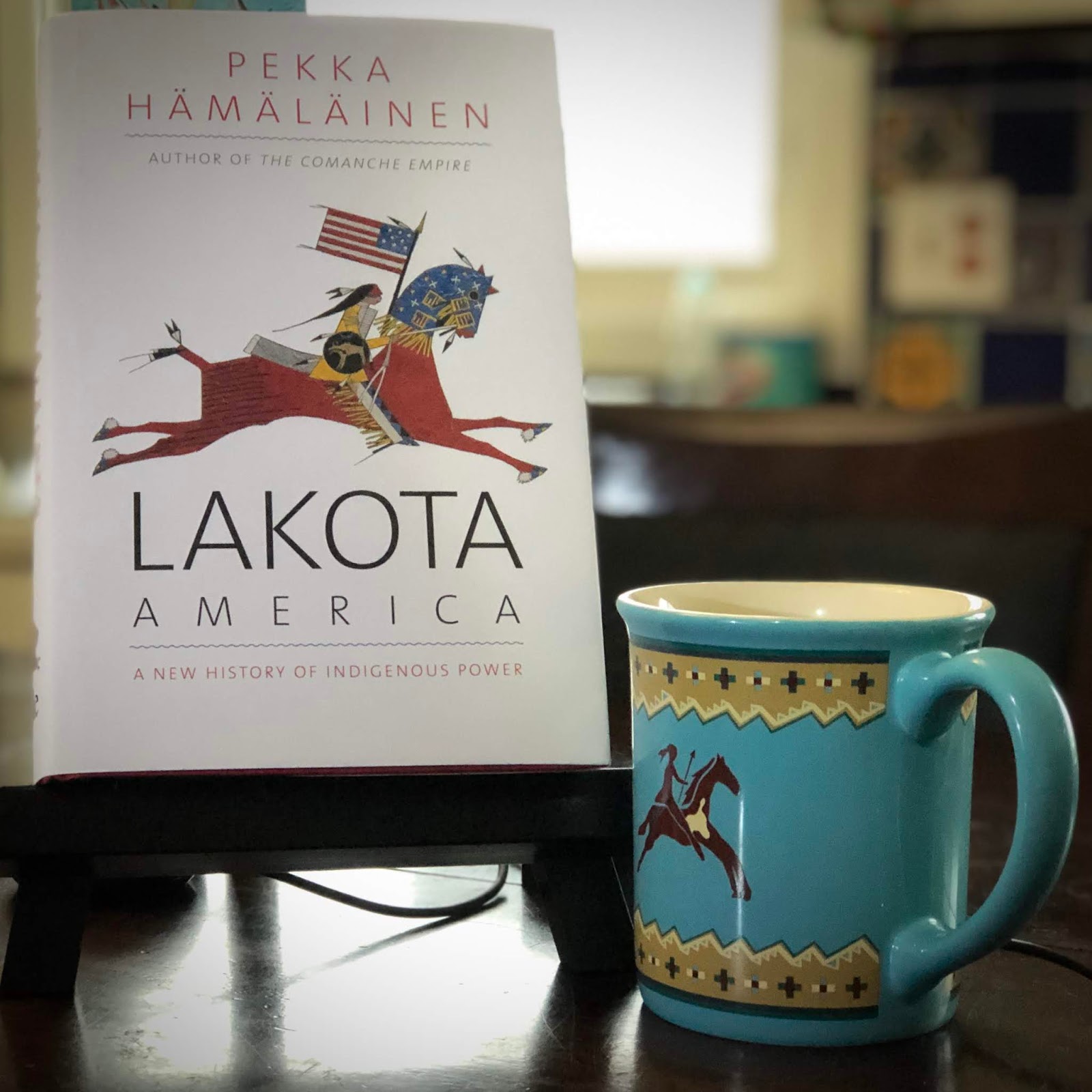
The cover of Lakota America features the art of Lakȟóta artist Jim Yellowhawk (Cheyenne River Sioux Tribe; Itázipčho). A simple photo of my copy of this book. 
Lakota America, A Book Review
This Book Fuckin' Moved Me
By Dakota Wind
Hämäläinen, Pekka. Lakota America: A New History of Indigenous Power. New Haven, CT: Yale University Press. 2019. $35.00 (hardcover). 544 pages + ix. Acknowledgments, a note on terminology, introduction, epilogue, a list of abbreviations, notes, glossary, index, maps, photos, illustrations.

“Yet this book is decidedly a history of the Lakotas, written from sources that seek to convey their perspective, often in their own words. An extraordinary archive makes this possible to an unusual degree. Lakota communities traced the passage of time by drawing on a buffalo hide a pictograph of one memorable event for each year. Lakotas call these calendars waníyetu iyáwapi. They draw attention to the mundane and reveal the sublime. Perhaps most important, as a body of historical record, winter counts capture what fascinated Lakotas and what mattered to them most. Lakota America makes the fullest use yet of this Indigenous archive in writing Lakota history.” (Hämäläinen, 2019; 8)

Thus begins Hämäläinen’s Lakota America, a post-colonial contact history of a people referencing their own historical records, and in this process, treating these pictographic records with a serious care and careful regard that these primary resource documents deserve. Most histories regarding the Očhéthi Šakówiŋ, Seven Council Fires (or “The Great Sioux Nation), are constructed primarily from colonial records (i.e. explorer journals, trader records, and missionary accounts). Hämäläinen embraces the indigenous record as a concurrent history, complemented by the colonial record.

I felt a deep sense of gratification reading this beautiful work.

Hämäläinen paints a picture of a people occupying a known and busy landscape inhabited and shaped by other indigenous peoples from trade, war, disease, and expanding colonial empires, to displacement, removal, imprisonment, and survival in a post-reservation world.

The story begins not with conflict, but with the arrival of Thiyóškate (Plays In The Lodge) on a diplomatic mission to Montreal to secure peace in the interior of North America. Conflict spread west threatening to invade Očhéthi Šakówiŋ homelands for beaver pelts in a trading system that left indigenous peoples dependent on iron wrought trade items.

There are many books about the Očhéthi Šakówiŋ, among them other notables including Royal Hassrick’s “The Sioux: Life and Customs of a Warrior Society,” Thomas Mails’ “Mystic Warriors of the Plains.” Nearly all western history books agree that the horse arrived in the mid-1700s. Hämäläinen breaks from academic consensus by informing readers that the horse arrived on the northern plains following the Pueblo Revolt of 1682. (Hämäläinen, 2019; 55)

The chapter, The Lakota Meridian, explores the Očhéthi Šakówiŋ in the context of world history. Hämäläinen reconstructs the setting of the interior of North America following the arrival of the horse, the gun, and smallpox epidemics which obliterated or weakened so many other first nations. The Lakȟóta secured and manipulated trade to their benefit. The Arikara War of 1823, the first American military campaign against Plains Indians sees the Očhéthi Šakówiŋ side with the United States, years after refusing “to be discovered” and acknowledging the United States as sovereign. (Hämäläinen, 2019; 140)

Lakota America is not a conflict history of the American West. It is closer to a biography in tone, but not on any one individual or few of Očhéthi Šakówiŋ leadership. It is not so much a cultural examination either; there are other resources for that. This work is like a study of the character of a people throughout several generations. Hämäläinen briefly articulates the cultural story of the White Buffalo Calf Woman and the Gift of the Sacred Pipe but reimagines this ancient narrative as a story of new urgency as the Lakȟóta ventured west from the Mnišóše, the Water-Astir (or Missouri River). (Hämäläinen, 2019; 164-165). He does reiterate throughout his work that Očhéthi Šakówiŋ identity is evidenced by virtue of practice and language. 

The image above was drawn by Sitting Bull's own hand. In his later years, Sitting Bull and his own people, the Húŋkpapȟa, identified him as a medicine man or spiritual leader. 

Očhéthi Šakówiŋ homeland is determined by occupation of waterways, in particular, the Mnišóše and all his tributaries. Boundaries are determined by the waters, and those boundaries were recognized in both the Fort Laramie Treaties. Hämäläinen carefully determines and explains how those boundaries were set through conflict and diplomacy. Their villages moved from valley to valley across the plains. The traditional Očhéthi Šakówiŋ recalls that the people moved from stream source to stream source across the plains.

Hämäläinen explores Lakȟóta political philosophy in their own terms as well as they dealt with the decline of the great bison ganges and the arrival of more fixed signs of American occupation. Iwáštegla, meaning “moderate,” “gentle,” and “easy,” but for also for the greatest maximum benefit, that which is “wašté,” or “good,” for the people. “Lakotas still expected wašíčus [sic] to compromise more than they did: after all, most of their interactions took place in Lakota territory. In this charged moment one can glimpse something essential about Lakotas’ ability to accept new realities, adjust to changing governing conditions, and yet remain indigenous.” (Hämäläinen, 2019; 300)

Lakota America has many strengths. Meticulous research is one, but what makes Hämäläinen’s work stand out is that he acknowledges, employs, and attributes the history (oral and pictographic) of the people he writes about, putting it on the same page as colonial records equating its importance.

Lakota America touches on the greatest conflict to shape the American West, Pȟežíšla Wakpá Okíčhize, or the Battle of the Little Bighorn. Every year there’s a book written about Lt. Col. Custer and the fate of the 7th Cavalry. Every book published about the Očhéthi Šakówiŋ includes this fight. It is refreshing that Hämäläinen does not dedicate an entire chapter retreading the last great Indian fight.

Hämäläinen does not stop his narrative of Lakȟóta history with Čhaŋkpé Ópi Owíčhakte, the Wounded Knee Massacre. No, he brings the story of adaptation, survival, and self-determination up to recent events at Íŋyaŋ Iyá Wakpá, the Talking Stone River (or the Cannonball River). A people and their history did not end at the turn of 1900. It lives and is a constant story of change. Hämäläinen gets it.

Lakota America is an engaging read. I found myself stopping several times throughout, lost in thought, and provoked to remember that indigenous occupation includes several other first nations who contested the landscape and gratified to discover how much Hämäläinen relied on Lakȟóta history to create this immensely reflective work.

My only concern, and it is a very minor thing, is that not all Dakhóta-Lakȟóta use the same term for the “winter count:” Northern Lakȟóta (i.e. Húŋkpapȟa) and Iháŋkthuŋwaŋna (i.e. Wičhíyena, or “Upper Yanktonai”) refer to the pictographic records as Waníyetu Wówapi, which means, “Keeping an Account of the Winter.” The Dakhóta and Lakȟóta who were placed at Fort Peck refer to winter counts as Hékta Yawápi, or “Counting Back.”

Lakota America has earned its place on my bookshelf. Get your copy as soon as you can to add it to yours. 


Saturday, December 21, 2019

Winter Solstice Is Sacred Time

The Long Night Moon at White Earth Butte. The crescent represents the moon or month. Above the moon, appearing upside down at the top is the landscape profile of White Earth Butte as seen from the south looking north. 
Winter Solstice Is Sacred Time
A Time To Carry One Another

By Dakota Wind
The longest season of the year was winter on the Great Plains. On the traditional Očhéthi Šakówiŋ lunar calendar, the year consisted of two spring, four summer, two autumn, and five moons or months. The word for "year," in fact, is “Waníyetu,” meaning “Winter.”

The first snow was celebrated. Men put on their snowshoes and danced in the fresh powder. The snow made for ease of hunting. The Lakȟóta explained the changing of the seasons as an epic battle between two brothers: Wazíya (The North) and Okáǧa (The South). As one retreated, the other gained ground. When Wazíya won, his breath blew across the landscape, and for as deadly and sharp his cold breath might be, he brought a blanket of snow under which Uŋčí Makȟá (Grandmother Earth) slept.

The cultural genesis of the seasons aside, they remembered and shared real events from winters past. The High Dog Winter Count recalls the year 1800 as one of the most challenging years to survive. The summer heat was unbearably hot. The great gangs of bison went away, and hunting was poor. Flowers disappeared from the landscape, and the wind drank up the water. The birds refused to sing too.

A punishing winter followed, as remembered in the White Bull Winter Count.

Winter came, snow and ice were everywhere. A group of Lakȟóta decided to move winter camp from the bottomlands of one river to that of another. As they moved over the high plains, a blizzard caught them. Gradually some of them began to succumb to the cold and fell. As one person fell, another lifted and carried him or her for the rest of their journey. Kičhíč’iŋpi keúŋkiyapi, “They say that they carried each other.”

The Lakȟóta used the long winter night to share stories like that of Wičháȟpi Hiŋȟphaya (The Fallen Star; also called “Star Boy”). The story of his mother, Tȟapȟúŋ Šá Wíŋ (Red Cheek Woman), and father, Wičháȟpi Owáŋžila (The Star that Does Not Move; “The North Star”) is fairly well known and told in books and various online media.

The Lakȟóta share Ohúŋkakaŋ (stories from the distant past) and Wičhówoyake (stories, legends, myth) during the five lunar months of Waníyetu (the winter season), and during this moon especially, they share stories like the Fallen Star narrative. 


Sometime during the Long Night, the Fallen Star rises from the highest point of White Earth Butte. As the heavens turn, or as the earth rotates, the constellation gradually moves counter-clockwise until most of it gradually disappears past the northern horizon. Fallen Star, or Capella, dips down past the horizon, then majestically rises, bringing hope to the people. 

According to Ronald Goodman’s work in his Lakota Star Knowledge, Fallen Star was renowned among the Lakȟóta as “the Protector, the bringer of light and higher consciousness.” After becoming a father, Fallen Star ascended “a hill at night with a friend,” and told him that he was going to return home. Fallen Star laid down upon the hilltop and died. His spirit was seen as a light that rose into the star world. “At some time in the past, all Lakȟóta acquired the gift of light he brought them.” (Goodman, 2017; 32)

Goodman discusses an ancient central symbol strongly associated with the heavens and the world. This symbol is referred to as Kapémni (“the action is swinging around and around,” as with a warclub or bull roar), and resembles an hourglass. One half represents all that is heavenly, the other half represents all that is worldly. What is in the heavens is also present in the world. In the pages of Lakota Star Knowledge, this “mirroring” is demonstrated in a map of the Lakȟóta constellation Čhaŋgléška Wakȟáŋ (The Sacred Hoop) which demarcates the locations of landmarks in and around the Black Hills.

In 1967, Helen Blish published her thesis A Pictographic History of the Oglala Sioux, featuring the works of Amos Bad Heart Bull (~1868-1913), a noted Lakȟóta artist, amongst of what was a map of the Black Hills and other features including Pahá Ská (White Butte). White Butte is noted as being north of the Black Hills.

It is a general map; not everything matches up perfectly, in fact, maps of the landscape were concerned with lineal cohesion rather than over-exactness. Matȟó Thípila (Bear Lodge), or Devils Tower, is not actually within Khiíŋyaŋka Očháŋku (The Race Track), the edge of the Black Hills. The Race Track is the “mirror” of the Sacred Hoop, just as Makȟáska (White Earth Butte), or White Butte, is not a part of the Black Hills, it is north of the ‘Hills. It is a real butte. It is also the hill upon which Fallen Star made his journey back to the sky. 

Like Devils Tower, White Butte appears to be in the narrative of the Sacred Hoop in Bad Heart Bull’s map narrative, though it is not so in actuality. Yet according to the map of the Sacred Hoop constellation in Lakota Star Knowledge, a star commonly known as Capella, the brightest star in the constellation Auriga appears as part of the Sacred Hoop.

Referencing Bad Heart Bull’s map and tracking the sky from the Sacred Hoop to the North Star one “sees” the stars associated with the constellation Auriga “pointing” or “reaching” towards the North Star. The constellation Auriga appears to be Kapémni, or "mirror" of White Butte and the immediate landscape surrounding that beautiful plateau. 

Fallen Star returns to the sky to be with his father. He sends rays of light and hope to the Očhéthi Šakówiŋ people. 

As Capella is the Fallen Star I’d like to suggest that Auriga is his constellation. At about 6:00 PM on the longest night of the year, this constellation appears upside down. Twelve hours later, at about 6:00 AM, which is at the tail end of the longest night, the heavens have rotated 180° counterclockwise, and have become right side up. The Fallen Star “rises” from the horizon, it rises from the top of White Earth Butte.

Long ago, before the reservation era anyway, the month which some might call December today, was known by some Lakȟóta as Waníčhokaŋ Wí (The Midwinter Moon). They might not have known the exact time (it’s 10:19 PM CST) but could reckon the subtle shift in daylight when there was a little more of it and could track the general date with counting sticks; they knew it happened in the Midwinter Moon.

According to Vi Waln, “I believe the real day of prayer was observed on the winter solstice by the people with ceremony, food, and family.” Further, “Nature and the stars were monitored carefully to help with preparation for whatever time of year was upon the people.” And lastly, “Many Lakota people will offer prayer in much the same our ancestors did so on the Winter Solstice.” (Valn, Winter Solstice Is Sacred, 2011)

There are five winter moons in the traditional Lakȟóta calendar. After the Winter Solstice, it was time to gather red willow (eastern dogwood) to make čhaŋšáŋšaŋ, traditional tobacco made from the inner bark of the red willow, and used for ceremony.

In the heart of winter, in daylight, there sometimes appears the sundog. The Lakȟóta call it Wíačhéič'thi, which means "The Sun Makes A Campfire [For Himself]," and the story associated with this event holds the promise of light, that it returns. Sometimes, during the winter nights, they see a ring around the moon, also called Wíačhéič'thi, only this is interpreted as "The Moon Makes a Campfire [For Herself]." The Moon has vigorously stirred her pot and light has spilled about her lodge.

The New Lakota Dictionary lists the Winter Solstice as Waní-Wí-Ipȟá (Crest of the Winter Sun). The Húŋkpapȟa might call the same Haŋyétu Háŋska (The Long Night) as they called this traditional month Haŋyétu Háŋska Wí (The Long Night Moon).

However it is called this day, or this month, these things are certain: gather close together with family in observation or prayer, eat together, share stories, and carry each other.


Thursday, November 21, 2019

Dakota Moon Counting Tradition, A Poster

Above, a screen capture of the Dakhóta moons throughout the year.
Haŋwíyawapi Wičhóh'aŋ Kiŋ
Dakh
óta Moon Counting Tradition
Bismarck, N.D. (The First Scout) (Updated) - The Isáŋyathi, Dakhóta-speaking people east of the Red River of the north, east of the Big Sioux River, follow a twelve-month calendar. 

Their calendar system is much like that the moon counting tradition of the Thítȟuŋwaŋ, the Lakȟóta-speaking people west of the Missouri River. There are sometimes more than one name for the month, but each month reflected a deep relationship with that the people have with the environment. This informs us, that there was a long occupation and a record of observation for the people to survive and adapt to the landscape. 

Feedback from Spirit Lake informs us that the Dakhóta did, in fact, employ a thirteen-month traditional calendar. The twelve-month calendar indicates assimilation. Philámayaye Lekší. 

The historic Očhéthi Šakówiŋ held a world-view perspective that was south-oriented. Taking this into account, then the rotation of the moon and the rotation of the earth around the sun would give us a moon calendar layout that looks like the poster above with the cycle of the moons and the phases of the moons "read" in a counter-clockwise manner.

Of course, the 
Očhéthi Šakówiŋa would never have laid out images like this, rather, they kept track of the moons with counting sticks.

Get your copy of this 36"x48" poster of the Dakhóta Moon Counting Tradition for FREE. Share this with others and your classroom today. 


Tuesday, September 24, 2019

Lakota Territory Poster

Očhéthi Šakówiŋ (Seven Council Fires) Territory Poster, above, shows several maps, all of which show an occupation in the heart of North America.
Očhéthi Šakówiŋ Territory Poster
Traditional Homeland Of Great Sioux Nation
By Dakota Wind
Bismarck, N.D. (The First Scout) - Over 1800 places across the Great Plains have been pinned on a Google Map, drawn from oral tradition, books, journals, historic maps, to create a resource that reflects a historical and cultural occupational history of the Očhéthi Šakówiŋ (Seven Council Fires, or "Great Sioux Nation") over the past three hundred years. 

The Google Map, called Makȟóčhe Wašté (The Good Country, or The Beautiful Country), has over 1800 places in the language of the Očhéthi Šakówiŋ people. Over 24,000 geo-referenced pins on over two hundred historical maps using Google Earth and the David Rumsey Map Collection at the Stanford University Library were employed to create a map history detailing the historic and cultural occupation of the Očhéthi Šakówiŋ in the heart of North America. 

The Makȟóčhe Wašté Map demands a lot of computer memory and bandwidth that it is best accessed online via desktop computer. This poster was created to provide viewers and educators a general view of the Great Plains as the Očhéthi Šakówiŋ saw it, with a south-orientation. A screen capture image of various points shows not just occupation but far reaches of inter-tribal trade. The map is updated as placenames are shared or revealed. 

Three historic maps drawn by Iháŋkthuŋwaŋna Dakhóta (the Whitestone Hill Massacre Map by Richard Cottonwood guided by Takes His Shield) and Húŋkpapȟa Lakȟóta (the two maps of the 1876 Little Bighorn Fight) are included. All three are south-oriented. A Google Map overlaps the various historic occupations (blue is Dakhóta; purple is the Middle Dakhóta; red is Lakȟóta). 

Also included are two historic trader maps, one by John Pope when he was a trader before the 1862 Minnesota Dakota Conflict, and the other by Joseph Nicollet. Both of these maps demarcate the landscape with hundreds of placenames in Dakhóta. 

An explanation of the south-orientation worldview perspective can be found here.

Lastly, several Lakȟóta names appear in large, bold, red text which recalls how they referred to the Great Plains, and by extension North America. This poster measures 36"x48". Download your free Lakota Territory Poster and share it. 

Friday, August 30, 2019

Moon Counting Tradition, A Poster

Pictured above is a screen capture of a poster with information about the Moon Counting Tradition. 
Haŋwíyawapi Wičhóȟ'aŋ Kiŋ
The Moon Counting Tradition
Dakota Wind, Editor
Bismarck, N.D. (The First Scout) - Winter Count Keepers kept track of time by following natural changes in the environment and naming the moon in which that moon became associated. 

Months were moons, and thirteen moons represented a winter. The Očhéthi Šakówiŋ (the Seven Council Fires; the "Great Sioux Nation") called a cycle of thirteen moons a winter because winter was the longest season on the Northern Plains. 

A moon could have many names. The Wolf Moon one year may be called the Moon of Popping Trees the next. The Yellow Leaf Moon among the Lakȟóta might also be called the Brown Leaf Moon; this same moon among the Dakhóta would be called the Moon When Rise is Laid Up to Dry. 

The historic Lakȟóta held a world-view perspective that was south-oriented. Taking this into account, then the rotation of the moon and the rotation of the earth around the sun would give us a moon calendar layout that looks like the poster above with the cycle of the moons and the phases of the moons "read" in a counter-clockwise manner. 

Of course, the traditional Lakȟóta would never have laid out images like this, rather, the winter count keeper kept track of the moons with counting sticks. 

This poster measures at 3' x 4' and is available for FREE, click here. Share this poster with others and your classroom today. 

Sunday, March 24, 2019

Months of the Lakota Year as told to Rev Peter Rosen


Months of The Lakota Year
As Told to Rev. Peter Rosen

Edited by Dakota Wind
Rev. Peter Rosen was a Catholic missionary for seven years in the Black Hills beginning with his first placement at St. Andrew’s Parrish in Deadwood, Dakota Territory, 1882. Rosen collected any writing he could to acquaint himself with the Black Hills. He collected newspapers, books, copies of government records, church records including the manuscripts of Fr. Pierre DeSmet, and oral stories on his many various trips in and around the ‘Hills.

In 1895, Rosen published Pa-ha-sa-pah, or, The Black Hills of South Dakota: A Complete History. It was a series of six books published as one volume, with the first three focusing on the indigenous occupation of the Black Hills, their mythologies, and long associations with the ‘Hills.

Amongst Rosen’s work is a collection of Lakȟóta names for the twelve months of the year. The Lakȟóta employ a thirteen-month lunar calendar, not a twelve-month astrological one. Rosen recording offers readers a glimpse of both Lakȟóta and Dakhóta names for the times of year, with a few variant names. These month names have been re-written using the Standard Lakota Orthography which was developed by the Lakota Language Consortium; some of these month names appear in the LLC’s New Lakota Dictionary.

January
Theȟí Wí (Difficult Moon)

February
Wičhítegleǧa Wí (Racoon Moon)

March
Ištáwičhayazaŋ Wí (Sore Eye Moon)

April
Maǧáokada Wí (Moon When Geese Lay Their Eggs)
Watópȟapi Wí (Moon When They Paddle Their Canoes)

May
Wóžupi Wí (The Planting Moon)

June
Wažúštečaša Wí (Ripe Strawberry Moon)

July
Čhaŋpȟásapa Wí (Ripe Chokecherry Moon)
Wašúŋpȟa Wí (When The Geese Shed Their Feathers Moon)

August
Wasútȟuŋ Wí (Moon When Things Ripen)

September
Psiŋ’hnáketu Wí (Moon When They Lay Up Rice [To Dry])

October
Wážupi Wí (Drying Rice Moon)

November
Thakíyuȟa Wí (Deer Rutting Moon)

December
Tȟahékapšuŋ Wí (Moon When Deer Shed Their Horns)


Monday, February 4, 2019

A 2019 Lakota Calendar

For a great explanation of the traditional moon calendar get yourself a copy of "Moonstick: The Seasons of the Sioux," which was reviewed and checked by Mr. Raymond Winters (Fighting Bear), an enrolled member of the Standing Rock Sioux Tribe.
Haŋwí Wówapi 2019
A 2019 Lakota Calendar

By Dakota Wind
Bismarck, ND - For the Lakȟóta, the New Year begins in spring, and lasts until the next spring. A year is called Waníyetu or winter because winter is the longest season on the Northern Plains. The new month begins with the new moon. A month is called Wí. The sun is also called Wí. To differentiate between the luminaries, the moon is sometimes referred to as Haŋwí (Night-Luminary), and the sun as Aŋpétuwi (Day-Luminary).

The eight phases of the moon are:

Wit’é (Moon-Died) The New Moon.

Wílečhala (Moon To-Be-Recent). The Waxing Crescent between the New Moon and the First Quarter.

Wíokhiseya (Moon Half-Of). The First Quarter of the moon.

Wímimá Kȟaŋyela (Moon-To-Be-Round Near-By). The Waxing Gibbous between the First Quarter and the Full Moon.

Wímimá (Moon-To-Be-Round). The Full Moon.

Wí Makȟáŋtaŋhaŋ Ú (Moon From-The-Earth To-Be-Coming Here). The Waning Gibbous between the Full Moon and the Third Quarter.

Wiyášpapi (Moon-To-Bite-A-Piece-Off-Of). The Third Quarter of the moon.

Wit’íŋkta Kȟaŋyéla (Moon-Wears-About-The-Shoulders Near-By). The Waning Crescent between the Third Quarter and the New Moon.

The Thítȟuŋwaŋ (the Teton, or Lakota) regard the moon in a feminine sense. There is no “man on the moon,” but an old woman in the moon whom they call Hokhéwiŋ. When a ring around the moon appears it is called Wíačhéič’ithi (The Sun Makes A Campfire For Itself); when a ring appears around the moon they say that Hokhéwiŋ has vigorously stirred her pot and the light has spilled out and around her lodge.

Wíačhéič’ithi is also a reference to sundogs. Long ago, a man went out to pray when the cold gray winter seemed to linger too long. The constant bleak gray days began to effect the people’s dreams. He came back and instructed the camp to select two groups of youth to go out east of camp and build to fires, then to return. Everyone came together in the center of camp and prayed. The sun broke through the clouds and as it rose into the sky, the two fires rose into the sky with it. For the Húŋkpapȟa, the sundog is a promise of hope and light.

The Thítȟuŋwaŋ have two differing explanations for the cycles of the moon. The Húŋkpapȟa say that a large Itȟúŋkala (mouse) with a pointed nose gradually eats away the lodge of Haŋwí until there is nothing left (the waning of the moon). Haŋwí then has to reconstruct her lodge (the waxing of the moon). The Oglála say that Haŋwí draws her shawl over either side of her face as Wí approaches her or withdraws from her.

Like other cultures, the Očhéthi Šakówiŋ recognize four seasons. These are: Wétu (Spring) which is two months; Blokétu (Summer) which is four months; Ptaŋyétu (Fall) which is two months; Waníyetu (Winter) which is five months. The changes of seasons are caused by the eternal conflict of two brothers: Wazíya (the North) and Ókaǧa (the South). If Wazíya plays his flute during summer rains, he causes it to freeze, making hail. When Wazíya wins, we have winter; when Ókaǧa wins, we have summer.

The Očhéthi Šakówiŋ used to keep track of the days, months, and year with Čhaŋwíyawa (Counting Stick/s). Some might use thirteen sticks, one for each month in the lunar year; others might just use one willow switch and notch it (one for a day, or one for each month). Čhaŋwíyawa are recognized more for their use in hand games (a traditional guessing game) than for tracking time.

This calendar includes memorial days of some massacres and major conflicts. This 2019 moon calendar overlaps with part of December 2018 through part of January 2020. 

This year's calendar is made with the gracious assistance of Mr. Dustin White and Mr. Doug Wurtz. Both have allowed me to use their photographs to complete this year's calendar. Their names appear next to their photographs.