Showing posts with label Major McLaughlin. Show all posts

Tuesday, December 8, 2015

Bullhead And The Last Days Of Sitting Bull

Lt. Henry Bullhead, a Yanktonai Dakota. Photo by D.F. Barry. 
Who Really Killed Sitting Bull?
Lakota Leader Killed In Confrontation

Edited By Dakota Wind
FORT YATES, N.D. – Note: the following article appeared in the Sioux County Pioneer which had previously ran a story attributing the murder of Sitting Bull at the hands of Red Tomahawk. This article refutes and minimizes Red Tomahawk’s role in Sitting Bull’s camp.

Francis B. Bullhead, son of the famed Bullhead who led the policemen in the arrest and killing of Sitting Bull, has taken exceptions to an article appearing in the Pioneer some weeks ago giving Red Tomahawk credit for the killing of Sitting Bull and has requested us to publish the sworn statement of Wakhutemani (Shoots-Walking), one of the policemen who took part in the affair. His statement is verified by police men Cross Bear and Looking Elk, who were also present. The story of the killing of Sitting Bull follows which is very interesting reading:

“We had orders to meet at the home of Chief of Police Bullhead on the Grand River about three or four miles from the camp of Sitting Bull on the night of the fourteenth of December, 1890. We left Bullhead’s place on the morning of December 15th, mounted, and rode directly to the camp of Sitting Bull. When within one-half mile of his camp, we charged rapidly directly [sic] to his house.

In accordance with instructions we surrounding his house and Captain Bullhead, Sergeant Shavehead, Little Eagle, High Eagle, and Warrior Fear Him, entered the house. The remainder of the force were to stand outside but I was curious to know what was going on and went into the house with the officers. Sitting Bull was in bed with one of his wives and was pulled out of bed by High Eagle and Little Eagle. His rifle, which was lying by his bed was taken by Captain Bullhead and another rifle which was hanging on the wall was taken by Sergeant Shavehead. After Sitting Bull was dressed, I was ordered outside and the officers followed almost immediately with Sitting Bull. 


According to Mr. Ernie LaPointe, the direct lineal descendant, great-grandson of Sitting Bull, the police knocked on the door and asked Sitting Bull to come outdoors, then waited for him. When Sitting Bull walked to the door, Crow Foot rose with his rifle and said to his father, "I will stand with you." Sitting Bull turned to his family and sang: "I am a man and where ever I lie is my own." Just after Sitting Bull and Crow Foot stepped through the door was Sitting Bull shot and killed. Crow Foot joined his father seconds later. 

Sitting Bull had been brought out about forty yards from the house and was surrounded by a cordon of policemen with the officers in the middle of the enclosed space. There were thirty-four or thirty-five policemen.

By this time it had become somewhat light and we could begin to recognize each other at some distance in the early dawn. The hostiles were running from all directions toward us yelling to kill the policemen either by shooting them or clubbing them to death.

After Sitting Bull saw that his followers were surrounding the police he yelled in a loud voice in [the] Sioux language, “I will not go! Attack! Attack!” At this time, Catch The Bear, a hostile, broke through the cordon of police and weeping and lamenting demanded that the police turn Sitting Bull loose. Closely following Catch The Bear, three other hostiles broke through the cordon of police, wearing blankets with their rifles concealed under them. As they entered the ring they threw their blankets away and made for the group of officers surrounding Sitting Bull. 


Sitting Bull, photo by D.F. Barry.

Little Eagle was standing at the right of Sitting Bull and High Eagle was at Sitting Bull’s left. These two men had been chosen to handle the person of Sitting Bull as they were powerful men physically. They had hold of him and prevented him from getting away. Captain Bullhead stood immediately in front of Sitting Bull facing him and Sergeant Shavehead stood immediately behind Bullhead.

As the hostiles threw away their blankets Catch The Bear reached the group of officers first and fired point blank at Captain Bullhead, the bullet striking the officer at about waist line and passing through his body.

At the same instant Strikes The Kettle shot Sergeant Shavehead. When Captain Bullhead was shot he immediately raised his rifle and shot Sitting Bull. The bullet struck Sitting Bull just above the sternum and passed upward and back through his body, breaking the spinal column where his neck and body join. Where the bullet left the body it tore a hole about two inches in diameter. Sitting Bull dropped dead. Neither Bullhead nor Shavehead fell when shot but Sitting Bull collapsed at once.

I actually saw these things. The battle then became general and most of the police fell back towards Sitting Bull’s barn. Two of us remained where the officers had fallen. I was not hit, but a bullet went through my hat and was fired at such close range that my neck was burnt by the powder. During the fight it was impossible to observe what was going on but I know the man remaining with me, Broken Arm or Armstrong, was killed. Three other police remained beside the house, Bad Horse, Looking Elk, and Cross Bear. None of them were wounded.

Three of the four hostiles who started the fight were killed. They were Catch The Bear, Spotted Horn, and Black Bird. Strike The Kettle was wounded but he got away and lived for many years after the fight.

While the battle was still in progress the military detachment from Fort Yates arrived at the top of the hill and apparently began firing at us. They also discharged a cannon at us twice, the shells falling within a hundred yards of us and exploding. We sent a policeman with a white flag toward the military and formed in line and marched in twos to let the military know who we were. They then changed their range and fired their cannon in the direction in which the hostiles were retiring. The cannon scattered the hostiles in every direction and the battle was over. 

LaPointe's narrative says that during the military cannon fire, Sitting Bull's oldest daughter, Many Horses, his wives, Seen By Her Nation and Four Robes, their five children and perhaps 200 more fled south across the Grand River, but were intercepted by the military and then brought to Fort Yates. 

We then found that Bullhead and Shavehead were still alive. As the police came back to the point where the fight started and saw their officers lying mortally wounded and their comrades dead, many of them shot into the body of Sitting Bull. His body was badly mutilated. Swift Cloud, a half-brother of Little Eagle, was not a policeman but as he came to the battle ground and saw his brother lying dead, he seized a club and beat the head of Sitting Bull into a shapeless mass. Holy Medicine, who was not a policeman but was a brother of Broken Arm, also came to the battle ground and seeing his brother dead, seized a club and beat the remains of Sitting Bull. 

Crow Foot, by D.F. Barry.

Crow Foot was the son of Sitting Bull. He was a young man of seventeen or eighteen at the time and when his father was taken from the house followed at three different times in an effort to get him back to the house. The first two times he was sent back to the house but the third time the battle began.

After the battle we carried the dead and wounded into Sitting Bull’s house. When we made the third trip for the body of Little Eagle we heard two shots, following a commotion in the house and a voice pleading for mercy. As we came near the house a body was hurled through the door. It was Crow Foot. He had hidden under a pile of bedding in the corner of the hut and when found by the officers had been sent by Lone Man and One Feather. 

Mr. LaPointe begs to argue this discrepancy. "It seeks to humiliate the memory of his son," says LaPointe. Crow Foot died outside the cabin. Crow Foot's younger half-brother, William, was about twelve years old. William was the crying child present. 

The hostiles killed in the fight were Catch The Bear, Spotted Horn, Black Bird, Jumping Bull, his son Brave Thunder, and Crow Foot, the son of Sitting Bull. They were buried by Riggs, a Congregational minister.

There is no question as to who killed Sitting Bull. I saw the captain of police kill him, saw him fall and saw the terrible wound made by the heavy police rifle afterward. It literally tore the upper part of his chest to pieces.

After cooking our breakfast with the military our dead were loaded into a wagon and the wounded into a military ambulance and we started for Fort Yates. The wounded reached the agency that night but we camped on Oak Creek near where the town of McLaughlin now stands. The next morning the military proceeded to Fort Yates and we received orders to return to the Grand River and order the hostiles to report to the agency. This we did with those who still remained in that vicinity but most of them had stampeded to Pine Ridge.

Many years have gone by since that fateful morning but the events as I have related them are burned indelibly upon my mind. The ride in the early morning hours, the frenzy and the screams of the ghost dancers as they rallied to their leader, the wily medicine man who made every excuse to delay his departure, his change of front when he thought his followers could save him, the bravery of the officers who knew they faced certain death, the death of Crow Foot and the tardy arrival of the military make a picture on my mind that will never be effaced.”

Suggested reading:


Sitting Bull: His Life And Legacy, by Ernie LaPointe, Great-Grandson of Sitting Bull. 

Monday, May 5, 2014

Mischievous Boy Pranks Entire Village

"The little brave who visited the grave of a medicine woman, with several other boys," appears in Marie McLaughlin's "Myths And Legends Of The Sioux."
Mischievous Boy Pranks Others
Stunt Spreads To Village, Causes Fear
By Marie L. McLaughlin
GREAT PLAINS - "A Little Brave And The Medicine Woman" comes from Marie L. McLaughlin’s “Myths And Legends Of The Sioux.” It is retold here with minor edits.

A village of Indians[1] moved out of winter camp and pitched their tents[2] in a circle on high land overlooking a lake. A little way down the declivity was a grave. Chokecherry[3] bushes had grown up, hiding the grave from view. But as the ground had sunk somewhat, the grave was marked by a slight hollow.

One of the men going out to hunt took a short cut through the chokecherry bushes. As he pushed them aside he saw the hollow grave, but thought it was a washout made by the rains. As he essayed to step over it, to his great surprise he stumbled and fell. Made curious by this mishap, he drew back and tried again, but again he fell. When he came back to the village[4] he told the old men what had happened to him. They remembered then that a long time before there had been buried there a medicine woman.[5] Doubtless it was her medicine that made the hunter stumble.


Chokecherries. The fruit is ready to pick in late July/early August. 

The story of the hunter’s adventure spread through the camp and made many curious to see the grave. Among others were six little boys who were, however, rather timid, for they were in great awe of the dead medicine woman. But they had a little playmate named Brave,[6] a mischievous little rogue, whose hair was always unkempt and tossed about and who was never quiet for a moment.

“Let us ask Brave to with us,” they said, and they went in a body to see him.

“All right,” said Brave, “I will go with you. But I have something to do first. You go on around the hill that way, and I will hasten around this way, and meet you a little later near the grave.”

So, the little boys went on as bidden until they came to a place near the grave. There they halted.

“Where is Brave?” they asked.

Now Brave, full of mischief, had thought to play a jest on his little friends. As soon as they were well out of sight he had sped around the hill to the shore of the lake and sticking his hands in the mud had rubbed it over his face, plastered it in his hair, and soiled his hands until he looked like a newly risen corpse with the flesh rotting from his bones. He then went and lay down in the grave and awaited the boys.

When the little boys came they were more timid than ever when they did not find Brave, but they feared to go back to the village without seeing the grave, for fear the old men would call them cowards.

So they slowly approached the grave and one of them timidly called out, “Please, grandmother, we won’t disturb your grave. We only want to see where you lie. Don’t be angry.”

At once a thin quavering voice, like an old woman’s, called out, “Háŋ, háŋ, tȟakóža, héčhetuya! [Yes, yes, grandson, do so!]”

The boys were frightened out of their senses believing the old woman had come to life.

“Oh, grandmother,” they gasped, “Don’t hurt us. Please don’t. We’ll go.”

Just then Brave raised his muddy face and hands up through the chokecherry bushes. With the mud dripping from his features he looked like a witch just raised from the grave. The boys screamed outright. One fainted. The rest ran yelling up the hill to the village, where each broke at once for his mother’s thípi.

As all the thípi in a Dakȟóta encampment face theh center, the boys were in plain view when they came tearing into camp. Hearing the screaming, every woman in camp ran to her thiyópa[7] to see that had happened. Just then, Brave, as badly scared as the rest, came rushing in after them, his hair on end as covered with mud and crying out, forgetful of his appearance, “It’s me! It’s me!”

The women yelped and bolted in terror from the village. Brave dashed into his mother’s thípi, scaring her out of her wits. Dropping pots and kettles, she tumbled out of the thípi to run screaming with the rest. Nor would a single villager come near poor Brave until he had gone down to the lake and washed himself.


[1] Marie McLaughlin’s maternal grandmother was Mdewákhanthunwaŋ (Dwellers At The Sacred/Spirit Lake). Marie married Major James McLaughlin. She lived at Spirit Lake Agency (Devil’s Lake Agency) for ten years before moving with her husband to Standing Rock. In her book, “Legends Of The Sioux,” McLaughlin frequently uses “Sioux” and “Indian” interchangeably with Očhéthi Šakówiŋ (Seven Council Fires) and Dakȟótá or Lakȟótá (Allied; Friends).

[2] Wakhéya: Tents. The Lakȟótá word for thípi is thiíkčeya, or thipȟéstola.

[3] Čhaŋpȟáhu: Chokecherry bush. Čhaŋpȟá refers to the fruit.

[4] Wičhóthi: Village, camp, or encampment.

[5] The original text includes, “…or conjurer.”

[6] Ohítika: Brave.

[7] Thípi door.

Monday, March 5, 2012

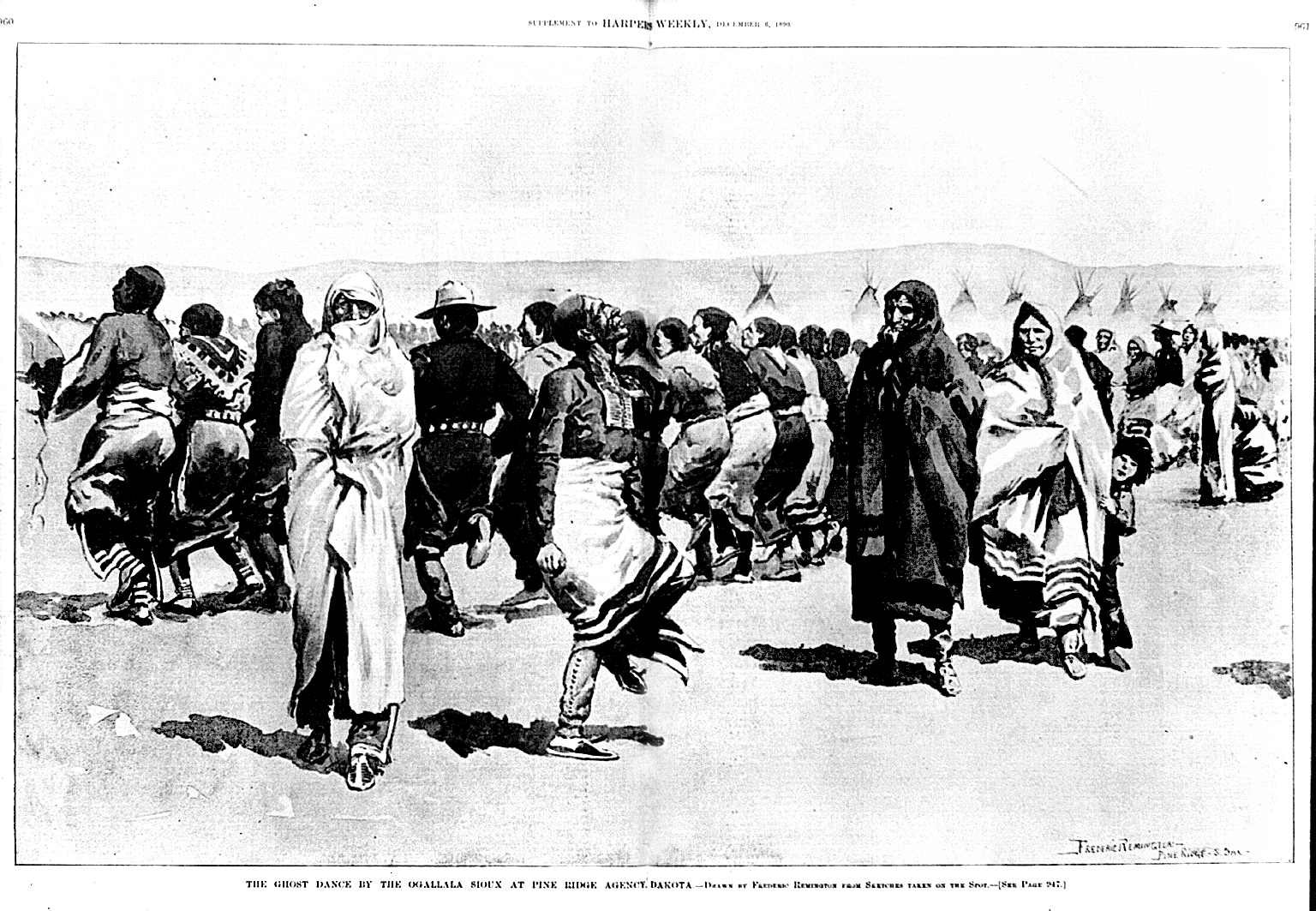
How The Ghost Dance Came To The Lakota

"The Ghost Dance Of The Oglala Lakota At Pine Ridge," by Frederic Remington.
How The Ghost Dance Came To The Lakota
From The Northwest To The Great Plains

By Dakota Wind
GREAT PLAINS - The origin of the Ghost Dance stemmed from the introduction of Christianity to the native people of the Northwest, specifically the Shaker Movement in which Christians prayed and danced for the Second Appearance of Jesus Christ.


Rev John Slocum
Pictured here is the Rev. John Slocum. The Indian Shaker church still exists today.

In October 1881, a Squaxin Indian man living on the Southwestern arm of Puget Sound known locally as John Slocum knelt down in the woods to pray. Slocum reflected about the impacts that hard liquor, gambling, idleness, and general vice had affected his life and the life of his people. He took ill and by all accounts, died. By those same accounts, later in the day, Slocum revived and told everyone of his journey to heaven, where he was given a choice: either go to hell or return to the world and minister to his people. He chose to live again.


Slocum’s shaker ministry quickly spread to the native population in the Northwest, causing some unease among settlers because the Indian Shakers had their own priests and built their own churches. The Presbyterian ministers actively sought to include the Indian shakers in the body of the Presbyterian Church.


The Indian shakers became known for visiting the shut-in and sick, and just as known for praying themselves into a trance over the same. A ritual followed the trance in which the sickness was pulled out of the patient and absorbed by the priest/medicine man who fell down dead and the patient recovered.

 
James Moony worked for the Bureau of Ethnology. Moony traveled to various native reservations to preserve and analyze as many native traditions as he could. He wrote many ethnological reports, one of which was his "The Ghost Dance Religion and the Sioux Outbreak of 1890."


James Mooney, author of The Ghost Dance and Wounded Knee, collected the story of two shaker medicine men venturing south into central Oregon to a tribe there where they apprenticed a young Indian man of the tribes, whom Mooney postulates could be none other than Wovoka, The Cutter.


Wovoka was the son of a highly respected medicine man or prophet of the Indian people in Mason Valley, called Tavibo. Tavibo died about 1870, leaving a fourteen-year-old Wovoka. Wovoka came into the employment of David Wilson and was given the Anglo name, Jack Wilson. David Wilson employed Wovoka until about 1886, when Wovoka decided it was time to share his experience of heaven and the message he received.


During the solar eclipse of August, 1868, Wovoka had fallen asleep and was taken up to heaven. There he saw all the people who had already departed and he met with God. Wovoka received the mission to go back to his people and tell them “They must be good and love one another, have no quarrelling, and live in peace with the whites; that they must work, and not lie or steal; that they must put away the old practices that savored of war; that if they faithfully obeyed his instructions they would at last be reunited with their friends in this other world, where there would be no more death or sickness or old age.”


[image]
Wovoka is seated here with leaders of the Northern Arapaho tribe.

Wovoka was given a dance to take to the Indian peoples, a dance which must be performed for five consecutive days. Mooney, who interviewed Wovoka when he made a study of the Ghost Dance religion in December, 1890 to April 1891, said that Wovoka disclaimed responsibility and association with the Ghost Dance shirt which had become an important part of the Sioux Ghost Dance. In fact, Wovoka asserted to Mooney, that it was “better to follow the white man’s road, and to adopt the habits of civilization,” and that his religion or practices were ones of universal peace. 


Wovoka had gone to live among the Paiute Indians of Utah and spread his message and vision. From there his message spread east to the Northern Arapaho and Shoshoni of Wyoming, then on to the Lakota and Cheyenne. A few of the Arikara, Hidatsa, and Mandan became caught up in the news from Fort Washakie, WY.


In the fall of 1889, three principle delegates, Porcupine (a Northern Cheyenne from Montana), Kicking Bear (Mniconjou Lakota, Cheyenne River Agency, SD) and Short Bull (Sicangu Lakota, Rosebud Agency, SD) made a pilgrimage to Fort Washakie to hear about the Ghost Dance for them selves.

 
Fort Washakie in 1892.


The Ogallala Lakota, Sword, had this to say, “In 1889, the Ogalala [sic] heard that the son of God had come upon earth in the west. They said the messiah was there, but he had come to help the Indians and not the whites, and it made the Indians happy to hear this.”


Porcupine, Kicking Bear, and Short Bull didn’t stop at Fort Washakie, but continued on to Pyramid Lake stopping along the way to witness the Ghost Dance. According to Porcupine, they were treated with kindness by the whites as they journeyed to the lake, and that even the whites participated in the Ghost Dance.


From Pyramid Lake, the delegation journeyed to Walker Lake where Wovoka himself led the Ghost Dance. After the dance there, Wovoka entered into a trance. According to Porcupine, Wovoka awoke and proclaimed to all that he went to heaven, saw all those who had died before, and that he had been sent back to instruct the native people. Porcupine essayed further that Wovoka claimed to be the returned Christ, that the dead would be resurrected, the Indian people would live forever; that there would be universal peace, and death and destruction to those who refused his message.


The delegation returned home.

The Ghost Dance at Sitting Bull's camp along the Grand River in South Dakota, on the Standing Rock Sioux Indian Reservation. Unknown photographer, 1890.


In October, 1890, Kicking Bear introduced the Ghost Dance to Standing Rock at Sitting Bull’s invitation to perform the dance at his camp along the Grand River. The Indian Agent, Major James McLaughlin, dispatched the Indian police to arrest Kicking Bear, but they returned to the agent’s office unsuccessful. Sitting Bull promised McLaughlin that Kicking Bear would leave when he was finished, which he did after two days.  Sitting Bull didn’t not discourage the Ghost Dance on Standing Rock, and on the Cheyenne River reservation, the Indian police couldn’t stop Big Foot’s band from dancing.


It is important to note that as the Ghost Dance was coming to a head North and South Dakota had recently entered the Union as states. Indian reservations were made smaller. Hunting grounds were being settled and turned into farmland. Traditional and culturally significant landmarks were given over to citizens for farming or ranching. Drought had caused native farmers’ crops to fail two years in a row and those who received government issued rations received a third to a half of what was promised by treaty. People were nearly starving. It was a desperate time and the native peoples turned to a desperate faith.

 
General Nelson A. Miles pictured here with former U.S. Army Scout Buffalo Bill Cody. Together they survey the field after Wounded Knee.


General Miles, of Civil War fame and for capturing Indian leaders like Chief Joseph and Geronimo, advised that no additional military force was necessary, to let the Ghost Dance run its course, that “the excitement would die out of itself.” Indian agents at Lakota Sioux agencies became increasingly alarmed because they could not stop the dancing.


On October 31, 1890, Short Bull rounded up his Ghost Dance followers and encouraged them to gather in one place and prepare for the coming of the messiah, even if they were surrounded by troops, even if they were fired upon. The Lakota who participated in the Ghost Dance firmly believed that their Ghost Dance shirts made them impervious to bullets; that the bullets would pass through them without causing injury.


On November 17, 1890, soldiers were ordered to report throughout the Indian agencies at Cheyenne River, Lower Brule, Rosebud, and Pine Ridge, under the field command of General Miles, altogether about 3,000 soldiers. No action was needed as the mere presence of soldiers was enough to dissuade dancers from dancing. John Noble, Secretary of the Interior, immediately ordered full rations to be distributed as was agreed to in treaty.

Farmers near New Salem rally to defend themselves against the perceived Ghost Dance threat. The farmers even went so far as to build an earthen fort, even cristening it "Fort Saurkraut." This farmer's volunteer militia wasn't authorized by General Miles or the Department of War. Unknown photographer, 1890.

The Department of War assumed control of Standing Rock, with arresting Sitting Bull as the next step. To convince Sitting Bull that his cooperation was necessary, former US Military Scout William F. Cody, better known as Buffalo Bill, was sent to persuade Sitting Bull to turn himself in. Cody arrived at Fort Yates on November 28, 1890, but his orders to continue to Sitting Bull’s camp were halted by Agent McLaughlin.


According to Mooney, Agent McLaughlin believed that a conflict would follow if the military were to arrest Sitting Bull. The military arrest was delayed on the advice of McLaughlin who told Cody that he’d send Indian police, which he did on December 14th, 1890. Lt. Bull Head lead the attempt to arrest Sitting Bull came with the dawn on Dec. 15 and ended in disaster with the death of Sitting Bull and seven of his followers, and the death of Bull Head and seven of his police officers.

Thursday, January 26, 2012

Spotted Elk's (Big Foot's) Journey Ends In Tragedy At Wounded Knee

Major James McLaughlin, BIA Indian Agent at the Standing Rock Sioux Indian Reservation. Photo by D.F. Barry.
Spotted Elk's (Big Foot's) Journey
Tragedy At Wounded Knee

By Dakota Wind
STANDING ROCK - The Ghost Dance came to the Standing Rock Sioux Indian Reservation sometime in 1889, about the time that North and South Dakota entered the union as states. Major James McLaughlin ordered BIA Indian Police to Sitting Bull’s home on the Grand River in South Dakota, in an attempt to halt the Ghost Dance. The arrest was to happen in the early morning of Dec. 15, 1890. The BIA Indian Police surrounded Sitting Bull’s cabin, knocked on the door, and informed the Lakota leader that he was under arrest. Sitting Bull’s camp awoke and tried to inhibit the arrest. Anxiety gripped the camp and the police alike. Catch-The-Bear shot Bullhead, Bullhead shot Sitting Bull in the chest, Red Tomahawk fired a round into Sitting Bull’s temple. At the end of the gunfight, the bodies of Sitting Bull, six policemen, and eleven warriors turned the winter snow red with blood.


Unphan Gleska (Spotted Elk), also known as Si Tanka (Big Foot), a chief of the Mniconjou band of Lakota, is pictured here with his wife Cetan Ska Win (White Hawk Woman).

Spotted Elk, also known as Big Foot, a Mniconjou Lakota Chief, took flight and lead his band south, the destination: Pine Ridge. There, perhaps Spotted Elk might find refuge among the Lakota of Red Cloud and Crazy Horse.

On Dec. 28, 1890, Spotted Elk’s band stopped near Porcupine Creek. Spotted Elk called for the men to raise the white flag. Major Whiteside of the 7th Cavalry parlayed with Spotted Elk, promising food to the hungry and blankets for the cold, and then escorted Spotted Elk’s band to Wounded Knee Creek where the 7th Cavalry was camped. Two companies of cavalry took the lead, followed by an ambulance carrying Spotted Elk, Spotted Elk’s band (now on foot), wagons, and two cavalry companies, and bringing up the rear was a battery of Hotchkiss guns.


In this picture are seven Lakota scouts and four soldiers posing with a Hotchkiss gun.

When the column of cavalry and Lakota reached the military camp at Wounded Knee, the Lakota were counted at about 120 men and 200 women and children. After camp was established, Major Whiteside ordered two troops of cavalry stationed around the camp to serve sentry duty with two Hotchkiss guns placed on a rise overlooking the camp. Later that night, Colonel Forsyth arrived with orders to take Spotted Elk and his band to a military prison in Omaha, NB. A few spectators and a self-serious Jesuit priest named Francis Craft came with Forsyth. Fr. Craft was selected to use his influence with the Lakota as a Black Robe to persuade them to come in peaceably (as Fr. John Lutz had done earlier that month with the Sicangu Lakota chief Two-Strike). Forsyth placed his Hotchkiss guns alongside Whitesides’s guns.


Colonel James Forsyth pictured here in his Brigadier General uniform. He made the rank of general in November 1894.

According to Fr. Craft’s account of the Wounded Knee Massacre, Forsyth made a peaceful speech and asked the Lakota to surrender their arms. The Lakota denied that they had any. Forsyth sent soldiers amongst the Lakota to retrieve any arms they found. A medicine man began to pray and sing. Some of the Lakota men came forward, one by one to leave their arms, and when about twenty rifles were collected, a soldier spied rifles under blankets and cried out, “Look out, look at that,” followed by nervous laughter on both sides. Forsyth assured the Lakota that he would not take their arms by force even if he had ten years to wait. Then according to Fr. Craft, he walked among the Lakota calming them as best as he could as he passed out cigarettes. Craft further says that several Lakota men threw aside their blankets and actually raised their guns to companies B and K, and he identified many of the Lakota arms as repeating twelve-shot Winchester rifles. Craft says that he ran along the line of Lakota warriors and begged them to stop, at which the Lakota warriors laughed then lowered their arms, all but one. Craft identified the remaining Lakota rifleman as Black Fox, a deaf-mute, who was unable to understand the exchange between priest and warriors and who then fired off a round.


Fr. Francis Craft carried a pipe. He fought in the Union army in the Civil War at the age of ten. He recieved a bayont wound to the head at the Battle of Gettysburg. His maternal great-grandfather, a mohawk chief in New York fought for the States in American Revolution. Craft was a descendant of Nathanial Greene, who also fought in the American Revolution.

Fr. Craft says that the Lakota women and children were standing behind the Lakota warriors, looking on. When the 7th retaliated with gunfire, the Lakota broke into small parties and tried to break past the lines of the soldiers. Hotchkiss gunfire mowed down all who were in its line of fire, whether they were soldier or Lakota. Scouts ordered the women and children down on, but were likely not heard over the gunfire or couldn’t understand English, but few obeyed.

Caught in the crossfire, Fr. Craft tried to give absolution to a dying cavalry soldier and was accidentally shot by him, a passing Lakota warrior tried to bring Craft to his feet but it looked to the soldiers as an attack on the priest and the dying soldier. The soldiers raised their weapons to fire on the Lakota who was assisting Craft, but Craft pushed the Lakota man down and interjected his body between the soldiers and the Lakota. A Lakota called Aimed-At-Him saw Craft push the Lakota down and he retaliated by stabbing the priest.


Fr. Craft is pictured here recovering from the wounded he received at Wounded Knee. The words on the image say, "Father Craft, the Hero of Wounded Knee Fight."

Fr. Craft paints an entirely different scene of the soldiers after the massacre, that after the gunfire was finished, soldiers carried the bodies of the children off the field in their coats, many of the men breaking down and crying. In contrast, American Horse’s account gives readers a view of cold-blooded murderers: “There was a woman with an infant in her arms who was killed as she almost touched the flag of truce...A mother was shot down with her infant; the child not knowing that its mother was dead was still nursing...The women as they were fleeing with their babies were killed together, shot right through...and after most all of them had been killed a cry was made that all those who were not killed or wounded should come forth and they would be safe. Little boys...came out of their places of refuge, and as soon as they came in sight a number of soldiers surrounded them and butchered them there."


General Nelson Miles, a Civil War hero, captured Chief Joseph and the Nez Perce, captured Geromino and his band of Apache, and surrounded the Lakota at White Clay in the last military engagement between the Lakota and the US military. Miles also served in the Spanish-American War. He wanted to serve in World War I, but was considered too old.

Hugh McGinnis, First Battalion, Co. K, Seventh Cavalry: “General Nelson A. Miles who visited the scene of carnage, following a three day blizzard, estimated that around 300 snow shrouded forms were strewn over the countryside. He also discovered to his horror that helpless children and women with babes in their arms had been chased as far as two miles from the original scene of encounter and cut down without mercy by the troopers. ... Judging by the slaughter on the battlefield it was suggested that the soldiers simply went berserk. For who could explain such a merciless disregard for life?... As I see it the battle was more or less a matter of spontaneous combustion, sparked by mutual distrust...”

Fr. Craft was a mix-blood Mohawk from upstate New York who was called to the priesthood because of his native heritage. Craft said that he “would not have endured the trials of religious profession for any other purpose.” Craft sought an appointment out west and eventually came to Pine Ridge where he learned the Lakota language and was adopted into Chief Spotted Tail’s family. Craft was given the name Waŋbli Cica Aglahpaya, The-Eagle-That-Covers-Its-Young, or simply Hovering Eagle. Fr. Craft wasn’t the typical religious zealot who forced conversion by persecuting traditional practices, in fact, he encouraged the traditional songs and dances. It would seem that Fr. Craft would have little reason to lie about what he saw at Wounded Knee, and perhaps from his vantage point as he lie wounded between soldier and Lakota he saw no more. He certainly didn’t see less.

Sinte Gleska, Spotted Tail.

According to Dee Brown in his book Bury My Heart At Wounded Knee, Col. Forsyth broke fast and then ordered the Lakota to disarm. The Lakota stacked their arms in the center of the camp and when there weren’t enough arms piled up, the soldiers were ordered to go through the Lakota’s belongings and retrieve them all. The soldiers collected two more guns and removed axes, knives, and even tipi stakes. A medicine man named Yellow Bird began to sing and dance. One of the rifles belonged to a deaf Lakota named Black Coyote. Black Coyote shouted about how much he had paid for the gun and raised it above his head. Soldiers grabbed him, and though he hadn’t directed his rifle at anyone, then the rifle. Somehow, Black Coyote was spun around and as he was spun, the gun went off. Brown’s resources say that Black Coyote was of bad influence and that he fired his gun at no one, possibly in hopes of keeping it. Brown quotes Weasel Bear as saying, “They shot us like we were buffalo. I know there are some good white people, but the soldiers must be mean to shoot women and children. Indian soldiers would not do that to white children.” Brown estimates that as many as 300 of Big Foot’s band were killed or mortally wounded. Four men and forty-seven women and children were taken to the fort at Pine Ridge and left in the open winter, at least until the Episcopal mission church there opened.


One of the images of the scene of Wounded Knee after the firefight.

General Miles pressed charges against Colonel Forsyth for the murders of the women and children, but Forsyth was exonerated. The Lakota were outraged and united at White Clay, south of Pine Ridge. The Lakota camp there numbered about 4,000, meaning that there were anywhere from 800 to 1000 able-bodied warriors. On Dec. 30, 1890, the Lakota ambushed the 7th Cavalry at Drexel Mission and a small skirmish followed until the buffalo soldiers of the 9th Cavalry came to the rescue. Meanwhile, Gen. Miles quietly surrounded the Lakota war party with a force of 3,500 men, and what nearly became the Lakota’s Last Stand became complete surrender on January 15, 1891.


One of the most iconic images of the Wounded Knee Massacre is this one of Spotted Elk (Big Foot).

John Keegan writes in his book Fields Of Battle: The Wars of North America, that “soldiers caught up with the last hostiles at Wounded Knee Creek in South Dakota, surrounded them, and when they refused to be disarmed, opened fire with automatic cannon. Within a few minutes, 150 Sioux were dead, and within the month, Native American resistance to white power in the continent was over for ever. Custer had been avenged. The 7th Cavalry paraded its colour to mark the surrender of his rifle by Kicking Bear, the last fighting Indian chief.”

If no one actually ever said “revenge,” it was implied. On January 21, 1891, one week after complete surrender, a grande parade passed before General Miles as the military band played “Garry Owen” when the 7th Cavalry marched by. It goes further to say that when a soldier shouted, “Remember Custer,” during the Wounded Knee Massacre retaliation of some kind was being executed.


A view of the canyon where the Mniconjou were killed in the Wounded Knee Massacre.

General Miles’ words regarding Wounded Knee were that the rudeness of the white soldiers frightened the women and children and that “a remark was made by some of the soldiers that ‘when we get the arms away from them we can do as we please with them’ indicating that they were to be destroyed. Some of the Indians could understand English. This and other things alarmed the Indians and [a] scuffle occurred between warrior who had [a] rifle in his hand and two soldiers. The rifle was discharged and a massacre occurred, not only the warriors but the sick Chief Spotted Elk, and a large number of women and children who tried to escape by running over the prairie were hunted down and killed.”

Mr. Will Robinson, Secretary of the South Dakota State Historical Society, 1946-68, said, “It is the army viewpoint that they are not only dead but bad Indians and deserved what they got. That is not realistic but it is the apparent army line dating back into antiquity. It is the basis of their denial of the right of the survivors to compensation. It is not based on fact or sound logic but on guilt complex so strong that they gave out Congressional Medals of Honor to the participants in the Wounded Knee affair (eighteen) and 12 more to the people who did next to nothing at the Mission and White River fracas later of which were of minor importance. They built a great monument at Ft. Riley eulogizing the dead soldiers in this lamentable affair. When one considers that in World War II, sixty-four thousand South Dakotans were engaged for the better part of four years and that they received only three Congressional Medals the incongruity of the Army’s attitudes toward Wounded Knee is emphasized.”

Did Spotted Elk have to go to Pine Ridge at all? Some might say that he went to find a chance at a better life for his band. Others might say that he went because he had no sureties for the survival of his band of Lakota, especially after the tragic death of Sitting Bull. Yet another possibility, a reason why, exists as to his disastrous journey to Pine Ridge. Spotted Elk was said to be the keeper of a white swan wing. This symbol tasked Spotted Elk with the responsibility of bringing peace and settling differences between the various Lakota bands. In the case of Spotted Elk’s pilgrimage to Pine Ridge, he was to bring reconciliation between the followers of Red Cloud and the followers of Crazy Horse. It was his obligation to his people that made him go, but it was the death of Sitting Bull that hurried him.

It is always too late to play “what if,” but if Sitting Bull was not killed, Spotted Elk may have waited until the spring to go to Pine Ridge, but he would have gone nonetheless, and Wounded Knee might not have happened or may have been delayed. It is a matter of honor to remember that it did.


Updated April 6, 2016.
____________________
Bibliography:

Brown, Dee, Bury My Heart At Wounded Knee: A History Of The American West, page 440, Henry Colt and Company LLC, 1970.

Foley, Thomas, Father Francis M. Craft: Missionary To The Sioux, page 87, University of Nebraska Press, 2002.

Utley, Robert M., & Wilcomb E. Washburn, Indian Wars, page 300, Houghton Mifflin Company, 1977.

Keegan, John, Fields Of Battle: The Wars For North America, pp. 311-312, Vintage Books (A Division of Random House), 1997.

Wagner, Sally, Editor, Daughters Of Dakota: Stories From The Attic, Vol. 2, Yankton, SD, 1990.

Ricker, Eli Seavey, Voices of the American West: The Indian interviews of Eli S. Ricker, 1903-1919.

Hugh McGinnis, "I Took Part In The Wounded Knee Massacre", Real West Magazine, January 1966.