Showing posts with label SD Nelson. Show all posts

Tuesday, April 30, 2013

Maĥpíya Kiŋy’Aŋ (Flying Cloud) Glí: SD Nelson Returns

Nelson's cover painting to "Greet The Dawn: The Lakota Way."
The Ancient Painting Tradition
Maĥpíya Kiŋy’Aŋ (Flying Cloud) Glí
SD Nelson Returns
By Dakota Wind
White Shield, N.D. – White Shield rests on the Fort Berthold Indian Reservation, about a two hour drive north and west from the North Dakota state capital. The drive may have been a few hours, but it allowed me to take in the majesty of the vast open plains and the great open sky and the quiet drive north on HWY 83 took me through Lake Sakakawea and Lake Audubon.

I had been in contact with S.D. Nelson since the South Dakota Book Festival of 2012. I happened to pass him by one afternoon there. He had just finished a conversation with another festival attendant and it was obvious that he had other business to attend to, and I had wanted to meet him so I called out to Nelson. He gave me a nod and wave, and intended to continue on, but when I said, “I’m from Standing Rock.” Nelson immediately stopped in his tracks, turned around and made time to visit with me.

A late winter storm the previous week dropped about eighteen inches of snow on the prairie steppe. Piles of snow were pushed or dumped in efforts to open the roads and drives, but the daytime warmth of spring had melted much and puddles of water had collected in potholes and ditches, slush lined the sidewalks and steamed as it evaporated.

White Shield public school, an unassuming weary-looking older building dominates the townscape. A pale beige brick exterior masked an updated interior. A tiled floor carried the echoes of children at play or lessons down the halls and out the main door when I entered and made my way to the library.

Nelson's program was received with great enthusiasm and many students had questions.

It was a tidy library but bigger than the school library of my youth back on Standing Rock. The chairs and tables were arranged in a horseshoe to accommodate Nelson’s presentation. A select cadre youth had made the drive up from the Cannonball Elementary School on Standing Rock just to see Nelson’s program and to get him to sign their books. They arrived about forty minutes early and Nelson graciously gave them his complete attention before the program began.

Nelson is a member of the Standing Rock Sioux Tribe. His traditional name in the Lakota language is Maĥpíya Kiŋy’Aŋ, or Flying Cloud, which is also the name of one of his ancestral grandfathers who was a storyteller and horse thief. He may not have grown up on the reservation, but he spent his summers there with his maternal grandparents and frequently returns. The land of sky and wind reached settled deep into Nelson’s mind and heart, and while he traveled with his enlisted father across the nation, and even as he now lives in Arizona, Standing Rock and the Great Plains are still home.

Nelson is a retired teacher. He earned a BS in Art Education from Minnesota State University in Moorehead, MN and taught art at Wahpeton, ND before making a move to Arizona and teaching there. “The winters got to be too much for me,” said Nelson with a smile. He is now retired from teaching, but he still engages learners in scheduled workshops and makes time, like today, to be with native youth back on the plains. Nelson may be self-employed, but he’s still an educator at heart.

Images like this of an old pickup truck out in the field and horses speak to the native youth who for them is a common occurrence.

Nelson actively engaged the students. His use of the lecture style presentation tells how he was taught and how he learned, but Nelson includes a media presentation, a showcase of selected past works, sketches of works and brilliant finished paintings which keeps the students in rapt attention. One painting depicts children on a prairie in the morning waiting to get on a bus, and putting it that way makes it sound unexciting, but the painting reaches out to the children because the landscape is alive with plains symbols of strength, medicine and life. The imagery and symbolism meant more, meant something cultural as well as personal to those children.

Whether the children are aware of it or not, Nelson had shown them the importance of going to school and getting an education. Later in the hour, he reinforces that message by encouraging them to pursue an education and in a field they love. 


There is evidence in many of Nelson’s paintings of a deep love and respect for horses, or as he would say, “The Horse Nation.” Horses are also associated with thunder too, and much of his work ties the horses with thunder. Once a traditionalist questioned Nelson’s authority to depict lightning and the workings of thunderstorms, which stemmed from a deep-seated tradition that only certain people could depict, to which Nelson replied, “Lightning came to my house twice. I have a direct connection to lightning, thunder and hail.”

Along with a presentation of stories and select images of his paintings, Nelson shared painting techniques with the children. “I brush the paint on, but I also take a little sponge. I get them wet and squeeze them until their soft and pliable and then dip them in paint, and I sponge paint on.”
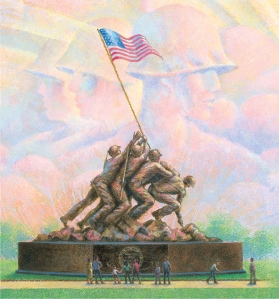
From Nelson's "Quiet Hero: The Ira Hayes Story."

The presentation moved into illustrations of Ira Hayes, the Pima Indian from Sacaton, Arizona who helped raise the American flag on top of Mt. Suribachi in WWII. After the war, Hayes descended into alcoholism and died. Nelson then delicately shared his own experience as a recovering alcoholic.

The air grew a little heavy and the children settled into a solemn silence as Nelson spoke of the native struggle with alcohol and alcoholism, but he brought hope in his message that life is so much better without alcohol or substances. “I’m an alcoholic. I haven’t had a drink in twenty-seven years.” He credits God, the Great Spirit, with giving him the strength to stay sober. “Thank you God, for giving me a good life, so that I could write these books and tell these stories,” Nelson said.

Recalling a hangover one morning long ago, Nelson was watching his two little girls play in the backyard when he realized that he needed help. He picked up the phone and called the local A.A. chapter who immediately sent over two people to give him reassurances and encouragement to live clean.


Nelson concluded his warning of the perils of alcohol, “My hope for you is that you won’t drink and you’ll receive a blessing…I promise you.”

Art has been in Nelson’s life since he was little boy. His earliest memory of art in the home is of his mother’s project in which she applied tempera paint to the living room window. “I remember marveling at her. It was big and it was colorful, and the sun shone through the paint like a stained glass window.” Art was encouraged in the home and when he was three or four years old, Nelson recalled sitting at the kitchen table and finger painting.

Art runs in Nelson’s blood. His mother was a landscape artist who had studied academic and classical painting under the tutelage of Herr Von Schmidt, a German artist. His maternal great-grandmother, Khízá Wiŋ (Fighting Woman) was a traditional artist—a fine beader. Unfortunately, one of her creations, a fully beaded buckskin dress had to be sold to help support the family. Nelson’s mother, had little time to devote to painting due to the demands of motherhood, but her creativity manifested in quilting.

It wasn’t until a rainy day at school when his class stayed indoors that Nelson decided to consider art seriously. He was working on a wildlife scene at his desk when an older “alpha male” fellow whom the class all admired stopped by Nelson’s desk and peered over his shoulder, and said, “Wow, that’s really good.” Nelson’s confidence was boosted further when his classmate declared, “Guys, come over here and look at this.”


Nelson’s mother spoke fluent Lakota and English, and she handed down cultural stories with life lessons like the old Iktomi, or Trickster, stories. Nelson fondly recalls a summer night in his childhood in Fort Yates. His father had heard that the satellite ECHO was going to pass above so Nelson’s mother took him and his brothers and sister outside to watch for it. While watching the heavens Nelson’s mother told them that the Lakota are people of the stars, and up above was their grandfather, Nelson’s Lakota namesake Flying Cloud, riding his horse. “I looked and I couldn’t see a horse, all I saw were stars, but I knew what she was talking about. I got it. I didn’t have to ask her or say that grandpa’s not there. She was talking about infinity. She was talking about forever. I felt the stars were alive.”

When he was a little boy, when the Missouri River was still free flowing on the bottomlands below Fort Yates, his mother and grandmother repeatedly warned Nelson and his siblings not to go swimming in the river. Historically the river was dangerous. In fact, the Lakota called the river Mni Šhošhé, which means “The Water-Astir.” Before the dam, the river was brown with sediment that was stirred up by the swirling churning river and for the Lakota who had become coffee drinkers the river reminded them of the motion of stirring their coffee with sugar or cream. The river was indeed dangerous and only in the mid to late summer was swimming in the river advised for even strong swimmers were pulled under by the undercurrent and never seen from again. Today, the river and the lake are blue.

Nelson’s remembers the river as a river. As a boy, he longingly desired to swim in the forbidden waters and that longing is echoed in his voice today. “It’s a beautiful lake,” said Nelson in an accepting tone. “I like to see kids swimming there.”


After the dams were built in the 1950s, the US Army Corps of Engineers approached the people of Standing Rock and asked them what they would like to call the new lake. Their cryptic response, for they weren’t happy with the Corps, “O’ahé,” which means Something To Stand On in reference to the buildings that were taken under the rising waters and drifted apart and away leaving only the foundations.

Childhood memories came swift to Nelson. His grandmother, Josephine Gipp Pleets, was born in a tipi, and lived in a cabin in Fort Yates when he knew her. In her back yard grew a modest grove of Chinese Elm trees. Nelson would climb them as high as he could. The birds were used to him and continued to land in their nests or flit away unconcerned in their business. He would gaze out over the tree tops for hours at a time watching the river, the valley and the sky.

SD Nelson may live in the southwest. His house is there in eternal summer, but his heart is in the never ending horizon of the Great Plains, his soul is with the Lakota and Dakota people in the land of sky and wind. He is a son of Standing Rock and his life’s work recalls it in each sketch and painting, and his paintings touch the souls of children.

For more information about SD Nelson visit him online at SDNelson.net

Wednesday, January 30, 2013

Racing To Save A Language

The beautiful vesper twilight on the Standing Rock Sioux Indian Reservation.
Lakota Language Nest, An Immersion School
Reviving Language On Edge Of Extinction

By Dakota Wind
FORT YATES, N.D. - Standing Rock Sioux Indian Reservation, N.D. & S.D. - It is the heart of winter on the Standing Rock Sioux Indian Reservation. Gleaming white snow blankets the landscape, the Missouri River has turned to ice and the crisp cold air somehow makes every sound sharper–the peal of a bell seems to carry an impossible distance from town–but the sounds of children playing, laughing and singing warms everything.

The children are in pre-school, ages three to four. Their high-pitched play echoes down the hall when their door opens. The pitch of little voices sounds like what one would hear in any other early child care service across the state, but listen closer and it becomes obvious that this isn’t like any other day care service. The children speak a mix of English and Lakota amongst themselves, but the teachers strictly speak only Lakota in the classroom.

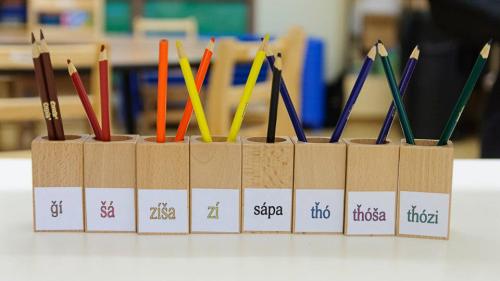
I grew up learning my colors with a few different words. "Luta" is another word for red; I grew up with "Tho'Tho" for green. Here they use "Thozi," or "blue-yellow" for the color green.

This preschool is called Lakȟól’iyapi Wahóȟpi, the Lakota Language Nest. It is an immersion school still in its first year of practice and based on the language nest model which was designed by the Maori people in New Zeeland. The language nest was established to raise language loss awareness on the reservation and to raise up a new generation of first-language Lakota speakers.

The language nest is one part of the Lakota Language Education Action Program (LLEAP) designed for students to go to college and pursue language studies. Students who are in the program are given financial aid to learn Lakota and gain proficiency in the language with the caveat that LLEAP participants must teach the language. Many of the nest’s learners have parents participating in LLEAP at Sitting Bull College.

Tipiziwin Young answers a question only in Lakota.

Tipiziwin Young, a second-language teacher in the Lakȟól’iyapi Wahóȟpi program, estimates that there are about 200 fluent Lakota speakers left on the Standing Rock Sioux Indian Reservation. “A few years back, I was facetious with Jan Ullrich about who I am and where I’m from when he said to me, ‘You’re language will die.’ He didn’t say it to be mean. He said it to be real. I was moved to silence. I was provoked. The loss of my language motivated me to learn it.” Young is an enrolled member of the Standing Rock Sioux Tribe, born and raised on the reservation, and a mother to three children. “I teach here, then go home and stay in Lakota for my children to learn.”

A little boy with a mop of brown hair approaches me. In a quiet unassuming voice he introduces himself to me. Thinking to obey the rule of the classroom, I go down on one knee and respond, “Hau. Dakota émaĥčiyapi lo.” I gesture to him, an open palm when I greet him, then gesture to my heart. I place my right fist above my left fist over my heart, then gesture with my right hand–index finger–to my mouth when I say my name. I’ve seen few others use the Plains Indian sign and gesture language and the signs I made were for “my” or “mine” and for “name.” I don’t know that his little one has seen the old sign and gesture but he nods his head and smiles.

Whitetail-Cross prepares a hands-on activity with one of the children.

Sacheen Whitetail-Cross, Project Director of LLEAP and the Lakȟól’iyapi Wahóȟpi at Sitting Bull College, is preparing an activity with rice for the children. For Whitetail-Cross the greatest challenge with the language nest has been to “stay” in Lakota, “I spent a week in Washington DC, speaking nothing but English. When I came back to the classroom, during an activity, I asked a couple of the children, ‘What are you doing?’ in English. They were as shocked as I was.”

One observation that Whitetail-Cross shared about the children of the language nest is that they are showing ownership of Lakota. At a recent program, they heard a Lakota speaker, and many of them told Whitetail-Cross, “That’s my language.”

Red Bird works with a young boy on a puzzle. He answers the boy's questions only in Lakota.

Tom Red Bird, the first-language teacher on staff at the Lakȟól’iyapi Wahóȟpi, approaches a group of little boys near the window. One mischievous boy stands on a heater behind the short bookcase which was put next to the window. “Héčé šni! [Don’t do that!]” Red Bird says and gestures to the boy to get down. The boy casually climbs down as though he were going to get down anyway and rejoins the other boys.

Perhaps an indication of how comfortable the children are is use of Lakota is in their own little conversations. Two of the children, a boy and a girl are playing with Legos. They began to argue over a few choice bricks in their construction. The boy wants a brick that the girl is already using. As he reaches for it he says in English, “That’s mine!” She retorts in Lakota, “Šni! Šni! Héčé šni! No, don’t do that!” and keeps her brick.

Two children work out who can play with which brick.

A father steps into the classroom. Chase Iron Eyes is his name. His daughter Azilya (4) is among the nest participants. “I heard of this program through community members,” says Iron Eyes, “My wife and I were immediately drawn to it. We wanted her to have this opportunity.” Iron Eyes commutes each week day from Mandan, ND. “She’s not a morning baby. She fights every morning.” He believes the effort is worth the struggle.

Iron Eyes relates to me that Azilya experienced culture shock for the first two weeks then she started to like it and began to speak Lakota at home. Azilya’s older siblings have begun asking their sister and father how to say things in Lakota, and she corrects her father’s Lakota grammar.

Chase Iron Eyes, Esq., founding writer and editor of The Last Real Indians.

Iron Eyes doesn’t believe that language revitalization today equals a renaissance. “Its something that’s been building up now since the 1960s and ‘70s,” he points out, “native activists were and are proponents of language practice. It’s not a renaissance because you live it.” Iron Eyes is active with the community and engaged as a parent in the Lakȟól’iyapi Wahóȟpi program.

The children in the Lakȟól’iyapi Wahóȟpi are getting to be good speakers. “Their American accent is going away,” says Red Bird. They hold hands and pray before lunch. Little hands clasped in little hands. When the prayer of thanksgiving, the Wota Wačéki, is finished the children say together in unison, “Mitakuyé Oyasiŋ,” the traditional way the Lakota conclude prayers meaning “All My Relatives.” During lunch one of the little boys stops eating and spontaneously breaks into song, singing in the Lakota language.

Red Bird work on a project for one of the children while Tipiziwin Young engages them busy with a language activity.

After the parents have picked up their children, Red Bird deeply breathes what sounds like a sigh of satisfaction. The only relief he shares is that the language is spoken again daily. “I like it,” Red Bird says in English, “I get to speak my language all day. It feels good.” Red Bird is originally from the Cheyenne River Sioux Indian Reservation, and had taught Lakota at United Tribes Technical College for several years. “Our Lakota people get lonesome to be home or go home, and language is part of that. That’s where our heart is. I go home to get re-energized.”

Red Bird has hopes for the children, the Thakoza, as he refers to them. “If this keeps going, maybe in ten years we’ll have a new group of Lakota speakers who speak the language correctly.” Red Bird is a great-grandfather and he speaks only Lakota to his great-grandson. His optimism for what can only be called a language revival pours out of him, “We have a culture and tradition, our spirituality, a land base, and our relationship with all of those is best expressed with words found only in our language. It is a sacred language.”

Whitetail-Cross offers comfort to a little boy during an activity.
Whitetail-Cross’ hopes for language revival echoes Red Bird’s, but her optimism is laced with concerns for the program, “Funding is an issue.” The Lakȟól’iyapi Wahóȟpi program received funding from an Administration of Native Americans grant for three years. The first year of programming consisted of developing preschool curriculum, training for language educators, and classroom startup. The Lakȟól’iyapi Wahóȟpi is in its second year of funding, its first year of operation.

The North Dakota Humanities Council recently awarded a $10,000 grant to the Lakȟól’iyapi Wahóȟpi program to assist the program with publication of language materials, but its not enough. Both Whitetail-Cross and Red Bird have expressed the dire need for age-appropriate language materials. There isn’t much published.

The author of this beautiful children's book, SD Nelson, contains some text in Lakota. Nelson is an enrolled member of the Standing Rock Sioux Tribe. Whitetail-Cross is working with Nelson and the South Dakota State Historical Society to acquire the necessary permissions to print a limited number of language resource materials for the children.

Once a week, Red Bird will take a children’s book, translate the text, and then read the story to the children. Having extra copies of Red Bird’s translations for parents to take home and read with their children would help to reinforce that day’s language lesson. “We desperately need more language materials,” Red Bird said.

Jan Ullrich, linguistic director of the Lakota Language Consortium, shares Red Bird’s concern for speaking the Lakota language correctly. Ullrich has had a hand in the development of a standard Lakota orthography for the New Lakota Dictionary. We converse on Skype getting to know a little of one another before business. Ullrich is from the Czech Republic. As a little boy he admired the survival story of the American Indian. In 1992, he travelled to the Pine Ridge Sioux Indian Reservation and made friends with the Fire Thunder and Looking Horse families and came to learn Lakota.

Ullrich may come from the Czech Republic but his heart is Lakota. Visit his work online at the Lakota Language Consortium.

Ullrich sends me the letters t, o, k and a. He then asks me to pronounce what he’s spelled. I reply TOH-kah which can mean “enemy,” then follow up with toh-KAH which can mean “first.” Ullrich then sends me the texts Tĥoka and Tĥoká. The accent marks take a moment to get used to, but the new standard orthography he employs has me pronouncing Lakota correctly when I read it.

Ullrich’s standard orthography isn’t embraced by all Lakota speakers, nor is it the first effort at standard orthgraphy he admits. Sometime back, a Lakota man named Curly from the Cheyenne River Sioux Indian Reservation developed a thirty-six character alphabet. The main drawback with this alphabet for modern Lakota speakers is that it involves learning and remembering entirely new symbols. The new standard orthography makes use of the modern keyboard and letters with sounds Lakota students learned with English, the only addition are marks for accent, aspirants, glottal sounds and glottal stops.

Ullrich is the editor of the New Lakota Dictionary, but being the editor means little to Ullrich who credits several Lakota people who've contributed to this work. Support the Lakota Language Consortium and buy a copy of this dictionary or any other of their published Lakota language materials online at the Lakota Language Consortium Bookstore.

“Missionaries did a good job of starting the process of recording the language,” explains Ullrich, “But they ‘invented’ new words in the interest of literal word for word translation, rather than translation of concept for concept.” Thousands of entries in the Buechel and Riggs dictionaries should be carefully and critically examined according to Ullrich. These dictionaries should also be praised for bringing the Lakota and Dakota languages to the general public’s attention.

Ullrich recently joined the Lakȟól’iyapi Wahóȟpi via Skype to encourage the young learners and to offer courage to the language teachers. Like Red Bird, Ullrich believes that the key to language revitalizing is learning consistently and accurately.

Young engages the children in an activity. The children enthusiastically respond with requests for pictures of various faces and feelings.

Young gathers the children together in a circle on a soft blue carpet. A couple of the children take their time in getting to the circle. Young raises her voice a little, “Inaĥni!” she says, hurry. I know the word well from my own childhood and it becomes obvious that these young ones do too. “Iyotake, iyotake,” Young commands with the strong confidence that mother’s everywhere instinctively possess. Sit down, sit down, and they do so without argument.

She takes out a pen and paper and quickly draws a series of faces with a variety of expressions. The children respond somewhat in unison, “Iyokipiya!” “Wačiŋko!” Happy! Sad! The children tell her in Lakota what faces to draw next and she obliges. When they finish this exercise, they even take time to sing happy birthday to two of the boys, “Aŋpétu tuŋpi,” Young begins and the thakoza sing following her cues. It is to the popular tune “Good morning to all” which was popularly appropriated to the Happy Birthday song, and it’s a close translation in Lakota, They day you were born.

Little voices singing in Lakota continue to echo in my mind when I leave the Lakȟól’iyapi Wahóȟpi, the Lakota Language Nest. It was spoken everyday in the days of warriors and legend. It was spoken everyday when the reservations were established.

The Bismarck Indian Boarding School for girls, 1933.

Somehow along the way between then and now the language began to die through a variety of reasons. Some speakers were scarred from their experiences in learning English during the boarding school days. Some left the reservation and never returned, their children and grandchildren grew up speaking only English. Schools on the reservation teach only in English. Lakota became a language for church or special occasion.

These thakoza speak the language in fun, in play, in prayer, and even in arguments. They can express themselves and articulate their feelings accurately through the knowledge of two languages. Perhaps English has too many words. There is a word for everything, a noun. It’s a language of things. Lakota is a language of description and relation, and that’s just what we need these days.