Showing posts with label Fort Abraham Lincoln. Show all posts

Monday, July 31, 2017

Mandan Woman Turned Into Stone

A lichen covered red granite stone rests in the earth about halfway up the plateau at Fort Abraham Lincoln State Park. Not evident in this photo of this stone, but a rut runs through the half which is exposed to the elements.
Mandan Woman Turned Into Stone
Trees Grew To Honor Her Bravery

As told by Capt. Henry Marcotte (ret.)
Bismarck Tribune, Reprinted Dec. 15, 1922 as “The Clump of Trees on The Hogback”
Mandan, N.D. (TFS) - Fifty years after the construction of Fort McKean and Fort Abraham Lincoln, Captain Henry Marcotte (ret.), shared a story of sacrifice and remembrance regarding a Lakȟóta war party leader, a Nu’Eta (Mandan) man, and a beautiful Nu’Eta woman.

In 1872, Marcotte was serving at Fort McKeen as the Chief of Scouts. In his first summer of service he witnessed many ambuscades carried out on the north side of the newly constructed fort. Marcotte also witnessed the brave responses of the Fort McKeen Detachment of US Indian Scouts - namely, the Sahnis (Arikara). On the evening of November 3rd, Marcotte was invited to sit and smoke with the Sahnis, Hidsatsa, and Nu’Eta, and heard the tale of Black Hare, a Nu’Eta woman.

They had gathered just outside the north side of the palisades of Fort McKeen. It was the custom of Plains Indian men and women to sit on the ground in treaty, in council, at home, and in prayer. Men sat with straight backs and legs crossed; women sat with their knees together, legs tucked under and back, heels to one side. On this day, however, only men were present, and Marcotte undertook to sit on a rock that had been rolled into the circle.

At this gathering, though all spoke different first languages, Marcotte watched and listened to the men speak carefully and deliberately, testing the friendship of all gathered. Sergeant Young War Eagle began the afternoon with a pipe and passed it onto each man calling out his name, who responded in the affirmative. 


By 1910, five trees remained on the top of the plateau, where once was Fort McKeen.

When it was Marcotte’s turn, Young War Eagle recognized him as an officer, then pointed at the rock upon which Marcotte sat. Young War Eagle explained that Marcotte sat on the petrified remains of the Nu’Eta woman known to them as Black Hare. It was to recount her story that brought them together that day. Marcotte doesn’t mention whether or not he removed himself from his perch, but it would have been good manners to do so, and to apologize for his faux pas. Young War Eagle and the men gathered apparently took no offense, and the sergeant recounted the story of Black Hare, as Marcotte noted, “in pleasing tones.”

Black Hare, a young woman, was renowned by many nations near and far for her great beauty. She turned down all her suitors for the simple reason that she didn’t want to leave her village there overlooking the floodplain of the Heart and Missouri Rivers. According to the Sitting Rabbit map of the river, this village was called Watchman’s Village, which today is known as On-A-Slant.

A Thítȟuŋwaŋ (lit. “Dweller On The Plains”; Teton; Lakȟóta) man whom the Nu’Eta knew as Crow Necklace, a leader amongst his people, approached the Nu’Eta and wanted Black Hare for his woman. She declined. Crow Necklace then threatened the Nu’Eta leader with death, to be carried out by sundown, if Black Hare wasn’t brought to him.

The Mandan leader, “To’sh” according to Marcotte’s memory and spelling, induced Black Hare to go walking with him, and on this walk, he took her to where Crow Necklace was lodged, and turned her over to the Xa’Numak (Nu’Eta: lit. “Grass Man”; the Nu’Eta word for the “Sioux”). When To’sh returned to the safety within his palisaded village, he contrived to tell his people that Crow Necklace abducted Black Hare.

The Nu’Eta suspected To’sh’ insincerity, and the other leader of the village - for each village each had a civil chief and a war chief - ordered To’sh to be buried on the spot up to his neck for his disingenuity. The other Nu’Eta leader then made the very threat to To’sh that Crow Necklace made earlier that day, saying that if Black Hare wasn’t here by sundown, To’sh would die. 


By 1922, only one tree remained on the plateau. This photo was taken in the 1930s following the CCC's reconstruction of the three blockhouses. A last tree, dead, can be seen in this image.

From a distance, To’sh saw Black Hare returning to the village, her feet wounded and bleeding. Marcotte’s recollection didn’t tell readers why Black Hare would return in this condition, but other first nations of the Great Plains knew by cultural understanding that when a Lakȟóta man stole a woman from another tribe with the intention of making her his wife, he removed her háŋpa (her moccasins) so that she would be less likely to return to her people. Makȟóčhe Wašté (lit. “The Beautiful Country”; the Great Plains, and by extension, North America) is fraught with uŋkčéla ( little cacti). In this story, Black Hare was a strong-willed young woman to leave her captor and return.

To’sh feared that Black Hare’s return would reveal his falsehood, and earnestly prayed for her to turn into stone. Lo! Black Hare turned into a red calcined stone (as Marcotte described his seat)! A bird sang out during this transformation, and a spirit planted seeds in Black Hare’s bloody footprints. Winter spread its mantle of purity over the stone of Black Hare and her seeded tracks. The sun warmed the land and from Black Hare’s innocent blood grew trees to shade and shelter her stone memorial.

The stone is near Watchman’s Village, within present-day Fort Abraham Lincoln State Park, about halfway up the plateau. When the 17th Infantry arrived, they cut all but eight trees, which were transplanted in front of the officers’ quarters at Fort McKeen. Black Hare’s stone lay on the hillside, bereft of shade and shelter. The water wagons used the stone to check and hold the rear wheels to afford the mules momentary rest.

In 1922, one last tree remained on the hilltop.


Marcotte's narrative appeared as "The Clump of Trees on The Hogsback" in The Bismarck Tribune, Dec. 15, 1922. 

Dakota Wind is an enrolled member of the Standing Rock Sioux Tribe. He is currently a university student working on a degree in History with a focus on American Indian and Western History. He maintains the history website The First Scout.


Friday, December 9, 2016

Forgotten History At State Park

A Corps of Discovery Bicentennial medallion is on display near the visitor center at Fort Abraham Lincoln State Park. 
Forgotten History At State Park
Omission Of Prison Camp Narrative
By Dakota Wind
Mandan, ND – On the night of October 21-22, 1804, the Corps of Discovery established camp above the abandoned Mandan Indian Village known today as On-A-Slant, located at present-day Fort Abraham Lincoln State Park. Their mission, one of exploration and science, but also one of peace and friendship.

Seventy-three years later, on October 5, 1877, the Nimiipuu (Nez Perce) concluded a running battle from their homelands in Idaho to Bear Paw Mountain, MT, heart-breakingly short a few miles to US-Canadian border. Their destination: Fort Walsh, to live amongst Sitting Bull and the Hunkpapa Lakota, whom the Nez Perce thought would assist them. Nearly 800 Nez Perce were captured by Col. Miles. 300 of the Nez Perce were imprisoned at Fort Abraham Lincoln in October, 1877, as they were prepared to be shipped to Indian Territory (OK). Some of them died, as prisoners of war, at Fort Abraham Lincoln.

Among the 300 Nez Perce prisoners of war was Tzi-Kal-Tza, or Daytime Smoke, an elder at seventy-one/two years, who survived the military’s single-minded pursuit of his people, had actually fought to defend his people in the Nez Perce War, and was part of their subsequent capture at the Bear Paw conflict, and their relocation to Indian Territory (OK). Information at the Nez Perce County Historical Museum in Lewiston, ID, says that Daytime Smoke was the son of Captain William Clark.

The son of Captain William Clark, Daytime Smoke, who was imprisoned at Fort Abraham Lincoln in October, 1877, where his father once stepped. 

The imprisonment of the Nez Perce survives in living memory today, which isn’t so long ago as one would imagine. “My great-grandmother’s sisters, two of them, died there,” shared Mr. Woodrow Star, an enrolled member of the Nez Perce tribe. “I paid a visit to Fort Lincoln to visit my grandmothers’ graves. None of the park rangers, not even the park manager, had ever heard of this.”

After the fort was decommissioned in 1890, all veterans and citizens at rest there – including the POWs, were exhumed and reinterred at St. Mary’s Cemetery. The Nez Perce were buried in a line, their names unrecorded. Their graves in Bismarck lie there still, in unmarked graves. The Nez Perce today, want to change this.

Fort Abraham Lincoln has seen a lot of reconstruction over the years. Blockhouses and the museum/visitor center have been in place in the 1930’s. Earthlodges were originally reconstructed by the CCC in the 1930’s too, then reconstructed as needed. In the late 1980’s the commanding officer’s quarters were reconstructed, built as General Custer would have known it in 1875. Four other buildings followed. The museum/visitor center was renovated to feature the Mandan Indian and military occupations.

The visitor center features an area dedicated to representing the overnight stay of the Corps of Discovery within present-day Fort Abraham Lincoln State Park.

The museum/visitor center displays feature archaeological findings both from the Mandan and military, Sheheke, (White Wolf; White Coyote) a Mandan who was born there, an artistic diorama of the historic Mandan village there, Fort Abraham Lincoln, General Custer, and the Civilian Conservation Corps. The Little Bighorn campaign and battle are also featured, as is the Corps of Discovery.

Guided tours of the commanding officer’s quarters (“The Custer House”) are offered throughout the tourist season. The guides are dressed in period attire and speak in the present tense as though it’s 1875 rather than the modern day. The Custer House features various novelties that once belonged to Lt. Col. G.A. Custer and his wife. These are pointed out to the visitor by way of a prompt, “Take special notice of…”

The fort’s history is summarized in a prologue and conclusion of every tour: it was built in 1873, a cavalry post to protect the Northern Pacific Railway survey crews, the Black Hills Expedition of 1874 (to confirm the discovery of gold) receives a mention, the Little Bighorn Campaign (Centennial Campaign), the plight of Elizabeth “Libby” Custer following the failure of her husband’s command, the decommission of the fort, citizens dismantling the fort for construction materials in their homes, the CCC placing building markers, and the reconstruction of the fort.

Fort Abraham Lincoln State Park's interpretive programming focuses heavily on the military occupation of the site from 1872 to 1890. 

What is entirely missing from the narrative in the interpretive programming and the museum information about the military occupation is the prison camp history. There is no mention either of the 1875 Treaty of Fort Abraham Lincoln, which was a big activity there at the fort. Lt. Col. Custer called on members of the Arikara, Hidatsa, Hunkpapa Lakota, Mandan, and Yanktonai Dakota to end their generations-long intertribal warring.

The interpretive training that seasonal staff at Fort Abraham Lincoln State Park receive is based on the practices of Freeman Tilden. There are six principles in this methodology. Tilden’s principles are the basics of all interpretive programming found in the National Parks, state parks, museums, and other institutions across the country. Tilden’s principles are:

Tilden's work began with a focus on state parks before his work on interpretive programming was picked up by the National Park Service. 

1. Any interpretation that does not somehow relate what is being displayed or described to something within the personality or experience of the visitor will be sterile.

2. Information, as such, is not interpretation. Interpretation is revelation based upon information. But they are entirely different things. However, all interpretation includes information.

3. Interpretation is an art, which combines many arts, whether the materials presented are scientific, historical or architectural. Any art is in some degree teachable.

4. The chief aim of Interpretation is not instruction, but provocation.

5. Interpretation should aim to present a whole rather than a part, and must address itself to the whole man rather than any phase.

6. Interpretation addressed to children (say, up to the age of twelve) should not be a dilution of the presentation to adults, but should follow a fundamentally different approach. To be at its best, it will require a separate program.

Artistic licence was used to create this reconstruction of the On-A-Slant Mandan Indian village. The layout is slightly different, and according to the archaeological report, there was no ceremonial lodge. 

The whole history of the park is not addressed, so the whole experience of the visitor is not “wholesome.” This omission has shaped the experience of millions of visitors over the years the park has been active. It isn’t just the interpretation or presentation of this tragic history that this is missing; the prison camp history of Fort Abraham Lincoln State Park receives a half paragraph mention in the ND Parks and Recreation Department’s publication by Arnold O. Goplin, “The Historical Significance of Ft. Lincoln State Park” and then only that the 7th Cavalry escorted the Nez Perce to Bismarck, not Fort Abraham Lincoln. In another publication of the ND Parks and Recreation Department, “100 Years – Fort Abraham Lincoln State Park,” the Nez Perce are missing entirely.

An informal visit to the North Dakota Parks and Recreation Department on Thursday, August, 25, 2016, and message for the director went unanswered. An email to the Fort Abraham Lincoln State Park received a reply on Oct. 15, 2016, but only to say that the park manager would respond “next week.” There has been no further follow-up from the North Dakota Parks and Recreation Department. 

The original post cemetery was located at the top of the bluff near old Fort McKeen. 

Mr. Woodrow Star humbly requested any and all information that the North Dakota Parks and Recreation could share with him about his relatives imprisonment. The staff could not respond to Mr. Woodrow, because their information is woefully incomplete. Fort Abraham Lincoln State Park does not employ an actual historian to research and construct their interpretive program. In October of 2015, the park manager referred Mr. Star to me.

Here’s follows a bibliography of non-native primary resources which specifically mention the Nez Perce in Bismarck and at Fort Abraham Lincoln in October of 1877.

Primary Resources:
Fred G., Bond. “Floatboating On The Yellowstone.” 1st Ed. New York, New York: New York Public Library, 1925. 1-22.

Miles, Gen. Nelson Appleton. "The Nez Perce Campaign & The Siege And The Surrender." In Personal Recollections And Observations Of General Nelson A. Miles, 250-280. 1st Printing. New York, New York: Werner Company, 1896.

Zimmer, William F. "Part Two: August 1, 1877 to December 31, 1877." In Frontier Soldier: An Enlisted Man's Journal, Sioux And Nez Perce Campaigns, 1877, edited by Jerome Greene, 89-160. 1st ed. Helena, Montana: Montana Historical Society Press, 1998.

Journals:
Romeyn, Capt. Henry. "The Capture Of Chief Joseph And The Nez Perce Indians." Contributions To The Montana Historical Society, Vol. 2 (1896): 283-91.

Haines, Francis. "Nez Perce Indians." Army And Navy Journal, 1877, 290-91.

Magazines:
Henry Remsen, Remsen (Tilton). "After The Nez Perces." Field And Stream And Rod And Gun, December 1, 1877, 403-04.

"The Surrender Of Joseph." Harper's Weekly, November 17, 1877, 905-906.

Newspapers:
Bismarck Tri-Weekly Tribune, November, 21 & 23, 1877.

Cheyenne Daily Leader, November 25, 1877.

Inter-Ocean, November 23, 1877.

The Nez Perce themselves know their own history. They survived displacement from their homelands, imprisonment, and placement in Indian Territory (Oklahoma).

Goplen, Former Senior Foreman Historian for the National Park Service minimized this tragedy to half a paragraph and displaced the locality to Bismarck, ND. Fort Abraham Lincoln State Park staff have repeatedly ignored calls to address the omission of this history in an effort to preserve the lionized integrity of an egotistical and incompetent military commander. The Fort Abraham Lincoln State Park website focuses only on the Mandan Indian and military occupations and provides a link to Little Bighorn History. There is a pattern of omission of historical fact that is taking place at Fort Abraham Lincoln State Park. One can only hope that this changes. 

Visit this park. It's still the greatest park in North Dakota. Ask the park manager to develop the interpretive narrative. It doesn't need to be apologetic. It needs to be informed. 

Tuesday, February 14, 2012

Attacks On Fort Abraham Lincoln

An aerial view of Fort Abraham Lincoln State Park, 1963.
Attacks On Fort Abraham Lincoln
Fort Faces Gunfire And Skirmishes
By Dakota Wind
MANDAN, N.D. - The following is an excerpt from the article “Embracing a relation of the history of the state from the earliest times down to the present day, including the biographies of the Builders of the Commonwealth” which was published by the Bismarck Tribune in 1910 in the “History of North Dakota.” This article features the skirmishes surrounding Fort Abraham Lincoln. It should be noted that the Fort Abraham Lincoln military reservation itself was about twenty-three square miles, which is about 15,000 acres. The Fort Abraham Lincoln State Park today encompasses only 1,100 acres.


These were the ominous figures on the northern line of Sioux unceded land through which the Northern Pacific was to pass. The survey had been carried on to the Missouri river without serious interference from the Indians, and it as much menaced until the Hunkpapa leaders had gathered about them a very considerable force, composed of the fiercest and most bitter of the Sioux nation. There is not doubt that up to the summer of 1872 the work of the leaders was directed to getting the spirit of the Indians aroused. And they succeeded in drawing the Cheyennes into their quarrel. August 14, 1872, a column of the Second cavalry was attacked in Montana by Black Moon a the head of a considerable body of Sioux and Cheyennes. Two whites were killed and a number of Indians killed and wounded. The Indians might have pursued the advantage they had, and inflicted more injury on the soldiers, but for a strange policy they pursued of quitting when a battle was well night [sic] won.

WARFARE NEAR BISMARCK

Sitting Bull wears a hat with a monarch butterfly affixed to it.


This affair started the entire hostile element into activity. Twelve days later a war party attacked a detail of the Sixth Infantry from Fort Abraham Lincoln. The soldiers with some ‘Ree scouts were making a reconnoisance [sic] about twelve miles west of Bismarck when attacked. Two of the ‘Rees were killed. The affair indicated that Sitting Bull had influenced his people nearer at home to make trouble close to the settlements and Bismarck was threatened by many alarms. October 2, about four hundred Sioux attacked Fort Lincoln itself, but were repulsed by the troops after they had killed three ‘Rees -- who seem to have born the brunt of the battle in these skirmishes. There was fighting on the White River about the first of October and on the 14th a big party made a demonstration against Fort Lincoln. A company of the Sixth and body of scouts were sent out against the marauders and drove them off, with the loss of two men. The Indians suffered again, losing at least three men. These affairs took place right on the threshold of civilization for by this time the white man had advanced to the Missouri with the determination to stay.

A picture of General Custer, after the Civil War and during his Indian fighting days. He was actually a Lieutenant Colonel at the time of his death, but out of respect for the rank he once held during the Civil War, he was called "General."


An attempt was made to negotiate another treaty with the Indians to open the way for the surveyors, but it was ineffective and while it was going on, in the spring of 1873, three distincts attacks were made on Fort Lincoln. Lt. Col. Carlin was in command and he drove the Indians off on each occasion with some loss, but the eyes of the authority were opened to the reality of the menace of these attacks and Lt. Col. Geo. A. Custer, with the Seventh Cavalry, was sent to establish headquarters at Fort Lincoln and clear the hostiles out of the country, which marked the beginning of the end of Custer and the dashing organization he brought with him. The coming of Custer assembled in North Dakota and the adjacent territory the elements which entered into the playing out of the tragedy of the Indian and the breaking of the power of the Sioux nation.


It was the perspective of the Hunkpapa Lakota that Forts Rice and Lincoln represented the arrival of the US military and signaled that settlers were here to stay. The Ihanktowana (Yanktonai) were already pushed west across the Missouri after the punitive campaigns of Generals Sibley and Sully after the Dakota Conflict in Minnesota of 1862. The Cheyenne at one time dwelled on the west bank of the Missouri River, and viewed the river as a boundary line themselves. It was easy for the Hunkpapa Lakota to pique the Cheyenne by rousing their need for self-preservation.


The Fort Laramie Treaty of 1868 stated the boundaries of the Great Sioux Nation, and that no surveyors, minors, nor settlers could enter those lands. The Hunkpapa had every right to believe they were defending their lands, especially after Fort McKeen and Fort Abraham Lincoln were built at the convergence of the Heart and Missouri Rivers, one of the boundary markers of the Great Sioux Nation, and the site of the Battle of Heart River in 1803 that determined Lakota territory.

Monday, February 13, 2012

The Treaty of Fort Abraham Lincoln, or The Treaty of 1875

Soldiers practice on the parade ground of Fort Abraham Lincoln. The Commissary sits in the background (left) and Captain Tom Custer's bachelor officer's quarters (background, right).
The Treaty of Fort Abraham Lincoln
The Treaty of 1875
By Dakota Wind
FORT ABRAHAM LINCOLN, D.T. (MANDAN, N.D.) - In May, 1875, Fort Abraham Lincoln served a purpose much the same as the United States serves in the Middle East in recent times, that of intermediary between two warring nations. It worked then about as much as it works today.


Fort Abraham Lincoln was built partly on the remains of the Mandan Indian village site, On-A-Slant, located on the west bank of the Missouri River, across from Bismarck, Dakota Territory. Fort Abraham Lincoln is also built at the convergence of the Heart River and Missouri River, where in 1803, a battle between the Ihanktowana Dakota and the previous claimants to this locale was fought, it ended in victory for the Dakota and the contested land became part of “Sioux” territory.


After the treaty was signed, a great celebration at Fort Abraham Lincoln ensued lasting several days. There was feasting and dancing, but after the parties returned to their respective agencies, conflict resumed.

The Indian Scout standing on the porch wearing a military blanket is often misidentied as Bloody Knife, an Arikara Indian and General Custer's favorite scout. Bloody Knife stood about 5'7". The Indian in this picture is most probably the Hunkpapa Lakota Indian Scout Long Soldier who stood at 7' (observe his height in relation to the front door). Long Soldier served at Fort Abraham Lincoln. A leader of his band of Hunkpapa, he signed the treaty of Fort Abraham Lincoln.

Fort Abraham Lincoln served as host to the Hunkpapa Lakota, the Sihasapa Lakota, the Ihanktowana Dakota (Yanktonai), the Sahnish (Arikara), the Hidatsa (Gros Ventres), and the Nu’Eta (Mandan). Here follows the text of the Treaty of Fort Abraham Lincoln:


TREATY BETWEEN THE YANKTONAI, HUNKPAPA, AND BLACKFOOT SIOUX AND THE ARIKARA, HIDATSA, AND MANDAN

May 29, 1875

Whereas war has prevailed for many years between the Sioux Indians on one side and the Arickaree, Mandan, and Gros Ventres on the other, and whereas, it is now the desire of the Yanctonnais, Uncpapa and Blackfeet bands of the Sioux Nations and of the Arickaree, Mandan and Gros Ventres to put an end to such hostilities forever:--


We, the undersigned chiefs and headmen of the tribes and people above named do solemnly and in good faith promise—


First


That we the undersigned chiefs and headmen of the Sioux Nations and the people we here represent will from this day forward live in peace and friendship with the chiefs and headmen of the Arickaree, Mandan and Gros Ventres and the people they here represent, and that we will exert all our power and influence over our people to prevent them or any of them from committing any unfriendly or hostile acts against the Arickaree, Mandan and Gros Ventres.


Second


That we the understood chiefs and headmen of the Arickaree, Mandan and Gros Ventres tribes of Indians and the people we here represent will from this day forward live in peace and friendship with the chiefs and headmen of the Yanctonnais, Uncpapa and Blackfeet bands of the Sioux Nation and the people they here represent, and that we will exert all our power and influence over our people to prevent them or any of them from committing unfriendly or hostile against the people of individuals of the tribe of Sioux represented in this council.


Third


That we the chiefs and headmen of the Yanctonnais, Uncpapa and Blackfeet tribes of Sioux will use all our power and influence toward preventing Sioux of the Cheyenne River Agency from committing hostile or unfriendly acts against the Arickaree, Mandan and Gros Ventres.


Fourth


That we the undersigned chiefs and headmen of the Arickaree, Mandan and Gros Ventres of Indians will use all our power and influence towards preventing hostile or unfriendly acts on the parts of the people we represent against the Sioux of the Cheyenne River Agency.


Five


That if any of the chiefs and headmen who have signed this treaty shall learn that their young men are engaged in organizing expeditions or war parties intended to or likely to violate this treaty, they will forthwith inform their Agents in order that he may take such measure as will prevent any violation of the treaty made and entered into this day.


Done at Fort Abraham Lincoln, Dakota Territory, this 29th day of May, A.D. 1875, in presence of


                                                                        W.P. Carlin


                                                                        Lieut. Colonel 17th Infantry


                                                                        Commdg Fort A. Lincoln D.T.


L.B. Sperry                                                      John Burke


U.S. Indian Agent for the Arickarees,      U.S. Indian Agent for the Sioux Tribes


Gros Ventres, and Mandan Indians.


Arickaree      Son of the Stars        [x]        Lower             Two Bears                  [x]


                        White Shield              [x]        Yanctonnais  Mad Bear                  [x]


Gros Ventres Crow Breast              [x]                                Bulls Ghost                 [x]


                        Lean Wolf                  [x]        Uncpapa       Running Antelope   [x]


Mandans       Bad Gun                    [x]                                Thunder Hawk          [x]


                        Flag Lance                [x]                                Bear’s Rib                  [x]


                                                                                                Slave                          [x]


                                                                                                Long Soldier              [x]


                                                                                                Bears Eye                   [x]


                                                                        Blackfeet       The Grass                   [x]


                                                                                                Fire Heart                   [x]


                                                                                                Sitting Crow              [x]


                                                                        Upper             Wolf Necklace         [x]


                                                                        Yanctonnais  Black Eye                   [x]


Signed in Quadruplicate


one copy given to Sioux Agent John Burke


one copy given to Ree, Mandan and Gros Ventres Agent L.B. Sperry


one copy forwarded to Headqrs, Dept. Of Dakota


one copy retained at Post headquarters


                                                                        James Calhoun


                                                                        1st Lieut 7th Cavalry


                                                                        Adjutant

Thursday, October 20, 2011

One Day My Sense of Place Changed

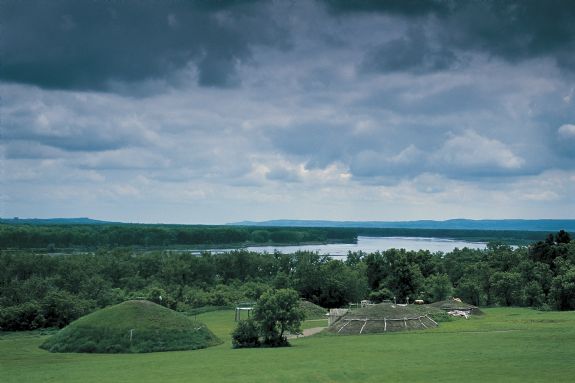
A view of the On-A-Slant Mandan Indian Village overlooking the Missouri River.
One Day My Sense Of Place Changed
A Look At A Major Historical Site
By Dakota Wind
MANDAN, N.D. - When I was growing up on the Standing Rock Sioux Indian Reservation I heard many of the negative typical commentary about General Custer.  I’d see t-shirts at the pow-wow stands of Yellow Hair with an arrow through this hat, with words like “Custer was Siouxed,” or variants of the theme of giving Custer an arrow shirt.  T-shirts like that can still be found on the pow-wow circuit throughout Indian Country, and whenever I see one, I can’t help but smirk and nod my head at the truth of it. 

Growing up in Fort Yates, there wasn’t much choice by way of food in town, either at the grocery store or in the commodity box.  Often enough, my grandparents and many people would drive to Bismarck or Mobridge to buy groceries for the week.  When we’d drive to Bismarck, we use to have to drive through Fort Abraham Lincoln State Park.  That’s back when ND HWY 1806 went through the park. 

When I was elementary school, I remember visiting the park twice, once in fourth grade and again in middle school.  This was before the reconstructed Custer House and other buildings that followed.  The only things I recall as as a little boy were the earthlodges of the On-A-Slant Mandan Indian village.  I recall how immense the earthlodges were and how they smelled like an old cellar.  There was no guide to tell us anything more about the history, archaeology, or culture of the park.  There was no ranger to monitor or secure the earthlodges or the blockhouses.  My earliest impression of the site wasn’t just the earthlodges’ size but the smell.  People, the general public, used them as restrooms.

When I was in high school, the Custer House, Granary, Commissary, and Central Barracks were being constructed.  I’d sit in the backseat and look out the window, sometimes I’d have my headphones on and I’d almost always be listening to Def Leppard, but when my grandparents were speaking, I’d be listening to them.  When we’d drive through the park, sometimes my grandmother would tell me about General Custer and how he’d taken an Indian woman, a Cheyenne maiden, how the soldiers took Indian women and had their way with them.  Sometimes my grandmother would even talk about her great-grandfather, one of Custer’s own men.  My grandfather never spoke of Custer or mentioned the soldiers, but I could tell by the set of his hands on the steering wheel as he gripped it, it provoked him. 

In high school, I joined the basketball team and sometimes we’d drive through Fort Abraham Lincoln State Park on the way to or from a game.   The coach was also an assistant in the school’s “Indian Club.”  He definitely had an opinion about the fort reconstructions and openly shared it with the team.  I felt ashamed that one of the soldiers was my ancestor and I heard a lot of things about the character of General Custer. 

One fall day, the history teacher, a burned-out recovering hippie of a woman with weary eyes and a tired cracked monotone voice to match (we called her “Beanie”) took the class on a tour of the reconstructed Custer House.  We were guided by a man portraying one of the General’s strikers.  He told us all about the virtues of General Custer, but we had our own opinion – at least I did – and I we quietly stepped through the house.  It was one-sided and uninviting.  Nothing the reenactor could say or do could make me or the class interested because what he said didn’t affect in any way our established opinion of General Custer. 

In 1908, President Theodore Roosevelt felt a sense of place about Fort Abraham Lincoln and General Custer, and he did something about it.  He signed the Fort Abraham Lincoln Act, deeding the old Fort Abraham Lincoln to the State Historical Society of North Dakota.  What’s Roosevelt’s connection? 

In 1877, Colonel Nelson Miles led the 7th Cavalry at the Battle of Bearpaw Mountain at the end of the Nez Perce Campaign.  On Oct. 5, 1877, Chief Joseph surrendered to Colonel Miles.  Miles was ordered to bring the Nez Perce to Fort Abraham Lincoln for internment, which he did and when he delivered the Nez Perce to Bismarck, ND, he took the first train to St. Paul, MN, to meet with Gen. Terry.  The colonel was promoted to Brigadier General. 

Brig. Gen. Miles went on to capture Geronimo and was promoted to Major.  Maj. Gen. Miles had a bit part to play in the events that led to Sitting Bull’s death.  Miles believed that the Lakota should have been firmly under control of the US Military not the agents of the Bureau of Indian Affairs.  Miles personally led the invasion of Cuba in the Spanish-American War of 1898.  Colonel Theodore Roosevelt led the 1st Volunteer Cavalry, popularly known as the Rough Riders, in the Kettle and San Juan charges. 

Aside from President Roosevelt’s contemporary relationship with Gen. Miles, Roosevelt was aware of General Custer’s association with the site, and the fact that Fort Abraham Lincoln was also a prison camp for the Nez Perce (only ten days; ten Nez Perce died during that time) and for the Grasshopper Band of the Northern Cheyenne in the winter of 1877-1878. 

President Roosevelt signed the Fort Abraham Lincoln Act to preserve and protect the history and culture of the site. 

My first experience of working at Fort Abraham Lincoln State Park visited me in the form of an elderly Mandan Indian woman.  She was dying of cancer and had asked one of her relatives, her children and grand children, to step forward to continue a native presence in the On-A-Slant Mandan Indian village.  When none came forward, she reached out and asked me.  But it isn’t as simple as that.  

She greeted me in Hidatsa in passing one day.  A few days went by, then she asked who I was (when a native elder asks that kind of question, it implies asking who I descend from, who my people are, and what my traditional name is).  Time passed and one day she called me “grandson” and asked me if I would work her ancestral village.  I said yes. 

The Mandan Indian people lived at this village, only they knew it as Watchman’s Village (it was later named the On-A-Slant Village by the Civilian Conservation Corps in the 1930s), and they lived there from about 1550 to 1781.  The Mandan Chief Four Bears’ father Good Boy called that village home.  The Mandan Chief Shehek Shote, White Wolf (called Sheheke or White Coyote by some) knew this village as his first home. 

In 1781, the Mandan were struck by an epidemic of smallpox.  They left their deceased loved ones in the lodges and abandoned the village in a move north to Knife River.  They never forgot where they came from.  There are still people at rest in the On-A-Slant Mandan Indian village. 

The Mandan, the Nu’Eta, have a sense of place about Fort Abraham Lincoln State Park.  Its home and its sacred. 

I had to learn more about Fort Abraham Lincoln State Park if I was going to work there, to make it matter to me, to establish my own sense of place. 

For the Lakota, there is the phrase, “My home is where I set my lodge.  One pole rests at the mouth of the Heart River…”  In 1803, the Hunkpapa Lakota and the Yanktonai Dakota engaged the Assiniboine and Mandan for control of this contested area and won in the Battle of Heart River.  For the Lakota, one pole of the lodge of the Teton lies in Fort Abraham Lincoln State Park.  For the Lakota, despite the connection the site holds with General Custer, Fort Abraham Lincoln State Park is home. 

For the Hunkpapa Lakota, there was a skirmish within the boundaries of Fort Abraham Lincoln State Park, a “Wood Cutter Fight.”  For the Lakota, battlefields are respected and honored because that’s where people died defending their way of life, their territory, even if they were the enemy.  For the Lakota, Fort Abraham Lincoln State Park is a memorial. 

In the fall of 1874, Lieutenant Tom Custer captured the Lakota war chief Rain-In-The-Face and imprisoned him in the Fort Lincoln guard house.  Two years before his arrest, Rain-In-The-Face conducted a successful horse-stealing raid on the Arikara at the Infantry Post.  He was arrested for killing surveyors on the Yellowstone Expedition of 1873.  Rain-In-The-Face might have been arrested and detained at Fort Abraham Lincoln but he was released in the dead of night in the late winter of 1874-75.  Rain-In-The-Face never spoke a word against Fort Abraham Lincoln and the only animosity he held was for Lieutenant Tom Custer. 

In May of 1875, General Custer hosted a ten-day celebration at Fort Abraham Lincoln in honor of the peace treaty he witnessed between the Arikara, Hidatsa, Mandan, Dakota and Lakota Indians.  At that very same celebration, General Custer heard testimony of the Indians about the mistreatment they were dealt at the hands of the Bureau of Indian Affairs Agents, and carefully recorded it.  In the fall of 1875, General Custer travelled east where in the spring of 1876, he testified to Congress on behalf of the American Indians and their plight, testified against President Grant and against the Secretary of the BIA.  He was arrested.  General Terry pressured President Grant to release him.  General Terry ordered General Custer to “use any means necessary” on the Centennial Campaign, the Little Bighorn campaign. 

The Lakota of the nineteenth century might not have liked the ideology of Manifest Destiny that gripped the United States, nor the fact that General Custer led his men in the field after he hosted them at his fort, but its history, and the Lakota respect what happened.  Sitting Bull himself offered that he would not speak ill against the dead, the enemy, out of respect. 

When I began my first summer at Fort Abraham Lincoln, it was with mixed feelings.  I’ve since learned all that I’ve written above, reader, and more.  My sense of place changed. 

I believe that history should be preserved, protected, promoted even, and I believe that it must and should be shared.  The history of Fort Abraham Lincoln State Park is a story about Indians, Indians fighting Indians, Indians fighting soldiers, a story about Dakota Territory, its what you might call an all American story. 

Reader, you may already have a sense of place about Fort Abraham Lincoln State Park or a sense of place of near you, you may not.  In the very least, I hope that I give you a moment to consider something about it.