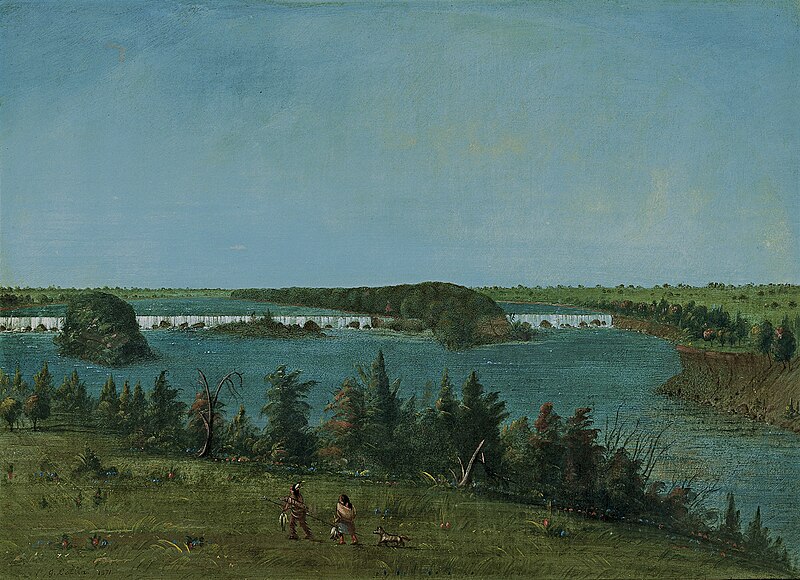
An excerpt of a pictograph by Sitting Rabbit. The scene is of the Hidatsa village along Knife River, the village that Sacagawea lived in when she encountered the Corps of Discovery.
Interpreting A Pictograph Calendar
An Examination Of A Mandan Lunar Chart
By Dakota Wind
BISMARCK, N.D. - Sometime back in the fall of 2003, enrolled member of the
Cherokee in Oklahoma
and Distinguished Professor of Anthropology, Dr. Russell Thornton and Dr.
Candace Green published a short paper about the Little Owl calendar, a lunar
chart, of the Mandan Indians.
The calendar, or lunar chart, is a fascinating example of
Plains Indian pictography. It is similar and yet different to another Plains
Indian pictographic tradition, the Winter Count.
The lunar chart is the personal property of the late Mr. Ronald
“Sammy” Little Owl, of the Arikara Hidatsa and Mandan Nation on the Fort
Berthold Indian Reservation in North
Dakota, who found it amongst his late mother’s
belongings. Mr. Little Owl brought the lunar chart to Dr. Thornton’s and Dr.
Green’s attention in 1998. Little Owl also supposed that the lunar chart was associated
with the Bad News Clan, to which his father and paternal grandfather belonged.
Dr. Green suggests that the Little Owl lunar chart may
indicate “a possible record of planting by the agricultural Mandan…apparent cycles and obvious plant
symbols, one might conclude that the calendar was used to keep a record of
planting and harvesting.”[1]
In the fall of 2003 I contacted Dr. Edwin Benson, of the
Arikara Hidatsa and Mandan Nation, who was teaching the Nu’Eta (Mandan) language at the Twin
Buttes Day
School on the Fort Berthold Indian Reservation at the time for
his knowledge of the Mandan
calendar. Dr. Benson graciously responded with the following:
January Kupa-hanas Seven Nights
February Ma-istami-ba-da Sore Eyes
March Wa-he-knew Spring
April Ma-nabe-ki-bu-ke Game
May Muut-ogeheneh Planting/Sowing
June Ma-na-bu
Shu-kena-de-ke June Berries
July Ka-dek-na-de-ke Chokecherries
August Wak-da-na-de-ke Wild Plums
September Koxate-du-kie Ripe Corn
October Ma-nah-pe-o-dee-geh Frost-On-The-Ground
November Ikatehne-o-nu
Des-o Freezing Rivers
December Hump-ni-nahge-ge-gipdahg Short Day/s
Dr. Benson also sent me a few alternate names, but these
only in English:
January Seven
Cold Days
April Breaking-Up-Of-The-Ice
October Falling-Of-The-Leaves
December Little
Cold
Here follows a basic understanding of the Mandan and Hidatsa gardening practices throughout the summer. This may assist with interpreting the Little Owl Lunar Calendar (chart).
"Singing The Corn" by Jack Stewart.
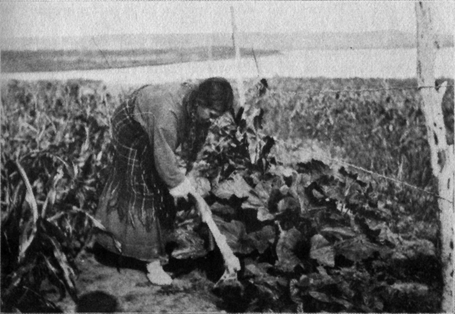
“In the old garden, the work usually started when the first
geese appeared on their way north, or when the Missouri
River broke up, events which usually occurred almost together. At
this time the old weeds and stalks and vines were collected and burned.”[2]
The women would arise when the light began to appear on the
horizon or at daybreak, sometimes as early as three o’clock in the morning.[3]
The women would work the fields from sunup to when the heat of the day could be
felt, at which point they returned to their lodges and did other work. If any
time was left over in the day, toward the close of the afternoon, they would go
back to their fields.
Often times the women would sing while working or watching
the crops for intruders, or to make fun of the men and boys.[4]
After the fields were cleared of debris, the planting hills
were dug up, loosened, and broken back down again into loose soil. The hills
measured about twelve to eighteen inches in diameter and were approximately
twelve to eighteen inches apart from one another. Sunflowers were the first
crop to be planted around the edge of the garden before clearing and digging
were finished.[5] They
were planted three to a hill of their own about eight or nine paces apart.[6]
Corn followed soon after the sunflower was planted, sometime
in the first half of May. Sixty to one hundred corn seeds were planted which
was believed sufficient in the sheltered bottomlands to insure that only slight,
if any, crossbreeding of the corn.[7]
Corn was planted in every other hill, usually seven or eight kernels of corn to
a hill, with beans being planted in those early hills skipped by the corn.[8]
Planting usually lasted from early May “until the roses bloom in June,”[9]
but in the big gardens the beans were planted immediately following the corn,
and in the same amounts as the corn. Squash was planted after the beans, after
the blooming of the roses.[10]
Toward the latter part of summer, the gardens were rarely unoccupied
during the day. This was because of the flocks of crows and other birds that
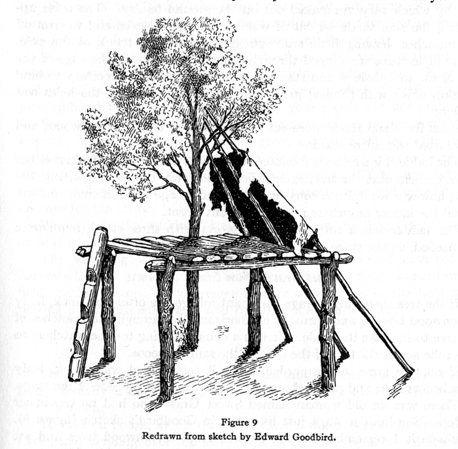
would try to come after the soft corn. To help the watchers, a brush shade was
constructed, or a scaffold with a shade of some type would be employed while
the women and girls worked on sewing, quillwork or other craft. Girls always
went with their mothers to do this work and it was permissible for a man to go
to work with his wife if they didn’t have children.
The first harvest of the Mandan, known as the green corn harvest,
started as early as August as the young squashes were gathered, sliced and
dried. This event is generally determined by the older women who examined the
ears and silk of the corn, which, if it was brown or withered and the husk was
dark brown, the corn was harvested until frost. The green corn harvest was a
time of feasting and rejoicing, but also a time of drying food for storage.
Preparing corn to eat might consist of either boiling or roasting.[11]
The green corn harvest seldom lasted more than ten days. The second harvest,
the ripe corn harvest, followed two to four weeks later and usually lasted
about ten days or until early October. Sunflowers were the last to be
harvested.

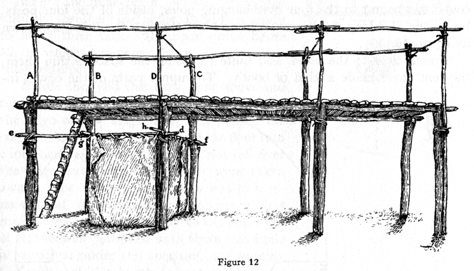
A corn threshing booth. Corn was dried on the stage above ground, then the kernels were threshed or beaten from the cob in the booth. Choice corn, or corn which was traded, was braided together, about a hundred ears of corn to a braid and was considered the equal of a tanned bison robe.
Depending on the variety of corn, Mandan corn generally matured in about ninety
to 105 days. Squash was picked immediately after the first frost. Beans, which
were planted after immediately after the squash, were picked in the fall after
they had ripened and the pods were dead and dried.
Tobacco was planted at the same time as sunflowers, but only
by the men; the first harvest of tobacco took place in about midsummer, or
June. The men would go out amongst the tobacco and pluck some of the flowers,
which were dried, crushed and later enjoyed in their pipes. The rest of the
tobacco would be harvested sometime before the frost came.
Corn, squash and beans were stored in a bell-shaped cache pit. As deep as six feet and as wide as three to five feet.
The new year begins, or at least a new growing season, after
the ice has broken up, when the geese have returned, after the spring rains,
when the bison calves are born, and when the leaves began to bud on the trees.
Figure 1 of the Little Owl Lunar Chart.
In figure 1, the crests, or lunar crescents mark only a very
small part of the entire page. Only one of the crescents appears to bear
additional markings of a tree on its convex and rain in the concave. If this
series of lunar crescents indicate the new year or growing season, this lunar
cycle might concur with the roman calendar of April. The crescent with tree and
rain could read as “The rains fell; the trees returned to life.”
Figure 2 of the Little Owl Lunar Chart.
In figure 2, the series of pictographs appear to begin on the
bottom left and seem to read up the page. The second row then appears to read
top to bottom, and seems to be aligned with the lunar crescents, and there is
no line separating the row of pictographs and the row of crescents, which also
seem to be combined with glyphs in concordance with the row of pictographs.
It should be noted that when a death is mentioned, it may
indicate that someone actually died or that someone, likely a woman or child,
was abducted by an enemy. Women were eventually married into and accepted by a
tribe; children were treated and raised as members of a tribe, this was
particularly true of the Teton Lakota and Yanktonai Dakota whom the Mandan were sometimes at
war.
Figure 2 interpretation:
- Unknown.
- Fish/Fishing.[12]
- A
gathering or council.
- A man.
- Five
days.
- Corn.
- Corn
medicine.
- Man
with a staff, perhaps a man called a war party.
- A
horse, perhaps a successful horse raid.
- A
bison jump or bison hunt.
- A
lasso, perhaps indicating a successful horse raid.
- Unknown,
indiscernible.
- An
event regarding the Assiniboine Sioux.[13]
- Three
lassos, perhaps indicating either three successful horse raids or that
horses were stolen back and forth between an enemy tribe.
- They
heard a spirit.[14]
- Someone
killed, perhaps an enemy.
- Bison
Bull killed.[15]
- Unknown.
Squash? Beans?
- A
tornado struck.
- Squash
and beans.
- This
appears to be an extension of the squash and beans pictograph.
- Singing
to the crops?[16]
- Lassos
arranged in a column, perhaps representing a series of successful horse
raids.
- Unknown.
- Unknown.
- A
talon?
- Someone
died.
- Elk,
perhaps someone made love medicine. Elk, or love medicine, has the
antithesis meaning of death.
- Staff,
perhaps a society’s call to action, or a war party.
- Someone
had vision.[17]
- Someone
died, maybe an enemy.
- A
field, planting.
- Unknown.
- A knife.
A standing knife.
- A man
with a staff. Perhaps a call to action, a call to gather a society or call
a society to action, a call to war.
- A time
for planting?
- Time
for planting a particular crop?
- Corn
has reached a particular stage?
- Someone
died.
- Trees
have a full display of leaves?
- Rain.
- Squash,
perhaps an indicator that it was time to plant squash, or that squash was
finished being planted.
- Man in
a garden, perhaps indicating that it was now time to establish sentry duty
in the gardens.
- Indiscernible
pictograph next to a pictograph of corn perhaps indicating that a certain
rite relating to corn happened at that time.
- Horse
tracks under the lunar crescent, perhaps a successful horse raid.
- The
image appears to be a bird.
- Garden,[18]
perhaps a time for hoeing.
- Beans?
- Corn,
the pictograph for corn appears to be sideways, perhaps a storm or wind
knocked down their crops or perhaps it indicates a time for a rite related
to the corn.
- Thunderbird.
- Horse
- Lodge,
perhaps a medicine lodge.
- Travois,
perhaps a hunting party or the trade party of another tribe.
- A
division of the garden?
- Travois.
- Lassos.
- Unknown.
- Travois.
- Lassos.
- Unknown.
- A
fallen travois.
- Three
fallen people, perhaps marking the passing of three people.
- Rain
- A
spirit appeared.
- Tree
or bush. Perhaps this pictograph indicates that it was time to pick
Juneberries. There are four marks beside this lunar crescent, perhaps the
entire pictographic entry indicates that it was time for the Mandan Okipa.
- Two
people beside an unknown pictograph.
- A
person.
- Rain.
To the very right of this lunar crescent and descending down are
twenty-two marks which appear to be connected to the lunar crescents on
the immediate left. These were the days when the Mandan prayed for rain.[19]
- Unknown.
- A
person.
- A
small garden, perhaps representing the tobacco garden which measured about
twenty feet by twenty feet, maybe indicating a time when the flowers were
plucked.
- Tree.
- Two
people.
- A
fence or palisade, perhaps noting the repair of either. Two pictographs
appear to be associated because of their proximity to the lunar crescent,
unknown.
- Unknown.
A pictograph appears one end of this lunar crescent, perhaps indicating a
death.
- Rain.
Twenty-three marks appear here much the same as the marks mentioned in “P”
above.
- Rain?
- Dog?
Coyote? Fox? There are two pictographs near this lunar crescent, a travois
and another which seems to represent a garden.
AA. Butterfly.
BB. Tree, and
what appears to be effigies which stand outside the medicine lodge as when the
Okipa ceremony takes place.
CC. Unknown,
and two “effigies.”
DD. Tree or
bush.
EE. Tree or
bush, perhaps the two pictographs of trees or bushes indicate that it was time
to harvest buffalo berries.
Figure 2.2 (right half of image turned 90 degrees clockwise) of the Little Owl Lunar Chart.
The other half of figure 2 consists of what seems to be
almost writing, similar to the Sioux alphabet which was developed by the Lakota
man named Curly.[20] A Bison
dancer sits astride a gracefully rendered horse. The dancer holds a lance with
two tassels attached. The lance resembles the ceremonial lances that the bison
dancers carried in their dance. This dancer brought the horse into the dance to
ensure a good hunt and to secure the safety of the hunters.
The Lakota alphabet as developed by Curly, from the Cheyenne River Sioux Indian Agency in 1982. Copied from the Lakota alphabet on display at the Crazy Horse Museum at the Crazy Horse Mountain near Custer, SD.
In figure 3 there appears to be no separation between the
pictographs to the immediate left of the lunar crescents; they appear to be
connected to the lunar crescents and relate directly to them.
Figure 3 of the Little Owl Lunar Chart.
Figure 3 interpretation:
- Someone
died?
- Travois.
- Corn.
- Hoeing
corn?
- Two
fallen people, perhaps noting their deaths.
- Two
fallen people and a travois, perhaps noting these deaths on a hunting
party.
- A
person – an inverted pictograph – and a garden, perhaps someone died in a
garden.
- Five
people, perhaps noting their passing.
- Rain,
a thunderbird and travois appear together.
- A
person and what appears to be a bush, perhaps harvesting chokecherries.
- The
pictograph appears to be a hoe, and corn.
- Nine
marks appear here. Possibly horse whips indicating a successful horse
raid, possibly marks to indicate fallen corn stalks.
- Garden.
Two lunar crescents below, twenty-three marks follow, perhaps an
indication for a period of prayer for rain and good weather for crops.
- Thunderbird,
a few other marks.
- Heavy
rain; travois.
- Garden
and a tree.
- Garden.
- Unknown.
- Travois;
another pictograph aside may indicate a skirmish.
- Two
people died?
- A
person with corn? Twenty-Two marks appear to the very right of this lunar
crescent, perhaps in indication for prayer for rain.
- Unknown.
- A
spirit.
- Travois;
spirit.
- Garden.
- Spirit.
- Travois;
rain.
- Travois;
unknown pictographs.
- Corn,
and what appears to be a burden basket, perhaps an indication for a harvest.
- Thunderbird.
- Travois.
- Garden;
three figures, perhaps three deaths.
- Rain.
- Corn,
and what appears to be a burden basket.
- An
inverted pictograph for a person, perhaps a death.
- Unknown.
- Corn.
- Travois.
- Garden,
and what appears to be a spirit.
- Unknown.
- Lassos.
- Travois;
thunderbird.
- Fallen
people and rain.
- Corn;
indiscernible pictograph. Seventeen marks appear to the immediate left of
the lunar crescents. This may indicate a time for prayers or ceremony.
- Unknown.
- Travois.
- Unknown.
- Rain;
indiscernible pictograph.
- Rain
and thunderbird.
- Corn,
and what appears to be a burden basket.
- Rain.
- Rain
and thunderbird.
- Pictograph
seems to articulate that it is a person of some note appears alongside
corn. What appears to be feathers or a hairstyle or a headdress is present.
The right half of figure 3 appears to be read bottom to top.
The line of pictographs seem to demarcate the Mandan Okipa ceremony. An
interpretation of the pictographs bottom to top follows:
Singing/Beginning
Pipe
Singing
Sweat Lodge
Singing
Medicine Lodge
Singing
Similar/Alike?
Singing Between?
Unknown
Singing
Singing Man
Night
Singing
Similar/Alike
Singing
Day
Singing
Night
Singing
Day
Singing
Night
Singing
Day
Singing
Night/End
Figure 4 of the Little Owl Lunar Chart.
Figure 4 interpretation:
- No
moon.
- Someone
in a garden, perhaps working.
- Someone
with a garden hoe.
- Unknown.
- Staff
with something attached to the top, it looks like a tassel or an ear of
corn. Perhaps a successful year.
- A
person.
- A
person with something held, possibly a child.[21]
- Corn,
and what looks like fallen corn under the standing corn.
- A
standing knife.
- Someone
holding a staff aloft.
- Unknown.
- Unknown.
- Garden.
- Person
standing.
- Five
circles, possibly representing five days.
- Corn
in a medicine wheel, perhaps an offering or prayers or ceremony.
- Corn
in a garden, perhaps a selection of the best seed for next year’s garden.
- Person
with a staff.
- They
shot a bison; a lasso below.
- They
shot another bison; another lasso appears.
- Lasso.
- A
wolf.[22]
- An
eagle.
- Unknown.
- A
spirit.
- A
person, or man, with the text “Foolish Woman” beside it, perhaps to
indicate the birth of the Mandan Foolish Woman who became a winter count
keeper.
- Bison.
The lines below indicate a great hunt and/or feast followed.
- Someone
in a field, perhaps working the field, or collected the last of a harvest.
- A
burden basket.
- A
little hill which seems to have crops yet in it, perhaps left as an
offering.
- Unknown.
Mistakes and assumptions about the interpretation of the
Little Owl lunar calendar are this author’s.
__________
END NOTES:
[1] Thornton, Ph.D., Russell, A Report of a New Mandan
Calendric Chart, Ethnohistory, Vol. 50, No. 4, Fall 2003.
[2] Will,
George F. (with George E. Hyde), Corn
Among The Indians of The Upper Missouri,
page 76, University
of Nebraska Press, 1917.
[3] Will,
George F. (with George E. Hyde), Corn
Among The Indians of The Upper Missouri,
page 92, University
of Nebraska Press, 1917.
[4]
Conversation with Lydia
Sage Chase, July 2006.
[5] Will,
George F. (with George E. Hyde), Corn
Among The Indians of The Upper Missouri,
page 79, University
of Nebraska Press, 1917.
[6] Wilson, Gilbert L. (as
told to), Buffalo Bird Woman’s Garden,
page 16, Minnesota Historical Society Press, 1917.
[7] Will,
George F. (with George E. Hyde), Corn
Among The Indians of The Upper Missouri,
page 291, University
of Nebraska Press, 1917.
[8] Will,
George F. (with George E. Hyde), Corn
Among The Indians of The Upper Missouri,
page 83, University
of Nebraska Press, 1917.
[9] Will,
George F. (with George E. Hyde), Corn
Among The Indians of The Upper Missouri,
page 88, University
of Nebraska Press, 1917.
[10]
Conversation with Amy Mossett, June 2001.
[11] The Mandan boiled their corn
in kettles or by roasting it. When they roasted the corn, they gathered bunches
of brush into as flat a pile as could make it, then covered the pile with corn,
while the corn was still in the husk, then burned away the brush. Report of the Indian Agent at Fort Berthold,
1878.
[12] The Mandan fished using a few
techniques, a switch with line, hook and sinker; a bell-shaped fish trap; a
weir made from willow and baited with rancid meat.
[13] A very
similar glyph was employed by Baptiste Good in his Brown Hat winter count to
represent the Assiniboine.
[14] Below
the pictograph for spirit is a pictograph for an ear. The Bad News Clan was
said to be able to converse with the deceased and owls, the messengers of the
deceased.
[15] The
bison in this pictograph is on a line that might be used to indicate death,
Bison Bull, or Buffalo Bull might be the name of the individual.
[16] The
pictograph that could represent “singing” bears a strong resemblance to Baptiste
Good’s pictograph which he employs to represent the Assiniboine.
[17] The
lines protruding from the vision seeker’s head seem to indicate a “crazy.”
[18] The
Sitting Rabbit Mandan Indian winter count utilized the square to represent the
garden.
[19]
Conversation with Kandi Mossett, Winter 2002.
[20]
Conversation with Jan Ullrich, January 2013. Ullrich said that the Lakota
alphabet was developed by Curly from the Cheyenne River Sioux Indian
Reservation, then the Cheyenne River Sioux Agency, in the mid to late 1800s.
[21] Little
girls would often walk around holding a squash as though it were a baby.
[22] It
doesn’t appear to be a deer or an elk or other four legged prey, the raised
ears seem to indicate a wolf.