Showing posts with label Hunkpapa Lakota. Show all posts

Wednesday, September 4, 2013

Pahá Kȟoškálaka: Young Man’s Butte

Pahá Kȟoškálaka: Young Man’s Butte
Plains Indian Warfare And Bravery
By Dakota Wind
RICHARDTON, N.D. – The Lakȟóta and the Kȟaŋğí (Crow) were once traditional enemies, that is, before the reservation era, these two tribes fought for war honors such as counting coup and stealing horses. Once in while however, these two tribes came together in great violent clashes that could not be called skirmishes, but battles.

At times warfare amongst the tribal nations in the pre-reservation era also involved the abduction of women and children. Sometimes a warparty might be mustered for the grim sake of revenge too.

The warparty that went out to steal horses did so, not just for war honors, but to keep the enemy off-balance. Having horses meant that a Thiyóšpaye, extended family, had the power to move a camp swiftly and further than those without horses. Horses meant a change in hunting too. No longer did the Oyáte, people, have to organize a community-wide effort to startle and direct a bison stampede over a cliff, which risked the safety of runners and scouts, and if unsuccessful, left them facing starvation.

Sometimes a horse raider might take advantage of a frenzied moment and on impulse abduct a woman too. That woman might then be married into the tribe. This was practical too as inter-tribal marriage, whether by formal trade or abduction, kept the blood lines open.

The young man’s self-sacrifice was regarded as gesture of great courage...

The John K. Bear winter count, a pictographic record of the Iháŋktȟuŋwaŋna Pabáska, Cuthead Yanktonai, recalls a full scale battle in 1710 as the year they wiped out another group whom they referred to as Wičóšawaŋ.

Cedric Goodhouse Sr. carries a story which came to him from his father, the late Innocent Goodhouse, about how a Lakȟóta horse-stealing raid to Crow country led to a young man stealing a woman there and bringing her back to his Thiyóšpaye. She grew to dearly love the Lakȟóta, and they her. When she took her journey, the Lakȟóta dressed her in her finest Crow regalia and took her home.

Another story handed down from Innocent Goodhouse was that a Lakȟóta Thiyóšpaye was camped at the base of Fire Heart Butte, north of the present-day North Dakota and South Dakota border just off HWY 1806. Late one night, the Crow made a successful horse-stealing raid to recover horses which were taken from them.

North of Spearfish, SD is the sight of Crow Buttes, where according to story, a Crow warparty were killed to the last man on the buttes there in a bloody standoff. Nine Crow Indians were shot and left there. A tragedy for certain, but also a story of bravery for not one of them pleaded for his life.

About three miles east of present-day Richardton, ND on the north side of I-94 is a little butte. It’s an unassuming hill and resembles many others on the western plains.  

The story goes, a long time ago, that a Crow hunting party numbering 106 came east to hunt. Perhaps drought drove bison east that summer, as drought drove the Húŋkpapȟa east across the Mníšoše, Missouri River, in 1863 to hunt bison which had migrated out of the dry airy region.

The Lakȟóta happened upon the Crow hunting party, immediately surrounded them, and fought them, for the Crow were not just hunting but trespassing on Lakȟóta territory. The Crow fought to the last, until there was one left, a young man.

The young Crow ascended the butte, whereupon he sang his last song. When he finished his song he took his own life rather than be taken by the Lakȟóta.  The young man’s self-sacrifice was regarded as gesture of great courage by the Lakȟóta who regarded the butte thereafter as a very significant and special place. From that day forward, they came to call it Pahá Kȟoškálaka, Young Man’s Butte.

Wednesday, August 28, 2013

Whitestone Hill 150 Years Later

Whitestone Hill 150 Years Later, 1863-2013
The Bloodiest Massacre On The Great Plains
By Dakota Wind
WHITESTONE HILL, N.D. – The wind blew in gusts across the vast open plains. The Dakota and Lakota people who have lived here for millennia are people of the stars, and some of them say too that they are people of the wind. The wind isn’t just the defining characteristic of prairie life, but a part of the indigenous culture.

The Dakota say that the patterns on ones’ fingertips indicate which direction the wind was blowing on the day of one’s birth. The swirling pattern on one’s crown was taken to mean not just the living presence of one’s spirit, but the wind that brings that spirit. Sometimes, a very powerful wind was even referred to as Táku Wakȟáŋ Škaŋškáŋ, Something With-Energy Is Moving About. Indeed, a Dakȟóta elder visiting from Crow Creek, SD declared that the strength of the wind was an indication that the spirits were there at Whitestone Hill.

On Saturday, August 24, 2013, over 300 people from across North Dakota and the Great Plains gathered at Whitestone Hill near Kulm, ND to remember the bloodiest massacre of Dakota Indians following the largest mass execution in the history of the United States, which involved thirty-eight of the Dakota Indians in Mankato, MN, Dec. 26, 1862.

Despite high winds, and green lodge assemblers, this beautifully painted lodge was set up.

On this day, someone from Lake Traverse, the Sisseton-Wahpeton Oyate, brought a beautifully painted thipí rendered in warm earth tones of red, orange, and brown with constellation patterns embellishing the outside of the lodge. A call went out for assistance to erect the lodge on that windy day and volunteers rushed to assist.

They say in the days of memory, that women could erect a lodge in as little as ten minutes. Their nomadic life way demanded a lifetime of practice, but on this day Dakȟóta women supervise a handful of non-native men, there’s even a Chippewa in the mix helping to get the lodge up.

Renowned and eminent flute-player and hoop dancer, and enrolled member of the Standing Rock Sioux Tribe, Kevin Locke, was called forward to begin the day with a prayer. At the end of the afternoon’s lectures and reflections, Locke would share the message of vision and unity of the human spirit with the hoop dance, traditional stories, and flute songs.

Locke performs the hoop dance, pictured here at Williston State College. 

Locke, known among the Dakȟóta and Lakȟóta as Tȟokéya Inážiŋ, The First To Arise, is also a descendant of Ta’Oyáte Dúta, His Red Nation, who is more widely known by the name Little Crow. Locke doesn’t make a public issue about his great-grandfather, probably because Tȟaóyate Dúta was not at Whitestone Hill, but had died of a gunshot wound in a field near Hutchinson, MN in a fight with a farmer.

One of Tȟaóyate Dúta’s sons, Mokáȟniȟya, had fled west to the Húŋkpapȟa and was among them in the running battle from Big Mound to Apple Creek. Mokáȟniȟya survived the Apple Creek conflict in late July by cutting a reed, grabbing a rock, and jumping into the Missouri River. There he waited until it was safe for him to cross. But this wasn’t a story that Locke shared at Whitestone Hill, it was a story shared with this writer in Locke’s home. Locke’s message this day was instead based on the ideal of what Dakȟóta is, as ally, as friend, and as peace.

Richard Rothaus, owner and director of Trefoil Natural and Cultural out of Minnesota, was invited to present about the causes of the 1862 Minnesota Dakota Conflict, and expertly tied the Dakota Conflicts in Minnesota and Dakota Territory to the American Civil War which was being waged concurrently in the south.

Aaron Barth, a historian and archaeologist from North Dakota State University, offered his thoughts about the Whitestone Hill massacre as an agent of genocide in American history. Barth facetiously suggested attaching cables to the current monument atop Whitestone Hill and pulling it down, but in seriousness suggested a memorial be erected on site honoring the Dakȟóta and Lakȟóta.


A local city band gathered together over the lunch hour and played music themes from popular movies and other pieces. The music, while rendered in the spirit of peace, seemed decidedly out of place. At one point the band played the theme made popular in the Rocky movies. A visitor from the Sisseton-Wahpeton Oyate observed that the music was very nice but out of place and jovially said during the Rocky theme, “That makes me feel like running to the top of the hill and raise my fists and shout, ‘We’re still here!’”

A panel discussion made up of members from the Sisseton-Wahpeton Oyate and the Standing Rock Sioux shared observations regarding the history and conflict of Whitestone Hill. LaDonna Brave Bull-Allard shared her grandmother’s story of survival when her people, the Iháŋktȟuŋwaŋna Pabáska, the Cuthead Yanktonai, came under sudden and unexpected fire.

The Cuthead Yanktonai band had been proponents of the United States since 1818 when their chieftain, Waná’at’á, The Charger, was released from an internment at Fort Snelling. The Charger led the Yanktonai in a siege under the command of Colonel Leavenworth against the Arikara in 1823. The Yanktonai had no reason to fear their American allies until General Sully brought the wrath of the soldiers on them at Whitestone Hill, Sept. 3-5, 1863.

A tribal elder from Crow Creek, and a descendant of Tȟóka Khuté, Shoots The Enemy, who was captured at Whitestone Hill and imprisoned at Fort Thompson, Dakota Territory (present-day South Dakota), articulated a short explanation of the site before he departed from Whitestone Hill that afternoon. In the Ihanktowana dialect, Wičhéyena, Whitestone Hill was never called or recognized as Whitestone Hill. They called it Pa IpuzA Nape Wakpana, Dry Bone [as in “Very Thirsty] Hill Creek. “They never called it ‘Whitestone Hill,’” insists Corbin Shoots The Enemy.

Shoots The Enemy shared the story that few young men were in the village as most were out hunting. Men who were past their warrior days stayed behind with elders and youth in the village. Among the chiefs who led thiyóšpaye, an extended family, at Whitestone Hill that day are: Nasúna Thaŋka (Big Head), Taȟča Ska (White Deer), Šuŋkáȟa Napíŋ (Wolf Necklace), Mahtó Wakáŋtuya (High Bear), Hotháŋke (Big Voice, Winnebago), Mahtó Nuŋpa (Two Bear), Wáğa (Cottonwood), Hoğáŋ Dúta (Red Fish), Mahtó KnaškiŋyAn (Mad Bear), Awáska (White With Snow), Waŋbdí Wanapȟéya (Eagle That Scares), Waŋbdí Maní (Walking Eagle), Waoŋzoği (With Pants, or Pantaloons), Čhaŋ Ičú (Takes The Wood), Waŋbdí Ska (White Eagle), Tȟóka Khuté (Shoots The Enemy), and Ziŋtkála Maní (Walking Bird).

These Itȟáŋčhaŋ, chiefs, led tens to hundreds in their thiyóšpaye. There were easily at least a thousand Ihanktowana at Whitestone Hill. Several tons of food were destroyed following the massacre, thousands of dogs were killed, and as many as three hundred Dakȟóta people lost their lives, and over a hundred were taken prisoner, most of whom were women and children.

Lakȟóta language instructor, Earl Bull Head, and an enrolled member of the Standing Rock Sioux Tribe, was called upon to share a song and story. A storyteller, Bull Head opened with a few jokes about his travels to Europe and his experiences with the world before sharing a story and song he originally composed for a friend who lost his son. Bull Head’s friend was caught up in misery and heartbreak. The song came to Bull Head to inspire his friend to live a good life; it was a call to redemption and forgiveness.

A stone circle, this one about five feet in diameter, rests on private land at the Whitestone Hill site.

A local landowner invited this writer to his land nearby to view some of the features not found at the Whitestone Hill State Historic Site. On top of a rolling hill were several stone circles, several about five feet across and one measured about fifty feet in diameter, and a few great heavy anvil stones bore evidence of shaping tools over thousands of years, which reminded this visitor once again that people were coming here millennia before the conflict.

Sunset at Stoney Lake, north of Tappen, ND. This is where the Lakota engaged General Sibley's command for the second time in July, 1863.

The day ended with a buffalo feed. A long lingering line gradually worked itself through the hundreds of visitors present. Plates were piled with great cuts of lean bison meat, hot steaming potatoes, warmed beans, and handmade biscuits. Conversation ebbed and flowed as the line shrunk. The wind gradually calmed to a breeze, which in the great shade a cottonwood, actually cooled the waiting hungry crowd.

My plate was piled high and heavy with food. I took a cup of lemonade and downed it before I made it back to my car. I was hungry and the smell of roasted meat nearly made me break my fast, but I couldn’t eat. I felt the impression of my grandmother, after all these years sometimes it seems like I can smell her or sense her watching me.

Sunset at Big Mound where Sitting Bull counted coup on one of Sibley's men. Sitting Bull also stole a mule from the line in a show of bravery. This was the first engagement that summer between the Lakota and Sibley's command, July 1863.

I drove off down the dusty gravel road, over the rolling grassy hills, and out of sight from the crowd. It may seem like waste to some, but it wasn’t to me. I pulled over onto the grass, took my plate, and carried it to the side of the road. I said no prayer or benediction. I didn’t call out or cry. I could not eat there when long ago my relatives were forced to go without. It is the custom of the Dakȟóta and Lakȟóta people to take food to our relatives who’ve taken their journey. 

Monday, July 29, 2013

The Remains Of Killdeer Mountain

An outcropping of stone along the trail ascending Killdeer Mountain to Medicine Hole.
The Remains Of Killdeer Mountain
Industry Encroaches On Historical Landmark
By Dakota Wind
Killdeer, N.D. – A Lakota tradition is that blue is a sacred color, all colors are, but blue is special. It’s the color of heaven. It’s the color of Iŋyaŋ’s (Stone's, or Rock's) sacrifice and of life that came forth in the Lakota creation story.

Aŋpó, the sun, stepped above the far horizon and golden light poured into the Mnišoše (Water-Astir; Missouri River) valley. The sky was clear and clean. Not a cloud in heaven dare bar the sun today. An uncle of mine likened days like this to be very special. ”Waŋžila tȟó,” I heard him breathe out after a long yawn of air, “It means complete blueness or blue oneness.

A quiet wind kissed me on the face and through my hair on the way to my car. A wave of melancholy took me momentarily as I remembered my uŋči (grandmother) on mornings like this. She’d rise when the sun was just a promise of light on the lip of the world and she'd down a tall glass of water, praying in-between deep draughts, then she’d ready herself for a walk along the river.


The drive to Killdeer was pleasant. I carpooled with friends and we exchanged good conversation on the drive west. Both are archeologists and shared stories about work in the field. Conversation made the trip short and soon enough we were in the rumbling city of Killdeer.

We stopped at the city park where a motley collection of local landowners, historians, more archaeologists, a biologist, and members of various organizations had gathered in fellowship to see Killdeer Mountain before more industrial development lay claim to the earth.

I am reminded of an interpretation of eucharist after a round in introductions. It’s a religious term generally held to mean the part of a Christian service in which the Gifts are brought forward, the Thanksgiving. One of my university professors, a Benedictine sister, in class one day said that, too, when people come together for a common purpose, at a common time, and at a common place, that it is eucharist.


The introductions in and of itself, was held in a circle. There might not have been prayer, but I felt something mutual pass among everyone who was there.

A few local landowners, the Jepsons and the Sands, hosted a picnic on the rise of the west side of Killdeer Mountain. The modest spot of land was an old tipi encampment site. Tertiary flint flakes lay scattered about on unturned soil. Native grasses, medium or middle grasses, grew unhindered about the gentle rise. The gentle wind combed its breeze through the grass, the trees shushed the landscape, and thousands of native flowers crowned the hill in yellow, purple, blue, pink, and white.


 Ancient cracked and worried stone testified to archaeologists that the steppe was once under a vast freshwater ocean millions of years ago. Old shattered stone broke the soil in defiance of the wind and rain. The formations looked deceptively small from a distance. Either I shrank as I approached the stones or they grew with each step toward them.

In the days of legend, the Mandan said that the son of Foolish Boy was killed at the plateau by the spirits who dwelt there. Foolish boy retaliated by taking up his staff and struck the plateau, cleaving the plateau as we see it today. The Mandan know the mountain by another name, Singing Butte.

I embraced the illusion of the changing hillside and hiked up to the western most point of the Killdeer plateau. Deer lived there. Careless prances quickly turned to startled runs at the arrival of people. They were sunning themselves only moments earlier in the grassy rise as evidenced by depressions in the grass. A few ground plums were nibbled on and abandoned, but there were a few more near the top.

Looking north, here's one of the ravines which leaves the west side of Killdeer and goes west to Elk River (Little Missouri River).

From the top of the western most rise of Killdeer Mountain I saw two ravines stretching west through the cracked thirsty earth to Heȟáka Wakpá Makȟočhe (Elk River Country; the Little Missouri River). There, in 1864, after Sully’s assault on Sitting Bull’s Huŋkpapȟa camp on the southeastern rise of Killdeer Mountain, he ordered his soldiers to pursue the Lakȟóta into the Badlands.

The Lakȟóta had been at Killdeer Mountain for a few reasons, but the most important to the people was that it was a place to hunt. In Lakȟóta, they call the plateau Tȟáȟča Wakhúte, The Place Where They Kill Deer. In July, they were hunting and gathering some of the very foods I saw on my hike. Kȟáŋta (wild plums), maštíŋčaphuté (buffalo berries), čhaŋpȟáhu (chokecherry bushes), ptetȟáwote (ground plums) all upon the hillside in abundance.


 General Sully was there to level the might of the U.S. military upon the Sioux in a punitive campaign for the Eastern Dakota’s participation in the 1862 Minnesota Dakota Conflict. Aside from obliteration of homes, the deaths of as many as 300, about 150 prisoners, and destruction of foodstuff for the coming winter, Sully’s aggressive campaign succeeded in shaping the opinion of the Huŋkpapȟa and other Lakȟóta tribes throughout the era of western settlement. Warfare between traders, land surveyors, the railroad, settlers, and the Lakȟóta continued throughout the 1860s and 1880s.


I descended the western point of Killdeer Mountain enjoying the sun that warmed me and the breeze that cooled me. The hikers I was with, made a circuit of our ascension then descended on a ridge line back to the old encampment site. There, the contentment of edification and gratification washed away from me at the site of two oil stakes. Did I miss them somehow while the picnic was happening earlier? Did I look past the stakes? Did I preoccupy myself with the setting of old encampment site? I must have, and a dreadful feeling of fatalism filled me.

Industry will be here soon. The earth will be turned, a well pad and a road will go in, and physical memory of a Lakȟóta camp will vanish entirely.

Mr. Rob Sand and Ms. Lori Jepson reflected about the experience of preserving Killdeer Mountain. 

Two local landowners expressed their heartfelt wishes that they could have done more. When the oil companies came to gauge the earth for mineral extraction, they weighed the hearts and minds of an otherwise close-knit community. Some individual land owners were lured by the promise of an income far more than what the humble rancher earns through his sweat.

Rob Sand, one of the local landowners, was asked by a visitor from out of state if there was any one thing he could change, and without a moment’s hesitation, Sand simply replied, “I would change the minds of the Industrial Commission.” Sand, a common man who holds the land dear as his settler ancestors and who finds beauty in the untouched and unturned land, carefully articulated - but not once criticized the character of the men who make up the North Dakota Industrial Commission nor the Director of the North Dakota Department of Mineral Resources - his deepest desire to preserve the history and heritage of the Killdeer Mountain.

The oil under the Killdeer plateau isn’t much, somewhere between three and three and a half million barrels of oil, but its enough that it’s considered a waste if its left there. That’s enough oil to power to the United States for over four hours, if it’s going to the U.S.

A golden eagle flew straight out of a nest near the top of Killdeer Mountain. 

A visit to the Killdeer Mountain conflict site was capped by the regal nature of the eagles’ aeries on a south facing cliff side of Killdeer Mountain. Golden eagles ride the endless prairie wind, a wind that has been a constant presence since before the landscape was under the ocean, since before Foolish Boy cracked the plateau.

Jagged cracked stone reaches out from Killdeer Mountain.

The climb up the mountain to the summit to where Medicine Hole sings is filled with pauses to enjoy the view by some. I look at the degree of ascension, anywhere from a 30° incline at the base to 90° on the cliff side. I imagine women holding babies and shepherding children in an escape from Sully’s command and thanked God I’m here today.

Indian Paint. My pictures of this flower did not turn out. Here is an image from Wikimedia Commons. 

Orange lichen clings to shattered stone. A forest of stunted white birch grows on the south face about half-way to the flat summit. More native flowers, purple, grow delicately in the cracks and crevices. Some Lakȟóta smile and call it “love medicine.” I recognize one yellow flower that some call “Indian Paint.” With it, one could acquire a yellow or purple pigment.

Along the way, a work crew had placed seismic sensors to measure the impact of oil wells a half-mile away, which makes me conscience of the well flares and further away, constant truck traffic on the roads. Men would ascend the plateau to remove their selves from the noise and distraction of everyday camp life. In seclusion, they prayed under a searing sun, they prayed in the winds, they prayed in moonlight and starlight. People still go to pray on Killdeer Mountain.

A traditional pilgrim created a medicine wheel from the broken white stone about the summit. I left a handful of seeds before I descended. The evening was as cloudless as the morning, sunlight golden again in the evening, the same breeze or perhaps a different one entirely, kissed my brow as I stepped into Killdeer’s shadow.


By day the air is drawn into Medicine Hole, at night it is exhaled like breath. The wind isn't seen by the dust of the earth that comes out, it is heard, and what is heard is the song of Makȟočhe, of Grandmother Earth. 

Wednesday, July 10, 2013

Oškate: A Victory Celebration

The morning haze made for a muggy afternoon at the pow-wow and rodeo grounds along the Long Soldier Creek.
Oškate: A Victory Celebration
A Commemoration Of The Little Bighorn
By Dakota Wind
Fort Yates, N.D. - Last year I had heard about a Little Bighorn victory commemoration on the Standing Rock Sioux Indian Reservation, where I’m from. Intrigued, but unable to attend the event, I waited. Another year passed, and my schedule allowed me to take it in.

My day began with the sunrise, north of Mandan. The morning sun shone brightly through the windows and into the living room spilling golden light throughout the house and into the kitchen. I bid the family goodbye and braced myself for a long hot day.

The morning was relatively cool. A light ran during the night kissed the grass with dew. The sun’s warmth rung the moisture from the ground and air, and filled the sky with a heavy clammy haze. Clouds hung low, and combined with the haze gave the landscape an almost dreamy quality. The sunlight danced through the clouds and haze as light would through water at the bottom of a pool.

The drive itself was quiet and uneventful. Traffic was light in the early dawn and I passed by what I imagine to be farm traffic. Almost nothing but pick-ups were on the highway or just merging with the highway from the many dirt roads that broke off from the main road.


 The poster that was circulating the web said that the event would begin promptly at 9:00 AM. I drove just slightly over the speed limit, pacing myself, so that I’d get there at least fifteen minutes before the flag song and flag raising at the Akičita Haŋska Wačipi grounds (the Long Soldier Pow-wow grounds).

When I pulled onto the grounds a group of veterans were already there patiently waiting for the singers (drum group) and Nača (headman) and eyapaha (announcers). One of my lekši (uncles) and his wife and their children and grandson came out to see and hear what was happening.

A short but pleasant wait later, the headman of the Šuŋg Sapa Gleška Okolakičiyĕ (The Spotted Black Horse Society) made an announcement that several people had mistaken the information that was circulating online and believed that the victory celebration wouldn’t take place until the evening.

Since there were veterans present, and two American flags to raise, regardless that the celebration wouldn’t take place until later that day, the leader brought out the Spotted Black Horse Society’s drum to render the Lakota National Anthem. There were few singers present, so my lekši and two of his sons, my téhaŋši (male cousins), joined the leader to render the song. My lekši turned to me and simply said, “Here,” and gestured to the drum. I have never sung with my lekši nor my téhaŋši before, and never at the grounds I danced at when I was boy.

Téhaŋši John led us in the Lakota National Anthem, then my téhaŋši Rick “Bu’bu” lead us in the flag song as the flags were reverently brought out and raised with honor.

One of the eyapaha, John Eagle, offers words in memory of our ancestors and encouragement to the Lakota people today. 

I thought to myself, “How could we [the Lakota] be so patriotic as we honored that flag and remembered our relatives who fought for a country who had once fought desperately to put us here, AND honor our relatives who fought to defend us on this day 137 years ago?” The setting of strong contemporary patriotism and commemoration for our relatives who defended our homes and land left me feeling a wonderful juxtaposition of humility, pride, and a tremendous amount of respect for our Lakota lalaki and unčiki (grandfathers and grandmothers) who fought, lived and sacrificed so that we could be here today.

Who can say they’re more patriotic in this land?

I took lunch with my lekši at his home. There he shared with me the story of my lala Innocent’s grandmother, Emma Creek, who had fought at the Little Bighorn to defend her family.

Great-Grandson of Sitting Bull, Ernie LaPointe, "Women didn't fight at the Battle of the Little Bighorn," he explained. 

A few summers ago, I heard an Oglala named Ernie LaPoint – a direct-lineal descendant, a great-grandson, of Tatanka Iyotanke (Sitting Bull) – speak about how Lakota women didn’t fight at the Battle of the Little Bighorn or elsewhere. I think that it may be true, from his perspective, that women didn’t fight.

Major Reno, who was an officer more at ease behind a desk than on actual campaign or in combat, lead his command of the 7th Cavalry into the Hunkpapa Lakota camp at the Little Bighorn.

There are other women who took up arms against the soldiers because the need to protect their children was so great. Among the Hunkpapa Lakota and Ihanktowana Dakota on Standing Rock there are women like Rocky Butte Woman and Moving Robe Woman, and many others, who stood up with their fathers’ or brothers’ warclubs and went into the fight, and not just to repel Reno and his command but also at General Custer’s fight on Last Stand Hill.

Midday came swiftly and the sun cast broken shadows through the passing clouds, dappling the land in sunlight and shadow. It wasn’t hot, but humid. The morning’s haze had burned away only by a small margin that the air seemed to have a bluish tinge to it. A nice crowd of maybe a hundred or so people had gathered at the rodeo grounds on the north side of Long Soldier Creek – the pow-wow grounds rest on the south bank of the creek.

I crossed the creek and memories of my grandmother Thelma camping along the creek during the pow-wow came back. I knew the exact spot where she set her tent, and I walked by it. I remember playing on the bridge there as a little boy during the pow-wows. I remember a quiet walk to the rodeo stand with a girl I used to like.


Jerking myself back from my own reverie of the past, I made my way to the racetrack where a horse racing challenge was about to take place. There, a drum group rendered an honor song for the spirit of the horses and a Lakota cowboy elder gave a prayer to commemorate our past relatives and the enduring spirit of the Lakota today.

Several races, bareback and saddle, occurred throughout the afternoon. My personal favorite to witness was the Stealing-A-Maiden race. The race began with my lekši providing exposition about a story he heard from his father, my grandfather, about a Lakota warparty long ago who went into Crow country not just to steal horses, but to bring back wives. One young man captured a Crow woman who eventually became so beloved by the people that when she died, she was honored in song.

Cedric Goodhouse tells the story of a Lakota horse-stealing raid that ended with a man taking a Crow woman too and eventually marrying her. 

My lekši shared too, that my grandfather also said to be mindful and respectful of the Crow because one day we may have relatives among them. And we do. My lekši has two granddaughters who are part Crow.

A young man "steals" a maiden in this race. 

The Stealing-A-Maiden race began in earnest with a bareback rider making a run to a point demarcated with a line of women. The riders rode hard to get to the women, dismounted, and put their women on horseback, then ran on foot while guiding their horses back to “camp.”


There was also the "Wounded Warrior" race in which a rider races to a point to pick up his kola (his best close personal friend; so close a friend that they were as brothers) from the open field and bring him back. I've seen a similar demonstration by the Frontier Army of the Dakota at Fort Abraham Lincoln State Park. 

The first place winner of the last race on foot and on horseback. 

The last horse racing contest of the day was a grueling test of stamina. It began with runners making a one-mile run uphill, down and through the creek, and to a line of horses, where they raced another three miles bareback. The runners/riders returned safely to the ending and singers honored them with victory songs.

The Vocational Rehabilitation program sponsored the feed. They made an announcement for people to bring their own plates utensils as was still practiced just a few decades ago, with the intention to cut down on refuse after the feed. I think I was the only one who saw that announcement in the poster, but the Voc-Rehab folks thoughtfully provided paper plates and plasticware for all.

The actual Oškate (Victory Celebration) began after the evening meal. There was no grand entry, typical of regular pow-wows. A young woman walked around with a handful of black grease paint, and applied a victory stripe to everyone’s cheek. The commemoration began with a victory round dance. Dancers were separated by sex. Men in the inner circle, women in the outer circle. It appeared to be generally arranged by age too. Generally speaking, older men and women led the circles followed, again, generally, by younger men and women. A whipman, a type of cultural enforcer, walked around the bowery and motivated passive attendees to become active dancers. Only the elderly or those unable to walk were given leave to remain seated.

The evening progressed with general community dances called “inter-tribals,” that is, songs were sung so that all dancers from all categories were invited to dance, even attendees who came in street clothes.

In between a few of the songs, the eyapaha invited people to come up and share family stories of relatives who were at the Little Bighorn. My tuŋwiŋ (aunt) Thipiziwiŋ was called up to the announcer stand and share the story of Rocky Butte Woman. She asked me to accompany her, and it was my pleasure to hear as complete a story as I’ve ever heard of Rocky Butte Woman’s account of the Little Bighorn.

Rocky Butte Woman entered the fight when Reno’s command attacked the Hunkpapa camp. She had no choice but to defend her children. A man, probably a lala or lekši of her’s told her to carry only a warclub into the fight at Last Stand Hill, as the air was so heavy with dust that none could clearly see. And it was as dark as dusk.

I left the Oškate at sundown with the question ringing in my heart, “Who can say they’re more patriotic in this land?” 

Thursday, June 30, 2011

Photo Essay: From Little Bighorn To Fort Abercrombie

Photo Essay Of Skirmish Site & Little Bighorn Battlefield
Theodore Roosevelt National Park & Ft. Abercrombie
By Dakota Wind
GREAT PLAINS - About five miles south of Fort Abraham Lincoln State Park is the original boundary of the Fort Abraham Lincoln military reservation along a little creek which converges with the Missouri River.  In the middle distance of the picture, close to where the bush and scrub line is, is that creek. The Lakota had launched a ten day siege on Fort Rice back in 1868, a smaller less-organized war party had attempted to do the same on Fort Abraham Lincoln in 1873. The field in the picture is privately owned (see image above), but the creek is property of the US Army Corps of Engineers. There is no signage to mark the skirmish, but it is right off of HWY 1806, five miles south of Fort Abraham Lincoln State Park. 


Painted Canyon (see above) lies west of Dickinson, ND on I-90, out by Theodore Roosevelt National Park. The canyon is as old as the Grand Canyon, but not nearly as large or well known. If you ever get a chance to visit North Dakota, take in a visit to this geophysical site and experience the mystery of creation. I felt a vast serenity and immense solitude on my early morning visit here. 


Another view of Painted Canyon (above). 


About fourteen miles easterly of the Little Bighorn Battlefield is "The Crow's Nest," (above) in the distance near the center of the photo. The Crow and Arikara scouts told General Custer that there were more Indians than bullets, and they also advised him to attack immediately while they had the element of surprise. The General waited for about three hours instead, much to the disgust of the scouts. 


In roughly the center of this picture (above) is where Major Reno began his engagement with the Hunkpapa Lakota (Teton).  Major Reno was an officer used to office work, and had no experience fighting Indians. General Custer divided his command into three with himself leading one third, Major Reno leading a third to make the first attack, and Captain Benteen who lead the last third - the pack train. Reno's attack was to draw the warriors south, the women and children of the Lakota and Cheyenne fled north, General Custer was to flank the encampment from the north - where the women and children were fleeing to, but the encampment was larger than he anticipated. This actually was the same strategy that General Custer employed at Washita, in Oklahoma, where he was also outnumbered.  When he captured the women and children there, the fight ended, but it ended with the deaths, a massacre, of Cheyenne women and children. But that's a tale for another day. 


Here's the timber line (above) where the Hunkpapa Lakota, led in a counter attack by Chief Gall, retaliated and pushed back Major Reno and his command.  Chief Gall, Pizi Intancan, had stepped away from his wife and children, as he did so, they were shot by the soldiers in Reno's command.  Among the first, if not the very first of Reno's command to be killed in retaliation, was Bloody Knife.  Gall, or Pizi, and Bloody Knife, known to the Lakota as "Tamina Wewe," were lifelong adversaries who grew up in the same Hunkpapa encampment. 


The Little Bighorn River, or creek if you prefer (above). Major Reno witnessed the end of Bloody Knife in a way that probably haunted him the rest of his life. Bloody Knife rode in with Reno against the Hunkpapa Lakota and was promptly shot in the head, his brains and blood spattered onto Reno's face. Reno was so rattled that he called for his men to mount and dismount three times before their retreat. Reno's and his men's retreat took them across this part of the Little Bighorn River, and up the embankment towards where I standing when I snapped this photo. 


After Reno's retreat, the entire encampment of Lakota and Cheyenne followed General Custer's command to this site, Last Stand Hill (above). General Custer failed to capture any women and children, the encampment was far larger than he thought, and tactics dictated that he ascend the highest point of battle for any advantage, however slight. He and his entire command were killed to the man. The warriors took the hill using three tactics at once: some warriors rode around the hill and me (as seen in many movies), some rode directly through the soldiers to count coup or take them out, yet others shot their arrows up and over the circle of riding warriors and into the soldiers on the hill - according to Wooden Leg, a Northern Cheyenne, it literally rained arrows, and the dust kicked up by the horses turned day to night. 


During and after the fight at Last Stand Hill, some Lakota continued to harass Reno and his command. A Lakota sharpshooter took shelter from the top of this hill (above) and proceeded to pick off soldiers who were trying to dig a shelter and assemble a makeshift field hospital. The Lakota Akicita nearly took out a line of soldiers before being shot himself. 


Here are the Bighorn Mountains to the south and west of Little Bighorn Battlefield (above). The Lakota and Cheyenne encampment broke the day after the Battle of the Greasy Grass and moved across this plain below. To the Crow and survivors who witnessed the camp break, the movement was awe inspiring. Nothing has been seen like that since. 


Captain Weir came a day after the camp breakup and took a survey of the battlefield from this point, today called Weir Point (above). I took this picture looking south to the Reno-Benteen site. 


From the same spot, I simply turned northerly to face the Last Stand Hill (above), which I tried to center in this photo. I have a higher resolution of this image, but I couldn't post it here - too big. 


On the drive north from Weir Point to Last Stand Hill I encountered some ponies on the privately owned part of the battlefield (above). The Real Bird family on the Crow Indian Reservation put on a reenactment of the battle each year on their land on the battlefield. I've only seen parts of it, but I'm sure that some day I'll catch the whole thing. My reenactor friend, Mr. Stephen Alexander (the world's foremost Custer living historian), has invited me to participate in killing Custer (him) one day and then dying beside him the next. As a native, I'm part of a very select few who could do this. I might take him up on killing him one day, figuratively speaking of course. 


The horses are acclimated to the heavy traffic from visitors to the battlefield. I got within five feet of this recently born foal (above). The mare "whuffed" at me and stepped over to me and brought her head to my outstretched hand. 


About a hundred paces north of the 7th Cavalry monument is the American Indian monument (above). It lists the tribes and bands who fought to defend their way of life at the battle. The tribes who participated in the battle are the Lakota, Cheyenne, Arapaho, Crow, Arikara, and Blackfeet. 


Here's a close up of the metal sculpture (above), a beautiful open representation of Northern Plains Indian pictography. I learned that the Cheyenne have a different name for the battle. They refer to it as "The Battle where the girl rescued her brother." According to one an oral tradition, a boy or young man was unhorsed at the battle. The girl, or young woman, jumped onto a horse and raced into the fight to get him, and she did. 


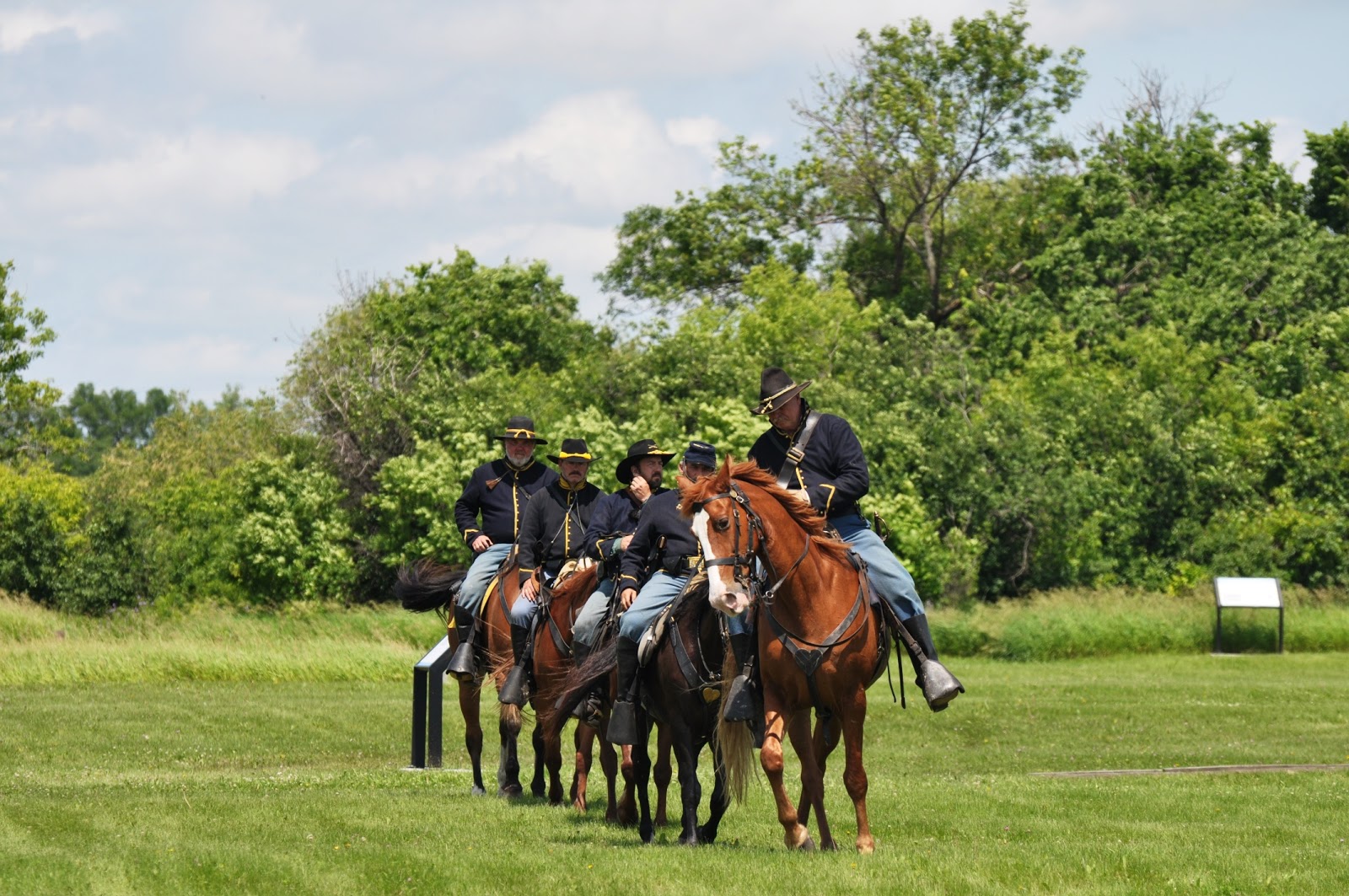
A few days later, I was at Fort Abercrombie south of Fargo, ND about twenty miles, on the day of the 135th anniversary of the Battle of the Little Bighorn (above). After the battle, Co. F of the 7th Cavalry, was brought to Fort Abercrombie. A group of reenactors of the 7th Cavalry were there. 


This group of the 7th Cavalry were conducting some drills on horseback (above).


One of the reenactors liked my presentation and my stuff, so he snapped this pic of me with my wintercount (above). I was in one of the blockhouses at the fort, Fort Abercrombie. Two of the 7th Cavalry reenactors were native, one an enrolled Cherokee and the other an enrolled Choctaw, both from Missouri. They really liked my combination of native regalia and cavalry, and invited me to participate in next year's civil war reenactment someplace in Missouri where natives fought for the Union and the Confederate States of America. I'd like to go, but I think that I'll wear the blue.


South of Mandan, ND about thirty miles on HWY 1806, is this interesting geophysical feature (above). It has at least four names I've heard, but my favorite is "Rain In The Face Butte." I took a long-time friend of mine down to Cannonball once and on our way I pointed this out on our drive. I told him that the Indians believe that this face looks up into the heavens to the face thats on Mars. I was so serious about it, and his reaction was a mix of confusion and wonder, that I waited a minute to tell him I was pulling his leg. The butte does resemble the profile of a person looking up though, and probably not to Mars.