Wednesday, September 11, 2013

Mní Nažúŋspe KawéğA (Broken Axe Lake), A Tragic Love Story

Mní Nažúŋspe Weǧáhaŋ (Broken Axe Lake)
Tragic Love Story: Painted Woods Revisited
By Dakota Wind
WASHBURN, N.D. – The story of tragic young love is universal. It is perhaps most widely known through the wonderful Shakespearean tale of Romeo and Juliet. It’s the age old tale of boy meets girl; a story of secret forbidden love. But whereas the story of Romeo and Juliet is fictional, this is a true story.

A summary of the tragedy is that a young Iháŋktȟuŋwaŋna (Yanktonai) man met a Miwátaŋni (Mandan; Nu’Eta, or The People as they know themselves) maiden during an intertribal trade one fall many winters ago near what was then known as Mní Nažúŋspe Weǧáhaŋ (Broke Axe Lake).

This young couple fell immediately and deeply in love. When trade ended, the young man elected to stay behind with his girl. This was the custom of the Miwátaŋni Indians that the man goes to live with his wife in her mother’s lodge. But they eloped.

The Miwátaŋni have the story that the Iháŋktȟuŋwaŋna killed the young woman, while the Iháŋktȟuŋwaŋna have it that the Miwátaŋni killed the young man.

Here is an excerpt of Colonel A.B. Welch’s Oral History Of The Dakota Tribes, 1800’s-1945, Story No. 32, Story Of Painted Lake [Note: In Welch’s version, the story entangles an Arikara maiden rather than a Mandan]:

A long time ago many Indian tribes, at war with each other, were encamped on the shores of the lake now known as “Painted Woods Lake,” but at that time known to the Sioux as “Broken Axe Lake.”

...Broken Axe Lake has passed into disuse.

A Sioux warrior flirted with an Arikara woman and they prepared to fly away.  But that night the Arikara men killed the Dakotah in the arms of newly-found love.

When the Dakotah discovered this murder, they all went to the tipi where the body lay, with the poor woman weeping over it.  They fitted arrows and shot her many times.  Then there was war for many years, and a dead tree trunk, white with age, was painted red by the Rees and their friends.  Whenever a war party of any Indians would pass that way, they would paint their war deeds upon the boles of certain dead trees as a taunt to their enemies.

Therefore, the place has become the Painted Woods place of the Indians, and the name Broken Axe Lake has passed into disuse. 

Wednesday, September 4, 2013

Pahá Kȟoškálaka: Young Man’s Butte

Pahá Kȟoškálaka: Young Man’s Butte
Plains Indian Warfare And Bravery
By Dakota Wind
RICHARDTON, N.D. – The Lakȟóta and the Kȟaŋğí (Crow) were once traditional enemies, that is, before the reservation era, these two tribes fought for war honors such as counting coup and stealing horses. Once in while however, these two tribes came together in great violent clashes that could not be called skirmishes, but battles.

At times warfare amongst the tribal nations in the pre-reservation era also involved the abduction of women and children. Sometimes a warparty might be mustered for the grim sake of revenge too.

The warparty that went out to steal horses did so, not just for war honors, but to keep the enemy off-balance. Having horses meant that a Thiyóšpaye, extended family, had the power to move a camp swiftly and further than those without horses. Horses meant a change in hunting too. No longer did the Oyáte, people, have to organize a community-wide effort to startle and direct a bison stampede over a cliff, which risked the safety of runners and scouts, and if unsuccessful, left them facing starvation.

Sometimes a horse raider might take advantage of a frenzied moment and on impulse abduct a woman too. That woman might then be married into the tribe. This was practical too as inter-tribal marriage, whether by formal trade or abduction, kept the blood lines open.

The young man’s self-sacrifice was regarded as gesture of great courage...

The John K. Bear winter count, a pictographic record of the Iháŋktȟuŋwaŋna Pabáska, Cuthead Yanktonai, recalls a full scale battle in 1710 as the year they wiped out another group whom they referred to as Wičóšawaŋ.

Cedric Goodhouse Sr. carries a story which came to him from his father, the late Innocent Goodhouse, about how a Lakȟóta horse-stealing raid to Crow country led to a young man stealing a woman there and bringing her back to his Thiyóšpaye. She grew to dearly love the Lakȟóta, and they her. When she took her journey, the Lakȟóta dressed her in her finest Crow regalia and took her home.

Another story handed down from Innocent Goodhouse was that a Lakȟóta Thiyóšpaye was camped at the base of Fire Heart Butte, north of the present-day North Dakota and South Dakota border just off HWY 1806. Late one night, the Crow made a successful horse-stealing raid to recover horses which were taken from them.

North of Spearfish, SD is the sight of Crow Buttes, where according to story, a Crow warparty were killed to the last man on the buttes there in a bloody standoff. Nine Crow Indians were shot and left there. A tragedy for certain, but also a story of bravery for not one of them pleaded for his life.

About three miles east of present-day Richardton, ND on the north side of I-94 is a little butte. It’s an unassuming hill and resembles many others on the western plains.  

The story goes, a long time ago, that a Crow hunting party numbering 106 came east to hunt. Perhaps drought drove bison east that summer, as drought drove the Húŋkpapȟa east across the Mníšoše, Missouri River, in 1863 to hunt bison which had migrated out of the dry airy region.

The Lakȟóta happened upon the Crow hunting party, immediately surrounded them, and fought them, for the Crow were not just hunting but trespassing on Lakȟóta territory. The Crow fought to the last, until there was one left, a young man.

The young Crow ascended the butte, whereupon he sang his last song. When he finished his song he took his own life rather than be taken by the Lakȟóta.  The young man’s self-sacrifice was regarded as gesture of great courage by the Lakȟóta who regarded the butte thereafter as a very significant and special place. From that day forward, they came to call it Pahá Kȟoškálaka, Young Man’s Butte.

Wednesday, August 28, 2013

Whitestone Hill 150 Years Later

Whitestone Hill 150 Years Later, 1863-2013
The Bloodiest Massacre On The Great Plains
By Dakota Wind
WHITESTONE HILL, N.D. – The wind blew in gusts across the vast open plains. The Dakota and Lakota people who have lived here for millennia are people of the stars, and some of them say too that they are people of the wind. The wind isn’t just the defining characteristic of prairie life, but a part of the indigenous culture.

The Dakota say that the patterns on ones’ fingertips indicate which direction the wind was blowing on the day of one’s birth. The swirling pattern on one’s crown was taken to mean not just the living presence of one’s spirit, but the wind that brings that spirit. Sometimes, a very powerful wind was even referred to as Táku Wakȟáŋ Škaŋškáŋ, Something With-Energy Is Moving About. Indeed, a Dakȟóta elder visiting from Crow Creek, SD declared that the strength of the wind was an indication that the spirits were there at Whitestone Hill.

On Saturday, August 24, 2013, over 300 people from across North Dakota and the Great Plains gathered at Whitestone Hill near Kulm, ND to remember the bloodiest massacre of Dakota Indians following the largest mass execution in the history of the United States, which involved thirty-eight of the Dakota Indians in Mankato, MN, Dec. 26, 1862.

Despite high winds, and green lodge assemblers, this beautifully painted lodge was set up.

On this day, someone from Lake Traverse, the Sisseton-Wahpeton Oyate, brought a beautifully painted thipí rendered in warm earth tones of red, orange, and brown with constellation patterns embellishing the outside of the lodge. A call went out for assistance to erect the lodge on that windy day and volunteers rushed to assist.

They say in the days of memory, that women could erect a lodge in as little as ten minutes. Their nomadic life way demanded a lifetime of practice, but on this day Dakȟóta women supervise a handful of non-native men, there’s even a Chippewa in the mix helping to get the lodge up.

Renowned and eminent flute-player and hoop dancer, and enrolled member of the Standing Rock Sioux Tribe, Kevin Locke, was called forward to begin the day with a prayer. At the end of the afternoon’s lectures and reflections, Locke would share the message of vision and unity of the human spirit with the hoop dance, traditional stories, and flute songs.

Locke performs the hoop dance, pictured here at Williston State College. 

Locke, known among the Dakȟóta and Lakȟóta as Tȟokéya Inážiŋ, The First To Arise, is also a descendant of Ta’Oyáte Dúta, His Red Nation, who is more widely known by the name Little Crow. Locke doesn’t make a public issue about his great-grandfather, probably because Tȟaóyate Dúta was not at Whitestone Hill, but had died of a gunshot wound in a field near Hutchinson, MN in a fight with a farmer.

One of Tȟaóyate Dúta’s sons, Mokáȟniȟya, had fled west to the Húŋkpapȟa and was among them in the running battle from Big Mound to Apple Creek. Mokáȟniȟya survived the Apple Creek conflict in late July by cutting a reed, grabbing a rock, and jumping into the Missouri River. There he waited until it was safe for him to cross. But this wasn’t a story that Locke shared at Whitestone Hill, it was a story shared with this writer in Locke’s home. Locke’s message this day was instead based on the ideal of what Dakȟóta is, as ally, as friend, and as peace.

Richard Rothaus, owner and director of Trefoil Natural and Cultural out of Minnesota, was invited to present about the causes of the 1862 Minnesota Dakota Conflict, and expertly tied the Dakota Conflicts in Minnesota and Dakota Territory to the American Civil War which was being waged concurrently in the south.

Aaron Barth, a historian and archaeologist from North Dakota State University, offered his thoughts about the Whitestone Hill massacre as an agent of genocide in American history. Barth facetiously suggested attaching cables to the current monument atop Whitestone Hill and pulling it down, but in seriousness suggested a memorial be erected on site honoring the Dakȟóta and Lakȟóta.


A local city band gathered together over the lunch hour and played music themes from popular movies and other pieces. The music, while rendered in the spirit of peace, seemed decidedly out of place. At one point the band played the theme made popular in the Rocky movies. A visitor from the Sisseton-Wahpeton Oyate observed that the music was very nice but out of place and jovially said during the Rocky theme, “That makes me feel like running to the top of the hill and raise my fists and shout, ‘We’re still here!’”

A panel discussion made up of members from the Sisseton-Wahpeton Oyate and the Standing Rock Sioux shared observations regarding the history and conflict of Whitestone Hill. LaDonna Brave Bull-Allard shared her grandmother’s story of survival when her people, the Iháŋktȟuŋwaŋna Pabáska, the Cuthead Yanktonai, came under sudden and unexpected fire.

The Cuthead Yanktonai band had been proponents of the United States since 1818 when their chieftain, Waná’at’á, The Charger, was released from an internment at Fort Snelling. The Charger led the Yanktonai in a siege under the command of Colonel Leavenworth against the Arikara in 1823. The Yanktonai had no reason to fear their American allies until General Sully brought the wrath of the soldiers on them at Whitestone Hill, Sept. 3-5, 1863.

A tribal elder from Crow Creek, and a descendant of Tȟóka Khuté, Shoots The Enemy, who was captured at Whitestone Hill and imprisoned at Fort Thompson, Dakota Territory (present-day South Dakota), articulated a short explanation of the site before he departed from Whitestone Hill that afternoon. In the Ihanktowana dialect, Wičhéyena, Whitestone Hill was never called or recognized as Whitestone Hill. They called it Pa IpuzA Nape Wakpana, Dry Bone [as in “Very Thirsty] Hill Creek. “They never called it ‘Whitestone Hill,’” insists Corbin Shoots The Enemy.

Shoots The Enemy shared the story that few young men were in the village as most were out hunting. Men who were past their warrior days stayed behind with elders and youth in the village. Among the chiefs who led thiyóšpaye, an extended family, at Whitestone Hill that day are: Nasúna Thaŋka (Big Head), Taȟča Ska (White Deer), Šuŋkáȟa Napíŋ (Wolf Necklace), Mahtó Wakáŋtuya (High Bear), Hotháŋke (Big Voice, Winnebago), Mahtó Nuŋpa (Two Bear), Wáğa (Cottonwood), Hoğáŋ Dúta (Red Fish), Mahtó KnaškiŋyAn (Mad Bear), Awáska (White With Snow), Waŋbdí Wanapȟéya (Eagle That Scares), Waŋbdí Maní (Walking Eagle), Waoŋzoği (With Pants, or Pantaloons), Čhaŋ Ičú (Takes The Wood), Waŋbdí Ska (White Eagle), Tȟóka Khuté (Shoots The Enemy), and Ziŋtkála Maní (Walking Bird).

These Itȟáŋčhaŋ, chiefs, led tens to hundreds in their thiyóšpaye. There were easily at least a thousand Ihanktowana at Whitestone Hill. Several tons of food were destroyed following the massacre, thousands of dogs were killed, and as many as three hundred Dakȟóta people lost their lives, and over a hundred were taken prisoner, most of whom were women and children.

Lakȟóta language instructor, Earl Bull Head, and an enrolled member of the Standing Rock Sioux Tribe, was called upon to share a song and story. A storyteller, Bull Head opened with a few jokes about his travels to Europe and his experiences with the world before sharing a story and song he originally composed for a friend who lost his son. Bull Head’s friend was caught up in misery and heartbreak. The song came to Bull Head to inspire his friend to live a good life; it was a call to redemption and forgiveness.

A stone circle, this one about five feet in diameter, rests on private land at the Whitestone Hill site.

A local landowner invited this writer to his land nearby to view some of the features not found at the Whitestone Hill State Historic Site. On top of a rolling hill were several stone circles, several about five feet across and one measured about fifty feet in diameter, and a few great heavy anvil stones bore evidence of shaping tools over thousands of years, which reminded this visitor once again that people were coming here millennia before the conflict.

Sunset at Stoney Lake, north of Tappen, ND. This is where the Lakota engaged General Sibley's command for the second time in July, 1863.

The day ended with a buffalo feed. A long lingering line gradually worked itself through the hundreds of visitors present. Plates were piled with great cuts of lean bison meat, hot steaming potatoes, warmed beans, and handmade biscuits. Conversation ebbed and flowed as the line shrunk. The wind gradually calmed to a breeze, which in the great shade a cottonwood, actually cooled the waiting hungry crowd.

My plate was piled high and heavy with food. I took a cup of lemonade and downed it before I made it back to my car. I was hungry and the smell of roasted meat nearly made me break my fast, but I couldn’t eat. I felt the impression of my grandmother, after all these years sometimes it seems like I can smell her or sense her watching me.

Sunset at Big Mound where Sitting Bull counted coup on one of Sibley's men. Sitting Bull also stole a mule from the line in a show of bravery. This was the first engagement that summer between the Lakota and Sibley's command, July 1863.

I drove off down the dusty gravel road, over the rolling grassy hills, and out of sight from the crowd. It may seem like waste to some, but it wasn’t to me. I pulled over onto the grass, took my plate, and carried it to the side of the road. I said no prayer or benediction. I didn’t call out or cry. I could not eat there when long ago my relatives were forced to go without. It is the custom of the Dakȟóta and Lakȟóta people to take food to our relatives who’ve taken their journey. 

Monday, August 12, 2013

The Origin Of Tokio

A log cabin with an awning near Spirit Lake.
Origin: Čhaŋbdáska Otȟúŋwahe (Tokio, ND)
Tókhiya (Where Is It) Is Where Its At
By Louie Garcia
SPIRIT LAKE, N.D. - The town of Tokio began in 1906 when Victor Ruth built a general store in anticipation of the Great Northern Railroads arrival. The story begins with the construction of the store building in the middle of nowhere. An unidentified elderly Indian observed the carpenters at work and asked Alex DuMarce, the local interpreter, what these crazy men were building. Mr. DuMarce or GuGu (Burnt) informed him a store was being built, where he could buy or trade for general merchandise. The elderly Indian only half understanding kept repeating “Tókhiya (Where)?" The carpenters remembered part of the word, and when it was time to pick a name for the new town, suggested Toki. Everyone agreed and the name was sent to J.J. Hill the President and Owner of the Great Northern Railroad. He disapproved, “we will just add an ‘o’, and call this place Tokio”. Unfortunately and incorrectly Mary Ann Williams in her book, Origins of North Dakota Place Names was informed the term "To-ki" means "a gracious gift." This error as continued on to this very day.

A hundred years ago when the Dakota language was used on a daily basis, Indian people had their own name for most of the local towns. The rational for this is obvious; the town names selected was foreign and difficult to pronounce for Native people. The official Indian name for Tokio is Čhaŋbdáska Otȟúŋwahe. Čhaŋ (Chahn) means wood; bdáska (b'DAH skah) means flat; and Otȟúŋwahe (oh-TOON-wah-hay) means a town. The name was used because Tokio was the only place in the area where you could buy ‘flat wood’ or lumber.

Tokio officially became a town when Victor Ruth became the first postmaster on January 26, 1907. The town is located in Section 2, T.151, R.64W, Woodlake Township, Benson County. Originally the town was to be located two miles north of the Doyle homestead, and named Revere, the railroad however changed the location. Today the postal Zip Code is 58379. The largest number of residents recorded was 112 in the 1930 and 1940 censuses. Today about 35 people live in the old townsite, but south, across the road over 200 people live in the Tribal Housing circle.

On August 29, 1907 the first train arrived in Tokio on the Great Northern Aneta line. In 1908 there was only the Ruth Store and Post Office. By the 1920’s Tokio reached its height. There were two stores, two poolrooms, one café, one beer hall, one restaurant, a bank, lumberyard, butcher shop, school, Catholic Church, three-grain elevators, and a blacksmith shop. The depression of 1929 killed the town, and people began to move away.
__________
Bibliography:
Origins of North Dakota Place Names: Benson, Cavalier, Pembina, Ramsey, and Walsh Counties. By Mary Ann Barnes Williams. Bismarck Tribune 1976, Page 14.

North Dakota Place Names by Douglas A. Wick. Prairie House, Fargo, ND 1989, Page 194.

Friday, August 9, 2013

The 1863 Apple Creek Conflict 150 Years Later

A composite panorama of Apple Creek from the northeast point of Pictured Bluff. The image is southwest (l) to north (r). 
The Dakota Conflict In Dakota Territory
The Apple Creek Conflict 150 Years Later
By Dakota Wind
BISMARCK, N.D. – The Mníšoše, Missouri River, moves determinedly along the ancient valley it has carved over thousands of years. The river flows in the very heart of the Great Plains, in fact, aside from the wind, it’s a defining feature of the prairie steppe. Its Lakȟóta name means “The Water A-stir” in reference to its muddy stirred up appearance in historic times. Commercial traffic on the river in the nineteenth century came to call it “The Big Muddy.”

Tȟaspáŋla Wakpála, Apple Creek, meanders along its own course from a field north and east of present-day Bismarck, N.D. The Menoken Indian Village rests along the quiet creek, a silent witness to trade in what archaeologists call the Late Woodlands period. The creek’s name refers to the tree that bears the tiny edible thorn apple.

Where the Tȟaspáŋla Wakpála converges with Mníšoše is Mayá Itówapi, Pictured Bluff. There, along the bluff are caves where the sediment is layered in colors. A testament to the changing climate throughout the ages of the world to the geologist, but to the Lakȟóta, it was a place to gather natural yellow and red pigments to create paint.

There was a conflict between the Pȟadáni (Arikara) and the Iháŋktȟuŋwaŋna (Yanktonai) in the 1830’s. According to the John K. Bear winter count the year is recorded as Čhaŋnóna na Pȟadáni ob thi apá kičhízapi, The Wood-Hitters (a band of the Iháŋktȟuŋwaŋna) fought with the Arikara. 


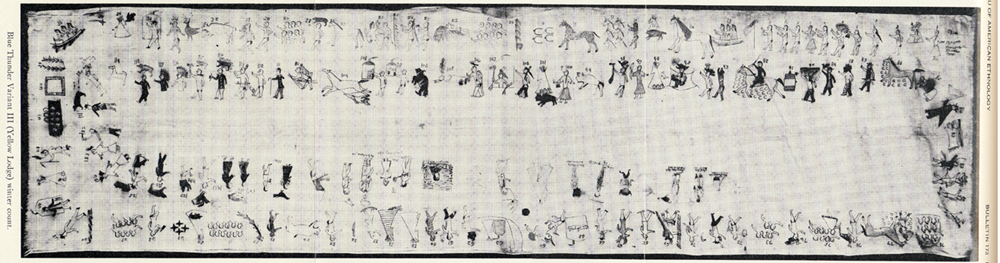
The Blue Thunder Winter Count, variant III.

The Waŋkíya Ťho, Blue Thunder, winter count correlates this event at a Dakota winter camp located below Čhaŋté Wakpá, Heart River. According to Blue Thunder, the assailants are variously identified as Arikara, Mandan, or Assiniboine. The Mandan Indians have the Foolish Woman winter count, and they record that they destroyed fifty lodges. The Tȟatȟaŋka Ska, White Bull, winter count has that winter as Wičhíyela waníyetu wičhákasotapi, the Yanktonai were almost wiped out that winter.

The John K. Bear winter count also mentions the Dakota Conflict in its 1863 entry: Isáŋyatí wašíčuŋ ob okȟíčize, the Santee warred with the whites. The Minnesota Dakota conflict is also reflected in the Red Horse Owner, Roan Bear, and Wind winter counts.

Clell Gannon, a depression era artist, painted this scene of General Sibley's command in pursuit of the Sioux. The painting can be found in the south vestibule of the Burleigh County Courthouse, Bismarck, ND.

The fight between the two tribes paled in comparison when in 1863, General Sibley and his command of about four thousand soldiers engaged the Dakȟóta and Lakȟóta people in a running battle lasting two weeks, from Big Mound (near present-day Tappen, N.D.) to Pictured Bluff.

Sitting Bull counts coup on one of Sibley's men and steals a mule at the Big Mound Conflict. The image was Sitting Bull's own account, from "Sitting Bull's Heiroglyphic Autobiography" which appears in Stanley Vestal's "Sitting Bull: Champion Of The Sioux."

In Tȟatȟáŋka Íyotake’s, Sitting Bull’s, own pictographic account, he placed himself at Big Mound where he rode into Sibley’s camp, stole a mule, and counted coup. It is almost entirely certain that if this great leader was at the beginning of the running battle, he was there to the end at Pictured Bluff.


The running battle began as a masterful retreat on July 24, 1863, across hilly terrain in a sinuous line back and forth across streams. This constant crossing, in effect, caused Sibley to lag behind enough for the Dakȟóta and Lakȟóta to gain enough lead time that the women, children, and elders could navigate their crossing waŋna hiyóȟpayA Tȟaspáŋla Wakpála hená Mníšoše, where the Apple Creek converges with the Missouri River.

That critical crossing came on July 29, 1863. The oyáte, people, abandoned their thiíkčeka, lodges, on the broad flood plain of the Mníšoše. A thousand lodges encircled two little lakes, sloughs in later years. They crossed the Mníšoše in as many as five places below Pictured Bluff. The warriors rallied together, perhaps under the leadership of Tȟatȟáŋka Íyotake or Phizí (Gall), and took the high ground a-top Pictured Bluff.

The women, children, and elders who made a successful crossing signaled the warriors with flashes of sunlight using trade mirrors. The warriors in turn, signaled back to their loved ones then they turned their attention to Sibley’s command. There is no exact number of warriors, but if there were a thousand lodges, then there was at least one able-bodied man or warrior per lodge. Using this projection, the warriors were outnumbered four-to-one.


Sibley and his men arrived on the scene, July 29, 1863, to witness flashes of light in communiqué to those in safety across the river. The general struck camp and named it “Camp Slaughter” after a doctor in his command. Over the course of the next few days, Sibley could not take the hill and some of his men were ambushed in the middle of the night. The morale of his soldiers suffered and on July 31, withdrew his men from the field when the enemy seemingly disappeared.

The Apple Creek Conflict is the only fight in the Punitive Campaigns of 1863 & 1864 in which the Dakȟóta and Lakȟóta chose the battlefield, met their aggressor, and held them off until they withdrew. This clear victory became entirely overshadowed by the tragedies of Iŋyáŋsaŋ (Whitestone Hill) and Tȟáȟča Wakútepi (Killdeer), and the victory of Pȟežísluta, the Battle of the Little Bighorn in 1876.


An unknown, or perhaps forgotten, artist pictographed this scene which was originally identified by Mike Cowdrey as "The Battle Of Whitestone Hill," but is quite possibly a Yanktonai account of the Apple Creek Conflict.

Susan Kelly Power, an esteemed uŋčí (grandmother) of the Iháŋktȟuŋwaŋna Dakȟóta and enrolled member of the Standing Rock Sioux Tribe and great-granddaughter of Chief Two Bear, has the oral tradition that places three warriors there at the Apple Creek Conflict: Callous Leg, Little Soldier, and Has Tricks. There must certainly be more warriors and oral traditions amongst the Iŋyáŋ Wosláta Oyáŋke, the community of Standing Rock, and others.

Today, a park named for General Sibley rests virtually where his Camp Slaughter once stood, where some of the Dakȟóta and Lakȟóta made their crossing. Bismarck has turned a battlefield into a place of recreation. There is no signage explaining the name of the park, nor of the conflict.

The landscape has been appropriated and development has erased the battlefield; Dakȟóta and Lakȟóta oral tradition recalls that the soldiers chased the people into the river. 

On July 29, 2013, 150 years after Sibley’s command withdrew entirely from the Apple Creek Conflict, the anniversary passed in silence. 

Thursday, August 8, 2013

Wamduska Bde: The Origin Of Stump Lake

Sunset at Stump Lake, N.D. Photo By Aaron Barth, The Edge Of The Village.
Wamduska Bde: Serpent Lake
The Origin Of Stump Lake
By Louie Garcia, Spirit Lake Oyate
SPIRIT LAKE, N.D. - They say a long time ago that there was no Stump Lake. The story goes that an underground fire, possibly a vein of coal, burned continuously for about forty years. The ground caved in upon itself, and water from nearby Spirit Lake rushed in to fill it. The tree stumps protruded from the lake inspired the Metis to call it Lac du Chilots, Lake of Snags, or Stump Lake.

The Dakota who lived in the region say that there's an ancient entity that inhabits Stump Lake, a great serpent they call in their language Wamduska, which means Creeping Thing or Serpent, which is one of sixteen spirits of Unktehi, or Large Water Monster. The Dakota came to call the new lake Wamduska Bde, or Lake of the Serpents.

The explorers, traders, and then settlers chose to call it Stump Lake. A name that reflects the natural history of the lake. Lake of the Serpents might have kept people away. 

Today Stump Lake is a place for recreation. Among the many events, which one might call the culture of North Dakota, are a threshing bee, a polka fest, craft shows, music & art, and a country fair. Visit Stump Lake Park for more information.