.jpg)
Tȟaté’káoškokpa (Canyon
Made-By-Wind), or Wind Canyon, along the Heȟáka Tȟa Wakpá (River Of Elk; Little
Missouri River) in Makȟóšíća (Badlands, N.D.; Theodore Roosevelt National
Park).
The Wind Is The Spirit Of The Great Plains
The Sky In Word, Pictograph, And Sign
By Dakota Wind
THE GREAT PLAINS - The wind has been a constant presence on the open prairie since creation, and has shaped the landscape with its caress. It races across the open sky with the summer and winter storms, and flows about the landscape playfully, fitfully, and angrily. It is the very essence of the Great Plains. The Lakȟóta have several words for the wind and its attributes such as tȟaté (air in motion), uyá (to blow leeward of the wind), kaȟwókA (to be carried along with the wind), ikápȟaŋyaŋ (to be beaten down by the wind, as with grass) or itáglaȟweya (with the wind). OkáluzA, or ičáluzA, refers to a breeze.
When a strong wind is present, or suddenly appears, during prayer or at a gathering, the wind might even be referred to as takú wakȟáŋ škaŋškáŋ (something with great energy is moving). A whirlwind is called tȟatéiyumni, which some regard as a sign that a spirit is present.
There is only one word to describe a windless day, ablákela (calm or quiet).
When the wind blows cold, such as it does in the winter months, the Lakȟóta refer to it as tȟatóšni. The cold winter wind had a story of its own, and in the days of legend, before steamboats and trains, before soldiers and missionaries, when the camps moved across the prairie steppe in the fall to establish winter camps, they told the story of Wazíya, that which some call a giant, or the Power Of The North. Wazíya blew his cold breath across the world.
The blizzard is known to the Lakȟóta as Iwóblu.
But even the wind has an origin. There are various stories about the wind, but the basics are that after creation, Tȟaté (Wind) took the daughter of Old Man and Old Woman, Ité (Face) as his wife. They had four sons, the Four Winds. Iŋktómi, the Lakȟóta trickster, persuaded Ité to begin an affair with Wí (the Sun) to gain status.
The affair backfired, and Takú Wakȟáŋ Škaŋškáŋ gave Haŋwí (the Moon) her own domain, and sent Old Man and Old Woman to earth along with Ité. Ité was ever after parted from her husband, Tȟaté, and their four sons. Ité, however, had a fifth son, Tȟatéiyumni (Whirlwind). Woȟpá (Falling Star Woman), daughter of Wí and Haŋwí, was sent to earth. Woȟpá became the wife of Okáǧa (the South Wind) and they raised Tȟatéiyumni as their son.
They say as the summer wanes and turns to autumn, the wind changes with the weather. That change in the wind is the breath of North. The cold was and is deadly, never to be feared, but respected. The North spreads his robe across the sleeping land. The North makes hunting game easier to track. In fact, the Lakȟóta used to dance in snowshoes in the blanket of the first snowfall. They rejoiced in the weather and embraced the deep cold.
In the spring or autumn mornings, in the early morning just as the sun rises, there appears a mist. The Lakȟóta call this Aŋptȟáŋiya. Regular fog is P'ó.
Sometimes the winter seems like it will never end, even for people who’ve lived here for thousands of years. Gray skies smother the light for days on end. Everywhere the land is monochrome. Months without color took its toll on the people. These days it’s called Seasonal Affective Disorder (SAD).
For the Lakȟóta people, even the winter holds the promise of light and hope.
On cold days one might see what they call a sundog, but its not every cold day that features a sundog. The ancient Greeks called it a “mock sun.” The Romans called it a “double sun.” The English in the early 1400s said the sundog was a representation of the Holy Trinity.
 This Campfire-Of-The-Sun is seen here above the Mníšoše (Water-Astir; Missouri River) and Iŋyáŋ Wosláta Oyáŋke (Where Standing Rock Dwells), the Standing Rock Sioux Indian Reservation
The Lakȟóta call the sundog Wíačhéič’ithi which means The Sun Makes A Campfire For Itself. The story of this beautiful name for this awesome phenomenon comes to me from Cedric Good House: A long time ago the people experienced several days of bleak grayness. People began experiencing bad dreams and others became depressed. It was the bad dreams that haunted the grandchildren that moved a grandfather to leave his village to pray for an end to the grayness. When he returned he called everyone in to the center of the village and selected two groups of young men to go the east of the camp and build two campfires. They did as they were told and returned to the camp where the people prayed. A lightening of the grayness indicated that morning had arrived. The clouds broke and the sun burst through the grayness. As the sun rose above the horizon, the campfires ascended into the sky with it. The people rejoiced and sang.
Just as there are several words for wind, the Lakȟóta have some words for clouds, which are of the sky. Maȟpíya in itself is a reference to the sky, or heavens. Maȟpíya tȟó, is the blue sky. Maȟpíya šápe is dark clouds. Maȟpíya akáȟpA is a cloudy overcast. Maȟpíya naȟléčA literally “the sky tears,” is a reference to a cloud burst of rain. Maȟpíya okáksaksa is partly cloudly. Maȟpíyaya is cloudy. Čhumaȟpiya means “dew clouds” or “vapor clouds.” Op’ó is a cloud of dust or steam. OkpúkpA is cloudy, hazy, or unclear. Makȟóp’oya is a cloud of dust.
When the Christian missionaries arrived they needed to articulate the Kingdom of Heaven, and coined the term Maȟpíya Wókičhuŋze, which literally means “Kingdom of the Sky.”
 The northern lights above North Dakota. Unknown photographer.
The northern lights mean something very special to the Lakȟóta. Maȟpíya Tȟaŋíŋ is the northern lights, but is literally, “Buffalo-hair Sky.” Wanáği Tȟawáčhipi, a reference for the northern lights meaning “Dance Of The Spirits,” and there’s a story, or experience, about out there but it won't be shared here. Haŋwákȟaŋ, another word for the northern lights, literally means “Night With-Energy.” It was a tradition of some Lakȟóta to burn incense, sweet-grass or cedar, when the northern lights appeared.
Sometimes, just as there is no wind, there are no clouds in the sky. There are a few ways of describing a day without clouds: Maȟpíya waníče, there are no clouds. Waŋžíla Tȟo, blue oneness or complete blueness, or tȟowáŋžiča, the sky is blue.
In the spring or summer, storms or rainfall strikes in daylight. The Lakȟóta have the tradition that the Wakíŋya, Thunder-Beings, bring the storms, but not just to bring rain. Lightning flashes from their eyes, claws, and wings. With lightning and rain the Wakíŋya cleansed the earth and destroyed or perhaps chased out the negative entities which settled into the lands. At the end of daylight storms the plains are treated to rainbows stretching from horizon to horizon, a grand arch reaching to heaven.
In the blistering summer months mirages appear on the horizons. The Lakȟóta call this shimmer of air at the edge of the earth Mašténaptapta.
The Lakȟóta refer to rainbows as Wígmuŋke, A Snare. It is said that the wígmuŋke, causes the storm to end by trapping it, so that no more rain can fall. No one points at wígmuŋke with their fingers, but use their lips or elbows if they gesture to it.
In the spring, the wind signals another change. The Lakȟóta call this wind Niyá Awičhableze, The Enlightening Breath. This is the first spring wind upon which the meadowlarks return. It’s the time of year in which the Lakȟóta carefully watch for the ice to break on the Mníšoše, the Water-Astir (Missouri River), the geese return, and when the bison bear their calves.
One of the names that the Lakȟóta people have for the courting flute is Wayážo, which means To Play A Flute. It is the essence of the wind. Flutes are traditionally made from red cedar. The heart of the wood, the soft red center, is removed with the intention of that space becoming filled with the flute-maker’s own heart. Breath flows through the flute and the wind carries its haunting song.
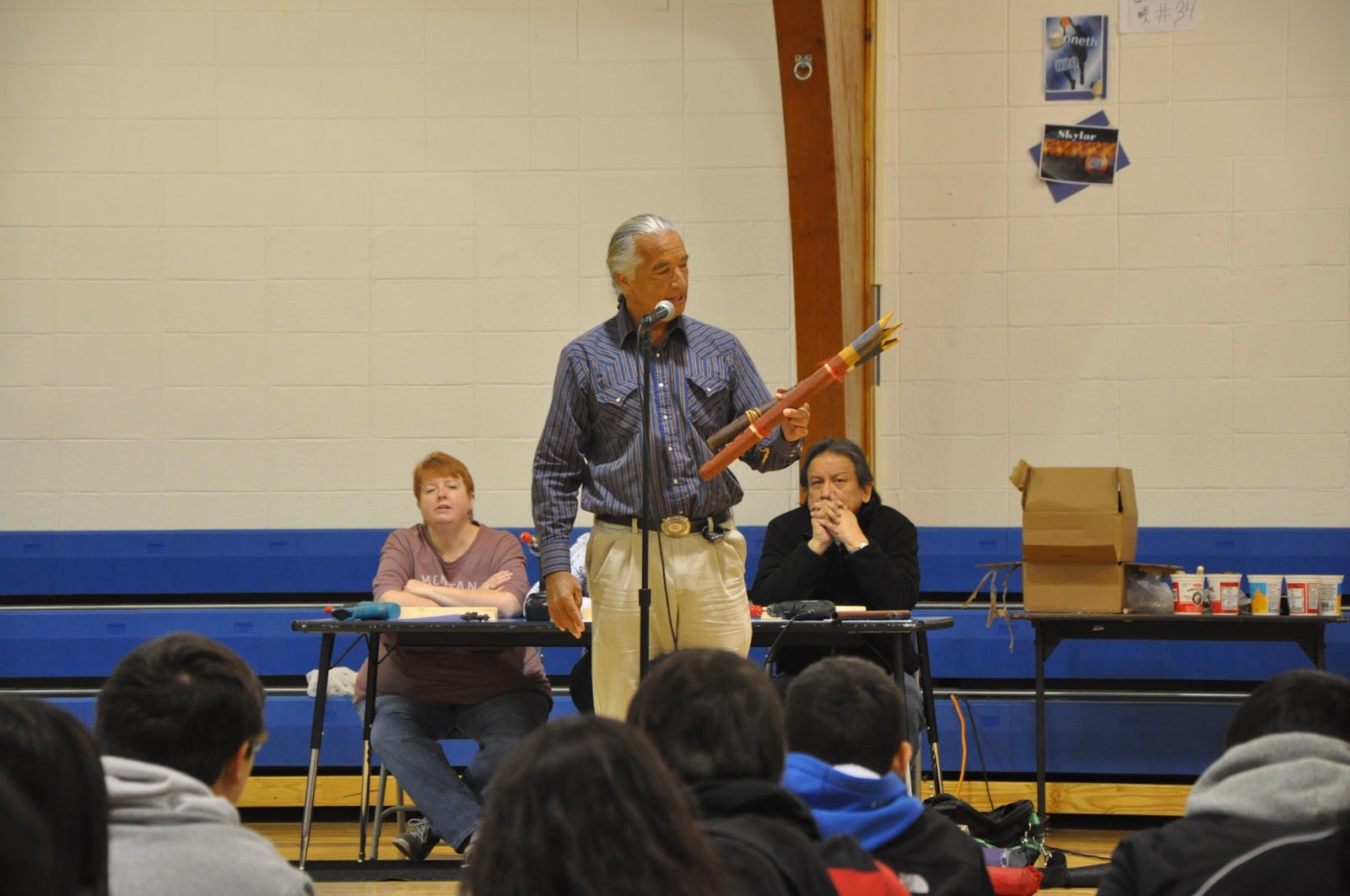
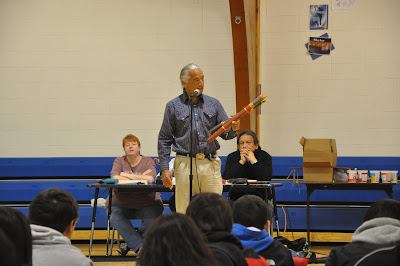 Tȟokéya Inažiŋ (The First To Arise; Kevin Locke) here with his great-grandfather's flute, shares the flute tradition with youth on the Standing Rock Sioux Indian Reservation.
In a discussion with Deacon Terry Star, enrolled member of the Standing Rock Sioux Tribe, about the wind and the flute, Deacon Star shared that he heard the four winds were brothers who represented the four cardinal directions. The West Wind, according to how Deacon Star heard it, didn’t just bring the thunderstorms, but also played the flute.
The wind, clouds, northern lights, and rainbow are expressed in the non-speaking languages of the Great Plains too.
In pictography, the wind is represented by a series of straight lines ending in a curly-cue or wave, and more lines indicate the strength of the wind. A whirlwind is represented by a swirl of four lines spiraling outward from the center of a circle. Clouds are represented sometimes by a simple line drawing of a cloud, but generally clouds are almost always depicted with rain and lightning. An arch above a straight line is a representation of the sky above the earth.
A pictograph for northern lights may be represented by night (a darkened circle with a line running through it top to bottom; or other variant) and fire (above the image depicting night). A rainbow is depicted by a series of arches over a straight line.
 Dr. Jesse Johnson (Cheyenne River Lakota), center, in front of a thípi.
In the sign and gesture language of the American Indians, there is a sign for wind as well. In a communiqué from Dr. Jesse Johnson, Blú Wakpá (Powder River), enrolled member of the Cheyenne River Sioux Tribe, the sign for wind takes a few forms, but its most basic execution involves holding the hands up, backs up at about shoulder height, fingers spread, and moving hands in a wavy tremulous motion in the direction of the wind.
Like pictography, the Plains Indian sign for cloud or clouds is inseparable from rain or lightning. The sign for rain consists of holding one’s hands up at shoulder height and drawing one’s hands down slowly two to three times. Kevin Locke, enrolled member of the Standing Rock Sioux Tribe, draws his hands down, backs up, and does “piano fingers” to sign rain. Lightning is signed by miming a jagged lightning pattern in mid air with either hand.
According to Dr. Johnson’s research into the Plains Indian sign language, the northern lights are depicted as “both hands, backs down, half closed, thumb and finger tips together, raised very high and spread with a sweep to indicate flashes. It should be done facing north.” Johnson adds that the sign is helped if the hands are swung apart in an arc at the highest point in executing the sign.
 Wáǧačhaŋ (Cottonwood) on the floodplain of the Heȟáka Tȟa Wakpá.
The constant wind blowing across the open prairie steppe and through a vast open sky is a part of the Lakȟóta culture, or perhaps it is that the Lakȟóta are a part of the wind. They say that patterns on one’s fingertips indicate the direction the wind was blowing on the day of one’s birth.
The Lakȟóta have the saying Takú šičá owás’iŋla kaȟwóg iyáyiŋ kte ló, which means, "All the bad things will blow away."
On the vast open plains, grasses bow down and sway in motion as if in dance. Great cottonwood trees catch the winds and rattle their leaves in a deafening roar, like the crash of waves in the distant oceans. These ancient trees catch the smallest breeze and their leaves shush the world.
Le tȟaté na maȟpíya tȟa makȟóčhe hečha lo. This is the land of sky and wind.
Terry Star is an enrolled member of the Standing Rock Sioux Tribe. His traditional Dakȟóta name is Ȟé Ská, White Mountain, after Mount Rainier of which the top of the mountain bears snow year round. He is a deacon in the Episcopal Church and is currently a candidate for the Master of Divinity at Nashotah House Theological Seminary in Wisconsin. Star was raised by his late grandmother, Lillian Ironbull Martinez in the traditions of the church and the Dakota. For several years he has served as a youth pastor on Standing Rock and has frequently called on the stories he received from Lillian and her friends to relate biblical ones to the youth.
Jesse Johnson is an enrolled member of the Cheyenne River Sioux Tribe. His traditional Lakȟóta name is Blú Wakpá, Powder River, after Čhaȟlí Wakpá, which means Charcoal River and is the proper place name of Powder River. Johnson graduated with his Ph.D. in American Indian Studies. In his spare time Johnson teaches martial arts.
GLOSSARY:
Ablákela: Quiet, or windless, calm
Aŋptȟáŋiya: Vapor, mist that arises in the early morning
Čhumaȟpiya: Dew Clouds, Vapor Clouds
Haŋwákȟaŋ: Night-With-Energy, Northern Lights
Haŋwí: Moon
Heȟáka Tȟa Wakpá: River Of Elk, Little Missouri River
IčáluzA: Breeze
Ikápȟaŋyaŋ:To-Be-Beaten-Down-By-The-Wind
Iŋktómi: Trickster
Iŋyáŋ Wosláta Oyáŋke: Standing Rock Agency
Itáglaȟweya: With-The-Wind
Ité: Face
Iwóblu: Blizzard
KaȟwókA: To-Be-Carried-Along-With-The-Wind
Maȟpíya: Cloud, Sky, Heaven
Maȟpíya AkáȟpA: Clouds Overcasted
Maȟpíya NaȟléčA: The Sky Tears, a cloud burst of rain
Maȟpíya Okáksaksa: Partly Cloudy
Maȟpíya Šápe: Dark Clouds
Maȟpíya Tȟaŋíŋ: Buffalo-Hair Sky, Northern Lights
Maȟpíya Tȟó: Blue Sky
Maȟpíya Waníče: No-Clouds, Cloudless
Maȟpíya Wókičhuŋze: "Kingdom of Heaven"
Maȟpíyaya: Cloudy
Makȟóp’oya: A cloud of dust
Makȟóšíća: Badlands
Mašténaptapta: Sunlight-Waving, shimmer on the horizon on a hot day, mirage
Mníšoše: Water-Astir, Missouri River
Niyá Awičhableze: Enlightening Breath, spring wind
Okáǧa: South Wind
OkáluzA: Breeze
Op’ó: A cloud of dust or steam
OkpúkpA: Haze
P'ó: Fog
Takú Wakȟáŋ Škaŋškáŋ: Somthing With-Energy Moves/Moving; often contracted to Takú Škaŋškáŋ (Something Moving), or when talking about creation, simply Škaŋ.
Tȟaté: Air-In-Motion, Wind
Tȟatéiyumni: Whirlwind
Tȟaté’káoškokpa: Canyon Made-By-Wind, Wind Canyon
Tȟatóšni: Cold Wind
Tȟowáŋžiča: Completely Blue, Blue Oneness, a completely blue sky
Uyá: To-Blow-Leeward-Of-The-Wind
Wáǧačhaŋ: Cottonwood
Wakíŋya: Thunder
Wanáği Tȟawáčhipi: Dance of The Spirits, Northern Lights
Waŋžíla Tȟo: Complete Blueness, Blue Oneness, a completely blue sky
Wayážo: To-Play-The-Flute, Flute
Wazíya: Lit. Pine, Power-Of-The-North, also a name of the North Wind
Wí: Sun
Wíačhéič’ithi: The Sun Makes A Campfire For Itself, Sundog
Wígmuŋke: Snare, Rainbow
Woȟpá: Meteor, Falling Star
They say as the summer wanes and turns to autumn, the wind changes with the weather. That change in the wind is the breath of North. The cold was and is deadly, never to be feared, but respected. The North spreads his robe across the sleeping land. The North makes hunting game easier to track. In fact, the Lakȟóta used to dance in snowshoes in the blanket of the first snowfall. They rejoiced in the weather and embraced the deep cold.
In the spring or autumn mornings, in the early morning just as the sun rises, there appears a mist. The Lakȟóta call this Aŋptȟáŋiya. Regular fog is P'ó.
Sometimes the winter seems like it will never end, even for people who’ve lived here for thousands of years. Gray skies smother the light for days on end. Everywhere the land is monochrome. Months without color took its toll on the people. These days it’s called Seasonal Affective Disorder (SAD).
For the Lakȟóta people, even the winter holds the promise of light and hope.
On cold days one might see what they call a sundog, but its not every cold day that features a sundog. The ancient Greeks called it a “mock sun.” The Romans called it a “double sun.” The English in the early 1400s said the sundog was a representation of the Holy Trinity.

The Lakȟóta call the sundog Wíačhéič’ithi which means The Sun Makes A Campfire For Itself. The story of this beautiful name for this awesome phenomenon comes to me from Cedric Good House: A long time ago the people experienced several days of bleak grayness. People began experiencing bad dreams and others became depressed. It was the bad dreams that haunted the grandchildren that moved a grandfather to leave his village to pray for an end to the grayness. When he returned he called everyone in to the center of the village and selected two groups of young men to go the east of the camp and build two campfires. They did as they were told and returned to the camp where the people prayed. A lightening of the grayness indicated that morning had arrived. The clouds broke and the sun burst through the grayness. As the sun rose above the horizon, the campfires ascended into the sky with it. The people rejoiced and sang.
Just as there are several words for wind, the Lakȟóta have some words for clouds, which are of the sky. Maȟpíya in itself is a reference to the sky, or heavens. Maȟpíya tȟó, is the blue sky. Maȟpíya šápe is dark clouds. Maȟpíya akáȟpA is a cloudy overcast. Maȟpíya naȟléčA literally “the sky tears,” is a reference to a cloud burst of rain. Maȟpíya okáksaksa is partly cloudly. Maȟpíyaya is cloudy. Čhumaȟpiya means “dew clouds” or “vapor clouds.” Op’ó is a cloud of dust or steam. OkpúkpA is cloudy, hazy, or unclear. Makȟóp’oya is a cloud of dust.
When the Christian missionaries arrived they needed to articulate the Kingdom of Heaven, and coined the term Maȟpíya Wókičhuŋze, which literally means “Kingdom of the Sky.”
The northern lights mean something very special to the Lakȟóta. Maȟpíya Tȟaŋíŋ is the northern lights, but is literally, “Buffalo-hair Sky.” Wanáği Tȟawáčhipi, a reference for the northern lights meaning “Dance Of The Spirits,” and there’s a story, or experience, about out there but it won't be shared here. Haŋwákȟaŋ, another word for the northern lights, literally means “Night With-Energy.” It was a tradition of some Lakȟóta to burn incense, sweet-grass or cedar, when the northern lights appeared.
Sometimes, just as there is no wind, there are no clouds in the sky. There are a few ways of describing a day without clouds: Maȟpíya waníče, there are no clouds. Waŋžíla Tȟo, blue oneness or complete blueness, or tȟowáŋžiča, the sky is blue.
In the spring or summer, storms or rainfall strikes in daylight. The Lakȟóta have the tradition that the Wakíŋya, Thunder-Beings, bring the storms, but not just to bring rain. Lightning flashes from their eyes, claws, and wings. With lightning and rain the Wakíŋya cleansed the earth and destroyed or perhaps chased out the negative entities which settled into the lands. At the end of daylight storms the plains are treated to rainbows stretching from horizon to horizon, a grand arch reaching to heaven.
In the blistering summer months mirages appear on the horizons. The Lakȟóta call this shimmer of air at the edge of the earth Mašténaptapta.
The Lakȟóta refer to rainbows as Wígmuŋke, A Snare. It is said that the wígmuŋke, causes the storm to end by trapping it, so that no more rain can fall. No one points at wígmuŋke with their fingers, but use their lips or elbows if they gesture to it.

In the spring, the wind signals another change. The Lakȟóta call this wind Niyá Awičhableze, The Enlightening Breath. This is the first spring wind upon which the meadowlarks return. It’s the time of year in which the Lakȟóta carefully watch for the ice to break on the Mníšoše, the Water-Astir (Missouri River), the geese return, and when the bison bear their calves.
One of the names that the Lakȟóta people have for the courting flute is Wayážo, which means To Play A Flute. It is the essence of the wind. Flutes are traditionally made from red cedar. The heart of the wood, the soft red center, is removed with the intention of that space becoming filled with the flute-maker’s own heart. Breath flows through the flute and the wind carries its haunting song.
In a discussion with Deacon Terry Star, enrolled member of the Standing Rock Sioux Tribe, about the wind and the flute, Deacon Star shared that he heard the four winds were brothers who represented the four cardinal directions. The West Wind, according to how Deacon Star heard it, didn’t just bring the thunderstorms, but also played the flute.
The wind, clouds, northern lights, and rainbow are expressed in the non-speaking languages of the Great Plains too.
In pictography, the wind is represented by a series of straight lines ending in a curly-cue or wave, and more lines indicate the strength of the wind. A whirlwind is represented by a swirl of four lines spiraling outward from the center of a circle. Clouds are represented sometimes by a simple line drawing of a cloud, but generally clouds are almost always depicted with rain and lightning. An arch above a straight line is a representation of the sky above the earth.
A pictograph for northern lights may be represented by night (a darkened circle with a line running through it top to bottom; or other variant) and fire (above the image depicting night). A rainbow is depicted by a series of arches over a straight line.
In the sign and gesture language of the American Indians, there is a sign for wind as well. In a communiqué from Dr. Jesse Johnson, Blú Wakpá (Powder River), enrolled member of the Cheyenne River Sioux Tribe, the sign for wind takes a few forms, but its most basic execution involves holding the hands up, backs up at about shoulder height, fingers spread, and moving hands in a wavy tremulous motion in the direction of the wind.
Like pictography, the Plains Indian sign for cloud or clouds is inseparable from rain or lightning. The sign for rain consists of holding one’s hands up at shoulder height and drawing one’s hands down slowly two to three times. Kevin Locke, enrolled member of the Standing Rock Sioux Tribe, draws his hands down, backs up, and does “piano fingers” to sign rain. Lightning is signed by miming a jagged lightning pattern in mid air with either hand.
According to Dr. Johnson’s research into the Plains Indian sign language, the northern lights are depicted as “both hands, backs down, half closed, thumb and finger tips together, raised very high and spread with a sweep to indicate flashes. It should be done facing north.” Johnson adds that the sign is helped if the hands are swung apart in an arc at the highest point in executing the sign.

The constant wind blowing across the open prairie steppe and through a vast open sky is a part of the Lakȟóta culture, or perhaps it is that the Lakȟóta are a part of the wind. They say that patterns on one’s fingertips indicate the direction the wind was blowing on the day of one’s birth.
The Lakȟóta have the saying Takú šičá owás’iŋla kaȟwóg iyáyiŋ kte ló, which means, "All the bad things will blow away."
On the vast open plains, grasses bow down and sway in motion as if in dance. Great cottonwood trees catch the winds and rattle their leaves in a deafening roar, like the crash of waves in the distant oceans. These ancient trees catch the smallest breeze and their leaves shush the world.
Le tȟaté na maȟpíya tȟa makȟóčhe hečha lo. This is the land of sky and wind.
Terry Star is an enrolled member of the Standing Rock Sioux Tribe. His traditional Dakȟóta name is Ȟé Ská, White Mountain, after Mount Rainier of which the top of the mountain bears snow year round. He is a deacon in the Episcopal Church and is currently a candidate for the Master of Divinity at Nashotah House Theological Seminary in Wisconsin. Star was raised by his late grandmother, Lillian Ironbull Martinez in the traditions of the church and the Dakota. For several years he has served as a youth pastor on Standing Rock and has frequently called on the stories he received from Lillian and her friends to relate biblical ones to the youth.
Jesse Johnson is an enrolled member of the Cheyenne River Sioux Tribe. His traditional Lakȟóta name is Blú Wakpá, Powder River, after Čhaȟlí Wakpá, which means Charcoal River and is the proper place name of Powder River. Johnson graduated with his Ph.D. in American Indian Studies. In his spare time Johnson teaches martial arts.
GLOSSARY:
Ablákela: Quiet, or windless, calm
Aŋptȟáŋiya: Vapor, mist that arises in the early morning
Čhumaȟpiya: Dew Clouds, Vapor Clouds
Haŋwákȟaŋ: Night-With-Energy, Northern Lights
Haŋwí: Moon
Heȟáka Tȟa Wakpá: River Of Elk, Little Missouri River
IčáluzA: Breeze
Ikápȟaŋyaŋ:To-Be-Beaten-Down-By-The-Wind
Iŋktómi: Trickster
Iŋyáŋ Wosláta Oyáŋke: Standing Rock Agency
Itáglaȟweya: With-The-Wind
Ité: Face
Iwóblu: Blizzard
KaȟwókA: To-Be-Carried-Along-With-The-Wind
Maȟpíya: Cloud, Sky, Heaven
Maȟpíya AkáȟpA: Clouds Overcasted
Maȟpíya NaȟléčA: The Sky Tears, a cloud burst of rain
Maȟpíya Okáksaksa: Partly Cloudy
Maȟpíya Šápe: Dark Clouds
Maȟpíya Tȟaŋíŋ: Buffalo-Hair Sky, Northern Lights
Maȟpíya Tȟó: Blue Sky
Maȟpíya Waníče: No-Clouds, Cloudless
Maȟpíya Wókičhuŋze: "Kingdom of Heaven"
Maȟpíyaya: Cloudy
Makȟóp’oya: A cloud of dust
Makȟóšíća: Badlands
Mašténaptapta: Sunlight-Waving, shimmer on the horizon on a hot day, mirage
Mníšoše: Water-Astir, Missouri River
Niyá Awičhableze: Enlightening Breath, spring wind
Okáǧa: South Wind
OkáluzA: Breeze
Op’ó: A cloud of dust or steam
OkpúkpA: Haze
P'ó: Fog
Takú Wakȟáŋ Škaŋškáŋ: Somthing With-Energy Moves/Moving; often contracted to Takú Škaŋškáŋ (Something Moving), or when talking about creation, simply Škaŋ.
Tȟaté: Air-In-Motion, Wind
Tȟatéiyumni: Whirlwind
Tȟaté’káoškokpa: Canyon Made-By-Wind, Wind Canyon
Tȟatóšni: Cold Wind
Tȟowáŋžiča: Completely Blue, Blue Oneness, a completely blue sky
Uyá: To-Blow-Leeward-Of-The-Wind
Wáǧačhaŋ: Cottonwood
Wakíŋya: Thunder
Wanáği Tȟawáčhipi: Dance of The Spirits, Northern Lights
Waŋžíla Tȟo: Complete Blueness, Blue Oneness, a completely blue sky
Wayážo: To-Play-The-Flute, Flute
Wazíya: Lit. Pine, Power-Of-The-North, also a name of the North Wind
Wí: Sun
Wíačhéič’ithi: The Sun Makes A Campfire For Itself, Sundog
Wígmuŋke: Snare, Rainbow
Woȟpá: Meteor, Falling Star