Showing posts with label General Miles. Show all posts

Friday, December 9, 2016

Forgotten History At State Park

A Corps of Discovery Bicentennial medallion is on display near the visitor center at Fort Abraham Lincoln State Park. 
Forgotten History At State Park
Omission Of Prison Camp Narrative
By Dakota Wind
Mandan, ND – On the night of October 21-22, 1804, the Corps of Discovery established camp above the abandoned Mandan Indian Village known today as On-A-Slant, located at present-day Fort Abraham Lincoln State Park. Their mission, one of exploration and science, but also one of peace and friendship.

Seventy-three years later, on October 5, 1877, the Nimiipuu (Nez Perce) concluded a running battle from their homelands in Idaho to Bear Paw Mountain, MT, heart-breakingly short a few miles to US-Canadian border. Their destination: Fort Walsh, to live amongst Sitting Bull and the Hunkpapa Lakota, whom the Nez Perce thought would assist them. Nearly 800 Nez Perce were captured by Col. Miles. 300 of the Nez Perce were imprisoned at Fort Abraham Lincoln in October, 1877, as they were prepared to be shipped to Indian Territory (OK). Some of them died, as prisoners of war, at Fort Abraham Lincoln.

Among the 300 Nez Perce prisoners of war was Tzi-Kal-Tza, or Daytime Smoke, an elder at seventy-one/two years, who survived the military’s single-minded pursuit of his people, had actually fought to defend his people in the Nez Perce War, and was part of their subsequent capture at the Bear Paw conflict, and their relocation to Indian Territory (OK). Information at the Nez Perce County Historical Museum in Lewiston, ID, says that Daytime Smoke was the son of Captain William Clark.

The son of Captain William Clark, Daytime Smoke, who was imprisoned at Fort Abraham Lincoln in October, 1877, where his father once stepped. 

The imprisonment of the Nez Perce survives in living memory today, which isn’t so long ago as one would imagine. “My great-grandmother’s sisters, two of them, died there,” shared Mr. Woodrow Star, an enrolled member of the Nez Perce tribe. “I paid a visit to Fort Lincoln to visit my grandmothers’ graves. None of the park rangers, not even the park manager, had ever heard of this.”

After the fort was decommissioned in 1890, all veterans and citizens at rest there – including the POWs, were exhumed and reinterred at St. Mary’s Cemetery. The Nez Perce were buried in a line, their names unrecorded. Their graves in Bismarck lie there still, in unmarked graves. The Nez Perce today, want to change this.

Fort Abraham Lincoln has seen a lot of reconstruction over the years. Blockhouses and the museum/visitor center have been in place in the 1930’s. Earthlodges were originally reconstructed by the CCC in the 1930’s too, then reconstructed as needed. In the late 1980’s the commanding officer’s quarters were reconstructed, built as General Custer would have known it in 1875. Four other buildings followed. The museum/visitor center was renovated to feature the Mandan Indian and military occupations.

The visitor center features an area dedicated to representing the overnight stay of the Corps of Discovery within present-day Fort Abraham Lincoln State Park.

The museum/visitor center displays feature archaeological findings both from the Mandan and military, Sheheke, (White Wolf; White Coyote) a Mandan who was born there, an artistic diorama of the historic Mandan village there, Fort Abraham Lincoln, General Custer, and the Civilian Conservation Corps. The Little Bighorn campaign and battle are also featured, as is the Corps of Discovery.

Guided tours of the commanding officer’s quarters (“The Custer House”) are offered throughout the tourist season. The guides are dressed in period attire and speak in the present tense as though it’s 1875 rather than the modern day. The Custer House features various novelties that once belonged to Lt. Col. G.A. Custer and his wife. These are pointed out to the visitor by way of a prompt, “Take special notice of…”

The fort’s history is summarized in a prologue and conclusion of every tour: it was built in 1873, a cavalry post to protect the Northern Pacific Railway survey crews, the Black Hills Expedition of 1874 (to confirm the discovery of gold) receives a mention, the Little Bighorn Campaign (Centennial Campaign), the plight of Elizabeth “Libby” Custer following the failure of her husband’s command, the decommission of the fort, citizens dismantling the fort for construction materials in their homes, the CCC placing building markers, and the reconstruction of the fort.

Fort Abraham Lincoln State Park's interpretive programming focuses heavily on the military occupation of the site from 1872 to 1890. 

What is entirely missing from the narrative in the interpretive programming and the museum information about the military occupation is the prison camp history. There is no mention either of the 1875 Treaty of Fort Abraham Lincoln, which was a big activity there at the fort. Lt. Col. Custer called on members of the Arikara, Hidatsa, Hunkpapa Lakota, Mandan, and Yanktonai Dakota to end their generations-long intertribal warring.

The interpretive training that seasonal staff at Fort Abraham Lincoln State Park receive is based on the practices of Freeman Tilden. There are six principles in this methodology. Tilden’s principles are the basics of all interpretive programming found in the National Parks, state parks, museums, and other institutions across the country. Tilden’s principles are:

Tilden's work began with a focus on state parks before his work on interpretive programming was picked up by the National Park Service. 

1. Any interpretation that does not somehow relate what is being displayed or described to something within the personality or experience of the visitor will be sterile.

2. Information, as such, is not interpretation. Interpretation is revelation based upon information. But they are entirely different things. However, all interpretation includes information.

3. Interpretation is an art, which combines many arts, whether the materials presented are scientific, historical or architectural. Any art is in some degree teachable.

4. The chief aim of Interpretation is not instruction, but provocation.

5. Interpretation should aim to present a whole rather than a part, and must address itself to the whole man rather than any phase.

6. Interpretation addressed to children (say, up to the age of twelve) should not be a dilution of the presentation to adults, but should follow a fundamentally different approach. To be at its best, it will require a separate program.

Artistic licence was used to create this reconstruction of the On-A-Slant Mandan Indian village. The layout is slightly different, and according to the archaeological report, there was no ceremonial lodge. 

The whole history of the park is not addressed, so the whole experience of the visitor is not “wholesome.” This omission has shaped the experience of millions of visitors over the years the park has been active. It isn’t just the interpretation or presentation of this tragic history that this is missing; the prison camp history of Fort Abraham Lincoln State Park receives a half paragraph mention in the ND Parks and Recreation Department’s publication by Arnold O. Goplin, “The Historical Significance of Ft. Lincoln State Park” and then only that the 7th Cavalry escorted the Nez Perce to Bismarck, not Fort Abraham Lincoln. In another publication of the ND Parks and Recreation Department, “100 Years – Fort Abraham Lincoln State Park,” the Nez Perce are missing entirely.

An informal visit to the North Dakota Parks and Recreation Department on Thursday, August, 25, 2016, and message for the director went unanswered. An email to the Fort Abraham Lincoln State Park received a reply on Oct. 15, 2016, but only to say that the park manager would respond “next week.” There has been no further follow-up from the North Dakota Parks and Recreation Department. 

The original post cemetery was located at the top of the bluff near old Fort McKeen. 

Mr. Woodrow Star humbly requested any and all information that the North Dakota Parks and Recreation could share with him about his relatives imprisonment. The staff could not respond to Mr. Woodrow, because their information is woefully incomplete. Fort Abraham Lincoln State Park does not employ an actual historian to research and construct their interpretive program. In October of 2015, the park manager referred Mr. Star to me.

Here’s follows a bibliography of non-native primary resources which specifically mention the Nez Perce in Bismarck and at Fort Abraham Lincoln in October of 1877.

Primary Resources:
Fred G., Bond. “Floatboating On The Yellowstone.” 1st Ed. New York, New York: New York Public Library, 1925. 1-22.

Miles, Gen. Nelson Appleton. "The Nez Perce Campaign & The Siege And The Surrender." In Personal Recollections And Observations Of General Nelson A. Miles, 250-280. 1st Printing. New York, New York: Werner Company, 1896.

Zimmer, William F. "Part Two: August 1, 1877 to December 31, 1877." In Frontier Soldier: An Enlisted Man's Journal, Sioux And Nez Perce Campaigns, 1877, edited by Jerome Greene, 89-160. 1st ed. Helena, Montana: Montana Historical Society Press, 1998.

Journals:
Romeyn, Capt. Henry. "The Capture Of Chief Joseph And The Nez Perce Indians." Contributions To The Montana Historical Society, Vol. 2 (1896): 283-91.

Haines, Francis. "Nez Perce Indians." Army And Navy Journal, 1877, 290-91.

Magazines:
Henry Remsen, Remsen (Tilton). "After The Nez Perces." Field And Stream And Rod And Gun, December 1, 1877, 403-04.

"The Surrender Of Joseph." Harper's Weekly, November 17, 1877, 905-906.

Newspapers:
Bismarck Tri-Weekly Tribune, November, 21 & 23, 1877.

Cheyenne Daily Leader, November 25, 1877.

Inter-Ocean, November 23, 1877.

The Nez Perce themselves know their own history. They survived displacement from their homelands, imprisonment, and placement in Indian Territory (Oklahoma).

Goplen, Former Senior Foreman Historian for the National Park Service minimized this tragedy to half a paragraph and displaced the locality to Bismarck, ND. Fort Abraham Lincoln State Park staff have repeatedly ignored calls to address the omission of this history in an effort to preserve the lionized integrity of an egotistical and incompetent military commander. The Fort Abraham Lincoln State Park website focuses only on the Mandan Indian and military occupations and provides a link to Little Bighorn History. There is a pattern of omission of historical fact that is taking place at Fort Abraham Lincoln State Park. One can only hope that this changes. 

Visit this park. It's still the greatest park in North Dakota. Ask the park manager to develop the interpretive narrative. It doesn't need to be apologetic. It needs to be informed. 

Monday, March 5, 2012

How The Ghost Dance Came To The Lakota

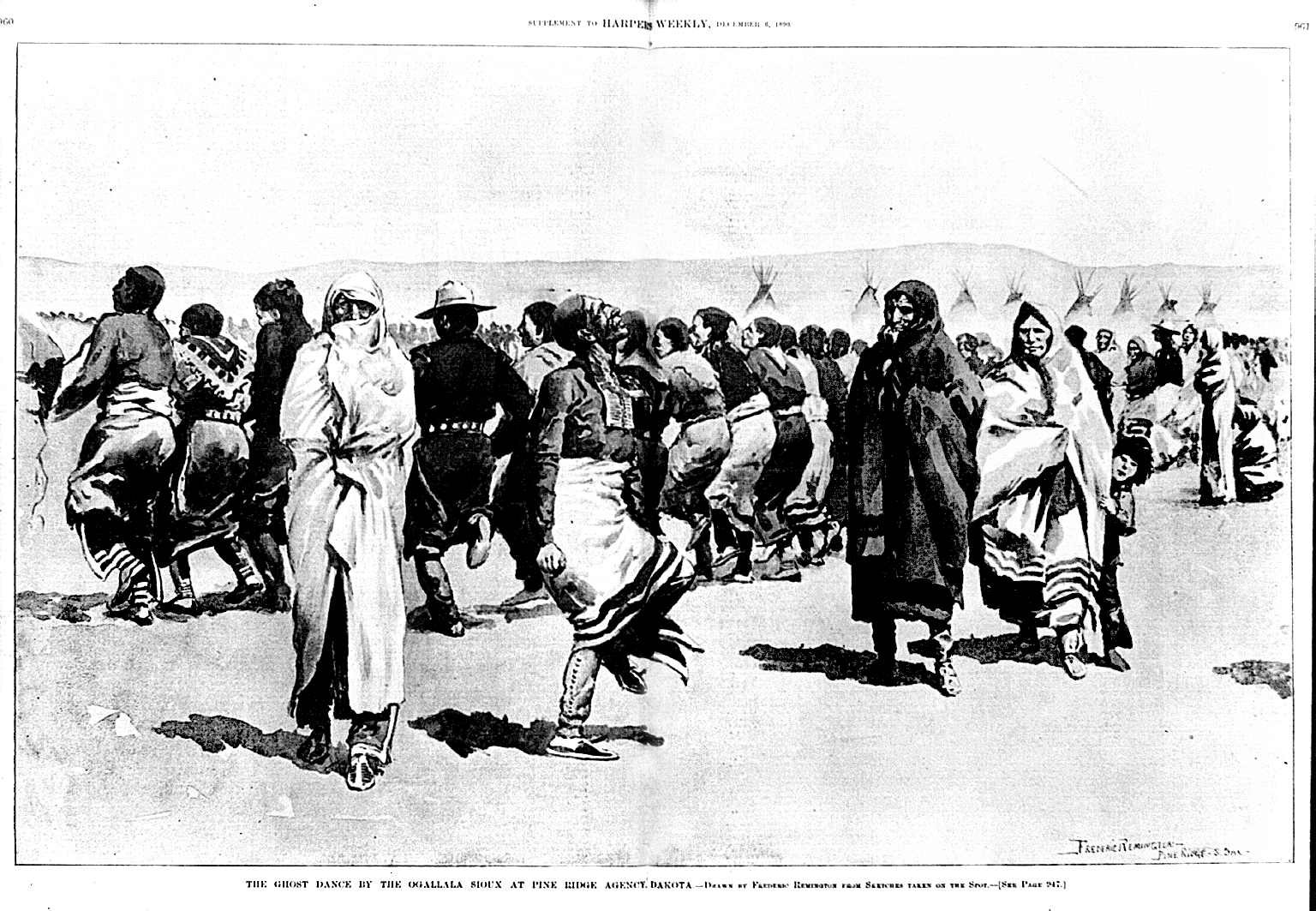
"The Ghost Dance Of The Oglala Lakota At Pine Ridge," by Frederic Remington.
How The Ghost Dance Came To The Lakota
From The Northwest To The Great Plains

By Dakota Wind
GREAT PLAINS - The origin of the Ghost Dance stemmed from the introduction of Christianity to the native people of the Northwest, specifically the Shaker Movement in which Christians prayed and danced for the Second Appearance of Jesus Christ.


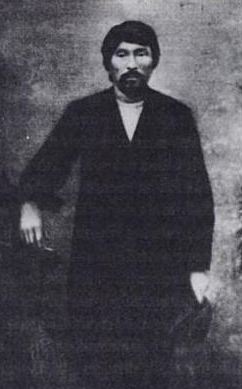
Rev John Slocum
Pictured here is the Rev. John Slocum. The Indian Shaker church still exists today.

In October 1881, a Squaxin Indian man living on the Southwestern arm of Puget Sound known locally as John Slocum knelt down in the woods to pray. Slocum reflected about the impacts that hard liquor, gambling, idleness, and general vice had affected his life and the life of his people. He took ill and by all accounts, died. By those same accounts, later in the day, Slocum revived and told everyone of his journey to heaven, where he was given a choice: either go to hell or return to the world and minister to his people. He chose to live again.


Slocum’s shaker ministry quickly spread to the native population in the Northwest, causing some unease among settlers because the Indian Shakers had their own priests and built their own churches. The Presbyterian ministers actively sought to include the Indian shakers in the body of the Presbyterian Church.


The Indian shakers became known for visiting the shut-in and sick, and just as known for praying themselves into a trance over the same. A ritual followed the trance in which the sickness was pulled out of the patient and absorbed by the priest/medicine man who fell down dead and the patient recovered.

 
James Moony worked for the Bureau of Ethnology. Moony traveled to various native reservations to preserve and analyze as many native traditions as he could. He wrote many ethnological reports, one of which was his "The Ghost Dance Religion and the Sioux Outbreak of 1890."


James Mooney, author of The Ghost Dance and Wounded Knee, collected the story of two shaker medicine men venturing south into central Oregon to a tribe there where they apprenticed a young Indian man of the tribes, whom Mooney postulates could be none other than Wovoka, The Cutter.


Wovoka was the son of a highly respected medicine man or prophet of the Indian people in Mason Valley, called Tavibo. Tavibo died about 1870, leaving a fourteen-year-old Wovoka. Wovoka came into the employment of David Wilson and was given the Anglo name, Jack Wilson. David Wilson employed Wovoka until about 1886, when Wovoka decided it was time to share his experience of heaven and the message he received.


During the solar eclipse of August, 1868, Wovoka had fallen asleep and was taken up to heaven. There he saw all the people who had already departed and he met with God. Wovoka received the mission to go back to his people and tell them “They must be good and love one another, have no quarrelling, and live in peace with the whites; that they must work, and not lie or steal; that they must put away the old practices that savored of war; that if they faithfully obeyed his instructions they would at last be reunited with their friends in this other world, where there would be no more death or sickness or old age.”


[image]
Wovoka is seated here with leaders of the Northern Arapaho tribe.

Wovoka was given a dance to take to the Indian peoples, a dance which must be performed for five consecutive days. Mooney, who interviewed Wovoka when he made a study of the Ghost Dance religion in December, 1890 to April 1891, said that Wovoka disclaimed responsibility and association with the Ghost Dance shirt which had become an important part of the Sioux Ghost Dance. In fact, Wovoka asserted to Mooney, that it was “better to follow the white man’s road, and to adopt the habits of civilization,” and that his religion or practices were ones of universal peace. 


Wovoka had gone to live among the Paiute Indians of Utah and spread his message and vision. From there his message spread east to the Northern Arapaho and Shoshoni of Wyoming, then on to the Lakota and Cheyenne. A few of the Arikara, Hidatsa, and Mandan became caught up in the news from Fort Washakie, WY.


In the fall of 1889, three principle delegates, Porcupine (a Northern Cheyenne from Montana), Kicking Bear (Mniconjou Lakota, Cheyenne River Agency, SD) and Short Bull (Sicangu Lakota, Rosebud Agency, SD) made a pilgrimage to Fort Washakie to hear about the Ghost Dance for them selves.

 
Fort Washakie in 1892.


The Ogallala Lakota, Sword, had this to say, “In 1889, the Ogalala [sic] heard that the son of God had come upon earth in the west. They said the messiah was there, but he had come to help the Indians and not the whites, and it made the Indians happy to hear this.”


Porcupine, Kicking Bear, and Short Bull didn’t stop at Fort Washakie, but continued on to Pyramid Lake stopping along the way to witness the Ghost Dance. According to Porcupine, they were treated with kindness by the whites as they journeyed to the lake, and that even the whites participated in the Ghost Dance.


From Pyramid Lake, the delegation journeyed to Walker Lake where Wovoka himself led the Ghost Dance. After the dance there, Wovoka entered into a trance. According to Porcupine, Wovoka awoke and proclaimed to all that he went to heaven, saw all those who had died before, and that he had been sent back to instruct the native people. Porcupine essayed further that Wovoka claimed to be the returned Christ, that the dead would be resurrected, the Indian people would live forever; that there would be universal peace, and death and destruction to those who refused his message.


The delegation returned home.

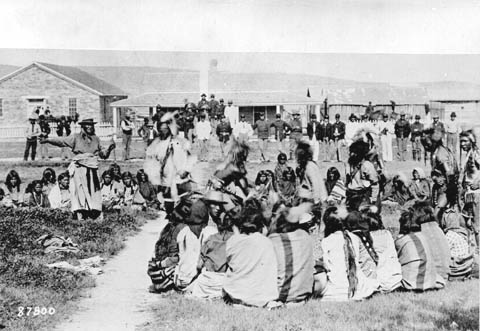
The Ghost Dance at Sitting Bull's camp along the Grand River in South Dakota, on the Standing Rock Sioux Indian Reservation. Unknown photographer, 1890.


In October, 1890, Kicking Bear introduced the Ghost Dance to Standing Rock at Sitting Bull’s invitation to perform the dance at his camp along the Grand River. The Indian Agent, Major James McLaughlin, dispatched the Indian police to arrest Kicking Bear, but they returned to the agent’s office unsuccessful. Sitting Bull promised McLaughlin that Kicking Bear would leave when he was finished, which he did after two days.  Sitting Bull didn’t not discourage the Ghost Dance on Standing Rock, and on the Cheyenne River reservation, the Indian police couldn’t stop Big Foot’s band from dancing.


It is important to note that as the Ghost Dance was coming to a head North and South Dakota had recently entered the Union as states. Indian reservations were made smaller. Hunting grounds were being settled and turned into farmland. Traditional and culturally significant landmarks were given over to citizens for farming or ranching. Drought had caused native farmers’ crops to fail two years in a row and those who received government issued rations received a third to a half of what was promised by treaty. People were nearly starving. It was a desperate time and the native peoples turned to a desperate faith.

 
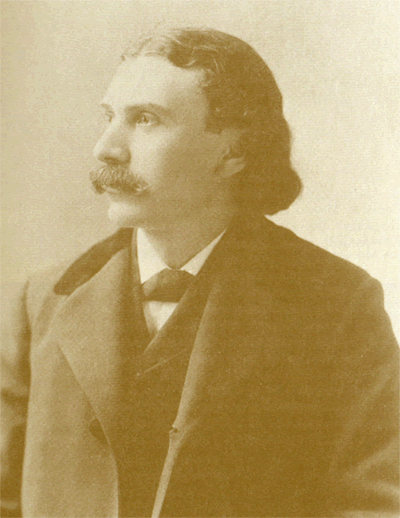
General Nelson A. Miles pictured here with former U.S. Army Scout Buffalo Bill Cody. Together they survey the field after Wounded Knee.


General Miles, of Civil War fame and for capturing Indian leaders like Chief Joseph and Geronimo, advised that no additional military force was necessary, to let the Ghost Dance run its course, that “the excitement would die out of itself.” Indian agents at Lakota Sioux agencies became increasingly alarmed because they could not stop the dancing.


On October 31, 1890, Short Bull rounded up his Ghost Dance followers and encouraged them to gather in one place and prepare for the coming of the messiah, even if they were surrounded by troops, even if they were fired upon. The Lakota who participated in the Ghost Dance firmly believed that their Ghost Dance shirts made them impervious to bullets; that the bullets would pass through them without causing injury.


On November 17, 1890, soldiers were ordered to report throughout the Indian agencies at Cheyenne River, Lower Brule, Rosebud, and Pine Ridge, under the field command of General Miles, altogether about 3,000 soldiers. No action was needed as the mere presence of soldiers was enough to dissuade dancers from dancing. John Noble, Secretary of the Interior, immediately ordered full rations to be distributed as was agreed to in treaty.

Farmers near New Salem rally to defend themselves against the perceived Ghost Dance threat. The farmers even went so far as to build an earthen fort, even cristening it "Fort Saurkraut." This farmer's volunteer militia wasn't authorized by General Miles or the Department of War. Unknown photographer, 1890.

The Department of War assumed control of Standing Rock, with arresting Sitting Bull as the next step. To convince Sitting Bull that his cooperation was necessary, former US Military Scout William F. Cody, better known as Buffalo Bill, was sent to persuade Sitting Bull to turn himself in. Cody arrived at Fort Yates on November 28, 1890, but his orders to continue to Sitting Bull’s camp were halted by Agent McLaughlin.


According to Mooney, Agent McLaughlin believed that a conflict would follow if the military were to arrest Sitting Bull. The military arrest was delayed on the advice of McLaughlin who told Cody that he’d send Indian police, which he did on December 14th, 1890. Lt. Bull Head lead the attempt to arrest Sitting Bull came with the dawn on Dec. 15 and ended in disaster with the death of Sitting Bull and seven of his followers, and the death of Bull Head and seven of his police officers.