Showing posts with label Star Knowledge. Show all posts

Saturday, December 8, 2018

Winter Solstice and the Midwinter Moon

"The Long Night Moon," or Winter Solstice, pictured above, a pictographic representation for the lunar month of the Lakota people. This month will last from Dec. 7, 2018, through Jan. 4, 2019. The crescent represents the moon, or month, the star represents the night, and the arc represents the length of the night. 
Winter Solstice and the Midwinter Moon
They Were Carried When They Fell
By Dakota Wind
The long star-filled nights were a time to remember the myth-history of the people. I imagine a family similar to mine, gathered around a glowing fire, watching the flame, feeling the heat, and listening to the voice of ancient authority in a line of grandmothers and grandfathers going back to their elders and those before them.

The first snow was celebrated. Men put on their snowshoes and danced in the fresh powder. The snow made for ease of hunting. The Lakȟóta explained the changing of the seasons as an epic battle between two brothers: Wazíya (The North) and Okáǧa (The South). As one retreated, the other gained ground. When Wazíya won, his breath blew across the landscape, and for as deadly and sharp his cold breath might be, he brought a blanket of snow under which Uŋčí Makȟá (Grandmother Earth) slept.

The High Dog Winter Count recalls the year 1800 as one of the most challenging years to survive. The summer heat was unbearably hot. The great gangs of bison went away, and hunting was poor. Flowers disappeared from the landscape, and the wind drank up the water. The birds refused to sing too.

The punishing summer was followed by a harsh winter.

Winter came, snow and ice were everywhere. According to the White Bull Winter Count, a group of Lakȟóta decided to move winter camp from the bottomlands of one river to that of another. As they moved over the high plains, a blizzard caught them. Gradually some of them began to succumb to the cold and fell. As one person fell, another lifted and carried him or her the rest of their journey. Kičhíč’iŋpi keúŋkiyapi, “They say that they carried each other.” 


This constellation is commonly known as "Auriga" is as it would be seen in the middle of the night during the Winter Solstice. The biggest star closest to the middle of the crescent is commonly known as Capella. 

By firelight and starlight, the Lakȟóta used the time of the long winter night to share stories like that of Wičháȟpi Hiŋȟphaya (The Fallen Star; also called “Star Boy”). The story of his mother, Tȟapȟúŋ Šá Wíŋ (Red Cheek Woman), and father, Wičháȟpi Owáŋžila (The Star that Does Not Move; “The North Star”) is fairly well known.

According to Ronald Goodman’s work in his Lakota Star Knowledge, Fallen Star was renowned among the Lakȟóta as “the Protector, the bringer of light and higher consciousness.” After becoming a father, Fallen Star ascended “a hill at night with a friend,” and told him that he was going to return home. Fallen Star laid down upon the hilltop and died. His spirit was seen a light that rose into the star world. “At some time in the past, all Lakȟóta acquired the gift of light he brought them.” (Goodman, 2017; 32) Goodman’s work says that human beings are composed of matter and light.

In 1967, Helen Blish published her thesis A Pictographic History of the Oglala Sioux, featuring the works of Amos Bad Heart Bull (~1868-1913), a noted Lakȟóta artist, amongst of what was a map of the Black Hills and other features including Pahá Ská (White Butte). White Butte is noted as being north of the Black Hills. 


Kapemni, an hourglass shape symbolizing what is in the heavens is also on earth. 

Goodman discusses an ancient central symbol strongly associated with the heavens and the world. This symbol is referred to as Kapémni (“the action is swinging around and around,” as with a warclub or bullroar), and resembles an hourglass. One half represents all that is heavenly, the other half represents all that is worldly. What is in the heavens is also present in the world. In the pages of Lakota Star Knowledge, this “mirroring” is demonstrated in a map of the Lakȟóta constellation Čhaŋgléška Wakȟáŋ (The Sacred Hoop) which demarcates the locations of landmarks in and around the Black Hills.

It is a general map; not everything matches up perfectly. Matȟó Thípila (Bear Lodge), or Devils Tower, is not actually within Khiíŋyaŋka Očháŋku (The Race Track), the edge of the Black Hills. The Race Track is the “mirror” of the Sacred Hoop. White Butte is not a part of the Black Hills, but it is north. It is a real butte. It is also the hill upon which Fallen Star made his journey back to the sky. 


White Butte, located in southwest North Dakota near the town of Amidon. 

Like Devils Tower, White Butte appears to be in the narrative of the Sacred Hoop, though it is not so on earth. Yet according to the map of the Sacred Hoop constellation in Lakota Star Knowledge, a star commonly known as Capella, the brightest star in the constellation Auriga appears as part of the Sacred Hoop.

Referencing Bad Heart Bull’s map, and tracking the sky from the Sacred Hoop to the North Star one “sees” the stars associated with the constellation Auriga “pointing” or “reaching” towards the North Star. The constellation Auriga appears to be Kapémni, or "mirror" of White Butte and the immediate landscape surrounding that beautiful plateau. 


The constellation is commonly known as Auriga. The brightest star in this constellation is Capella. If this were the Lakota constellation for Fallen Star it would seem that his arm is raised, perhaps reaching for his father, North Star. 

I suggest that Capella is the Fallen Star, and Auriga is his constellation.

The Lakȟóta share Ohúŋkakaŋ (stories from the distant past) and Wičhówoyake (stories, legends, myth) during the five lunar months of Waníyetu (the winter season), and during this moon especially, they share stories like the Fallen Star narrative. 


Fallen Star, wears a robe symbolizing the day and night, a bow under the edge of his robe. 

Long ago, before the reservation era anyway, the month which some might call December today, was known by some Lakȟóta as Waníčhokaŋ Wí (The Midwinter Moon). They might not have known the exact day, but could reckon the subtle shift in daylight when there was a little more of it and could track the general date with counting sticks; they knew it happened in the Midwinter Moon.

According to Vi Waln, “I believe the real day of prayer was observed on the winter solstice by the people with ceremony, food, and family.” Further, “Nature and the stars were monitored carefully to help with preparation for whatever time of year was upon the people.” And lastly, “Many Lakota people will offer prayer in much the same our ancestors did so on the Winter Solstice.” (Valn, Winter Solstice Is Sacred, 2011)


There are five winter moons in the traditional Lakȟóta calendar. After the Winter Solstice, it was time to gather red willow (eastern dogwood) to make čhaŋšáŋšaŋ, a traditional tobacco made from the inner bark of the red willow, and used for ceremony. 

In the heart of winter, in daylight, there sometimes appears the sundog. The Lakȟóta call it Wíačhéič'thi, which means "The Sun Makes A Campfire [For Himself]." Sometimes, during the winter nights, they see a ring around the moon, also called Wíačhéič'thi, only this is interpreted as "The Moon Makes a Campfire [For Herself]."

The New Lakota Dictionary lists the Winter Solstice as Waní-Wí-Ipȟá (Crest of the Winter Sun). The Húŋkpapȟa might call the same Haŋyétu Háŋska (The Long Night) as they called this traditional month Haŋyétu Háŋska Wí (The Long Night Moon).

However it is called this day, or this month, these things are certain: gather close together with family in observation or prayer, eat together, share stories, and carry each other.



Saturday, October 14, 2017

The Spirit and The Sky, A Book Review

The Spirit And The Sky, A Book Review
Astronomer's Study Of Lakota Starscape
By Dakota Wind
Hollabaugh, Mark. The Spirit and the Sky: Lakota Visions of the Cosmos. Lincoln, NB: University of Nebraska Press. 2017. 276 + xii pages. $50.00 (hardcover). Illustrations, tables, photos, notes, bibliography, and index.

The title of Hollabaugh’s The Spirit and the Sky calls to mind Norman Greenbaum’s 1969 psychedelic/gospel classic rock anthem Spirit in the Sky. I contacted the author about this, and he personally assured me that the title of his book is inspired by Lakȟóta star knowledge (which is touched on at the end of chapter 9).

Hollabaugh’s bibliography draws heavily from non-native resources who’ve spent considerable time learning Lakȟól Wičhóȟ’aŋ (Lakota language, tradition, lifeways, philosophy) direct from the Lakȟóta themselves. These resources reach back through the years with specific references to winter count (pictographic records) years, and recorded oral tradition.

What makes The Spirit in the Sky special is that Hollabaugh draws on carefully constructed relationships with contemporary Dakhóta and Lakȟóta people since the ‘90s, and fully acknowledges lasting friendships with scholars, native and non-native in his preface.

A chapter on Telling Time gives readers an insight into how the Lakȟóta reckon a year (generally thirteen months), a month (a lunar month; from new moon to new moon), and seasons (winter is the longest, and why a year is called a “winter”). The times of the month are explained (phases of the moon) as well as times of day (position of the sun). Counting sticks are touched on briefly insofar as the Lakȟóta attempts to measure the months and years, which is frustrating to any who try to tack down exact times. The general acceptance of natural time in the Lakȟóta tradition encourages a non-reliance of exactness. What matters is Wókiksuye, or Remembrance.

A chapter on Eclipses and the Aurora Borealis examines Lakȟóta beliefs of the two events. The eclipse is regarded as the sun’s death by many Lakȟóta, and some reacted with fear. Some said/say that a great serpent swallows the sun, but the sun proves victorious and lives again, and some fire their guns or holler into the air in triumph. The Northern Lights have several names, and several narratives – none more important than another. Surprising to this reviewer is the connection of the Northern Lights to Woȟpé (Falling Star Woman) of Lakȟóta myth-history, and to the Huŋkáyapi (the Making-of-Relatives; when one is taken as a relative).

A chapter on Stars and Constellations explores the cultural narratives of the night sky. Many of the same familiar Greek and Arabic constellations have Lakȟóta counterparts with equally interesting stories. The children of the Sun and Moon dance forever around one wakȟáŋ (with-energy; “holy,” or “sacred”) star, Wičháȟpi Owáŋžila (The Star That Does Not Move), and those who do not, fall down as Wičháȟpi Hiŋȟpáya (Falling Stars).

Hollabaugh doesn’t conclude his study with the establishment of the reservation era. His work breaks that tired trope and includes an entire chapter dedicated to the living tradition of Lakȟóta star knowledge. It’s necessary to show the Lakȟóta as they are today, survivors of a system that has tried to extinguish language, culture, and tradition. Some of Hollabaugh’s native resources and informants are still alive and still sharing.

What makes The Spirit in the Sky an essential for studies of the North American Plains is that the Lakȟóta relationship with the land is reflected in the sky. The Lakȟóta star stories are indigenous and to hear them, one must go to an elder to hear them. This book is a good place to become acquainted. 

The only thing that would make reading this resource better would be to read, deconstruct, and interpret each topic as it’s mentioned with a Lakȟóta elder or other knowledgeable person. It would be a wonderful supplement if Hollabaugh or his publisher included a slideshow or an interactive online feature or smartphone application to articulate the heavens as one goes through each chapter. 

The Spirit in the Sky isn’t hearty enough for college instructors to develop an entire course around – Hollabaugh might even agree with this, but it is solid enough to pique anyone’s interest whether he or she have a passive or deep interest in the stars or Lakȟóta views of the heavens and earth. Make certain your local library has a copy, or get yourself one.

Dakota Wind is an enrolled member of the Standing Rock Sioux Tribe. He is currently a university student working on a degree in History with a focus on American Indian and Western History. He maintains the history website The First Scout.


Friday, February 22, 2013

An Experience of Traditional Storytelling

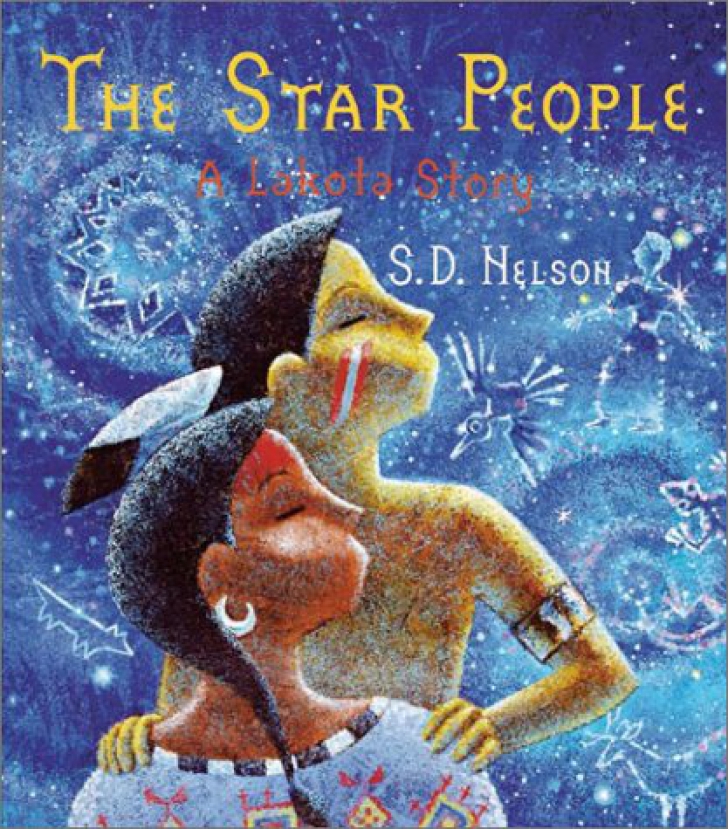
S.D. Nelson's "The Star People." Get your copy of this beautifully illustrated book.
An Experience Of Traditional Storytelling
Star Stories Told In The Days Of Winter 
By Dakota Wind
FORT YATES, N.D. - The Lakota people call the month of February Čhaŋnápĥopa Wi (The Moon of Popping Trees) or Thiyŏĥeyunka Wi (The Moon of Frost in The Lodge). These are names to articulate the coldest months of Waniyetu (Winter) when Makĥoče (Grandmother Earth) was at rest.

The needle dropped below zero and the only news the wind carried was that more cold was on the way. Over a hundred people gathered together over the course of two evenings at Sitting Bull College in Fort Yates, ND in the heart of winter, to hear a Lakota visitor, an elder from South Dakota, share the Lakota Creation Story and Lakota Star Knowledge.

The room was filled with the murmur of raucous laughter, playful teasing and the cries of hungry babies when an assuming man entered the room and quietly prepared at a table near the front of the room. His name, Rick Two Dogs.

Two Dogs, an Oglala Lakota from the Pine Ridge Sioux Indian Reservation, began the first evening with a little exposition that the stories he was going to share were told in the lodges around the campfire long ago. These were the kind of stories that were shared by the Lala and Uŋči (Grandfathers and Grandmothers) and one can feel the weight of centuries and tradition echo in Two Dogs’ tranquil voice when he began the evening with a prayer of Whŏpila, Thanksgiving.

The attention and quiet in the room which followed was like the crack of a whip, sudden and sharp, and even the youngest of children quickly stood in quiet respect when prayer was invoked.

When the prayer concluded, a traditional horseman named Jon reiterated to the mass what many already know, that elders eat first, then visitors before the rest. Young women dashed off to the front of the line to prepare bowls of bapa soup, a traditional soup made with corn and jerked meat, wŏžapi, a type of pudding traditionally made with chokecherries but for these two evenings is made with blueberries, fresh fried bread and steaming black coffee for the elders. Everyone else formed a line and the jocular murmur of laughter and teasing among friends returned.

When hunger was satiated and thirst was slaked, Jon introduced Two Dogs in Lakota and English. Two Dogs isn’t just unassuming, he’s self-deprecating, and is quick to attribute or credit others for the stories he shared, his Lala especially, who witnessed the Battle of Little Bighorn when he was ten years old.

Two Dogs recalled his Lala fondly. He took his meals seated on the floor, speared his food with his knife and refused the aid of a fork. He would look askance at anyone who offered him a napkin, and wiped his hands on his braids. During the long winter nights, his Lala put a few sprigs of cedar on the wood-burning stove, the kerosene lamps were doused, and firelight lit the home.

When Two Dogs opened the floor to field questions, one man asked, “Why are these stories told only in the winter?” Two Dogs replied that he once asked the Lakota scholar Albert White Hat the same thing and was told that if the stories were told out of season, one would get a hairy butt crack, but quickly reminded the crowd too, that the stories were shared when the world was at rest.

The following night, Two Dogs and his wife asked everyone to imagine the room as though it were one great lodge with one entrance. They divided the room between the sexes with men on the left half of the lodge and the women on the right. Between the men and women they explained was a path, a path of wisdom. The men sat in descending order from eldest to youngest going left from the path, just as the women sat in descending age from eldest to youngest, only they sat in order right from the path. It was an exercise in tradition and order.

Two Dogs’ stories are the traditional stories of the people, and should best be listened to in person, on a cold winter night, after supper, in the natural dark.

Haŋhépi čhaŋečela héčhuŋpi (This was done only at night).

Waniyetu čhaŋečela héčhuŋpi (This was done only in the winter).