Monday, April 21, 2014

Horse Appears In Village One Morning, A First Encounter

"The head of this strange animal was not shaggy like that of the buffalo," illustration by Herbert Morton Stoops, as it appears in Standing Bear's "Stories of The Sioux."
The First Horse In The Early Morning
Šúŋkawakáŋ: The Holy Dog
By Óta Kté (Kills Many), Luther Standing Bear
GREAT PLAINS - Luther Standing Bear’s “Stories of The Sioux,” was published in 1938. Standing Bear was an Oglála Lakȟóta. He attended the Carlisle Indian School in Pennsylvania, worked in Buffalo Bill’s Wild West show, appeared in twelve motion pictures, and authored six books. “The Holy Dog,” a chapter of Standing Bear’s “Stories of The Sioux” details a first encounter with the horse.

GREAT PLAINS - In the olden days the Sioux[1] did not have horses. They had never even heard of one. Their travois[2] were dragged along by large dogs,[3] and when the camp was moved these big dogs served as pack animals carrying tipis[4] and household goods, and dragging the travois. Dogs were indispensible to the Sioux, and they had great numbers of them.

The Sioux dogs were big shaggy fellows, strong and intelligent. They had lived with the Sioux in this country had been his companion, for a long, long time.

In those days the Indians lived peaceably with all animals. Even the buffalo[5] would often wander into the camp of the Sioux and eat the grass that grew within the circle of the village. They would usually come during the night, and when the Sioux awoke in the morning there would be the buffalo feeding on the green grass. When the smoke began to rise from the tipis and the people began to stir about, the buffalo would move away. It was as if the Great Mystery[6] sent the buffalo, so that if meat were needed it would be there at hand. In fact, many times if there was need for meat, a buffalo could be had for the morning meal. Those were the days of plenty for the Sioux.

One morning the Sioux came out of their tipis and there were the buffalo close by feeding as usual. Soon they moved away, but still feeding around was a strange looking object such as had never before been seen. It seemed very gentle, not heeding the people, who stared at it curiously. No one ventured near it at first, for the animal was too strange, and no one knew its habits. They did not know whether it bite or kick or run. Everyone stared, but still the animal fed on, scarcely lifting its head to look at those who began to walk closer for a better view. The head of this strange animal was not shaggy like that of the buffalo. Its eyes were large and soft-looking, like those of the deer, and its legs were slender and graceful. A mane flowed from its neck, and its tail reached nearly to the ground. The beauties of this strange animal were greatly praised by first one and then another.

Then some hunter got some rawhide rope. Maybe this animal would permit being tied, for it seemed so gentle. The rope was thrown, but the animal escaped, for it raised its head on its long slender neck and raced around a short distance, not in fright nor in anger, but as if annoyed. How handsome this animal was when it ran! It did not resemble the buffalo, nor the deer, nor wolf, but was more beautiful than any of these.

The rope was thrown again and again, and at last it was on the neck of the animal. It seemed only more kind and gentle, and stood tamely while some dared to stroke it gently. Now and then it nibbled at the grass as if aware it was among friends. Admiration for the lovely animal grew. All wanted to stroke its neck and forehead, and the creature seemed at once to enjoy this extra attention. Finally a warrior grew brave enough to mount upon its back. Then all laughed and shouted with joy. What a wonderful creature! It must have come straight from the Great Mystery!

The people did not know that in later years this animal was to come to them in great numbers and was to become as great a friend to them as the dog. Both the hunter and the warrior came in time to think of it as an inseparable companion in peace and war, for it faithfully shared the work of the long-time friend of the Sioux, the dog.

The Sioux loved their dogs, their daily companions in camp or on the trail. And liking the strange lovely animal so well, they could think of no better name to call it than the Holy Dog.

So to this day the horse to the Sioux is Sunke Wakan, “Holy Dog.”[7]


[1] The “Sioux” refer to themselves as the Očhéthi Šakówiŋ, the Seven Council Fires.

[2] Hupáwaheyuŋpi, lit. “Poles Pack-things-up-to-travel,” or travois. When using English this writer has heard the travois referred to as a “pony drag.” Šúŋk’ók’iŋ is the dog travois. Waŋžíkšilá is the type of travois that was employed by a person, a one-person travois.

[3] Šúŋka is dog. Khečhá refers to a long haired dog or a shaggy dog.

[4] Tiíkčeya, is the proper word, thípi, or tipi is also used.

[5] Ptéȟčaka is the traditional Lakȟóta term for bison. Tȟatȟáŋka, bison bull, has become the common term for bison.

[6] Wakȟáŋ Tȟáŋka (Great Mystery; Great Spirit) and Tȟuŋkášila (Grandfather) are used to address prayer to the Creator. Wawíčhaȟya is "Creator."

[7] Šúŋka Wakȟáŋ, lit. “Dog With-Energy.” Wakȟáŋ is often translated as “Holy,” “Sacred,” or “Mysterious.” 

Thursday, April 17, 2014

A Legend Of Devil's Lake

Sunrise on Devils Lake by Mitchell's Guide Service.
The Heart Of The Mysterious Land
A Legend Of Devil’s Lake
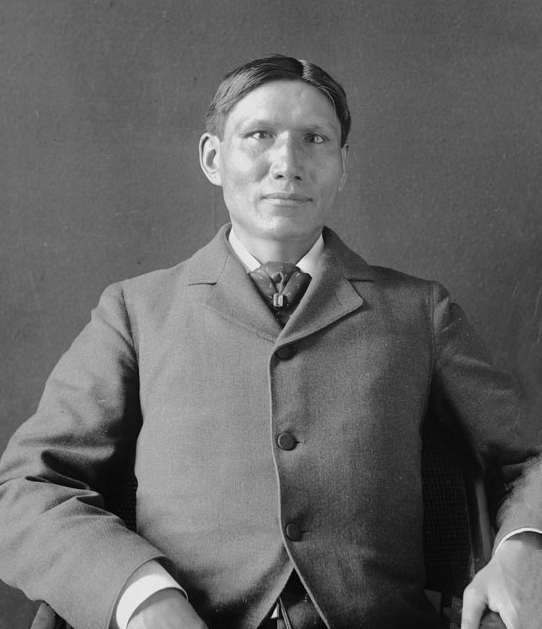
By Ohíyesa (The Winner), aka Dr. Charles Eastman
GREAT PLAINS - Ohíyesa’s wonderful first person narrative, "Indian Boyhood," is about his life growing up as a traditional Dakȟóta. “I have put together these fragmentary recollections of my thrilling wild life expressly for the little son who have to late to behold for himself he drama of savage existence,” he wrote, in dedication to his son, also named Ohíyesa. Here is an excerpt from his book, “Indian Boyhood."

The Animals Are Given Different Form
“Tell me, good Weyuha, a legend of your father’s country,” I said to him one evening, for I knew the country which is now known as North Dakota and South Dakota and Southern Manitoba was their ancient hunting ground. I was prompted by Uncheedah[1] to make this request, after the old man had eaten at our lodge.

Many years ago, he began, as he passed the pipe to uncle, we traveled from the Otter Tail to Minnewakan[2] (Devil's Lake). At that time the mound was very distinct where Chotanka lies buried. The people of his immediate band had taken care to preserve it.

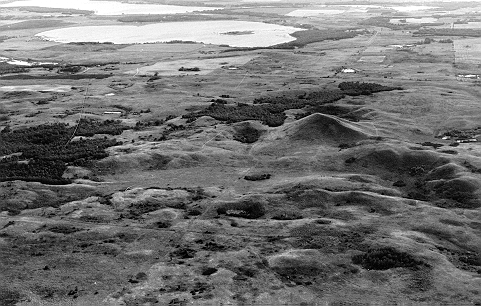
This mound under which lies the great medicine man is upon the summit of Minnewakan Chantay,[3] the highest hill in all that region. It is shaped like an animal's heart placed on its base, with the apex upward.

A view of Spirit Heart Butte from above. It is popularly known as "Devil's Heart Butte."

The reason why this hill is called Minnewakan Chantay, or the Heart of the Mysterious Land, I will now tell you. It has been handed down from generation to generation, far beyond the memory of our great-grandparents. It was in Chotanka's line of descent that these legends
were originally kept, but when he died the stories became everybody's, and then no one believed in them. It was told in this way.

I sat facing him, wholly wrapped in the words of the storyteller, and now I took a deep breath
and settled myself so that I might not disturb him by the slightest movement while he was reciting his tale. We were taught this courtesy to our elders, but I was impulsive and sometimes forgot.

A long time ago, resumed Weyuha, the red people were many in number, and they inhabited all the land from the coldest place to the region of perpetual summer time. It seemed that they were all of one tongue, and all were friends.

All the animals were considered people in those days. The buffalo, the elk, the antelope, were tribes of considerable importance. The bears were a smaller band, but they obeyed the mandates of the Great Mystery[4] and were his favorites, and for this reason they have always known more about the secrets of medicine. So they were held in much honor. The wolves, too, were highly regarded at one time. But the buffalo, elk, moose, deer and antelope were the ruling people.

These soon became conceited and considered themselves very important, and thought no one could withstand them. The buffalo made war upon the smaller tribes, and destroyed many. So one day the Great Mystery thought it best to change the people in form and in language.

The hill, or butte, resembles a great lodge in shape. 

He made a great tent and kept it dark for ten days. Into this tent he invited the different bands, and when they came out they were greatly changed, and some could not talk at all after that. However, there is a sign language given to all the animals that no man knows except some medicine men, and they are under a heavy penalty if they should tell it.

The buffalo came out of the darkened tent the clumsiest of all the animals. The elk and moose were burdened with their heavy and many branched horns, while the antelope and deer were made the most defenseless of animals, only that they are fleet of foot. The bear and the wolf were made to prey upon all the others.

Man was alone then. When the change came, the Great Mystery allowed him to keep his own shape and language. He was king over all the animals, but they did not obey him. From that day, man's spirit may live with the beasts before he is born a man. He will then know the animal language but he cannot tell it in human speech. He always retains his sympathy with them, and can converse with them in dreams.

I must not forget to tell you that the Great Mystery pitched his tent in this very region. Some legends say that the Minnewakan Chantay was the tent itself, which afterward became earth and stones. Many of the animals were washed and changed in this lake, the Minnewakan, or Mysterious Water. It is the only inland water we know that is salt. No animal has ever swum in this lake and lived.

"Tell me," I eagerly asked, "is it dangerous to man also?"

Yes, he replied, we think so; and no Indian has ever ventured in that lake to my knowledge. That is why the lake is called Mysterious, he repeated.

"Attacking the Grizzly Bear" by George Catlin.

Life As A Grizzly Bear
I shall now tell you of Chotanka. He was the greatest of medicine men. He declared that he was a grizzly bear before he was born in human form. Weyuha seemed to become very earnest when he reached this point in his story. Listen to Chotanka's life as a grizzly bear.
“As a bear,” he used to say, “my home was in sight of the Minnewakan Chantay. I lived with my mother only one winter, and I only saw my father when I was a baby. Then we lived a little way from the Chantay to the north, among scattered oak upon a hillside overlooking the Minnewakan.”

“When I first remember anything, I was playing outside of our home with a buffalo skull that I had found nearby. I saw something that looked strange. It walked upon two legs, and it carried a crooked stick, and some red willows with feathers tied to them. It threw one of the willows at me, and I showed my teeth and retreated within our den.’”

“Just then my father and mother came home with a buffalo calf. They threw down the dead calf, and ran after the queer thing. He had long hair upon a round head. His face was round, too. He ran and climbed up into a small oak tree.”

“My father and mother shook him down, but not before he had shot some of his red willows into their sides. Mother was very sick, but she dug some roots and ate them and she was well again.” It was thus that Chotanka was first taught the use of certain roots for curing wounds and sickness, Weyuha added.

"Hunting of the Grizzly Bear" by Karl Bodmer.

“One day,” he, Weyuha, resumed the grizzly's story, “when I was out hunting with my mother, my father had gone away and never came back, we found a buffalo cow with her calf in a ravine. She advised me to follow her closely, and we crawled along on our knees. All at once mother crouched down under the grass, and I did the same. We saw some of those queer beings that we called ‘two legs' riding upon big-tail deer (ponies). They yelled as they rode toward us. Mother growled terribly and rushed upon them. She caught one, but many more came with their dogs and drove us into a thicket. They sent the red willows singing after us, and two of them stuck in mother's side. When we got away at last she tried to pull them out, but they hurt her terribly. She pulled them both out at last, but soon after she lay down and died.”

“I stayed in the woods alone for two days. Then I went around the Minnewakan Chantay on the south side and there made my lonely den. There I found plenty of hazel nuts, acorns and wild plums. Upon the plains the teepsinna[5] were abundant, and I saw nothing of my enemies.”

“One day I found a footprint not unlike my own. I followed it to see who the stranger might be. Upon the bluffs among the oak groves I discovered a beautiful young female gathering acorns. She was of a different band from mine, for she wore a jet black dress.”

“At first she was disposed to resent my intrusion, but when I told her of my lonely life she agreed to share it with me. We came back to my home on the south side of the hill. There we lived happy for a whole year. When the autumn came again Woshepee, for this was her name, said that she must make a warm nest for the winter, and I was left alone again.”

"Purple Lightning" over Morton County, ND. Photo by Dee Brausch.

A Race Between Lightning And A Bear
Now, said Weyuha, I have come to a part of my story that few people understand. All the long winter Chotanka slept in his den, and with the early spring there came a great thunder storm. He was aroused by a frightful crash that seemed to shake the hills, and lo! A handsome young man stood at his door. He looked, but was not afraid, for he saw that the stranger carried none of those red willows with feathered tips. He was unarmed and smiling.

“’I come,’”said he, “’with a challenge to run a race. Whoever wins will be the hero of his kind, and the defeated must do as the winner says thereafter. This is a rare honor that I have brought you. The whole world will see the race. The animal world will shout for you, and the spirits will cheer me on. You are not a coward, and therefore you will not refuse my challenge.’”

“’No,” replied Chotanka, after a short hesitation. The young man was fine looking, but
lightly built.

“’We shall start from the Chantay,[6] and that will be our goal. Come, let us go, for the universe is waiting!’ impatiently exclaimed the stranger.’”

He passed on in advance, and just then an old, old wrinkled man came to Chotanka's door. He leaned forward upon his staff.

“My son,” he said to him, “I don't want to make you a coward, but this young man is the greatest gambler of the universe. He has powerful medicine. He gambles for life. Be careful! My brothers and I are the only ones who have ever beaten him. But he is safe, for if he is killed he can resurrect himself. I tell you he is great medicine.”

“However, I think that I can save you. Listen! He will run behind you all the way until you are within a short distance of the goal. Then he will pass you by in a flash, for his name is Zig-Zag Fire![7] (Lightning!). Here is my medicine.” So speaking, he gave Chotanka a rabbit skin and the gum of a certain plant. “When you come near the goal, rub yourself with the gum, and throw the rabbit skin between you. He cannot pass you.”
“And who are you, grandfather?” Chotahka inquired.

“I am the medicine turtle,” the old man replied, “The gambler is a spirit from heaven, and those whom he outruns must shortly die. You have heard, no doubt, that all animals know beforehand when they are to be killed; and any man who understands these mysteries may also know when he is to die.”

The race was announced to the world. The buffalo, elk, wolves and all the animals came to look on. All the spirits of the air came also to cheer for their comrade. In the sky the trumpet was sounded, the great medicine drum was struck.[8] It was the signal for a start. The course was around the Minnewakan.[9] Everywhere the multitude cheered as the two sped by.

The young man kept behind Chotanka all the time until they came once more in sight of the Chantay. Then he felt a slight shock and he threw his rabbit skin back. The stranger tripped and fell. Chotanka rubbed himself with the gum, and ran on until he reached the goal. There was a great shout that echoed over the earth, but in the heavens there was muttering and grumbling. The referee declared that the winner would live to a good old age, and Zig-Zag Fire promised to come at his call. He was indeed great medicine, Weyuha concluded.

“But you have not told me how Chotanka became a man," I said.

Ohíyesa, Dr. Charles Eastman.

The Bear Is Reborn As A Man
One night a beautiful woman came to him in his sleep. She enticed him into her white teepee[10] to see what she had there. Then she shut the door of the teepee and Chotanka could not get out. But the woman was kind and petted him so that he loved to stay in the white teepee. Then it was that he became a human born. This is a long story, but I think, Ohiyesa, that you will re- member it, said Weyuha, and so I did.


[1] Uŋčí is the Dakȟóta/Lakȟóta word for maternal grandmother.

[2] Mníwakȟáŋ is literally “Water-With-Energy,” which is taken in the context of this story to mean present-day Spirit Lake in North Dakota.

[3] Mníwakȟáŋ Čhaŋté is literally “Water-With-Energy Heart,” is in reference to the mound, a sand volcano on the south side of Spirit Lake. According to tradition, the butte resembles a heart, and it is this heart that serves as the lodge of a water spirit. The butte, according to Ohíyesa, was the Creator’s lodge where he transformed the animals into their present shape. After the animals were transformed, the lodge became earth and stone. Contemporary North Dakotans call this site, “Devil’s Heart Butte.”

[4] Wakȟáŋ Tȟáŋka is most often freely translated as “Great Mystery,” it is literally “With-Energy Great,” and serves as a way to address the Creator.

[5] Thíŋpšiŋla, the prairie turnip.

[6] Mníwakȟáŋ Čhaŋté, the butte.

[7] Wakȟáŋgli is “Lightning.”

[8] Wakíŋyaŋ, or “Thunder.”

[9] According to Ohíyesa,That means around the earth or the ocean.”

[10] Thiíkčeya is the proper word for “Teepee,” though some use “Tipi” or Thipí interchangeably. 

Monday, April 14, 2014

Bird Brings Spotted Black Horse To The People

Light and shadow fall on a horse made of light and shadow. A spotted black horse grazes on fresh spring grass along the Long Soldier Creek, near Fort Yates, N.D. Photo by Dakota Wind.
Little Prairie Bird Brings Prosperity
The Gift Of The Horse
By Ella Deloria
STANDING ROCK, N.D. & S.D. - The Gift Of The Horse appears in Ella Deloria’s “Dakota Texts.” Deloria refers to this story as Ohúŋkakaŋ, as something that is regarded to be true, and that it happened to our people in comparatively recent times, perhaps in the lifetime of the aged narrator’s grandfather or great-grandfather. Ohúŋkakaŋ are only to be told after sunset. 

One winter the people lived without want, on the Powder River[1] where buffaloes were abundant, and everyone was happy; and then, now that spring was here, about the time of the Sore Eyes Moon[2] (March), the cry went forth from the council-tipi[3] that the people were to move about, visiting other parts. So everyone broke camp, and soon they were gone.

Only one man and his wife were left behind. The reason was that they owned one horse, a mare that was not much good, and with it they could not hope to keep up to the pace of the tribe, and hence, they stayed behind.

They went from campsite to campsite, picking up what they found, of discarded bone[4], or bits of meat; and to the south, there was a lake, so they walked around it, gathering wood.

A spotted black horse along Long Soldier Creek, on the Standing Rock Sioux Indian Reservation. Photo by Dakota Wind.

Then the man ascended a hill, and sat down to rest and view the surrounding country, when he saw something come up over the horizon, in the spot where the sun rises, and advanced towards his direction. When it was near enough to be observed, it proved to be a beautiful black spotted horse which was coming to drink at the lake.

After drinking, he stopped under a tree, and stood rubbing against it, and then he lay down and rolled, and then he rose and went back the way he came. Then, a tiny grey bird[5] flew to the man and sitting down next to him said, “I’ll bring you a horse.[6] Go home and make a bridle and apply this medicine to it, and hang it, in the form of a noose, from that tree where he rubs himself. When his head becomes caught in the rope, chew this root, and apply it on yourself, and catch him. Rub some of this medicine on the mare which you already have.”

So the man went home and carried out the orders in detail.

Now the black spotted horse was again coming, so he caught him and blew some of the medicine on his nose, which made the horse stand still and permitted himself to be held. He stared at the man every second and yet he did not try to get away, so the man stroked him and took him home.

A brown-grey hermit thrush. Photo by Tom Grey.

Again the little grey bird talked to him, “The days of your hardship in the tribe are now over. By and by this black spotted horse is going to sire many horses; he will thus multiply himself, but on both sides.”[7] So he allowed the horse to stay with the mare he already owned, and the following summer, there was a colt, as beautiful as, and marked exactly like, the black spotted horse. It was a male. Another year and then a female colt was born. Again the following summer a male was born. So from that horse which the bird had brought him, the man owned three horses, exactly alike, possessing inconceivable speed.

In the tribe they became famous, and the man who owned them was now far different from that poor man he used to be; now his name was held high in the tribe.

During the night he used to picket these horses in front of his door; and one night, someone crept up to them, planning evil against them; but the first black spotted horse spoke, “Wake up, and come out. Someone approaches with the intention of causing our death.” He said this while neighing[8] and his master heard it and came outside.

This is what he [the master] said, “I do not keep these horses in order that you shall insult me through them. I keep them for the sole purpose of bringing good to the tribe, and in that spirit, I lend them to you to hunt meat for your children, as you know; you have used them freely in war and, as a result, have achieved glory. These horses are here to serve. Yet when I tied them for the night and then came in to rest, someone sneaked up on them causing them to run home. You see then it is useless to anything  to them secretly.”

A spotted black horse grazes in an open area between thick brush. Photo by Dakota Wind.

That man understood the speech of the horses, they say. Then the first horse spoke this way; so his master announced it, “In order that you in this tribe might be fortunate in all things, I and my young have multiplied; and from that, you have benefited in the past; yet now, because an evil thing has entered the tribe, this source of good shall stop. You must go back to your former state when things were hard for you, all because that one who tried to kill us has by his act brought it upon the entire tribe.”

In that way he spoke, so his owner told the people. The horses now lost their power to run as of old, and no more colts were born, until at last that entire breed became extinct. In that way, this tribe which was so fortunate, took a backward step to their former state of hardships. That man who owned them and permitted the tribe to rely on them was named Táya Máni U (He always Walks Guardedly, as in free of pitfalls).

He was pitied and caused to have good fortune himself; had he so wished, he might have enjoyed it all alone; but that was not what he wanted. He caused all the tribe to share in it; and then, regretful fact, one, through jealousy perhaps, brought ill fortune on them all.

Keúŋkeyapi. (They Said.)


[1] Čȟaȟlí Wakpá translates as “Charcoal River” or “Gun Powder River.”

[2] Ištáwičhayazaŋ Wí translates as, “Sore Eyes Moon.” Deloria says: “In that part of the country, the sun shining very brightly while the snow is yet on the ground causes snowblindness. March is given its name for this reason.”

[3] Thípiyókhiheya translates as “Council Tipi.”

[4] Discarded bone, if still green, can be pounded and boiled, and the grease that rises to the top is skimmed off to be used later in pemmican, and other rich dishes.

[5] Waǧíyoǧi, the Hermit Thrush is possibly what Deloria mentions. She says: “A bird resembling the common prairie blackbird, and which the same habits of staying around buffaloes and cows, but with a grey instead of a black coat.”

[6] According to Deloria, the bird “uses the un-contracted term for horse, šúŋkawakȟáŋ, mysterious dog. In songs, and formal speech and religious language of the old days, this form was always used when the horse was spoken of with the respect due it.

[7] Deloria wrote, “…the black horse was destined to sire a breed through both a male and female line.”

[8] The Dakȟóta sometimes hear things in the utterances of animals. Once, a man heard a person wailing, far, far away; and stood listening intently, wondering who was dead, and what it was all about. He thought he understood the words, telling who was dead, when he had died, and the details of his death. Then he found that he was listening to a common fly, which, very near his ear, was trying to free itself. All the same, in due time, the message came that so and so had died, and that friend of the dead man had gone wailing, using the words he had heard. Old people used to say the wolves told the future, when they howled at night. Anyone, with or without supernatural power, can understand the meadowlark. Its song is not indicative of impending evil; only amusing, and a welcome note of spring. 

Friday, April 11, 2014

A Gift Of Horses Leads To Marriage

Horses in the River of Elk country (Little Missouri River country). The Lakhota call this river "Hehaka Tha Wakpa," as opposed to "Hehaka Wakpa," which is Elk River (Yellowstone River).
A Gift Of Horses Leads To Marriage
Standing Rock Legend
By Ella Deloria
STANDING ROCK, N.D. & S.D. - The Standing Rock Legend appears in Ella Deloria’s “Dakota Texts.” Deloria refers to this story as Ohúŋkakaŋ, as something that is regarded to be true, and that it happened to our people in comparatively recent times, perhaps in the lifetime of the aged narrator’s grandfather or great-grandfather. Ohúŋkakaŋ are only to be told after sunset. 

The rock that stands upright became so in the following manner.

In the early beginnings of the people, a certain young man wanted a beautiful girl for his wife. But she did not care for him, and so she wept continually over the matter. After a time, the young man becoming discouraged, got together practically all the horses there were, and offered them for the girl. The young girl’s male relatives (brothers and cousins), wished very much to own the horses, and they all joined together in urging her to accept the man.

So, because of deference to towards her male relatives, the girl at last declared her willingness to marry the man. So everyone was very happy. But some days, shortly before the date of the marriage, the girl disappeared; so they all looked for her but she was absolutely gone. Her relatives and all the riders in the tribe joined together in looking for her.

The mother of the girl was especially diligent in her search and often would be gone days at a time, during which she roamed weeping over the land.

One day when she was again walking about, when the sun was low, she looked towards the west and saw, outlined against the sunset, a small hill on top of which sat a woman, in the correct sitting posture for a woman.[1] The light in her eyes was so bright that it was difficult for her to see. Yet for all that, she knew at once that that woman was her daughter.


And, sitting beside her, was the little puppy also facing the same direction. The woman wept and stroked her daughter’s head and shoulders in affection, and then she invited her to go home with her. But when the girl tried to stand, she could not move; so her mother felt of her legs, and already they were turned into rock.

There the woman sat, holding her daughter in her arms, and wept continually, and felt of her body from time to time. Each time she found that more and more it was turning into stone. At last both the girl and her little pet were turned into rock.

Keúŋkeyapi.[2] They say.

Inyan Woslata, Standing Rock, as she stands today outside the agency headquarters in Fort Yates, North Dakota. 

Note: This happened a very long time ago, in fact before anyone’s memory. It was only recently, yesterday you might say, that the stone was brought into the agency and set up at the fort[3] and the government disbursing station took its name from the image, and became Standing Rock. Even today, anyone who goes there may see the stone.

Ella Deloria, Aŋpétu Wašté Wiŋ (Beautiful Day Woman) was born in Yankton, S.D. on January 31, 1889. Her father was an Episcopal priest whose ministry brought him to Wakpala, S.D. on the Standing Rock Sioux Indian Reservation, where Deloria came to call St. Elizabeth’s home. Deloria attended All Saints’ School in Sioux Falls, S.D. then Oberlin College in Ohio, and Columbia University in New York. Her career included stints at the YWCA in New York, Haskell Indian School in Kansas, and as the director of St. Elizabeth’s school in Wakpala, S.D. Deloria had a lifelong passion for her peoples’ heritage and tradition and published many works about the subject; she also left many unpublished works behind. She took her journey on February 12, 1971.


[1] Delora notes that the correct sitting posture is to sit with both legs flexed to the right. No woman ever sits cross-legged. Even little girls are corrected, if they do.
[2] Ohúŋkakaŋ stories that that are held to be true, and that are said to have happened to the D/Lakȟóta people in the times of the grandfathers or great-grandfathers, end with Keúŋkeyapi (They say), rather than with Heha’yela owi’hake (That is all).
[3] Fort Yates, North Dakota.

Thursday, April 10, 2014

Pointing Is Impolite And Can Cause Death

The Crazy Horse monument has taken some criticisms over the years. 
Pointing Is Impolite And Can Cause Death
The Hero Overcomes The Cold

By Ella Deloria
STANDING ROCK, N.D. & S.D. - The Hero Overcomes The Cold appears in Ella Deloria’s “Dakota Texts.” Deloria refers to this story as “Ohu’kaka,” as a story that is intended to amuse and entertain, but not to be believed. These types of stories are only to be told after sunset. 

There was a great tribal camp, and in the centre lived a man with many children. Whenever the people had a killing, he would go there with his children, and the people would leave their meat and run away in fear. And his children would take it all home. This practice had continued so long that the entire tribe was now starving. But even the important men of the camp feared to object, so the tribe was in a sad state.

Now, there was a little orphan boy who with his grandmother lived in an old smoke-tanned tipi, back of the circle [at the edge of the camp]. He said, “Grandmother, go to the tipi within the circle where that man lives and say, ‘My grandchild is hungry and bids me come here.’”

So the old woman answered, “What! Why, that’s out of the question, grandchild! Even the finest people get no results when they appeal to him for food. What am I, that he should not kick me out!”

There was another hunt and a great killing; and the boy said, “Well, then, grandmother, I shall go to him myself!”

The old woman did not place any hope in him, evidently, for she laughed and said, “Really?”[1] But he went to the butchering ground, and there he saw the mean man and his children frightening away the people. 


"Sioux Tipi" by Karl Bodmer.

But the boy stood his ground, so the tyrant frowned on him and said, “Get out of here!”

The boy replied, “Do you think that you alone can cause destruction of so large a tribe?”

So the people said, “Look! He-who-lives-with-his-grandmother is standing his ground!”

But the mean man said, “Keep still and get away. If you don’t, I shall point my finger at you!” (The people said whenever he pointed his finger at anyone, that person died at once.)

But the boy replied, “All right. Point your finger at me. And then I will point mine at you in turn. It’s no trick to point a finger!”

So the man pointed first one of his fingers and then another, at the boy, but he did not die. Then the boy said, “Now it is my turn to point my finger at you!” And the instant he pointed a finger, the man died on the spot.

On seeing this, his wife and his many children ran in fear in all directions. Then the people ran to the drying racks thus abandoned, and scrambled for meat.

“Now, grandmother, ask that a crier be sent around to tell the people to heat water.” This was done by all the people who used every single vessel available; so meantime the tyrant’s wife and children ran for refuge into all the holes in the ground that they could find. Vapor issued from the various holes where they hid.

The people ran with the hot water and poured it down all their hiding places, killing them where they lay. Only one hole remained untouched when the hot water ran out, just as they were going to pour it there; thus, that one child was not killed. And they say that is how it happens that we occasionally have cold weather.[2]

Heha’yela owi’hake.[3] That is all.


Ella Deloria, Aŋpétu Wašté Wiŋ (Beautiful Day Woman) was born in Yankton, S.D. on January 31, 1889. Her father was an Episcopal priest whose ministry brought him to Wakpala, S.D. on the Standing Rock Sioux Indian Reservation, where Deloria came to call St. Elizabeth’s home. Deloria attended All Saints’ School in Sioux Falls, S.D. then Oberlin College in Ohio, and Columbia University in New York. Her career included stints at the YWCA in New York, Haskell Indian School in Kansas, and as the director of St. Elizabeth’s school in Wakpala, S.D. Deloria had a lifelong passion for her peoples’ heritage and tradition and published many works about the subject; she also left many unpublished works behind. She took her journey on February 12, 1971.
____________________

[1] “Really?” is a rather flat translation of an idiomatic phrase, showing lack of confidence in another’s undertaking, or statement. According to Deloria’s introduction, the interjection that the Lakȟóta people use to express incredulity, and the phrase that the grandmother most likely would have uttered, was Išé’he’ȟuká’kȟahe lo/le (lo for male speakers; le for female speakers), which is used when someone is talking nonsense , bragging, or making wild promises.

[2] Deloria’s synopsis says, “The boy who lived with his grandmother defies the Cold Tyrant, and overcomes both him and his wife and children; all but one, who escapes by hiding in a hole made by a tent-pole. He it is that produces the cold we now have." This boy who survived is not to be confused with the giant of the north, Waziya, who brings the winter and great snows.

[3] According to Deloria, all Ohu’kaka stories end with this conventional phrase meaning, “That is all.”

Wednesday, April 9, 2014

The Tragic Love Of Flying Shadow Woman And Track Maker

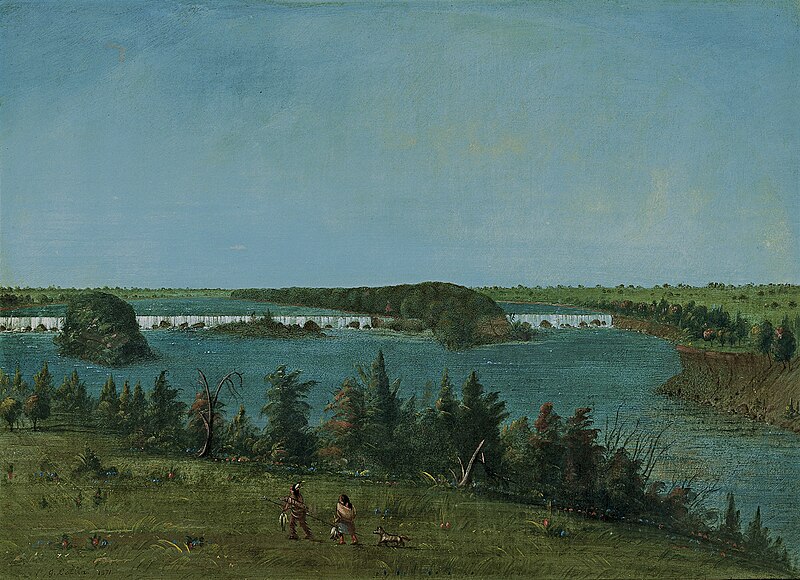
"The Falls Of Saint Anthony" by Henry Lewis.
Love And Death Between Enemies
Flying Shadow Woman And Track Maker

Edited by Dakota Wind
The story of the love between the Dakȟóta warrior Track Maker and the young Anishinaabe woman Flying Shadow has appeared in print twice, once in Charles Skinner’s Myths And Legends Of Our Own Lands, 1896, and again in Terri Hardin’s Legends And Lore Of The American Indians, 1993. Both books are out of print. This story is retold here with edits. It has not been verified by living oral tradition, but it bears similarities (i.e tragic deaths of lovers, conflict) to living stories such as Painted Woods and Spirit Wood.

BDÓTE, M.N. - The Anishinaabe and Dakȟóta had come together at Bdóte (“Where Two Waters Converge*”) to cement friendships and celebrate. A young Anishinaabe, Flying Shadow Woman, was sad when the time came for the tribes to part, for a Dakȟóta man, Track Maker, had won her heart.

In those days, inter-tribal marriages were not unknown. If she married him and went to live with his people, it might well be possible that every Dakȟóta would be against her should the tribes wage war. War between the Anishinaabe and the Dakȟóta was closer than neither Flying Shadow Woman nor Track Maker anticipated.

The Anishinaabe left with feelings of good will. Flying Shadow Woman had received a token of love from Track Maker and kept it close.


"The Falls Of Saint Anthony" by George Catlin.

Two Anishinaabe warriors lingered behind their band, and for reasons of their own, killed a Dakȟóta man after this congenial gathering. News of the murder reached the Dakȟóta village which provoked an immediate retaliation, and a war party of 300 was swiftly formed. Track Maker counted himself first among the war party as it was his brother who was shot and killed, and though he loved Flying Shadow Woman, he could not remain behind. The war party descended upon the unsuspecting Anishinaabe who had made camp between Owámni (“Whirlpool,” aka St. Anthony Falls) and Wakpá Wakáŋ (“Spirit River,” aka Rum River).

The Anishinaabe camp was unaware of the murder of the Dakȟóta man. 

"Ojibwe Encampment" by Paul Kane.

The Dakȟóta fell upon them and exacted furious revenge. In the midst of the violence Track Maker beheld Flying Shadow Woman who rushed into his arms with a cry of relief, but serenity was denied her. Track Maker embraced her but for a moment until he bowed his head and fortified his will to annihilate her people for the murder of his brother. Track Maker abandoned Flying Shadow Woman to claim retribution. He never looked back. He did not kill her, but he refused to save her.

The Dakȟótas' thirst for vengeance was slaked only when the last Anishinaabe lay dead.

The war party took a hundred scalps that day, and upon their return celebrated their victory.

Track Maker returned with more scalps than any other warrior, and the Dakȟóta welcomed him home as a hero, but he kept a solemn distance from all, and refused to share in the celebration. The memory of Flying Shadow Woman’s face haunted him thereafter. He saw her in the river, in the leaves, in the clouds, and even in the faces of deer when he went hunting.

At last, one day, a war party was mustered. Track Maker was the first to join, and on the field of battle he was the first to engage the enemy by running directly into them. He laid his axe about the enemy until he fell, pierced by a several arrows.

He smiled as he died.

Though this is a very short story retold with edits, two people graciously offered guidance:

Lise Erdrich, an enrolled member of the Turtle Mountain Band of Chippewa, lives and works in Wahpeton, ND, and has worked in American Indian health and education for over twenty years. She is the author of the children’s picture books Sacagawea, Bear Makes Rock Soup, and many other acclaimed works.

Dawí, Huhá Máza, is a lineal descendant of the Kap'óža Bdewákhaŋthuŋwaŋ Oyáte. A traditional bow and arrow maker, and Dakȟóta language student, Dawí lives in occupied Bde Óta Othúŋwe (aka Minneapolis).

____________________

* Where the Wakpá Mní Šóta (Smoking Water River, aka “Minnesota River”) converges with the Ȟaȟá Wakpá (Falling Water River, aka “Mississippi River”).