Thursday, March 20, 2014

A Bashful Courtship: Offer To Draw Water Leads To Love

"A young man with the sloppy moccasins won the heart of the belle of the village," artist unknown. Pictograph accompanies the story "A Bashful Courtship," in McLaughlin's "Myths And Legends Of The Sioux."
Offer To Draw Water Leads To Love
A Bashful Courtship
Collected by Marie L. McLaughlin, edited by Dakota Wind
STANDING ROCK, N.D. & S.D. - The following story comes from Marie L. McLaughlin’s “Myths And Legends Of The Sioux.” This story of “A Bashful Courtship” is retold here with minor edits which include spellings of Lakȟóta words using the Lakȟóta Language Consortium's standard orthography.

A kȟoškálaka (young man) lived with his uŋčí (grandmother). He was a good hunter and wished to marry. He knew a wikȟóškalaka (young girl) who was a good moccasin maker, but she belonged to a great family. He wondered how he could win her.

One day, Wikȟóškalaka passed by the wakhéya (tipi or tent), where Kȟoškálaka dwelt, on her way to draw water from the river. Kȟoškálaka’s uŋčí was at work in the thipȟéstola (tipi). Uŋčí wore an old worn pair of haŋpíkčeka (moccasins). Kȟoškálaka sprang to his feet saying, “Quick, Uŋčí, let me have those old haŋpíkčeka!”

“My old haŋpíkčeka, what do you want of them?” Uŋčí cried out in astonishment.

“Quick! I can’t stop to explain,” answered Kȟoškálaka as he took the haŋpíkčeka from Uŋčí and immediately put them on. He threw a robe over his shoulders, slipped through the door, hastened to the watering place, and met Wikȟóškalaka just as she arrived with her bucket.

“Let me fill your bucket for you,” said Kȟoškálaka.

“Oh, no, I can do it.”

“Oh, let me. I can go in the mud. You surely don’t want to get your haŋpíkčeka dirty,” replied Kȟoškálaka as he took her bucket and stepped into the mud. He took exaggerated care in his steps so that 
Wikȟóškalaka could see his poor haŋpíkčeka. She giggled at the sight of them on his feet.

“My, what old haŋpíkčeka you wear!” Wikȟóškalaka announced.

“Yes. I have nobody to make me a new pair,” replied Kȟoškálaka.

“Why don’t you have Uŋčí make you a new pair?”

“She’s old and blind. And she can’t make them any longer. That’s why I want you!”

“Oh, you’re fooling me! You're not speaking the truth.”

“Yes, I am. If you don’t believe, come with me now!”

Wikȟóškalaka looked down, somewhat abashedly. So did Kȟoškálaka.

At last, Kȟoškálaka quietly asked, “Well, which is it? Shall I take up your bucket, or will you go with me?”

She answered still more softly, “I guess I’ll go with you.”

The girl’s tȟuŋwíŋ[i] (aunt) came down to the river, wondering what kept her niece so long. In the mud she found two pairs of tracks close together.

At the edge of the water stood an empty bucket.
_______________

[i] The term “tȟuŋwíŋ” applies to father’s sisters. Mother’s sisters were addressed the same as mother, “iná.” It is possible that the young woman’s aunt, a sister of her father’s, came down to the river. It is also possible that her mother’s sister came down, and when the story was translated, the term “aunt” was used instead of “mother.”

Wednesday, March 19, 2014

The Origin Of The Bow And Arrow

From Paul Goble's "The Great Race," story from the Lakȟóta.
The Origin Of The Bow And Arrow
The First Battle

By Ohíyesa (The Winner), Dr. Charles A. Eastman
GREAT PLAINS, N.D. & S.D. - The following story comes from Dr. Charles Eastman's "Wigwam Evenings: Sioux Folktales Retold." Minor edits include spellings of Dakȟóta words using the Lakȟóta Language Consortium's standard orthography.


In both "The Great Race" and "The First Battle," man gains dominion to hunt animals, but also to care for them and honor them. Both these stories feature the introduction of the bow and arrow.
Now after some time it came about that the wamákȟaškaŋ (animals) became jealous of the greater wit of Boy Man, and as they feared that he would somehow gain mastery over them, they secretly began to plot against him.

As the wamákȟaškaŋ schemed, Boy Man who questioned his čhiyé (Older Brother), “Čhiyé, why do all the nations have weapons, such as spears upon their heads and daggers in their mouths, while I am unarmed and naked?”

He-Who-Was-First-Created sadly replied, “Misúŋkala, Little Brother, the time to give you weapons is now and I am sorry to do so. Now at last there is war in the hearts of animals and man. They are many and you are only one, therefore I am going to help you!”

Then he gave Boy Man a strong bow and arrows with flint arrowheads, then a spear with a flint head as well, and showed him how to use them.

Afterward, He-Who-Was-First-Created tossed a pebble into the air which came down as a wall of rock and enclosed their dwelling. He tossed up another and another until he and Boy Man were defended by high cliffs on every side. Boy Man spread out his new weapons upon the flat tops of the cliffs. The stone heads were destined to be scattered far and wide when the battle was over, to be sought out and preserved by men as relics of the beginning of warfare. 


The story of the Great Race features a contest between the animals and man. In both stories, man receives supernatural aid and is given an edge over the animals. In "The Great Race," man receives aid from the Uŋkčékhiȟa (Magpie).

The call to battle was announced by a single tȟatȟáŋka (bison bull), running at top speed over the prairie. Tȟatȟáŋka assigned others to various roles in the attack. The čhápa (beaver) was ordered to dig trenches under the defenses of Boy Man, so that they might flood his dwelling. The maštíŋčala (rabbits), tȟašnáheča (squirrels), and other little wamákȟaškaŋ were to gather food for the ozúye (war party), of whom the principle fighters were the matȟó (bears), šuŋgmánitu tȟáŋka (wolves), igmúgleza (lynx), and the pté (bison). The ičápšiŋpšiŋčala (swallow) served as messenger to the ziŋtkála (birds), and the swift hoğáŋwičhašašni (trout) carried the news to the hoğáŋ (fish), for all were to join in this war.

Gray dawn came, and with it hó šuŋgmánitu tȟáŋka (the wolf’s howl), the first war hoop, which broke the silence and peace of the world.

When the sun rose, dancing for an instant upon the sharp edge of the sky, one after another, all the wamákȟaškaŋ joined in the great war cry, with deep bellows of the larger wamákȟaškaŋ, howls and barks of the šuŋgmánitu tȟáŋka and šuŋgmánitu (coyotes), hissing of zuzéča (snakes), and the shrill cries of the ziŋtkála, of whom the pȟeháŋ (crane) and the huŋ’tká (loon) were the loudest.

Boy Man then stood up on top of the wall and saw the ozúye coming from all directions, as far as the eye could see. On they came with a mighty thunder of hooves. Overhead, the great war chief of the air waŋblí (eagle) commanded the ziŋtkála, while below the wablúška (bugs) began to scale the lofty defenses of Boy Man. There he stood alone and fearlessly let fly hundreds of arrows, of which every one found its mark, until the ground was covered with the fallen. 


At the end of "The Great Race" man is allowed to hunt the animals, but is charged with the responsibility of caring for them and honoring them even as he hunts them. 

Then there descended on Boy Man great hosts of the smaller ziŋtkála who had been provided with sharp poisonous weapons. Against these, his čhiyé had forgotten to warn him, but in great haste did he tell Boy Man to strike two flints together, and to catch the spark and put it upon some fallen dry leaves. Soon enough, a great cloud of smoke and flames arose toward heaven, not only drifting off the little ziŋtkála, but forcing the whole body of the enemies to retreat in confusion, for they had never before seen fire, and to this day it is feared by all but used only by man.

Thus the wamákȟaškaŋ were convinced that wičáša (man) possesses greater wit and is the hunter[i]. While they sued for peace, all agreed to give him of their flesh for food and their skins for clothing, in exchange, he promised to never wantonly kill them. Boy Man further agreed that they keep their weapons to use in their own defense.

This was the first treaty made upon the earth.

____________________

[i] The original text reads, “Thus the animals were convinced that Man is their master.” While many sentences were edited, this line of text was significantly altered to reflect the first reference to man possessing wit, the creation of weapons, and man’s use of fire.

Sunday, March 16, 2014

A Dakȟóta Story Of Transformation And Resurrection

The tree swallow, photo taken in North Dakota, July 2007. Why We Love Birds.
Dakȟóta Story: Transformation & Resurrection
The Return Of The Little Boy Man

By Ohíyesa (The Winner), Dr. Charles A. Eastman
GREAT PLAINS, N.D. & S.D. - The following story comes from Dr. Charles Eastman's "Wigwam Evenings: Sioux Folktales Retold." Minor edits include spellings of Dakȟóta words using the Lakȟóta Language Consortium's standard orthography.

He-Who-Was-First-Created, the Lonely One, now took the form of an ičápšiŋpšiŋčala, a swallow, and flew down from the high cliffs, skimming over the surface of water. Within a sheltered cove among the pines, the water birds were holding a feast. Some were singing, some dancing, and that great medicine-man Huŋtka, the Loon, was among them, blowing his sacred whistle.

The Lonely One-as-ičápšiŋpšiŋčala dipped down to the water’s edge and respectfully addressed Huŋtka, asking for some of the secrets of his medicine. Huŋtka was very kind. He taught him several mystery songs, and showed him how to treat the sick.

“Now,” said the Lonely One, “If you will permit me to take your form for a short time, I will go down to the deep and try to cure Uŋktéhi and his wife of their dreadful wounds.”


The common loon, Adventure Publications.

Huŋtka made no objection, so the Lonely One transformed himself into the form of Huŋtka, balanced himself upon the crest of a wave and gave his loudest call before he dove down into the blue water. There in the deep the water nations saw him as if he were sailing down from the sky. His path led now through a great forest of sea weeds, now upon the broad plains, and finally he came into a deep valley of the underworld, where he found everybody anxiously awaiting him. The Lonely One was met by Khéya, Turtle, who begged the Lonely One to make haste, for the chief and his wife were in great agony.

“Let all the people retire, for I must be alone in order to work a cure,” demanded the Lonely One-as-Huŋtka as he entered the típi of the mniwátu, the water monster.

All went away unwillingly, Khéya last of all. He told the others that he had heard the Huŋtka whisper as his hand touched the door flap, “Ah, my poor Misúŋkala! My poor Little Brother!” The door flap was made from the skin of the little Boy Man. Feeling suspicious, Khéya sent a little water snake to spy on the Huŋ’tká.

He-Who-Was-First-Created ignored the dreadful groans of Uŋktéhi and his wife, and at once took down the skin of his misúŋ, but as he did so, he saw the little water snake spying on him from behind the típi flap.

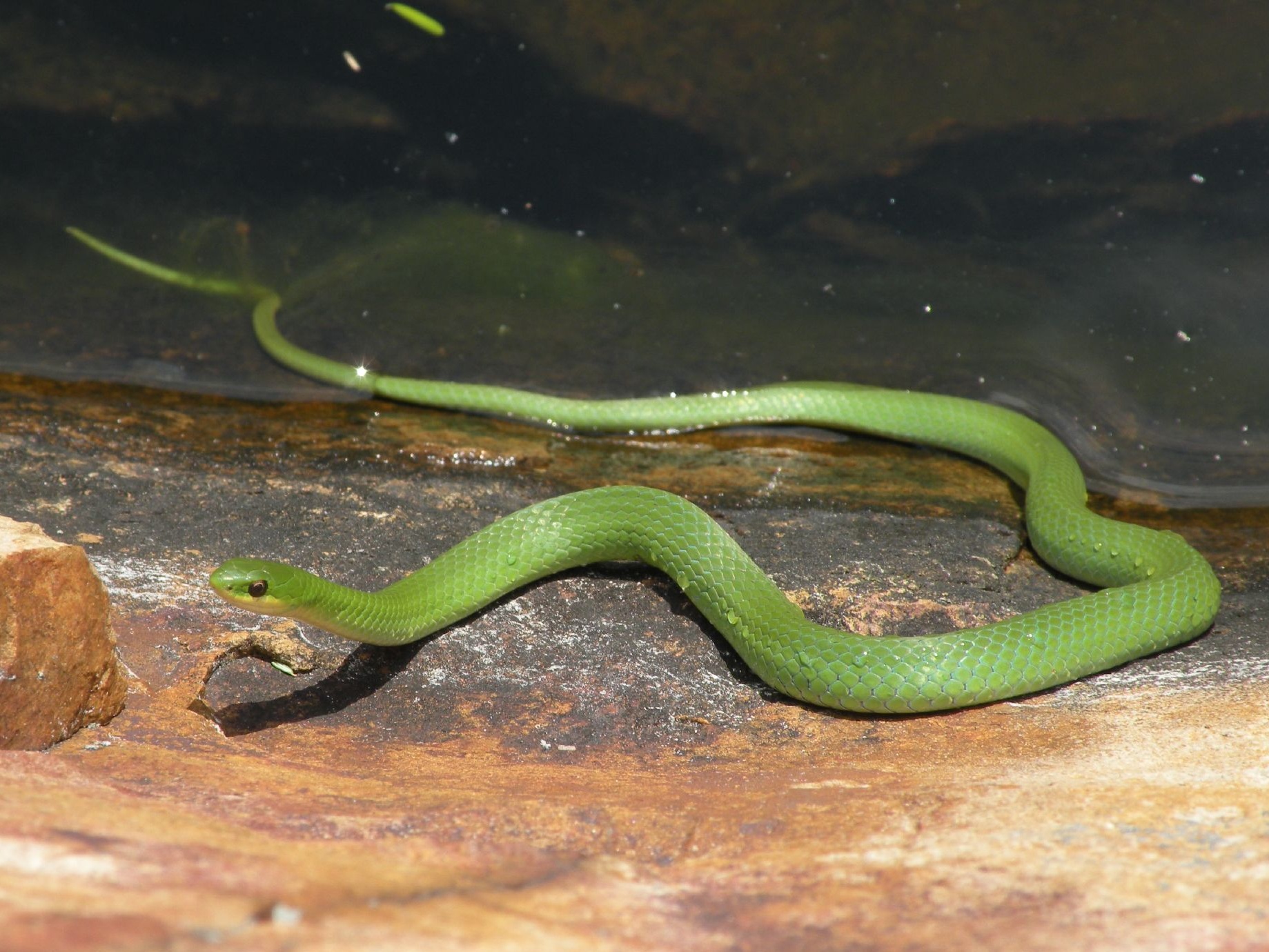
A smooth green snake.

He called the little water snake inside, and compelled him to tell where he should find the bones of Boy Man. The snake revealed the location, and as a reward, He-Who-Was-First-Created painted the little water snake green and declared that as the snake had served both sides, he should crawl upon his belly forever.

He-Who-Was-First-Created gathered together all the bones of his misúŋ and removed them with him to dry land. There he immediately built a fire and heated stones for the first Iníkağapi, Sweat Lodge Ceremony. He also picked pȟežíȟota, which is sage, and gathered water in a large shell.

He then wrapped the bones with the dry skin and built a low shelter of willow switches over the heated stones and bundle; he covered the lodge tightly with green boughs, then picked up his shell of water, and thrust his right arm through the cover and sprinkled water and sage upon the heated stones.

The frame of an iníthipi, sweatlodge.

The steam arose and filled the lodge, and with the steam there came a faint sigh.

He sprinkled water over the stones a second time and from within there came rustlings as if the bones were gathering themselves together.

He sprinkled water a third time, and this time he could hear singing as if from a distance. Immediately after the signing, the little Boy Man then spoke in his own voice, begging to be let out of the iníthipi, the sweat lodge.

Friday, March 14, 2014

Origin Of The Father Of The Human Race

User "Chuck" at Paleoplanet constructed a birch bark típi in 2011. Interior shot of the smoke hole by Chuck. Check out his birch bark típi.
The Little Boy Man
Origin Of The Father Of The Human Race
By Ohíyesa (The Winner), Dr. Charles A. Eastman
GREAT PLAINS, N.D. & S.D. - The following story comes from Dr. Charles Eastman's "Wigwam Evenings: Sioux Folktales Retold." Minor edits include spellings of Dakȟóta words using the Lakȟóta Language Consortium's standard orthography.

At the beginning of things, He-Who-Was-First-Created found himself living alone. Uŋčí Makȟá, Grandmother Earth, was here before him, clothed in green grass and thick forests, and populated with the animal nations. At that time, all these nations spoke one language, and the Lonely One was heralded by them everywhere as he roamed over the world, both upon dry land and in the depths of the sea.

One day, when he returned to his típi from a long wandering, he felt a pain in his left foot, and lo! A splinter in the great toe! Drawing out the splinter, he tossed it upward through the smoke-hole of the lodge. He could hear it roll and rattle down over the birch bark covering, and in the instant that it touched the ground, there arose the cry of a new-born child!

He-Who-Was-First-Created at once came forth and took up the infant, who was the Boy Man, the father of the human race here upon the earth.

Now the little Boy Man grew and flourished, and was perfectly happy under the wise guidance of his Čhiyé, Elder Brother, and friend. Although he had neither até nor iná (father nor mother), and only the animals for playmates, it is said that no child born of human parents has ever led so free and happy a life as he. In those days, there was peace between the animals and the Boy Man. Sometimes they challenged him to friendly contests, whereupon He-Who-Was-First-Created taught his misúŋkala, little brother, how to outwit them by clever tricks and devices. This he was often able to do, but not always, for sometimes the animals by their greater strength finally overcame him. 


Three birch bark tipis in Meadow, ND.

One morning the Boy Man went out from his lodge as usual to the day’s occupations, but did not return at night nor for many nights afterward. He-Who-Was-First-Created mourned and wailed long for the lost one. At last he became angry, and set out to look for the bones of his misúŋ.

He traveled from east to west across the world, but found no trace of the one he sought, and all of the land creatures whom he questioned declared that they had not seen him pass by.

Next he followed the rivers, and the shores of the Great Lakes, and there one day he heard an old woman singing as she cut down a tree at the edge of the water. The traveler came closer to hear the words of the song; and lo! It was a song of the scalp dance, and in it she spoke the name of the lost Boy Man. 


He-Who-Was-First-Created now turned himself into a hoyázela, a kingfisher, and so approached and spoke with Čhápa Winúȟčala, Old Beaver Woman. From her he learned that his misúŋkala and been enticed into the Great Water and destroyed by the monster of the deep, Uŋktéhi. Thereupon he went down to the shore and changed himself into a wazí, a tall pine, overlooking the lake.

For many moons He-Who-Was-First-Created remained thus, until at last he beheld two huge forms rising up in the midst of the waves. The mniwátu, water monsters, glided gradually toward the shore and lay basking in the sun at his feet, rocking gently with the motion of the quiet water. It was Uŋktéhi and his mate.

“Husband!” exclaimed the wife of Uŋktéhi, “for ages this has been our resting place, and yet I have never seen this tree before!”

“Woman, the tree has always been there!” returned the mniwátu.

“But I am sure it was not here before,” she insisted.

Then Uŋktéhi wound his immense scaly tail about the giant pine and tried to pull it out by the roots. The water foamed and boiled with his struggles, but He-Who-Was-First-Created stood firm, and at last the mniwátu gave up the attempt.

“There,” he declared,” I told you it had always been there!” His wife appeared satisfied, and presently the gentle waves rocked them both to sleep. 


He-Who-Was-Created-First stabs the Uŋktéhi with his long spear. Image by Edwin Willard Deming.

Then He-Who-Was-First-Created returned to his own shape, and with his long spear he stabbed each of the mniwátu, so that with groans of pain they dove down to their homes at the bottom of the great lake, and the waters boiled above them, and the foam was red with their blood.

Wednesday, March 12, 2014

The Thunderbirds and Water Dragons

From the cover of Eastman's book "Wigwam Evenings." Image by Paul Goble.
Wakíŋyaŋ (Thunderbirds), Uŋktéhi (Dragons)
At War Since Creation
By Ohíyesa (The Winner), Dr. Charles A. Eastman
GREAT PLAINS, N.D. & S.D. - The following story comes from Dr. Charles Eastman's "Wigwam Evenings: Sioux Folktales Retold." Minor edits include spellings of Dakȟóta words using the Lakȟóta Language Consortium's standard orthography.

Wakíŋyaŋ is the Great Bird of storm and tempest, who was appointed in the beginnings of things to keep the earth and upper air pure and clean. Although there is sometimes death and destruction in his path, yet he is a servant of the Great Mystery and his work is good.

Yet he rules only one half of the year. The other half is ruled by Wazíya, the Spirit of Cold, and he too purifies the air and the water.

When Wazíya, the North Wind, the Cold-Maker, comes, the animals put on thicker robes and some even change their eye color to be like the white blanket that he lays over the earth. Then the waters are imprisoned for a season, and all things sleep and rest.

Then comes Heyókȟa, the South Wind, also called the Fool Wind, he who is the herald of the Thunder Bird and causes all the trees and the plains to put on their garments of green.

For ages there had been war between the Thunder Bird, the ruler of the upper air, and the Water Monster, or Uŋktéhi, the ruler of the deep. Whenever a black cloud appeared in the sky and cast its threatening shadow upon the water, all the fish knew it for a warning to descend to the floor of their watery abode, the deep, dark realm, away from the power of his arrows.

Even the sea birds must seek their sheltered coves and hiding places, pull tight their downy blankets and be still, for now Wakíŋyaŋ would sweep sea and air with his mighty wing, and punish the disobedient.

All was quiet before his approach. His breath was the tempest, the roll of thunder his drumbeat, the lightening’s flash his tomahawk. At his approach, the dace of the deep was thrown into a mighty commotion. Column after column of white warriors advanced boldly upon the land, and broke upon the rocky shores with a loud war hoop. Such was the combat of the Spirits of Air and Water, at which all living creatures hid themselves and trembled.

At last the great peace maker, Wí, the Sun, appeared, holding in his hand the Wígmuŋke, the Rainbow, like a flag of many colors, a sign that the battle is over. He sent each of the warriors to his own place. Gentle airs came down from above to meet and play with the little waves that danced upon the blue water. He who is our Father, the father of our bodies, whose wife is Uŋčí Makȟá (Grandmother Earth), our Mother the Earth, wishes safety and peace for all his children, therefore he still watches the unruly ones from the middle of the sky, and their battles are quickly ended. 

Monday, March 3, 2014

Battle Of The Buttes: Warfare At Saddle Butte


Photo of Saddle Butte, near present-day Stanley, ND, by bobneugenbauer.
Battle Of The Buttes
Warfare At Saddle Butte

As told to Colonel A.B. Welch, edited by Dakota Wind
BISMARCK, N.D. - In the summer of 1860, a war party of six Dakȟóta warriors advanced into Kȟaŋğí (Crow) country for the purpose of obtaining satisfaction for the death of a relative of the leader of the band. Having been successful in their undertaking and provided with fresh horses, they left the Heȟáka Wakpá (Elk River; Yellowstone River) and cut across to the Makȟóšiča (Bad Lands) of the Heȟáka Tȟa Wakpá (River Of Elk; Little Missouri River) and the intention of striking the head of Ožáte Wakpá (Branching River; Knife River) and following its course to the villages of the Pȟaláni (Arikara), where they expected to trade for some corn from these Indians; then sell their otter skins which they had secured from the Kȟaŋğí, at Fort Berthold trading post at Fish Hook Ford, for powder and lead, and pass into the country of their relatives, the Iháŋktĥuŋwaŋna Dakȟóta (Yanktonai Dakota), on the east banks of the Mní Šošé (Water-Astir; Missouri River). But their plans miscarried and, with the souls of explorers, they had held to the Heȟáka Tȟa Wakpá and, in December, had struck the great Mní Šošé at a point a few miles north of the confluence of these two streams. They had purposely avoided the mouth of the stream for, at that day, it was a favorite camping place of the Miwátani (Mandan).


Map of the region from Fort Berthold to the Grand River Agency, 1873.

Three and a half miles north of the Heȟáka Tȟa Wakpá is a commanding elevation which, by its peculiar shape, has always been known as Pahá Čháŋwak’iŋ (Lit. Saddle Butte/s). A half mile south of that butte is another one which is very steep and difficult to ascend and the summit is a perfectly flat area of perhaps two acres. Across the Mní Šošé from these buttes, and nestling among the brushy trees along the banks of a small stream called Mnitáŋ Wakpá (Lit. Flood Creek/Rising Water Creek; possibly Deep Water Creek), was a temporary winter hunting camp of Miwátani, Ȟewáktokta (Hidatsa) and Pȟaláni, who had come up from their comfortable round dirt lodges at Fish Hook Village, to lay in a stock of meat and skins. A few friendly Hóhe (Assiniboine) were camping with them.


Like A Fishhook Village, as portrayed by Martin Bearsarm.

From the heights of the buttes on the western shore, the Dakȟóta scouts located the horses of their old-time enemies, and the band decided that they needed a few new horses to take home for the gift-giving dances which would take place upon their triumphant arrival at the thiyóšpaye (band) of their people along the Pȟaláni Wakpá (Arikara River; Grand River). Their plan was to cross the thin ice after dark and work the herd easily away, if the herd guards were not present. However, if an alarm were made, they would stampede the horses at once toward the east and keep them pounding straight in that direction until morning, when they would turn south and finally cross the Mní Šošé in the vicinity of the mouth of the Iŋyaŋ Wakağapi Wakpá (Lit. Stone Statue River; Cannonball River).


They reasoned that the villagers, not knowing the Dakȟóta strength, would hesitate to follow them during the night and, before their signs of approach could be made out in the morning, the herd would have such a start that they could not be overtaken. Not being able to cross their own mounts on the ice, it was decided that they would enter the camp and secure horses from among the lodges, where they would be tied or hobbled and held ready for the next day’s hunting.


Karl Bodmer painted this scene of Mandan Indians crossing a frozen Missouri River.

The weather turned very cold in the evening and the members of the little party shivered around their small fire behind the butte during the afternoon and waited for the night to come. The fact that they had but a few rounds of ammunition for their heavy Sharps rifles and Springfield carbines, did not cause them much concern, for they did not anticipate fighting unless they were discovered by some late stroller when they were among the lodges after riding horses, in which case they expected to take coup, grab horses and, riding into the herd, stampede them by the waving of blankets and firing. The dark would veil their movements. At any rate, they were brave men and had been against the Kȟaŋğí, who were greater warriors than these village corn-eaters, whom they held in much contempt. They had struck terror to the hearts of the Kȟaŋğí and they would succeed in this small affair against these people who lived in dirt houses and looked to tall pickets for protection rather than fighting.

When the low circling sun had settled below Makȟóšiča, darkness descended quickly and the six Dakȟóta crossed the ice without difficulty and approach the camp. But sharp eyes had noted their every movement as they boldly passed in among the scattered lodges. A woman or two walked among the shelters and sounds of a drum and dance songs came from one of the largest of them where the Miwátani were feasting. Several horses were standing in a group before a large buffalo tipi and towards these, the scouts advanced. But even as the audacious Thítȟuŋwaŋ [1] stopped to loosen the thongs by which the horses were attached to their picket pins, a wild yell and a shot was heard, and the lodges appeared to pour out armed men by the score.

Tȟašúŋke Kȟokípopi [2] (His Horses Cause Fear), who was the leader of the party, at once started firing into the mass of advancing villagers and yelled to his men to get the horses loose. But the knots were secure and, before they had time to slash the tough raw hide open, the crowd was upon them and they were compelled to retire or be overwhelmed. Shooting their way through the circle, they leapt into the tangled brush where pursuit was difficult and retraced their trail of approach where they reached the river bank without the loss of a single man.

Their only safety now lay in getting across the river ice and gaining the western shore, before the pursuit became too close, from which place they could prevent their enemies from crossing after them. A few rifle bullets slashed the ice as they safely made the crossing, but to their great surprise their pursuers made no attempt to follow. This puzzled the Dakȟóta and caused them some uneasiness as they huddled around the embers of their old camp fire. The attempt to steal the enemy’s horses had failed, so they decided to follow the Mní Šošé down to the entrance of the Heȟáka Tȟa Wakpá and then enter Makȟóšiča south of that stream, where game was plentiful and cover in the gorges was easily found and pursuit would be very difficult even if the enemy followed in force.

Theodore Roosevelt National Park in winter by Scott Thomas.

Meanwhile, a body of their enemies, consisting of about thirty Miwátani under the leadership of Red Star, a war chief, moved rapidly toward the south along the shores of the Mní Šošé for several miles and then crossed the ice to the western bank and, turning north, strung out along the banks of the Heȟáka Tȟa Wakpá where they maintained a close watch and waited for the day. Another band, made up of Pȟaláni under Sitting Wolf, also crossed the river and took up a position in the hills to the west of the Dakȟóta, and a strong force of Ȟewáktokta with Lean Bull at their head, and strengthened by a half-blood named Powder Horn (His French name was Packineau), with a mixed body of Hóhe and others from the camp, filtered across the ice during the night and stayed close under the banks until daylight came. The six Dakȟóta were completely surrounded.

Having recovered the horses which they had abandoned on the west shore, the Dakȟóta were led out of their uncomfortable camp before sun up by Tȟašúŋke Kȟokípopi, keeping some distance back from the river in the hills. Sensing danger at the Heȟáka Tȟa Wakpá, Kȟaŋğí Hó Wakȟáŋ [3] (Holy Voice Crow) was sent forward to scout out a safe place for the crossing and, as he cautiously approached, he was met by a flight of arrows from Red Star’s men, who crossed the river at once and started in pursuit of him. Signal yells were answered from all sides and Kȟaŋğí Hó Wakȟáŋ lost no time in rejoining his comrades. It became apparent to the Dakȟóta that they were in the middle of the circle of advancing warriors and that their chances of cutting through in safety to the rough country were small. They decided to make an effort to gain the butte behind which they had spent the night and there make their supreme effort. Owing to the cautious advance of the enemy, they did finally reach the foot of this steep-sided, flat-topped butte without any loss.

Keeping under cover of the piled-up masses of sandstone which had fallen from the outjutting [sic] strata which covered the summit, the Dakȟóta managed to kill several of their pursuers and finally reached a point directly under the projecting sandstone cap. To find a crack up which they night crawl to the summit, before the enemy could reach the top from the other side, became their problem and, in doing this, it became necessary to expose themselves to fire from below.

Another photo of Saddle Butte, near present-day Stanley, ND, by bobneugenbauer.

In so doing, Tȟašúŋke Kȟokípopi was shot dead and his body slid down until it was caught and held by some sprawling mountain cedar. White Horse, the Pȟaláni who had made the kill, sprang up the rocky steep to strike the body and complete the coup and was almost within reach of the dead man, when Wahíŋkpe Uŋ Ópi [4] (Wounded With Arrows) jumped from behind a rock and, with his rifle touching the surprised and dumbfounded Pȟaláni, fired his last remaining shot.

The rush of the Dakȟóta to gain control of the summit had succeeded with the lost of but one man, and they yelled with derision at their enemies and dared them to come and take them. The northern Indians were seen to carry several bodies away during the day, and an effort was made in the afternoon to rush the Dakȟóta from all directions at once. But this was costly. The attackers were only too glad to retire before the heavy Sharps and Springfields of the men on the butte, and a number of me were carried across the ice to the village, but whether dead or wounded, the Dakȟóta could not tell from their position. The affair settled down to a siege; the Dakȟóta were out of rifle ammunition and had nothing left except their clubs and bows and a few arrows, then they began to feel the effects of hunger and thirst and cold. They saw meat brought from the village to the several camp fires of the men on guard and the distressed Dakȟóta were taunted by the tȟóka (enemy/enemies) below with songs of victory and yells of vengeance.

Late winter in the Badlands, along the Little Missouri River near Watford City, ND. Photo by Dennis Rosenkranz, USGS.

As the sun went down, the stinging cold of the night chilled the Dakȟóta upon the butte and the air became filled with fine snow, which was flung winds which swept the high place into the faces of the worried men and added much to their discomfort and dismay. A council was held and the five men decided that the only hope of escape was to make an attempt to break through the ring of tȟóka below. While it was true that their enemies could not reach them, the brave Dakȟóta decided to fight them below; they would carry the fight to them; if they should escape they could join their friends and relatives in the Dakȟóta camps; if they died, their people would sing of their bravery and the story of their heroic death would be told by the evening fires.

The men who gathered about the little fires in the middle of the night among the trees and rough lands dozed with their buffalo robes drawn closely about them and their heads upon their knees, but sprung to their feet by the whispered caution of the sentinels. Something strange was taking place upon the butte. An unseen Dakȟóta was singing his death song and as the song of death was carried to their ears by the shifting winds of the storm, it brought to them a sense of mysterious and intangible fear of the super-natural, and of the possible failure of their own “medicine.” But the strange Dakȟóta song was soon forgotten as old Black Bear, the Ȟewáktokta Medicine Man, began some ceremonies and the men danced and sang in honor of the Pȟaláni, Miwátani and Ȟewáktokta warriors who had met death that day.

The long, cold night was nearly ended; the east was turning grey and the neighing of the horses on the opposite shore could be plainly heard as they were being driven down by the young boys of the camp to the holes in the ice for water; many of the waiting tȟóka below the butte had gathered in a body in a place at the foot of the hill. Nothing had been heard of the Dakȟóta for some time and the allies were debating about sending men to scout out the condition of affairs upon the top of the butte, when they were suddenly startled by the yells of the Dakȟóta warriors and by the sight of them hurling themselves over the edge of the high hill.

"Winter Village Of The Minatarres," by Karl Bodmer.

They leapt from the flat top to the icy sides and slid and tumbled to the very center of the amazed tȟóka. So suddenly had this even taken place that those desperate warriors killed many of them before the tȟóka had sufficiently recovered from their consternation to defend themselves. Then they swarmed to the attack and, in a few minutes, Čhaŋȟpí Sápa (Black Tomahawk) and Travelling All Over Warrior [5] were overwhelmed and killed, but a number of tȟóka also lay dead in the trampled snow to show with what fury these two Dakȟóta had fought. Kȟaŋğí Hó Wakȟáŋ and Tȟatȟáŋka Nážiŋ [6] (Standing Bull) were engaged in a terrific hand to hand combat with so many Pȟaláni and Miwátani that the tȟóka dared not use firearms against them for fear of killing their own men. The stone clubs of the Dakȟóta were used with terrible effect, but against such heavy odds they could not hope to win through and Tȟatȟáŋka Nážiŋ soon died from a blow with the butt of a rifle.

As many of the tȟóka crowded to make coup upon the body of the dead Dakȟóta, Kȟaŋğí Hó Wakȟáŋ managed to break through them and sprung for the shelter of the timber. But he soon met other Miwátani coming in from the night fires a short distance away and died in a whirl of blows by clubs and knives, his death song ringing clear and loud upon the crisp, cold morning air.

The villagers subjected the bodies of these brave men to every indignity and, in their rage at losing so many men, cut and slashed the bodies in a frightful manner. The storm, which had lulled during the early morning hours, however, now arose to such fury that they were compelled to straggle across the ice to their camps for protection as well as to attend to their own serious wounds, which were many. The tȟóka were given over to mourning and grief and for once, the scalp dance of the women was not accompanied by the boastful stories of the warriors, and the victory had been purchased at so great a sacrifice in dead and wounded that no one had the audacity to propose a new name for anyone. The wailing of the grief-stricken women, who had cut off their hair and slashed their arms and breasts in token of the loss of their dead men and sons, was heard in their camp for many days. The white traders at Fort Berthold sold every white sheet and blanket they had, and the white-robed figures of those who mourned had not been so numerous since the great battle between the Pȟaláni and Thítȟuŋwaŋ [7], which had caused the Arikara to go to live with their friends, the Miwátani and Ȟewáktokta at Berthold.

A section of the Sitting Rabbit (Mandan) map of the Missouri River. This screen capture is of the map where the Little Missouri River converges with the Missouri River. Saddle Butte appears on this map.

During this short, fierce battle at the foot of the icy slopes of the butte, none of the villages had noticed that only five Dakȟóta were accounted for. It is possible that they thought that one had escaped. But the sixth Dakȟóta had met with a remarkable adventure and one which saved him from the fury of the tȟóka.

When the desperate Dakȟóta had taken the leap from the rim of the butte, Wahíŋkpe Uŋ Ópi, a Húŋkpathi Iháŋktĥuŋwaŋna Dakȟóta (Lower Yanktonai Dakota), had charged with the others. But some snow had drifted across a wide crack and, giving way as his weight struck it, he had fallen into a cave-like recess and struck his head heavily against a stone, for the day was ended and night arrived when he regained sufficient consciousness and strength to enable him to struggle to the surface of the ice field.

From the camp across the river came the sound of victory and celebration, and the wailing of the bereaved women. Wahíŋkpe Uŋ Ópi picked his way to the bottom and searched the bloody, trampled snow for the bodies of his comrades. The signs of a terrible combat were very plain and he counted the bodies of twenty-one tȟóka, scattered in the vicinity, before he succeeded in locating his four friends who had died there. Their bodies were all terribly slashed and unrecognizable from the mutilation they had received, except by the breech clothes they wore around their loins, and their moccasins. The body of Kȟaŋğí Hó Wakȟáŋ was discovered in the edge of the timber, some hundred yards away from the others, and the bodies of seven Miwátani, lying in a close ring around him, the price the enemy paid in their pursuit of him.

Fort Berthold by De Trobriand.

Hastily filling a quiver with arrows and selecting a bow, he picked up a buffalo robe, then secured several pairs of moccasins from the dead warriors and, entering the timber, started for the south. He passed a still-smoldering fire where some of the tȟóka had passed the night and the day before and which they had vacated so soon after the Dakȟóta made their attempt to escape. He tied up a bundle of meat and, with renewed strength and hope, passed the Heȟáka Tȟa Wakpá and was soon lost to probable discovery and pursuit in the deep gorges and piled-up masses of Makȟóšiča.

The Húŋkpathi was not able to follow a straight direction, but by keeping in the depths of the gorges which led in the general direction, he was able to come out on the watershed about morning. To the north were the dark hills of Makȟóšiča through which he had passed and to the south stretched the easier traveled plains country drained by the Ožáte Wakpá.

The snow was not deep on the uplands and Wahíŋkpe Uŋ Ópi had no great apprehension of meeting any tȟóka there at that time of the year. He was armed and supplied with extra moccasins and plenty of meat and he felt encouraged at the sight of the rolling country which, with the exception of a few gentle and narrow ranges of hills, reached to the country of the Dakȟóta, which he would enter when he crossed the first large river which flowed east after leaving the Ožáte Wakpá, which was not far from him.

A panoramic view of the landscape north of Killdeer Mountain. Photo by Dakota Wind.

His plan was to strike the north branch of the Ožáte Wakpá at a point almost due south of where he was, then cross the short highlands to the south branch, leaving which he would travel up some small tributary, flowing in from the south and east, to its head then, after crossing another narrow watershed, he would follow down the first waterway he found, to Čhaŋté Wakpá (Heart River). This river was the boundary line between the Thítȟuŋwaŋ and the tȟóka from whom he had just escaped. The high point, known as Pahá Kȟoškálaka (Young Man’s Butte), would be his guide and he would look for that landmark to appear far to his right; after he caught sight of that, he knew the country well and, provided that he did not meet with any tȟóka of the trail, he felt that his troubles were almost at an end.

After a long and close inspection of his back trail for party of pursuers, he rested for some time in a jungle of high buck brush and ate some of the cooked meat which he had taken from the fires of the Miwátani. Much refreshed, and after another survey of the slopes and valleys from which he had come, he started once more upon his long journey. He now made his way to a long, gentle slope; threw off his buffalo robe and started to sing. The song was in honor of his comrades and of their bravery and death and, after calling loudly each man by name, he raised his arms to the south and promised Wakȟáŋ Tȟáŋka (Creator; The Great Mystery) that, as he had already taken a public vow to make the Wiwáŋyaŋg Wačhípi (Sun Dance), if he should be fortunate enough to return from the war expedition with honor, in addition he would cut his arms and bleed in one hundred places when the vow was performed, and smoke seven pipes at seven different times. Together with fasting and purification ceremonies, if he were permitted to reach his people alive.

As Wahíŋkpe Uŋ Ópi came up over a gentle hill a short time after his prayer had been made, he was started to see another man coming directly toward him. He also was afoot, but did not appear to be armed; moreover, he was reeling like a sick man or one who was exhausted by starvation.

He rearranged his robe so it might be discarded easily and shifted his arrow pouch to a better position. He was not afraid of any one man; he would not turn aside or hide from one lone tȟóka, and held to his course. The other man had not appeared to fear him, either, and neither did he turn aside and, as they approached each other, both watched the other closely. Wahíŋkpe Uŋ Ópi identified the other man as a Pȟaláni from the manner in which he wore his hair, and could see that he was bloody and had been wounded in a fight. The two men passed within ten paces, and it was only when they had passed that Wahíŋkpe Uŋ Ópi saw a large knife sticking in the naked back of the Pȟaláni. He had a right to kill him or let him live, so he permitted the tȟóka to keep on his way, and he was soon lost to sight among the folds of the prairie hills.

Later that evening the Dakȟóta came to the scantily-timbered south branch of the Ožáte Wakpá and was fortunate enough to kill a small rabbit and a number of prairie chickens in a snow-covered brush pile on the edge of a steep-cut bank. There was the framework of an abandoned summer camp close by and the willow top and sides were covered with snow and afforded some protection, so he entered and decided to spend the night there. But presently he heard voices and, listening intently, he was surprised to hear his own companions talking. “Now. This is the place and here is our brother, Wahíŋkpe Uŋ Ópi. He has beaten us to this old camp. We are all together now. He will be glad to see us. Perhaps he has something to eat. We will send some messages to our relatives. He will tell them how bravely we died. Let us go in at once and feast and rest with him.”

He rushed out of the place and looked around. There was no one in sight. Frightened by these spirit voices, he once more started for the south and, a few days later, staggered into a camp of his own people in Pȟahíŋ Makȟóčhe (Porcupine country), south of Iŋyaŋ Wakáŋğapi Wakpá. He was never able to tell the people anything of his journey after the voices of his dead comrades had come to him. For he could not recall a single incident after that time until he was discovered by a Dakȟóta rider in the Pahá Pȟahíŋ (Porcupine Hills), far to the west of Íŋyaŋ Wosláta (Standing Rock).

True to his word to Wakȟáŋ Tȟáŋka, Wahíŋkpe Uŋ Ópi took a principal part in the next Wiwáŋyaŋg Wačhípi, but his friends gave him many horses for the privilege of taking some of the cuts in his arms for him, so that now he bears but two rows of ten cuts each, upon either arm.

The site of the well-known Indian battle has been marked by the tȟóka. At every place where a dead native lay is a pile of stones. These marking the spot where a Pȟaláni was found are built of white stones; the Miwátani placed stones of a red color upon the graves of their dead warriors, and the Ȟewáktokta use another color for theirs.

At the places where the five Dakȟóta fell are mounds of stones of all colors, and thus do the tȟóka honor the bravery of the small band of Dakȟóta who attacked an entire village in the winter; the old men often sit together when in the vicinity and talk in low, subdued voices of this party who died in battle, far from their own lodges, with songs in their hearts and bravery shining in their eyes.

Vocabulary:
Dakȟóta: (Lit. Affection) Friend, Ally

Kȟaŋğí: Crow

Heȟáka Wakpá: Elk River, Yellowstone River

Makȟóšiča: Badlands

Heȟáka Tȟa Wakpá: River of Elk, Little Missouri River

Ožáte Wakpá: Branching River, Knife River

Pȟaláni: Arikara

Iháŋktĥuŋwaŋna: (Lit. Little End Village) Yanktonai

Mní Šošé: Water-Astir, Missouri River

Miwátani: Mandan

Pahá Čháŋwak’iŋ: Saddle Butte/s

Mnitáŋ Wakpá: Flood Creek,

Ȟewáktokta: Hidatsa

Hóhe: Assiniboine

Thiyóšpaye: Band

Pȟaláni Wakpá: Arikara River, Grand River

Iŋyaŋ Wakaŋğapi Wakpá: Stone Statue River, Cannonball River

Thítȟuŋwaŋ: Dwellers On The Plains, Teton

Lakȟóta: Friend, Ally

Húŋkpathi Iháŋktĥuŋwaŋna Dakȟóta: Lower Yanktonai Dakota

Čhaŋté Wakpá: Heart River

Pahá Kȟoškálaka: Young Man’s Butte

Wakȟáŋ Tȟáŋka: Great Mystery, Creator

Wiwáŋyaŋg Wačhípi: Sundance

Pȟahíŋ Makȟóčhe: Porcupine Country

Pahá Pȟahíŋ: Porcupine Hills

Íŋyaŋ Wosláta: Standing Rock

End Notes:
[1] Lit. Plains-Dwellers; Teton whose language is Lakȟóta, but in this case is in reference to the plains dwelling Dakȟóta; original text was “Teton.”

[2] Not to be confused with Tȟašúŋke Kȟokípȟapi, or Young Man Afraid Of His Horses, the Oglála. He was the son of the famous Iháŋktĥuŋwaŋna Dakȟóta Chief Matȟó Núŋpa (Two Bear).

[3] One of the six Dakȟóta in this horse-stealing party.

[4] He was the brother of Wakíŋyaŋ Máza (Iron Thunder) and a member of the band of Matȟó Núŋpa.

[5] Note: no available Dakȟóta text on this name.

[6] Not to be confused with another Santee Dakȟóta of the same name.

[7] A reference to the 1823 conflict near present-day Mobridge, SD between a combination of Colonel Leavenworth’s command of soldiers and Thítȟuŋwaŋ against the Pȟaláni.