Tuesday, April 24, 2012

Sibley Island or Burnt Boat Island?

This image is taken from the hilltop at Fort Abraham Lincoln State Park looking south southeast. In the center line is Sibley Island.
Sibley Island or Burnt Boat Island?
One North Dakota Landmark, Two Names
By Dakota Wind
BISMARCK, N.D. - In the 1830s, Prinz Maximilian ascended the Missouri River with the artist Karl Bodmer. On coming up the Missouri River, they noted a burned out steamboat which had run aground on a sandbar. The steamboat as called "The Assiniboine," it was the second steamboat to travel upriver from St. Louis to Fort Union. It became grounded and overheated and burned. The sandbar grew to an island and is new part of the west bank of the Missouri River.

A different view of Sibley Island, looking west from the University of Mary, Bismarck, ND.

The island was renamed after General Sibley and his campaign against the Dakota in 1863. On July 29, 1863, Sibley engaged a force of perhaps as many as 2600 Dakota and Lakota warriors and fought them for three days in a battle larger and lasting longer than the Little Bighorn. Sibley was unable to take prisoners and could not estimate how many his men killed. The Sioux were encamped on the bluff overlooking the Missouri River and Apple Creek and held their ground until their women and children escaped. The "battle" was essentially a stalemate.

North of the Bismarck Landing is Burnt Boat Recreation and boat landing.

There is a Burnt Boat Drive in north Bismarck, ND. It was named for an incident on a sandbar island on the Missouri River north of the Bismarck Landing.

In the 1860s, miners descended the Missouri River from Fort Benton, Dakota Territory (Montana), to spend their loot somewhere downriver. The miners' keelboat was either hung up on a sandbar or they decided to rest for a bit on the sandbar. A Lakota woman was bathing her baby on the same sandbar. She and her baby were shot and killed by the miners. Lakota warriors retaliated by firing on the keelboat. The miners returned fire. On the keelboat was a small cannon mounted on a swivel and secured to the bottom of the boat. The cannon came loose and fired into the floor of the keelboat, firmly keeping the boat from going anyway. The boat caught fire and the miners were all killed. Several pounds of gold dust was lost.

The sandbar island became known as Burnt Boat Island, and later a nearby road became known as Burnt Boat Drive. For a virtual tour of Burnt Boat Landing Recreational Area visit: http://www.realnd.com/burntboatlanding1.htm.

Friday, April 20, 2012

Christian Iconography...But Painted in The Tradition of Plains Indian Pictography

Above is a side view of the icon I wrote.
Christian Iconography
Plains Indian Pictography
By Dakota Wind
BISMARCK, N.D. - Some years back I painted an icon of the Holy Trinity. I thought that I'd take a traditional art like American Indian pictography and attempt to "write" an icon in the tradition of eastern or Russian Christian iconography. Here's my first attempt.

I am no expert in iconography. I took a course of Christian art while I pursued my degree in Theology at the University of Mary from Sister Edith Selzer. 

Traditionally, I believe, and I hope I'm recalling this correctly, iconographers selected a cypress plank upon which to write their icon. They "wrote" the icon rather than "painted" it because many Christians couldn't read or write, but they could understand pictures and colors. 

I chose to use cedar on which to write my icon, for it is a sacred wood. Its an aromatic wood, and the tree itself grows with other cedar trees. The roots of one cedar twine around the roots of other cedar trees and in this way the trees are collectively stronger, and on the Great Plains of North America the cedar needs all the strength it can call on to withstand the winds.

I anointed the plank with linseed oil. I then applied a red cotton cloth to the side on which I was going to write. Iconographers typically use white cloth to represent the shroud of Jesus Christ. I used red cloth, for red is a sacred color and is often used in medicine ties when one prays, and to represent the blood of the Christ. 

From the angle of the above picture, one can see plaster. I had put it on rather thick. Over the past few years, the wood has warped ever so slightly which caused the plaster to crack. 

A head-on view of the icon. The good people at KAT Communications allowed me to use their studio to take these pictures.

A bald eagle flies in the bottom left hand corner, a golden eagle flies in the opposite corner. The two eagle do not fly within the circle of green, they fly above and beyond. In the Lakota tradition, eagles carry the messages or prayers of the people to the Creator above. 

The circle of green has three green rectangles in the top left corner, two rectangles and a triangle in the corner opposite. The green circle and the green shapes subtly suggest a turtle. In the Lakota tradition the turtle represents the world, grandmother earth.

The Holy Trinity stand above or beyond the visible heavens.

A closer view of the icon.

The Holy Trinity stand in front of the Creator's lodge. On the left tipi flap are seven stars arranged in the pattern of Seven Brothers, commonly known as The Big Dipper. On the right tipi flap are also seven stars, these are the Seven Sisters, more commonly known as the Pleiades. In the Lakota tradition, some say that our souls or spirits descend from the heavens from the Seven Sisters, on its descent, the spirit passes through the "spoon" of the Big Dipper, before beginning its worldly journey in a body. 

A closer view yet of the icon.

The "Black Warbonnet" pattern radiates from the heads of the Holy Trinity. The left figure wears a creation robe, the robe with the patterns of the sun, the stars, the moon, and animals which were created before people. The right figure wears a blanket of holiness and humaness, and also carries the gift of the sacred pipe and a pipe bag which features the image of a bison cow. In Lakota tradition, the White Buffalo Calf Woman brought the pipe to the people, a "covenant" if you will, that each Lakota person create a deep and personal relationship with the Creator and the world around. The figure in the center is the Christ. This center figure makes two signs. The first sign is the sign for good in the Plains Indian Sign Language - with the left hand. The second sign is the Christian sign for divinity touching humanity - two fingers are shown, the thumb and the ring and pinky fingers touch, leaving the middle and index fingers straight out.

The icon was blessed by then Roman Catholic Bishop Paul Zipfel of the Bismarck Diocese. The icon now resides in a private collection.

Tuesday, March 27, 2012

Thunderbirds and Dragons on The Northern Plains

Pictograph of a thunderbird on stone.
Thunderbirds & Dragons on Northern Plains
Spring Returns And With It Comes Legends
By Dakota Wind
GREAT PLAINS - The sun set in a dark cloudy sky. There was very little color. No pinks, reds, oranges, or purples. No fanfare for the setting sun but for a dark blue and black sky. The clouds seemed to absorb whatever colors the setting sun usually paints on the evening sky. The stars flickered fitfully through the haze of those thin gauzy clouds that like to hang in the far upper atmosphere. A cool breeze blew across fields of brown grass, what was left of last year’s growth of native prairie grasses. The breeze itself carried a hint of frost that nipped at the inside of my nose when I inhaled deeply, as if one can truly smell cold but its really no different than one can smell rain, only this was colder.


The family had long since gone to bed. The boys usually bid their mother an innocent “goodnight,” and she usually goes in to tuck them in. There’s no “goodnight” for me. Instead, I like to bid them a “Sleep well and wake,” as though there’s no other way for me to say a simple goodnight, and I like it like that.


The rain began to fall as I was preparing for bed. I say “prepare” as though I’m getting ready for a journey of some kind, but preparing myself consists of raking a comb through my silky fine hair, brushing my teeth with that new foaming toothpaste which I rather prefer to the regular paste, and splashing some water on my face, all before I slip under the covers and wrestle with my pillow. My pillow looks like a regular pillow, but it somehow gains a life of its own as I lay my head down as though it decides to get too fluffy and too hot or my head sinks too far into it. But the damn pillow looks just fine sitting there on the blankets.


I’ll slaughter a goat and offer it to the God of Thunder like the heathens of ancient Europe...

The rain fell in large heavy drops. I thought it was hailing at first, but the news person said that pea-size hail was on its way yet. Well, I’ll tell you weather man, I’ll slaughter a goat and offer it to the God of Thunder like the heathens of ancient Europe, but it won’t change the fact that hail is here and it’s falling with the rain on my car.


While the heavy rain and pea-size hail that the weather man said was going to arrive later fell on the house and my car, and maybe its why I personify my car as though its alive that gives me dreams that my car is a version of Bumblebee from Transformers, that gentle breeze carrying that taste of winter decides to change into a roaring beast that’s whipping the neighbor’s garbage cans and shit through our front yard and down the street.


As I’m listening to the wind and rain, personifying my car and wrestling my pillow, I stop for a moment and imagine what it was like for the ancestors to go through a spring thunder storm. I remember reading something on the internet about long ago giant birds called “Teratorns.” Apparently there are as many teratorn sightings as there are bigfoot sightings, these giant winged terrors.


The teratorn is said to have flown before the storms looking for thermals to carry it above the storm it flew before. It is said to have been capable of carrying off people and even bison.


...their wings were the clouds and lighting flashed from their eyes...

Did the ancestors see giant birds? I think so. We have stories of the Wankiya, the Thunderbeings, or as some call them, the Thunderbirds. Thunderbirds rode in on the clouds. No, their wings were the clouds and lighting flashed from their eyes, lighting bolts flew from their claws when they opened their taloned grips.


The Wankiya were a force of nature, that is they weren’t necessarily good but nor were they evil. They flung to the earth their lightning in an ages-old duel with other forces of nature. No, they cleansed the earth, purified the earth with pure rain and electric wrath. Sometimes these Thunderbirds would stretch out a claw and grapple with Unkcegila. Think dragon or serpent. When the Thunderbird and the serpent fought, the fury of the wind was unleashed and the serpent was carried up into the sky and destroyed. The world was cleaned and the day could begin anew, at peace.


I imagine a world, a mystical world, the world before the horse and gun. When the mysteries of creation were respected, honored, and cherished. When the Thunderbirds were real and they really would snap up the unwary traveler or a bison for a meal. I imagine the ancient world of the Great Plains and the dragon or dragons slithering up and down the Missouri River, filling the flood plains, and charming human and animal alike to enter and drown in the crushing depths of the corners of the river.

...I imagine I’m a warrior in another time and place looking at the front right hoof of my pony...


I wonder that such things are real. Did my ancestors personify the wind and rain and river as I personify my pillow and car? I don’t know. They saw things, Teratorns and Loc Ness creatures, things they couldn’t explain and shared hushed stories around the lodge fire. I’m certainly not sitting around the tv and night telling my boys how my pillow makes me snore or how my car drags its ass when I drive it – I finally got under my car and saw that it was a piece of plastic. And then I imagine I’m a warrior in another time and place looking at the front right hoof of my pony only to find a burr or rock.


As I wrestled my pillow and hit it into a comfortable mass, our youngest calls out to his mother. I experience the impulse to go in there and tell him about how the Thunderbirds would snatch children but I decide to wait until he’s older. I don’t think my wife would appreciate my interjection of culture at the moment, but just the thought of it makes me smile. I cleared my throat and said to her, “Your son is calling you.”


I fell asleep comforted by the memory of my grandparents telling me about the traditional Lakota view of the spring thunderstorms.  The wind and rain doesn’t bother me and I slept soundly, and I dreamt of my car as Bumblebee.

Monday, March 5, 2012

How The Ghost Dance Came To The Lakota

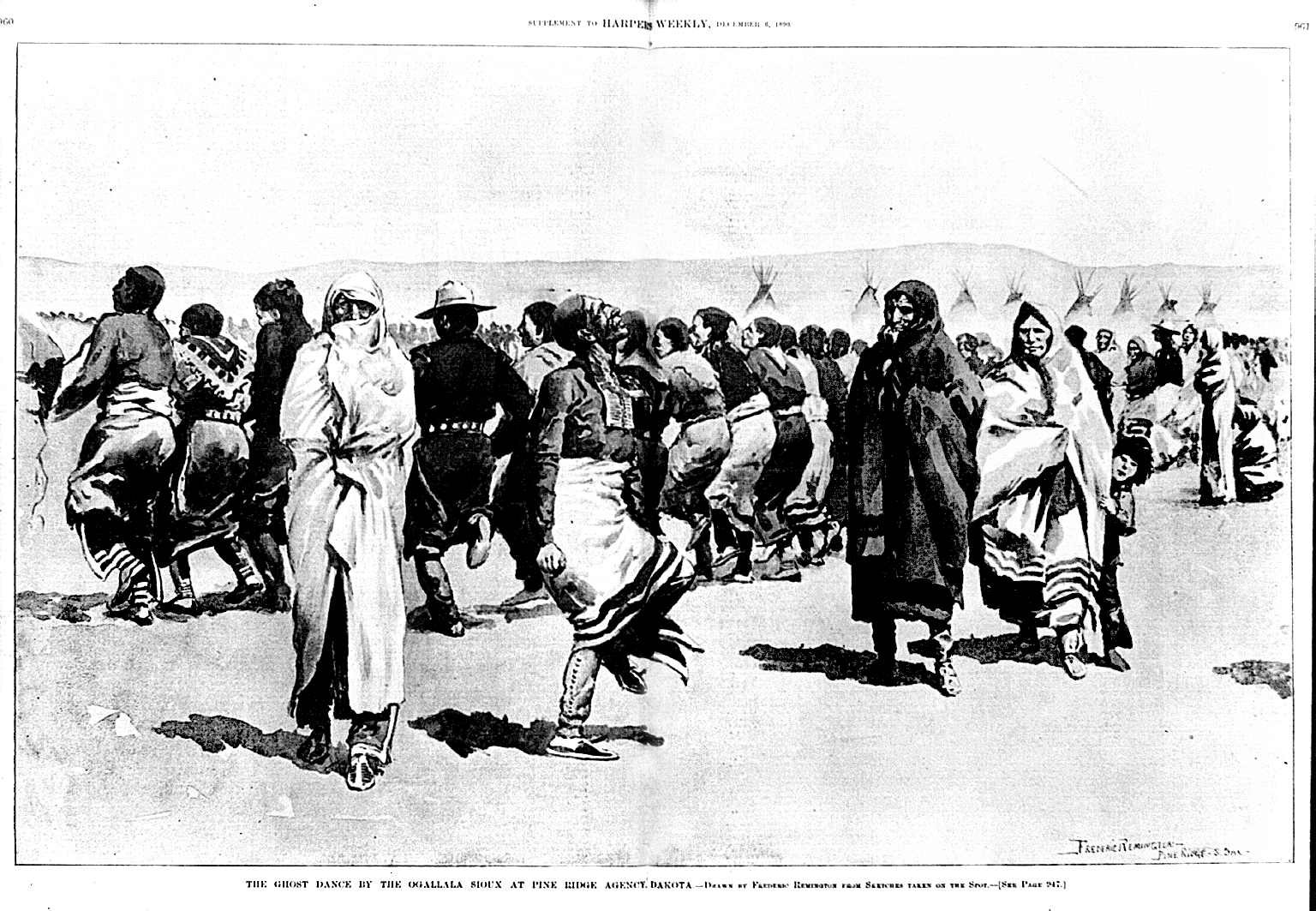
"The Ghost Dance Of The Oglala Lakota At Pine Ridge," by Frederic Remington.
How The Ghost Dance Came To The Lakota
From The Northwest To The Great Plains

By Dakota Wind
GREAT PLAINS - The origin of the Ghost Dance stemmed from the introduction of Christianity to the native people of the Northwest, specifically the Shaker Movement in which Christians prayed and danced for the Second Appearance of Jesus Christ.


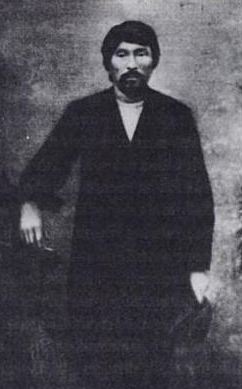
Rev John Slocum
Pictured here is the Rev. John Slocum. The Indian Shaker church still exists today.

In October 1881, a Squaxin Indian man living on the Southwestern arm of Puget Sound known locally as John Slocum knelt down in the woods to pray. Slocum reflected about the impacts that hard liquor, gambling, idleness, and general vice had affected his life and the life of his people. He took ill and by all accounts, died. By those same accounts, later in the day, Slocum revived and told everyone of his journey to heaven, where he was given a choice: either go to hell or return to the world and minister to his people. He chose to live again.


Slocum’s shaker ministry quickly spread to the native population in the Northwest, causing some unease among settlers because the Indian Shakers had their own priests and built their own churches. The Presbyterian ministers actively sought to include the Indian shakers in the body of the Presbyterian Church.


The Indian shakers became known for visiting the shut-in and sick, and just as known for praying themselves into a trance over the same. A ritual followed the trance in which the sickness was pulled out of the patient and absorbed by the priest/medicine man who fell down dead and the patient recovered.

 
James Moony worked for the Bureau of Ethnology. Moony traveled to various native reservations to preserve and analyze as many native traditions as he could. He wrote many ethnological reports, one of which was his "The Ghost Dance Religion and the Sioux Outbreak of 1890."


James Mooney, author of The Ghost Dance and Wounded Knee, collected the story of two shaker medicine men venturing south into central Oregon to a tribe there where they apprenticed a young Indian man of the tribes, whom Mooney postulates could be none other than Wovoka, The Cutter.


Wovoka was the son of a highly respected medicine man or prophet of the Indian people in Mason Valley, called Tavibo. Tavibo died about 1870, leaving a fourteen-year-old Wovoka. Wovoka came into the employment of David Wilson and was given the Anglo name, Jack Wilson. David Wilson employed Wovoka until about 1886, when Wovoka decided it was time to share his experience of heaven and the message he received.


During the solar eclipse of August, 1868, Wovoka had fallen asleep and was taken up to heaven. There he saw all the people who had already departed and he met with God. Wovoka received the mission to go back to his people and tell them “They must be good and love one another, have no quarrelling, and live in peace with the whites; that they must work, and not lie or steal; that they must put away the old practices that savored of war; that if they faithfully obeyed his instructions they would at last be reunited with their friends in this other world, where there would be no more death or sickness or old age.”


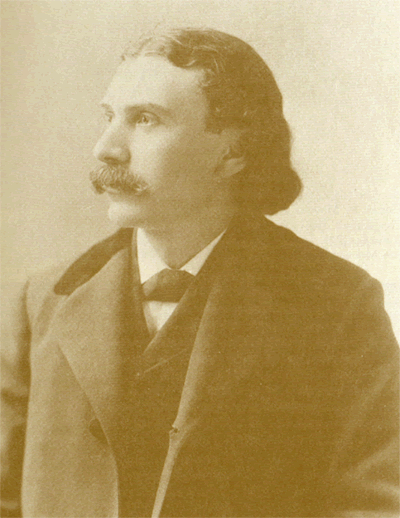
[image]
Wovoka is seated here with leaders of the Northern Arapaho tribe.

Wovoka was given a dance to take to the Indian peoples, a dance which must be performed for five consecutive days. Mooney, who interviewed Wovoka when he made a study of the Ghost Dance religion in December, 1890 to April 1891, said that Wovoka disclaimed responsibility and association with the Ghost Dance shirt which had become an important part of the Sioux Ghost Dance. In fact, Wovoka asserted to Mooney, that it was “better to follow the white man’s road, and to adopt the habits of civilization,” and that his religion or practices were ones of universal peace. 


Wovoka had gone to live among the Paiute Indians of Utah and spread his message and vision. From there his message spread east to the Northern Arapaho and Shoshoni of Wyoming, then on to the Lakota and Cheyenne. A few of the Arikara, Hidatsa, and Mandan became caught up in the news from Fort Washakie, WY.


In the fall of 1889, three principle delegates, Porcupine (a Northern Cheyenne from Montana), Kicking Bear (Mniconjou Lakota, Cheyenne River Agency, SD) and Short Bull (Sicangu Lakota, Rosebud Agency, SD) made a pilgrimage to Fort Washakie to hear about the Ghost Dance for them selves.

 
Fort Washakie in 1892.


The Ogallala Lakota, Sword, had this to say, “In 1889, the Ogalala [sic] heard that the son of God had come upon earth in the west. They said the messiah was there, but he had come to help the Indians and not the whites, and it made the Indians happy to hear this.”


Porcupine, Kicking Bear, and Short Bull didn’t stop at Fort Washakie, but continued on to Pyramid Lake stopping along the way to witness the Ghost Dance. According to Porcupine, they were treated with kindness by the whites as they journeyed to the lake, and that even the whites participated in the Ghost Dance.


From Pyramid Lake, the delegation journeyed to Walker Lake where Wovoka himself led the Ghost Dance. After the dance there, Wovoka entered into a trance. According to Porcupine, Wovoka awoke and proclaimed to all that he went to heaven, saw all those who had died before, and that he had been sent back to instruct the native people. Porcupine essayed further that Wovoka claimed to be the returned Christ, that the dead would be resurrected, the Indian people would live forever; that there would be universal peace, and death and destruction to those who refused his message.


The delegation returned home.

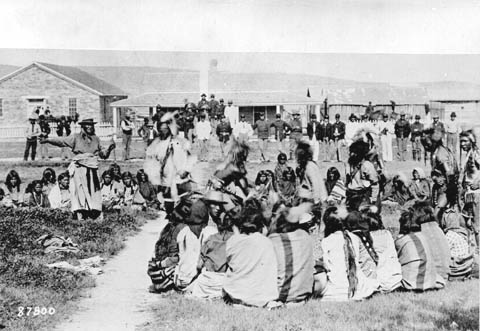
The Ghost Dance at Sitting Bull's camp along the Grand River in South Dakota, on the Standing Rock Sioux Indian Reservation. Unknown photographer, 1890.


In October, 1890, Kicking Bear introduced the Ghost Dance to Standing Rock at Sitting Bull’s invitation to perform the dance at his camp along the Grand River. The Indian Agent, Major James McLaughlin, dispatched the Indian police to arrest Kicking Bear, but they returned to the agent’s office unsuccessful. Sitting Bull promised McLaughlin that Kicking Bear would leave when he was finished, which he did after two days.  Sitting Bull didn’t not discourage the Ghost Dance on Standing Rock, and on the Cheyenne River reservation, the Indian police couldn’t stop Big Foot’s band from dancing.


It is important to note that as the Ghost Dance was coming to a head North and South Dakota had recently entered the Union as states. Indian reservations were made smaller. Hunting grounds were being settled and turned into farmland. Traditional and culturally significant landmarks were given over to citizens for farming or ranching. Drought had caused native farmers’ crops to fail two years in a row and those who received government issued rations received a third to a half of what was promised by treaty. People were nearly starving. It was a desperate time and the native peoples turned to a desperate faith.

 
General Nelson A. Miles pictured here with former U.S. Army Scout Buffalo Bill Cody. Together they survey the field after Wounded Knee.


General Miles, of Civil War fame and for capturing Indian leaders like Chief Joseph and Geronimo, advised that no additional military force was necessary, to let the Ghost Dance run its course, that “the excitement would die out of itself.” Indian agents at Lakota Sioux agencies became increasingly alarmed because they could not stop the dancing.


On October 31, 1890, Short Bull rounded up his Ghost Dance followers and encouraged them to gather in one place and prepare for the coming of the messiah, even if they were surrounded by troops, even if they were fired upon. The Lakota who participated in the Ghost Dance firmly believed that their Ghost Dance shirts made them impervious to bullets; that the bullets would pass through them without causing injury.


On November 17, 1890, soldiers were ordered to report throughout the Indian agencies at Cheyenne River, Lower Brule, Rosebud, and Pine Ridge, under the field command of General Miles, altogether about 3,000 soldiers. No action was needed as the mere presence of soldiers was enough to dissuade dancers from dancing. John Noble, Secretary of the Interior, immediately ordered full rations to be distributed as was agreed to in treaty.

Farmers near New Salem rally to defend themselves against the perceived Ghost Dance threat. The farmers even went so far as to build an earthen fort, even cristening it "Fort Saurkraut." This farmer's volunteer militia wasn't authorized by General Miles or the Department of War. Unknown photographer, 1890.

The Department of War assumed control of Standing Rock, with arresting Sitting Bull as the next step. To convince Sitting Bull that his cooperation was necessary, former US Military Scout William F. Cody, better known as Buffalo Bill, was sent to persuade Sitting Bull to turn himself in. Cody arrived at Fort Yates on November 28, 1890, but his orders to continue to Sitting Bull’s camp were halted by Agent McLaughlin.


According to Mooney, Agent McLaughlin believed that a conflict would follow if the military were to arrest Sitting Bull. The military arrest was delayed on the advice of McLaughlin who told Cody that he’d send Indian police, which he did on December 14th, 1890. Lt. Bull Head lead the attempt to arrest Sitting Bull came with the dawn on Dec. 15 and ended in disaster with the death of Sitting Bull and seven of his followers, and the death of Bull Head and seven of his police officers.

Thursday, February 23, 2012

Traditional Lakota Courtship

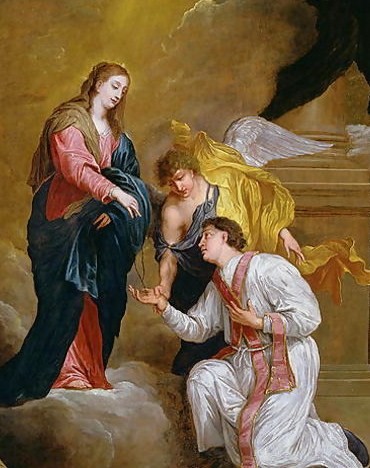
File:St-Valentine-Kneeling-In-Supplication.jpg
Saint Valentine recieves a rosary from the Virgin Mary.
Traditional Lakota Courtship
Lakota Demonstrations Of Affection

By Dakota Wind
GREAT PLAINS - Valentine’s Day is a day most associated with romantic love, often celebrated with affectionate cards, fresh flowers, or gifting of sweets to loved ones. Its my understanding that celebrating Valentine’s Day as it is celebrated today wasn’t always so, that it wasn’t until the Middle Ages that the saint’s day became associated with courtly love.


Amongst the Lakota there is a courting practice, an old tradition seldom performed today, but reaching back nearly a thousand years, and it starts with serenading one’s object of affection with the haunting sound of flute music.


Like many ancient world traditions, the Lakota used to arrange marriages for their daughters. This practice, along with polygamous marriages (when a man took more than one wife), have not been put into practice in well over a century.


The origin of the flute on the Northern Plains has many stories, about as many stories as there are tribes with variations among the bands or clans of those tribes.

Kevin Locke from his Makoche album "Open Circle." Artistically speaking, it is Kevin's best piece of work. Gratify yourself and get a copy on Amazon or buy it through Makoche in Bismarck, ND.

Traditional flute-players Bryan Akipa and Kevin Locke tell the story of a young man who fell in love with a young woman a long time ago. The young man became so smitten around the woman of his affections, that he found he could not talk to her. Motivated by his silence of melancholy, the young man removed himself from the village.

They say this young man came to the river and followed it. He eventually came to rest under the shade of a tree; some say it was a cedar tree. He fell asleep, or as he was drifting off to sleep, he heard the wind passing through the branches of the tree. In the branches of the tree were holes that a woodpecker had drilled, probably looking for termites or bore beetles. As the wind passed over the holes of the branch, a melody was produced.

Some say that it was the personification of elk who came to visit the young man and gifted him with the flute because they were moved by his inability to articulate his feelings to the young woman of his affections. Some say he merely reached up and carefully removed the branch and the birds taught him how to sing with it.


Englishman Paul Goble renders the first flute story in his book "Love Flute" which is published by Aladdin Paperbacks. The look and feel of the book is based on pictographs of the Plains Indians.

However he came to possess the flute, he learned its art. Then he returned to his village. He played his flute from the outskirts of the encampment, perhaps from the top of a hill or perhaps upwind so that his music could carry.

The young woman with whom he was in love with knew immediately that the music was for her. She returned his affections and they became a couple.

I have always been interested in when something happened. Like the flute story. When did the flute appear on the Northern Plains? I like to ask flute-players when they think the flute came to be, but the answer is almost always a resounding “a long time.” Then one day I asked Keith Bear, a Mandan-Hidatsa flute-player when the flute came to be. He quietly reflected that when he was young he had asked a grandfather that same question who in turn told him that when he was young, had asked the same question of a grandfather and was told, “They [the flutes] have been around for the span of ten grandfather’s lives.”

Keith Bear poses regally in a traditional quilled war shirt and carried a beautiful crane flute. He, like Kevin Locke, recorded at Makoche in Bismarck.

It was a puzzle to figure out, the span of ten grandfather’s lives. Keith ruminated that a grandfather’s life could be anywhere from forty to 100. Who knew the answer? I turned to renowned Plains Indian archaeologist Dr. Ray Wood and asked him how long the whistle has been on the northern plains, for in Lakota, one word for whistle is the same as flute, while flute also has another name for it.

As I was waiting for Dr. Wood’s response to my query, I came across the Brown Hat Winter Count in which the span of a grandfather’s life is measured at about seventy-five winters (years). I took this as a good sign, for the Mandan and Hidatsa are long ago relatives of the Lakota. Being that Keith is a grandfather himself, and he had asked a grandfather too, we could easily today say that the flute has been on the Northern Plains for the span of twelve grandfathers. Twelve times seventy-five equals 900. Now subtract 900 from the year I asked, which was back in 2000, we arrive at the year AD 1100.


Here's one of Dr. Wood's many works about the archaeology and history on the Northern Plains. Dr. Wood might not have had the excitement of Indiana Jones, but at one point fifty some years ago, he and several other archaeologists worked feverishly to salvage what they could when the dams were built by the Army Corps of Engineers back in the 1950s.

I eventually received a reply from Dr. Wood. He graciously and swiftly responded (in two weeks) and sent me images of the whistles he personally recovered from a few sites along the Upper Missouri River. He dated them to the year AD 1100.

In contrast of the flute story where the young man courts the affections of the woman and wins her heart is the story of the Homely Girl.

A long time ago, as these stories go, a young girl was relentlessly teased about her looks. She wasn’t regarded in any way beautiful. In the version I heard, she lived with her grandmother, and she was in love with the chief’s son. The grandmother was in a way, the fairy god-mother of this story.

A day came when the chief wanted to arrange the marriage of his son and he made an announcement to the people. The chief’s son was considered by many to be not just brave in battle but quite handsome in appearance. All the single young women of the village wanted to be the wife of the chief’s son. The chief proclaimed that a test would determine who would be his son’s wife.


I haven't heard the story of the Homely Girl since I was little, but the story of the "Rough-Face Girl" by Rafe Martin and David Shannon is close. Buy yourself a copy of this beautiful story.

Perhaps it was a year that passed as the women prepared for the test, perhaps a summer only, I don’t recollect that detail, but they prepared. When the young women heard that the homely girl wanted to participate, they scoffed and openly mocked her efforts.

The test consisted of a demonstration of domestic life, which at that time meant food preparation, building a fire, and a host of other skills like tanning and making moccasins.

The homely girl’s grandmother took her granddaughter out in the summer field and showed her which turnips to pick to make soup with, and they plaited them together into one long braid. The grandmother took her granddaughter into the woods and showed her which wood to pick for starting a fire and which wood to pick to burn the longest. The grandmother showed her granddaughter how best to set up the tipi and take it down in wind and rain, in the heat and cold.

The time of the test arrived, and the chief and his son visited all the families who had suitors. They visited the beautiful and the daughters of other chiefs, many who rushed to prepare food, who couldn’t maintain a fire, whose impatience showed in their beadwork or quillwork, or who couldn’t assemble or disassemble a tipi swiftly enough to satisfy the chief.

They came at last to the homely girl’s demonstration. She made simple moccasins with hard soles and modest accents of quillwork. She built a fire and it lasted through the night. For much of their time, the chief and his son quietly watched the homely girl in her demonstrations.

The test came to an end. The beautiful women were confident one of them would be chosen. The daughters of other chiefs were confident were confident one of them would chosen. At the end of the day, though, it was the homely girl who was chosen for her quality of character was revealed in her craft and preparation. She was not haughty, she was not impatient, and she did not spite any of her rivals.

In the first story, the lesson men should take is patience, and to find one’s voice. A natural lesson is to be learned from it too is that in nature it is the male who must prove his worth to the female.

In the second story, the virtues that Lakota women should practice are humility and patience. Virtue wins out in the end.

Tuesday, February 14, 2012

Attacks On Fort Abraham Lincoln

An aerial view of Fort Abraham Lincoln State Park, 1963.
Attacks On Fort Abraham Lincoln
Fort Faces Gunfire And Skirmishes
By Dakota Wind
MANDAN, N.D. - The following is an excerpt from the article “Embracing a relation of the history of the state from the earliest times down to the present day, including the biographies of the Builders of the Commonwealth” which was published by the Bismarck Tribune in 1910 in the “History of North Dakota.” This article features the skirmishes surrounding Fort Abraham Lincoln. It should be noted that the Fort Abraham Lincoln military reservation itself was about twenty-three square miles, which is about 15,000 acres. The Fort Abraham Lincoln State Park today encompasses only 1,100 acres.


These were the ominous figures on the northern line of Sioux unceded land through which the Northern Pacific was to pass. The survey had been carried on to the Missouri river without serious interference from the Indians, and it as much menaced until the Hunkpapa leaders had gathered about them a very considerable force, composed of the fiercest and most bitter of the Sioux nation. There is not doubt that up to the summer of 1872 the work of the leaders was directed to getting the spirit of the Indians aroused. And they succeeded in drawing the Cheyennes into their quarrel. August 14, 1872, a column of the Second cavalry was attacked in Montana by Black Moon a the head of a considerable body of Sioux and Cheyennes. Two whites were killed and a number of Indians killed and wounded. The Indians might have pursued the advantage they had, and inflicted more injury on the soldiers, but for a strange policy they pursued of quitting when a battle was well night [sic] won.

WARFARE NEAR BISMARCK

Sitting Bull wears a hat with a monarch butterfly affixed to it.


This affair started the entire hostile element into activity. Twelve days later a war party attacked a detail of the Sixth Infantry from Fort Abraham Lincoln. The soldiers with some ‘Ree scouts were making a reconnoisance [sic] about twelve miles west of Bismarck when attacked. Two of the ‘Rees were killed. The affair indicated that Sitting Bull had influenced his people nearer at home to make trouble close to the settlements and Bismarck was threatened by many alarms. October 2, about four hundred Sioux attacked Fort Lincoln itself, but were repulsed by the troops after they had killed three ‘Rees -- who seem to have born the brunt of the battle in these skirmishes. There was fighting on the White River about the first of October and on the 14th a big party made a demonstration against Fort Lincoln. A company of the Sixth and body of scouts were sent out against the marauders and drove them off, with the loss of two men. The Indians suffered again, losing at least three men. These affairs took place right on the threshold of civilization for by this time the white man had advanced to the Missouri with the determination to stay.

A picture of General Custer, after the Civil War and during his Indian fighting days. He was actually a Lieutenant Colonel at the time of his death, but out of respect for the rank he once held during the Civil War, he was called "General."


An attempt was made to negotiate another treaty with the Indians to open the way for the surveyors, but it was ineffective and while it was going on, in the spring of 1873, three distincts attacks were made on Fort Lincoln. Lt. Col. Carlin was in command and he drove the Indians off on each occasion with some loss, but the eyes of the authority were opened to the reality of the menace of these attacks and Lt. Col. Geo. A. Custer, with the Seventh Cavalry, was sent to establish headquarters at Fort Lincoln and clear the hostiles out of the country, which marked the beginning of the end of Custer and the dashing organization he brought with him. The coming of Custer assembled in North Dakota and the adjacent territory the elements which entered into the playing out of the tragedy of the Indian and the breaking of the power of the Sioux nation.


It was the perspective of the Hunkpapa Lakota that Forts Rice and Lincoln represented the arrival of the US military and signaled that settlers were here to stay. The Ihanktowana (Yanktonai) were already pushed west across the Missouri after the punitive campaigns of Generals Sibley and Sully after the Dakota Conflict in Minnesota of 1862. The Cheyenne at one time dwelled on the west bank of the Missouri River, and viewed the river as a boundary line themselves. It was easy for the Hunkpapa Lakota to pique the Cheyenne by rousing their need for self-preservation.


The Fort Laramie Treaty of 1868 stated the boundaries of the Great Sioux Nation, and that no surveyors, minors, nor settlers could enter those lands. The Hunkpapa had every right to believe they were defending their lands, especially after Fort McKeen and Fort Abraham Lincoln were built at the convergence of the Heart and Missouri Rivers, one of the boundary markers of the Great Sioux Nation, and the site of the Battle of Heart River in 1803 that determined Lakota territory.