Monday, February 13, 2012

The Treaty of Fort Abraham Lincoln, or The Treaty of 1875

Soldiers practice on the parade ground of Fort Abraham Lincoln. The Commissary sits in the background (left) and Captain Tom Custer's bachelor officer's quarters (background, right).
The Treaty of Fort Abraham Lincoln
The Treaty of 1875
By Dakota Wind
FORT ABRAHAM LINCOLN, D.T. (MANDAN, N.D.) - In May, 1875, Fort Abraham Lincoln served a purpose much the same as the United States serves in the Middle East in recent times, that of intermediary between two warring nations. It worked then about as much as it works today.


Fort Abraham Lincoln was built partly on the remains of the Mandan Indian village site, On-A-Slant, located on the west bank of the Missouri River, across from Bismarck, Dakota Territory. Fort Abraham Lincoln is also built at the convergence of the Heart River and Missouri River, where in 1803, a battle between the Ihanktowana Dakota and the previous claimants to this locale was fought, it ended in victory for the Dakota and the contested land became part of “Sioux” territory.


After the treaty was signed, a great celebration at Fort Abraham Lincoln ensued lasting several days. There was feasting and dancing, but after the parties returned to their respective agencies, conflict resumed.

The Indian Scout standing on the porch wearing a military blanket is often misidentied as Bloody Knife, an Arikara Indian and General Custer's favorite scout. Bloody Knife stood about 5'7". The Indian in this picture is most probably the Hunkpapa Lakota Indian Scout Long Soldier who stood at 7' (observe his height in relation to the front door). Long Soldier served at Fort Abraham Lincoln. A leader of his band of Hunkpapa, he signed the treaty of Fort Abraham Lincoln.

Fort Abraham Lincoln served as host to the Hunkpapa Lakota, the Sihasapa Lakota, the Ihanktowana Dakota (Yanktonai), the Sahnish (Arikara), the Hidatsa (Gros Ventres), and the Nu’Eta (Mandan). Here follows the text of the Treaty of Fort Abraham Lincoln:


TREATY BETWEEN THE YANKTONAI, HUNKPAPA, AND BLACKFOOT SIOUX AND THE ARIKARA, HIDATSA, AND MANDAN

May 29, 1875

Whereas war has prevailed for many years between the Sioux Indians on one side and the Arickaree, Mandan, and Gros Ventres on the other, and whereas, it is now the desire of the Yanctonnais, Uncpapa and Blackfeet bands of the Sioux Nations and of the Arickaree, Mandan and Gros Ventres to put an end to such hostilities forever:--


We, the undersigned chiefs and headmen of the tribes and people above named do solemnly and in good faith promise—


First


That we the undersigned chiefs and headmen of the Sioux Nations and the people we here represent will from this day forward live in peace and friendship with the chiefs and headmen of the Arickaree, Mandan and Gros Ventres and the people they here represent, and that we will exert all our power and influence over our people to prevent them or any of them from committing any unfriendly or hostile acts against the Arickaree, Mandan and Gros Ventres.


Second


That we the understood chiefs and headmen of the Arickaree, Mandan and Gros Ventres tribes of Indians and the people we here represent will from this day forward live in peace and friendship with the chiefs and headmen of the Yanctonnais, Uncpapa and Blackfeet bands of the Sioux Nation and the people they here represent, and that we will exert all our power and influence over our people to prevent them or any of them from committing unfriendly or hostile against the people of individuals of the tribe of Sioux represented in this council.


Third


That we the chiefs and headmen of the Yanctonnais, Uncpapa and Blackfeet tribes of Sioux will use all our power and influence toward preventing Sioux of the Cheyenne River Agency from committing hostile or unfriendly acts against the Arickaree, Mandan and Gros Ventres.


Fourth


That we the undersigned chiefs and headmen of the Arickaree, Mandan and Gros Ventres of Indians will use all our power and influence towards preventing hostile or unfriendly acts on the parts of the people we represent against the Sioux of the Cheyenne River Agency.


Five


That if any of the chiefs and headmen who have signed this treaty shall learn that their young men are engaged in organizing expeditions or war parties intended to or likely to violate this treaty, they will forthwith inform their Agents in order that he may take such measure as will prevent any violation of the treaty made and entered into this day.


Done at Fort Abraham Lincoln, Dakota Territory, this 29th day of May, A.D. 1875, in presence of


                                                                        W.P. Carlin


                                                                        Lieut. Colonel 17th Infantry


                                                                        Commdg Fort A. Lincoln D.T.


L.B. Sperry                                                      John Burke


U.S. Indian Agent for the Arickarees,      U.S. Indian Agent for the Sioux Tribes


Gros Ventres, and Mandan Indians.


Arickaree      Son of the Stars        [x]        Lower             Two Bears                  [x]


                        White Shield              [x]        Yanctonnais  Mad Bear                  [x]


Gros Ventres Crow Breast              [x]                                Bulls Ghost                 [x]


                        Lean Wolf                  [x]        Uncpapa       Running Antelope   [x]


Mandans       Bad Gun                    [x]                                Thunder Hawk          [x]


                        Flag Lance                [x]                                Bear’s Rib                  [x]


                                                                                                Slave                          [x]


                                                                                                Long Soldier              [x]


                                                                                                Bears Eye                   [x]


                                                                        Blackfeet       The Grass                   [x]


                                                                                                Fire Heart                   [x]


                                                                                                Sitting Crow              [x]


                                                                        Upper             Wolf Necklace         [x]


                                                                        Yanctonnais  Black Eye                   [x]


Signed in Quadruplicate


one copy given to Sioux Agent John Burke


one copy given to Ree, Mandan and Gros Ventres Agent L.B. Sperry


one copy forwarded to Headqrs, Dept. Of Dakota


one copy retained at Post headquarters


                                                                        James Calhoun


                                                                        1st Lieut 7th Cavalry


                                                                        Adjutant

Monday, January 30, 2012

"Go West" by Michelle Hespe

In the summer of 2011, I had a chance to visit Michelle Hespe over lunch at the Blarney Stone in Bismarck, ND. Michelle came to North Dakota to write a story about the American West, the Western spirit that's still alive here on the Northern Plains.

Let me just say that I respect the writings of the Corps of Discovery. I do think that there's a lot left out when studying the Corps' writings, like the fact that the French, English, and Spanish all made the journey to the Knife River Indian Villages - the Corps of Discovery, however, did document and map all that was unknown to western science after they left the Mandan and Hidatsa.

In Michelle's article, I related to her the visit of a traditional Lakota man to my elementary school, he could very well have been a medicine man, I don't quite recall, but he did relate to the students the prophecy of the 7th generation, that seven generations after the post-reservation period began, the Lakota culture would experience a revival or resurgence, a Lakota Renaissance if you will.

I remember in the sixth grade having about twenty classmates. By the time I graduated there were only six of us. In my graduating class I was the only one with a traditional Lakota name. I mentioned my cousin Rick who also was the only one in his graduating class to bear a traditional name.

There's two parts to ensuring the legacy of culture. Tradition, that which is handed down, and appropriation, that which is made one's own. I wished I had seized more when I was younger.

Here's Michelle Hespe's article:
"Go West" by Michelle Hespe

Thursday, January 26, 2012

Spotted Elk's (Big Foot's) Journey Ends In Tragedy At Wounded Knee

Major James McLaughlin, BIA Indian Agent at the Standing Rock Sioux Indian Reservation. Photo by D.F. Barry.
Spotted Elk's (Big Foot's) Journey
Tragedy At Wounded Knee

By Dakota Wind
STANDING ROCK - The Ghost Dance came to the Standing Rock Sioux Indian Reservation sometime in 1889, about the time that North and South Dakota entered the union as states. Major James McLaughlin ordered BIA Indian Police to Sitting Bull’s home on the Grand River in South Dakota, in an attempt to halt the Ghost Dance. The arrest was to happen in the early morning of Dec. 15, 1890. The BIA Indian Police surrounded Sitting Bull’s cabin, knocked on the door, and informed the Lakota leader that he was under arrest. Sitting Bull’s camp awoke and tried to inhibit the arrest. Anxiety gripped the camp and the police alike. Catch-The-Bear shot Bullhead, Bullhead shot Sitting Bull in the chest, Red Tomahawk fired a round into Sitting Bull’s temple. At the end of the gunfight, the bodies of Sitting Bull, six policemen, and eleven warriors turned the winter snow red with blood.


Unphan Gleska (Spotted Elk), also known as Si Tanka (Big Foot), a chief of the Mniconjou band of Lakota, is pictured here with his wife Cetan Ska Win (White Hawk Woman).

Spotted Elk, also known as Big Foot, a Mniconjou Lakota Chief, took flight and lead his band south, the destination: Pine Ridge. There, perhaps Spotted Elk might find refuge among the Lakota of Red Cloud and Crazy Horse.

On Dec. 28, 1890, Spotted Elk’s band stopped near Porcupine Creek. Spotted Elk called for the men to raise the white flag. Major Whiteside of the 7th Cavalry parlayed with Spotted Elk, promising food to the hungry and blankets for the cold, and then escorted Spotted Elk’s band to Wounded Knee Creek where the 7th Cavalry was camped. Two companies of cavalry took the lead, followed by an ambulance carrying Spotted Elk, Spotted Elk’s band (now on foot), wagons, and two cavalry companies, and bringing up the rear was a battery of Hotchkiss guns.


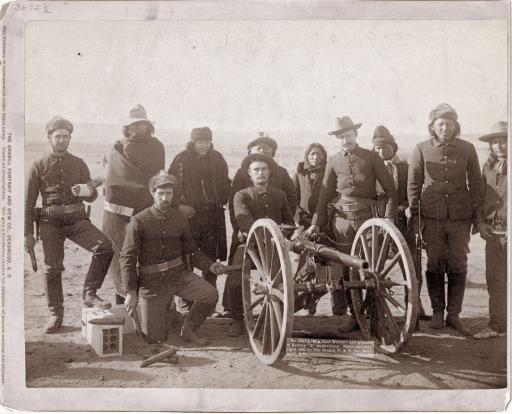
In this picture are seven Lakota scouts and four soldiers posing with a Hotchkiss gun.

When the column of cavalry and Lakota reached the military camp at Wounded Knee, the Lakota were counted at about 120 men and 200 women and children. After camp was established, Major Whiteside ordered two troops of cavalry stationed around the camp to serve sentry duty with two Hotchkiss guns placed on a rise overlooking the camp. Later that night, Colonel Forsyth arrived with orders to take Spotted Elk and his band to a military prison in Omaha, NB. A few spectators and a self-serious Jesuit priest named Francis Craft came with Forsyth. Fr. Craft was selected to use his influence with the Lakota as a Black Robe to persuade them to come in peaceably (as Fr. John Lutz had done earlier that month with the Sicangu Lakota chief Two-Strike). Forsyth placed his Hotchkiss guns alongside Whitesides’s guns.


Colonel James Forsyth pictured here in his Brigadier General uniform. He made the rank of general in November 1894.

According to Fr. Craft’s account of the Wounded Knee Massacre, Forsyth made a peaceful speech and asked the Lakota to surrender their arms. The Lakota denied that they had any. Forsyth sent soldiers amongst the Lakota to retrieve any arms they found. A medicine man began to pray and sing. Some of the Lakota men came forward, one by one to leave their arms, and when about twenty rifles were collected, a soldier spied rifles under blankets and cried out, “Look out, look at that,” followed by nervous laughter on both sides. Forsyth assured the Lakota that he would not take their arms by force even if he had ten years to wait. Then according to Fr. Craft, he walked among the Lakota calming them as best as he could as he passed out cigarettes. Craft further says that several Lakota men threw aside their blankets and actually raised their guns to companies B and K, and he identified many of the Lakota arms as repeating twelve-shot Winchester rifles. Craft says that he ran along the line of Lakota warriors and begged them to stop, at which the Lakota warriors laughed then lowered their arms, all but one. Craft identified the remaining Lakota rifleman as Black Fox, a deaf-mute, who was unable to understand the exchange between priest and warriors and who then fired off a round.


Fr. Francis Craft carried a pipe. He fought in the Union army in the Civil War at the age of ten. He recieved a bayont wound to the head at the Battle of Gettysburg. His maternal great-grandfather, a mohawk chief in New York fought for the States in American Revolution. Craft was a descendant of Nathanial Greene, who also fought in the American Revolution.

Fr. Craft says that the Lakota women and children were standing behind the Lakota warriors, looking on. When the 7th retaliated with gunfire, the Lakota broke into small parties and tried to break past the lines of the soldiers. Hotchkiss gunfire mowed down all who were in its line of fire, whether they were soldier or Lakota. Scouts ordered the women and children down on, but were likely not heard over the gunfire or couldn’t understand English, but few obeyed.

Caught in the crossfire, Fr. Craft tried to give absolution to a dying cavalry soldier and was accidentally shot by him, a passing Lakota warrior tried to bring Craft to his feet but it looked to the soldiers as an attack on the priest and the dying soldier. The soldiers raised their weapons to fire on the Lakota who was assisting Craft, but Craft pushed the Lakota man down and interjected his body between the soldiers and the Lakota. A Lakota called Aimed-At-Him saw Craft push the Lakota down and he retaliated by stabbing the priest.


Fr. Craft is pictured here recovering from the wounded he received at Wounded Knee. The words on the image say, "Father Craft, the Hero of Wounded Knee Fight."

Fr. Craft paints an entirely different scene of the soldiers after the massacre, that after the gunfire was finished, soldiers carried the bodies of the children off the field in their coats, many of the men breaking down and crying. In contrast, American Horse’s account gives readers a view of cold-blooded murderers: “There was a woman with an infant in her arms who was killed as she almost touched the flag of truce...A mother was shot down with her infant; the child not knowing that its mother was dead was still nursing...The women as they were fleeing with their babies were killed together, shot right through...and after most all of them had been killed a cry was made that all those who were not killed or wounded should come forth and they would be safe. Little boys...came out of their places of refuge, and as soon as they came in sight a number of soldiers surrounded them and butchered them there."


General Nelson Miles, a Civil War hero, captured Chief Joseph and the Nez Perce, captured Geromino and his band of Apache, and surrounded the Lakota at White Clay in the last military engagement between the Lakota and the US military. Miles also served in the Spanish-American War. He wanted to serve in World War I, but was considered too old.

Hugh McGinnis, First Battalion, Co. K, Seventh Cavalry: “General Nelson A. Miles who visited the scene of carnage, following a three day blizzard, estimated that around 300 snow shrouded forms were strewn over the countryside. He also discovered to his horror that helpless children and women with babes in their arms had been chased as far as two miles from the original scene of encounter and cut down without mercy by the troopers. ... Judging by the slaughter on the battlefield it was suggested that the soldiers simply went berserk. For who could explain such a merciless disregard for life?... As I see it the battle was more or less a matter of spontaneous combustion, sparked by mutual distrust...”

Fr. Craft was a mix-blood Mohawk from upstate New York who was called to the priesthood because of his native heritage. Craft said that he “would not have endured the trials of religious profession for any other purpose.” Craft sought an appointment out west and eventually came to Pine Ridge where he learned the Lakota language and was adopted into Chief Spotted Tail’s family. Craft was given the name Waŋbli Cica Aglahpaya, The-Eagle-That-Covers-Its-Young, or simply Hovering Eagle. Fr. Craft wasn’t the typical religious zealot who forced conversion by persecuting traditional practices, in fact, he encouraged the traditional songs and dances. It would seem that Fr. Craft would have little reason to lie about what he saw at Wounded Knee, and perhaps from his vantage point as he lie wounded between soldier and Lakota he saw no more. He certainly didn’t see less.

Sinte Gleska, Spotted Tail.

According to Dee Brown in his book Bury My Heart At Wounded Knee, Col. Forsyth broke fast and then ordered the Lakota to disarm. The Lakota stacked their arms in the center of the camp and when there weren’t enough arms piled up, the soldiers were ordered to go through the Lakota’s belongings and retrieve them all. The soldiers collected two more guns and removed axes, knives, and even tipi stakes. A medicine man named Yellow Bird began to sing and dance. One of the rifles belonged to a deaf Lakota named Black Coyote. Black Coyote shouted about how much he had paid for the gun and raised it above his head. Soldiers grabbed him, and though he hadn’t directed his rifle at anyone, then the rifle. Somehow, Black Coyote was spun around and as he was spun, the gun went off. Brown’s resources say that Black Coyote was of bad influence and that he fired his gun at no one, possibly in hopes of keeping it. Brown quotes Weasel Bear as saying, “They shot us like we were buffalo. I know there are some good white people, but the soldiers must be mean to shoot women and children. Indian soldiers would not do that to white children.” Brown estimates that as many as 300 of Big Foot’s band were killed or mortally wounded. Four men and forty-seven women and children were taken to the fort at Pine Ridge and left in the open winter, at least until the Episcopal mission church there opened.


One of the images of the scene of Wounded Knee after the firefight.

General Miles pressed charges against Colonel Forsyth for the murders of the women and children, but Forsyth was exonerated. The Lakota were outraged and united at White Clay, south of Pine Ridge. The Lakota camp there numbered about 4,000, meaning that there were anywhere from 800 to 1000 able-bodied warriors. On Dec. 30, 1890, the Lakota ambushed the 7th Cavalry at Drexel Mission and a small skirmish followed until the buffalo soldiers of the 9th Cavalry came to the rescue. Meanwhile, Gen. Miles quietly surrounded the Lakota war party with a force of 3,500 men, and what nearly became the Lakota’s Last Stand became complete surrender on January 15, 1891.


One of the most iconic images of the Wounded Knee Massacre is this one of Spotted Elk (Big Foot).

John Keegan writes in his book Fields Of Battle: The Wars of North America, that “soldiers caught up with the last hostiles at Wounded Knee Creek in South Dakota, surrounded them, and when they refused to be disarmed, opened fire with automatic cannon. Within a few minutes, 150 Sioux were dead, and within the month, Native American resistance to white power in the continent was over for ever. Custer had been avenged. The 7th Cavalry paraded its colour to mark the surrender of his rifle by Kicking Bear, the last fighting Indian chief.”

If no one actually ever said “revenge,” it was implied. On January 21, 1891, one week after complete surrender, a grande parade passed before General Miles as the military band played “Garry Owen” when the 7th Cavalry marched by. It goes further to say that when a soldier shouted, “Remember Custer,” during the Wounded Knee Massacre retaliation of some kind was being executed.


A view of the canyon where the Mniconjou were killed in the Wounded Knee Massacre.

General Miles’ words regarding Wounded Knee were that the rudeness of the white soldiers frightened the women and children and that “a remark was made by some of the soldiers that ‘when we get the arms away from them we can do as we please with them’ indicating that they were to be destroyed. Some of the Indians could understand English. This and other things alarmed the Indians and [a] scuffle occurred between warrior who had [a] rifle in his hand and two soldiers. The rifle was discharged and a massacre occurred, not only the warriors but the sick Chief Spotted Elk, and a large number of women and children who tried to escape by running over the prairie were hunted down and killed.”

Mr. Will Robinson, Secretary of the South Dakota State Historical Society, 1946-68, said, “It is the army viewpoint that they are not only dead but bad Indians and deserved what they got. That is not realistic but it is the apparent army line dating back into antiquity. It is the basis of their denial of the right of the survivors to compensation. It is not based on fact or sound logic but on guilt complex so strong that they gave out Congressional Medals of Honor to the participants in the Wounded Knee affair (eighteen) and 12 more to the people who did next to nothing at the Mission and White River fracas later of which were of minor importance. They built a great monument at Ft. Riley eulogizing the dead soldiers in this lamentable affair. When one considers that in World War II, sixty-four thousand South Dakotans were engaged for the better part of four years and that they received only three Congressional Medals the incongruity of the Army’s attitudes toward Wounded Knee is emphasized.”

Did Spotted Elk have to go to Pine Ridge at all? Some might say that he went to find a chance at a better life for his band. Others might say that he went because he had no sureties for the survival of his band of Lakota, especially after the tragic death of Sitting Bull. Yet another possibility, a reason why, exists as to his disastrous journey to Pine Ridge. Spotted Elk was said to be the keeper of a white swan wing. This symbol tasked Spotted Elk with the responsibility of bringing peace and settling differences between the various Lakota bands. In the case of Spotted Elk’s pilgrimage to Pine Ridge, he was to bring reconciliation between the followers of Red Cloud and the followers of Crazy Horse. It was his obligation to his people that made him go, but it was the death of Sitting Bull that hurried him.

It is always too late to play “what if,” but if Sitting Bull was not killed, Spotted Elk may have waited until the spring to go to Pine Ridge, but he would have gone nonetheless, and Wounded Knee might not have happened or may have been delayed. It is a matter of honor to remember that it did.


Updated April 6, 2016.
____________________
Bibliography:

Brown, Dee, Bury My Heart At Wounded Knee: A History Of The American West, page 440, Henry Colt and Company LLC, 1970.

Foley, Thomas, Father Francis M. Craft: Missionary To The Sioux, page 87, University of Nebraska Press, 2002.

Utley, Robert M., & Wilcomb E. Washburn, Indian Wars, page 300, Houghton Mifflin Company, 1977.

Keegan, John, Fields Of Battle: The Wars For North America, pp. 311-312, Vintage Books (A Division of Random House), 1997.

Wagner, Sally, Editor, Daughters Of Dakota: Stories From The Attic, Vol. 2, Yankton, SD, 1990.

Ricker, Eli Seavey, Voices of the American West: The Indian interviews of Eli S. Ricker, 1903-1919.

Hugh McGinnis, "I Took Part In The Wounded Knee Massacre", Real West Magazine, January 1966.

Thursday, December 15, 2011

The Death of Sitting Bull: The Story of Red Tomahawk

The Death Of Sitting Bull
The Story Of Red Tomahawk
By Dakota Wind
STANDING ROCK, N.D. & S.D. - December 15, marks the anniversary of the death of one of the greatest Lakota leaders, a veteran and survivor of the “Indian Wars,” Sitting Bull. In Lakȟóta his people knew him as Tȟatȟáŋka Íyotake. Lt. Henry Bullhead was also attributed to the violent end of Sitting Bull.

There are many books out there that talk about the traditional life, war exploits, the tragic death, and the enduring legacy of Sitting Bull.  I’d like to recommend a few different perspectives about the Lakota leader:


"The Lance and the Shield" by Robert Utley
Gratify yourself with a copy of this comprehensive book and get to the know Sitting Bull as a hero. 


"Sitting Bull: His Life and Legacy" by Ernie LaPoint. A really great read, a reflection and recollection of the oral traditions of Sitting Bull as he was known to his children and grandchildren. Just remember that Sitting Bull was Huŋkphápȟa Lakȟóta, the author is Oglála Lakȟóta, and that there are good people on the Standing Rock Sioux Indian Reservation. 

There’s so much written about Sitting Bull and events surrounding his murder. It is true that Agent McLaughlin sent the Indian Police to arrest Sitting Bull. It is true that Sitting Bull was killed by a fellow tribesman. If you want to read and know more about Sitting Bull, there are number of books about him. I’d like to share with you a little about the man who killed Sitting Bull. 

In 2009, I came across a short paper about Red Tomahawk written by one of his descendants. A copy of this account is at the North Dakota State Archives and can be viewed there in person. This resource cannot be checked out. I was curious about what I found and dug a little deeper into the story about Red Tomahawk.

I believe that Red Tomahawk was a man of his time, a time of vanishing bison, a time of radical change on the Great Plains, a desperate time when the only choices left were hard ones. Here’s the paper by Brenda Red Tomahawk, expanded upon by myself.


Captain Red Tomahawk of the BIA Standing Rock Indian Police.

Red Tomahawk is a name forever associated with ending Sitting Bull’s life on the Standing Rock Sioux Indian Reservation in 1890. But, he was a man of great stature, determination, and leadership in his own right, before and after Major James McLaughlin ever ordered him to arrest the Huŋkphápȟa Lakȟóta leader Sitting Bull. 

Tačháŋȟpi Lúta (Red Tomahawk) was born in 1849 somewhere in Montana Territory. His mother, Waŋblí SápA Wiŋ (Black Eagle Woman) was both Huŋkphápȟa and Sihásapa Lakȟóta of the Thítȟuŋwaŋ (Teton). His father, Siŋté Máza (Iron Tail) was Iháŋktȟuŋwaŋna (Yanktonai). 

Red Tomahawk’s name was also his paternal grandfather’s name, given to him by Siŋté Máza as a mark of honor. "I got my name from my grandfather after doing some deed once," he explained to Colonel Alfred Welch.


Red Tomahawk's pictograph signature. 

Red Tomahawk shared some of his lineage with Welch, going back to Wanáta, The Charger, "I can show my father's [line] back for a long time. Back to Wanáta. So can Chief [John] Grass." His grandmother and Grass' grandmother were sisters. "There was a fight between the Dakȟóta and the enemy close to the Lake Of The Broken Axe [Painted Woods Lake] and a girl was taken away from the enemy and finally married into the family of Red Thunder [the father of Wanáta]. From them I came," Red Tomahawk explained.

As a young man, Red Tomahawk traveled throughout his people’s land from Montana to Minnesota hunting bison. In 1866, Red Tomahawk was part of the foray that harassed the soldiers at Fort Rice and took their entire beef heard. Two years later, Red Tomahawk participated in the ten-day siege of Fort Rice which was lead by Phizí, Chief Gall, of the Huŋkphápȟa Lakȟóta. "I was sixteen years of age when we ran off those cattle at Fort Rice," said Red Tomahawk to Welch.

In the years between the Dakota Conflict of 1862 in Minnesota and the discovery of gold in the Black Hills Expedition of 1874, Red Tomahawk fought bravely alongside his tribesmen in defending his people’s lands from miners.

In the summer of 1876, when General Custer and the 7th Cavalry were meeting their fate at the Battle of the Little Bighorn, Red Tomahawk stayed behind at Standing Rock Agency. The following year, a Black Hills treaty negotiations party came to Standing Rock. When the treaty  was ratified, Red Tomahawk put aside his warrior days and became a friend of all citizens. 

The BIA Indian Police on Standing Rock in 1890.

Red Tomahawk maintained a semblance of his warrior status by becoming a member of the BIA Indian Police. He was hired as a sergeant and gradually through promotion worked himself up to the rank of captain during his eighteen years of service. He became a prominent leader who was recognized on and off the reservation. 

According to Colonel Welch's notes regarding Red Tomahawk, Chief Joseph of the Nez Perce was a close personal friend of Red Tomahawk in the post-reservation era. 

Red Tomahawk became an allotted member of the Standing Rock Sioux Tribe (“allotted” meaning he received an allotment of land on which to live) and later an enrolled member of the federally recognized Standing Rock Sioux Tribe (“enrolled” meaning he became an official member of a tribe which is recognized by treaty and is guaranteed certain rights such as health care, education, and housing). 

Red Tomahawk became a member of the Standing Rock Sioux Tribal Council and strove for improvements for the welfare of his people. He always spoke Lakȟóta and used very little English, but he also recognized that change of lifestyle was important to his people. 

Red Tomahawk and Queen Marie of Romania.

Red Tomahawk met many dignitaries during his lifetime. In 1902 he met with President Roosevelt at Mandan, ND. In 1921, Red Tomahawk met with Ferdinand Foch who was both the Marshall of France and the British Field Marshall; he smoked a pipe with Foch and afterwards gifted him with a warbonnet

In 1926, he honored Romania’s Queen Marie with a gift of an eagle feather warbonnet and a traditional Lakȟóta name. In June, that same year, 1926, Red Tomahawk attended the 50th anniversary of the Battle of the Little Bighorn. After the anniversary, U.S. Secretary of War, Mr. Patrick Hurley met with Red Tomahawk at a lunch in Bismarck, ND. As became his standard tradition when meeting key figure heads, Red Tomahawk gifted Hurley with a warbonnet. In 1928, U.S. Army Chief of Staff, Mr. Charles P. Summerall, was met and welcomed to the Standing Rock Sioux Indian Reservation by Red Tomahawk in his language on behalf of all the Lakȟóta living there.

In 1929, Red Tomahawk travelled to Washington D.C. as Summerall’s personal guest. Once there at the U.S. Capital, Red Tomahawk was invited to attend a luncheon with President Herbert Hoover and Vice-President Charles Curtis (Curtis was an enrolled member of the Osage Indian Nation in Kansas, with native linage also from the Pottawatomie and Kaw Indian Nations). Red Tomahawk presented each with a pipe and a beaded tobacco bag wrapped in grey cloth as a token of Standing Rock’s friendship. 

This photo of Red Tomahawk was taken by Frank B. Fiske.

While in Washington D.C. Red Tomahawk took a tour of Arlington National Cemetery and there he placed his personal warbonnet upon the Tomb of the Unknowns. Upon returning from his State visit, Red Tomahawk was welcomed back to North Dakota and given a general reception at the Bismarck capital. He was the guest of honor. 

But Red Tomahawk met more than presidents and royalty. Dignitaries were also tribal. On July 4, 1920, met with Pawnee visitors, former scouts under General Nelson Miles in 1876. The Pawnee acknowledged stealing horses from Red Cloud, and one added that this was the first time he had ever been in a Sioux camp. 

Red Tomahawk gifted one of the former scouts ten dollars, and extended the hospitality of Standing Rock that they would have lodging, food, and that they should make themselves at home in the camp and ceremonies. Red Tomahawk assured the safety of the Pawnee visitors, that once they were enemies and that he had fought them himself but didn't think they were very brave, and boasted that if he "had coughed in the night time, they would have run away." Then Red Tomahawk assured the Pawnee that none would hurt them.


Tačháŋȟpi Lúta died as he lived – among his people. He was married four times throughout his life and left six surviving children at the time of his death on August 7, 1931. Relatives and friends, native and non-native, gathered at his home to pay their final respects to a beloved leader. Burial services were conducted in both Lakota and English. The State Board of Administration requested that Red Tomahawk be interred on the Bismarck State Capital grounds, but he was laid to rest on the reservation near the Cannonball River according to his family’s wish. 

Red Tomahawk's image was chosen to represent the North Dakota Highway Patrol.

During his lifetime, Red Tomahawk diligently strove to create positive awareness of his Lakota culture and helped to educate the general public. In public ceremonies, he introduced his culture to everyone from foreign countries to various parts of the United States.  He adamantly displayed his traditional warrior attire for all to see. He generously offered items of cultural and personal significance as tokens of personal relations and to demonstrate a willingness to create harmony amongst all. He advocated for a better life for Standing Rock and worked for peaceful negotiations among all Americans, native and non-native alike. 

The old ND Highway signs with Red Tomahawk's profile.

In 1923, Red Tomahawk’s profile was chosen to mark all North Dakota state highways. It is displayed to show all travelers that a friendly Lakota was safely guiding them. In 1951, the North Dakota Highway Patrol also adopted his profile for use as the department symbol and as the patrol vehicle emblem. The department’s Colonel’s Award for Excellence bears Red Tomahawk’s name and likeness to symbolize his contributions to the state of North Dakota as a Lakota warrior and ambassador for peace. 

Present-day ND Highway signs with Red Tomahawk's profile.

Red Tomahawk took the Christian name Marcellus, meaning Young Fighter, when he converted to Christianity, and to reflect his warrior days. 

Of Sitting Bull’s death, Red Tomahawk offered this frank, brutal, and succinct account: 

Sitting Bull was my friend. I killed him like this...

At the time of the death of Sitting Bull I was second lieutenant of the Indian Police at Fort Yates.  Sitting Bull had become sullen because of some action of the government and had gone out unto the reservation with a band of Indians. The Indian police were ordered to go out and bring him in dead or alive. We found him with about 500 men out on the banks of the Grand River, about thirty miles from Fort Yates. The Indians in the party were holding a ghost dance, which the government had prohibited. The Indian police went over to where the camp was and told them to stop the dance, but they did not do so. Captain Bull Head, Sergeant Shave Head and myself went over and stood beside Sitting Bull and I grabbed Sitting Bull’s left arm and held him. One of Sitting Bull’s men fired and shot Bull Head. When I saw him sinking to the ground I drew my revolver and shot Sitting Bull twice, once through the left side and once through the head. We broke up the dance and Sitting Bull was taken back to the agency dead.

In Fort Yates, 1915, Colonel Alfred B. Welch interviewed Tačháŋȟpi Lúta (Red Tomahawk), who asserted to Welch that his name meant [His] Red War Club. Welch spoke with Red Tomahawk about the death of Sitting Bull. "I was under orders," Red Tomahawk said to Welch, "so I killed him. He should not have been hollared [sic]." 

Welch asked if Sitting Bull's spirit ever returned there. "Yes. Sometimes," replied Red Tomahawk, "He rides in on an elk spirit." Welch wanted to visit Sitting Bull's burial site and asked Red Tomahawk to go with him there. Red Tomahawk declined the invitation and ended the interview with, "No. I do not go. I am afraid. There are mysterious flowers upon his grave every year. We do not know where they come from. They are wakȟáŋ."

Wednesday, December 14, 2011

Horned Horse's Account of the Battle of the Little Bighorn

A depiction of the Battle of The Little Bighorn by Kicking Bear.
Horned Horse's Account
The Battle of the Little Bighorn
By Dakota Wind
BISMARCK, D.T. (N.D.) - In Chapter 2 of Warpath and Bivouac, or Conquest of the Sioux, by John Finerty, Finerty compares the Battle of the Little Bighorn to the Battle of Thermopylae in ancient Greece over two thousand years ago. Finerty also compares General Custer to the biblical hero Samson, “both were invincible while their locks remained unshorn.”


In Jessie Reil’s article, Custer’s Stand Mattered for Victory, which appears on the website http://www.custerwest.org, Reil compares General Custer’s passing, also, to that of Samson’s death.  Both “pulled the house down” on their enemies and lost their lives for it. 


Here follows an excerpt from Finerty’s book, chapter XIV. 


Horned Horse, an old Sioux chief, whose son was killed early on in the fight, stated to the late Capt. [William] Philo Clark, after the surrender of the hostiles, that he went up on a hill overlooking the field to mourn for the dead, as he was too weak to fight, after the Indian fashion.  He had a full view of all that took place almost from the beginning.  The Little Bighorn is a stream filled with dangerous quicksand, and cuts off the edges of the northern bluffs sharply near the point where Custer perished.  The Indians saw the troops on the bluffs early in the morning, but, owing to the abruptness and height of the river banks, Custer could not get down to the edge of the stream.  The valley of the Little Big Horn is from half a mile to a mile and a half wide, and along it, for a distance of fully fifty miles, the mighty Indian village stretched.  Most of the immense pony herd was out grazing when the savages took the alarm at the appearance of troops on the heights.  The warriors ran at once for their arms, but by the time they had taken up their guns and ammunition belts, the soldiers had disappeared.  The Indians thought they had been frightened off by the evident strength of the village, but again, after what seemed quite a long interval, the head of Custer’s column showed itself coming down a dry water course, which formed a narrow ravine, toward the river’s edge.  He made a dash to get across, but was met by such a tremendous fire from the repeating rifles of the savages that the head of his command reeled back toward the bluffs, after losing several men, who tumbled into the water, which was there but eighteen inches deep, and were swallowed up in the quicksand.  This is considered an explanation of the disappearance of Lieutenant Harrington and several men whose bodies were not found on the field of battle.  They were not made prisoners by the Indians, nor did any of them succeed in breaking through the thick array of the infuriated savages. 


Horned Horse did not recognize Custer, but supposed he as the officer who led the column that attempted to cross the stream.  Custer then sought to lead his men up to the bluffs by a diagonal movement, all of them having dismounted, and firing, whenever they did, over the backs of their horses at the Indians, who by that time crossed the river in thousands, mostly on foot, and had taken the General in flank and rear, while others annoyed him by a galling fire from across the river.  Hemmed in on all sides, the troops fought steadily, but the fire of the enemy so close and rapid that they melted like snow before it, and fell dead among their horses in heaps.  He could not tell how long the fight lasted, but it took considerable time to kill all the soldiers.  The firing was continuous until the last man of Custer’s command was dead.  Several other bodies besides that of Custer remain unscalped, because the warriors had grown weary of the slaughter.  The water-course, in which most of the soldiers died, ran with blood.  He had seen many massacres, but nothing equal to that.  If the troops had not been encumbered by their horses, which plunged, reared and kicked under the appalling fire of the Sioux, they might have done better.  As it was, a great number of Indians fell, the soldiers using their revolvers at close range with deadly effect.  More Indians died by the pistol than by the carbine.  The latter weapon was always faulty.  It “leaded” easily and the cartridge shells stuck in the breech the moment it became heated, owing to some defect in the ejector.  It is not improbable that many of Custer’s cavalrymen were practically disarmed, because of the deficiency of that disgracefully faulty weapon.  If they had been furnished with good Winchesters, or some other style of repeating arm, the result of the battle of the Little Big Horn might have been different. 


What happened to Custer, after he disappeared down the north bank of the river, has already been told in the words of Curly and Horned Horse.  Not an officer or enlisted man of the five troops under Custer survived to tell the tale.  The male members of the Custer family, George A., Colonel Tom and Boston, were annihilated.  Autie Reed, a young relative of the General, who, like Boston Custer, accompanied the command as sightseer, was also killed.  Mark Kellogg, of the St. Paul and Bismarck Press, the only correspondent who accompanied the Custer column, nearly succeeded in making his escape.  The mule he rode was too slow, however, and he was finally overtaken and shot down.  Had he succeeded in getting away, his fame would have rivaled that of the explorer, Stanley. 


Reno crossed the Little Big Horn, accompanied by some of the scouts, and charged down the valley a considerable distance.  He finally halted in the timber and was, as he subsequently claimed, attacked by superior numbers.  He remained in position but a short time, when he thought it advisable to retreat across the river and take up a position on the bluffs.  This movement was awkwardly executed, and, in scaling the bluffs, several officers and enlisted men were killed and wounded.  The Indians, as is always when white troops retreat before them, became very bold, and succeeded in dragging more than one soldier from the saddle.  Captain De Rudio, an Italian officer, exiled from his country for political reasons, and a scout, unable to keep up with Reno’s main body, concealed themselves in the brush, and the Indians passed and repassed so close to them that they could have touched the savages by merely putting out their hands.  They were fortunate in remaining undiscovered, and joined Reno on the 27th, after the arrival of Terry and Gibbon. 


Col. F. W. Benteen, new retired and residing at Atlanta, GA., has, at the request of the author, given the following statement relative to the movements of his battalion after parting from the main command:


There was to have been no connection between Reno, McDougall and myself in Custer’s order.  I was sent off to the left several miles from where Custer was killed to actually hunt up some more Indians.  I set out with my battalion of three troops, bent on such purpose, leaving the remainder of the regiment, nine troops, at a halt and dismounted.  I soon saw, after carrying out the order that had been given me by Custer, and two other orders which were sent to me by him, through the sergeant-major of the regiment and the chief trumpeter, at different times, that the Indians had too much “horse sense” to travel over the kind of country I had been sent to explore, unless forced to; and concluded that my battalion would have plenty of work ahead with the others.  Thus, having learned all that Custer could expect, I obliqued to the right to strike the trail of the main column, and got into it just ahead of McDougall and his pack train. 


I watered the horses of my battalion at the morass near the side of the road, and the advance of McDougall’s “packs” got into it just as I was “pulling out” from it.  I left McDougall to get his train out in the best manner he could, and went briskly on, having a presentiment that I’d find hot work very soon.  Well, en route, I met two orderlies with messages – one for the commanding officer of the “packs” and one for myself.  The messages read: “Come on.  Be quick” and “Bring packs;” written and signed by Lieutenant Cook, adjutant of the regiment.  Now, knowing that there were no Indians between the packs and the main column, I did not think it necessary to go back for them – some seven or eight miles – nor did I think it worth while waiting for them where the orders found me, so I pushed to the front at a trot and got there in time to save Reno’s “outfit.”  The rest you know.


Reno, Benteen and McDougall, having effected a junction, fortified themselves on the bluffs and “stood off” the whole Indian outfit, which laid close siege to them, until the 27th.  Several desperate charges of the savages on the position were handsomely repulsed.  The troops, especially the wounded, suffered terribly from thirst, and during the night a few daring soldiers succeeded in getting some water out of the river in their camp kettles, at the peril of their lives.  One of those brave men was Mr. Theodore Golden, then of the 7th Cavalry, and now a resident of Janesville, Wisconsin. 


The situation of the closely beleagured troops was growing desperate, when the infantry and light artillery column of General Gibbon, which was accompanied by General Terry, came in sight on the morning of the 27th.  The soldiers of Reno, at this inspiriting vision, swarmed out over the rough and ready breastworks, cheering the heroes of Fort Fisher and Petersburg vociferously.  Many wept for joy and the chivalrous Terry and the gallant Gibbon did everything in their power to cheer up the wearied soldiers in their hour of misfortune.  The Indians did not attempt any further attack after the rescuing party arrived.  They, too, were tired out, and had expended a vast quantity of ammunition.  They drew off toward the mountains, first burning such irremovable impedimenta as remained in their village.  A part of their teepees had been burned in the fight with Custer.  General Gibbon, after a brief rest, set out to see what had become of that officer.  Reno’s men felt certain that something dreadful had happened to their comrades, because during the afternoon of the 25th and the morning of the 26th they had recognized the guidons of the 7th Cavalry, which the savages were waving in ecstasy of triumph.  General Gibbon had to march several miles before he came upon the field of blood.  The sight that met his eyes was a shocking one.  The bluffs were covered with the dead bodies of Custer’s men, all stripped naked, and mostly mutilated in the usual revolting manner.  The General’s corpse was found near the summit of the bluff, surrounded by the bodies of his brothers and most of the officers of his command.  The Indians, had recognized his person, and who respected his superb courage, forbore from insulting his honored clay by the process of mutilation.  The 7th Infantry, General Gibbon’s regiment, buried the gallant dead where they fell, marking the graves of all that could be identified.  Custer’s remains, and those of his relatives, together with those of most of the officers, have been removed.  The brave General is buried at West Point, from which he graduated, and on which his glorious career and heroic death have reflected immortal luster. 


General Custer’s body was mutilated, not nearly to the extent as his brother Tom’s body was – who was mutilated beyond recognition; a tattoo was the only thing that identified Tom Custer’s body at all.  In fact, several, out of the 206 other soldiers were not mutilated, and two soldiers, it would seem, out of respect were not mutilated at all.  One of General Custer’s legs was slashed, an arrow was forced up his manhood, and his ears were perforated – possibly with arrows or awls. 

Waniyetu Wowapi, Keeping an Account of the Winter

A view of the new campus developments on the south side of United Tribes.
Waniyetu Wowapi: Winter Count
Keeping An Account Of The Winter
By Dakota Wind
BISMARCK, N.D. - A while back I was invited to United Tribes Technical College by the Theodore Jamerson Elementary School to talk about the Lakota Winter Count.  While I was there, some students in the Media Arts program recorded my program to the kids.  After I broke down the winter count and what it means for our native people, I shared some traditional stories with the children and answered some questions. 

The program was also opened up to the general public and I was delighted not just that the place was packed with the young, but that many of the college students themselves and elders were in attendance.  I made sure to offer the elders a chance to speak and share their stories in relation to the history we covered. 

It was a beautiful experience to be there. The children paid attention the entire time and asked intelligent and thoughtful questions.  I was supposed to have maybe 45 minutes with them, but they were so interested and continued to ask questions we went over an hour and even as they needed to return to class they still had questions. 

Here's a link to the video that the media arts students put together of me with and my winter count program. Its a little short, but it looks pretty good.