Showing posts with label Book Review. Show all posts

Wednesday, December 6, 2017

History Of North Dakota, A Book Review

History of North Dakota, A Book Review
Environment Determines Character
By Dakota Wind

Robinson, Elwyn Burns. History of North Dakota. Lincoln, NB: University of Nebraska Press, 1966. Out of print. (Fargo, ND; ND Institute for Regional Studies, 1995. $40.00.) 610 pages + viii. Preface, table of contents, maps, illustrations.

Robinson’s History of North Dakota is a dense read. Twenty-three chapters take readers on a journey of remoteness from the formation of the prairie, a modest “Indian” occupation, through exploration, settlement, booms, WWI & WWII, to the culture and character of North Dakotans.

Robinson’s History’ features indigenous history, but the human occupation history only begins with Pierre La Vérendry’s 1838 fall encounter with the Mandan on the Missouri River. Robinson disguises ecological history as pre-contact history, describing the conditions in which the Indians lived and hunted.

The Opening of the West unapologetically includes frontier military history. Lt. Col. Armstrong gets a two-page mention here regarding his role in the Black Hills Expedition of 1874, and his last failed command which concluded at the Little Bighorn Fight of 1876. The military was placed in an odd position, to the natives, the forts represented a permanent advancing presence, and to the pioneer, the military represented the furthest most edge of western civilization. Robinson describes the military as practically impotent, a token might that couldn’t hold back its own citizens from entering and occupying the Black Hills, but a might that was exercised only after American citizens died in escalating conflict with the natives.

The environment, the dry, semi-arid plains, industrial technology, and a desperate need to help and be helped or utterly fail developed the cooperative character of the North Dakota farmer. If environment determined the pioneer spirit, it would seem that one could make the argument that the vast open plains did the very same to the indigenous for millennia. One simply couldn’t survive or progress without the help of another soul. For farmers, this real need to cooperate extended beyond the social confines of church and field, and developed into cooperations.

The completion of settlement teeters on a few things, not just immigration. War in the Philippines and Cuba, industrial and technological advances in agriculture, contributed to the development and settlement of the plains.

The Character of a People offers an answer to the spirit of North Dakota citizens: common experience and conditions of existence (the environment). It’s the environment that Robinson determines is the factor in character development and cites the work of psychologist and part-time ethnohistorian Dr. James H. Howard, that even the natives were affected by the environment because plains Indians differ in personality and disposition than their woodland kin.

Robinson touches on the “country mouse” mentality of North Dakota citizens, and feelings of inferiority and non-adjustment of rural citizens among city-folk, even among the city or townfolk in the state. Politicians reacted to their rural constituents by dressing down. The two characteristics that both the indigenous and colonist must posses are courage and faith in the future.

Robinson wrote his History’ for the citizens of North Dakota, perhaps to instill a sense of pride that the people of the state could live and thrive to a time then a history of book could reward their patience and faith. Though Robinson recognizes the struggle settlement, and acknowledges the displacement and confinement of the indigenous, his work is too optimistic. Fifty-seven years after the first printing of History and North Dakota is still dealing with the consequences of native dispossession and treaty issues decades before the territory entered the union as a state. Perhaps Robinson would attribute his optimism to the North Dakota experience.

Robinson’s book is dense, and it’s certainly not a recreational read. It’s dated material, but that’s probably why one should read it, for its insight to North Dakota as someone who’s experienced North Dakota; a retrospect from the middle of the twentieth century.


Dakota Wind is an enrolled member of the Standing Rock Sioux Tribe. He is currently a university student working on a degree in History with a focus on American Indian and Western History. He maintains the history website The First Scout.


Monday, October 9, 2017

Forgotten Fires, A Book Review

Wíačhéič’thi, "The Sun Makes A Campfire For Itself." In English, you'd call these "Sundogs."
Forgotten Fires, A Book Review
Historic Narratives Of Fires
By Dakota Wind
Stewart, Omer C. Forgotten Fires: Native Americans and the Transient Wilderness. Edited by Henry T. Lewis. Norman, OK: University of Oklahoma Press, 2002. 364 pp. $24.95 (paperback). Illustrations, bibliography, and references.

As a boy, my younger brother and I were fascinated with fire. Sometimes, around the Fourth of July, Golf Hill (aka “Boot Hill,” “Agency Hill,” or even as the Cheyenne knew it, “The Hill That Stands Alone”) would burn. It was an annual occasion. At some point, before I cared, someone had arranged and painted white some stones to say on the hillside, “WARRIORS.” Following one of the fires, my brother and I took to rearranging the letters to spell, “ASS.” You could see it fifteen miles away.

We loved fire. Especially starting them. My enthusiasm for fire waned one day after burning myself on the smoker in the backyard. My brother’s infatuation continued unabated. He’d carefully cut open fireworks to light the powders. One day he almost burned down the house when he lit our mother’s god’s eye that hung in the corner of the dining area. I still remember him saying, “It started by itself!” I threw a pitcher of water on it, and he hung it back up after turning it around. When our mother discovered it, she thought it was the result of one of her parties.

Omer’s Forgotten Fires is a great resource for all things fire related in native North America. Historic fires, like the Chicago Fire, isn’t included here, and with good reason. One can find a number of resources on that one topic. Omer has combed through the journals of explorers, traders, trappers, and artists and has delivered an astonishing read that challenges the notion of Indians living harmoniously in a pristine Garden of Eden.  

There are several reasons to start fires on the Great Plains and Omer explores them all. From renewing the grass so that horses could consume fresh green grass and driving game to signal fires and maintaining trails.

Omer perfectly captures George Catlin’s fascination with the great prairie fires, “sparkling and brilliant chains of liquid fire.” Catlin also describes a firestorm, “…there is yet another character of burning prairies…that requires another letter, and a different pen to describe – the war, or hell of fires!” The kind of firestorm that creates and sustains its own weather, drawing in air with hurricane force winds, which overtakes the swiftest horses, and animals coming to an immutable and terrified stop when such fires cross the plains.

The German traveler Maximilian Wied-Neuwied mentions that some of the fires were caused by the natives in order to escape the pursuit of their enemies, and witnesses fire whirls or, “graceful undulations, to the zenith.” Catlin and Bodmer never seem to run out of adjectives and adverbs to describe the wildfires.

Other firsthand accounts of fires range across North America from the woodlands to the mountains, plateaus, and valleys. Omer’s book is an amazingly fast read because of it. And suffers because of it. These accounts are overwhelmingly non-native, that the book title should perhaps be instead Forgotten Fires, Forgotten Resources: Non-Native Accounts of Native Americans and the Transient Wilderness.

There is no mention of sedentary agricultural tribes like the Arikara, Hidatsa, Mandan, or Pawnee burning their fields in the fall after a harvest, or why. The resources to draw from are out there, like Bowers’ Mandan Social and Ceremonial Organization or Hidatsa Social and Ceremonial Organization. These two tribes are still with us today, it’s not as if one couldn’t ask them “why?”

While there’s some mention of fire used in warfare, there isn’t one native narrative regarding the use of fire in war. Garrick Mallery’s Picture Writing of the American Indians, Vol. 1, contains part of such a narrative when the Cheyenne resorted to prairie fires in retaliation against a Thítȟuŋwaŋ (Teton; Lakota) war party in the 1760s.

Lastly, what’s missing is an inclusion of the living memory of Native Americans regarding fires, actual and metaphorical. There are many descriptions for fire, but here’s a basic few to consider: óna (prairie fire), pȟetá (fire), and očhéthi (the council fire). Fire is for more than burning, cooking, signaling, and destruction. It’s constructive, has spiritual significance, and for gathering the community together.

If one is studying the Great Plains, one needs this book. It contains immense ecological value about establishing a balance on the Great Plains between natural and human benefit. It is worth one’s time to revisit it a few times more, and certainly worth referencing Omer’s scholarship. Forgotten Fires is a good book, it's only missing a little. If it’s worth this much time to read and re-read, get a copy for yourself. 

Dakota Wind is an enrolled member of the Standing Rock Sioux Tribe. He is currently a university student working on a degree in History with a focus on American Indian and Western History. He maintains the history website The First Scout.


Sunday, October 7, 2012

Life's Journey - Zuya, A Review

Add White Hat's wonderful book to your library.
Life's Journey - Zuya, A Review
Oral Teachings Contained Within Book

By Dakota Wind
BISMARCK , N.D. - Instruction in Lakota oral tradition began at home with food, an exchange of pleasantries and conversation, and an offering of tobacco. Albert White Hat Sr. wistfully recalls the days when the elders of his youth remembered the days before the reservation and shared the unbroken cycle of stories.

White Hat carefully, yet concisely, renders a summary of the swift changes, both good and bad, which have deeply impacted how the Lakota people interact with one another and the land, their philosophy, and how they pray and speak.

Life’s Journey is part history, part language instruction, part biography, and through it all is the strong first-person narrative of story and tradition carefully crafted and preserved through the editing efforts of John Cunningham. Cunningham took White Hat’s recorded lectures with the idea to transcribe them for the original draft of what became Life’s Journey, and delicately retains the character and voice of the Lakota speaker for the English reader.

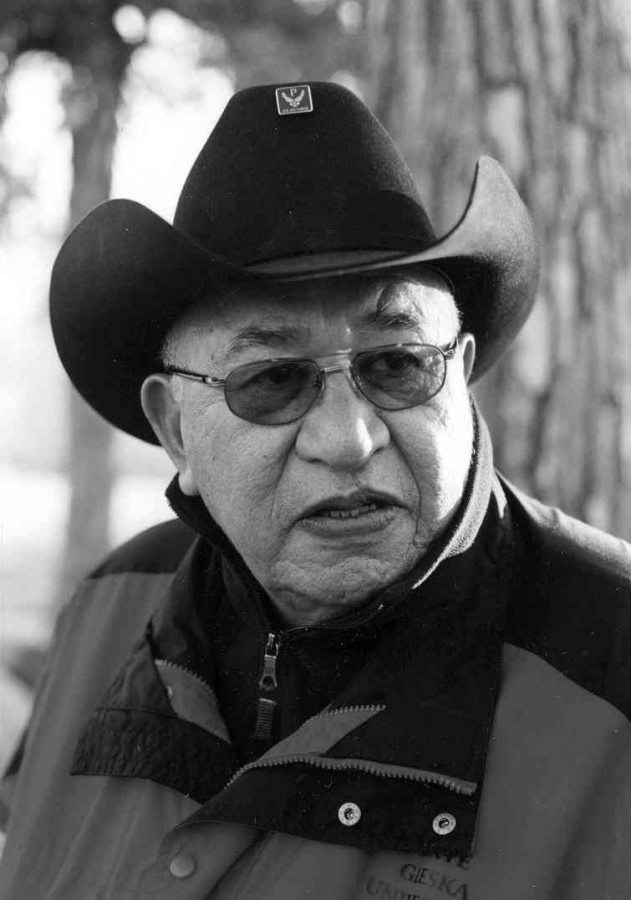
A great black and white photo of White Hat.

Throughout Life’s Journey readers will encounter White Hat’s attribution to the elders and medicine practitioners with the words “they say” or “they always say.” This is a cultural practice, a way of respect White Hat demonstrates for those whom he heard a story. In other parts of White Hat’s narrative, he uses “them” or “they.” It is these times in which White Hat is referring to relatives who have taken their journey.

White Hat’s stories are repeated or referenced to throughout the different chapters. In the Lakota tradition, if something is very important it is worth sharing and hearing several times again. According to White Hat, there are connections that are not apparent in the first telling.


Natan Tokahe, The First One To Charge, is White Hat’s traditional name. White Hat grew up on the Rosebud Sioux Indian Reservation, but the people call themselves Sicangu, Burnt Thighs. He beautifully articulates in the first chapter who he is and where he comes from in the Lakota tradition. As part of sharing who he is and the people he belongs to, White Hat touches on the story that the Sicangu originated as the Sicangu near present-day Bismarck, ND.

Nine years of visits, listenings, and edits went into creating White Hat’s Life’s Journey. Each chapter, including the appendices, has a Lakota heading and translation. Each story includes Lakota words and clear translations in the cultural context.


Order yourself a copy of White Hat's book from "Prairie Edge" in Rapid City, SD. (or where ever man). This is one of my favorite spots to stop for beads and stuff.

The only criticism of this work is that so much effort has gone into preserving the “flavor” and cultural nuances of the Lakota language, that one wonders if the work should have been published bilingual, page for page, in Lakota and in English. The very subtitle of Life’s Journey, “Zuya” literally translates as “To Go Out,” but carries with the Lakota context of going out with a war party. A Lakota reader may look at the title and step away with the impression that life’s journey is comparable with making war, but that may have been White Hat’s intention all along.

For the Lakota reader whose first language is English, Life's Journey's strength is the fact that it is in English and retains the cultural context, and includes translations. Edify yourself and go get yourself copy today!

Saturday, September 15, 2012

Ghost Dances: Proving Up On The Great Plains


"Ghost Dances: Proving Up On The Great Plains" by Josh Garrett-Davis
Ghost DancesA Review
A Reasonable Book, Personable Author
By Dakota Wind
GREAT PLAINS, N.D. & S.D. - Garrett-Davis took this reviewer on a journey of self-examination and reflection of his life as it is now and what it was for him as he grew up on the Great Plains of South Dakota. A memoir unlike any that you may pick up or read again, it is a blend of history of the late nineteenth century interlaced with pre-internet life, of a young boy’s discovery of counter-culture heavy rock music in the days when MTV actually played music videos.

Garrett-Davis wistfully recalls the angst of young boyhood when his parents divorced after unsuccessfully trying to maintain a record store stocked with music they believed represented the rage of a generation against the machine of state and federal policy, even as Garrett-Davis’ book details his own rage against the machinations of a lesbian mother and a distant workaholic father.

Ghost Dances captures the longing of many Great Plains youth to leave the wind, the plains, and the open skies behind for a cultured and contemporary life in any city. Garrett-Davis’ visits to his grandmother in Minnesota are as much a relief from the stresses of a broken home as from the constant winds, the sweeping grasses and the endless sky.

The history of the state, the Great Plains, the settlers and the native peoples which Garrett-Davis peppers Ghost Dances throughout seem an attempt to make the hardships of all, his own, while the author captures perfectly the dreams to escape, he fails to capture the feelings of those who choose to stay. Garrett-Davis includes stats in Ghost Dances about out-migration, even as he acknowledges moving out of state himself.


In the end, the book is about confirming the character of himself as well as the people who grow up on the plains. It is the wind, the grass, and the sky, the very openness which (at least compared to people not from the plains) imbibes wholesomeness, openness, and perhaps honesty (even a steady wariness of small town politics) in the people who dream of leaving.

Beware reader. This isn’t for everyone and it shouldn’t be. It’s about life on the plains after Little House On The Prairie…with MTV, broken family ties, massacre, He-Man escapism, return of the bison, idealized politics heaped unto a young mind, and love of late 80s and early 90s hard rock here, there, then and now.

Gratify yourself, reader, with a copy of Ghost Dances today. Visit Josh Garrett-Davis’ website at www.joshgarrettdavis.com