Tuesday, April 30, 2013

Maĥpíya Kiŋy’Aŋ (Flying Cloud) Glí: SD Nelson Returns

Nelson's cover painting to "Greet The Dawn: The Lakota Way."
The Ancient Painting Tradition
Maĥpíya Kiŋy’Aŋ (Flying Cloud) Glí
SD Nelson Returns
By Dakota Wind
White Shield, N.D. – White Shield rests on the Fort Berthold Indian Reservation, about a two hour drive north and west from the North Dakota state capital. The drive may have been a few hours, but it allowed me to take in the majesty of the vast open plains and the great open sky and the quiet drive north on HWY 83 took me through Lake Sakakawea and Lake Audubon.

I had been in contact with S.D. Nelson since the South Dakota Book Festival of 2012. I happened to pass him by one afternoon there. He had just finished a conversation with another festival attendant and it was obvious that he had other business to attend to, and I had wanted to meet him so I called out to Nelson. He gave me a nod and wave, and intended to continue on, but when I said, “I’m from Standing Rock.” Nelson immediately stopped in his tracks, turned around and made time to visit with me.

A late winter storm the previous week dropped about eighteen inches of snow on the prairie steppe. Piles of snow were pushed or dumped in efforts to open the roads and drives, but the daytime warmth of spring had melted much and puddles of water had collected in potholes and ditches, slush lined the sidewalks and steamed as it evaporated.

White Shield public school, an unassuming weary-looking older building dominates the townscape. A pale beige brick exterior masked an updated interior. A tiled floor carried the echoes of children at play or lessons down the halls and out the main door when I entered and made my way to the library.

Nelson's program was received with great enthusiasm and many students had questions.

It was a tidy library but bigger than the school library of my youth back on Standing Rock. The chairs and tables were arranged in a horseshoe to accommodate Nelson’s presentation. A select cadre youth had made the drive up from the Cannonball Elementary School on Standing Rock just to see Nelson’s program and to get him to sign their books. They arrived about forty minutes early and Nelson graciously gave them his complete attention before the program began.

Nelson is a member of the Standing Rock Sioux Tribe. His traditional name in the Lakota language is Maĥpíya Kiŋy’Aŋ, or Flying Cloud, which is also the name of one of his ancestral grandfathers who was a storyteller and horse thief. He may not have grown up on the reservation, but he spent his summers there with his maternal grandparents and frequently returns. The land of sky and wind reached settled deep into Nelson’s mind and heart, and while he traveled with his enlisted father across the nation, and even as he now lives in Arizona, Standing Rock and the Great Plains are still home.

Nelson is a retired teacher. He earned a BS in Art Education from Minnesota State University in Moorehead, MN and taught art at Wahpeton, ND before making a move to Arizona and teaching there. “The winters got to be too much for me,” said Nelson with a smile. He is now retired from teaching, but he still engages learners in scheduled workshops and makes time, like today, to be with native youth back on the plains. Nelson may be self-employed, but he’s still an educator at heart.

Images like this of an old pickup truck out in the field and horses speak to the native youth who for them is a common occurrence.

Nelson actively engaged the students. His use of the lecture style presentation tells how he was taught and how he learned, but Nelson includes a media presentation, a showcase of selected past works, sketches of works and brilliant finished paintings which keeps the students in rapt attention. One painting depicts children on a prairie in the morning waiting to get on a bus, and putting it that way makes it sound unexciting, but the painting reaches out to the children because the landscape is alive with plains symbols of strength, medicine and life. The imagery and symbolism meant more, meant something cultural as well as personal to those children.

Whether the children are aware of it or not, Nelson had shown them the importance of going to school and getting an education. Later in the hour, he reinforces that message by encouraging them to pursue an education and in a field they love. 


There is evidence in many of Nelson’s paintings of a deep love and respect for horses, or as he would say, “The Horse Nation.” Horses are also associated with thunder too, and much of his work ties the horses with thunder. Once a traditionalist questioned Nelson’s authority to depict lightning and the workings of thunderstorms, which stemmed from a deep-seated tradition that only certain people could depict, to which Nelson replied, “Lightning came to my house twice. I have a direct connection to lightning, thunder and hail.”

Along with a presentation of stories and select images of his paintings, Nelson shared painting techniques with the children. “I brush the paint on, but I also take a little sponge. I get them wet and squeeze them until their soft and pliable and then dip them in paint, and I sponge paint on.”
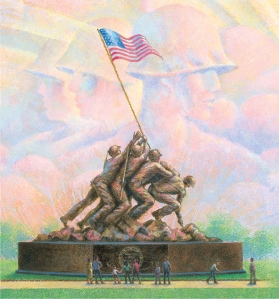
From Nelson's "Quiet Hero: The Ira Hayes Story."

The presentation moved into illustrations of Ira Hayes, the Pima Indian from Sacaton, Arizona who helped raise the American flag on top of Mt. Suribachi in WWII. After the war, Hayes descended into alcoholism and died. Nelson then delicately shared his own experience as a recovering alcoholic.

The air grew a little heavy and the children settled into a solemn silence as Nelson spoke of the native struggle with alcohol and alcoholism, but he brought hope in his message that life is so much better without alcohol or substances. “I’m an alcoholic. I haven’t had a drink in twenty-seven years.” He credits God, the Great Spirit, with giving him the strength to stay sober. “Thank you God, for giving me a good life, so that I could write these books and tell these stories,” Nelson said.

Recalling a hangover one morning long ago, Nelson was watching his two little girls play in the backyard when he realized that he needed help. He picked up the phone and called the local A.A. chapter who immediately sent over two people to give him reassurances and encouragement to live clean.


Nelson concluded his warning of the perils of alcohol, “My hope for you is that you won’t drink and you’ll receive a blessing…I promise you.”

Art has been in Nelson’s life since he was little boy. His earliest memory of art in the home is of his mother’s project in which she applied tempera paint to the living room window. “I remember marveling at her. It was big and it was colorful, and the sun shone through the paint like a stained glass window.” Art was encouraged in the home and when he was three or four years old, Nelson recalled sitting at the kitchen table and finger painting.

Art runs in Nelson’s blood. His mother was a landscape artist who had studied academic and classical painting under the tutelage of Herr Von Schmidt, a German artist. His maternal great-grandmother, Khízá Wiŋ (Fighting Woman) was a traditional artist—a fine beader. Unfortunately, one of her creations, a fully beaded buckskin dress had to be sold to help support the family. Nelson’s mother, had little time to devote to painting due to the demands of motherhood, but her creativity manifested in quilting.

It wasn’t until a rainy day at school when his class stayed indoors that Nelson decided to consider art seriously. He was working on a wildlife scene at his desk when an older “alpha male” fellow whom the class all admired stopped by Nelson’s desk and peered over his shoulder, and said, “Wow, that’s really good.” Nelson’s confidence was boosted further when his classmate declared, “Guys, come over here and look at this.”


Nelson’s mother spoke fluent Lakota and English, and she handed down cultural stories with life lessons like the old Iktomi, or Trickster, stories. Nelson fondly recalls a summer night in his childhood in Fort Yates. His father had heard that the satellite ECHO was going to pass above so Nelson’s mother took him and his brothers and sister outside to watch for it. While watching the heavens Nelson’s mother told them that the Lakota are people of the stars, and up above was their grandfather, Nelson’s Lakota namesake Flying Cloud, riding his horse. “I looked and I couldn’t see a horse, all I saw were stars, but I knew what she was talking about. I got it. I didn’t have to ask her or say that grandpa’s not there. She was talking about infinity. She was talking about forever. I felt the stars were alive.”

When he was a little boy, when the Missouri River was still free flowing on the bottomlands below Fort Yates, his mother and grandmother repeatedly warned Nelson and his siblings not to go swimming in the river. Historically the river was dangerous. In fact, the Lakota called the river Mni Šhošhé, which means “The Water-Astir.” Before the dam, the river was brown with sediment that was stirred up by the swirling churning river and for the Lakota who had become coffee drinkers the river reminded them of the motion of stirring their coffee with sugar or cream. The river was indeed dangerous and only in the mid to late summer was swimming in the river advised for even strong swimmers were pulled under by the undercurrent and never seen from again. Today, the river and the lake are blue.

Nelson’s remembers the river as a river. As a boy, he longingly desired to swim in the forbidden waters and that longing is echoed in his voice today. “It’s a beautiful lake,” said Nelson in an accepting tone. “I like to see kids swimming there.”


After the dams were built in the 1950s, the US Army Corps of Engineers approached the people of Standing Rock and asked them what they would like to call the new lake. Their cryptic response, for they weren’t happy with the Corps, “O’ahé,” which means Something To Stand On in reference to the buildings that were taken under the rising waters and drifted apart and away leaving only the foundations.

Childhood memories came swift to Nelson. His grandmother, Josephine Gipp Pleets, was born in a tipi, and lived in a cabin in Fort Yates when he knew her. In her back yard grew a modest grove of Chinese Elm trees. Nelson would climb them as high as he could. The birds were used to him and continued to land in their nests or flit away unconcerned in their business. He would gaze out over the tree tops for hours at a time watching the river, the valley and the sky.

SD Nelson may live in the southwest. His house is there in eternal summer, but his heart is in the never ending horizon of the Great Plains, his soul is with the Lakota and Dakota people in the land of sky and wind. He is a son of Standing Rock and his life’s work recalls it in each sketch and painting, and his paintings touch the souls of children.

For more information about SD Nelson visit him online at SDNelson.net

Monday, April 29, 2013

The KKK In North Dakota

Former Confederate soldiers founded the Ku Klux Klan (KKK) after the American Civil War (1861-65). The KKK used violence and intimidation to keep blacks segregated and to prevent them from voting and holding office. Courtesy of D. Jerome Tweton.
The KKK In North Dakota
An Investigative Report
By Jerome Tweton, North Star Dakotan, January 31, 1932
Grand Forks, ND - Following the American Civil War an organization called the Ku Klux Klan (KKK) spread like wildfire across the South. Begun as a social club in Pulaski, Tennessee, in 1867, the KKK soon became a symbol of hatred and bigotry. Its main objective was to keep black people from voting and taking their constitutionally rightful place in society.

Led by the Grand Cyclops, the Klan, a secret organization, was organized into local Adens. Dressed in bizarre fashion - high-pointed hats, masks, and flowing white robes - KKK members promised to defend the constitution and to protect the weak and oppressed, but in reality they terrorized black Americans and filled their lives with fear and fright.

Having succeeded in reducing the black vote, in 1877 the KKK disbanded as a national organization. This did not mean, however, that local Adens stopped tormenting blacks. Lynchings and cross burnings continued as part of the southern scene into the 1890s. The KKK then pretty much faded from view until 1915.
In that year a new Ku Klux Klan was organized in Georgia as a fraternal organization dedicated to the principles of white supremacy. It sounded and looked like the old KKK, but it was different. The new Klan added Roman Catholics, Jews, and left-wing political radicals to its list of enemies. The new KKK sought to protect the purity and values of native-born, white, Anglo-Saxon Americans and claimed a higher morality and dedication to Christian ideals. Led by the Imperial Wizard, the KKK, like its predecessor, held secret meetings around fiery crosses with members hooded and robed in white. Its tactics for intimidation included whipping, branding, mutilating, and lynching.
In the summer of 1921 Klan organizers moved into South Dakota and gained many followers by attacking the politically radical Nonpartisan League. The national organizers attempted to recruit Protestant ministers who were staunchly anti-Catholic to serve as heads of the local klans/klavens. This has been a successful method in South Dakota.
At that time an Indiana Klansman traveled secretly to Grand Forks where the Presbyterian minister, F. Halsey Ambrose, had gained a reputation as a powerful orator, a staunch foe of the Roman Catholic Church, an arch-opponent of the Nonpartisan League, and a booster of white Protestant Americanism. Soon after arriving in Grand Forks in 1918 Ambrose began attacking the Nonpartisan League as “socialist” and “Bolshevist,” endearing himself to the Grand Forks Herald and its owner, Jerry Bacon. Ambrose’s pamphlet, “A Sermon on Applied Socialism,” a violent assault on the League, was published with the help of the Herald and sold 5,000 copies in two weeks.
Ku Klux Klan Rally. Courtesy of D. Jerome Tweton.
Ambrose believed that a Roman Catholic couldn’t be a good American because the Catholic’s first allegiance is to the Pope in Rome. His sermons were full of anti-Catholic statements. Ambrose was a clergyman who fit the KKK’s qualifications for leadership. His popularity tripled church membership and his special Sunday night services usually have attracted 1,200 people. What more could the Klan want? Reverend Ambrose became its chief leader for Grand Forks and for North Dakota. Even though Roman Catholics were outnumbered almost three to one by Protestants in Grand Forks, Ambrose persuaded Protestant civic leaders that the Catholics had a master plan to take over the city’s government. The minister’s charisma convinced business leaders that the town’s Roman Catholics, led by furniture dealer and funeral director Moses Norman, presented a threat to their livelihoods and American values.
A source within the Klan has told the North Star Dakotan that the Grand Forks Klan first met 22 miles west of that city in September 1922, and that its leaders were members of the business community, including three bankers, three insurance men, seven store owners, two hotel proprietors, three lawyers, one doctor, one architect, and one clergyman other than Ambrose. According to our source, about 500 men have joined the Grand Forks klaven.
That North Dakota legislative leaders saw the KKK as a mounting threat became obvious in 1922 when a bill was introduced to outlaw the wearing of a mask or regalia which concealed the identity of the wearer except when such a mask was worn inside a building or by a person less than 15 years old.
Reverend Ambrose, who has never denied his leadership in the KKK, went to Bismarck and testified for an hour against the bill. He argued that no klansman had ever been convicted of a crime committed while wearing hoods. He insisted that hundreds of klansmen around the state were pillars of their communities and concluded that the KKK had to remain secret, in his words, “to do its valuable work.”
Both houses overwhelmingly approved the bill and Governor R.A. Nestos signed it into law, earning him the hatred of klansmen.
That fall of 1923, paying no attention to the new law, Ambrose organized a Klan rally west of Grand Forks. A thousand hooded klansmen from all parts of the state gathered to hear Ambrose preach the virtues of the KKK. Amid burning crosses, he emphasized the Klan’s patriotism and its desire to accomplish its goals in a peaceful manner. A reporter has told the North Star Dakotan that he saw at least 300 carloads of klansmen arrive at the ceremony and that a major reason for the rally was to initiate new members and install a klaven in Larimore.
With a growing membership and increasing strength within the city, the Klan moved into civic politics, endorsing and working for candidates who were in the KKK or sympathetic toward it. In the 1924 Grand Forks city election, one Klan candidate won a seat on the five-person city commission, and a klansman defeated the incumbent city justice, a Roman Catholic.
Flushed with victory, the Klan entered vigorously into the school board election three weeks later. The division was clear: two Klan businessmen versus a physician’s wife and the wife of a retired minister. In a Sunday night sermon Ambrose attacked the women as pawns of the Roman Catholics and charged that the Catholics were attempting to gain control of the public schools. The campaign tore the community apart. Mass rallies on behalf of the Klan and the anti-Klan candidates drew crowds numbering in the hundreds.
The Presbyterian clergyman told the North Star Dakotan that Moses Norman had started the petition drive for the women. “He will give his unqualified support to circulating those petitions,” he stated. “Any woman who will accept his support absolutely deserves the disrespect of every respectable woman in the city. Any two ladies who will permit a dirty thing like this to take his support are unworthy of the name of woman.” He referred to Catholic supporters as “the scum of the earth” and pledged that Catholics were the same the world over, “rotten.” Jerry Bacon and his Grand Forks Herald now began to attack the Klan. The paper backed the women candidates, stating that Ambrose’s reasoning was absurd. Tracy Bangs, a longtime Grand Forks lawyer, told the North Star Dakotan, “Ambrose has disturbed old friendships and has torn families asunder with his gospel of hatred.”
The two klansmen easily won election to the school board. Their objective was to reintroduce Bible reading into school classrooms. This, the Klan believed, would make the schools safe from the Roman Catholic threat. The board passed a Bible-reading motion. The Klan achieved its goal.
Ku Klux Klan members march down Pennsylvania Avenue in Washington, D.C., 1928. Courtesy of D. Jerome Tweton.
After its political victory in 1924, the Klan became much more open. A statewide Fourth of July rally at Hillsboro drew hundreds of klansmen, mostly from Fargo and Grand Forks. The visit of the national head of the KKK, the Imperial Wizard, attracted a crowd of 5,000 to the Grand Forks fairgrounds. In 1926 the Klan won control of four of the five seats on the city commission. The klansmen voted as a block to dismiss many Roman Catholic and anti-Klan city workers. The fire chief, a Catholic with 33 years in the department, and the electrician, a Catholic with 28 years of employment, were fired. In all, ten officials were let go, including the City Hall’s janitor who was a Catholic.
A Klansman told this paper that most members believed that the KKK’s work was finished with the housecleaning at City Hall and that there was no longer a need for the Klan. Ambrose tried to whip up Klan enthusiasm for last year’s city elections and asked, “Will our citizens stand for a silent campaign?”
The answer was “yes”; the Klan began to run out of steam. Reverend Ambrose has departed Grand Forks for a pulpit in St. Paul. He has left behind a bitterly divided town. He convinced many of its people, through the force of his dynamic personality, that Protestant Grand Forks had much to fear from Roman Catholic Grand Forks. This, of course, was an imagined fear - a danger that existed in Ambrose’s head. For all the hatred that he spread, the accomplishments were small: Bible reading in the schools and a dozen fired city employees. There were no whippings, mutilations, or lynching in North Dakota, but the mental scars left by the KKK run deep.

Sunday, April 21, 2013

Winter In The Land Of Sky And Wind

A beautiful vesper dusk sets on the Standing Rock Sioux Indian Reservation, south of Mandan, N.D.
WINTER IN THE LAND OF SKY AND WIND
A Reflection of The Changing of Seasons
By Dakota Wind
Mandan, ND - It was quiet uneventful drive through the countryside. Despite the dawn, the clouds hung heavy and cast a steely grey pall over the landscape. Clouds hung low, low enough that I could reach high and feel the cool droplets that filled the air. The land itself reminded me of a patchy brown and white mottled pony.

Some would call it spring, and if it weren’t for this last snowfall, it might very well be spring. A wind came out of the west carrying the promise of rain, or more snow. It smelled clean and earthy, like rain, but it also smelled cold too.

It’s always windy here on the Great Plains. It is rather like a messenger carrying the scent of ionized air before a storm, the promise of a storm. In the days of summer the wind cools nothing. It’s like standing in front of a furnace with the heat blasting you right in the face. In the heart of winter the wind whips the snow into a riot and locks the land in a blizzard.

...the years were literally called winters.

Today though, the wind and the snow only remind the citizenry that winter is the lord of seasons. In the days of warriors and legends, the winter and wind so shaped the relationship that the Lakota share with the land that the years were literally called winters. We have no mountains to reach the heavens and take snow and rain from the sky. We have endless rolling hills that allow the arctic air to stretch forth from the far north and touch the land here.

The geese have returned, heralding the change of winter to spring. Only their honking has been subdued by the sudden return of snow. The meadowlarks keep their enthusiasm and sing through the cold wind. It’s a tradition going back to the moment of creation. They welcome the end of the winter, the end of the year, and sing in the new. On the Great Plains, that's how it is. Spring marks the new year, not the middle of winter.

Deer prance in fields of last year’s left over corn stalks, noses to the ground in search of bites of last year’s harvest. Ducks waddle into a pothole lake, submerge their heads in that half way manner that only ducks can and set themselves back upright, and then vigorously shake their heads as though they were trying to dislodge water from their ears.

A peregrine falcon...settled itself...as a king on a throne, on a fence brightly labeled "No Hunting."

A hawk, a peregrine falcon to birders, one of many of the birds of prey on the prairie, settled itself in bold irony, as a king on a throne, on a fence post brightly labeled “No Hunting.” Its head turned nonchalantly in my direction as though it had planned on looking my way all along. As I drove by, it casually spread its wings and took flight in front me.

To the west of the road lay a swath of wind turbines, giant windmills, erected in the past decade to harvest the wind and convert the wild energy into electricity. The ever-present wind passed them by, its raw energy undiminished by the great turning wheels. The blades silently cut through the low grey overhang of clouds.

By the time I get home, the sun has burned through most of the fog and the wind had blown some of the low cloud cover to the east. Rays of light playfully pierced through the remaining cover and practically danced; the motion of the sun’s rays are like looking up through water from the bottom of a pool.

This is North Dakota. This is the Great Plains, a rolling steppe west of flat prairie, a gentle swell east of the Badlands. Winter rules much of the year, and the wind has been here since creation. 

Wednesday, April 10, 2013

Dakĥota Kaškapi Okicize Wowapi: The Dakota Prisoner Of War Letters, A Review

The Dakota Prisoner Of War Letters
A Review Of A Powerful Narrative
By Dakota Wind
BISMARCK, N.D. - I received my copy of Dr. Clifford Canku’s The Dakota Prisoner Of War Letters: Dakota Kaškapi Okicize Wowapi through the mail and I carefully removed it from the box it came in. I was excited to read it, but not joyous to do so. Its about a real life tragedy, the consequences of which the Dakota and Lakota are still living with today. 

My initial perception of the book, my judgment of the book based on its cover, was that I was getting a book in the vein of Albert White Hat’s Life’s Journey. In the case of White Hat’s book, the transcriber, Mr. John Cunningham, and White Hat took great pains to keep the oration of the book even as a translation into English as how a traditional Lakota would speak English. White Hat’s work retains the “flavor” of the language.

Canku’s book goes a step further. Not only did White Hat and his associates invest several years translating beautifully hand-written letters in Dakota to English, Canku keeps the original Dakota, but he adds a word for word translation, then a free translation into English which contains Dakota connotations.

Dr. Canku carefully reads a letter of a Dakota prisoner.

There are two things which reached out to me about this book. The first being that its about the Dakota who became prisoners of war following the Minnesota Dakota Conflict of 1862. The book contains letters, first-person accounts of innocent men and women who were wrongly accused and imprisoned. They weren’t US Citizens, so due process didn’t apply to them, so they were guilty and imprisoned until they were determined to be innocent or no longer a threat.

Part of the story of the letters involves a missionary to the Dakota people, Rev. Stephen Riggs.

Riggs, a missionary among the Dakota in the 1850s, was present when cases involving the Dakota were judged, as fast as the service at a fast food restaurant. In one day, Riggs saw forty Dakota cases judged and sentenced to death in about seven hours. Some of the cases took mere minutes.

The missionary Stephen Riggs.

Missionaries, including Riggs, visited the Dakota prisoners, and converted a captive audience, while writing their letters of appeal for them, letters to loved ones at different agencies and letters to military commanders pledging to never more resist the American expansion westward.

The second thing which reached out to me was that the book is bi-lingual. There aren’t many resources published in both Dakota and English. As a person whose first language is English, and being a Dakota-Lakota person, having the original Dakota language present for me to read and learn is wonderful.

The most intriguing part of this book is the scholar himself. Dr. Clifford Canku. He is an enrolled member of the Sisseton-Wahpeton Oyate and a retired Presbyterian minister. Canku is a common man and his stirring introduction includes early efforts from the previous teams he worked with at Flandreau, SD, the Sisseton Wahpeton College, and then North Dakota State University. Even though his name is on the cover alongside Michael Simon, Canku is quick to acknowledge the efforts of others.

Taoyate Duta, His Red Nation, more commonly known as "Little Crow."

Before being brought on to earliest efforts of this translation project, Canku was visited by the spirit of Taoyate Duta (His Red Nation; aka Little Crow). Throughout the translation process, a spiritual presence was always present. When the project wrapped, Canku received another visitor through a dream. He was at a sundance in this dream and a old man was brought into the east gate where his name was announced four times. The grandfather’s name: Wakaŋboide (Sacred Blazing Fire). The grandfather came to Canku and said, “Hau, wičohaŋ ečanupi kiŋ de wašhté do.” (Yes, the work you are doing is good, it is so.)

Canku is deliberate in that the reader, casual or otherwise, clearly understands that the book is about the Dakota prisoners of war. There are plenty of books out there, and more so with the 150th anniversary of the Civil War and the Dakota War, but Canku’s and Simon’s book is the only published primary resource from the perspective of the people who fought, the people who defended, and the people who were entirely innocent of the 1862 Minnesota Dakota Conflict.

Camp Kearny, where the Dakota prisoners of war were taken.

An excerpt of one of the letters places the reader in the first person. Wiŋyaŋ, or Woman, writes to her relative Pa Yuĥa, Curly Head, about starving and the heartbreak in the prison camp at Davenport, Iowa:
…my heart is so very broken, it is so. Last summer, we all know one terrible event has occurred, and always we are very heartbroken, because now again, my heart if broken very much, because this winter we are without, we are all suffering. I hate to live, it is so. And now where will they take us?...now we don’t know where they will take us, and therefore I thought maybe we will never see all of you, and therefore my heart is very sad.

Another letter by Stands On Earth Woman tells her relative His Country that she is recently widowed and with a new baby, at the prison camp. She asks for her relative’s assistance because she literally has nothing and she’s starving.

Get this book if you are interested in the “other” side, the forgotten side of the story. Get this book to support a native elder and scholar, but get this book so that we never forget what happened as a result of this terrible conflict. 

Thursday, March 28, 2013

Revival Of The Flute Tradition


Kevin Locke shares the background of some of the oldest flutes in his collection.
Flute Tradition Returns With The Spring
Practice Nearly Faded Away
By Dakota Wind
Standing Rock, N.D. & S.D. - Dawn hit the Land of Sky and Wind, the Land of Standing Rock, and bathed the ancient prairie steppe with warm sweet light that turned last year’s grass gold despite the cold silence of winter. The frozen air seemed to shatter with each mile I drove. Aside from my car, I imagine that the morning of the first spring must have been much like this. The cold and quiet was so sharp I could imagine a knife scraping along the backs of my exposed hands.

I pulled up to Solen High School on the Standing Rock Sioux Indian Reservation. My passenger Rich Dubé, a personal friend of my Lekši (uncle) and Wauŋšpekiyapi (teacher) Kevin Locke, and I swapped stories about the gift of Šiyotĥaŋka (the flute), where it came from, when it appeared on the steppe of the Northern Great Plains, and its growing revival.

Rich Dubé, came down from the great snows of Saskatoon, Saskatchewan to conduct a flute workshop in four of the schools on the reservation. I visited with Dubé the evening before. When I heard he was from Saskatoon, and was coming down to the Land of Sky and Wind, I prejudged who I thought I’d be meeting. Kevin raved about Dubé’s knowledge in the reconstruction of the traditional flute, how they were made, the original sound, and that Dubé even wrote his Masters thesis around the flute.

Naturally, I thought Dubé was going to be a member of the White Cap Dakota Nation who reside on a reserve just south of Saskatoon. Not that skin color matters but I was expecting to meet a native man. Who met me instead, and broke my prejudice, was an impeccable skinny white guy. He seemed used to native scrutiny however and graciously anticipated and answered my probing questions, which eased my mental lockjaw. I backed off when I was satisfied that he knew what he was about.

Dubé had never heard of the native flute until he attended a session for choir teachers...

Dubé is a music teacher. His story with the native flute begins about ten years ago in Saskatoon. He was teaching native youth in an inner city music program. Dubé had never heard of the native flute until he attended a session for choir teachers and he leafed through a book by Bryan Burton called Voices of the Wind which had native flute songs transcribed for the recorder. He was looking for something to capture the interest and inspire his senior kids and thought the native flute would be much more appealing to his students than just trying to play the songs on a recorder, a western European instrument.

The music teacher searched the internet looking for flute makers, and experimenting with various flute kits, discarding those that didn’t seem to have a true sound to his sharp ears. Eventually, Dubé crossed paths with Kevin Locke. Kevin sent Dubé the schematics of one of his great-grandfather’s flutes. Dubé seized the opportunity to reconstruct not just a traditional flute, but a traditional flute with the original sound.

One of Dubé's flutes.

Dubé created a cast using the original traditional flute from Kevin’s schematics. Dubé wanted to create a flute that was easily constructed and mass produced yet true to the original sound. In the end, his experiments found success in a custom size ABS plastic flute matching the exact sound of the original one-hundred twenty-year-old flute.

...small town pride in the class B team that represented the best hopes of the community...

I entered the high school and remembered my days when my team played the Solen Sioux. There was the typical small town pride in the class B team that represented the best hopes of the community, and like any small town, the team was fiercely held high in respect. Putting the games of yesteryear firmly in the back of my head I made my way down the hall towards the gym where Dubé was preparing his workshop.

Dubé’s luggage was opened up on the bleachers and inside it was as though he had brought an entire workshop. Someone had set up some tables and Dubé was quick to set drills, tools and all his accoutrements out for the workshop. In the span of twenty minutes he trained staff and volunteers in preparation for students to drill the holes of their flutes.

Kevin arrived about fifteen minutes after we got to the school. Students were quietly milling about in the halls in eager anticipation of the morning’s project. A few had poked their heads into the gym to watch Dubé set up and train the school staff. A teacher, possibly the principle, cheerfully made some announcements about lunch and stuff before she gently reminded students to be on their best behavior for Dubé’s flute workshop.

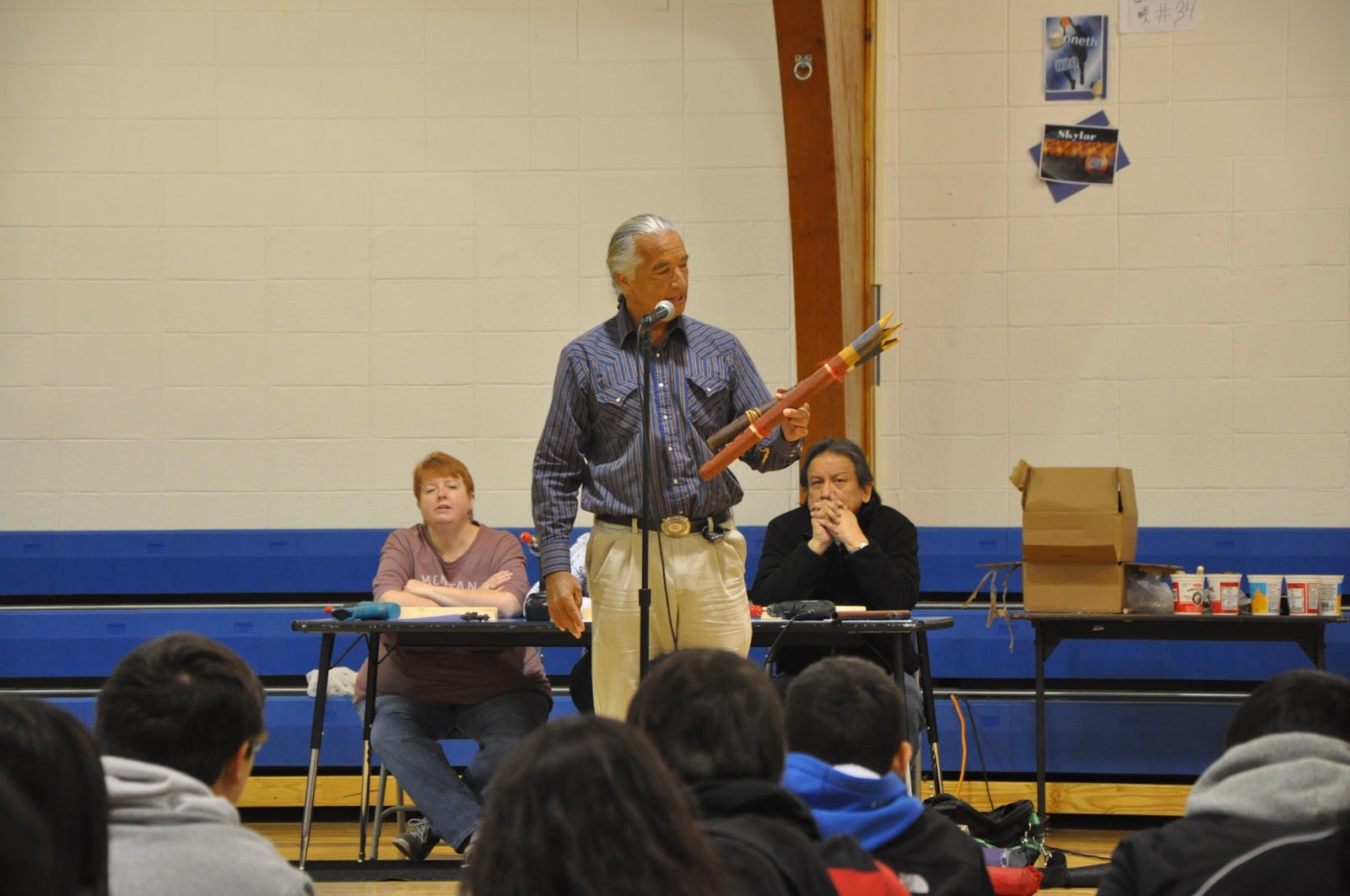
Locke offered a heart-felt greeting to the youth who assembled at the school.

About fifty-five high school students filed into the gym, arranged by year, and immediately staked out spots on the basketball court. The gym quickly filled with echoes of growing chatter which became a loud buzz with the arrival of fifth and sixth graders from the nearby community of Cannonball, who took the floor closest to where Dubé was set up.

The principle made a few announcements reiterating students to be on their best behavior and extended a welcome on behalf of the schools and introduced Kevin. Kevin introduced Dubé who shared some technical things about the flute and what to be expected in the workshop, and the students listened as best as students could while they itched to get to the construction.

Dubé divided the large group into three and subdivided each of those into three at each table. From the time of Dubé’s beginning instructions to the last student drilling the last hole in the last flute and the last student assembling the various pieces into a replica of the Lakota Grandfather flute, about forty minutes had passed. At one point in the assembly Kevin remarked, “Rich is really organized,” a sentiment which was repeated by high school staff.

Dubé (orange shirt) plays a quick tune between instructing students.

When the last flute was put together, Dubé called for the students to gather together once again on the basketball court where he offered some basic flute instruction. It was this instruction that Dubé’s experience as music teacher came out. When the students were quieted with their flutes and ready to play, Dubé played a few simple songs with the students who echoed his rendition of the old English tune “Hot Cross Buns.” The fifth and sixth grade students were quite familiar with playing the song on their recorders and followed Dubé’s instruction swiftly.

There, Kevin shared the story of the first flute.

After Dubé’s crash course in flute basics, Kevin stepped in and shared a few flute songs, one of which was the Flag song which the students recognized right away. The students had grown tired of the floor towards the end of the workshop and took to the bleachers on the other side of the gym after the song. There, Kevin shared the story of the first flute. He played the first flute song as part the story, and sang the song at the end.

One of the things that Kevin shared, a traditional belief, was that the Dakota and Lakota people are people of the wind. On the tips of ones fingers are what we call fingerprints. We all have fingerprints. For the Dakota and Lakota people however, fingerprints are more than something that identifies and/or incriminates a person, they say that the patterns tell one which direction the winds were blowing on the day of one’s birth.

In the days of warriors and legend, the flute was played by young men in traditional courtship, to win the heart of a particular young woman. A young man might sit outside the lodge of a young woman and serenade her. If he was successful, she might contrive an excuse to fetch water or gather additional firewood to spend a few moments with a suitor.

"Indian Courting" by Captain Seth Eastman, 1852.

The flute was a part of daily life.

The flute was a part of daily life. Early American Western artists like Seth Eastman and George Catlin painted scenes of young men playing the flute. When the post reservation era began, traditional courtship faded and was nearly forgotten.

In the 1970s, Kevin Locke took up the flute and learned about the tradition from men like Richard Fool Bull, William Horn Cloud, Joseph Rockboy, Asa Primeaux, Henry Crow Dog, Bill Black Lance, Charles Wise Spirit and Pete Looking Horse among many others. At a wacipi, Locke saw Richard Fool Bull’s display of flutes and remarked, “Someone should learn this tradition,” to which Fool Bull said, “Maybe you should.” And Kevin did.

Locke hopes to pass on the flute tradition to the today’s generation. Dubé’s flute workshop fits snugly into the world of the young native student. An individual can construct a flute with traditional specs and a faithful sound and be finished in five minutes using Dubé’s kit. In a world where studies come first, where extracurricular activities play a large role in a student’s life and where popular media influences style and dress, there’s still time and place for dancers and singers to hit the pow-wow circuit.

In the Land of Sky and Wind the wind is a constant presence. The people of Standing Rock are people of the stars. They are people of the wind. Maybe the flute tradition will work itself back into the daily lives of the people as it once did. 

Visit Kevin Locke online at Kevin Locke.
Visit Rich Dubé at Northern Spirit Flutes.

Tuesday, March 26, 2013

Interpreting A Pictograph Calendar

An excerpt of a pictograph by Sitting Rabbit. The scene is of the Hidatsa village along Knife River, the village that Sacagawea lived in when she encountered the Corps of Discovery.
Interpreting A Pictograph Calendar
An Examination Of A Mandan Lunar Chart
By Dakota Wind
BISMARCK, N.D. - Sometime back in the fall of 2003, enrolled member of the Cherokee in Oklahoma and Distinguished Professor of Anthropology, Dr. Russell Thornton and Dr. Candace Green published a short paper about the Little Owl calendar, a lunar chart, of the Mandan Indians.

The calendar, or lunar chart, is a fascinating example of Plains Indian pictography. It is similar and yet different to another Plains Indian pictographic tradition, the Winter Count.

The lunar chart is the personal property of the late Mr. Ronald “Sammy” Little Owl, of the Arikara Hidatsa and Mandan Nation on the Fort Berthold Indian Reservation in North Dakota, who found it amongst his late mother’s belongings. Mr. Little Owl brought the lunar chart to Dr. Thornton’s and Dr. Green’s attention in 1998. Little Owl also supposed that the lunar chart was associated with the Bad News Clan, to which his father and paternal grandfather belonged.

Dr. Green suggests that the Little Owl lunar chart may indicate “a possible record of planting by the agricultural Mandan…apparent cycles and obvious plant symbols, one might conclude that the calendar was used to keep a record of planting and harvesting.”[1]


Dr. Edwin Benson, the last man to speak Nu'Eta as a first language. Watch and listen to him.

In the fall of 2003 I contacted Dr. Edwin Benson, of the Arikara Hidatsa and Mandan Nation, who was teaching the Nu’Eta (Mandan) language at the Twin Buttes Day School on the Fort Berthold Indian Reservation at the time for his knowledge of the Mandan calendar. Dr. Benson graciously responded with the following:

January            Kupa-hanas                              Seven Nights
February          Ma-istami-ba-da                      Sore Eyes
March              Wa-he-knew                           Spring
April                Ma-nabe-ki-bu-ke                   Game
May                 Muut-ogeheneh                        Planting/Sowing
June                 Ma-na-bu Shu-kena-de-ke      June Berries
July                  Ka-dek-na-de-ke                    Chokecherries
August             Wak-da-na-de-ke                   Wild Plums
September       Koxate-du-kie                         Ripe Corn
October           Ma-nah-pe-o-dee-geh             Frost-On-The-Ground
November       Ikatehne-o-nu Des-o                Freezing Rivers
December        Hump-ni-nahge-ge-gipdahg     Short Day/s

Dr. Benson also sent me a few alternate names, but these only in English:

January                                                            Seven Cold Days
April                                                                Breaking-Up-Of-The-Ice
October                                                           Falling-Of-The-Leaves
December                                                        Little Cold

Here follows a basic understanding of the Mandan and Hidatsa gardening practices throughout the summer. This may assist with interpreting the Little Owl Lunar Calendar (chart).

"Singing The Corn" by Jack Stewart.

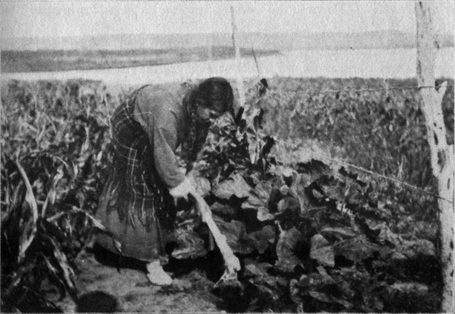
“In the old garden, the work usually started when the first geese appeared on their way north, or when the Missouri River broke up, events which usually occurred almost together. At this time the old weeds and stalks and vines were collected and burned.”[2]

The women would arise when the light began to appear on the horizon or at daybreak, sometimes as early as three o’clock in the morning.[3] The women would work the fields from sunup to when the heat of the day could be felt, at which point they returned to their lodges and did other work. If any time was left over in the day, toward the close of the afternoon, they would go back to their fields.

Often times the women would sing while working or watching the crops for intruders, or to make fun of the men and boys.[4]

After the fields were cleared of debris, the planting hills were dug up, loosened, and broken back down again into loose soil. The hills measured about twelve to eighteen inches in diameter and were approximately twelve to eighteen inches apart from one another. Sunflowers were the first crop to be planted around the edge of the garden before clearing and digging were finished.[5] They were planted three to a hill of their own about eight or nine paces apart.[6]


Corn followed soon after the sunflower was planted, sometime in the first half of May. Sixty to one hundred corn seeds were planted which was believed sufficient in the sheltered bottomlands to insure that only slight, if any, crossbreeding of the corn.[7] Corn was planted in every other hill, usually seven or eight kernels of corn to a hill, with beans being planted in those early hills skipped by the corn.[8] Planting usually lasted from early May “until the roses bloom in June,”[9] but in the big gardens the beans were planted immediately following the corn, and in the same amounts as the corn. Squash was planted after the beans, after the blooming of the roses.[10]


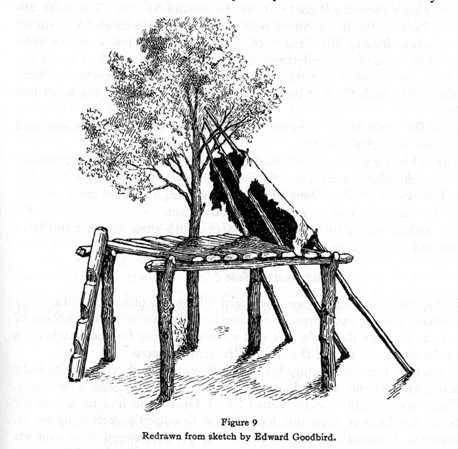
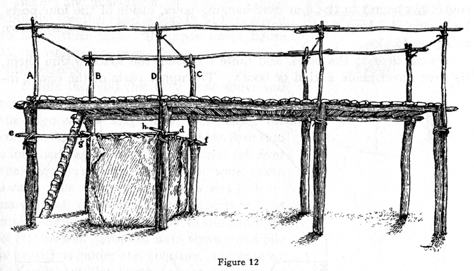
Toward the latter part of summer, the gardens were rarely unoccupied during the day. This was because of the flocks of crows and other birds that would try to come after the soft corn. To help the watchers, a brush shade was constructed, or a scaffold with a shade of some type would be employed while the women and girls worked on sewing, quillwork or other craft. Girls always went with their mothers to do this work and it was permissible for a man to go to work with his wife if they didn’t have children.

The first harvest of the Mandan, known as the green corn harvest, started as early as August as the young squashes were gathered, sliced and dried. This event is generally determined by the older women who examined the ears and silk of the corn, which, if it was brown or withered and the husk was dark brown, the corn was harvested until frost. The green corn harvest was a time of feasting and rejoicing, but also a time of drying food for storage. Preparing corn to eat might consist of either boiling or roasting.[11] The green corn harvest seldom lasted more than ten days. The second harvest, the ripe corn harvest, followed two to four weeks later and usually lasted about ten days or until early October. Sunflowers were the last to be harvested.

A corn threshing booth. Corn was dried on the stage above ground, then the kernels were threshed or beaten from the cob in the booth. Choice corn, or corn which was traded, was braided together, about a hundred ears of corn to a braid and was considered the equal of a tanned bison robe.

Depending on the variety of corn, Mandan corn generally matured in about ninety to 105 days. Squash was picked immediately after the first frost. Beans, which were planted after immediately after the squash, were picked in the fall after they had ripened and the pods were dead and dried.

Tobacco was planted at the same time as sunflowers, but only by the men; the first harvest of tobacco took place in about midsummer, or June. The men would go out amongst the tobacco and pluck some of the flowers, which were dried, crushed and later enjoyed in their pipes. The rest of the tobacco would be harvested sometime before the frost came.

Corn, squash and beans were stored in a bell-shaped cache pit. As deep as six feet and as wide as three to five feet. 

The new year begins, or at least a new growing season, after the ice has broken up, when the geese have returned, after the spring rains, when the bison calves are born, and when the leaves began to bud on the trees.

Figure 1 of the Little Owl Lunar Chart.

In figure 1, the crests, or lunar crescents mark only a very small part of the entire page. Only one of the crescents appears to bear additional markings of a tree on its convex and rain in the concave. If this series of lunar crescents indicate the new year or growing season, this lunar cycle might concur with the roman calendar of April. The crescent with tree and rain could read as “The rains fell; the trees returned to life.”

Figure 2 of the Little Owl Lunar Chart.

In figure 2, the series of pictographs appear to begin on the bottom left and seem to read up the page. The second row then appears to read top to bottom, and seems to be aligned with the lunar crescents, and there is no line separating the row of pictographs and the row of crescents, which also seem to be combined with glyphs in concordance with the row of pictographs.

It should be noted that when a death is mentioned, it may indicate that someone actually died or that someone, likely a woman or child, was abducted by an enemy. Women were eventually married into and accepted by a tribe; children were treated and raised as members of a tribe, this was particularly true of the Teton Lakota and Yanktonai Dakota whom the Mandan were sometimes at war.

Figure 2 interpretation:

  1. Unknown.
  2. Fish/Fishing.[12]
  3. A gathering or council.
  4. A man.
  5. Five days.
  6. Corn.
  7. Corn medicine.
  8. Man with a staff, perhaps a man called a war party.
  9. A horse, perhaps a successful horse raid.
  10. A bison jump or bison hunt.
  11. A lasso, perhaps indicating a successful horse raid.
  12. Unknown, indiscernible.
  13. An event regarding the Assiniboine Sioux.[13]
  14. Three lassos, perhaps indicating either three successful horse raids or that horses were stolen back and forth between an enemy tribe.
  15. They heard a spirit.[14]
  16. Someone killed, perhaps an enemy.
  17. Bison Bull killed.[15]
  18. Unknown. Squash? Beans?
  19. A tornado struck.
  20. Squash and beans.
  21. This appears to be an extension of the squash and beans pictograph.
  22. Singing to the crops?[16]
  23. Lassos arranged in a column, perhaps representing a series of successful horse raids.
  24. Unknown.
  25. Unknown.
  26. A talon?
  27. Someone died.
  28. Elk, perhaps someone made love medicine. Elk, or love medicine, has the antithesis meaning of death.
  29. Staff, perhaps a society’s call to action, or a war party.
  30. Someone had vision.[17]
  31. Someone died, maybe an enemy.
  32. A field, planting.
  33. Unknown.
  34. A knife. A standing knife.
  35. A man with a staff. Perhaps a call to action, a call to gather a society or call a society to action, a call to war.
  1. A time for planting?
  2. Time for planting a particular crop?
  3. Corn has reached a particular stage?
  4. Someone died.
  5. Trees have a full display of leaves?
  6. Rain.
  7. Squash, perhaps an indicator that it was time to plant squash, or that squash was finished being planted.
  8. Man in a garden, perhaps indicating that it was now time to establish sentry duty in the gardens.
  9. Indiscernible pictograph next to a pictograph of corn perhaps indicating that a certain rite relating to corn happened at that time.
  10. Horse tracks under the lunar crescent, perhaps a successful horse raid.
  1. The image appears to be a bird.
  2. Garden,[18] perhaps a time for hoeing.
  3. Beans?
  4. Corn, the pictograph for corn appears to be sideways, perhaps a storm or wind knocked down their crops or perhaps it indicates a time for a rite related to the corn.
  5. Thunderbird.
  6. Horse
  7. Lodge, perhaps a medicine lodge.
  8. Travois, perhaps a hunting party or the trade party of another tribe.
  9. A division of the garden?
  10. Travois.
  11. Lassos.
  12. Unknown.
  13. Travois.
  14. Lassos.
  15. Unknown.
  16. A fallen travois.
  17. Three fallen people, perhaps marking the passing of three people.
  1. Rain
  2. A spirit appeared.
  3. Tree or bush. Perhaps this pictograph indicates that it was time to pick Juneberries. There are four marks beside this lunar crescent, perhaps the entire pictographic entry indicates that it was time for the Mandan Okipa.
  4. Two people beside an unknown pictograph.
  5. A person.
  6. Rain. To the very right of this lunar crescent and descending down are twenty-two marks which appear to be connected to the lunar crescents on the immediate left. These were the days when the Mandan prayed for rain.[19]
  7. Unknown.
  8. A person.
  9. A small garden, perhaps representing the tobacco garden which measured about twenty feet by twenty feet, maybe indicating a time when the flowers were plucked.
  10. Tree.
  11. Two people.
  12. A fence or palisade, perhaps noting the repair of either. Two pictographs appear to be associated because of their proximity to the lunar crescent, unknown.
  13. Unknown. A pictograph appears one end of this lunar crescent, perhaps indicating a death.
  14. Rain. Twenty-three marks appear here much the same as the marks mentioned in “P” above.
  15. Rain?
  16. Dog? Coyote? Fox? There are two pictographs near this lunar crescent, a travois and another which seems to represent a garden.
AA. Butterfly.
BB. Tree, and what appears to be effigies which stand outside the medicine lodge as when the Okipa ceremony takes place.
CC. Unknown, and two “effigies.”
DD. Tree or bush.
EE. Tree or bush, perhaps the two pictographs of trees or bushes indicate that it was time to harvest buffalo berries.

Figure 2.2 (right half of image turned 90 degrees clockwise) of the Little Owl Lunar Chart.
The other half of figure 2 consists of what seems to be almost writing, similar to the Sioux alphabet which was developed by the Lakota man named Curly.[20] A Bison dancer sits astride a gracefully rendered horse. The dancer holds a lance with two tassels attached. The lance resembles the ceremonial lances that the bison dancers carried in their dance. This dancer brought the horse into the dance to ensure a good hunt and to secure the safety of the hunters.

The Lakota alphabet as developed by Curly, from the Cheyenne River Sioux Indian Agency in 1982. Copied from the Lakota alphabet on display at the Crazy Horse Museum at the Crazy Horse Mountain near Custer, SD.

In figure 3 there appears to be no separation between the pictographs to the immediate left of the lunar crescents; they appear to be connected to the lunar crescents and relate directly to them.

Figure 3 of the Little Owl Lunar Chart.

Figure 3 interpretation:

  1. Someone died?
  2. Travois.
  3. Corn.
  4. Hoeing corn?
  5. Two fallen people, perhaps noting their deaths.
  6. Two fallen people and a travois, perhaps noting these deaths on a hunting party.
  7. A person – an inverted pictograph – and a garden, perhaps someone died in a garden.
  8. Five people, perhaps noting their passing.
  9. Rain, a thunderbird and travois appear together.
  10. A person and what appears to be a bush, perhaps harvesting chokecherries.
  11. The pictograph appears to be a hoe, and corn.
  12. Nine marks appear here. Possibly horse whips indicating a successful horse raid, possibly marks to indicate fallen corn stalks.
  13. Garden. Two lunar crescents below, twenty-three marks follow, perhaps an indication for a period of prayer for rain and good weather for crops.
  14. Thunderbird, a few other marks.
  15. Heavy rain; travois.
  16. Garden and a tree.
  17. Garden.
  18. Unknown.
  19. Travois; another pictograph aside may indicate a skirmish.
  20. Two people died?
  21. A person with corn? Twenty-Two marks appear to the very right of this lunar crescent, perhaps in indication for prayer for rain.
  22. Unknown.
  23. A spirit.
  24. Travois; spirit.
  25. Garden.
  26. Spirit.
  27. Travois; rain.
  28. Travois; unknown pictographs.
  29. Corn, and what appears to be a burden basket, perhaps an indication for a harvest.
  30. Thunderbird.
  31. Travois.
  32. Garden; three figures, perhaps three deaths.
  33. Rain.
  34. Corn, and what appears to be a burden basket.
  35. An inverted pictograph for a person, perhaps a death.
  36. Unknown.
  37. Corn.
  38. Travois.
  39. Garden, and what appears to be a spirit.
  40. Unknown.
  41. Lassos.
  42. Travois; thunderbird.
  43. Fallen people and rain.
  44. Corn; indiscernible pictograph. Seventeen marks appear to the immediate left of the lunar crescents. This may indicate a time for prayers or ceremony.
  45. Unknown.
  46. Travois.
  47. Unknown.
  48. Rain; indiscernible pictograph.
  49. Rain and thunderbird.
  50. Corn, and what appears to be a burden basket.
  51. Rain.
  52. Rain and thunderbird.
  53. Pictograph seems to articulate that it is a person of some note appears alongside corn. What appears to be feathers or a hairstyle or a headdress is present.
The right half of figure 3 appears to be read bottom to top. The line of pictographs seem to demarcate the Mandan Okipa ceremony. An interpretation of the pictographs bottom to top follows:

Singing/Beginning
Pipe
Singing
Sweat Lodge
Singing
Medicine Lodge
Singing
Similar/Alike?
Singing Between?
Unknown
Singing
Singing Man
Night
Singing
Similar/Alike
Singing
Day
Singing
Night
Singing
Day
Singing
Night
Singing
Day
Singing
Night/End

Figure 4 of the Little Owl Lunar Chart.

Figure 4 interpretation:

  1. No moon.
  2. Someone in a garden, perhaps working.
  3. Someone with a garden hoe.
  4. Unknown.
  5. Staff with something attached to the top, it looks like a tassel or an ear of corn. Perhaps a successful year.
  6. A person.
  7. A person with something held, possibly a child.[21]
  8. Corn, and what looks like fallen corn under the standing corn.
  9. A standing knife.
  10. Someone holding a staff aloft.
  11. Unknown.
  12. Unknown.
  13. Garden.
  14. Person standing.
  15. Five circles, possibly representing five days.
  16. Corn in a medicine wheel, perhaps an offering or prayers or ceremony.
  17. Corn in a garden, perhaps a selection of the best seed for next year’s garden.
  18. Person with a staff.
  19. They shot a bison; a lasso below.
  20. They shot another bison; another lasso appears.
  21. Lasso.
  22. A wolf.[22]
  23. An eagle.
  24. Unknown.
  25. A spirit.
  26. A person, or man, with the text “Foolish Woman” beside it, perhaps to indicate the birth of the Mandan Foolish Woman who became a winter count keeper.
  27. Bison. The lines below indicate a great hunt and/or feast followed.
  28. Someone in a field, perhaps working the field, or collected the last of a harvest.
  29. A burden basket.
  30. A little hill which seems to have crops yet in it, perhaps left as an offering.
  31. Unknown.
Mistakes and assumptions about the interpretation of the Little Owl lunar calendar are this author’s.
__________
END NOTES:


[1] Thornton, Ph.D., Russell, A Report of a New Mandan Calendric Chart, Ethnohistory, Vol. 50, No. 4, Fall 2003.
[2] Will, George F. (with George E. Hyde), Corn Among The Indians of The Upper Missouri, page 76, University of Nebraska Press, 1917.
[3] Will, George F. (with George E. Hyde), Corn Among The Indians of The Upper Missouri, page 92, University of Nebraska Press, 1917.
[4] Conversation with Lydia Sage Chase, July 2006.
[5] Will, George F. (with George E. Hyde), Corn Among The Indians of The Upper Missouri, page 79, University of Nebraska Press, 1917.
[6] Wilson, Gilbert L. (as told to), Buffalo Bird Woman’s Garden, page 16, Minnesota Historical Society Press, 1917.
[7] Will, George F. (with George E. Hyde), Corn Among The Indians of The Upper Missouri, page 291, University of Nebraska Press, 1917.
[8] Will, George F. (with George E. Hyde), Corn Among The Indians of The Upper Missouri, page 83, University of Nebraska Press, 1917.
[9] Will, George F. (with George E. Hyde), Corn Among The Indians of The Upper Missouri, page 88, University of Nebraska Press, 1917.
[10] Conversation with Amy Mossett, June 2001.
[11] The Mandan boiled their corn in kettles or by roasting it. When they roasted the corn, they gathered bunches of brush into as flat a pile as could make it, then covered the pile with corn, while the corn was still in the husk, then burned away the brush. Report of the Indian Agent at Fort Berthold, 1878.
[12] The Mandan fished using a few techniques, a switch with line, hook and sinker; a bell-shaped fish trap; a weir made from willow and baited with rancid meat.
[13] A very similar glyph was employed by Baptiste Good in his Brown Hat winter count to represent the Assiniboine.
[14] Below the pictograph for spirit is a pictograph for an ear. The Bad News Clan was said to be able to converse with the deceased and owls, the messengers of the deceased.
[15] The bison in this pictograph is on a line that might be used to indicate death, Bison Bull, or Buffalo Bull might be the name of the individual.
[16] The pictograph that could represent “singing” bears a strong resemblance to Baptiste Good’s pictograph which he employs to represent the Assiniboine.
[17] The lines protruding from the vision seeker’s head seem to indicate a “crazy.”
[18] The Sitting Rabbit Mandan Indian winter count utilized the square to represent the garden.
[19] Conversation with Kandi Mossett, Winter 2002.
[20] Conversation with Jan Ullrich, January 2013. Ullrich said that the Lakota alphabet was developed by Curly from the Cheyenne River Sioux Indian Reservation, then the Cheyenne River Sioux Agency, in the mid to late 1800s.
[21] Little girls would often walk around holding a squash as though it were a baby.
[22] It doesn’t appear to be a deer or an elk or other four legged prey, the raised ears seem to indicate a wolf.