Tuesday, January 1, 2013

Wi'ace'iciti: The Sun Makes For Itself A Campfire

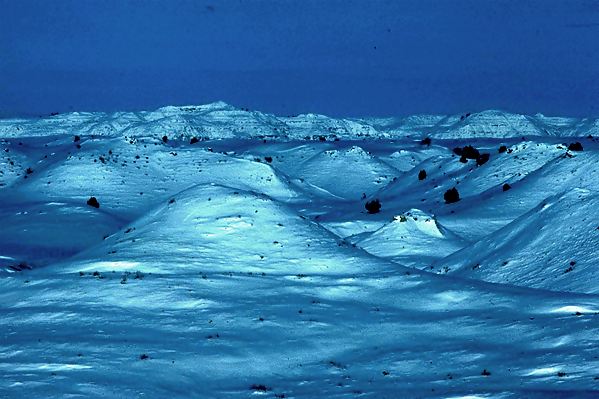
There are two constants on the Great Plains: the wind and long winters. Theodore Roosevelt National Park (wikimedia commons) above. 

The Sun Makes A Campfire
Keeping The Tradition Alive Through Story

By Dakota Wind
STANDING ROCK, N.D. & S.D. - On the Northern Great Plains there are two constants which shaped the natural landscape throughout the ages: the endless wind and the long cold winter.

The wind is always here. From the summer breezes which carry only the oppressive heat of summer to the cutting sting of winter, the wind has shaped the land as much as it has touched the souls of the native sons and daughters and left its mark on their character and spirit.

The Lakota call the wind tȟatė. In the days of warriors, they had another term for the spirit of the wind, Táku Wakȟáŋškaŋškaŋ. I’ve heard the term as used to mean “Something Holy Moving.” I like Albert White Hat’s translation of the word Wakan, in his efforts to cleanse and revitalize the Lakota language, in which he interprets it as “with-energy.” Something with great energy moving across the land perfectly describes the respect for the mystery of creation the Lakota held for when the clouds raced across the sky, the wind blowing across a vast ocean of native grasses, the very power of the wind. Today, scattered across the prairies are wind farms, taking the momentum – the energy – of the wind and convert it into electricity.



In the days of warriors, the Lakota believed that there lived a great giant in the far north, Wazíya, who blew his cold breath out across the land and visited frost on the grasses, leaves, and trees in the fall and spring, but as the rivers and streams froze, true winter tested the people with cruel stinging cold and pure white snow. Winter was a test of character.

The winter became a part of the culture for the indigenous. Many tribes marked the passing of seasons by the passing of winter. The new year began when the geese returned, when the trees began to bud, when the river ice broke, and when bison calves were born. In this observance of nature did the Lakota elders, holy people, and leaders gather together and name the previous year, or winter.

On the longest night of the year, the Lakota would reflect and pray in the way of the ancestors. Some still do this with a midwinter Iníkaǧapi, a cleansing ceremony.


There is another natural phenomenon, the sundog, which is revealed to the world each winter. For the ancient and medieval Christian it was regarded as an omen, of God’s impending judgment. Maybe a long ago priest interpreted the sundog as evidence of the Living Presence of the Holy Trinity appearing in the sky. For the Lakota, the sundog held the promise of the sun.

I saw a sundog recently. I had seen them as a child and had never once felt them as a sign of ominous peril. I remember being entranced by the halo of light, the arc from one sundog to its twin on the other side of the sun. Without possessing the language for what I felt then as I do now, I can truly tell you that even then I felt an overwhelming respect for the mystery of creation. Seeing a sundog recently rekindled the curiosity of youth that I asked my lekší, my uncle, about the sundog.

One said to me, the sundog was simply a natural sign which meant that the Lakota could expect cold weather. Another gave me the honest reply that he had not heard of a story associated with the sundog event.

The Lakota call the sundog Wíačhéič'ithi, which means The Sun Makes A Campfire [For Himself. The Plains Indian sign language, a mutually intelligible gesture language in use for communicating among the many tribes, articulates the sundog with the sign for sun (thumb and index finger making nearly a closed circle, tracing the sun’s arc in the sky) and the sign for fire (one hand, back down above the palm of the other, fingers of the top hand wiggling to and fro mimicking dancing flames).


The design above is most often regarded as an example of what is called the Black Warbonnet Society pattern. The very center pattern and the inner track of abstract feathers is certainly the Black Warbonnet pattern. The daystar, or sun, Aŋpó, was said to have worn a brilliant flaming headdress. It would seem that this particular execution of the Black Warbonnet pattern should be reexamined. The execution of the pattern with three medicine wheel centers, and arc of the second track of abstract feathers bears a striking semblance to the sundog phenomenon.

My lekší Cedric listened patiently to my petition for traditional knowledge regarding the sundog phenomenon. This is what he shared with me:

Being short with it, there is a story that my Uncle Ed told us when we were little guys. It occurred probably at a time when there was a severe cold time and there were lots of clouds, or the sky was grey. Many days had passed when the people went and had council with the elders of the camp.

It was directed after prayers and careful deliberation, that two fires were to be made in the east gate or opening of the camp circle. One of the elders then prayed to the east and asked for a break in the weather. As prayers were had, the sky began to light up and the clouds dissipated, winds calmed, and the sun rose.

As the elder prayed, the sun (wi) was on the horizon with the two fires on each side. Many witnessed this. Praying in the time of purification of the earth is sacred, especially in the morning, when the air is calm and your voice can be heard to the horizon.

The animals will let you know also when it is time to do these things.

This is what I remember of the story.


I share this short story with you. It’s not something that is in a book. Paul Goble hasn’t made a children’s book out of this story. It is living culture. It is tradition. There is more to learn and I’m a lifelong student.


Monday, December 17, 2012

Movies In Lakota

So, I've been on this kick where I've been taking pop culture things, namely movies, and re-imagining them in with Lakota text. 


So, here's how I kind of imagine The Hobbit: An Unexpected Journey as a Lakota story. "Wangi" is the Lakota word for the little people, or little spirit people. "Kin" is a Lakota word but its origin lies more with the Jesuits and other missionaries who've used it as the word "The." "Canku Okokipe" is the "Road Dangerous."


Here's a famous quote by Arnold from the movie "The Terminator." Arnold says, "I'll be back." In Lakota, the term toksa [dohk-SHAH] is a future tense word that is most often meant to mean "Next time." Ake [ah-KAY] means again, and po, is a suffix men use to finish what their statement. 


"Move yourself, my day is good."
"Dirty" Harry Callahan from the movie Sudden Impact.

Star Lodge-Door
Stargate, one of my all-time favorite movies.

The Day Is Good: A Difficult Death
A Good Day To Die Hard

"...and monkeys out of my butt will come!"
Wayne Campbell [Mike Myers], from the movie Wayne's World.

"Luke, it is so, here I am, you're father."
Darth Vader, from The Empire Strikes Back.

Always Be Prepared Mother Russia
Yippie-Kai-Yay Mother Russia, A Good Day To Die Hard

With-Energy The Fifth
The Fifth Element

"On behalf of my little friend say 'hau.'"
"Say 'Hello' to my little friend," Tony Montana, Scarface

The famous quote "You Shall Not Pass," Gandalf The Grey [Ian McKellen], The Lord Of The Rings: The Fellowship Of The Rings.

Friday, December 7, 2012

No Smoking in North Dakota: Local History and the Atlantic World

By Aaron Barth for The Edge Of The Village
My commentary is in italics.

This evening from my post office box I retrieved several envelopes, one of which was the “SmokeFree!” announcement to inform North Dakotans of the latest smoke free Century Code 23-12-9 to 23-12-12. This got me thinking about tobacco in both a local and global historical context. Tobacco as a cash crop is one of the reasons Great Britain continued colonizing Virginia, and tobacco was cultivated by Native America long before the Columbian Exchange.

Sometimes, I find myself thinking of history-related things. I probably would have stood out there beside Aaron with glazed eyes and a far off gaze until a pressing need brought me back to reality. I received not just the smoke-free mailer, but an e-newsletter. I didn't realize that I signed myself up for that until Monday.
As for a local historical context, tobacco appears in a variety of sources. One of them is through Guy Gibbon’s thorough work on the Sioux. Gibbon indexed the word “tobacco” seven times in The Sioux: The Dakota and Lakota Nations (Malden, MA and Oxford, UK: Blackwell Publishing, 2003). Gibbon notes the archaeological sites around Mille Lacs Lake in east-central Minnesota as yielding a variety of botanics, or plant remains, including locally cultivated tobacco.

The native varieties of tobacco on the Northern Plains are maybe a quarter to half the size of the commercial tobacco which is grown today. One leaf is about as big as my open hand. 
From Paul Goble's "White Buffalo Cal Woman"
A cultural and socio-religious story concerning tobacco in the Lakota historical record comes in the form of “The White Buffalo Calf Woman,” a story set down by Black Elk, an Oglala wicasa wakan (“holy man”) and Catholic catechist. In 1931 and in the late 1940s, Black Elk embraced a hybridized version of Euro-American Christianity and Native ways, and he narrated a story where “the sacred messenger of the Great Spirit, brings the People the peace pipe, tobacco, and seven rites.” Students of American literature have considered this story for quite some time, and as Gibbon also notes, “A popular current trend is to devalue Black Elk’s teachings because they seem compromised by Christianity.” (Gibbon, 2003: 149) Whether it is used in customs on behalf of old and new ways, the role of tobacco remains central throughout Native America.

There are variations of the story of the coming of Pte Hincala San Win, The White Buffalo Calf Woman, and Black Elk shared one. In one variation I've become familiar with, the pipe was first seen by the Cheyenne, Tsitsistas as they name themselves, at the sacred site Mahto Tipila, Bear Lodge, popularly known as "Devil's Tower." When a Cheyenne was made to choose between the pipe and seven arrows, he took the arrows back to his people, and when he turned back to look the pipe and the tunnel in Bear Lodge had vanished. The Cheyenne heard later that the pipe was brought to the Lakota.

The story of the pipe is different than the story of tobacco. The Teton Lakota, or Western Sioux, didn't cultivate tobacco but traded it from the Arikara, Hidatsa, and Mandan. 

I don't smoke, but I always carry a bag or twist of tobacco in my car in case I need it to express gratitude or if someone renders a traditional prayer. In the long ago days, when the northern lights filled the night skies, the Lakota people would burn incense. On foggy mornings people would leave a pinch or twist of tobacco for the relatives who've taken their journey. Once I gifted someone from Fort Berthold a tie of tobacco and his relatives whispered, "That's a Sioux thing," but he and they graciously received my gift in the spirit it was given. Maybe it is a "Sioux thing," but I'm happy to carry the tradition. 
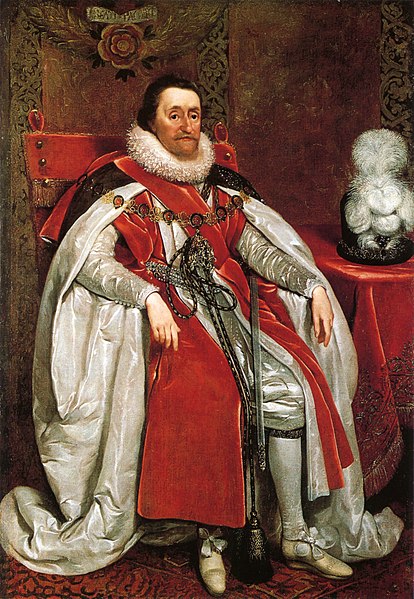
The second history of tobacco text to come to mind upon receiving the update to the new ND tobacco free century code was from James VI and I, a primary source from 1604 entitled, “A Counterblaste to Tobacco.” As the English found ways to bring this cash crop across the Atlantic from the new to the old world, King James felt provoked to respond for the sake of the mainland British common wealth. The paradox remained: England profited financially from tobacco on the one hand, and yet the aristocracy critiqued it on the other. Keeping in mind his use of elitist language, and his complete and raging mischaracterization of the use of tobacco throughout Native America, in 1604 the King of England, verbatim, said,
“…For Tobacco being a common herbe, which (though vnder diuers names) growes almost euery where, was first found out by some of the barbarous Indians, to be a Preseruative, or Antidot against the Pockes, a filthy disease, whereunto these barbaous people are (as all men know) very much subject, through the intemperate heate of their Climat: so that as from them was first brought into Christendome, that most detestable disease, so from them likewise was brought this vse of Tobacco, as a stinking and vnsavourie Antidot, for so corrupted and execrable a Maladie, the stinking Suffumigation whereof they yet vse against that diesease, making son one canker or venime to eate out another.


And this goes on for some length.

Don’t smoke cigarettes, kids, because yes, they do stink, they are unhealthy for you, and they no doubt will cause and/or contribute to cancer. Yet also remember that not every culture uses or has used tobacco the same way, individually and throughout history. Every cultural historical perception toward tobacco is always in flux. And also there is a difference between cigarettes and leaf tobacco: the former are jammed with additives (even with fiber glass, they tell me!) while the latter is not.

I don't smoke as a recreation or past time. I tried it once down by the Missouri River after school with some friends when I was in the sixth grade and coughed so bad I nearly threw up. It was such an awful experience I never tried again. In high school, I never kissed a girl who smoked either. So, to reiterate what my friend Aaron said, don't smoke. If you do, grow your own tobacco, there's less additives. 

Sunday, December 2, 2012

Winter's Kiss Reminds Me Of My Grandfather

A lovely dusk just north of Fort Yates, N.D.
A Reflection:
Childhood Remembered 
By Dakota Wind
FORT YATES, N.D. - The morning arrived on the Missouri River valley with a slow swell of purples and reds. The air hung heavy with a thick curtain of fog which slowly dispelled as early morning became go-to-work morning. The fog had turned to frost and heavily clung to every surface. Windows became frosty effigies of stained glass with fantastic whorls and impossible leaves. The trees had clothed their bare winter branches with thick delicate coats of frost. The trees were so heavy with frost that the morning shadows they cast were as the summer shade again.

I started the car, my little beast, and he came to life rather reluctantly, as though he would rather sleep in. “I feel the same,” I said and patted him on the roof. I imagine another man in the days of warriors in the same spot I stand, rousing his horse and talking to it in a like manner.

In the old days, when fog smothered the land with its cool, almost tangible embrace, it was an in between time and an in between place between our world and the next. Some might leave a pinch of tobacco or an offering of food for the spirits visiting the people. My grandmother shared a tall glass of water with the world and gave thanks for living.

There’s frost on my windshield and for a moment I regret that I must scrape away winter’s kiss on my little beast. I spend a minute tracing the stitches of frost on my window, lost in thought, and I am reminded of my lala (grandfather) just then. Though we lived maybe six blocks from school, he insisted on giving my brother and me a ride on the coldest days, sometimes even when it was warm too. Wordlessly, we did a lot of things without words it seemed but I cherish the memories, he would rouse his car and scrape its windows and I would watch him scrape from inside the car and we would share smiles when he cleared my window.

...for a moment that I am my grandfather and he is me...

I felt the sweet heavy pang of memory in my heart as I cleared my son’s window. He’s eleven now. When he was a toddler and sat in a car seat in the back, I scraped the windows in wintertime and we would share smiles and wave as I cleared his window. For a moment, I saw that little boy again waiting in my car and I wonder if that’s how my lala saw me, a juxtaposition of past and present sharing the same space. By looking at me and smiling, did he see the future? Did he see my son reflected in my eyes? I like to imagine, in the in-between times like dawn, and the in-between spaces created by the fog, that for a moment that I am my grandfather and he is me, and I can feel love surrounding me, holding me, lifting me, as I look on my son. Maybe, just maybe if look carefully I’ll see my grandsons as he looks to me and see his grandfathers.

I hate measuring time, but the world I live in draws me from that place of fog and frost and memory. I get in my pony and put on some Def Leppard. I indulge my imagination once more, and see a warrior dusting off his blanket and settling it on his horse’s back before getting on. I settle into my seat and buckle up, and he straightens his pony-drag (travois). I am ready for the day and my work is the hunt.

It’s my turn to take my son to school. 

Monday, November 26, 2012

The Lost Daughter of The Mandan

A mural of the Yellow Earth Village, a Mandan Indian village, known today as Double Ditch State Historic Site, north of Bismarck, ND. The mural is painted by Robert Evans, and can be viewed in the Early Peoples Gallery of the North Dakota Heritage Center.
The Lost Daughter Of The Mandan
Long Ago Battle Separates Child
By Dakota Wind
DOUBLE DITCH, N.D. - A reader came across my blog and took me up on my offer to look tackle a story or subject. Thank you for reading!

Sue writes:

I have visited your blog, and wanted to submit an article that was written in 1864 about my great-great-great-great-great ??Grandmother, Charlotte Boucher. (I do not know her Indian name) Her story is very interesting, although its hard to tell how much is true.

I was told growing up, that she was the daughter of the Mandan Chief, and this article also states that. I have not been able to verify that, as her date of birth is hard to verify. One article I found online showed her birth year of 1781, while the attached article said she lived to the ripe old age of 125, which would have made her birth year 1739 (one of the harder things to swallow). However, she was taken from her tribe, by the Sioux, before the smallpox outbreak of 1781 at the age of 4.

Her husbands name was Joseph Boucher Jr., who was a French Canadian Fur Trader. Joseph Boucher Jr. was born February 9, 1760 in Riviere-des-Praries (Island of Montreal).

If by chance, you should be able to verify her year of birth, or who the Chief was in 1781, or any other pertinent information, I would love to hear from you. If not, enjoy the article.


What follows next is the article, stated in character, unaltered from the language of the original article about Mrs. Charlotte Busche which Sue sent me. My commentary within the article is bold and my commentary following the article is italicized.

The Green Bay Advocate, January, 28, 1864

sketch [sic] of the Life of Mrs. Charlotte Busche'- We mentioned two weeks ago, the death of Mrs. Charlotte Busche' in the town of Bellevue, near this city, at the age of 125 years and called upon the old residents to furnish us with a sketch of her eventful life. This was found to be a very difficult task. The old lady had bee in her socond  [sic] childhood for more than six years previous to her death, and during that time it was only occaionally [sic] that her mind would brighten up sufficiently to enable her to talk coherently of her early history, therefore all that can be written of her is from the memory of her friends and relatives, gleaned from her before her imbecility. the Chicago Journal calls upon us to extablish [sic] by proof this extraordinary case of longevity. This we cannot do-having always lived among the Indians until her marriage with Busche she had no idea of dates, nor of her own age, and those who might have told her age with tolerale certainty in connection with the events she remembered, had passed away long years before to "that country from whose bourne no travelers returns" In stating her age at 125 years, we did not pretend to exactness, but gave the generally received impression. She wa [sic] "old Charlotte Busche" 45 years ago, which is abouta s [sic] far back as any of our old residents can remember. (If Charlotte were 125 years of age, then she would have been born around the time of Pierre La Verendrye’s first contact with the Mandans, ~1738.)

Mr. John Dousman of Bellevue who was well acquainted with her, gave the following incidents of her life. Gathered from conversations with her descendants.

The late Mrs Charlotte Busche' was born in the far West, near the headwaters of the Missouri River (This would place her birth at what is today known as Three Forks, MT. Perhaps either the author or Charlotte herself meant where the Heart River and Missouri River converge which is where the Mandan Indians lived until smallpox forced them to abandon their villages and move north to Knife River – which is where Lewis and Clark encountered them in 1804). She was of full Indian Blood, of the tribe of Mandans, her father being the Chief of that nation. When a young woman, a great battle occurred between the Sioux and the Mandans, in which she was taken prisoner by the Sioux (The John K. Bear Winter Count recalls a major battle between the Ihanktowana Dakota, also called the Yanktonai, and the Nu’Eta, who are also called Mandan, in 1781 at Yellow Earth Village, presently known as Double Ditch Mandan Indian Village, located north of Bismarck, ND on HWY 1804). Her Mother being dead. she was at that time in the care of her Grandmother, who hid her during the fight in a clump of bushes. This was before the use of fire-arms was known to the Indians, and being discovered by a Sioux warrior, she was dragged forth and dealt her a heavy blow on the head with his bow, leaving her senseless and would have killed her but for the interference of another of the tribe, who claimed her as his prisoner. She carried the scar of this wound through her life. After the battle, she was put on a horse and carried to the Sioux country, near the Mississippi River (this could be any one of the Santee Dakota villages at that time along Minnesota River, near the Mississippi River), and the next day after her arrival at the Sioux village was compelled to run the gauntlet. Two lines were formed of women and children armed with sticks and sharp arrows and stripped naked she was compelled to run through between them, enduring their stripes and arrow thrusts. She came out fearfully lacerated and covered with blood (this torturous process seemed to be the practice of the Huron and Iroquois; in Thomas E. Mails Mystic Warriors of The Plains, he relates the brutal treatment of captives, but also, not all captives were tortured) .

She was then submitted to other tortures too horrible to narrate, and afterward adopted into the Sioux nation, becoming the slave of her captor. About a year afterward, her father came to ransom her by purchase with a drove of horses, but owing to a superstition of the Sioux that once adopted into the tribe would die if taken away, they would not give her up and her Father left her. She lived with captor until his death, when she was sold to the Winnebago Indians, on the Wisconsin River. Here she lived for many years, enduring much cruelty, and had a child in that nation. The Winnebagoes, however, finally sold her to a French trader , who took her to Mackinac, and gave her as a present to the wife of an Ottawa Chief by the name of Na-o-kau-ta (or four legs), who proved to be fiend incarnate and where her worst suffering commenced (Four Legs had fought beside Tecumseh against the United States in the War of 1812 at Moraviantown, Ontario – he was against US land treaties and purchases). she was held as his slave, and by every cruelty that this devil could invent. But all this she survived, and met with an unexpected deliverance. One day her mistress had a son dying, and she came out to the field where the unhappy slave was at work, and told her to hurry and finish hoeing that corn, as she intended to have her accompany her son, as soon as he should lie to make fires for him on his way to the land of spirits.

The hint was enough, it was her sentence of death: so as soon as her mistress was gone she ran away. (The Ottowas were not living on the island of Mackinac, but at Little Traverse Bay, on the main land.) She had not gone far when she was missed, and search was made for her. She crept into a hollow log, and had no sooner got in than her master came to the spot, with his rifle in his hand, and actually stood upon the log in which she was hidden, but did not discover her. She remained there all night, and in the morning came out and went to an Indian Lodge, where she threw herself on her knees and besought the Indians to protect her from those who sought her life, but,instead of befriending her, they took her back to her mistress. On her arrival, her mistress remarked that she must be hungry and she would give her something to eat. She seized a knife and cut off both her ears, scorched them a little in the fire, and commanded her to eat them, on pain of instant death if she refused. She tried to eat the disgusting morsel, and made several attempts to swallow them, but could not. She was then condemned to die the next day, bound hand and foot, and placed in a camp.

Sometime in the night, a friend, she never knew who, came and unbound her, and she made her escape she walked through the woods, following the lake shore for three days, and on the fourth day saw and saw an Indian canoe on its way to Mackinac. She hailed its occupants, and they had pity on her, took her on board and carried her to Mackinac Island. There she told her story and the people of the Island offered her protection, telling her that the marks she bore were sufficient proofs of her suffering. (Was she walking on the shoreline of Mackinac Island on Lake Huron or did she swim to the shoreline – just over two miles – and then walked through the woods and followed the lake shore? Following the lake shore of Mackinac Island for three to four days would have taken her around the entire island which is about 3.8 sq. miles.)

To get her out of the way of this savage tribe of Indians, a trader offered to take her on his Mackinac boar to Green Bay. She accepted his offer, and embarked with him, but had not gone far when they met a canoe of Ottawa warriors bound for Mackinac. The trader hid the old woman beneath the baggage. The warriors hailed the trader, and told him they had heard that their escaped slave was at Mackinac (Mackinaw?), and asked him if he had her on board. He denied all knowledge of her, and preceded on his way to Green Bay, and the canoe to Mackinac. (The previous paragraph mentions that Charlotte saw an Indian canoe on its way to Mackinac. If she swam, she would have risked hypothermia but could have made it to the shoreline – the nearest mainline point from Mackinaw is St. Ignace which is over two miles away. If Charlotte escaped by canoe, why would she need to flag down a trader and get a ride from him to Green Bay? Maybe she took a canoe, then abandoned it.)

Arrived safely at Green Bay, she was taken up to Portage, (now Portage City) and given to a Winnebago [sic]

a [sic] Winnebego woman, Mrs Lequya. Here she lived many years, during which time the Winnebagoes made several attempts to kill her, but were foiled. Mrs. L. compelled her to marry a Winnebego vy the name of Dashba, but she still lived with Mrs. L. She had 2 children with Dashna (Frank Dashna; 1803-1805).

Finally the same French trader who had taken her awa from the Winnebagoes several years before, came and took her away from Dashna and started, with her for the Ottawas, near Mackinac, to restore her to Four Legs. He got as far as Green Bay, where he sold her to Mr Joseph Busche' (1807), with whom she lived until he died (in 1838), and by whom she had 9 children, and since his death, which occurred more than thirty years ago, she had lives with her children, until death came to close hr eventful life two or three weeks ago. (After the death of Joseph Boucher/Busche, Charlotte made an attempt to return to her natural tribe, the Nu’Eta, or Mandan Indians, but she was mis-informed that her tribe had passed into history after smallpox hit them in 1837.)

By 1838, Charlotte was either about fifty-six years old if she were born in 1781, or ninety-nine if she were born in 1739. The average life expectancy of women in 1840 was about forty-five years of age (Daniel Perry, Executive Director of the Alliance for Aging Research). Charlotte applied for and was given permission for her to be enrolled as a member of the Menominee Indian Tribe of Wisconsin. As such, she was permitted access to Indian Health Services and received a small subsidy from the Department of War (of which the Bureau of Indian Affairs was then a part) for illegal seizures of Menominee land from the 10 million acres it was to the 235,000 acres reservation it became. A curious circumstance is, that after the death of old Mr Busche', over thirty years ago, as we have stated, which occurred on the old Rouse farm, known as Private Claim No.10, now Judge Cotton's farm, the old lady never lived upon the farm until about two weeks before her death, when her son with whom she resided moved up on it, and the old lady consequently died upon the same farm where her husband did (Joseph Boucher/Busche’s role somehow moved from purchaser to husband).

In the above sketch (no sketch available), Mr Dousman had omitted mention of many of the barbarities to which this sufferer was subjected, which are too revolting for print.

Thus has passed away another of the connecting links between a past age and the present-the children of the subject of this sketch are now becoming old men and women and will soon have passed away, and if, mayhap, in after years, a stray copy of this tale of woe should chance to be found and read, the reader will think it altogether to preposterous of credence. Even now, the very name of the tribe of which she was born are memories nearly forgotten, and te powerfl tribes of Indians who peopled this country in the days of her youth, have dwindled down to mere handfuls. the unbroken forests through which she made her journeys are now studded thickly with cities, villages and farms, and the iron horse courses on the ancient war paths. The birch canoe and the "Mackinac Boat" have given place on the waters of Lake Michigan to floating monsters propelled by steam, the idea of which was not conceived until she had laid aside all the [sic]...

are among the curiosities we see in museums, and yet she has but just gone to her rest. With her has perished much valuable information with regard to the face of this country, which will be sought for with laborious research by the antiquarian, and perhaps never found. The old lady had a distinct remembrance of the fox River, upon the banks of which we now live, when it was a mere creek, so narrow at the point at Mr Lewis (now Peter L.) Grignon's farm, and the southern line of the city of Green Bay, that a canoe could readily be pushed across it. The river is now about 80 rods wide there (About 1300 feet; 400 meters). This would seem almost beyond belief, were it not confirmed by the testimony of other old citizens who have now gone to their rest. (In the 1850s, the Fox and Wisconsin Improvement Company built a series of locks and dams on the Fox River, then a canal connecting it to the Wisconsin River at Portage, WI.)

One of the most pleasant thoughts that now occur to us is that the Ottawa tribe of Indians, then one of most barbarous, and with whom the old lady suffered the greatest indignities became one of the most Christianized, nearly all having embraced the Catholic, or some Protestant faith, and education among them has reached a high standard. (As a result of reaching such a high standard in education and faith, Michigan citizenry called for dismantling the Ottawa reservations and began to settle on Ottawa homelands. Many Ottawa feared removal to them as President Andrew Jackson did to the Cherokee and other tribes. Some Ottawa who had sold their lands in Michigan, Illinois, and Ohio were removed to Kansas. The Ottawa there were removed to Oklahoma in 1867. The Ottawa who remained in Michigan retained some recognition by the state, and in 1994 the Little River Band of Ottawa’s federal recognition was restored. Today five Ottawa bands have state recognition and many struggle to regain their federal status.)


Charlotte Busche’s story in regards to her long struggle to return to her Nu’Eta (Mandan) Indian people went unrealized. She never again saw the sun set on her people’s earthlodge villages, never again saw the sun rise over the Missouri River. However, the (Nu’Eta) Mandan people are still alive today and many reside on the Fort Berthold Indian Reservation in North Dakota. 

There is the tradition of lineage among the (Nu’Eta) Mandan Indian people which was not at all mentioned in the story above. The Nu’Eta (Mandan) are matrilineal. Charlotte’s daughters, granddaughters, great-daughters, and so on would be regarded by the Nu’Eta (Mandan) as Nu’Eta (Mandan). Discovering who her father was is a start, but knowing who her mother was at Yellow Earth Village and her clan affirms any relations that Charlotte’s descendants may have among the Nu’Eta (Mandan) today.

Enrollment is another issue entirely.

Monday, November 5, 2012

The Legend Of Standing Rock

William A. Rogers engraved this image he called "Standing Rock, The Sacred Stone Of The Sioux." It appeared in Harper's Weekly, January 25, 1879.
The Legend Of Standing Rock
A Look Behind The Name Of Reservation
FORT YATES, N.D. - According to the John K. Bear Winter Count the legend of Woslata Inyan, or Standing Rock, happened not so long ago. In fact, the entry of the legend happened in the 1740 A.D. There are many different stories of the stone and how it came to be, but all involve a woman who turned to stone. The Cheyenne and the Arikara Indians also have Standing Rock stories. The stone can be found today along the western bank of the Missouri River, in present-day Fort Yates, ND, in front of the Tribal Administration.

In one version of the story, a Dakota man took an Arikara woman for a wife, and together they had a child. Sometime later he took a second wife, as was a custom of Plains Indian men.

The first wife took offense at the attentions her husband gave the second wife, and she grew resentful and jealous. At this time, the Yanktonai Dakota were camping along what today is called Stone Idol Creek, a tributary of the Cannonball River. When the time came to break camp, the angry woman refused to move from her place on the lodge floor. The lodge was taken down around her, and still she refused to move and there she sat on the ground with her baby on her back and remained there as the camp and her husband moved on.

Sometime towards the middle of the day, her husband halted the moving camp when he noticed his wife wasn't among them. He called out to his brothers and said, "Go back to your hankansi [sister-in-law], tell her to come along, and we'll await for you all here. Inahni yo! [Hurry!] I fear she may become desperate and take her own life."

The two brothers mounted their horses and made the best possible speed to their previous camp, arriving that evening. They saw that she was still sitting on the ground where they left her.

The older brother called out to her, "Hankansi! [Sister-in-law!] Inajin yo! [Rise!] We have come back to get you. The camp and our brother, your husband, await you." But she did not answer.

...as they came up close they saw for themselves that she was now a figure of stone.

The elder brother reached out to her when she did not answer and put his hand on her head. She had turned to stone!

The two brothers immediately mounted their horses and rode them furiously back to rendezvous with their tiyospaye [extended family; camp; band] and shared what they had seen, but no one believed such a story. "Ohk, duwahle! [an interjection of disbelief]," as they might say today.

The husband immediately thought something foul happened and braced himself for the worst news. He believed that his wife had indeed taken her own life, and his brothers refused to tell him how they found her.

Though  the camp had already traveled half a day, their interest was roused enough that the entire tiyospaye broke camp and made the journey back to their previous campsite. When they drew close they saw a figure sitting on the ground where they left her, and as they came up close they saw for themselves that she was now a figure of stone.

The stone was considered holy by all and was given a place of honor in the center of camp...

The tiyospaye couldn't leave her behind again, and believing that the stone itself was now sacred, they chose out a fine horse and painted it, and mounted a travois with streamers unto it. Then they carefully placed the stone, the rock which stood in place of the woman, into the catch of the travois.

The stone was considered holy by all and was given a place of honor in the center of camp and whenever the tiyospaye moved, so to did the stone. In the days when the bison began to disappear, when the Iron Horse on his iron road traveled from sunrise to sunset across the land, when the permanent Sioux reservations were established, and the people were utterly driven to settle and move no more, the stone, Woslata Inyan [Standing Rock] made the journey with them. The stone was placed on a brick pedestal when the reservation era began, and Standing Rock now stands in silent vigil overlooking Mnisose [The Missouri River].

Inyan Woslata rests in the middle of a parking lot in front of the Administration Building in Fort Yates, ND these days. A few bricks are missing from the pedestal and the mortar is much cracked or missing entirely in places. 

In another story, the Dakota and Lakota generally believed that the stone was once a young and beautiful maiden among them, whose intended love was slain in battle. She mourned for him with a deep and constant sorrow. Many suitors sought to win her heart in marriage but she only had room in her heart for her one first and true love. She turned away all suitors and died an old maid.

Wakan Tanka, the Great Spirit some say, looked upon her old and broken body and transformed her body into stone, rather than allow her to decay return to dust, so that she might remain a memorial of her love and faithfulness.

The Dakota and Lakota would frequently gift the Standing Rock with tobacco ties, food, or other demonstration of veneration, others would paint Standing Rock in loud shades of red or blue.