Monday, May 16, 2011

Winter Counts: The Art of History

The book "Moonstick: The Seasons of the Sioux" by Eve Bunting and John Sandford provides wonderful concise explanations of the months, and beautiful illustrations of the seasons. Its a children's book, but worth looking through for information. 
Winter Counts: The Art of History
Pictographic Lakota History
By Dakota Wind
GREAT PLAINS - In the age before the railroad, before horses and guns, the Dakota and Lakota Sioux regarded the full passing of a year in thirteen months. Thirteen twenty-eight or twenty-nine day months.

The year ended and began with the arrival of the spring, when the birds flocked north, when the ice broke on the Missouri, when the trees began to bud, and when bison calves were born. The sources for the Smithsonian however, state that the year is measured from first snowfall to first snowfall. One of those sources was an anthropologist in the 1880s names Garrick Mallory, who heard it first-hand from the people he was recording the winter counts.

The Dakota/Lakota kept track of time two ways. The first method was by using counting sticks. There were thirteen sticks, about the size of tipi pins, to represent the lunar months, and a long stave upon which were carved notches representing each passing day, and in the case of the winter count keeper Brown Hat, years. 


Above is a colored example of Baptiste Good 's (Brown Hat's) winter count. The complete winter count can be viewed in the text "Picture Writing of the American Indians, Vols. 1 & 2" by Garrick Mallory. 

The second method for tracking time was the winter count. The Dakota/Lakota call it WaniyÄ—tu Wowapi [lit. Winter They-Picture], freely translated as “Winter Count.” A winter count is a mnemonic device with a picture representing a year. The year is named rather than numbered. 

In the “dog days” (the days before horses) as the traditional elders say, the tribe would come together in the spring, as one year ended and a new one began, to decide what to name the year, then the winter count keeper would draw the year accordingly. 

Some anthropologists say that the winter count tradition began after first contact. The John K. Bear winter count begins with Wicokicize tanka [lit. Battle Big], and according to anthropologist James Howard, there are three tribes whom the Dakota/Lakota were at war with: the Assiniboine, the Cree, and the Chippewa. In one of the biggest battles fought between the Sioux and Chippewa was one which took place at Mille Lac in 1682. 1682, is also the year that the John K. Bear winter count has been determined to begin in. 

The John J. Bear winter count also starts two years before first contact, at least with this particular band of Sioux, the Ihanktowana (or Yanktonai). This winter count records 1684 as Wasicun tokahcin ahi kin [lit. takes-the-fat first came the], or “The very first white man they had ever seen among them,” or “the first white men came to them.” James Howard reasoned that the eastern Sioux, the Dakota, had made contact about 1640, with Jean Nicolet, and that the western branches of Sioux very probably didn’t have their first contact until the arrival of Nicholas Perrot in 1682. 

The Brown Hat winter count, also known as the Baptiste Good winter count, is a wonderful anomaly, for it begins in A.D. 901 with the coming of the White Buffalo Calf Woman bringing the gift of the sacred pipe and continues with various mythological histories and the arrival of the horse (which wasn’t reintroduced to North American until the arrival of the Spanish in Mexico in the early 16th century). 

Above is Blue Thunder's winter count, currently in the collections of the State Historical Society of North Dakota. It measures about 3' x 15' and was originally a tipi liner. The material is cotton, the pigments are a combination of ink, pencil, and paint.

Winter counts are an interesting subject to search for in libraries, archives, and museums. They defy being categorized. Is it philosophy? Is it psychology? Is it religious studies? Is it history or social science? Is it language? Is it art? Is it geography? Winter counts have been designated as a multi-discipline study, and are simply Dakota/Lakota.

The John K. Bear winter count has entries that fit philosophy, even an entry related to psychology case studies conducted by the North Dakota State Hospital back in the 1970s. It is definitely history. It is language. It is art. Winter counts even contain geographical data relating to movements over the plains and movements (due to warfare) of other tribes. They also contain meteorological data with references to deathly cold winters, blistering summers, devastating floods, and earthquakes. They even mention astronomical events such as unusually luminescent northern lights turning night to day, the passing of asteroids, comets, and falling stars.

The winter count is an art, and not just art, but the ability to relate the history to the listener. The winter count keeper was selected by the people made up of a council of elders, traditional tribal leaders, and spiritual leaders or advisors, for his artistic ability and his for his charisma or public speaking. The winter count keeper was referred to as Ehanna wicohan oyakapi [lit. Long-ago knowledge relating-to-the-people], relating the history to the people, or simply “historian.”


Above is the "British Museum" winter count, named that only because its part of the collection there. It is actually a variant of Blue Thunder's winter count.

Women have kept the tradition of the winter count too, in two cases at least. The Blue Thunder winter count was kept by a female relative, Yellow Lodge Woman, and was added to for a few years, until it was sold to the State Historical Society of North Dakota (it was the 1930s and the money was desperately needed).

The winter count tradition is still practiced. Cataloging and interpreting winter counts is on-going across the country as museums and other institutions realize they are more than an art piece.


The Brule winter count above is also a home. Winter counts were painted on hides, tipi liners, cloth, in ledger books, and also on the tipi.

The Smithsonian Institute has a wonderful online interactive exhibit of ten Lakota winter counts, including the Bapiste Good winter count (but only entries from 1700-01 and on). Visit: http://wintercounts.si.edu.

Wednesday, May 4, 2011

Remembering Whitestone Hill

This engraving of Whitestone Hill which appeared in Harper's Weekly, after a pencil drawing by General Alfred Sully.
Remembering Whitestone Hill
Sacred Cultural Site: Remembering Tragedy

By Dakota Wind
WHITESTONE HILL, N.D. - In 1914, about five thousand people attended the dedication of the Whitestone Hill Battlefield. Amongst the visitors were three Sioux Indians who went out and correctly identified the battle site and encampment of Sioux which is south-east of where it was supposed to be. The three Sioux delegates were: Red Bow, Takes-His-Shield, and Holy Horse. Red Bow and Takes-His-Shield both gave accounts of what happened at Whitestone Hill, with Rev. Beede, an Episcopal missionary on the Standing Rock Sioux Indian Reservation, serving as interpreter. Holy Horse, a veteran of the incident at Whitestone Hill, did not offer his account and only showed himself. Only one known record of Red Bow's account is available.[1]

At least one pictograph of the Sioux perspective of the Whitestone Hill Battle exists, that rendered by Mr. Richard Cottonwood under the direction of Takes-His-Shield in 1913; Takes-His-Shield was there in 1863 and was eighteen years old at the time of the battle. It was then interpreted by Rev. Aaron Beede in 1932.

See image below for Takes-His Shield’s map of events of Whitestone Hill.[2] An abbreviated interpretation follows (note: the map may well be a reverse; numerals may have been added later):


Takes-His-Sheild sat across from Richard Cotton Wood, directing Cotton Wood what to draw in this pictographic representation. The top of the pictograph is actually south, the bottom north, the left east, and the right west.

Many men, women, and children were in the camp. They were on an annual autumn bison hunt and drying meat for the winter. The camp was in the broken prairie country beside a small lake. The camp consisted of two groups of Sioux: one group prepared for war and the other for the hunt. They were on friendly terms with each other and so camped in one circle. White soldiers are shown to have attacked from the lower right (east?) of the camp. The Sioux back away in the opposite direction of the attack. 


The Sioux are near a small lake when soldiers rush in and surround them. A group of soldiers pursue some Sioux who’ve escaped, but don’t kill them. No one has been killed at this point.
The soldiers have the Sioux between them and are killing them, but the Sioux are not fighting back. Many Sioux were slaughtered at this point, with up to thirty Sioux were killed.
The soldiers distance themselves, cross their own trail from their first movement. At this point in the engagement, when darkness crept in, the Sioux made their escape.

It is interesting to note that according to Takes-His-Shield’s account, that not a single Sioux retaliated or offered resistance when they came under attack.

About 156 prisoners were taken into custody, mostly women and children and brought to the Crow Creek Indian Reservation. There, in November, 1863, Sam Brown, an interpreter sent a correspondence to his father about the incident at Whitestone Hill:

I hope you will not believe all that is said of “Sully’s Successful Expedition,” against the Sioux. I don’t think he aught to brag of it at all, because it was, what no decent man would have done, he pitched into their camp and just slaughtered them, worse a great deal than what the Indians did in 1862, he killed very few men and took no hostile ones prisoners…and now he returns saying that we need fear no more, for he has “wiped out all hostile Indians from Dakota.” If he had killed men instead of women & children, then it would have been a success, and the worse of it, they had no hostile intention whatever, the Nebraska 2nd pitched into them without orders, while the Iowa 6th were shaking hands with them on one side, they even shot their own men.[3]

Some winter counts mention the Sioux Uprising of 1862, much less the incident at Whitestone Hill. Colonel Garrick Mallory, an ethnologist employed by the US Army to study the Plains Indian sign language after the Civil War, suggests that the Sioux’s reluctance to record the history of the consequence of the Uprising (the Sibley and Sully campaigns of 1863) are the reason for choosing to not remember those military campaigns. Here are some entries in around the time of the Uprising of 1862 and the Whitestone Hill incident of 1863:

Anderson Winter Count[4]
1862-1863: Plenty buffalo that winter.
1863-1864: Red Feather, an Assiniboine Sioux, was killed.
1864-1865: The Crow came that winter and killed eight.

No Ears Winter Count
1863: Eight were killed by the enemy.
1864: Four Crow were killed.
1865: Horses died off that winter.

Short Man Winter Count
1863: Eight were killed by the enemy.
1864: Four Crow were killed.
1865: Horses died off that winter.

Iron Crow Winter Count[5]
1863: He and his wife died.
1864: Two Face was hanged (note: Two Face was unjustly hanged by the US Army after he returned a captive white woman he rescued from his own people.)
1865: Many Deer made peace that winter (note: This is reference to a treaty signed at Fort Laramie in 1865, in which Colonel H. Maynadier officiated over. The colonel’s name sounded like “Many Deer” to the Lakota and so they called him thus).

Red Horse Owner’s Winter Count[6]
1863: They scalped a boy near the camp.
1864: They were fighting with the white man [in reference to the battles the year before].
1865: Many Deers made peace.

The Red Horse Owner Winter Count. 

Blue Thunder Winter Count[7]
1863: Big Brain died. 
1864: A man was our prisoner, he told us the truth, so we named him that. 
1865: Turtle Head was stabbed to death. 

Iron Shell Winter Count[8]
1863: Broken up dance. Many divisions of Sioux were camping together when suddenly they dispersed [in reference to the Whitestone Hill incident]. 
1864: Laugh-As-He-Lies-Down is burned. The interpreter named so, was patronizing a trading post, located on the south bank of the Platte River near the Oregon Trail, when the post burned down. The Cheyenne were suspected of starting the blaze. 
1865: Many Deer came to make a treaty. 

John K. Bear Winter Count[9]
1863: The Santee Dakota warred with the whites (in reference to the uprising the previous year). 
1864: They camped with the beaver along Stone Idol Creek (presently known as “Porcupine Creek). 
1865: The Santee were held captive in a village (in reference to the Sioux who were taken prisoner after the Sioux Uprising of 1862; they were brought to Crow Creek Indian Reservation before being relocated to Santee, Nebraska). 

American Horse Winter Count
1862-1863: The Crow scalped an Oglala boy alive. 
1863-1864: The Oglala and Mniconjou took the war path against the Crow and stole 300 Crow horses. The Crow followed them and killed eight of the Sioux war party. 
1864-1865: Bird, a white trader, went to Powder River to trade with the Cheyenne. They killed him and took his goods. 

Cloud Shield Winter Count[10]
1862-1863: Some Crow came to their camp and scalped a boy.
1863-1864: Eight Dakota were killed by the Crow. 
1864-1865: Bird, a white trader, was burned to death by the Cheyenne. 

Flame Winter Count
1862-1863: Red Plume kills an enemy. 
1863-1864: The Crow kill eight Sioux on the Yellowstone. 
1864-1865: Four Crow were caught stealing horses from the Sioux and were tortured to death. 

Lone Dog Winter Count
1862-1863: Red Feather, a Mniconjou, was killed. 
1863-1864: Eight Sioux were killed. This year, Sitting Bull fought General Sully in the Black Hills. The interpreter Lavary says that General Sully killed seven or eight Crow at The-Place-They-Shot-Deer, which is about 90 miles south-west of Fort Rice. Another interpreter, Mulligan, says that General Sully fought the Yanktonai and the Santee at the same place. [Maybe the interpreter meant “90 miles south-east of Fort Rice,” which would be roughly the distance to Whitestone Hill.]
1864-1865: The Dakota killed four Crow. 

Swan Winter Count[11]
1862-1863: A Mniconjou killed an Assiniboine named Red Feather. 
1863-1864: Eight Mniconjou killed by the Crow.
1864-1865: Four Crow killed by the Mniconjou. 

Big Missouri Winter Count[12]
1862: Death of Chief Turkey Leg. The Minnesota Uprising this year alarmed the Sioux throughout the West. The Santees had asked for new hunting grounds, as their old ones had been taken. Promised government supplies did not arrive, and they asked for food from a private store owner because they were hungry. The store owner, Nathan Myrick, said, “Let them eat grass.” Following this and a long series of deceptions, the angered Santees went on a rampage, killing Myrick and other settlers, and taking many white hostages. This was the war in which Secretary of the Interior, Caleb Smith, proclaimed that Indians should be regarded as “wards of the government,” no longer as independent nations. Here is the origin of the BIA’s “trust powers” doctrine. 
1863: In a battle with the Pawnee, the Sioux were badly defeated. Nine of the bravest Sioux warriors were killed. 
1864: This year nearly all the Sioux bands camped together. 
1865: The Omaha dance was brought to the Sioux. The typical headdress of the Omaha was the roach. 

Garnier Winter Count[13]
1862: A boy scalped.
1863: Eight were killed.
1864: Four Crow were killed. There was a massacre at Sand Creek (in reference to the campaign led by Colonel Chivington on Black Kettle’s friendly band of Cheyenne). 
1865: All the horses were killed. General Patrick Conner organized three columns of soldiers to begin a campaign into Powder River country from the Black Hills to the Bighorn Mountains. They had one order: “Attack and kill every male Indian over twelve years of age.” Conner builds a fort on the Powder River. Wagon trains began to cross the Powder River basin on their way to Montana gold fields. The Battle of Platte Ridge, July 24-26, 1865. The Cheyenne and Lakota lay siege on the most northern outpost of the US Army and succeed in killing all members of a platoon of cavalry who were sent out to meet a wagon train. 

Cranbrook Winter Count[14]
1862: Twenty Mandan were killed. 
1863: Winter of chasing foxes. 
1864: Return of a captured white girl to her parents. There is a record of two white women being released by their Dakota captors during this year. The Oglala captured Mrs. Fanny Kelly while she was on her way to California with her family. According to one version, her captors sold her Brings-Plenty, a Hunkpapa, who made her his wife. An army major sent a delegation of Blackfoot Sioux to buy her freedom. Her Indian husband refused to sell her so the rescue group took her at gunpoint. She was released at Fort Sully. By her own account, she was well treated. 
1865: Winter of lots of blood for food.

This image of Whitestone Hill was taken in 1918 on site. According to Red Bow, the confrontation actually took place south east of where the Whitestone Hill Conflict is currently designated.

While there are hundreds of other Sioux winter counts from which to draw, many overlap with the ones correlated in this paper, meaning that they reflect warfare with the Assiniboine, Crow, Mandan, or Pawnee as the case may be. This may reflect the cultural norm of recording only one’s triumphs rather than one’s failures as in the case of making personal exploit robes. Or as Mallory suggested that the Sioux simply did not want to record the consequences of the Uprising of 1862.
____________________
Bibliography:

[1] Newspaper clipping from the Battle of Whitestone Hill Collection, SHSND.

[2] Page 96-98, Clair Jacobson, “Whitestone Hill: The Indians and the Battle,” Pine Tree Publishing, 1991.

[3] Sam J. Brown to Joseph R. Brown, November 13, 1863. Joseph Brown Papers (Minnesota Historical Society, St. Paul).

[4] http://eee.uci.edu/clients/tcthorne, Anderson winter count (also called the Rosebud Winter Count). Accessed and downloaded January, 2003.

[5] The No Ears, Short Man, and Iron Crow winter counts appear in James R. Walker’s, “Lakota Society,” University of Nebraska Press, 1982.

[6] Joseph S. Karol, “Red Horse Owner’s Winter Count: The Oglala Sioux, 1786-1968,” Booster Publishing Co., Martin, SD, 1969.

[7] Blue Thunder is the author’s great-great-grandfather.

[8] The Iron Shell Winter Count appears in Royal Hassrick’s, “The Sioux: Life and Customs of a Warrior Society,” University of Oklahoma Press, 1988.

[9] The John K. Bear Winter Count appears in The Plains Anthropologist, Memoir 11, 1976.

[10] The American Horse and Cloud Shield winter counts appear in Garrick Mallory’s “Pictographs of the American Indians,” Government Printing Office, 1886.

[11] The Flame, Lone Dog, and Swan winter counts appear in Garrick Mallory’s “Pictographs of the American Indians,” Government Printing Office, 1886.

[12] The Big Missouri winter count can be found in Roberta Carheek Cheney’s “The Big Missouri Winter Count,” Naturegraph Publishers Inc., 1979.

[13] The Garnier winter count can be found at http://freepages.geneology.rootsweb.com/milkstevens/timeline.htm, which was downloaded November, 2003 by the author.

[14] The Cranbook winter count can be found in Alexis Praus’ “The Sioux: 1798-1922: A Dakota Winter Count,” Institutes of Science Bulletins 44, 1962.

Wednesday, April 27, 2011

Elizabeth Custer Laments Her Boy General

Libbie sports a military kepi hat in this pose with her husband, General Custer.
Elizabeth Custer's Sorrow

Lamenting The Loss Of General Custer
By Dakota WInd
GREAT PLAINS - In 1890, Elizabeth Custer wrote an article for the Ladies Home Journal. Her sense of loss that holiday season had not lessened.

“If instead of writing a Christmas welcome to the thousands of women to whom this Christmas Journal will go, I could enter the homes myself and talk with you, it would please me far better than using this greeting made formal by pen and paper. Perhaps in the midst of Christmas carols and Christmas cheer there would be no opportunity to take me about your homes and show me what ingenuity, taste and thought you have given to ornamenting and making pleasant the blessed abode for your husband and children. I might not be permitted, for want of time on your part, to know the history of each gift which you have planned and thought out late at night, and in the calm of early morning. But still, I dearly wish that I might enter your comfortable homes, and hear of your aims, your blessings and perplexities, your sorrows. In wishing all the good things this world gives may descend on the households to which the Journal goes, I would that it might give me the special privliege to let me enter those thousands of little makeshifts for home throughout our land that the busy women of limited means have set up; the dingy rooms under the eaves, where deft fingers have made such transformations; the little apartments where is ever semi-twilight, where God's beautiful twilight comes in thru the narrow windows-ah, it is to you, brave, but lonely women, if any such read these words, that I wish to send my love, and whatever of courage deep felt words can convey. The widows, the girl bachelors, the solitary old maids, all of you who are so much to me, I envy the printed and pictured sheets of this holiday Journal, the cheer and comfort they carry. Elizabeth B. Custer, Ladies Home Journal, December 1890.

Her sense of loss and dread began the hour she last saw her boy general.


“...A premonition of disaster that I had never known before weighed me down. I could not shake off the baleful influence of depressing thoughts. This presentment and suspense, such as I have never known, made me selfish, and I shut into my heart the most uncontrollable anxiety and could lighten no one else’s burden. The occupations of other summers could not even give temporary interest.” Elizabeth Bacon Custer, Boots and Saddles, p. 220.

“We felt that we had nothing to expect but that our troops would be overwhelmed with numbers...” BAS, p. 221 Perhaps Libbie’s premonition was based on all the rumors that Fort Abraham Lincoln heard that spring. “On July 5 - for it took that time for the news to come - the sun rose on a beautiful world...A steamer came down the river bearing the wounded from the battle of the Little Big Horn...this battle wrecked the lives of twenty-six women at Fort Lincoln...From that time the life went out of the hearts of the ‘women who weep,’ and God asked them to walk on alone and in the shadow.” EBC, BaS, p. 222.

Pictured above is the Far West Riverboat, a steamer which brought the critically wounded back from the Battle of the Little Bighorn in ten days, a speed record on the Upper Missouri River that still stands in 2011.

Pat Decker Kines writes in her book A Life Within a Life: The Story and Adventures of Libbie Custer, “Libbie was 34 years old at the time of her husband’s death. It was a blow from which she never recovered. She never remarried, and she heard ‘the echo of [his] voice’ throughout the rest of her life. So keenly was Libbie’s sense of loss, that even Christmas fourteen years later, her husband’s absence haunted her as sharp as the day she first heard word of his death. It would seem that Christmas held little joy for her.

Libbie went on to meet Chief Gall, one of the traditional war captains at the Battle of the Little Bighorn. Gall returned from Canada before Sitting Bull did, became a Christian man and even a judge. When Libbie and Gall met, she described him as having the bearing of a gladiator. She held nothing against him for his part in the battle in which her husband and his command was annihilated.

Chief John Gall, Pizi, donated land from his Dawes allotment to the Episcopal Church which built St. Elizabeth's and a school so that the youth woudn't have to leave the reservation for boarding schools. A cemetery lies a mile north of the church, which is where Chief Gall lies in rest, along with veterans of the Indian Wars, WWI, WWII, and Vietnam.

Elizabeth’s work was written and the Ladies Home Journal published this piece before the Wounded Knee incident. The timing of her article is provocative in that as she was still reflecting on the loss of her husband and the 7th Cavalry, the country was reminded of the Battle of the Little Bighorn with the news of Big Foot’s band of Lakota.

Wednesday, April 20, 2011

War Correspondence from the Front Line: The Battle of the Rosebud

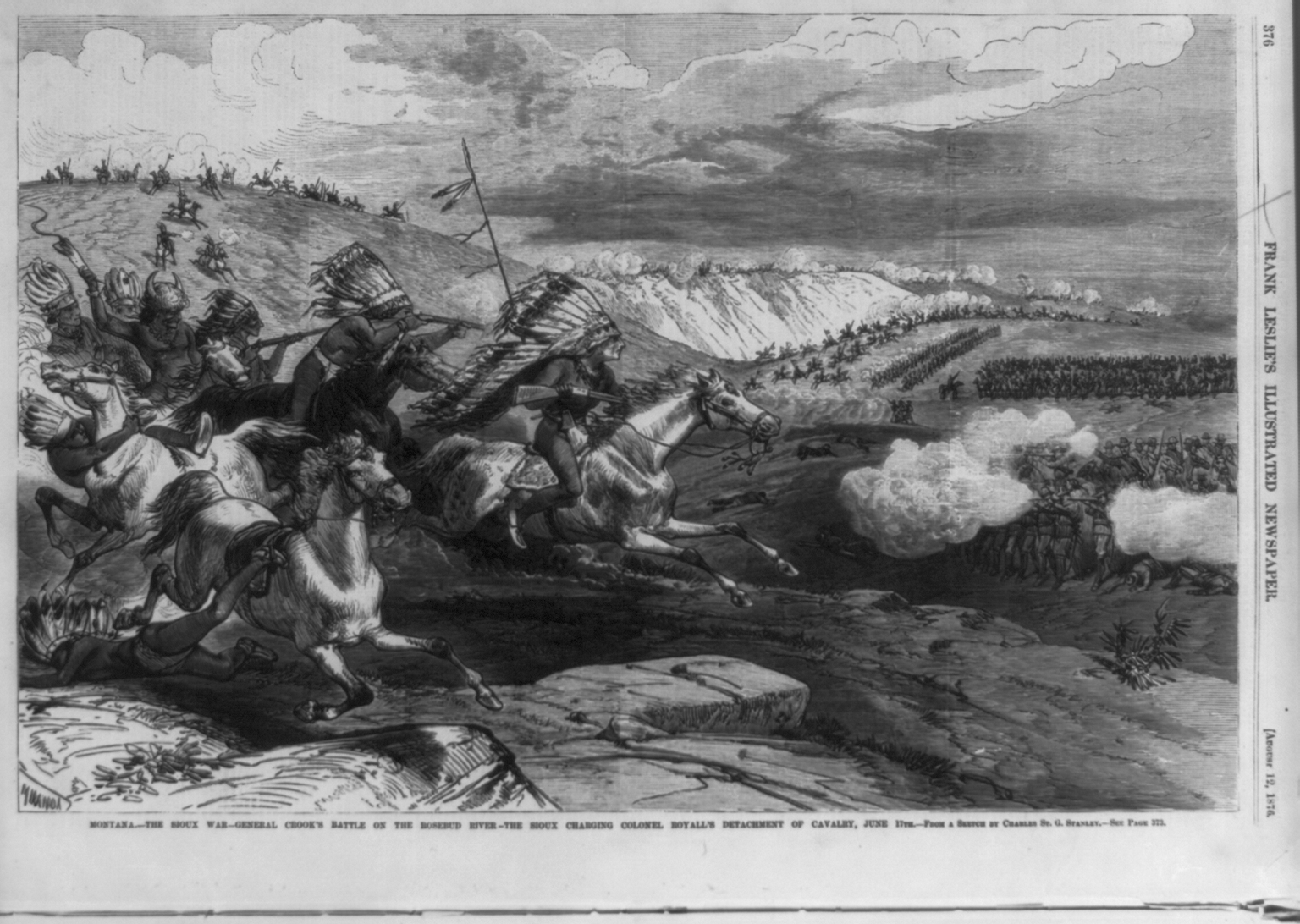
"Sioux charging at Battle of Rosebud," by Charles St. G. Stanley.
War Correspondence From The Front Line
The Battle Of The Rosebud, 1876

By Dakota Wind
Author and historian, Peter J. Powell collects the Cheyenne oral traditions about the Battle of the Rosebud in his resource "People of the Sacred Mountain." Therein is a story about how a Cheyenne maiden who witnessed her brother fall off his horse during the fight. She promptly jumped on a horse and rose into the crossfire to save him. The Cheyenne refer to the Battle of the Rosebud as "The Girl Who Saved Her Brother Fight."

Author and historian, Jerome Greene also has a wonderful resource utilizing Lakota and Cheyenne oral traditions about the Rosebud, the Battle of the Little Bighorn and other fights in his resource "Lakota and Cheyenne: Indian Views of the Great Sioux War, 1876-1877."

In 1890, Joseph F. Finerty a war correspondent for the Chicago Times, published a collection of his narratives from 1876 through 1879 titled “War-path and Bivouac, or the Conquest of the Sioux.” Here follows an excerpt:


Dawn had not yet begun to tinge the horizon above the eastern bluffs, when every man of the expedition was astir. How it came about, I know not, but, I suppose, each company commander was quietly notified by the headquarter’s orderlies to get under arms. Low cooking fires were allowed to be kindled, so that the men might have coffee before moving farther down the cañon, and every horse and mule was saddled and loaded with military despatch. Finerty notes that the Indians had a feast the night before and that the following morning the Crow were reluctant to go forward to meet the Sioux and Cheyenne, the Shoshone, however, showed some “martial alacrity.” They [the Cavalry and Scouts] got their horses ready, looked to their arms, and, at last, in the dim morning light, a large party left camp and speedily disappeared over the crests of the northern bluffs.

Finerty describes the Infantry moving out with their mules and other equipment. The Cavalry being generally bored and some even taking naps in the saddle until they all began with the “regularity of a machine complicated.” We marched in this fashion, the cavalry finally outstripping the infantry, halting occasionally, until the sun was well above the horizon. At about 8 o’clock, we halted in a valley, very similar in formation to the one in which we had pitched our camp the preceding night. Rosebud stream, indicated by the thick growth of wild roses, or sweet brier, from which its name is derived, flowed sluggishly through it, dividing it from south to north into almost equal parts. Our battalion (Mill’s) occupied the right bank of the creek, with the 2d Cavalry, while on the left bank were the infantry and Henry’s and Van Vliet’s battalions of the 3d Cavalry. The pack train was also on that side of the stream, together with such of the Indians as did not move out before daybreak to look for the Sioux, whom they were by no means anxious to find. The young warriors of the two tribes were running races with their ponies, and the soldiers in their vicinity were enjoying the sport hugely.


At 8:30 o’clock, without any warning, we heard a few shots from behind the bluffs to the north.  “They are shooting buffalo over there,” said the Captain [Sutorius]. Very soon we began to know, by the alternate rise and fall of the reports, that the shots were not all fired on one direction. Hardly had we reached this conclusion, when a score or two of our Indian scouts appeared upon the northern crest, and rode down the slopes with incredible speed. “Saddle up, there - saddle up, there, quick!” shouted Colonel Mills, and immediately all the cavalry within sight, without waiting for formal orders, were mounted and ready for action. General Crook, who appreciated the situation, had already ordered the companies of the 4th and 9th Infantry, posted at the foot of the northern slopes, to deploy as skirmishers, leaving their mules with the holders. Hardly had this precaution been taken, when the flying Crow and Snake [Shoshone] scouts, utterly panic stricken, came into camp shouting at the top of their voices, “Heap Sioux! Heap Sioux!” gesticulating wildly in the direction of the bluffs which they had abandoned in such haste. All looked in that direction, and there, sure enough, were the Sioux in goodly numbers, and in loose, but formidable array. The singing of the bullets above our heads speedily convinced us that they had called on business. Finerty doesn’t run out of adjectives to describe the bravery and fortitude of his company; Finerty never holds his callous estimation for the “inferior” race in check, clearly showing present day readers he was a man of his time. “Why the d---l don’t they order us to charge?” asked the brave Von Leutwitz. “Here comes Lemley (the regimental adjutant) now,” answered Sutorius. “How do you feel about it, eh?” he inquired, turning to me. “It is the anniversary of Bunker Hill,” was my answer. “The day of good omen.” “By Jove, I never thought of that,” cried Sutorius, and (loud enough for the soldiers to hear) “It is the anniversary of Bunker Hill, we’re in luck.” The men waved their carbines, but didn’t cheer. Lemley came bounding up on his horse. “The commanding officer’s compliments, Colonel Mill!” he yelled. “Your battalion will charge those bluffs on the center.”

Mills shouted the charge, and Troops A, E, I, and M went to meet the Sioux on the bluff. At about fifty paces the Sioux line broke. When Mills and his troops reached the crest of the bluff, they immediately formed a line. General Crook ordered the 2nd Battalion of the 3rd Cavalry under Col. Guy V. Henry to charge the right flank of the broken Sioux line.

General Crook kept five troops of the 2d Cavalry, under Noyes, in reserve, and ordered Troops C and G of the 3d Cavalry, under Captain Van Vliet and Lieutenant Crawford, to occupy the bluffs on our left rear, so as to check any movement that might be made by the wily enemy from that direction. General Crook estimated that they faced a Sioux force of about 2,500 warriors. The Sioux reformed another line on the second line of heights from Rosebud Creek. Finerty suggests that it was likely Crazy Horse directing and signaling the Sioux with a pocket mirror. Under Crook’s orders, our whole line remounted, and, after another rapid charge, we became masters of the second crest. When we got there, another just like it rose on the other side of the valley. There, too, were the savages, as fresh, apparently, as ever. We dismounted accordingly, and the firing began again. Colonel Mills, who had active charge of our operations, wished to dislodge them. The firefight shifted from Mills’ position to Maj. Evan’s position to the left. Mills led a charge into the valley under cover of the rocky terrain there. The Crow and Shoshone joined the fight led by Maj. Randall. The two bodies of savages, all stripped to the breech-clout, moccasins, and war bonnet, came together in the trough of the valley, the Sioux having descended to meet our allies with right good will. They began a most exciting encounter. Our regulars did not fire because it would have been sure death to some of the friendly Indians, who were barely distinguishable by a red badge which they carried. An Infantryman, Sergeant Van Moll joined the fight. Finerty found it strange that casualties on both sides couldn’t have exceeded more than twenty-five; he also remarks that war cries were constant on both sides. Since this fight was an “Indian” fight, one could safely speculate that the warriors on both sides were fighting for war honors, such as counting coup.

Sergeant Van Moll found himself fighting alone, when the Shoshone and Crow fled from the Sioux. A diminutive Crow scout, “Humpy,” made a bold rescue of Van Moll – and returned to the cheers of all the Cavalry and Scouts.

In order to check the insolence of the Sioux, we were compelled to drive them from the ridge. Colonel Royall met with difficulty on his front. Captain Vroom was deceived by the terrain and became overwhelmed. Lieutenant Foster and Lieutenant Morton, and Captain Andrews (Troop I) extricated Vroom. In repelling the audacions [sic] charge of the Cheyennes upon his battalion, the undaunted Colonel Henry, one of the most accomplished officers in the army, was struck by a bullet, which passed through both cheek bones, broke the bridge of his nose and destroyed the optic nerve in one eye. His orderly, in attempting to assist him, was also wounded, but temporarily blinded as he was, and throwing blood from his mouth by the handful, Henry sat his horse for several minutes in front of the enemy. He finally fell to the ground, and, as that portion of our line, discouraged by the fall of so brave a chief, gave ground a little, the Sioux charged over his prostrate body, but were speedily repelled, and he was happily rescued by some soldiers of his command.

As the day advanced, General Crook became tired of the indecisiveness of the action, and resolved to bring matters to a crisis. He rode up to where the officers of Mill’s battalion were standing, or sitting, behind their men, who were prone to skirmish line, and said, in effect, “It is time to stop this skirmishing, Colonel. You must take your battalion and go for their village away down the cañon.” “All right, sir,” replied Mills, and the order to retire and remount was given. The Indians, thinking we were retreating, became audacious, and fairly hailed bullets after us, wounding several soldiers. Our men, under the eyes of the officers, retired in orderly time, and the whistling of the bullets could not induce them to forget that they were American soldiers. Under such conditions, it was easy to understand how steady discipline can conquer mere numbers. 

The bluffs, on both sides of the ravine, were thickly covered with rocks and fir trees, thus affording ample protection to the enemy, and making it impossible for our cavalry to act as flankers. We began to think our force rather weak for so venturous an enterprise, but Lieutenant Bourke informed the colonel [Mills] that the five troops of the 2d Cavalry, under Major Noyes, were marching behind us. A slight rise in the valley enabled us to see the dust stirred up by the supporting columns some distance in the rear.

The day had become absolutely perfect, and we all felt elated, exhilarated as we were by our morning’s experience. Nevertheless, some of the more thoughtful officers has their misgivings, because the cañon was certainly a most dangerous defile, where all the advantage would be on the side of the savages. 


Noyes, marching his battalion rapidly, soon overtook our rear guard, and the whole column increased its pace. Fresh signs of Indians began to appear in all directions, and we began to feel that the sighting of their village must be only a question of a few miles further on. We came to a halt in a kind of cross cañon, which had an opening toward the west, and there tightened up our horse girths, and got ready for what we believed must be a desperate fight. Finerty remarked that Gruard’s keen ears heard gunfire toward the “occident.” Major A. H. Nickerson raced to where Colonel Mills and other officers were on the bluffs.

“Mills,”he [Maj. Nickerson] said,”Royall is hard pressed, and must be relieved. Henry is badly wounded, and Vroom’s troop is all cut up. The General orders that you and Noyes defile by your left flank out of this cañon and fall on the rear of the Indians who are pressing Royall.” This, then was the firing that Gruard had heard.


Crook’s order was instantly obeyed, and we were fortunate enough to find a comparatively easy way out of the elongated trap into which duty had led us. We defiled as nearly as possible, by the heads of companies, in parallel columns, so as to carry out the order with greater celerity. They carefully moved around boulders and fallen timbers. When they crested the crown of the plateau, they could hear the attack on Royall’s troop. “Prepare to mount - mount!” shouted the officers, and we were again in the saddle. Then we urged our animals to their best pace, and speedily came in view of the contending parties. The Indians had their ponies, mostly guarded by mere boys, in rear of the low, rocky crest which they occupied. The position held by Royall rose somewhat higher, and both lines could be seen at a glance. There was very heavy firing, and the Sioux were evidently preparing to make an attack in force, as they were riding in by the score, especially from the point abandoned by Mill’s battalion in its movement down the cañon, and which was partially held thereafter by the friendly Indians, a few infantry and a body of sturdy mule packers, commanded by the brave Tom Moore, who fought on that day as if he had been private soldier. Suddenly the Sioux lookouts observed our unexpected approach, and gave the alarm to their friends. We dashed forward at a wild gallop, cheering as we went, and I am sure we were all anxious at that moment to avenge our comrades of Henry’s battalion. But the cunning savages did not wait for us. They picked up their wounded, all but thirteen of their dead, and broke away to the northwest on their fleet ponies, leaving us only the thirteen “scalps,” 150 dead horses and ponies and a few old blankets and war bonnets as trophies of the fray. Our losses, including the friendly Indians, amounted to about fifty, most of the casualties being the 3rd Cavalry, which bore the brunt of the fight on the Rosebud. Thus ended the engagement which was the prelude to the great tragedy that occurred eight days later in the neighboring valley of the Little Big Horn.


According to the Biographical Directory of the United States Congress, Finerty was born in Galway, Ireland, 1846, immigrated to the United States in 1864 and immediately enlisted in the Ninety-Ninth Regiment of the New York State Militia. During the “Indian Wars,” Finerty corresponded with at least three newspapers, most often with the Chicago Times, during the “Indian Wars” from 1876-1881. He established his own weekly paper, the Citizen in 1882 and the following year was elected to the Forty-eighth Congress as an Independent Democrat. He died in June of 1908 and was interned in Cavalry Cemetery , Chicago, Ill.

Wednesday, April 13, 2011

Catlin Secured the Trust of the Mandan

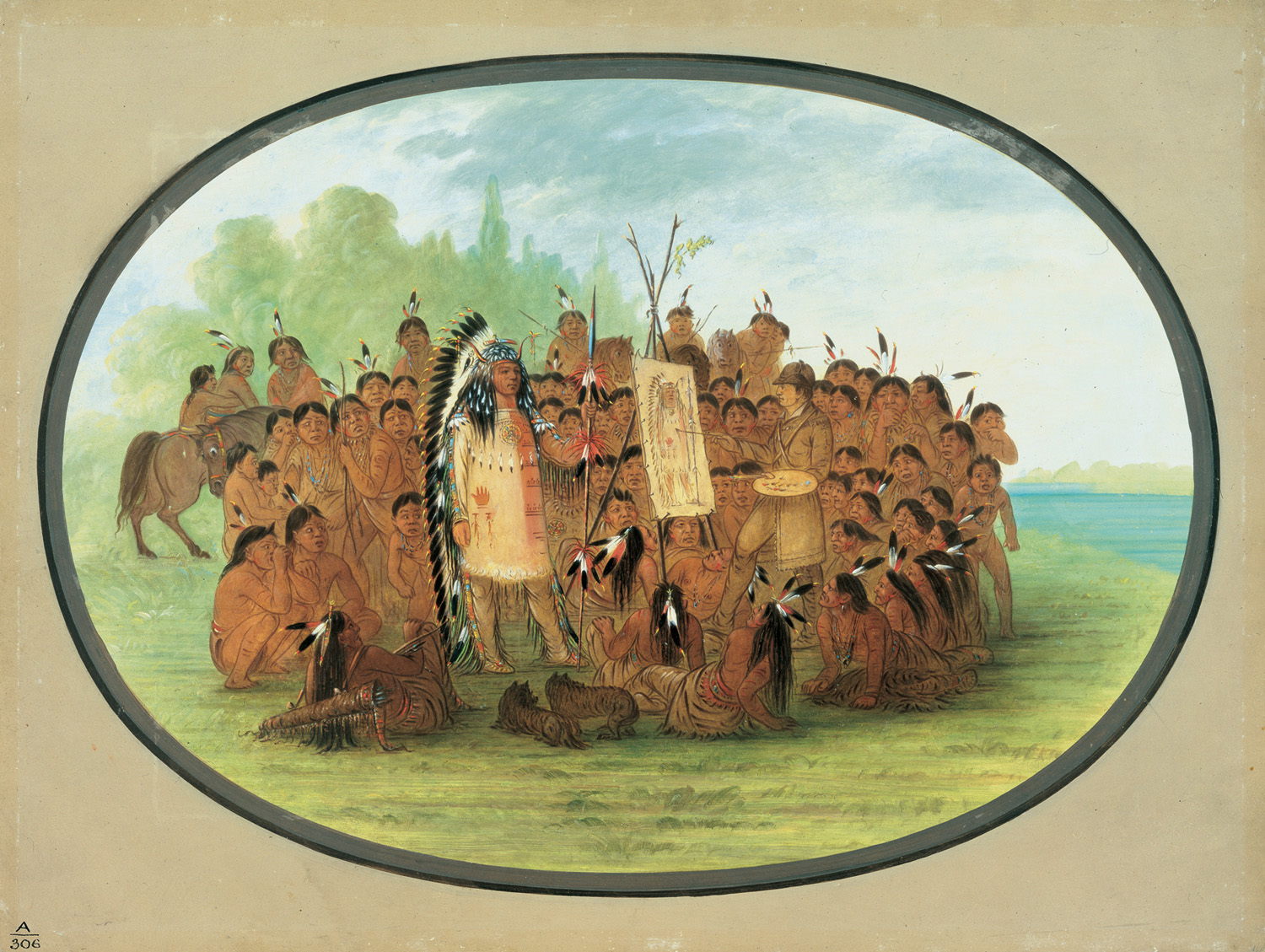
"Catlin Painting the Portrait of Mah-To-Toh-Pa," George Catlin.
George Catlin, Lawyer Turned Artist
Secures Trust Of The Mandan Indians
By Dakota Wind
GREAT PLAINS - In the summer of 1833, George Catlin, after visiting tribes like the Blackfoot, Crow, and Assiniboine among others, descended the Missouri River to Fort Clark from Yellowstone country. His aim, to finally meet for himself the Mandan Indians of whom he had heard so much about from General William Clark.

Catlin noted that the Mandan were very secure with little to fear with their fortifications at the edges of their two villages. When he got off the steamboat, he mentioned that hundreds of Mandan were standing about to greet the occupants as they disembarked.

Catlin may have received a warm welcome to Fort Clark from the natives living in the fort’s proximity, but he had to do more to gain their trust and respect. He made his acquaintances with the two of the Mandans’ chiefs in one village and he did so by taking long the tools of his trade, his paints.

Catlin painted the civil chief, or first chief, Ha-na-ta-nu-mauk, Wolf Chief, and didn’t necessarily walk away from this meeting with the trust he thought he could earn. When Catlin painted Mah-to-toh-pay, the popular Four Bears, the artist left the session greatly impressed by the grace and dignity of that mighty warrior.

Catlin painted both men in the privacy of an improvised studio within the walls of Fort Clark. Catlin learned from his earlier experiences painting his Indian subjects that he would either be met with adulation for his craft or intense superstitious wariness.

After the paintings were showcased to the Mandan, reactions were as Catlin expected, from wonder and praise to horror and disbelief.

A tribal council was called and, as tribal councils go, they argued with all the seriousness as though they had convened to go to war. Eventually, they decided that Catlin was doing good work. With all due haste, the Mandan council smoked a pipe and slew a dog – whose remains they hung over Catlin’s door at the fort - in ceremony to Catlin’s continued good health.

One tribal council dissenter, a medicine man named Mah-to-he-hah, Old Bear, went on strike outside Catlin’s makeshift studio and berated all who would have their portrait painted by the Anglo artist.

Catlin approached art as a matter of the heart, as any artist might well tell you, but to American Indians, art is a matter of the spirit, and as such, art, ceremony, and religious study go hand in hand. For Catlin, art was a way to hold onto a moment. For the Mandan and the American Indian in general, art - and later photography - captured the living essence of a person forever - and, one could argue, that’s what art/photography is supposed to do. Regardless how one interprets art, Catlin casually disregards the native interpretation of his craft.

In any event, Catlin held the steadfast support of two Mandan chiefs and the approval of the rest of the tribal council, but neglected to garner the support of the religious leader, until the day after the tribal council. He then stroked the ego of Old Bear, saying that he much admired the medicine man, and that the portraits of the two chiefs were merely practice so that he could do right by Old Bear’s portrait. Catlin’s strategy worked.

Old Bear spent the better part of a morning preparing to pose for Catlin. He took himself to a steam bath, or sweat lodge. He painted himself in his medicine colors, and dressed in his finest. He wore his finest moccasins with fox tails attached the heels. Catlin observed that Old Bear brought with him two medicine pipes. However, on close inspection of the color plate of the image, it would seem Old Bear brought only the pipe stems. Old Bear also wears no headdress, but instead feathers indicating his valor as a warrior, counting coup, and protecting his people. It could be speculated that Old Bear wanted his image captured as he wanted to be remembered, a warrior, as a defender of his people.

Catlin writes, “He took his position in the middle of the room, waving his eagle calumets in each hand and singing his medicine song ...looking me full in the face until I completed his picture, which I painted full length. His vanity was completely gratified by the operation. He lay for hours together, day after day in front of the picture, gazing upon it; lit my pipe for me as I was painting; shook my hands a dozen times each day; and enlarged upon my virtues and talents...and became my strongest supporter in the community.” A conjecture might be that the Mandan holy man wanted some of Catlin’s skill or craft to rub off onto him.

Equal to securing the interest and any assistance from the Mandan was garnering favor with the second-chief, or war chief, Mah-to-toh-pay, Four Bears, the Mandan’s most beloved chief.

Four Bears took a liking to Catlin, perhaps a brotherly connection that grew out of mutual fascination for the other’s foreign ways. Four Bears escorted Catlin arm-in-arm from his studio, through the village, to Four Bears’ family lodge, where a small feast was held in Catlin’s honor.

Four Bears seated Catlin on a painted robe, a very high honor, and briefly smoked from Four Bears’ own pipe. Catlin enjoyed a three-course meal of bison ribs, ground prairie turnips, and pemmican. He ate alone, while Four Bears and his wives (perhaps wife and daughters) waited on him. Afterward, they enjoyed a smoke together again, “for a quarter of an hour,” Catlin estimates.

After the feast and smoke were completed, Catlin was presented with Four Bears’ own exploit robe - the very robe on which he had Catlin sit on! The pipe from which they smoked together was also presented to Catlin.

Then, the Mandan regarded Catlin as a great medicine painter. They still recall him so to this day.

Thursday, April 7, 2011

The Code of the West, a Worthy Ideal

"Assiniboine hunting buffalo," by Paul Kane
The Code Of The West
Worthy Ideals To Practice
By Dakota Wind
THE GREAT PLAINS - The following is a commentary about the American West and the ideals of the west at the turn of 1900. Zane Grey wrote about life in the American west at the end of the nineteenth century. Though his observations about life on the frontier were largely based on his

Southwest experiences, his writings could easily have been about life anywhere in the American western frontier.

There are various interpretations of his “Code of the West,” an unwritten code that frontier men and women lived by. This unwritten code, of necessity, applied to all races and both sexes living in the frontier era. 

If one were to carefully examine the origin of the cowboy culture one finds an interesting twist. The rodeo comes from the Mexican vaqueros and early American cowboys and began as an extension of everyday life for the cowboy such as branding, roping, racing, and general riding.

Who made up the cowboy? According to Dee Brown's The American West, we see the cowboy population made up of about 1/3 white, 1/3 black, and the last 1/3 consisting of Mexicans and American Indians. Race had no impact on the job that needed to get done, but Hollywood and associated media have frozen the west as something between Cowboys and Indians, with cowboys almost exclusively being white. Were one to review the Bismarck Tribune of the 1870s and 1880s, one would find this to certainly be true, at least in Dakota Territory.

Certainly movies are about heroes, villains, and motivations. And movies, especially movies about the West, have served to perpetuate the West as being about the cowboy against the Indian. Media about the Little Big Horn have gone from good guy vs. bad guy, to romantic reluctant soldier vs. going-down-with-a-fight, stoic, heroic underdog.

One element remains missing from Raoul Walsh's They Died with their Boots On to Steven Spielberg's Into the West, and that is the simple fact that many American Indians were peaceful, and on their reservations; some were there by choice and others by force, though all practiced the unwritten code to some degree with their fellow frontiersman.

A general etiquette practiced amongst code followers was never to pester people about where they came from, what they did, or what their names were. Given the backgrounds of many people (social, political, religious, ethnic, legal, etc.) who had left much, if not everything behind to go west, it was best to hold one's peace.

There is nothing political, social, or racial about the code. It worked person to person then, and it works person to person today.

Below is an interpretation of the code from Dakota Livesay's Chronicle of the Old West:

1. Respect yourself and others.

2. Accept responsibility for your life.

3. Be positive and cheerful.

4. Be a person of your word.

5. Go the distance.

6. Be fair in all your dealings.

7. Be a good friend and neighbor.

Hopalong Cassidy's take on the code stressed humility, thrift, conservation, obedience to the law, and pride that one is born in America. Roy Rodgers mentions that one should protect the weak and offer assistance, a love for God, and American patriotism. Gene Autry includes all the above, and adds that a cowboy is free of racial and religious prejudice.

Zane Grey in his Lone Star Ranger's Creed argues that we should live by the rule of what is the best for the greatest number. A logic that fits the times he lived in, where Manifest Destiny was the most true, righteous, and logical choice of action to pursue to make our country better. However, Grey continues, “That sooner or later…somewhere…somehow…we must settle with the world and make payment for what we have taken.”