Follow by Email

Google+ Badge

Photos by The First Scout

Thursday, July 28, 2011

My Trip to Fort Buford and Back, a Photo Essay Part 2


Williston State College wants to challenge and change the sense of place that the community of Williston has of it.  The campus has what this writer could only describe as an industrial look to it.  The architecture of the campus is heavy on brick, concrete, and pavement.  Some locals have taken to calling it “Walmart.”


On July 15, 2011, Williston State College unveiled the Sitting Bull statue to commemorate the 130th anniversary of Sitting Bull’s return to the United States.  Sitting Bull and the Hunkpapa, or at least the Hunkpapa who followed him, numbered about 200 at Fort Walsh across the border.  Sitting Bull actually returned to Fort Buford on July 18, 1881, just over five years after the Battle of the Little Bighorn. 


Bronze sculpture, Michael Westergard, forged the statue which now stands at Williston State College.  At the base is the speech which Sitting Bull was said to give as he handed his gun to Crow Foot, who in turn turned it over to commanding officer of Fort Buford.  The speech is also in Lakota.  Did Sitting Bull Surrender?  On Standing Rock, where the Hunkpapa Lakota reside, some interpret the event as an exchange of one lifestyle that of the nomadic hunter-gatherer for that of a sedentary one. 


Kevin Locke performed the hoop dance and some flute playing.  Locke rendered White Cloud’s “The Indian Prayer” and an American Indian version of the 23rd Psalm in Plains Indian sign and gesture.  I did not take pictures of Locke demonstrating the prayers. 


Ernie LaPoint, great-grandson and direct lineal descendant of Sitting Bull, offered some words to the community of Williston and all present about his famous ancestor.  LaPoint is an enrolled member of the Oglala Lakota down on the Pine Ridge Sioux Indian Reservation in South Dakota.  LaPoint articulated his ill feelings about the people of Standing Rock to the people in attendance.  I don’t know if LaPoint has ever met with the 8,500+ members on Standing Rock or the 7,000+ enrolled members of Standing Rock living off the reservation, but you, reader, can read LaPoint’s harsh criticism of Standing Rock by reviewing his book Sitting Bull: His Life and Legacy. 


This writer isn’t trying to cut down the works or teachings of LaPoint.  Far from it.  LaPoint is seemingly a good man possessed of great humor and quick wit.  This writer wants you, reader, to be aware that Standing Rock has good people too and is a great place to live and visit.  There might not be direct descendants of Sitting Bull on Standing Rock, but Sitting Bull’s own band are still there, the Hunkpapa Lakota (some are also on the Fort Peck Sioux Indian Reservation). 


From Williston State College this writer went to Fort Union.  The above picture is the view across the river much the same as Karl Bodmer knew it back it in the 1830s. 

Picture of Fort Union from Frank Leslie’s Illustrated Newspaper, May 1868.


It was once an American Fur Trade company outpost from 1828 to 1867.  The Hunkpapa Lakota attacked this fort several times in the 1860s.  The fort itself was a rendezvous for several tribes like the Crow, Hidatsa, Arikara, Mandan, Chippewa, Blackfeet, and the Dakota/Lakota. 


Last summer, June 2010, this writer asked the ranger on duty in this room, the reception area for trade, for my allotment, to which he said after a stunned moment, “We don’t do that anymore.” 


Mr. Loren Yellow Bird was gracious enough to take a picture with this writer outside the commanding officer’s quarters within Fort Union.  The walls were intended to keep out Indians, but now an Indian serves as superintendant of the site.  Mr. Yellow Bird brings understanding of cultural and historical context to this national historic site. 


Fort Union along the Upper Missouri River seen today much as it would have been seen in the mid nineteenth century.  The fort is inside North Dakota but the drive and parking lot are in Montana. 


A couple of miles east of Fort Union is Fort Buford, a North Dakota state historic site.  It was in operation from 1866 to 1895 when the US Army abandoned it.  The fort was established as a camp in mid 1866 and was attacked almost daily until the late fall.  The Lakota saw the forts along the Missouri as representative of invasion.  Fort Buford is where Sitting Bull exchanged one lifestyle for another (generally regarded as a surrender) in July 1881. 


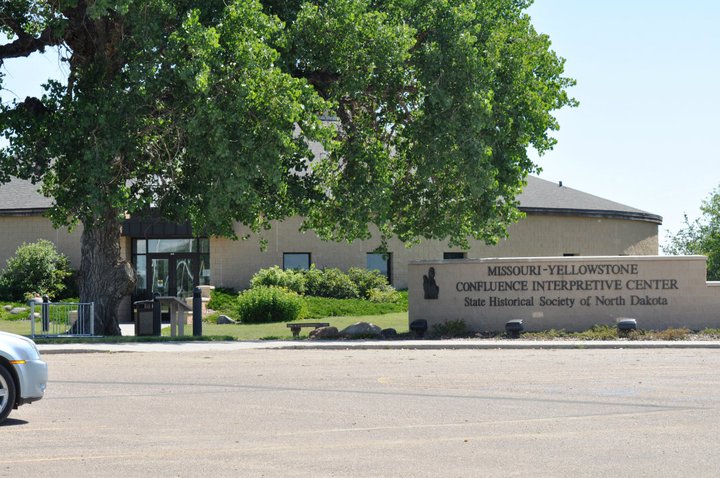
The Missouri-Yellowstone Confluence Interpretive Center.  If ever you, dear reader, get a chance to visit the northwest corner of North Dakota, take in this center.  A museum is inside and the trails there offer beautiful riverfront walks.  The staff are friendly and offer tours of Fort Buford. 


The North Unit of the Theodore Roosevelt National Park. 


Again.


Another view from the other side of the Little Missouri River valley at the North Unit. 


On my way home, I stopped by the Killdeer Battle site, a North Dakota state historic site.  The signage says “Tachawakute (The Place Where They Kill Deer),” and far be it from this writer to disagree with interpretive signage, and though this writer has often heard it called “Killdeer,” it might be more correct to interpret the name as The Place Where They Hunt Deer, or in Lakota “Taĥċa Wakutėpi.”  Killdeer would be Taĥċa Waktė (lit. Deer Kill). 


Carl Ludwig Boeckmann painted this scene of Killdeer entirely from memory.  The depiction of the landscape is surprisingly accurate.  Look for similarities between this image and the following pictures. 


This is the east side of the Killdeer plateau.  This writer parked and hiked and climbed the east embankment and walls to reach Medicine Hole, where the Dakota and Lakota say that some of them escaped the military by crawling through the tunnels.  This author arrived as the sun was setting.  A lonely coyote sung in the hills somewhere, dragonflies buzzed and kept the mosquitoes to a minimum.  A slight breeze caused the leaves and branches to “shush.”  It would have been an entirely peaceful visit if this author wasn’t aware of the gunfight that happened here in 1863. 


Medicine Hole.


A view from Medicine Hole at the top of the Killdeer plateau to the southwest.


A view from Medicine Hole (bottom foreground) to the sunset west-north-westerly. 


A view of the Killdeer plateau from the southeast facing northwest as the sun sank behind the geophysical feature. 


A hawk flew into frame as this writer caught one more picture of the Killdeer site from the southeast looking northwest. 

Tuesday, July 19, 2011

My Trip to Fort Buford and Back, a Photo Essay

Hi!  So, I was invited to the 130th Anniversary of Sitting Bull's return from Canada at Fort Buford, a North Dakota State Historic Site.  On my way up I thought that I'd stop at some sites along the way.  I left my home north of Mandan and crossed the interstate bridge (I had to stop by the State Historical Society of North Dakota and drop off some really important stuff) then I headed north on HWY 85 to Washburn. I wanted to check out Fort Mandan, but the fort was dangerously close to sitting smack in the Missouri - due the flood.  The Cottonwood Giftshop was surrounded by an earthen ditch and sandbags.  I didn't want to show a North Dakota site when its in such a sad state so I took no pictures.  Sorry.  If you don't know about the Lewis and Clark Expedition of 1804-06 and you're American, shame on you and go look it up - however, if you're a foreigner, I can forgive you.  The Lakota stole an iron-shod pony from the Corps of Discovery in February 1805 at Fort Mandan, then burned down an old Mandan Indian village to prevent the Corps from mounting chase. 

My first stop on the way to Fort Buford was at Fort Mandan up in Washburn, ND.  All the Indians (as if there's a whole bunch of them up there - there's only one) on staff up there were gone. 

So, being that I didn't want to take any pictures of the reconstructed Fort Mandan as it was nearly surrounded by water, I crossed the bridge there in Washburn and made my way to Fort Clark. 

I took the bridge in Washburn across the Missouri River to Fort Clark. 

At Fort Clark, a prominent American Fur Trade Post in the 1820s and 1830s, I stopped to admire the majesty of the Missouri River.  The site itself doesn't offer much other than shade and outhouses.  Back in the 1830s, a smallpox epidemic struck the Mandan living at the fort and nearly wiped them all out, by 1838, there were maybe only 500 Mandan Indians left.  The saddest story I heard about the fort was about a mother who had just given birth.  The mother died of smallpox, they wrapped her and her baby up, thinking the baby died as well, and buried them outside the fort.  For a day, the people around the fort nearly went mad because they could all hear a baby crying and none could remember where the baby and mother were buried.  I was moved to tears the first time I heard this from Amy Mossett, a Mandan Indian from the Fort Berthold Indian Reservation. 


An interpretive sign summing up the activity at the site, and the smallpox epidemic.

If you could see it from above, you'd see depressions of where earthlodges used to be, and outlines of the fort's buildings, including a retangular ceremonial lodge about 65' x 120', about twice the size the biggest earthlodge at Fort Abraham Lincoln State Park. 

This lone building provides a modest shelter in inclement weather.  There's also a log for visitors to sign in, but the size of the building only adds to the solitude of the site. 

From Fort Clark, I went up to Knife River, only a ten minute drive away.  I sometimes like to measure my trips by how many songs I can get there in, and this one was about the length of Def Leppard's "Rocket (Extended Atomic Mix)" which is about ten minutes. 


Knife River Indian Villages is designated a National Historic Site.  Behind the building and bushes is the site of three Hidatsa Indian villages and a late woodlands linear mound.  I used to work here as an Interpretive Ranger. 

The main entrance of the visitor center at Knife River.  The main foyer of the building is designed on the ground flood plan of an earthlodge.  A roof window lets in natural light as the smoke whole in an earthlodge would too. 

Here's a Hidatsa Indian earthlodge.  The entrance faces east, towards the rising sun.  An earthlodge typically only lasts about a dozen years due to the wood decaying, but with a cement ring and treated lumber this earthlodge has been standing over twenty years and looks great.

The Hidatsa Indians were an agricultural society.  Here is a garden, but due to the odd weather this year in North Dakota, the planting of corn, squash, and beans was put on hold, and tobacco was planted.  You can see that it is flourishing with this year's unseasonably wet weather.  The Hidatsa would even put up scarecrows too. 

A replica of Four Bears' robe.  Four Bears was the last war chief of the Mandan Indians.  Even though this rests in a Hidatsa earthlodge, it looks at home. 

Parfleche boxes hang from the ceiling.  I disk is suspended on the leather ties above the parfleche, so that if rodents tried to get at whatever may be in the parfleche (maybe food) they'd slip and fall to the ground. 

Two examples of horse saddles and robe hang on the posts near the entrance of the lodge.  The idea that Mandans or Hidatsas bringing their horses into the earthlodge is debated today.  I think they brought their horses in after the 1781 epidemic of smallpox, because there was so few to protect their horses from theft, certainly by Karl Bodmer's and George Catlin's time they did (the 1830s).  The low rise and light weight Plains Indian saddles were the basis for General George McClellan's saddle the US Cavalry used in the the latter half of the 1800s. 

Mandan and Hidatsa women produced pottery.  Here's a reproduction. 

A bunch of stuff sits on a cattail mat.  I nearly helped myself to that beaded knife sheath. 

A catlinite pipe and stem among other implements (including a wing fan) sit at rest here in the place of honor.  The Hidatsa call this spot the Ituka.  I nearly took that pipe too, because I'm sure that the Mandan and Hidatsa would want me to have it. 

A bed made of bison robes and elk skins.  A buckskin pillow stuffed with bison hair completes this bed set.

An anvil stone.  If one were to look closely and carefully atound this stone, one would find flint chips and flakes.  The stone has several grooves in the top of it.  Its glacial granite from the Canadian Rockies.  It was used for nearly ten thousand years to make flint arrowheads, knifes, hatchets, and other tools. 

This is the Sakakawea Site where the Corps of Discovery first encountered Sakakawea.  Natural grasses and flowers were reintroduced to the site back in 2006.  The earthlodge depressions are mowed regularly so that visitors may clearly see where the village used to be.  Jean-Baptiste Charboneau was born here in 1805. 

From Knife River Indian Villages near Stanton, ND, I drove to Dunn Center, or to privately owned land near Dunn Center to pay a visit to the ancient Knife River flint quarry. 


On top of this bluffline is the ancient Knife River flint quarry.  Flint was quarried here for about ten thousand years and traded across the North American continent.  It is a form of silicon, hard pressed over the ages of the world, and actually began as a plant.  This quarry is on private property near the community of Dunn Center, ND. 

From the flint quarry, I took off to Williston State Collge.  I made it with ten minutes to spare for the social and unveiling of the Sitting Bull statue.  I'll post those pictures and my time at Fort Union and Fort Buford next. 


The Horse Arrives on the Northern Plains

Woslata Inyan, or Standing Rock.  Legend says that a woman turned to stone.  There are three variations of the story of how she turned to stone, as well as three stones to commemorate her.  This one is located in Fort Yates, ND. 


When I was growing up on the vast open plains on Standing Rock, under an equally broad blue sky, I listened to stories of horse-stealing raids, heard songs to honor the equine spirit, saw meticulously carved and beautifully painted horse sticks, and I’ve heard at least four variations about how the horse came to the Lakota people. 


My grandfather was a minister, an Episcopal priest, in Fort Yates.  He was once a professional baseball player in the Great Depression, a World War II and Korean War veteran, a railroad worker, and a bus driver.  To me and my brothers and sisters he was our “Lala.”  “Lala” in Lakota is “grandpa,” and that’s what we called him. 


A map of the Standing Rock Sioux Indian Reservation.  It straddles the North Dakota and South Dakota border, and is one of the bigger reservations in North America.  Check it out on Google Earth. 


My Lala was often invited or called upon to go to different parts on the reservation, sometimes off too.  He and my grandmother would often take me and my younger brother to go with them.  We’d gas up at Tim’s and get a Coke before the drive to Cannonball, McLaughlin, Wakpala, Kenel, Bullhead, and sometimes to Whitehorse, or wherever else my Lala was called to be at. 


On those drives, no matter how long or short, we rarely listened to the radio, and only then to hear how the weather was going to be.  We’d always listen to AM radio too, which rather irritated me because the music and sound quality sounded old-fashioned.  On the drive home we’d listen to Paul Harvey tell the rest of the story. 


As my Lala drove us to wherever he’d always have a story to share.  Sometimes he’d tell the same stories about places we visited and for that I’m grateful because sometimes I didn’t pay attention or fell asleep.  If only I’d had the interest then as I do today.  Twice, at least twice that I remember when I was paying attention or was awake, he told about the horse. 


I regret that I didn't readily have a picture of the those flat topped buttes south of Fort Yates, but I found this one on the Standing Rock Water website.  At some point I'll take a descent picture and post it. 


The Crow came one year and stole horses, or stole them back, south of present-day Fort Yates.  You, dear reader could stand on Golf Hill (Boot Hill, or if you want to be culturally correct, The Hill That Stand Alone as the Cheyenne knew when they lived there three hundred to two hundred years ago) and look directly south, there in your field of vision on the far horizon are some flat topped buttes, is where this horse incident took place, so my grandfather told me. 


When he was a young boy himself, raised along the banks of Wakpala and Grand River, he was riding horse, bareback, when his horse became spooked by a rattler.  His horse reared bucking my lala off its back, but his foot became ensnared in the bridle during his fall, and as his horse broke into a gallop it drug him four miles in all across scrub, rocks, and cactus (Missouri Pincushion its called) before his horse came to stop.  My lala was seen by the reservation doctors who proclaimed they could do nothing for him.  My great-great-grandmother, Emma Creek, at this point stepped in and used traditional Lakota medicine on brought my lala back from the knife’s edge of death.  So my lala and my aunts and uncles told me. 


A horse pictograph.  On stone, they're called petroglyphs.  This one looks to be the latter and painted scarlet too. 


And I wondered about the horse. 


The Lakota didn’t always have the horse, in fact, when it did come to us we called it Tasunka (Big Dog), Sunka Wakan (Holy Dog), even Sunka Hehaka (Elk Dog).  But there are cultural experts better and greater than I who can tell you about the high horse culture which flourished on the Great Plains.  There are books on the subject of the changes in warfare and trade on the collective American Indian culture. 


Growing up on Standing Rock, I heard that the horse came to the Dakota-Lakota people out of the Missouri River, Mni Sose (Water A-Stir), as we called it.  The story, at least this version goes, we were breaking camp and as we crested a hill, there below us coming out of the river itself was a herd of ponies. 


A picture of Nakota horses running in the Theodore Roosevelt National Park.  The horses hae a rough history in the park there, being they were going to be culled or removed at one point.  The Nakota Horse Conservancy was established and took in as many as they could.  This breed of horse is said to descend from the Hunkpapa herd of horses which were taken from them after they returned from Canada.  A beautiful horse, look up the conservancy for yourself and see the images on their website. 


On Standing Rock, there is a prominent Ihanktowana (Yanktonai Dakota) elder, Mary-Louise Defender, who has a different take on the tale.  According to her oral tradition they broke camp one morning long ago, along the Missouri River.  They were traveling over the prairie and as they came to the top of a hill, some scouts who’d run ahead were excitedly calling everyone to hurry and see something.  As the tiyospaye, the band or extended family, came to the hill top, they looked down to the river, and as they watched, strange creatures drew themselves out of a great swirl of water and came to the shore where the people were.  They saw that one of these creatures was wearing a rope, and they knew that these creatures, these Sacred Dogs or Elk Dogs, were meant to help the people.  And that’s how the horse came to the people.  Ho hece tu welo (That’s the way it is).  This, of course, is my brief summarization of the story by Unci Wagmuhawin (Grandmother Gourd Woman). 


Here's the cover of one of Mary-Louise Defender Wilson's CD.  Visit Makoche's website and gratify yourself with a copy today. 


Some say the horse came with the thunder of a storm.  Others say the horse appeared in camp when they woke up in the morning. 


According to the John K. Bear Winter Count, the horse entered the Dakota-Lakota culture in 1692.  The story goes they were camped along the river, where the James River converges with the Missouri River, today that area is called Armidale Island near present-day Yankton, SD. 


Horse stealing quickly became an art of war as evidenced in the 1706 entry of the Brown Hat Winter Count. 


An exquisite example of the Lakota horse stick in the collections of the National Museum of the American Indian in Washington DC. 


Regardless of the story or variation of the horse’s arrival, one thing is universal: the horse is a sacred gift, a part of the mystery of creation, and should be treated respectfully.